
Obesity and the environment Density of fast food

Obesity and the environment Density of fast food outlets at 31/12/2017
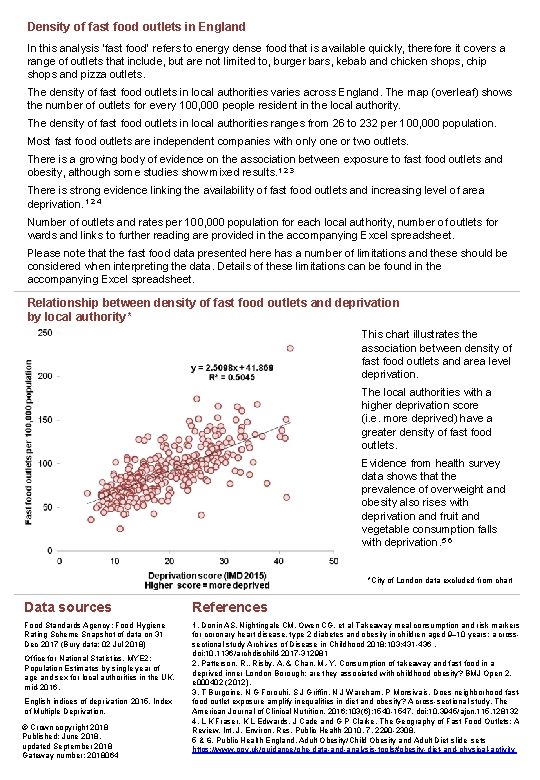
Density of fast food outlets in England In this analysis ‘fast food’ refers to energy dense food that is available quickly, therefore it covers a range of outlets that include, but are not limited to, burger bars, kebab and chicken shops, chip shops and pizza outlets. The density of fast food outlets in local authorities varies across England. The map (overleaf) shows the number of outlets for every 100, 000 people resident in the local authority. The density of fast food outlets in local authorities ranges from 26 to 232 per 100, 000 population. Most fast food outlets are independent companies with only one or two outlets. There is a growing body of evidence on the association between exposure to fast food outlets and obesity, although some studies show mixed results. 1, 2, 3 There is strong evidence linking the availability of fast food outlets and increasing level of area deprivation. 1, 2, 4 Number of outlets and rates per 100, 000 population for each local authority, number of outlets for wards and links to further reading are provided in the accompanying Excel spreadsheet. Please note that the fast food data presented here has a number of limitations and these should be considered when interpreting the data. Details of these limitations can be found in the accompanying Excel spreadsheet. Relationship between density of fast food outlets and deprivation by local authority* This chart illustrates the association between density of fast food outlets and area level deprivation. The local authorities with a higher deprivation score (i. e. more deprived) have a greater density of fast food outlets. Evidence from health survey data shows that the prevalence of overweight and obesity also rises with deprivation and fruit and vegetable consumption falls with deprivation. 5, 6 *City of London data excluded from chart Data sources References Food Standards Agency: Food Hygiene Rating Scheme Snapshot of data on 31 Dec 2017 (Bury data: 02 Jul 2018) 1. Donin AS, Nightingale CM, Owen CG, et al Takeaway meal consumption and risk markers for coronary heart disease, type 2 diabetes and obesity in children aged 9– 10 years: a crosssectional study Archives of Disease in Childhood 2018; 103: 431 -436. doi: 10. 1136/archdischild-2017 -312981 2. Patterson, R. , Risby, A. & Chan, M. -Y. Consumption of takeaway and fast food in a deprived inner London Borough: are they associated with childhood obesity? BMJ Open 2, e 000402 (2012). 3. T Burgoine, N G Forouhi, S J Griffin, N J Wareham, P Monsivais. Does neighborhood fastfood outlet exposure amplify inequalities in diet and obesity? A cross-sectional study. The American Journal of Clinical Nutrition. 2016; 103(6): 1540 -1547. doi: 10. 3945/ajcn. 115. 128132 4. L K Fraser, K L Edwards, J Cade and G P Clarke. The Geography of Fast Food Outlets: A Review. Int. J. Environ. Res. Public Health 2010, 7, 2290 -2308. 5 & 6. Public Health England, Adult Obesity/Child Obesity and Adult Diet slide sets https: //www. gov. uk/guidance/phe-data-and-analysis-tools#obesity-diet-and-physical-activity Office for National Statistics, MYE 2: Population Estimates by single year of age and sex for local authorities in the UK, mid-2016. English indices of deprivation 2015, Index of Multiple Deprivation. © Crown copyright 2018 Published: June 2018, updated September 2018 Gateway number: 2018064
- Slides: 2