
OB 14 FETAL MEGACYSTIS PRENATAL DIAGNOSIS AND MANAGEMENT
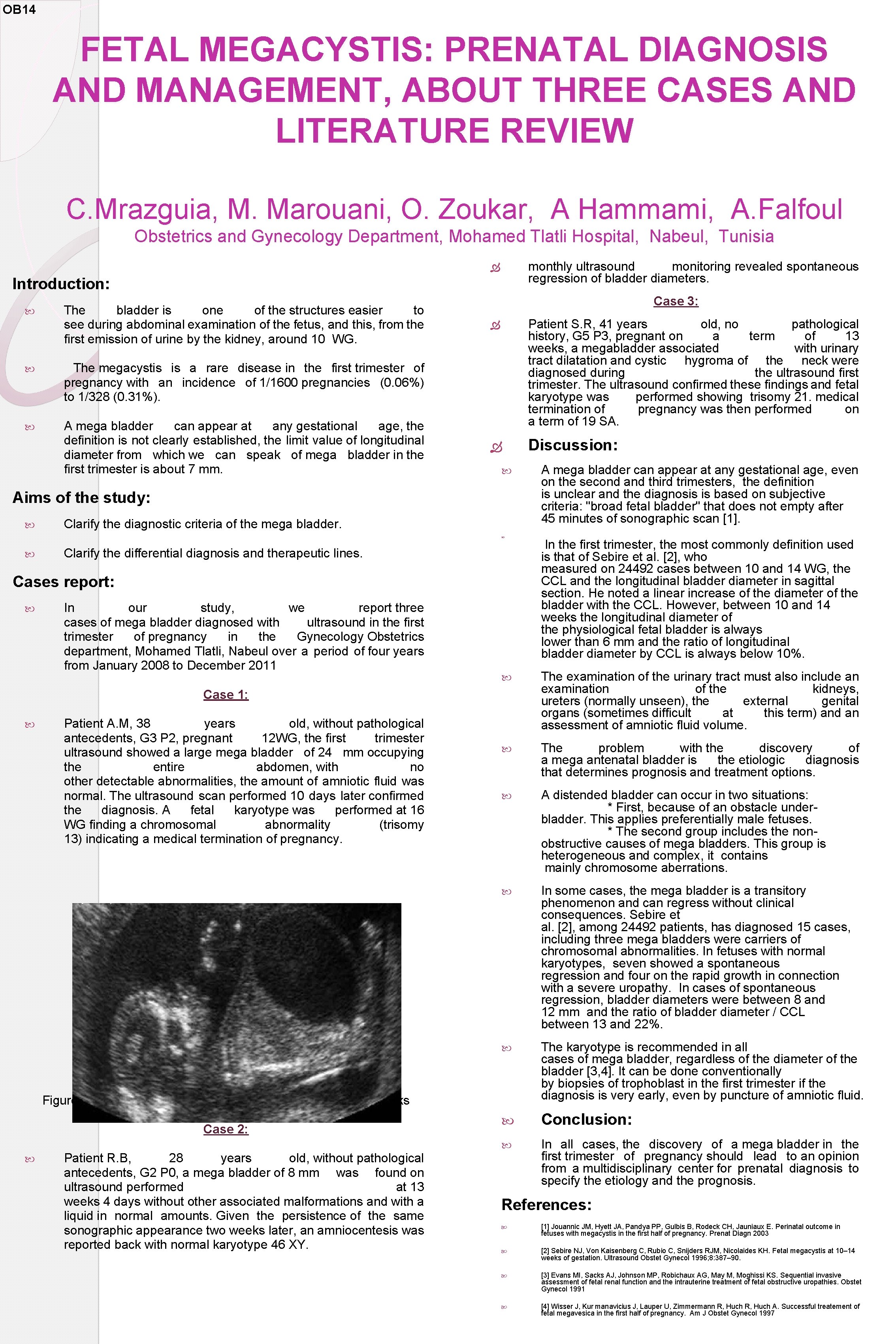
OB 14 FETAL MEGACYSTIS: PRENATAL DIAGNOSIS AND MANAGEMENT, ABOUT THREE CASES AND LITERATURE REVIEW C. Mrazguia, M. Marouani, O. Zoukar, A Hammami, A. Falfoul Obstetrics and Gynecology Department, Mohamed Tlatli Hospital, Nabeul, Tunisia monthly ultrasound monitoring revealed spontaneous regression of bladder diameters. Introduction: The bladder is one of the structures easier to see during abdominal examination of the fetus, and this, from the first emission of urine by the kidney, around 10 WG. The megacystis is a rare disease in the first trimester of pregnancy with an incidence of 1/1600 pregnancies (0. 06%) to 1/328 (0. 31%). A mega bladder can appear at any gestational age, the definition is not clearly established, the limit value of longitudinal diameter from which we can speak of mega bladder in the first trimester is about 7 mm. Case 3: Patient S. R, 41 years old, no pathological history, G 5 P 3, pregnant on a term of 13 weeks, a megabladder associated with urinary tract dilatation and cystic hygroma of the neck were diagnosed during the ultrasound first trimester. The ultrasound confirmed these findings and fetal karyotype was performed showing trisomy 21. medical termination of pregnancy was then performed on a term of 19 SA. Discussion: Aims of the study: Clarify the diagnostic criteria of the mega bladder. Clarify the differential diagnosis and therapeutic lines. Cases report: In our study, we report three cases of mega bladder diagnosed with ultrasound in the first trimester of pregnancy in the Gynecology Obstetrics department, Mohamed Tlatli, Nabeul over a period of four years from January 2008 to December 2011 Patient A. M, 38 years old, without pathological antecedents, G 3 P 2, pregnant 12 WG, the first trimester ultrasound showed a large mega bladder of 24 mm occupying the entire abdomen, with no other detectable abnormalities, the amount of amniotic fluid was normal. The ultrasound scan performed 10 days later confirmed the diagnosis. A fetal karyotype was performed at 16 WG finding a chromosomal abnormality (trisomy 13) indicating a medical termination of pregnancy. The examination of the urinary tract must also include an examination of the kidneys, ureters (normally unseen), the external genital organs (sometimes difficult at this term) and an assessment of amniotic fluid volume. The problem with the discovery of a mega antenatal bladder is the etiologic diagnosis that determines prognosis and treatment options. A distended bladder can occur in two situations: * First, because of an obstacle underbladder. This applies preferentially male fetuses. * The second group includes the nonobstructive causes of mega bladders. This group is heterogeneous and complex, it contains mainly chromosome aberrations. In some cases, the mega bladder is a transitory phenomenon and can regress without clinical consequences. Sebire et al. [2], among 24492 patients, has diagnosed 15 cases, including three mega bladders were carriers of chromosomal abnormalities. In fetuses with normal karyotypes, seven showed a spontaneous regression and four on the rapid growth in connection with a severe uropathy. In cases of spontaneous regression, bladder diameters were between 8 and 12 mm and the ratio of bladder diameter / CCL between 13 and 22%. The karyotype is recommended in all cases of mega bladder, regardless of the diameter of the bladder [3, 4]. It can be done conventionally by biopsies of trophoblast in the first trimester if the diagnosis is very early, even by puncture of amniotic fluid. Conclusion: In all cases, the discovery of a mega bladder in the first trimester of pregnancy should lead to an opinion from a multidisciplinary center for prenatal diagnosis to specify the etiology and the prognosis. Figure 1: mega bladder ultrasound showing at a term of 15 weeks Case 2: Patient R. B, 28 years old, without pathological antecedents, G 2 P 0, a mega bladder of 8 mm was found on ultrasound performed at 13 weeks 4 days without other associated malformations and with a liquid in normal amounts. Given the persistence of the same sonographic appearance two weeks later, an amniocentesis was reported back with normal karyotype 46 XY. In the first trimester, the most commonly definition used is that of Sebire et al. [2], who measured on 24492 cases between 10 and 14 WG, the CCL and the longitudinal bladder diameter in sagittal section. He noted a linear increase of the diameter of the bladder with the CCL. However, between 10 and 14 weeks the longitudinal diameter of the physiological fetal bladder is always lower than 6 mm and the ratio of longitudinal bladder diameter by CCL is always below 10%. Case 1: A mega bladder can appear at any gestational age, even on the second and third trimesters, the definition is unclear and the diagnosis is based on subjective criteria: "broad fetal bladder" that does not empty after 45 minutes of sonographic scan [1]. References: [1] Jouannic JM, Hyett JA, Pandya PP, Gulbis B, Rodeck CH, Jauniaux E. Perinatal outcome in fetuses with megacystis in the first half of pregnancy. Prenat Diagn 2003 [2] Sebire NJ, Von Kaisenberg C, Rubio C, Snijders RJM, Nicolaides KH. Fetal megacystis at 10– 14 weeks of gestation. Ultrasound Obstet Gynecol 1996; 8: 387– 90. [3] Evans MI, Sacks AJ, Johnson MP, Robichaux AG, May M, Moghissi KS. Sequential invasive assessment of fetal renal function and the intrauterine treatment of fetal obstructive uropathies. Obstet Gynecol 1991 [4] Wisser J, Kur manavicius J, Lauper U, Zimmermann R, Huch A. Successful treatement of fetal megavesica in the first half of pregnancy. Am J Obstet Gynecol 1997
- Slides: 1