
OAPSA Conference Fall 2019 Office for Exceptional Children

- Slides: 49
OAPSA Conference Fall 2019 Office for Exceptional Children 9. 20. 19
Office for Exceptional Children • Jo Hannah Ward, Interim Director • Monica Drvota, Interim Associate Director • Joseph Petrarca, Associate Director
Jo Hannah Ward Office for Exceptional Children Interim Director
Monica Drvota Office for Exceptional Children Interim Associate Director
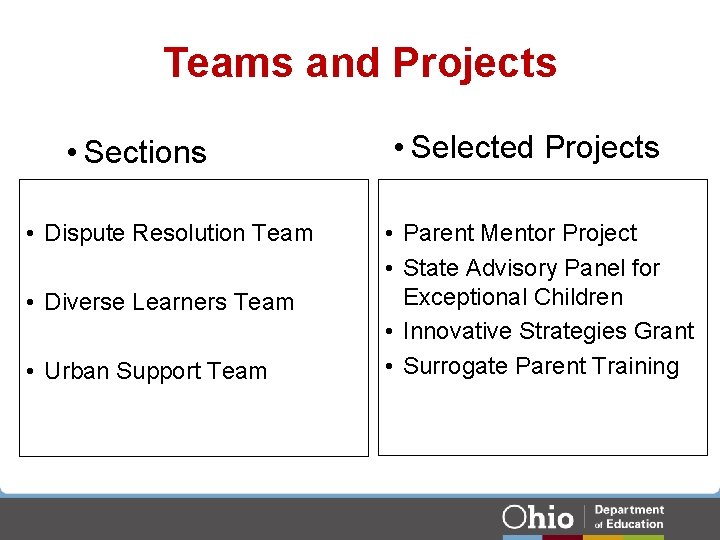
Teams and Projects • Sections • Dispute Resolution Team • Diverse Learners Team • Urban Support Team • Selected Projects • Parent Mentor Project • State Advisory Panel for Exceptional Children • Innovative Strategies Grant • Surrogate Parent Training
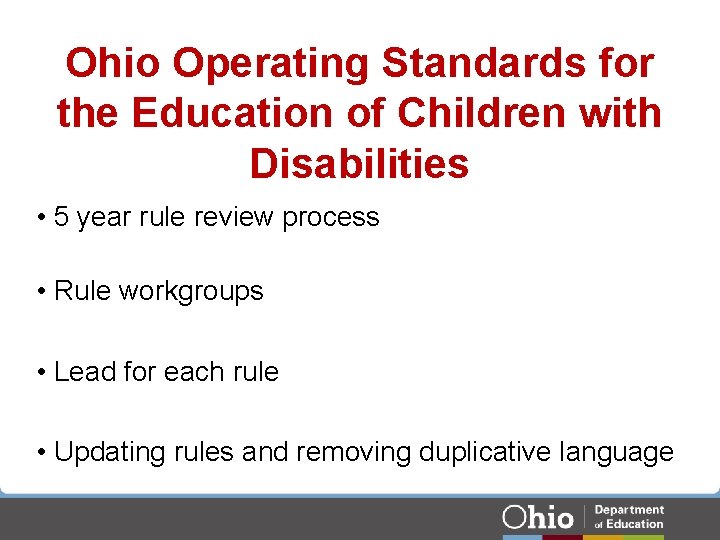
Ohio Operating Standards for the Education of Children with Disabilities • 5 year rule review process • Rule workgroups • Lead for each rule • Updating rules and removing duplicative language
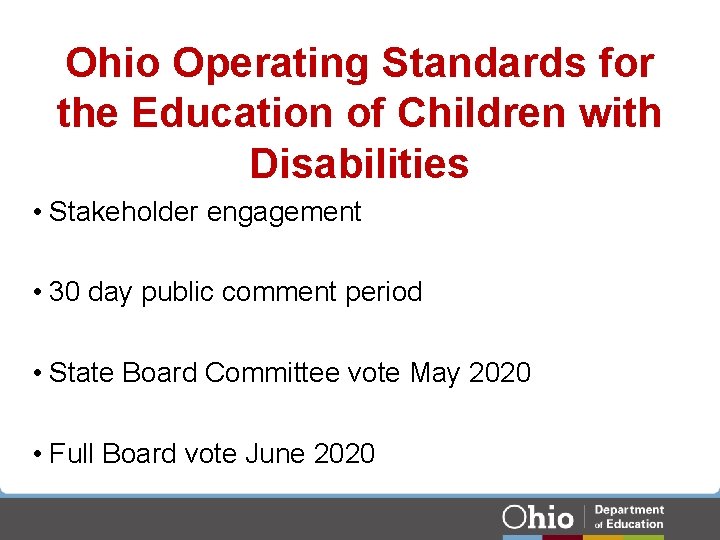
Ohio Operating Standards for the Education of Children with Disabilities • Stakeholder engagement • 30 day public comment period • State Board Committee vote May 2020 • Full Board vote June 2020
Joseph Petrarca Associate Director Office for Exceptional Children
Teams and Projects • Data Team • Supports and Monitoring • Resource Management
Teams and Projects • Related Services • Gifted (as acting assistant director) • Fiscal (as acting assistant director) • SPDG/SSIP • Disproportionality • Alternate Assessment
Students with Disabilities Roadmap • Post Secondary Outcomes and Graduation • Inclusive Leadership and Instructional Practices • Literacy • Disproportionality
Chrissy Cline Office for Exceptional Children Assistant Director, Urban Support Team
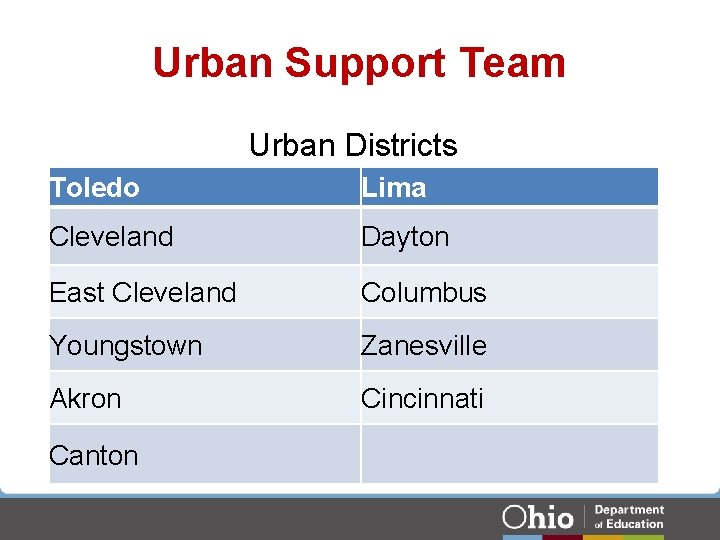
Urban Support Team Urban Districts Toledo Lima Cleveland Dayton East Cleveland Columbus Youngstown Zanesville Akron Cincinnati Canton
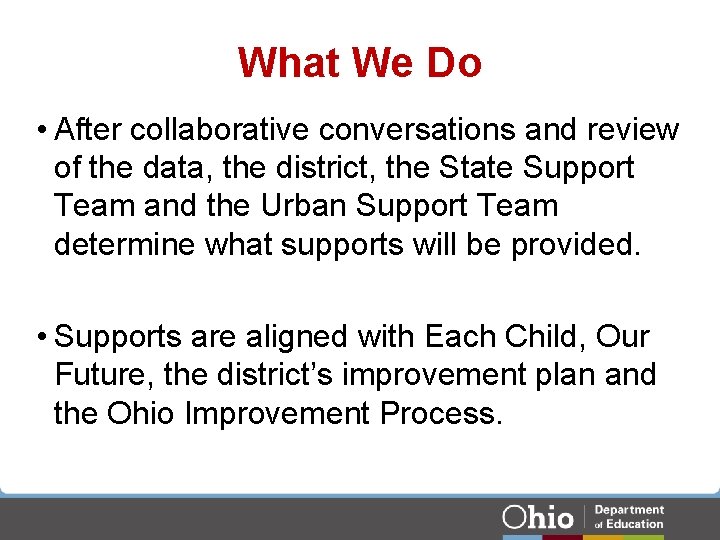
What We Do • After collaborative conversations and review of the data, the district, the State Support Team and the Urban Support Team determine what supports will be provided. • Supports are aligned with Each Child, Our Future, the district’s improvement plan and the Ohio Improvement Process.
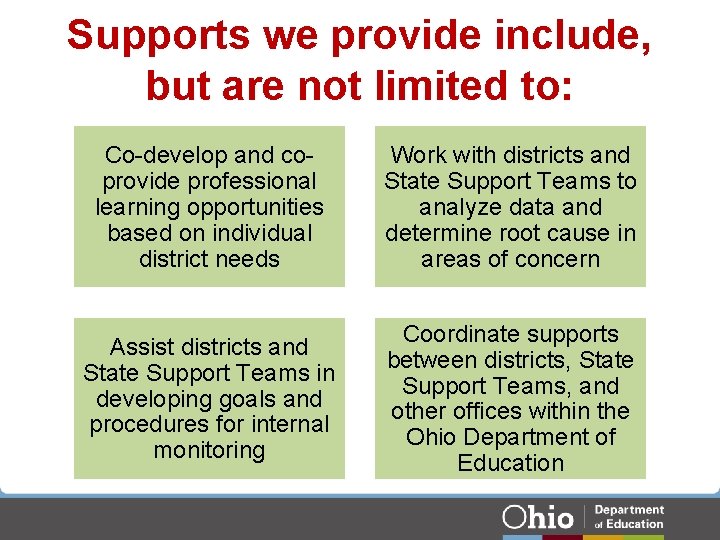
Supports we provide include, but are not limited to: Co-develop and coprovide professional learning opportunities based on individual district needs Work with districts and State Support Teams to analyze data and determine root cause in areas of concern Assist districts and State Support Teams in developing goals and procedures for internal monitoring Coordinate supports between districts, State Support Teams, and other offices within the Ohio Department of Education
Shelley Beard Office for Exceptional Children Assistant Director, Supports and Monitoring
Updates for Supports and Monitoring We are so excited to start a new year and eager to share the positive and collaborative happenings at the Office for Exceptional Children!
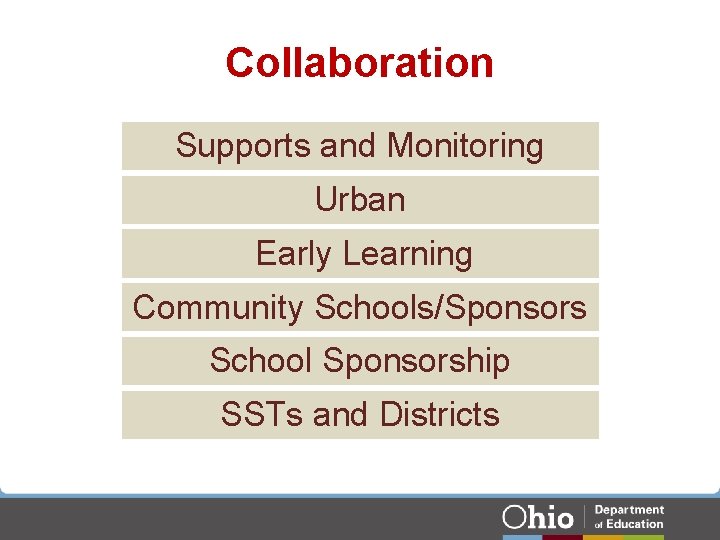
Collaboration Supports and Monitoring Urban Early Learning Community Schools/Sponsors School Sponsorship SSTs and Districts
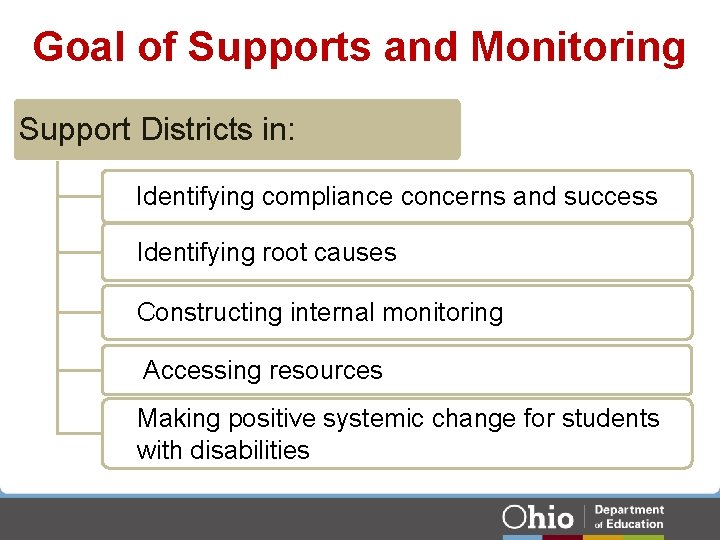
Goal of Supports and Monitoring Support Districts in: Identifying compliance concerns and success Identifying root causes Constructing internal monitoring Accessing resources Making positive systemic change for students with disabilities
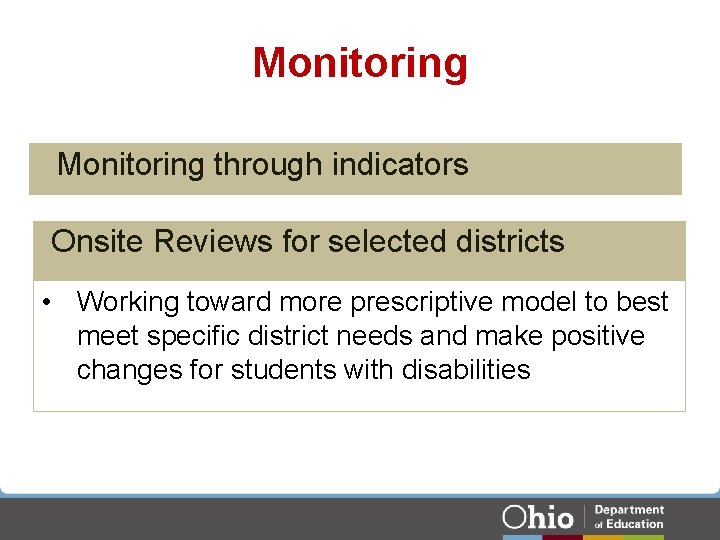
Monitoring through indicators Onsite Reviews for selected districts • Working toward more prescriptive model to best meet specific district needs and make positive changes for students with disabilities
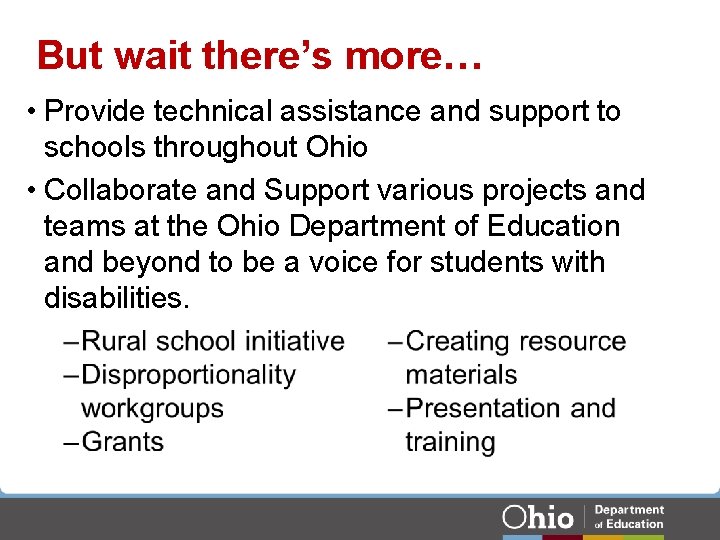
But wait there’s more… • Provide technical assistance and support to schools throughout Ohio • Collaborate and Support various projects and teams at the Ohio Department of Education and beyond to be a voice for students with disabilities.
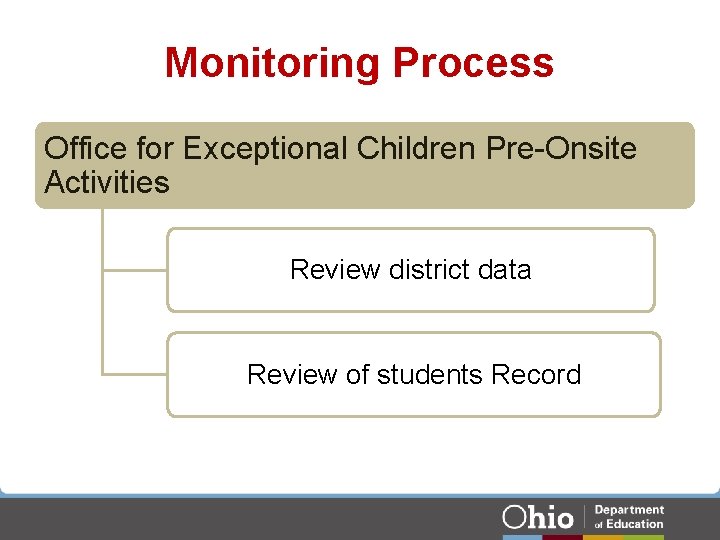
Monitoring Process Office for Exceptional Children Pre-Onsite Activities Review district data Review of students Record
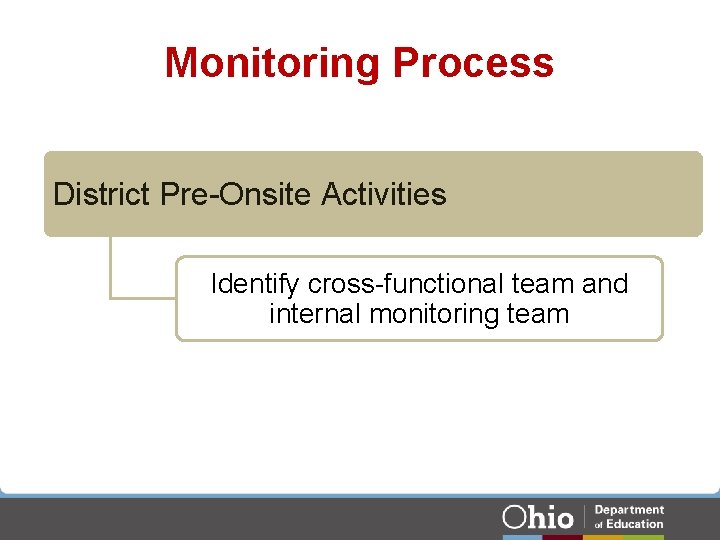
Monitoring Process District Pre-Onsite Activities Identify cross-functional team and internal monitoring team
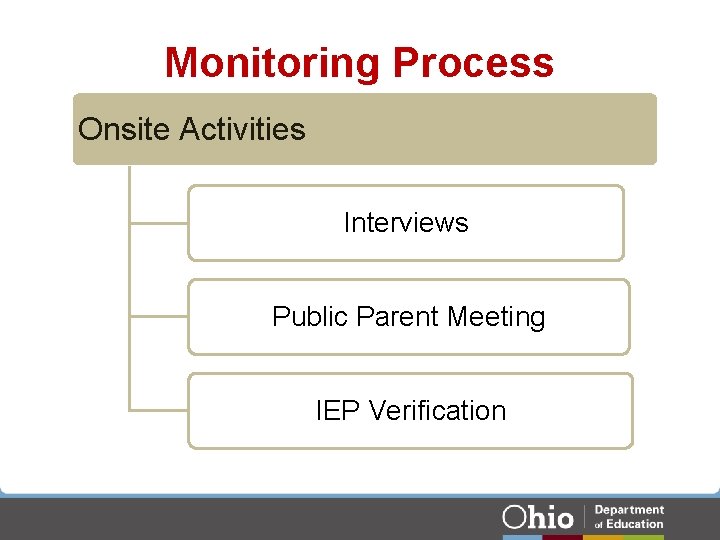
Monitoring Process Onsite Activities Interviews Public Parent Meeting IEP Verification
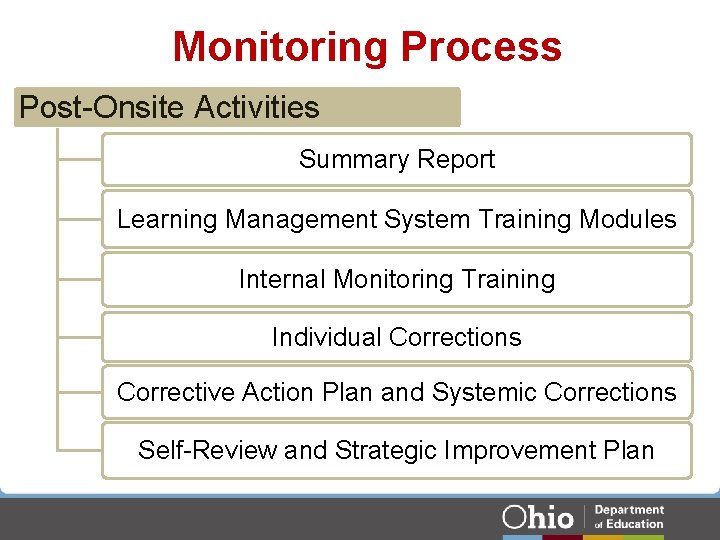
Monitoring Process Post-Onsite Activities Summary Report Learning Management System Training Modules Internal Monitoring Training Individual Corrections Corrective Action Plan and Systemic Corrections Self-Review and Strategic Improvement Plan
Heidi Kleinman Office for Exceptional Children Coordinator, Dispute Resolution
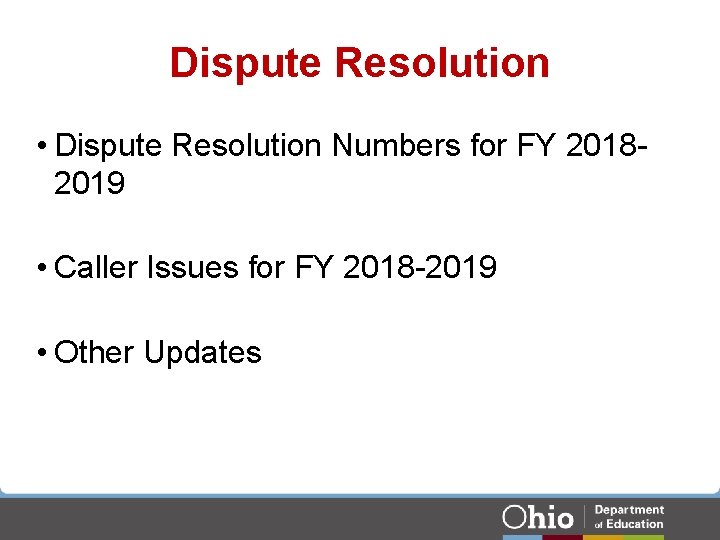
Dispute Resolution • Dispute Resolution Numbers for FY 20182019 • Caller Issues for FY 2018 -2019 • Other Updates
Kara Waldron Office for Exceptional Children Program Administrator, Data Team
Annual Special Education Determination Each state receives an annual rating on its implementation of IDEA, known as its determination Based on a combination of compliance data and student results data
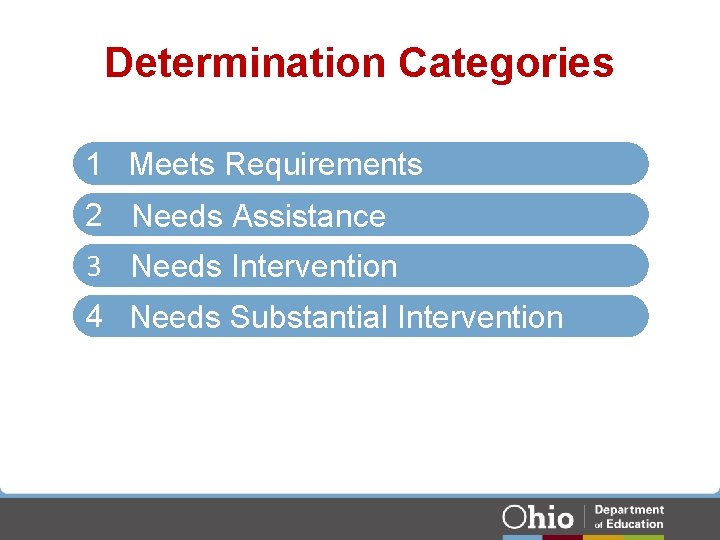
Determination Categories 1 Meets Requirements 2 Needs Assistance 3 Needs Intervention 4 Needs Substantial Intervention Sample Text
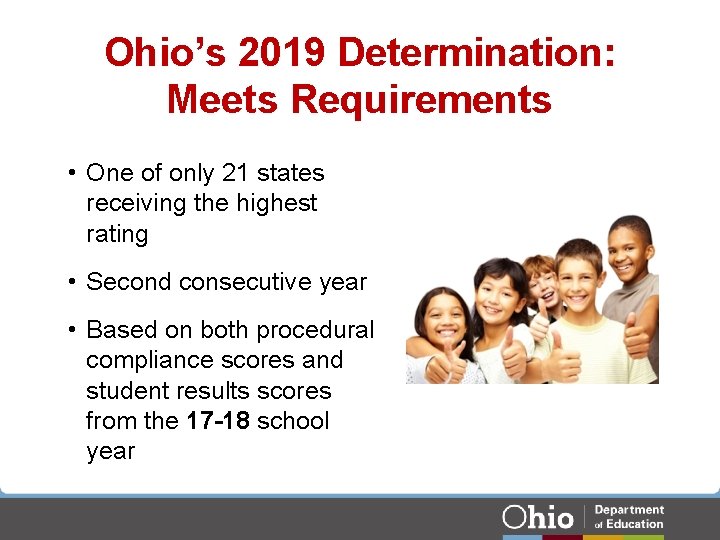
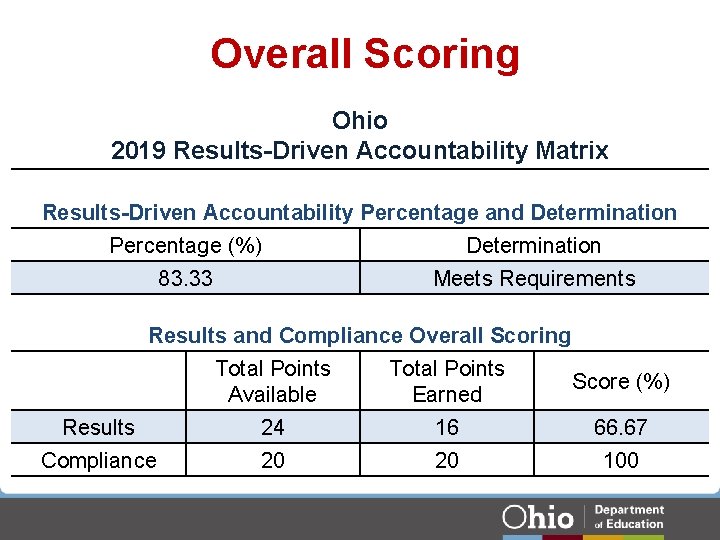
Ohio’s 2019 Determination: Meets Requirements • One of only 21 states receiving the highest rating • Second consecutive year • Based on both procedural compliance scores and student results scores from the 17 -18 school year
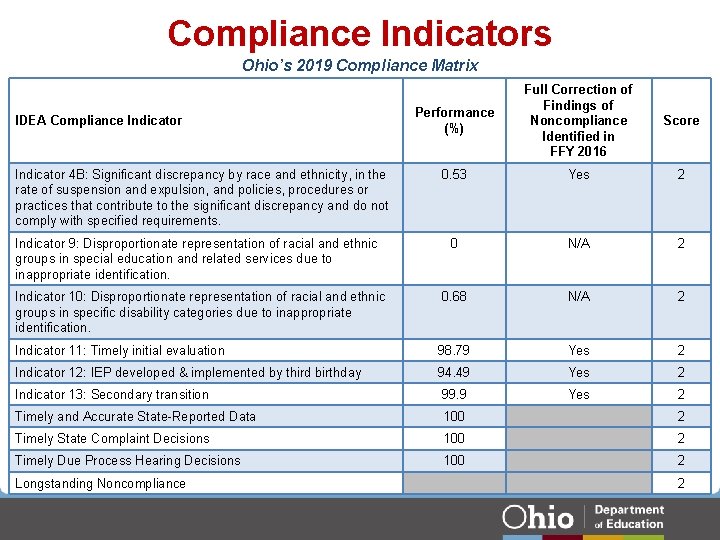
Ohio’s 2019 Determination Ohio continues to score 100% on compliance measures Some improvement in students taking standard assessments Lowest scoring area continues to be graduation
Overall Scoring Ohio 2019 Results-Driven Accountability Matrix Results-Driven Accountability Percentage and Determination Percentage (%) Determination 83. 33 Meets Requirements Results and Compliance Overall Scoring Total Points Score (%) Available Earned Results 24 16 66. 67 Compliance 20 20 100
Compliance Indicators Ohio’s 2019 Compliance Matrix Performance (%) Full Correction of Findings of Noncompliance Identified in FFY 2016 Score 0. 53 Yes 2 Indicator 9: Disproportionate representation of racial and ethnic groups in special education and related services due to inappropriate identification. 0 N/A 2 Indicator 10: Disproportionate representation of racial and ethnic groups in specific disability categories due to inappropriate identification. 0. 68 N/A 2 Indicator 11: Timely initial evaluation 98. 79 Yes 2 Indicator 12: IEP developed & implemented by third birthday 94. 49 Yes 2 Indicator 13: Secondary transition 99. 9 Yes 2 Timely and Accurate State-Reported Data 100 2 Timely State Complaint Decisions 100 2 Timely Due Process Hearing Decisions 100 2 IDEA Compliance Indicator 4 B: Significant discrepancy by race and ethnicity, in the rate of suspension and expulsion, and policies, procedures or practices that contribute to the significant discrepancy and do not comply with specified requirements. Longstanding Noncompliance 2
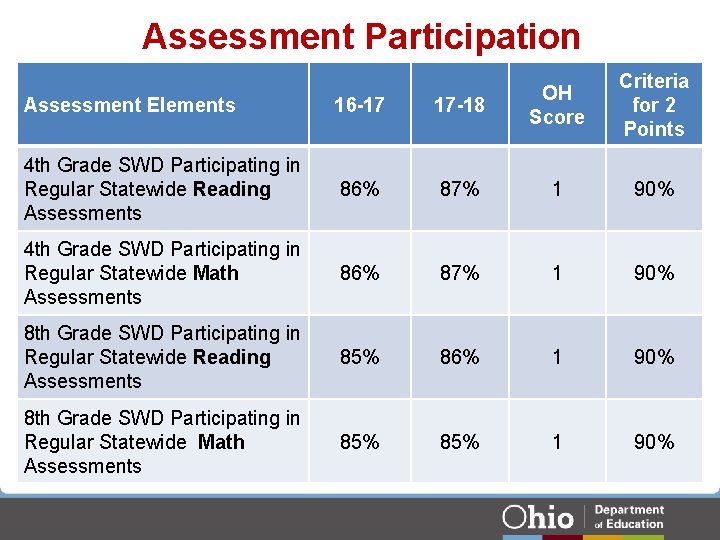
Assessment Participation Criteria for 2 Points Assessment Elements 16 -17 17 -18 OH Score 4 th Grade SWD Participating in Regular Statewide Reading Assessments 86% 87% 1 90% 4 th Grade SWD Participating in Regular Statewide Math Assessments 86% 87% 1 90% 8 th Grade SWD Participating in Regular Statewide Reading Assessments 85% 86% 1 90% 8 th Grade SWD Participating in Regular Statewide Math Assessments 85% 1 90%
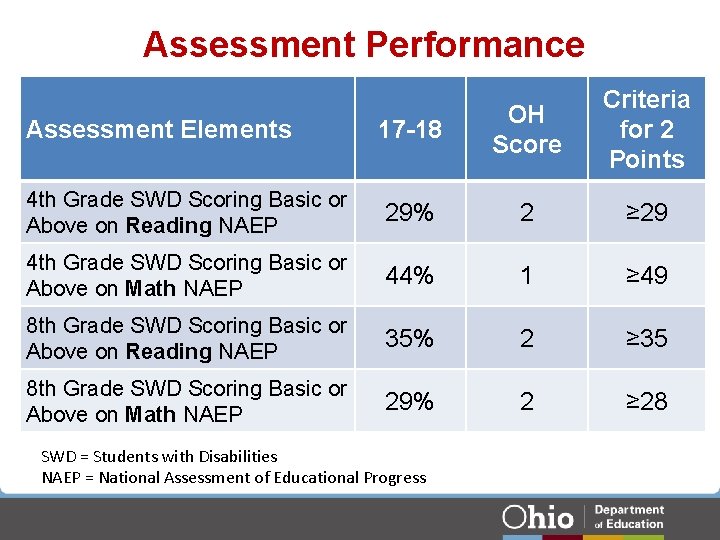
Assessment Performance 17 -18 OH Score Criteria for 2 Points 4 th Grade SWD Scoring Basic or Above on Reading NAEP 29% 2 ≥ 29 4 th Grade SWD Scoring Basic or Above on Math NAEP 44% 1 ≥ 49 8 th Grade SWD Scoring Basic or Above on Reading NAEP 35% 2 ≥ 35 8 th Grade SWD Scoring Basic or Above on Math NAEP 29% 2 ≥ 28 Assessment Elements SWD = Students with Disabilities NAEP = National Assessment of Educational Progress
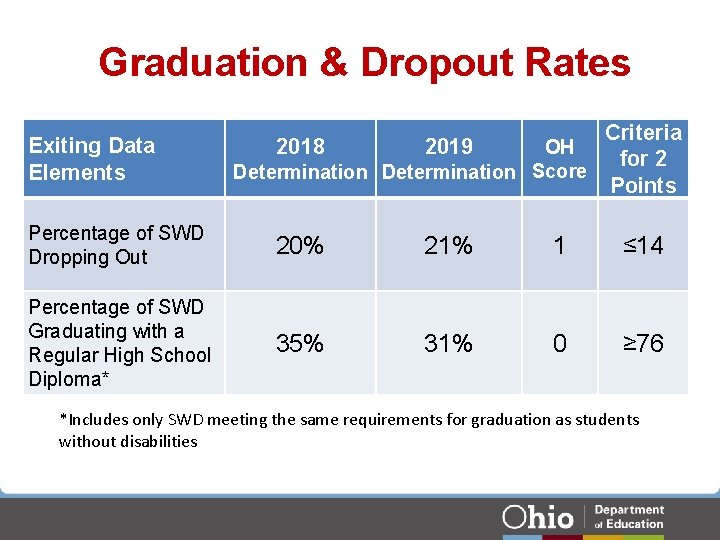
Graduation & Dropout Rates Exiting Data Elements Criteria OH 2018 2019 for 2 Determination Score Points Percentage of SWD Dropping Out 20% 21% 1 ≤ 14 Percentage of SWD Graduating with a Regular High School Diploma* 35% 31% 0 ≥ 76 *Includes only SWD meeting the same requirements for graduation as students without disabilities
Ohio’s District Ratings
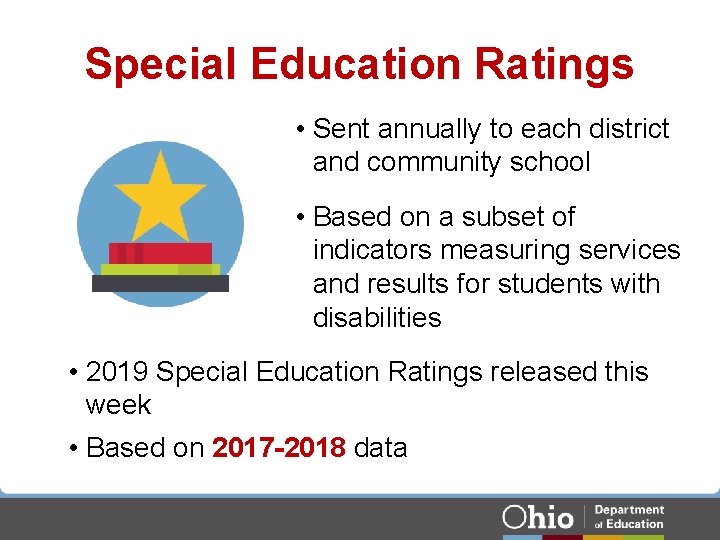
Special Education Ratings • Sent annually to each district and community school • Based on a subset of indicators measuring services and results for students with disabilities • 2019 Special Education Ratings released this week • Based on 2017 -2018 data
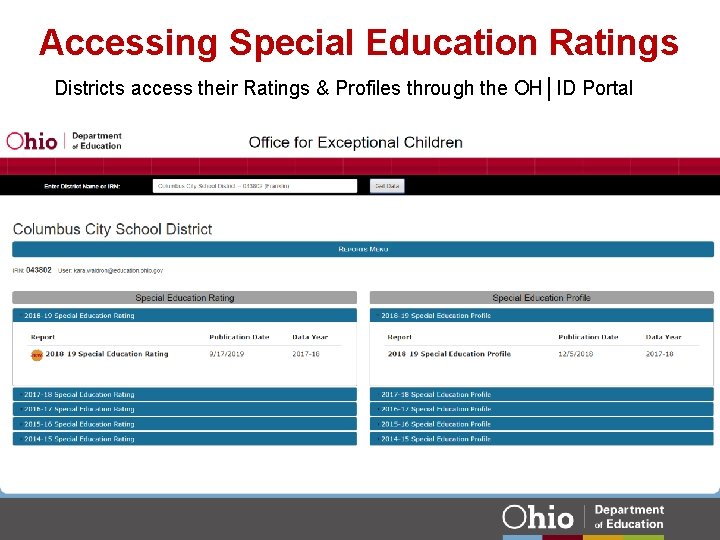
Accessing Special Education Ratings Districts access their Ratings & Profiles through the OH│ID Portal
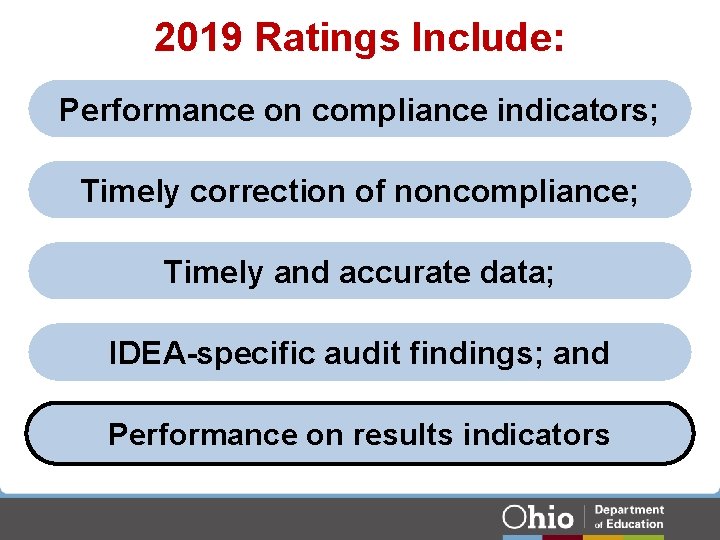
2019 Ratings Include: Performance on compliance indicators; Timely correction of noncompliance; Timely and accurate data; IDEA-specific audit findings; and Performance on results indicators
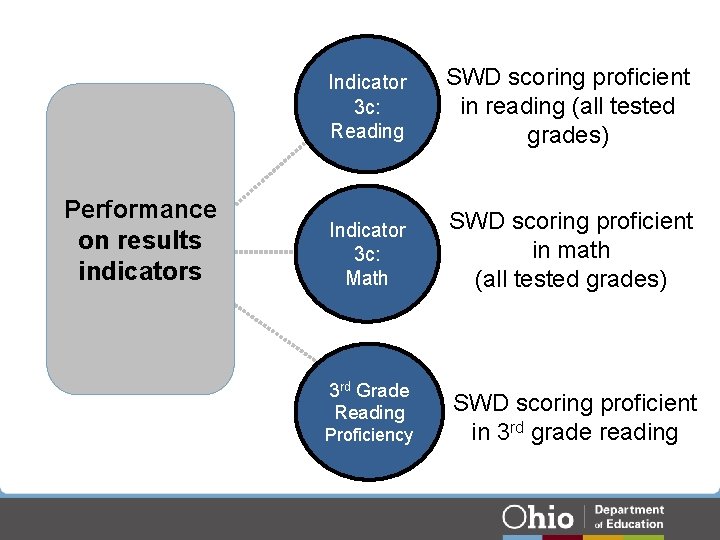
Performance on results indicators Indicator 3 c: Reading SWD scoring proficient in reading (all tested grades) Indicator 3 c: Math SWD scoring proficient in math (all tested grades) 3 rd Grade Reading Proficiency SWD scoring proficient in 3 rd grade reading
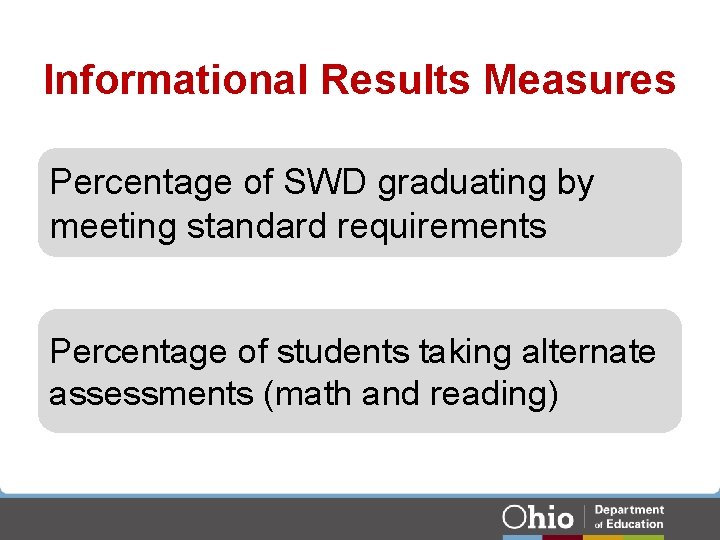
Informational Results Measures Percentage of SWD graduating by meeting standard requirements Percentage of students taking alternate assessments (math and reading)
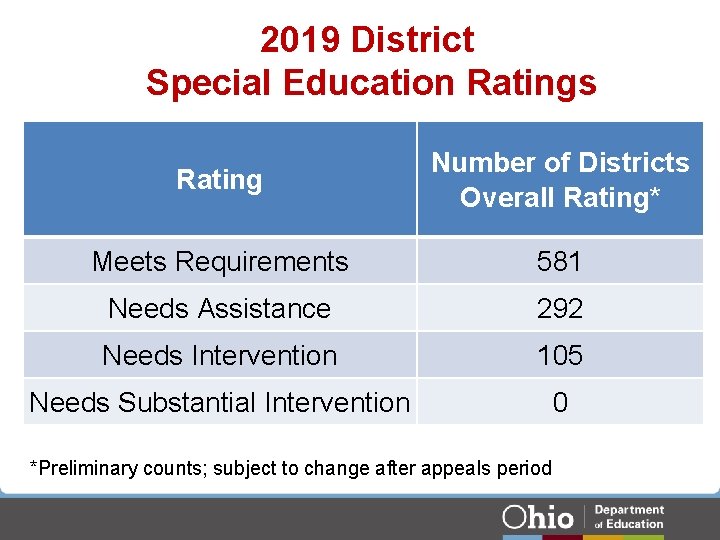
2019 District Special Education Ratings Rating Number of Districts Overall Rating* Meets Requirements 581 Needs Assistance 292 Needs Intervention 105 Needs Substantial Intervention 0 *Preliminary counts; subject to change after appeals period
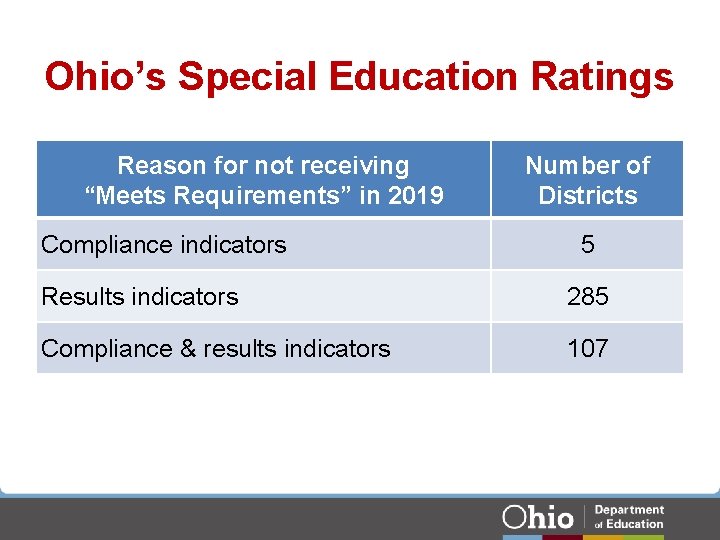
Ohio’s Special Education Ratings Reason for not receiving “Meets Requirements” in 2019 Compliance indicators Number of Districts 5 Results indicators 285 Compliance & results indicators 107
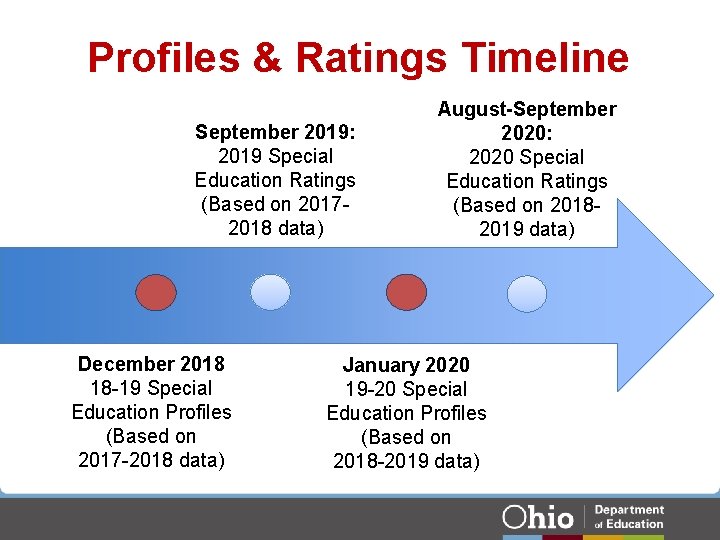
Profiles & Ratings Timeline September 2019: 2019 Special Education Ratings (Based on 20172018 data) December 2018 18 -19 Special Education Profiles (Based on 2017 -2018 data) August-September 2020: 2020 Special Education Ratings (Based on 20182019 data) January 2020 19 -20 Special Education Profiles (Based on 2018 -2019 data)
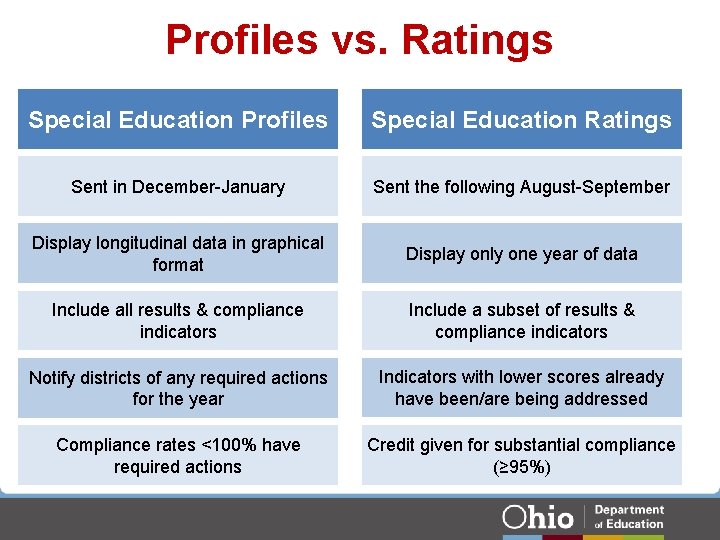
Profiles vs. Ratings Special Education Profiles Special Education Ratings Sent in December-January Sent the following August-September Display longitudinal data in graphical format Display only one year of data Include all results & compliance indicators Include a subset of results & compliance indicators Notify districts of any required actions for the year Indicators with lower scores already have been/are being addressed Compliance rates <100% have required actions Credit given for substantial compliance (≥ 95%)
@OHEducation
Share your learning community with us! #My. Ohio. Classroom Celebrate educators! #Ohio. Loves. Teachers