
O 1 DARM Loop Design Comparisons and Critiques
![DARM OLGTF (UGF Zoom) L 1 UGF: 56. 6 [Hz] H 1 UGF: 40.](https://slidetodoc.com/presentation_image_h/110578a38ff965cd6f92f10102bb8b80/image-3.jpg "DARM OLGTF (UGF Zoom) L 1 UGF: 56. 6 [Hz] H 1 UGF: 40.")


- Slides: 20
O 1 DARM Loop Design Comparisons and Critiques J. Kissel, for the ISC and Calibration Teams G 1501372 -v 1 1
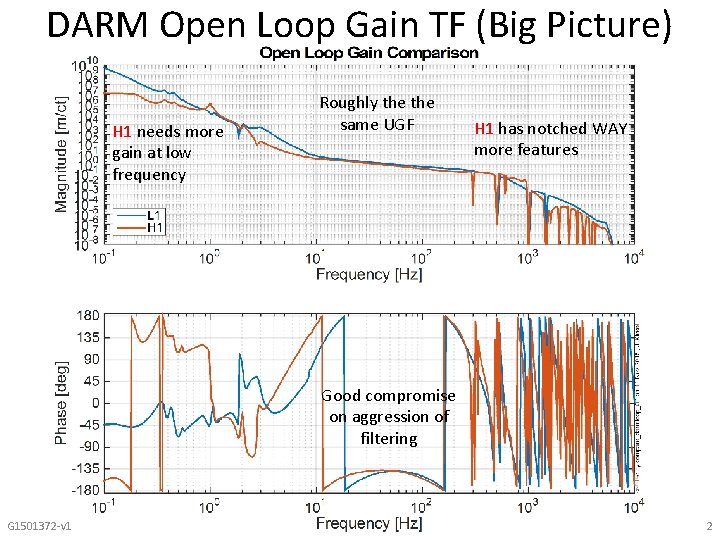
DARM Open Loop Gain TF (Big Picture) H 1 needs more gain at low frequency Roughly the same UGF H 1 has notched WAY more features Good compromise on aggression of filtering G 1501372 -v 1 2
DARM OLGTF (UGF Zoom) L 1 UGF: 56. 6 [Hz] H 1 UGF: 40. 1 [Hz] Good compromise on aggression of filtering H 1 Phase Margin: 42. 2 [deg] L 1 UGF: 40. 3 [Hz] G 1501372 -v 1 3
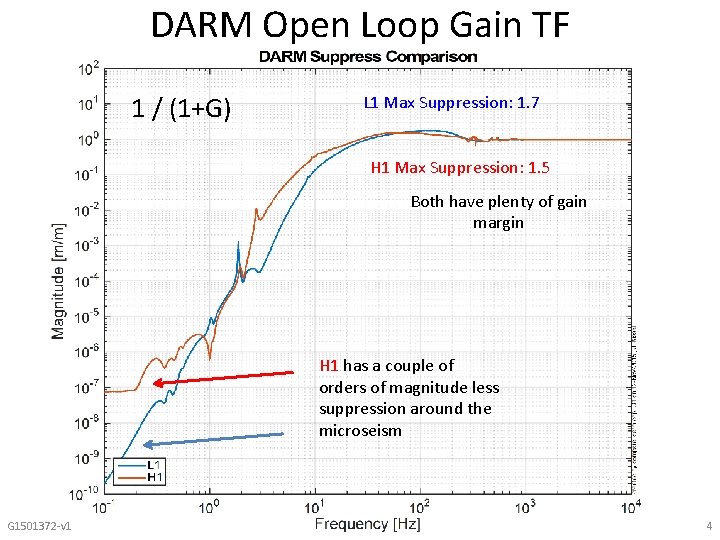
DARM Open Loop Gain TF 1 / (1+G) L 1 Max Suppression: 1. 7 H 1 Max Suppression: 1. 5 Both have plenty of gain margin H 1 has a couple of orders of magnitude less suppression around the microseism G 1501372 -v 1 4
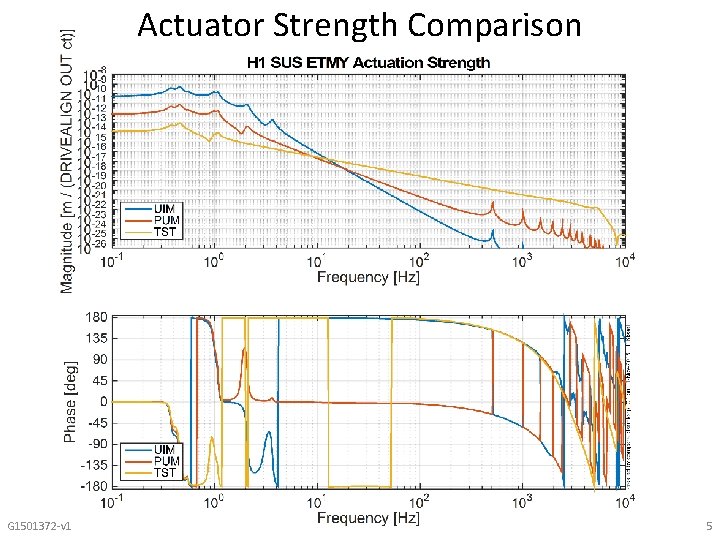
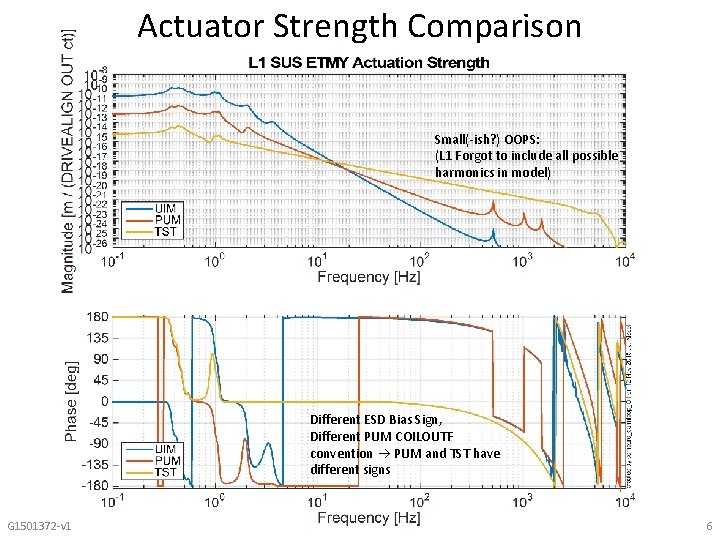
Actuator Strength Comparison G 1501372 -v 1 5
Actuator Strength Comparison Small(-ish? ) OOPS: (L 1 Forgot to include all possible harmonics in model) Different ESD Bias Sign, Different PUM COILOUTF convention PUM and TST have different signs G 1501372 -v 1 6
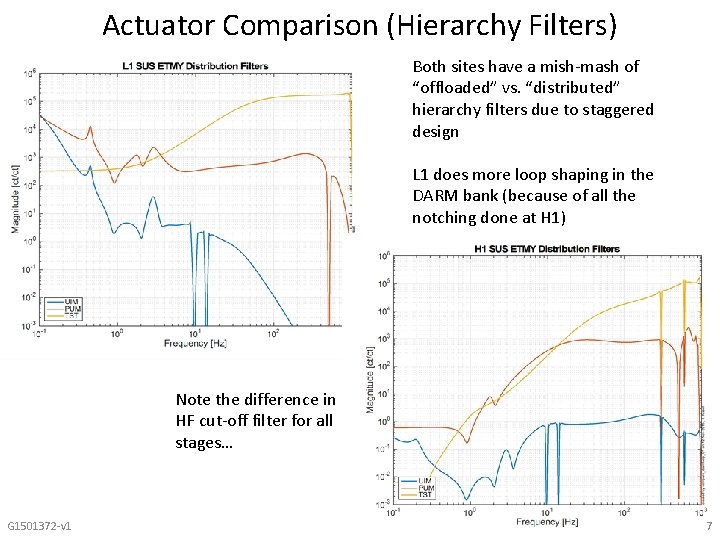
Actuator Comparison (Hierarchy Filters) Both sites have a mish-mash of “offloaded” vs. “distributed” hierarchy filters due to staggered design L 1 does more loop shaping in the DARM bank (because of all the notching done at H 1) Note the difference in HF cut-off filter for all stages… G 1501372 -v 1 7
The DARM Filter and Sensing Function H 1 boosts LF in the DARM bank Digital gains (and a sign) are distributed differently on the sensing side, so DARM filter gain and sign compensate, otherwise pretty similar… actual optical gain: ~3 [m. A/pm] at both sites But because of the different design choices, with frequency response and gains all over the place, tough to get a feel for the loop shaping from just one filter or plot G 1501372 -v 1 8
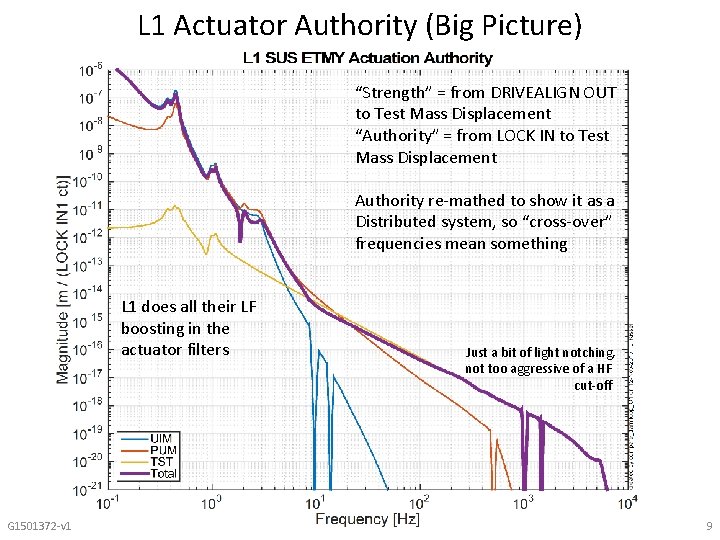
L 1 Actuator Authority (Big Picture) “Strength” = from DRIVEALIGN OUT to Test Mass Displacement “Authority” = from LOCK IN to Test Mass Displacement Authority re-mathed to show it as a Distributed system, so “cross-over” frequencies mean something L 1 does all their LF boosting in the actuator filters G 1501372 -v 1 Just a bit of light notching, not too aggressive of a HF cut-off 9
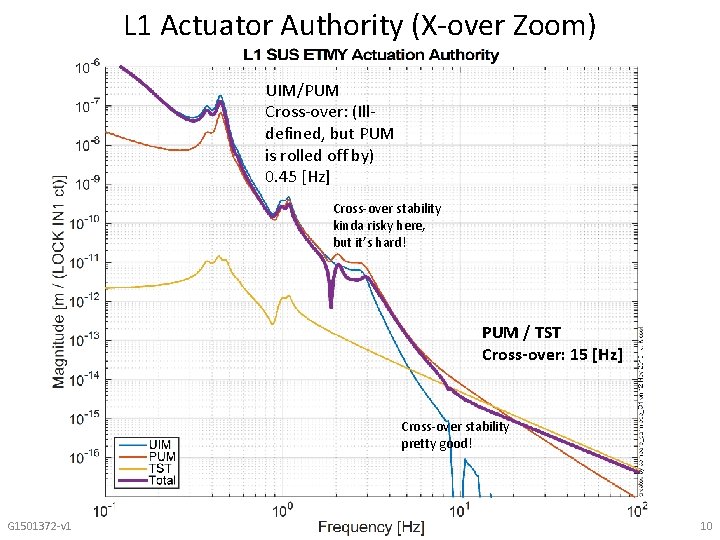
L 1 Actuator Authority (X-over Zoom) UIM/PUM Cross-over: (Illdefined, but PUM is rolled off by) 0. 45 [Hz] Cross-over stability kinda risky here, but it’s hard! PUM / TST Cross-over: 15 [Hz] Cross-over stability pretty good! G 1501372 -v 1 10
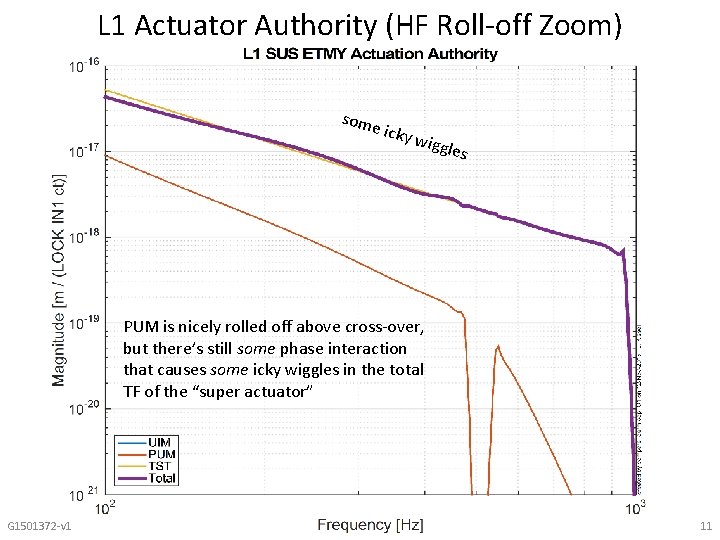
L 1 Actuator Authority (HF Roll-off Zoom) some icky w iggle s PUM is nicely rolled off above cross-over, but there’s still some phase interaction that causes some icky wiggles in the total TF of the “super actuator” G 1501372 -v 1 11
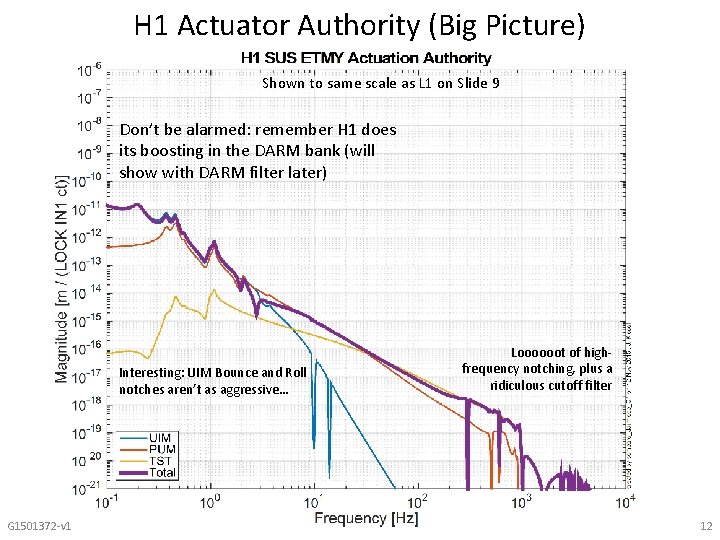
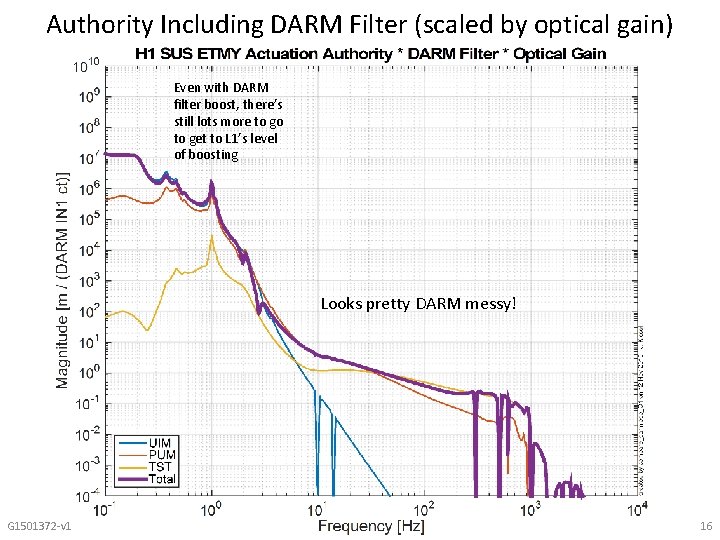
H 1 Actuator Authority (Big Picture) Shown to same scale as L 1 on Slide 9 Don’t be alarmed: remember H 1 does its boosting in the DARM bank (will show with DARM filter later) Interesting: UIM Bounce and Roll notches aren’t as aggressive… G 1501372 -v 1 Loooooot of highfrequency notching, plus a ridiculous cutoff filter 12
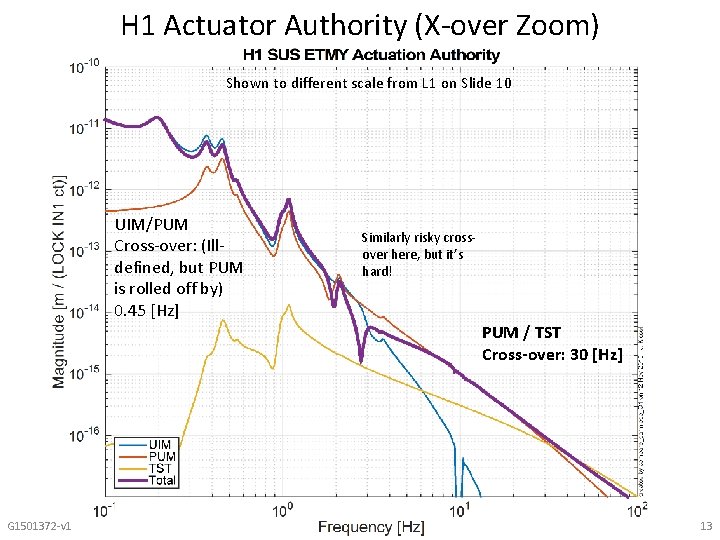
H 1 Actuator Authority (X-over Zoom) Shown to different scale from L 1 on Slide 10 UIM/PUM Cross-over: (Illdefined, but PUM is rolled off by) 0. 45 [Hz] Similarly risky crossover here, but it’s hard! PUM / TST Cross-over: 30 [Hz] G 1501372 -v 1 13
H 1 Actuator Authority (HF Roll-off Zoom) YUCK. PUM phase is still interacting with TST phase out to 300 Hz Notches + HF Cutoff causes all sorts of nastiness. G 1501372 -v 1 14
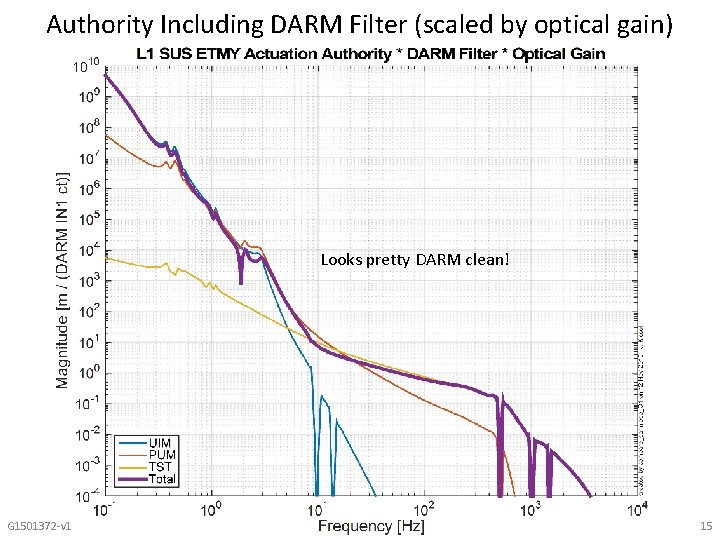
Authority Including DARM Filter (scaled by optical gain) Looks pretty DARM clean! G 1501372 -v 1 15
Authority Including DARM Filter (scaled by optical gain) Even with DARM filter boost, there’s still lots more to go to get to L 1’s level of boosting Looks pretty DARM messy! G 1501372 -v 1 16
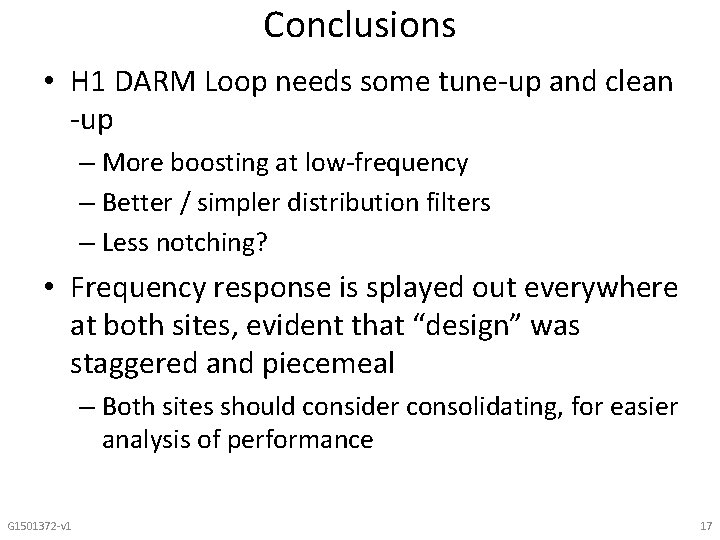
Conclusions • H 1 DARM Loop needs some tune-up and clean -up – More boosting at low-frequency – Better / simpler distribution filters – Less notching? • Frequency response is splayed out everywhere at both sites, evident that “design” was staggered and piecemeal – Both sites should consider consolidating, for easier analysis of performance G 1501372 -v 1 17
Bonus Material: Calibration Parameter Time Dependence Clues of “real” IFO parameters changing -- confirmation from alternative measurements G 1501372 -v 1 18
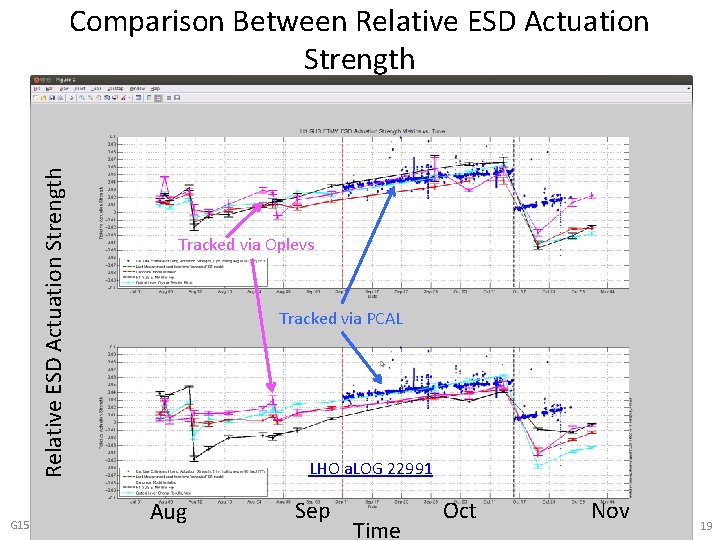
Relative ESD Actuation Strength Comparison Between Relative ESD Actuation Strength G 1501372 -v 1 Tracked via Oplevs Tracked via PCAL LHO a. LOG 22991 Aug Sep Time Oct Nov 19
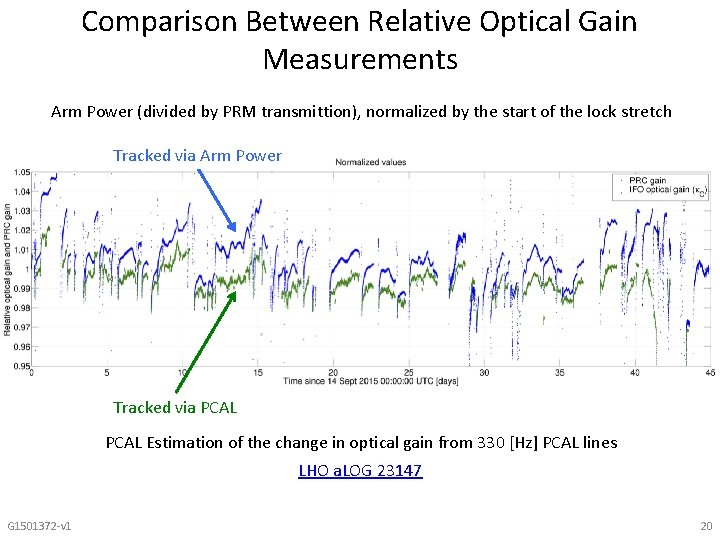
Comparison Between Relative Optical Gain Measurements Arm Power (divided by PRM transmittion), normalized by the start of the lock stretch Tracked via Arm Power Tracked via PCAL Estimation of the change in optical gain from 330 [Hz] PCAL lines LHO a. LOG 23147 G 1501372 -v 1 20