
NZISM Wellington Branch Knowing your risk management landscape
NZISM Wellington Branch Knowing your risk management landscape Prepared by: Michael Jones | January 2019 | Version 1. 0
Legislative requirement Positive “due diligence” duty to ensure PCBU has either – eliminated risks to health and safety “so far as is reasonably practicable”, or – Where risks cannot be eliminated, minimise them “so far as is reasonably practicable”.
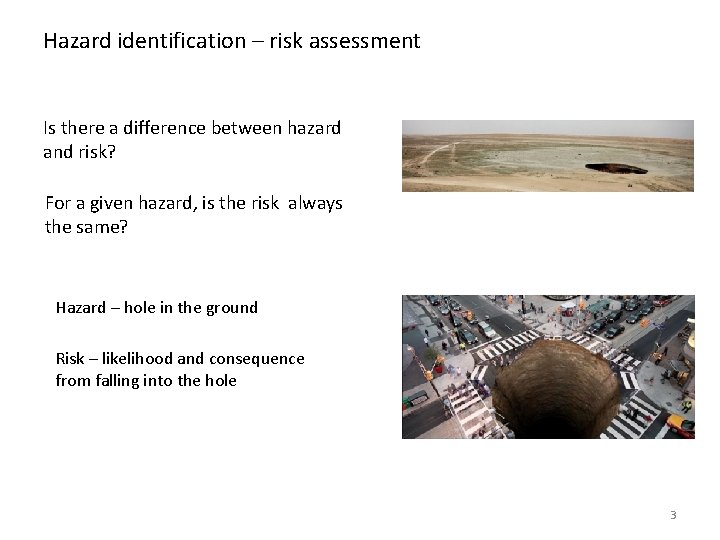
Hazard identification – risk assessment Is there a difference between hazard and risk? For a given hazard, is the risk always the same? Hazard – hole in the ground Risk – likelihood and consequence from falling into the hole 3
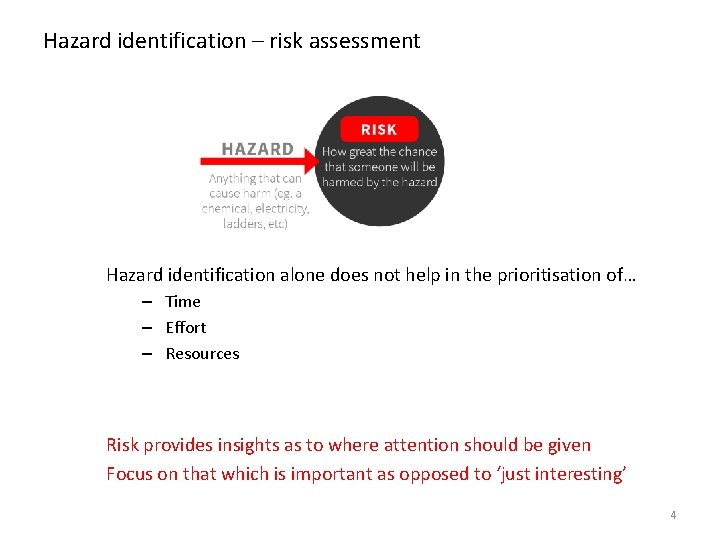
Hazard identification – risk assessment Hazard identification alone does not help in the prioritisation of… – Time – Effort – Resources Risk provides insights as to where attention should be given Focus on that which is important as opposed to ‘just interesting’ 4

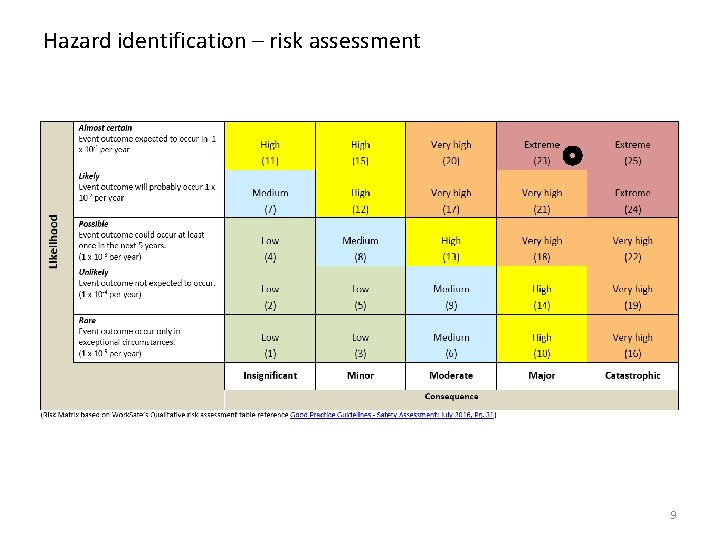
Hazard identification – risk assessment When assessing consequence and likelihood, organisations frequently use a Risk Matrix… This Risk Matrix will reflect your organisation’s risk appetite. Event classification Occupational safety and health Insignificant Minor Any injury not requiring treatment by medical professional. Lost time injury directly attributable to organisational or mechanical failure. Consequence Moderate One or more serious harm injury or LTI directly attributable to organisational, or mechanical failure. Major Catastrophic One fatality directly attributable to organisational, or mechanical failure. Multiple fatalities directly attributable to organisational, or mechanical failure. 5

Personal opinion - risk matrix numbering is important Is an annual first aid injury = single fatality every 11+ years? 6
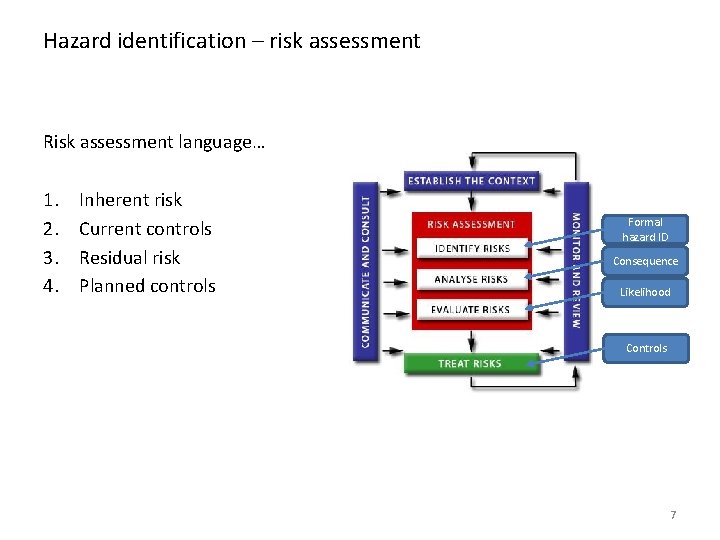
Hazard identification – risk assessment Risk assessment language… 1. 2. 3. 4. Inherent risk Current controls Residual risk Planned controls Formal hazard ID Consequence Likelihood Controls 7

Hazard identification – risk assessment Inherent risk 1. Assess the risk of the task without any controls being in place by… Task – Assessing the credible consequences following exposure to the hazard – The likelihood of that exposure occurring 8
Hazard identification – risk assessment 9
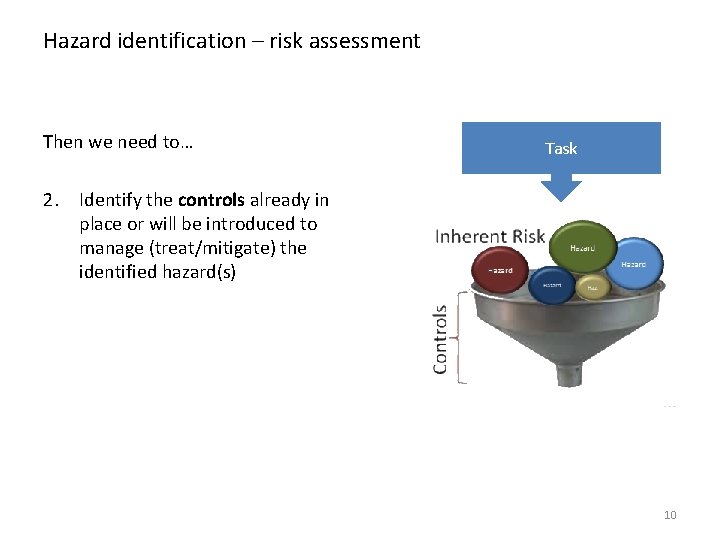
Hazard identification – risk assessment Then we need to… Task 2. Identify the controls already in place or will be introduced to manage (treat/mitigate) the identified hazard(s) 10
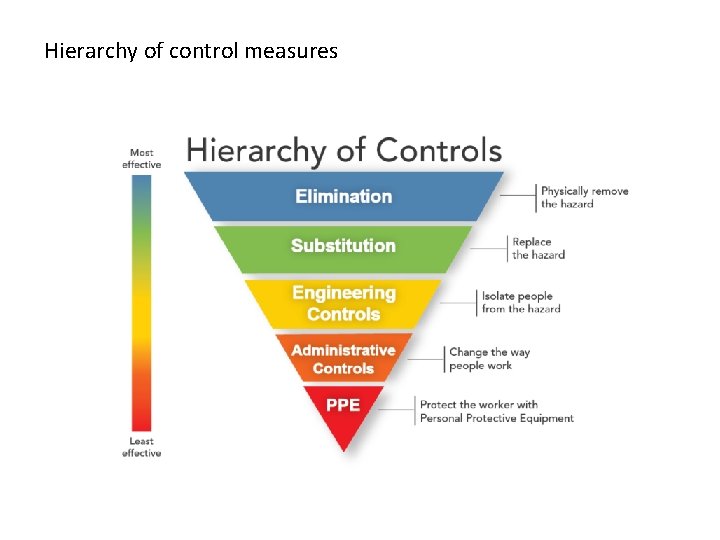
Hierarchy of control measures
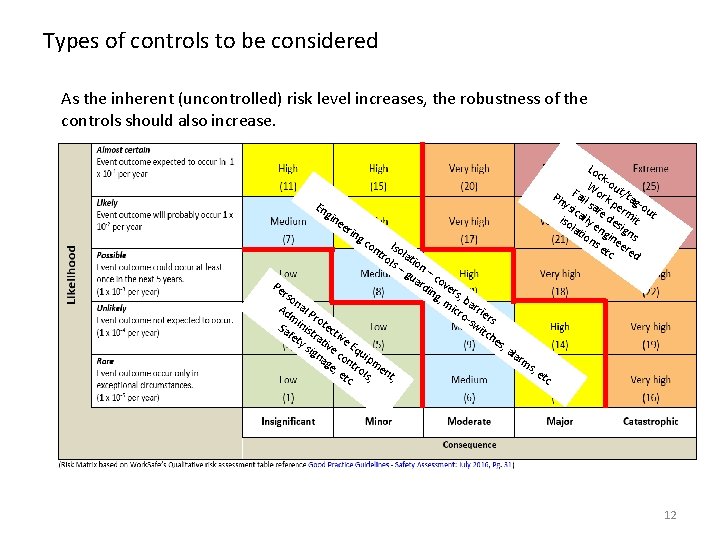
Types of controls to be considered As the inherent (uncontrolled) risk level increases, the robustness of the controls should also increase. En gin Pe ee r ing Lo ck W -out Ph Fail ork /tag ysi sa pe -o fe rm u c iso ally des it t lat eng ign ion in s s e eer tc. ed co nt Isola ro ls tion –g – ua co rd ve ing rs, , m ba icr rrie osw rs itc he s, rso n Ad al P mi ro Sa nist tect fet ra iv y s tiv e E ign e c qu ag ont ipm e, ro en et ls, t, c. ala r ms , etc . 12
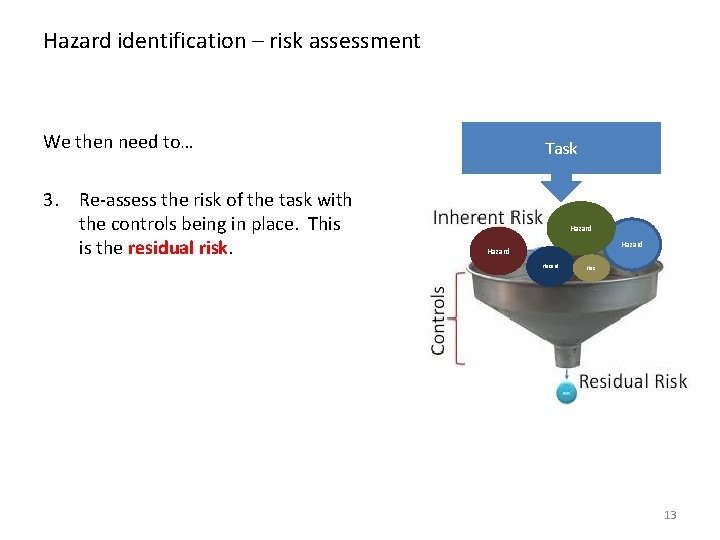
Hazard identification – risk assessment We then need to… 3. Re-assess the risk of the task with the controls being in place. This is the residual risk. Task Hazard Haz. 13
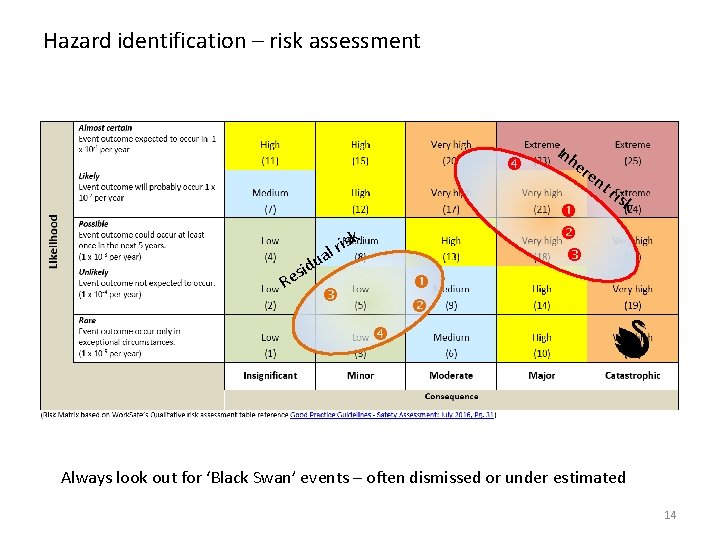
Hazard identification – risk assessment er en k s l ri ua d i s Re Inh tr isk Always look out for ‘Black Swan’ events – often dismissed or under estimated 14
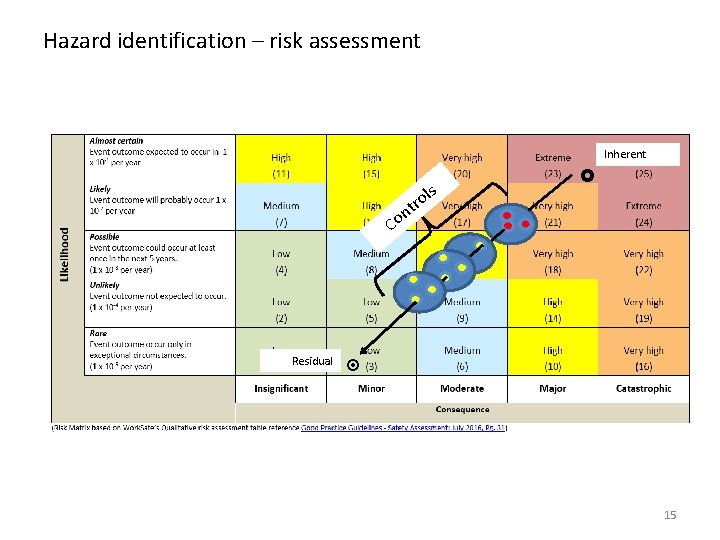
Hazard identification – risk assessment Inherent tro n Co Residual ls 15
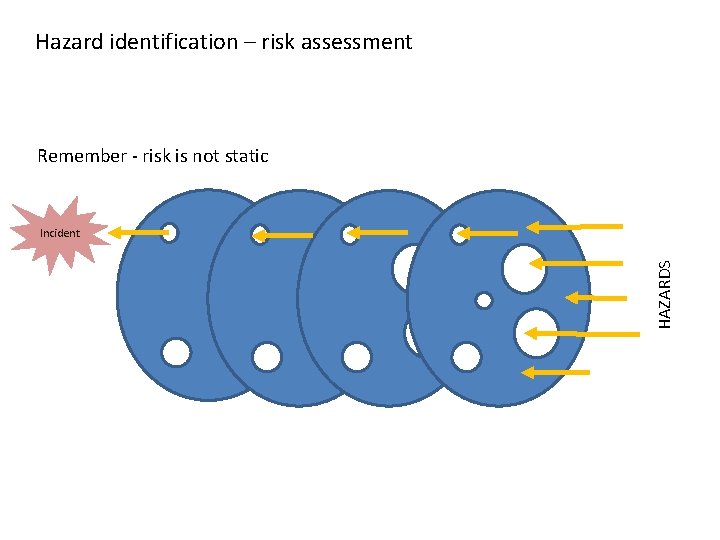
Hazard identification – risk assessment Remember - risk is not static HAZARDS Incident
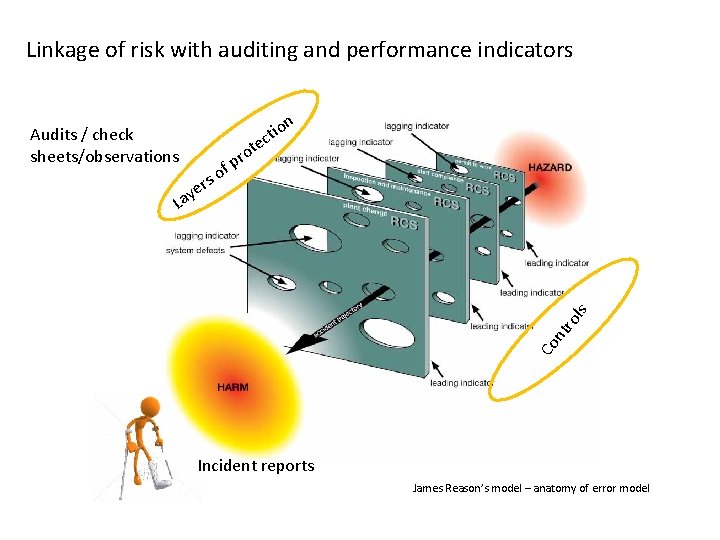
Linkage of risk with auditing and performance indicators Audits / check sheets/observations nt ro ls e Co y La of s r te o pr n o cti Incident reports James Reason’s model – anatomy of error model
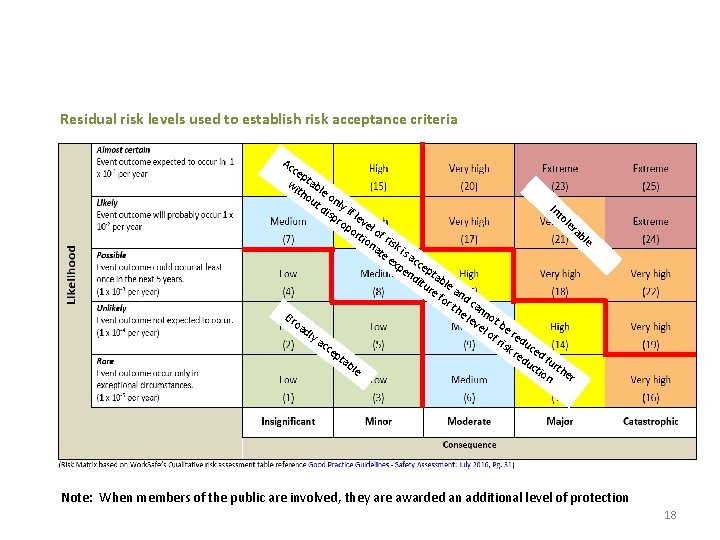
Residual risk levels used to establish risk acceptance criteria Ac ce p wi tabl th e o ou t d nly i In isp f le to ro ve le po l o ra bl rti f r e on isk ate is ex acc pe ep nd tab itu le re an for d c th an e l no Br ev t b oa el dly of e re ac ris du ce k r ced pt ed ab uc furt le tio he r n Note: When members of the public are involved, they are awarded an additional level of protection 18
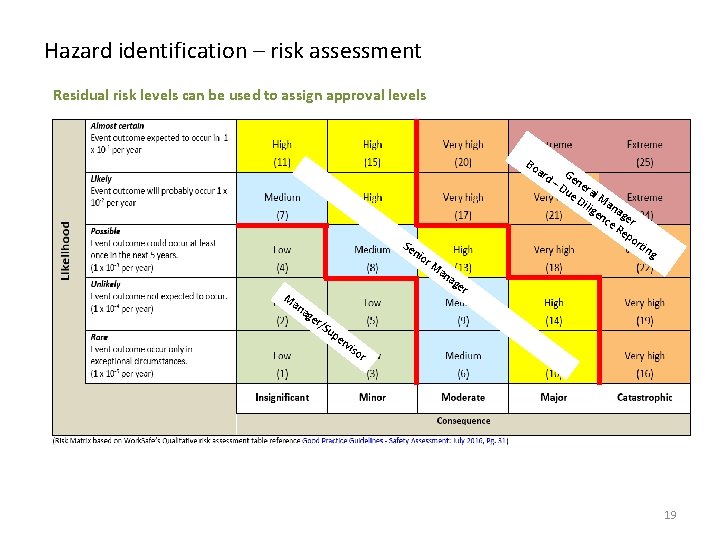
Hazard identification – risk assessment Residual risk levels can be used to assign approval levels Bo ard Se nio G – D ene ue ral M Dil ige ana nc ger e. R ep or tin r. M g an a ge r M an ag er /S up er vis or 19
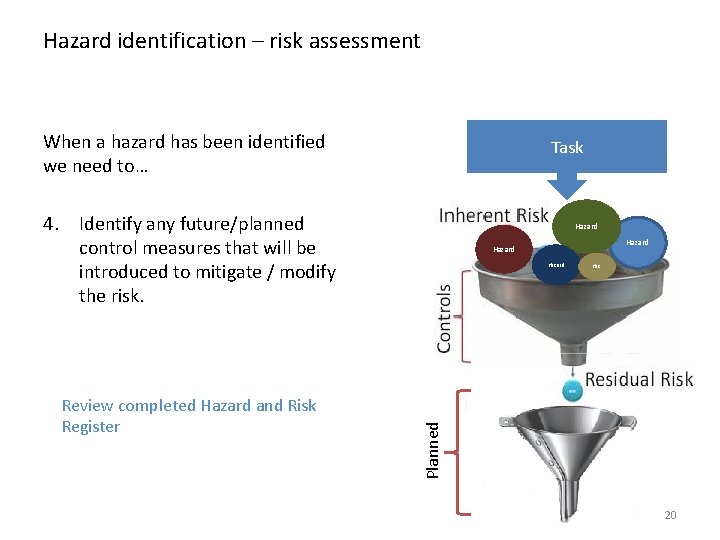
Hazard identification – risk assessment When a hazard has been identified we need to… Task 4. Identify any future/planned control measures that will be introduced to mitigate / modify the risk. Hazard Haz. Planned Review completed Hazard and Risk Register Hazard 20
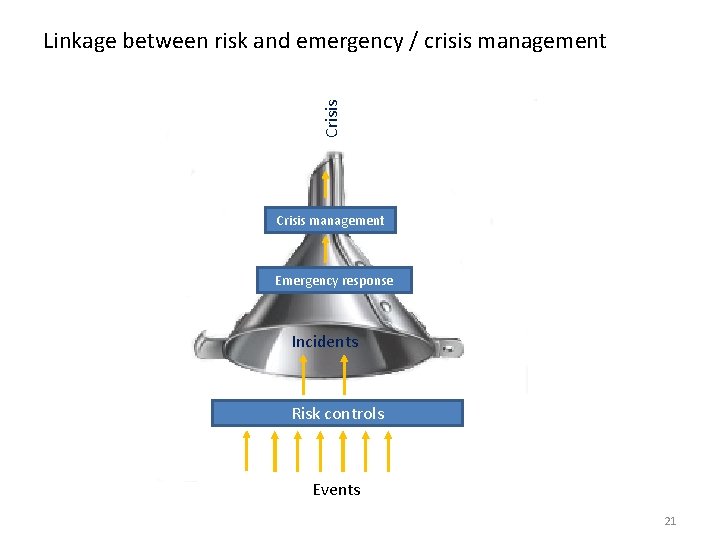
Crisis Linkage between risk and emergency / crisis management Crisis management Emergency response Incidents Risk controls Events 21
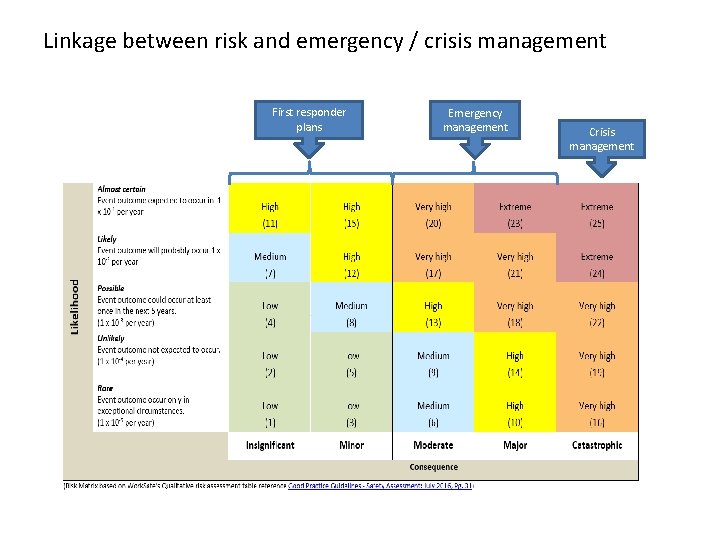
Linkage between risk and emergency / crisis management First responder plans Emergency management Crisis management
Linkage between incidents and risk When an incident occurs, it should be assessed for its • Actual consequence, and • Potential consequence • The potential consequence should dictate the investigation required. 23
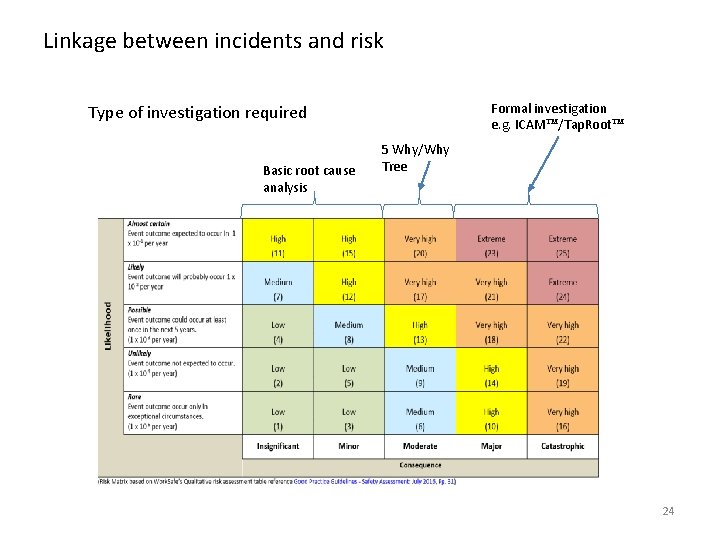
Linkage between incidents and risk Formal investigation e. g. ICAM /Tap. Root Type of investigation required Basic root cause analysis 5 Why/Why Tree 24
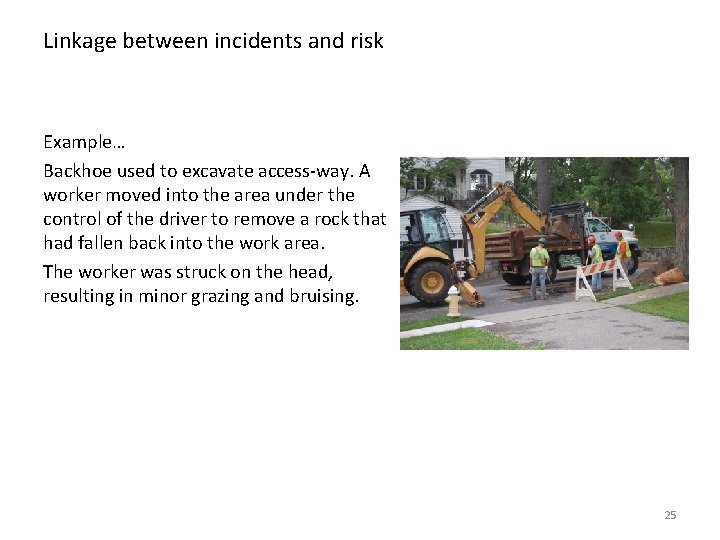
Linkage between incidents and risk Example… Backhoe used to excavate access-way. A worker moved into the area under the control of the driver to remove a rock that had fallen back into the work area. The worker was struck on the head, resulting in minor grazing and bruising. 25
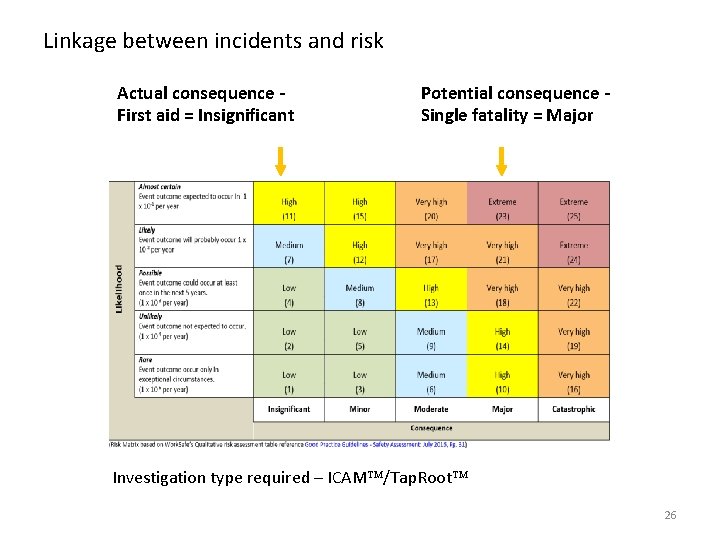
Linkage between incidents and risk Actual consequence First aid = Insignificant Potential consequence Single fatality = Major Investigation type required – ICAM /Tap. Root 26
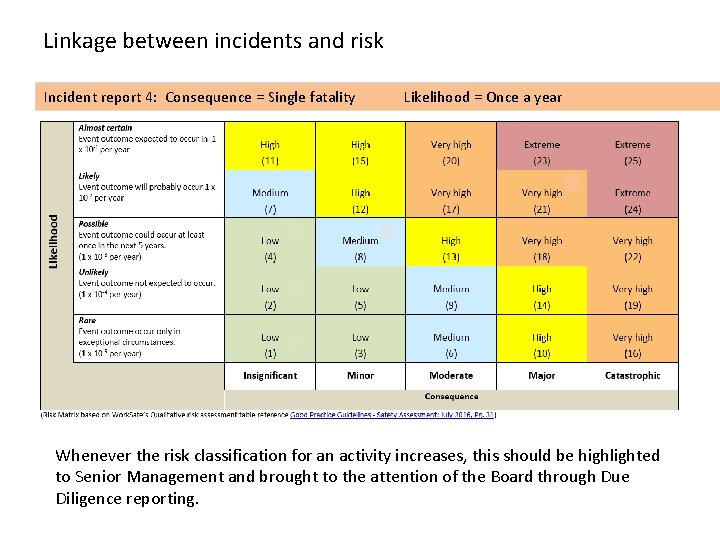
Linkage between incidents and risk Incident report 3: = Medical = =still assessed as once in 5 years 4: Consequence Singleaid fatality Once ainyear 2: First Likelihood changed to once 1: years Initial risk assessment: Consequence =treatment First aid =Likelihood once in 510 years 50 year event Whenever the risk classification for an activity increases, this should be highlighted to Senior Management and brought to the attention of the Board through Due Diligence reporting.
Risk provides insights as to where attention should be given Focus on that which is important as opposed to ‘just interesting’
- Slides: 28