
NYSPFP AHRQ Culture of Safety Survey Debrief Action
NYSPFP AHRQ Culture of Safety Survey Debrief & Action Planning Tool Hospital: Unit 2018 1 2 -16 -16
NYS PARTNERSHIP FOR PATIENTS Objectives • Review and discuss the 2018 Safety Culture Survey results with hospital and unit specific data • Understand what drives improvement in safety culture • Identify our hospital and/or unit strengths and weaknesses • Continuously improve or adopt new practices where indicated 2 September 25, 2020
NYS PARTNERSHIP FOR PATIENTS Safety Culture “Safety culture provides valuable insights as to what it feels like to be a unit secretary, nurse, physician, or other caregiver at the clinical unit level or those supporting direct caregivers. Feeling valued and having the psychological safety to speak up and voice concerns and learn from errors, all have a tremendous impact on the quality of care and the social dynamic among caregivers. Safety culture is measurable and can be deployed as a powerful mechanism to engage caregivers in positive behavioral change. ” From: Creating a Road Map for Patient Safety in The Essential Guide for Patient Safety Officers, 2 nd Ed. (2013); Joint Commission Resources 3
NYS PARTNERSHIP FOR PATIENTS What is Safety Culture? Elevator Speech: Safety culture is the attitudes, beliefs and behaviors that characterize an organization, group or unit’s level of commitment to preventing harm to its patients and staff 4 September 25, 2020
NYS PARTNERSHIP FOR PATIENTS Three Fundamental Questions • What are we trying to accomplish? • Our aim is to improve safety culture so that we can become a high reliability organization where we can anticipate patient harm and prevent it before it occurs • How will we know if a change is an improvement? • Our measures of improvement are the scores from the AHRQ Hospital Survey of Patient Safety Culture (HSOPS) • What changes can we make that will result in improvement? • There are specific interventions that have been identified through learning from best practices and we can develop actionable plans http: //www. nichq. org/how_we_work/model_for_improvement. html
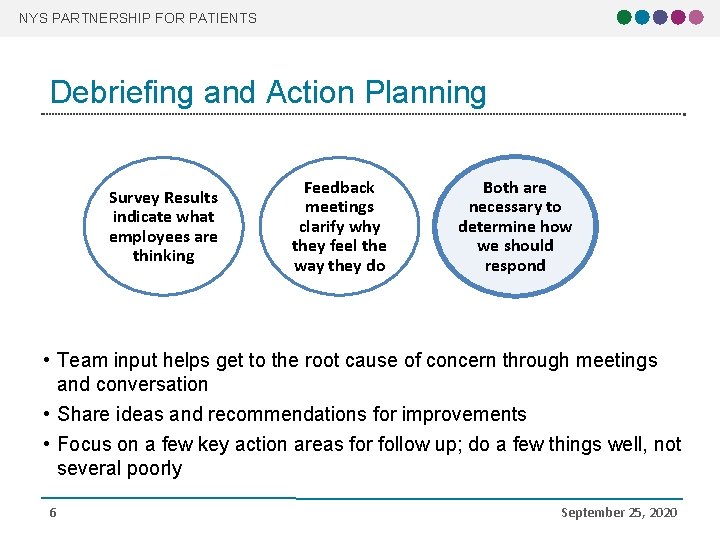
NYS PARTNERSHIP FOR PATIENTS Debriefing and Action Planning Survey Results indicate what employees are thinking Feedback meetings clarify why they feel the way they do Both are necessary to determine how we should respond • Team input helps get to the root cause of concern through meetings and conversation • Share ideas and recommendations for improvements • Focus on a few key action areas for follow up; do a few things well, not several poorly 6 September 25, 2020
Hospital & Unit-Level Debrief 7 2 -16 -16
NYS PARTNERSHIP FOR PATIENTS Participation Rate The overall participation rate was XX% for Hospital Name. Unit Numerator/Hospital Denominator of Unit Name colleagues contributed to the overall results. • • 8 The participation rate is an important metric for safety culture and engagement. Higher participation rates determine the confidence with which we believe the survey results truly reflect the opinions of the staff XX% of staff want to engage in a conversation about the factors which drive safety. September 25, 2020
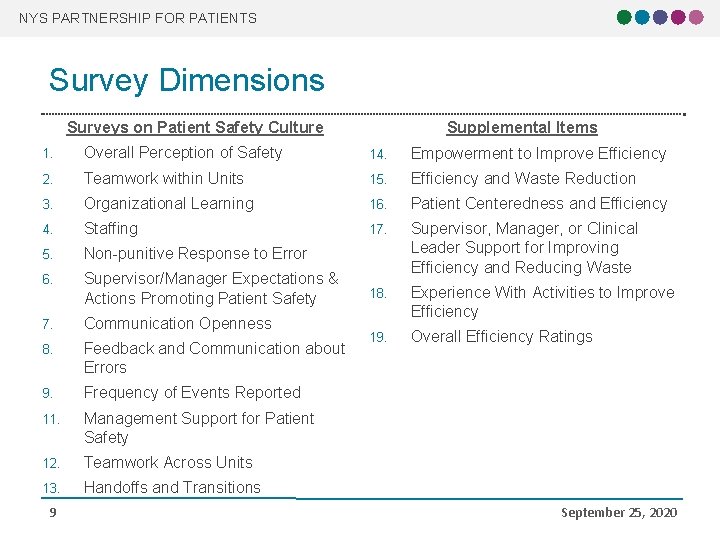
NYS PARTNERSHIP FOR PATIENTS Survey Dimensions Surveys on Patient Safety Culture Supplemental Items 1. Overall Perception of Safety 14. Empowerment to Improve Efficiency 2. Teamwork within Units 15. Efficiency and Waste Reduction 3. Organizational Learning 16. Patient Centeredness and Efficiency 4. Staffing 17. 5. Non-punitive Response to Error 6. Supervisor/Manager Expectations & Actions Promoting Patient Safety Supervisor, Manager, or Clinical Leader Support for Improving Efficiency and Reducing Waste 18. 7. Communication Openness Experience With Activities to Improve Efficiency 8. Feedback and Communication about Errors 19. Overall Efficiency Ratings 9. Frequency of Events Reported 11. Management Support for Patient Safety 12. Teamwork Across Units 13. Handoffs and Transitions 9 September 25, 2020
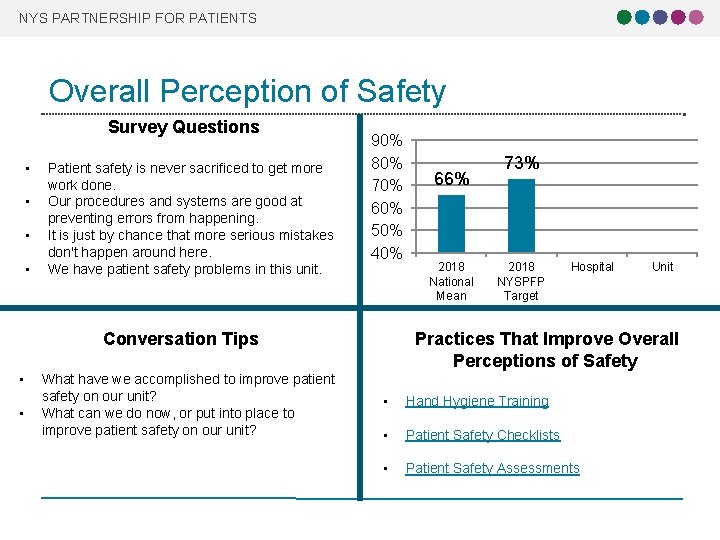
NYS PARTNERSHIP FOR PATIENTS Overall Perception of Safety Survey Questions • • Patient safety is never sacrificed to get more work done. Our procedures and systems are good at preventing errors from happening. It is just by chance that more serious mistakes don't happen around here. We have patient safety problems in this unit. 90% 80% 70% 60% 50% 40% Conversation Tips • • What have we accomplished to improve patient safety on our unit? What can we do now, or put into place to improve patient safety on our unit? 66% 2018 National Mean 73% 2018 NYSPFP Target Hospital Unit Practices That Improve Overall Perceptions of Safety • Hand Hygiene Training • Patient Safety Checklists • Patient Safety Assessments
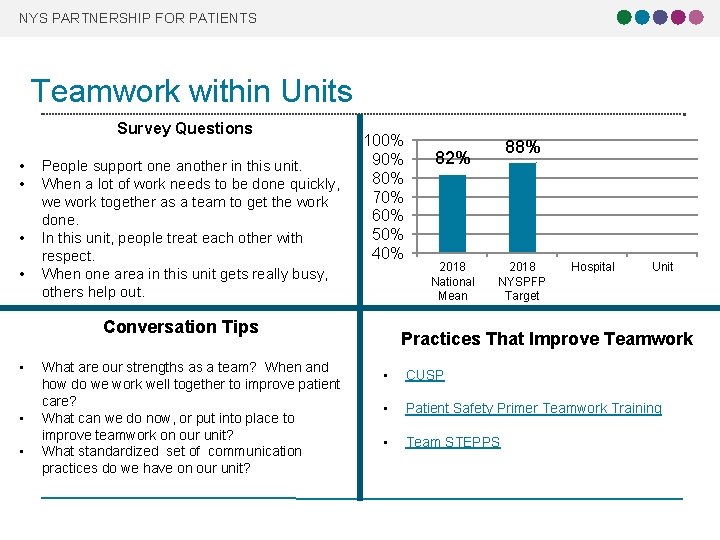
NYS PARTNERSHIP FOR PATIENTS Teamwork within Units Survey Questions • • People support one another in this unit. When a lot of work needs to be done quickly, we work together as a team to get the work done. In this unit, people treat each other with respect. When one area in this unit gets really busy, others help out. 100% 90% 80% 70% 60% 50% 40% Conversation Tips • • • What are our strengths as a team? When and how do we work well together to improve patient care? What can we do now, or put into place to improve teamwork on our unit? What standardized set of communication practices do we have on our unit? 88% 82% 2018 National Mean 2018 NYSPFP Target Hospital Unit Practices That Improve Teamwork • CUSP • Patient Safety Primer Teamwork Training • Team STEPPS
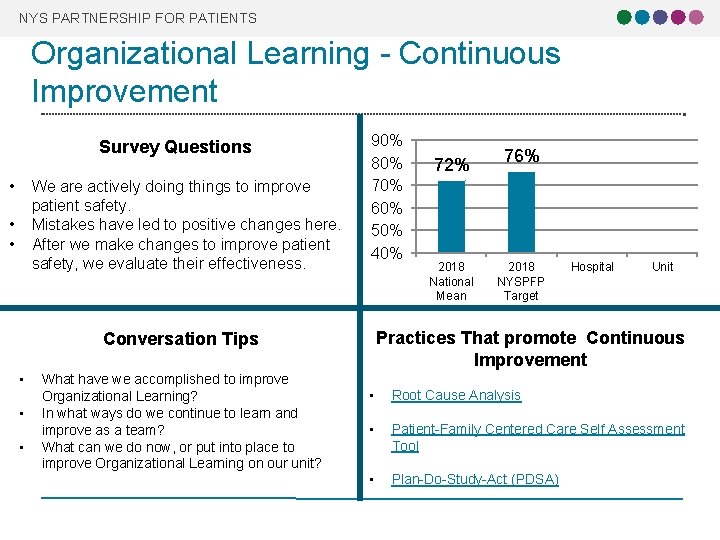
NYS PARTNERSHIP FOR PATIENTS Organizational Learning - Continuous Improvement Survey Questions • We are actively doing things to improve patient safety. Mistakes have led to positive changes here. After we make changes to improve patient safety, we evaluate their effectiveness. • • 90% 80% 70% 60% 50% 40% • • What have we accomplished to improve Organizational Learning? In what ways do we continue to learn and improve as a team? What can we do now, or put into place to improve Organizational Learning on our unit? 2018 National Mean 76% 2018 NYSPFP Target Hospital Unit Practices That promote Continuous Improvement Conversation Tips • 72% • Root Cause Analysis • Patient-Family Centered Care Self Assessment Tool • Plan-Do-Study-Act (PDSA)
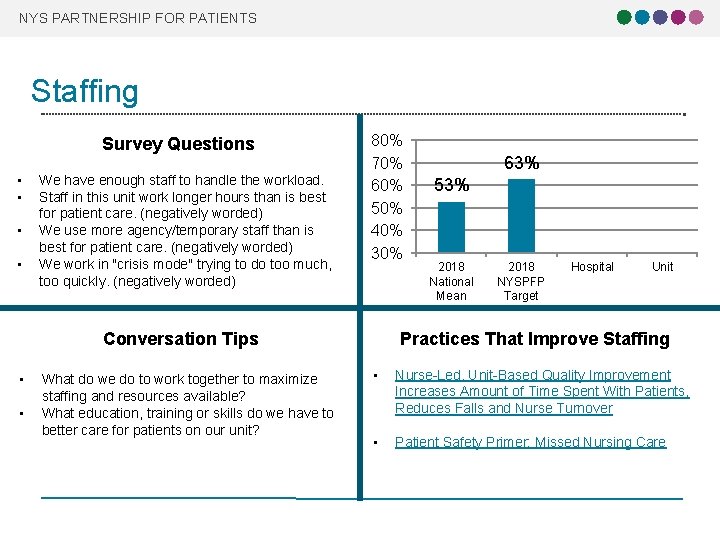
NYS PARTNERSHIP FOR PATIENTS Staffing Survey Questions • • We have enough staff to handle the workload. Staff in this unit work longer hours than is best for patient care. (negatively worded) We use more agency/temporary staff than is best for patient care. (negatively worded) We work in "crisis mode" trying to do too much, too quickly. (negatively worded) 80% 70% 60% 50% 40% 30% • What do we do to work together to maximize staffing and resources available? What education, training or skills do we have to better care for patients on our unit? 53% 2018 National Mean 2018 NYSPFP Target Hospital Unit Practices That Improve Staffing Conversation Tips • 63% • Nurse-Led, Unit-Based Quality Improvement Increases Amount of Time Spent With Patients, Reduces Falls and Nurse Turnover • Patient Safety Primer: Missed Nursing Care
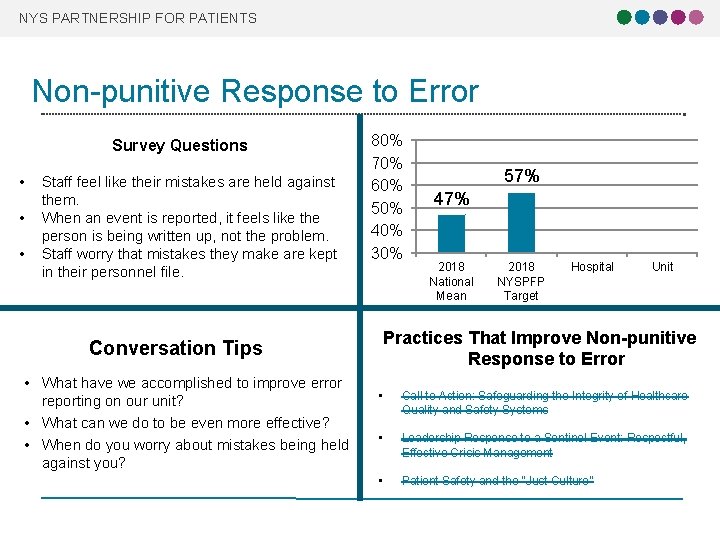
NYS PARTNERSHIP FOR PATIENTS Non-punitive Response to Error Survey Questions • • • Staff feel like their mistakes are held against them. When an event is reported, it feels like the person is being written up, not the problem. Staff worry that mistakes they make are kept in their personnel file. Conversation Tips • What have we accomplished to improve error reporting on our unit? • What can we do to be even more effective? • When do you worry about mistakes being held against you? 80% 70% 60% 50% 40% 30% 57% 47% 2018 National Mean 2018 NYSPFP Target Hospital Unit Practices That Improve Non-punitive Response to Error • Call to Action: Safeguarding the Integrity of Healthcare Quality and Safety Systems • Leadership Response to a Sentinel Event: Respectful, Effective Crisis Management • Patient Safety and the “Just Culture”
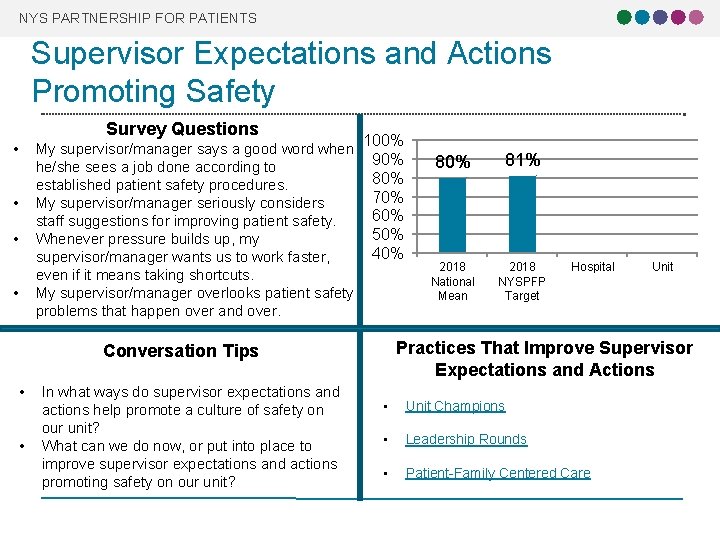
NYS PARTNERSHIP FOR PATIENTS Supervisor Expectations and Actions Promoting Safety Survey Questions My supervisor/manager says a good word when 100% 90% he/she sees a job done according to 80% established patient safety procedures. 70% My supervisor/manager seriously considers 60% staff suggestions for improving patient safety. 50% Whenever pressure builds up, my 40% supervisor/manager wants us to work faster, even if it means taking shortcuts. My supervisor/manager overlooks patient safety problems that happen over and over. • • • In what ways do supervisor expectations and actions help promote a culture of safety on our unit? What can we do now, or put into place to improve supervisor expectations and actions promoting safety on our unit? 81% 2018 National Mean 2018 NYSPFP Target Hospital Unit Practices That Improve Supervisor Expectations and Actions Conversation Tips • 80% • Unit Champions • Leadership Rounds • Patient-Family Centered Care
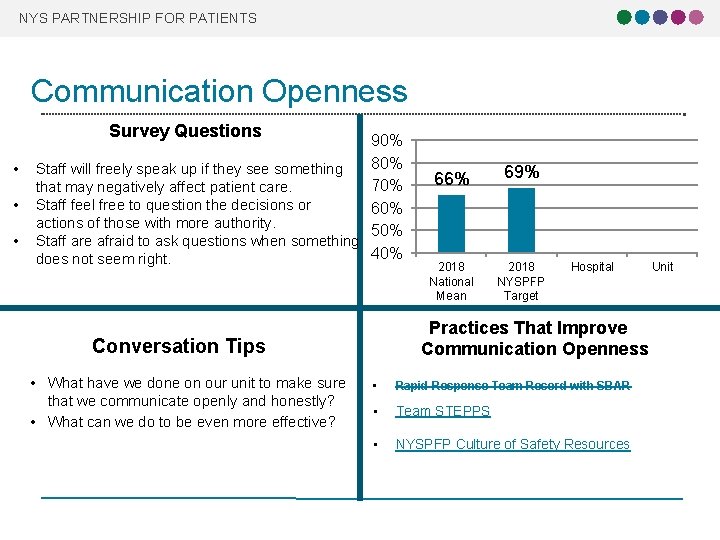
NYS PARTNERSHIP FOR PATIENTS Communication Openness Survey Questions • • • 90% 80% Staff will freely speak up if they see something 70% that may negatively affect patient care. Staff feel free to question the decisions or 60% actions of those with more authority. 50% Staff are afraid to ask questions when something 40% does not seem right. 2018 National Mean 69% 2018 NYSPFP Target Hospital Practices That Improve Communication Openness Conversation Tips • What have we done on our unit to make sure that we communicate openly and honestly? • What can we do to be even more effective? 66% • Rapid Response Team Record with SBAR • Team STEPPS • NYSPFP Culture of Safety Resources Unit
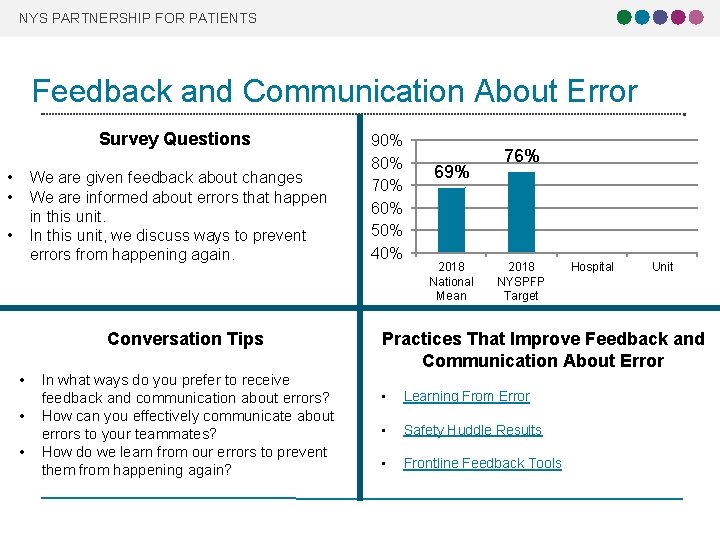
NYS PARTNERSHIP FOR PATIENTS Feedback and Communication About Error Survey Questions • • We are given feedback about changes We are informed about errors that happen in this unit. In this unit, we discuss ways to prevent errors from happening again. • Conversation Tips • • • In what ways do you prefer to receive feedback and communication about errors? How can you effectively communicate about errors to your teammates? How do we learn from our errors to prevent them from happening again? 90% 80% 70% 60% 50% 40% 69% 2018 National Mean 76% 2018 NYSPFP Target Hospital Unit Practices That Improve Feedback and Communication About Error • Learning From Error • Safety Huddle Results • Frontline Feedback Tools
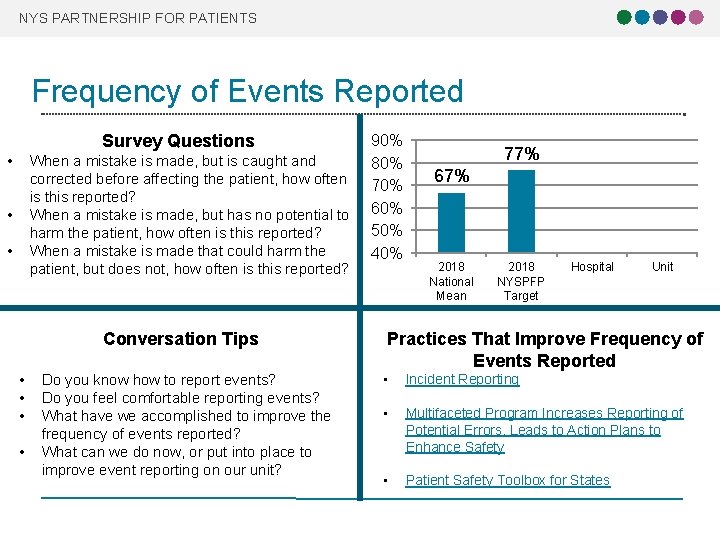
NYS PARTNERSHIP FOR PATIENTS Frequency of Events Reported Survey Questions • When a mistake is made, but is caught and corrected before affecting the patient, how often is this reported? When a mistake is made, but has no potential to harm the patient, how often is this reported? When a mistake is made that could harm the patient, but does not, how often is this reported? • • Conversation Tips • • Do you know how to report events? Do you feel comfortable reporting events? What have we accomplished to improve the frequency of events reported? What can we do now, or put into place to improve event reporting on our unit? 90% 80% 70% 60% 50% 40% 77% 67% 2018 National Mean 2018 NYSPFP Target Hospital Unit Practices That Improve Frequency of Events Reported • Incident Reporting • Multifaceted Program Increases Reporting of Potential Errors, Leads to Action Plans to Enhance Safety • Patient Safety Toolbox for States

NYS PARTNERSHIP FOR PATIENTS Hospital Management Support for Patient Safety Survey Questions • • • Hospital management provides a work climate that promotes patient safety. The actions of hospital management show that patient safety is a top priority. Hospital management seems interested in patient safety only after an adverse event happens. 90% 80% 70% 60% 50% 40% Conversation Tips • • When do you feel most supported by hospital management? What can we do now, or put into place to improve hospital management support for patient safety on our unit? 72% 2018 National Mean 77% 2018 NYSPFP Target Hospital Unit Practices That Improve Hospital Management Support for Patient Safety • Unit Champions • Leadership Rounds • Patient-Family Centered Care
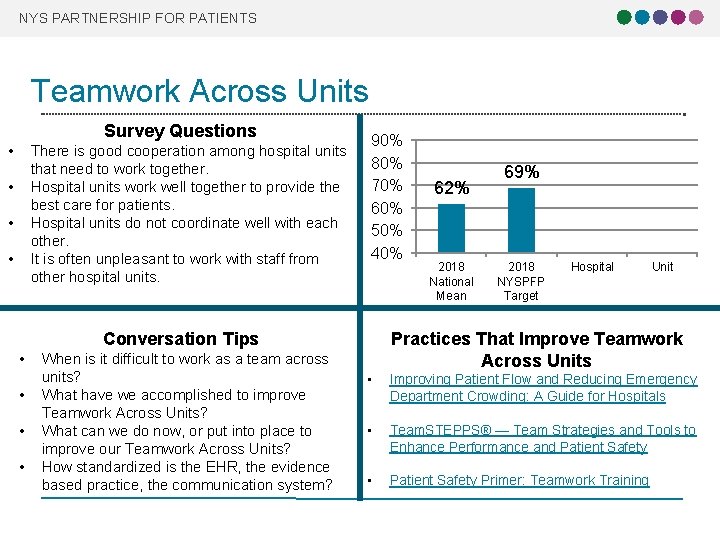
NYS PARTNERSHIP FOR PATIENTS Teamwork Across Units Survey Questions • There is good cooperation among hospital units that need to work together. Hospital units work well together to provide the best care for patients. Hospital units do not coordinate well with each other. It is often unpleasant to work with staff from other hospital units. • • • 90% 80% 70% 60% 50% 40% Conversation Tips • • When is it difficult to work as a team across units? What have we accomplished to improve Teamwork Across Units? What can we do now, or put into place to improve our Teamwork Across Units? How standardized is the EHR, the evidence based practice, the communication system? 62% 2018 National Mean 69% 2018 NYSPFP Target Hospital Unit Practices That Improve Teamwork Across Units • Improving Patient Flow and Reducing Emergency Department Crowding: A Guide for Hospitals • Team. STEPPS® — Team Strategies and Tools to Enhance Performance and Patient Safety • Patient Safety Primer: Teamwork Training
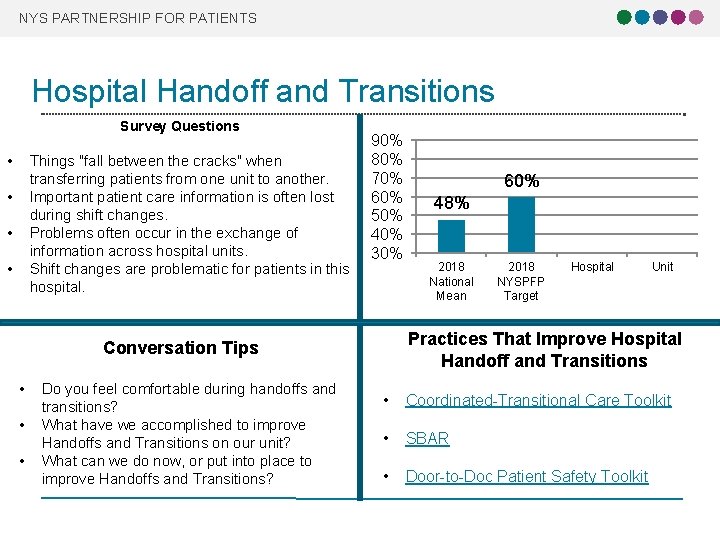
NYS PARTNERSHIP FOR PATIENTS Hospital Handoff and Transitions Survey Questions • Things "fall between the cracks" when transferring patients from one unit to another. Important patient care information is often lost during shift changes. Problems often occur in the exchange of information across hospital units. Shift changes are problematic for patients in this hospital. • • • 90% 80% 70% 60% 50% 40% 30% • • Do you feel comfortable during handoffs and transitions? What have we accomplished to improve Handoffs and Transitions on our unit? What can we do now, or put into place to improve Handoffs and Transitions? 48% 2018 National Mean 2018 NYSPFP Target Hospital Unit Practices That Improve Hospital Handoff and Transitions Conversation Tips • 60% • Coordinated-Transitional Care Toolkit • SBAR • Door-to-Doc Patient Safety Toolkit
Supplemental Items Debrief
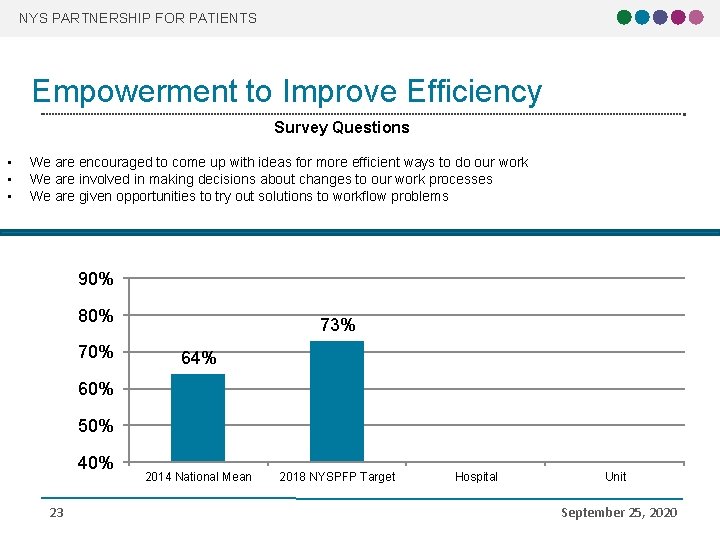
NYS PARTNERSHIP FOR PATIENTS Empowerment to Improve Efficiency Survey Questions • • • We are encouraged to come up with ideas for more efficient ways to do our work We are involved in making decisions about changes to our work processes We are given opportunities to try out solutions to workflow problems 90% 80% 73% 64% 60% 50% 40% 23 2014 National Mean 2018 NYSPFP Target Hospital Unit September 25, 2020
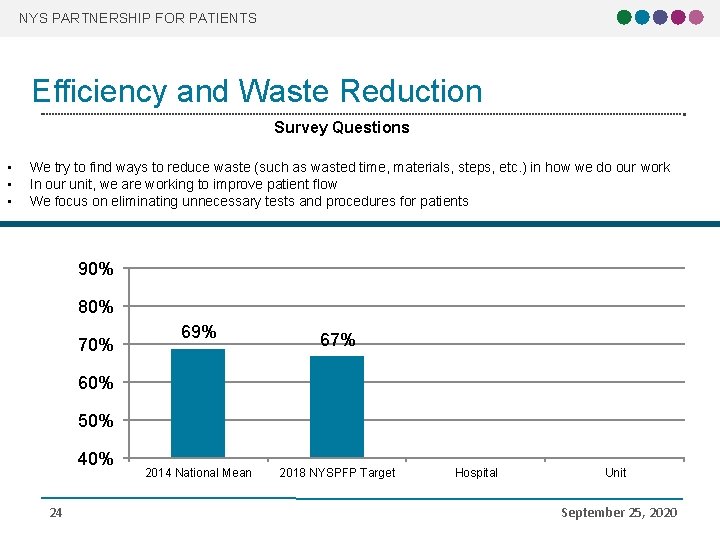
NYS PARTNERSHIP FOR PATIENTS Efficiency and Waste Reduction Survey Questions • • • We try to find ways to reduce waste (such as wasted time, materials, steps, etc. ) in how we do our work In our unit, we are working to improve patient flow We focus on eliminating unnecessary tests and procedures for patients 90% 80% 70% 69% 67% 60% 50% 40% 24 2014 National Mean 2018 NYSPFP Target Hospital Unit September 25, 2020
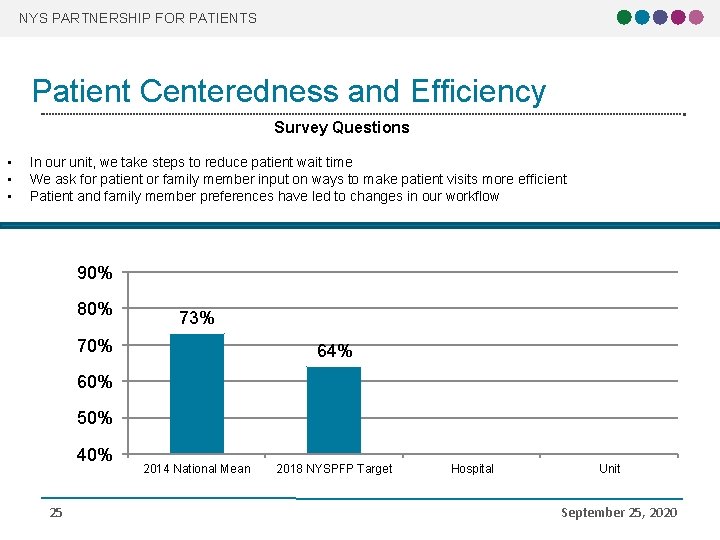
NYS PARTNERSHIP FOR PATIENTS Patient Centeredness and Efficiency Survey Questions • • • In our unit, we take steps to reduce patient wait time We ask for patient or family member input on ways to make patient visits more efficient Patient and family member preferences have led to changes in our workflow 90% 80% 73% 70% 64% 60% 50% 40% 25 2014 National Mean 2018 NYSPFP Target Hospital Unit September 25, 2020
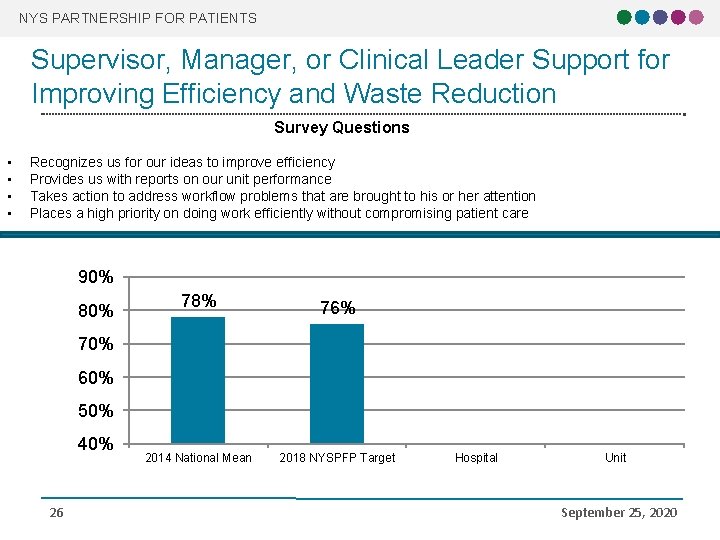
NYS PARTNERSHIP FOR PATIENTS Supervisor, Manager, or Clinical Leader Support for Improving Efficiency and Waste Reduction Survey Questions • • Recognizes us for our ideas to improve efficiency Provides us with reports on our unit performance Takes action to address workflow problems that are brought to his or her attention Places a high priority on doing work efficiently without compromising patient care 90% 80% 78% 76% 70% 60% 50% 40% 26 2014 National Mean 2018 NYSPFP Target Hospital Unit September 25, 2020
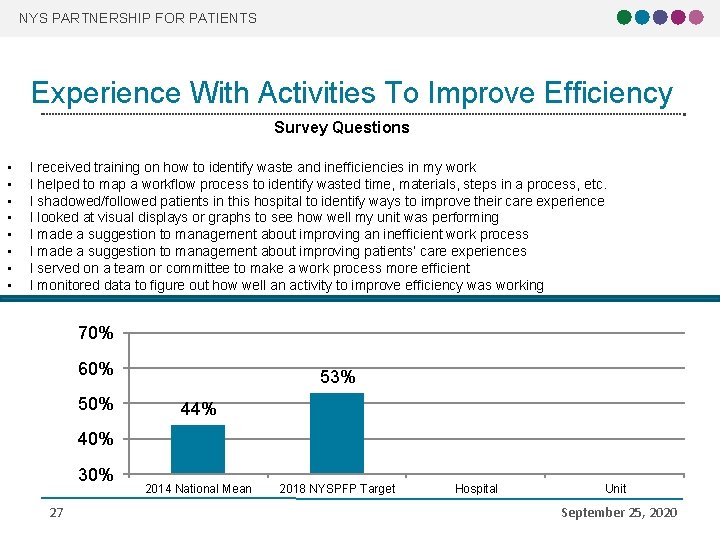
NYS PARTNERSHIP FOR PATIENTS Experience With Activities To Improve Efficiency Survey Questions • • I received training on how to identify waste and inefficiencies in my work I helped to map a workflow process to identify wasted time, materials, steps in a process, etc. I shadowed/followed patients in this hospital to identify ways to improve their care experience I looked at visual displays or graphs to see how well my unit was performing I made a suggestion to management about improving an inefficient work process I made a suggestion to management about improving patients’ care experiences I served on a team or committee to make a work process more efficient I monitored data to figure out how well an activity to improve efficiency was working 70% 60% 53% 44% 40% 30% 27 2014 National Mean 2018 NYSPFP Target Hospital Unit September 25, 2020
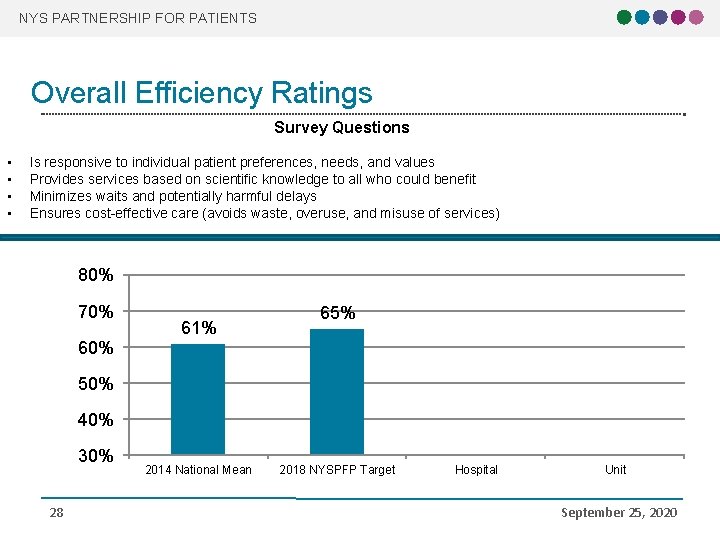
NYS PARTNERSHIP FOR PATIENTS Overall Efficiency Ratings Survey Questions • • Is responsive to individual patient preferences, needs, and values Provides services based on scientific knowledge to all who could benefit Minimizes waits and potentially harmful delays Ensures cost-effective care (avoids waste, overuse, and misuse of services) 80% 70% 61% 65% 50% 40% 30% 28 2014 National Mean 2018 NYSPFP Target Hospital Unit September 25, 2020
Action Planning 29 2 -16 -16
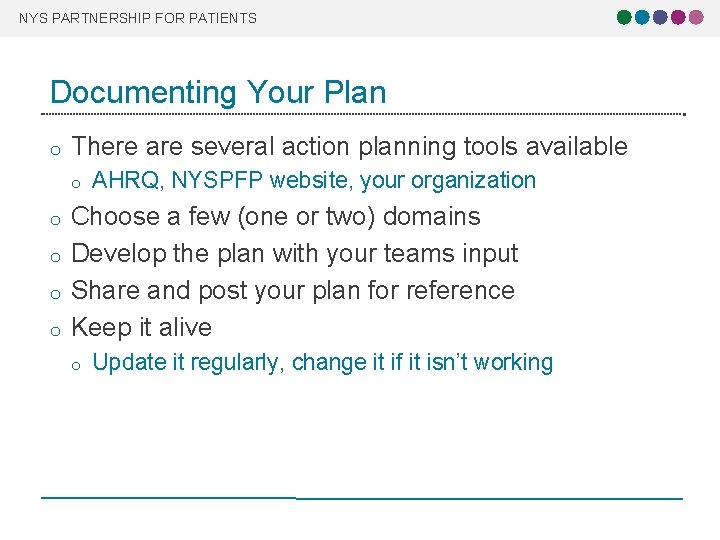
NYS PARTNERSHIP FOR PATIENTS Documenting Your Plan o There are several action planning tools available o o o AHRQ, NYSPFP website, your organization Choose a few (one or two) domains Develop the plan with your teams input Share and post your plan for reference Keep it alive o Update it regularly, change it if it isn’t working
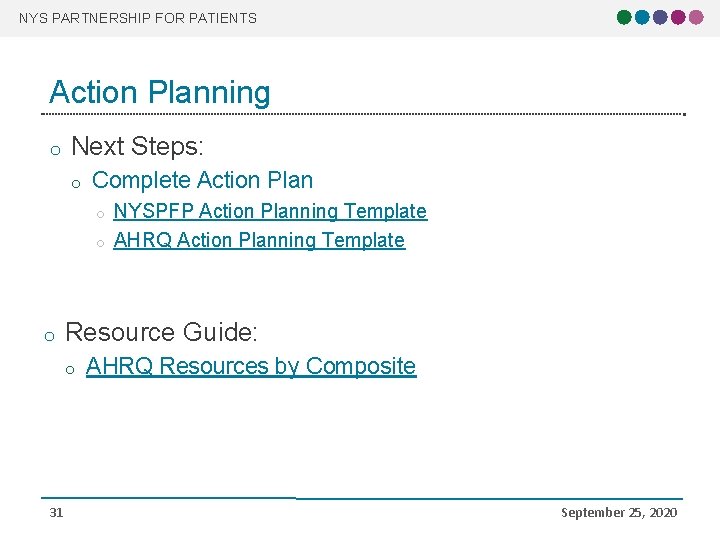
NYS PARTNERSHIP FOR PATIENTS Action Planning o Next Steps: o Complete Action Plan o o o Resource Guide: o 31 NYSPFP Action Planning Template AHRQ Resources by Composite September 25, 2020
![NYS PARTNERSHIP FOR PATIENTS Contact [PM Name], [Credentials] [Position Title] NYSPFP [email@domain. org] (555)555](http://slidetodoc.com/presentation_image/67b73539312dec7f872710d78bfe4087/image-32.jpg "NYS PARTNERSHIP FOR PATIENTS Contact [PM Name], [Credentials] [Position Title] NYSPFP [email@domain. org] (555)555")
NYS PARTNERSHIP FOR PATIENTS Contact [PM Name], [Credentials] [Position Title] NYSPFP [email@domain. org] (555)555 -5555 32 September 25, 2020
- Slides: 32