
NY Times Problem Solving Puzzle Source New York
![NY Times Problem Solving Puzzle Source: New York Times [https: //www. nytimes. com/interactive/2015/07/03/upshot/a-quick-puzzle-to-test-your-problem-solving. html]](https://slidetodoc.com/presentation_image_h2/5e850a9874b3d1dedb5281d32847440d/image-1.jpg "NY Times Problem Solving Puzzle Source: New York Times [https: //www. nytimes. com/interactive/2015/07/03/upshot/a-quick-puzzle-to-test-your-problem-solving. html]")
NY Times Problem Solving Puzzle Source: New York Times [https: //www. nytimes. com/interactive/2015/07/03/upshot/a-quick-puzzle-to-test-your-problem-solving. html] based on a paper by English psychologist Peter Cathcart Wason [On the failure to eliminate hypotheses in a conceptual task, Quarterly Journal of Experimental Psychology, Volume 12, 1960 - Issue 3]
Overview Game: NY Times Problem Solving Puzzle Length: 10 -15 minutes Type of Game: A problem-solving game that requires identifying patterns in numbers to test individual hypotheses. Target Audience: Anyone! Whether it be clinical and administrative staff, quality improvement team members, managers, or people with HIV. Learning Objectives • Learn about the reiterative learning process and the importance of creating a hypothesis. • Understand that we often learn more when our hypothesis fails. • Allow participants to problem solve. • Encourage critical thinking and articulation of a problem. Agenda 1. Setting the stage for the interactive exercise. 2. Playing the NY Times Problem Solving Puzzle. 3. Debrief and discussion on what lessons learned are and how they apply to HIV care. 4. Feedback and close. For more information | Check out the CQII Virtual Game Guide (2021) at www. CQII. org, including additional games, resources and the corresponding facilitator guide 2
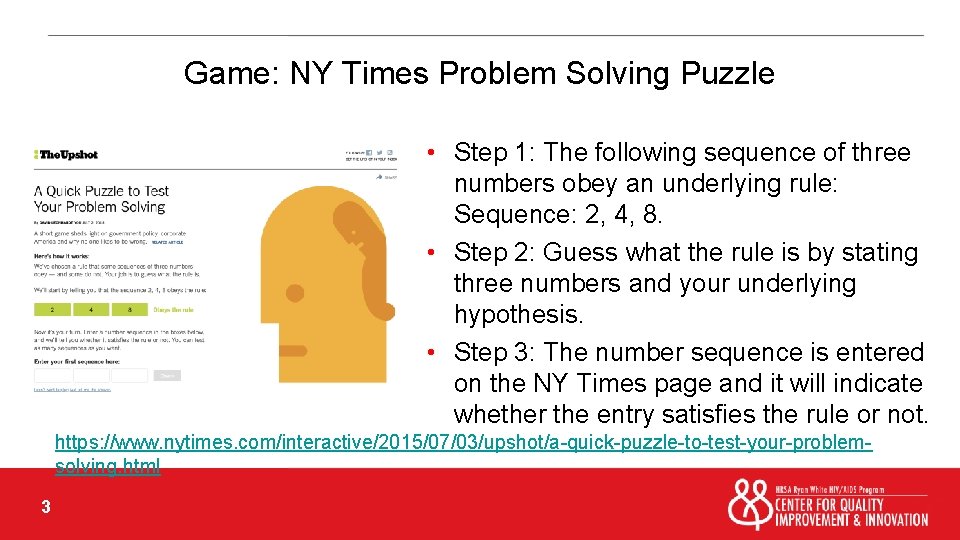
Game: NY Times Problem Solving Puzzle • Step 1: The following sequence of three numbers obey an underlying rule: Sequence: 2, 4, 8. • Step 2: Guess what the rule is by stating three numbers and your underlying hypothesis. • Step 3: The number sequence is entered on the NY Times page and it will indicate whether the entry satisfies the rule or not. https: //www. nytimes. com/interactive/2015/07/03/upshot/a-quick-puzzle-to-test-your-problemsolving. html 3

Answer: NY Times Problem Solving Puzzle 4 • The rule was simply: Each number must be larger than the one before it § 77% of people have guessed the answer without first hearing a single no. § 9% heard at least three nos even though there is no penalty or cost for being told no. • Confirmation bias - people more likely to believe information that fits their pre-existing beliefs, but they’re also more likely to go looking for such information. • We’re much more likely to think about positive situations than negative ones, about why something might go right than wrong and about questions to which the answer is yes, not no. • Often, people never even think about asking questions that would produce a negative answer when trying to solve a problem.
Debriefing • What did you observe? Any trends? Comments? Reflections? • What behavior helped the group to accomplish the task? What behavior hindered the group in completing the task? • How can the conclusions of this process/game be applied to your HIV care and/or HIV program? 5
Center for Quality Improvement & Innovation 212 -417 -4730 (phone) 212 -417 -4684 (fax) www. CQII. org Info@CQII. org This project is supported by the Health Resources and Services Administration (HRSA) of the U. S. Department of Health and Human Services (HHS) as part of an award totaling $1. 5 M. The contents are those of the author(s) and do not necessarily represent the official views of, nor an endorsement, by HRSA, HHS or the U. S. Government. 6
- Slides: 6