
NXT Labview with DCP Notes for System ID
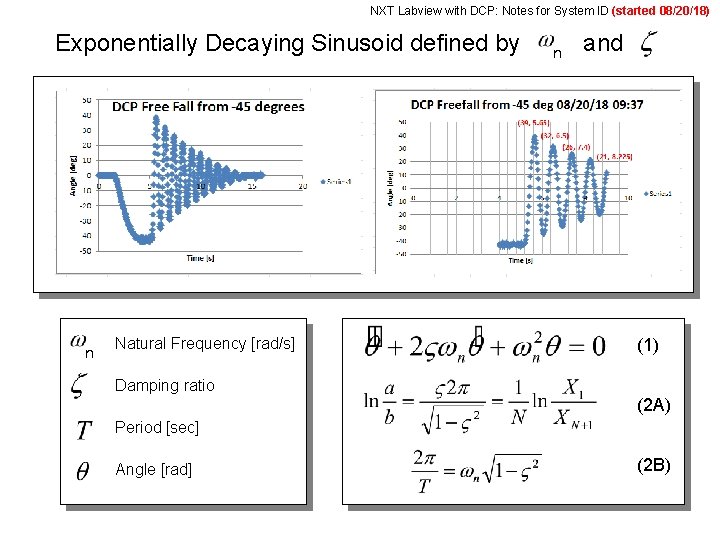
NXT Labview with DCP: Notes for System ID (started 08/20/18) Exponentially Decaying Sinusoid defined by n Natural Frequency [rad/s] n and (1) Damping ratio (2 A) Period [sec] Angle [rad] (2 B)
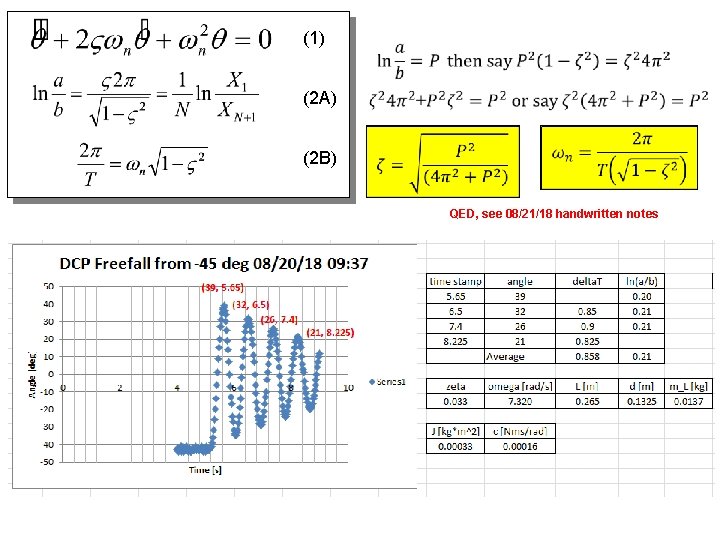
(1) (2 A) (2 B) QED, see 08/21/18 handwritten notes

Damped Compound Pendulum Equations of Motion (3) Linearized 2 nd order differential equation assumes small angles Bar length [m] Pivot to CG distance [m] Mass of pendulum [kg] Moment of Inertia Viscous damping coefficient
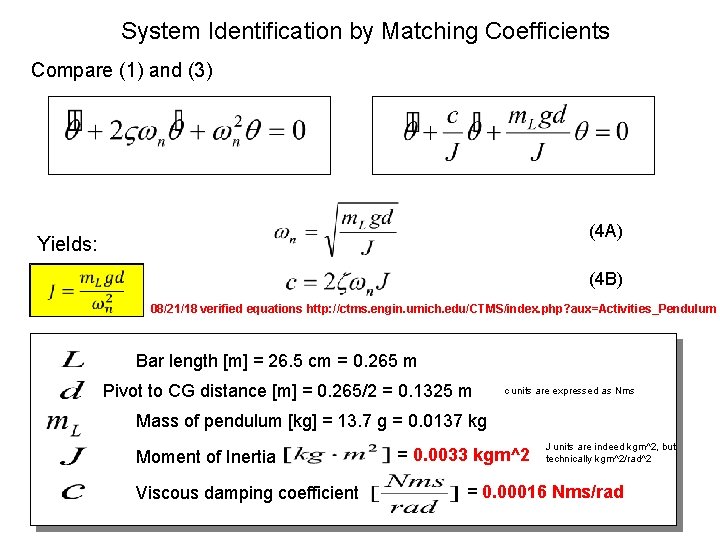
System Identification by Matching Coefficients Compare (1) and (3) (4 A) Yields: (4 B) 08/21/18 verified equations http: //ctms. engin. umich. edu/CTMS/index. php? aux=Activities_Pendulum Bar length [m] = 26. 5 cm = 0. 265 m Pivot to CG distance [m] = 0. 265/2 = 0. 1325 m c units are expressed as Nms Mass of pendulum [kg] = 13. 7 g = 0. 0137 kg Moment of Inertia Viscous damping coefficient = 0. 0033 kgm^2 J units are indeed kgm^2, but technically kgm^2/rad^2 = 0. 00016 Nms/rad
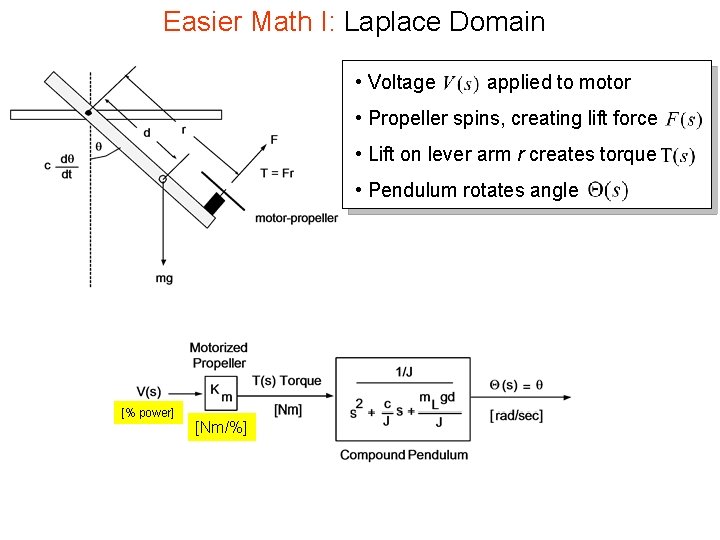
Easier Math I: Laplace Domain • Voltage applied to motor • Propeller spins, creating lift force • Lift on lever arm r creates torque • Pendulum rotates angle [% power] [Nm/%]
![Calculating Constants [% power] [Nm/%] Theory: can calculate lift force if have propeller pitch](http://slidetodoc.com/presentation_image/13308cd3e5e7004c3bed6150d8fefbcb/image-6.jpg "Calculating Constants [% power] [Nm/%] Theory: can calculate lift force if have propeller pitch")
Calculating Constants [% power] [Nm/%] Theory: can calculate lift force if have propeller pitch and radius dimensions, air density and motor angular velocity. Experimentally, apply known voltage V and pendulum will eventually reach steady-state. Recall At steady-state angular acceleration and velocity are zero. The torque at this known voltage is calculated by: And hence
![Open-Loop Transfer Function [% power] [Nm/%] OLTF: Given Nm/% m (3) kgm 2 kg](http://slidetodoc.com/presentation_image/13308cd3e5e7004c3bed6150d8fefbcb/image-7.jpg "Open-Loop Transfer Function [% power] [Nm/%] OLTF: Given Nm/% m (3) kgm 2 kg")
Open-Loop Transfer Function [% power] [Nm/%] OLTF: Given Nm/% m (3) kgm 2 kg Nms/rad Laplace domain OL Transfer function
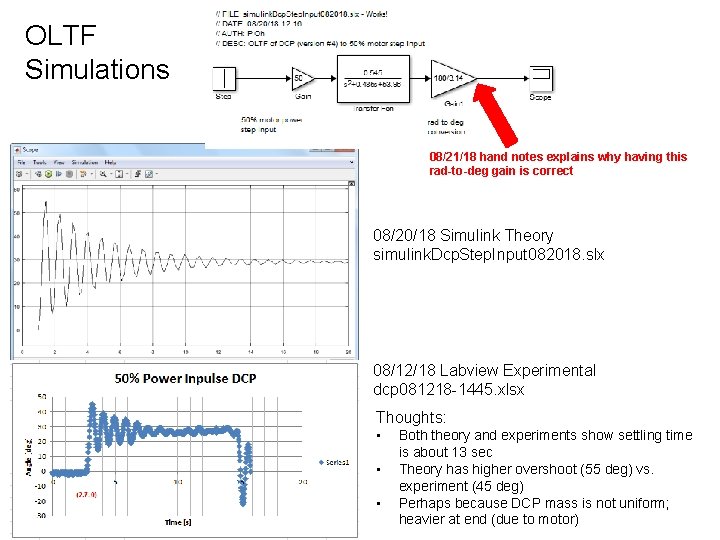
OLTF Simulations 08/21/18 hand notes explains why having this rad-to-deg gain is correct 08/20/18 Simulink Theory simulink. Dcp. Step. Input 082018. slx 08/12/18 Labview Experimental dcp 081218 -1445. xlsx Thoughts: • • • Both theory and experiments show settling time is about 13 sec Theory has higher overshoot (55 deg) vs. experiment (45 deg) Perhaps because DCP mass is not uniform; heavier at end (due to motor)
- Slides: 9