
NWP Verification and assimilation tests of the Nalli
- Slides: 16
NWP Verification and assimilation tests of the Nalli Infrared Sea Surface Emissivity model update (Nalli_V 2. 0). James Jung CIMSS / UW-Madison Jim. Jung@noaa. gov Nicholas Nalli and Ming Chen, NOAA/NESDIS/STAR Nick. Nalli@noaa. gov Jonathan Gero and Robert Knuteson, SSEC / UW-Madison
About the Authors • Nicholas Nalli and Ming Chen • Emissivity model design and CRTM development. • Jonathan Gero and Robert Knuteson • Observational verification from MARCUS Field Campaigns using M-AERI. • James Jung • NWP verification and observing system experiments. 14 September 2020 CIMSS Flash Talk Social 2
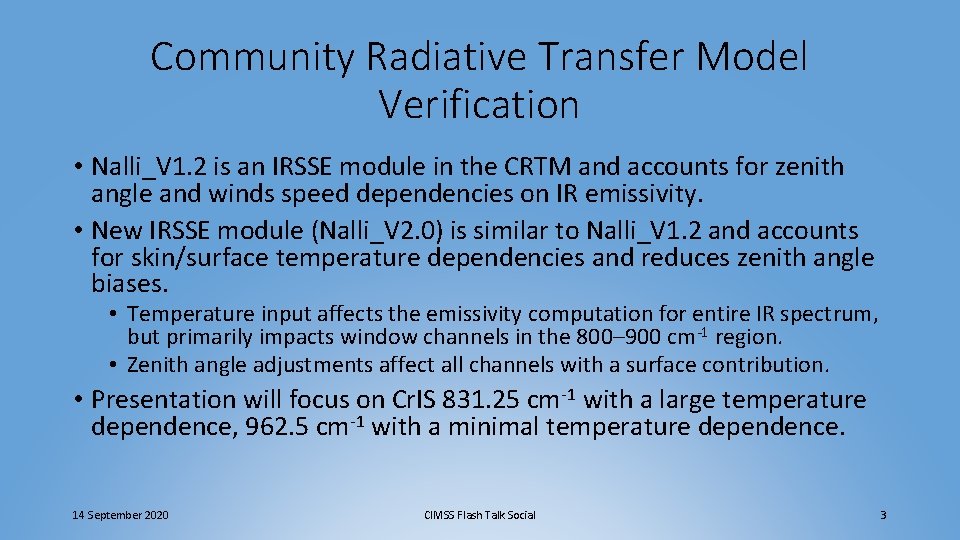
Community Radiative Transfer Model Verification • Nalli_V 1. 2 is an IRSSE module in the CRTM and accounts for zenith angle and winds speed dependencies on IR emissivity. • New IRSSE module (Nalli_V 2. 0) is similar to Nalli_V 1. 2 and accounts for skin/surface temperature dependencies and reduces zenith angle biases. • Temperature input affects the emissivity computation for entire IR spectrum, but primarily impacts window channels in the 800– 900 cm-1 region. • Zenith angle adjustments affect all channels with a surface contribution. • Presentation will focus on Cr. IS 831. 25 cm-1 with a large temperature dependence, 962. 5 cm-1 with a minimal temperature dependence. 14 September 2020 CIMSS Flash Talk Social 3
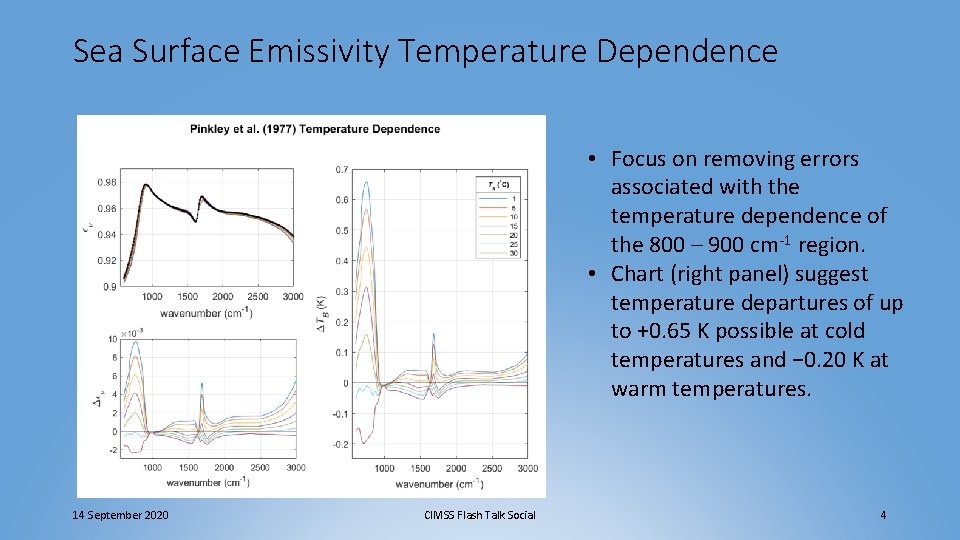
Sea Surface Emissivity Temperature Dependence • Focus on removing errors associated with the temperature dependence of the 800 – 900 cm-1 region. • Chart (right panel) suggest temperature departures of up to +0. 65 K possible at cold temperatures and − 0. 20 K at warm temperatures. 14 September 2020 CIMSS Flash Talk Social 4
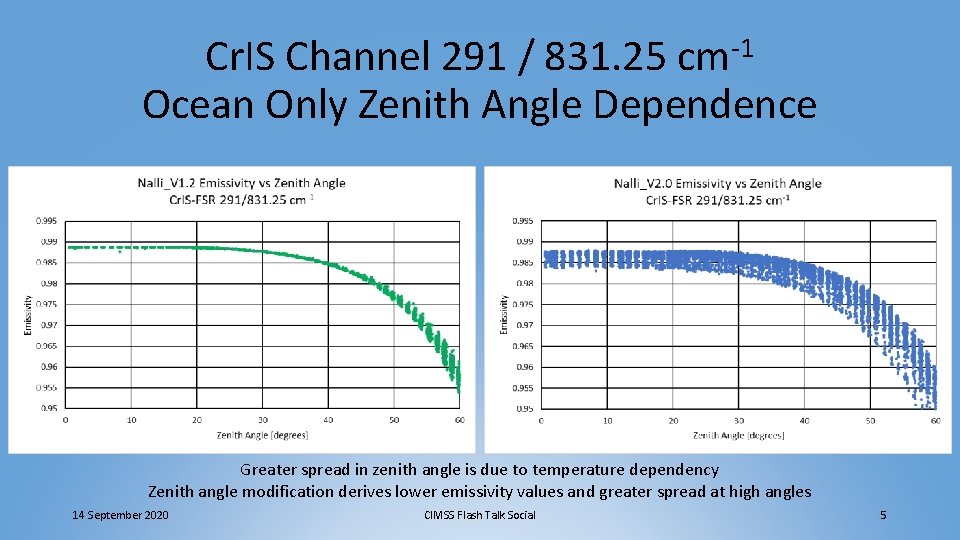
Cr. IS Channel 291 / 831. 25 cm-1 Ocean Only Zenith Angle Dependence Greater spread in zenith angle is due to temperature dependency Zenith angle modification derives lower emissivity values and greater spread at high angles 14 September 2020 CIMSS Flash Talk Social 5
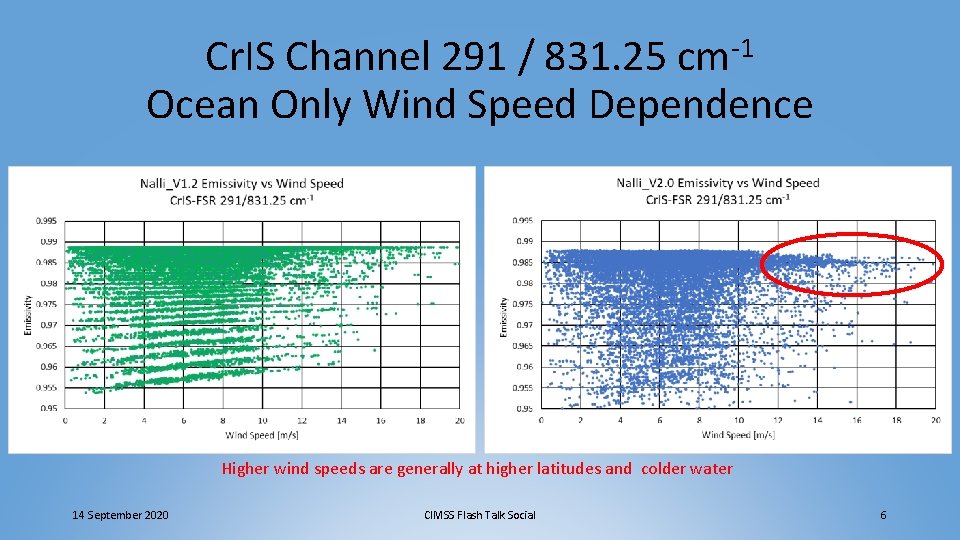
Cr. IS Channel 291 / 831. 25 cm-1 Ocean Only Wind Speed Dependence Higher wind speeds are generally at higher latitudes and colder water 14 September 2020 CIMSS Flash Talk Social 6
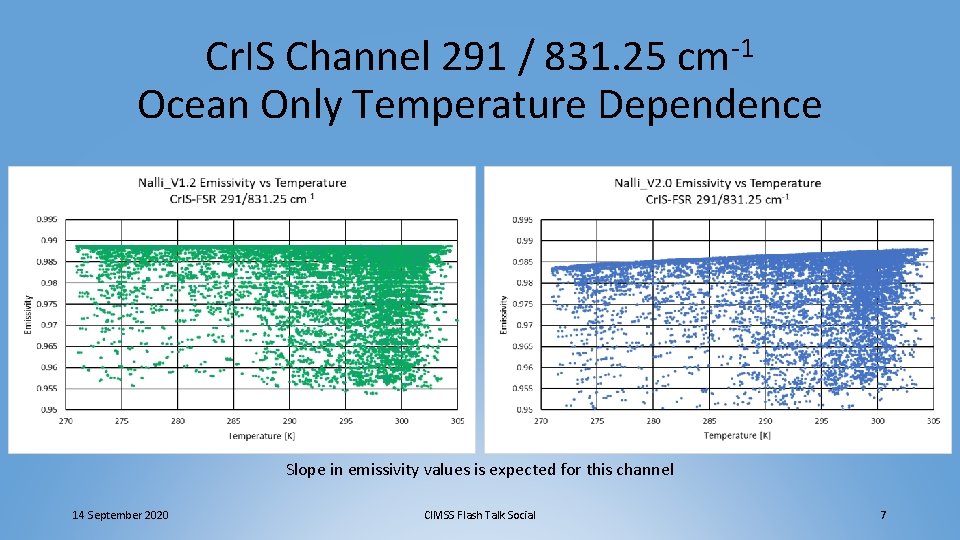
Cr. IS Channel 291 / 831. 25 cm-1 Ocean Only Temperature Dependence Slope in emissivity values is expected for this channel 14 September 2020 CIMSS Flash Talk Social 7
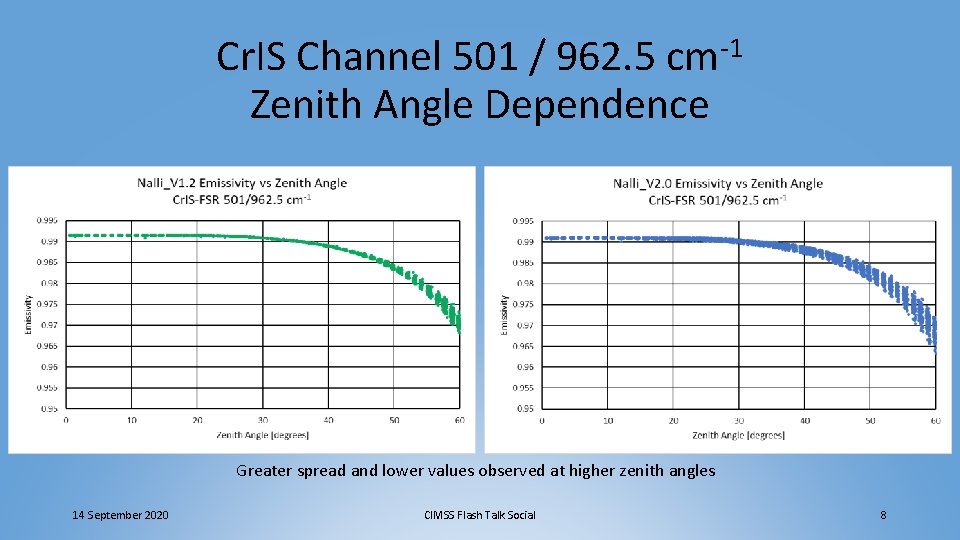
Cr. IS Channel 501 / 962. 5 cm-1 Zenith Angle Dependence Greater spread and lower values observed at higher zenith angles 14 September 2020 CIMSS Flash Talk Social 8
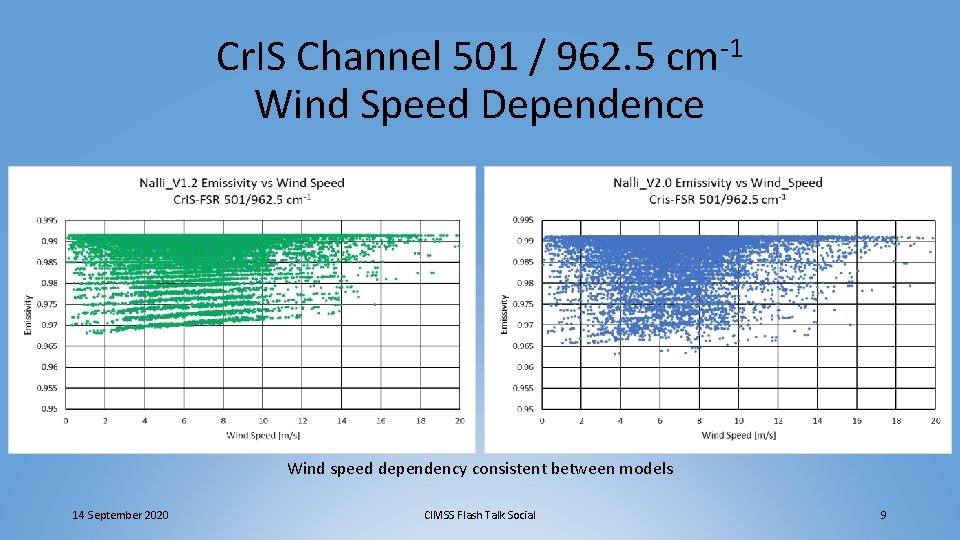
Cr. IS Channel 501 / 962. 5 cm-1 Wind Speed Dependence Wind speed dependency consistent between models 14 September 2020 CIMSS Flash Talk Social 9
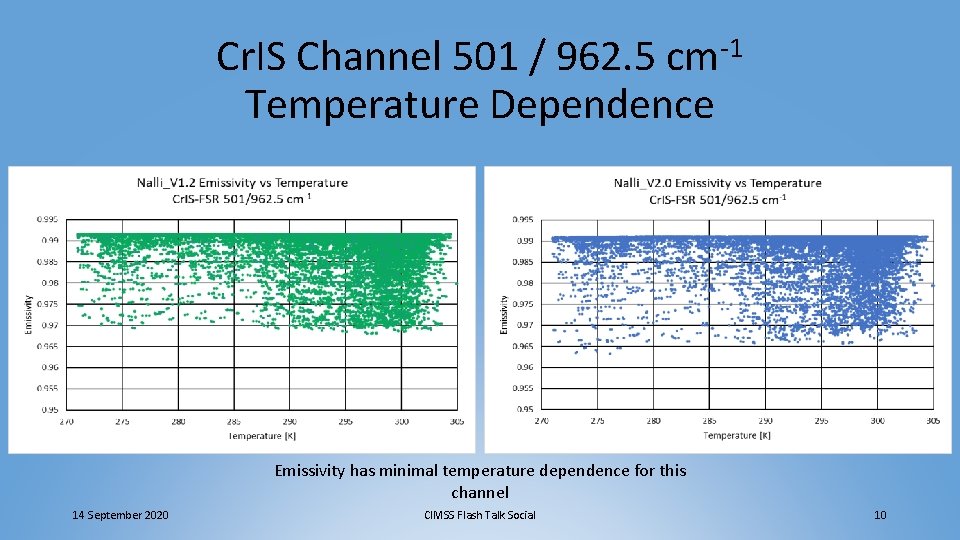
Cr. IS Channel 501 / 962. 5 cm-1 Temperature Dependence Emissivity has minimal temperature dependence for this channel 14 September 2020 CIMSS Flash Talk Social 10
Observing System Experiment • FV 3 GFS_V 15 • Low resolution with 20 ensemble members • Cr. IS 2211 and IASI 8461 • From NESDIS/STAR/ASSISTT and EMC/Obsproc Teams (all channels). • Verify/validate all affected channels. • Identical channels and weights used by operations. • Uses SST cycling. • CRTM-CSEM used for both simulations, bit flag switched to change IRSSE. • CSEM is new and planned for release with CRTM_3. 0 • • Control uses Nalli_V 1. 2 (Nalli_V 1. 2) Experiment uses Nalli_V 2. 0 (Nalli_V 2. 0) All infrared instruments (AIRS, IASI and Cr. IS) use the specified IRSSE. 10 day spinup, 29 day experiment (February 2020). 14 September 2020 CIMSS Flash Talk Social 11
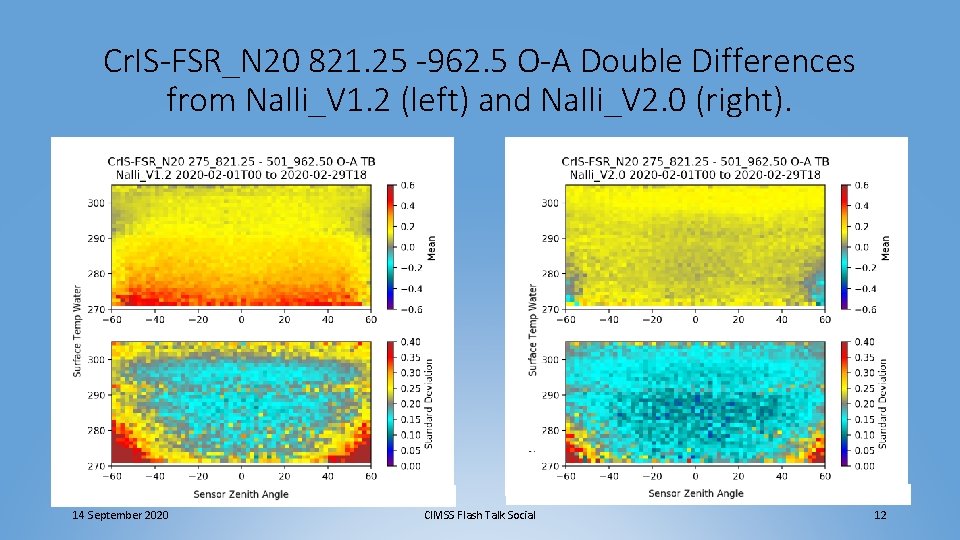
Cr. IS-FSR_N 20 821. 25 -962. 5 O-A Double Differences from Nalli_V 1. 2 (left) and Nalli_V 2. 0 (right). 14 September 2020 CIMSS Flash Talk Social 12
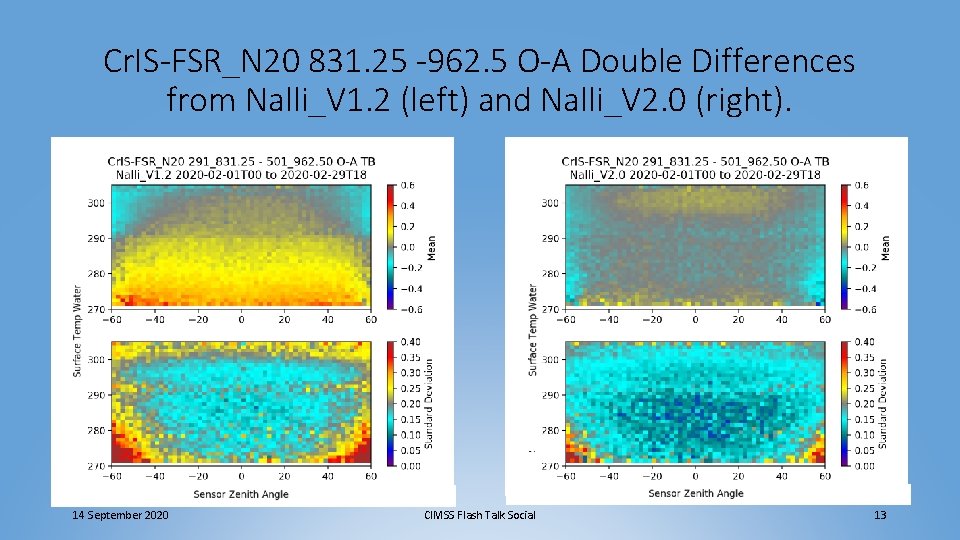
Cr. IS-FSR_N 20 831. 25 -962. 5 O-A Double Differences from Nalli_V 1. 2 (left) and Nalli_V 2. 0 (right). 14 September 2020 CIMSS Flash Talk Social 13
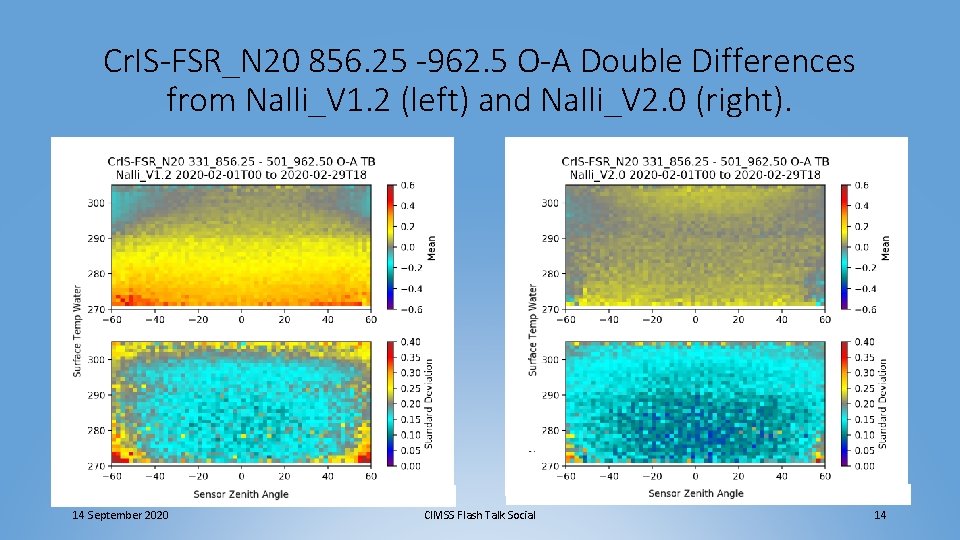
Cr. IS-FSR_N 20 856. 25 -962. 5 O-A Double Differences from Nalli_V 1. 2 (left) and Nalli_V 2. 0 (right). 14 September 2020 CIMSS Flash Talk Social 14
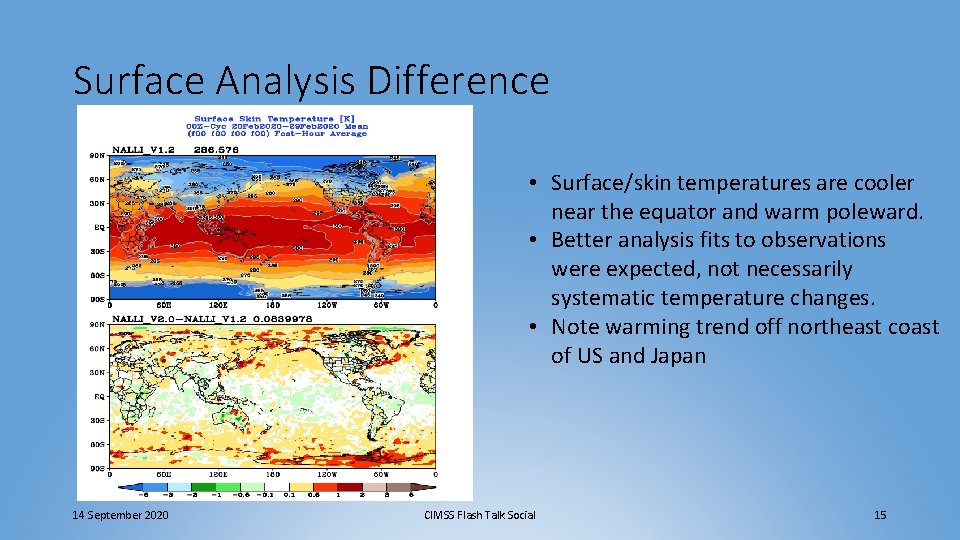
Surface Analysis Difference • Surface/skin temperatures are cooler near the equator and warm poleward. • Better analysis fits to observations were expected, not necessarily systematic temperature changes. • Note warming trend off northeast coast of US and Japan 14 September 2020 CIMSS Flash Talk Social 15
Summary • Cr. IS Channel O-A double differences are consistent with expectations for both Nalli_V 1. 2 and Nalli_V 2. 0. • • Nalli_V 2. 0 temperature biases are significantly reduced for 800 – 900 cm -1 Standard deviations between channels are consistently better. Similar results are observed for IASI. AIRS (281 subset) data do not contain enough channels to justify conclusions. • Model differences from assimilating data • Ocean surface temperatures are warmer at higher latitudes (i. e. , in colder waters) for Nalli_V 2. 0. • Temperature differences are subsequently observed throughout the atmosphere. • Anomaly correlations are generally neutral but on the positive side. • Encourage anyone using IR surface channels over ocean to try Nick’s new IRSSE model. 14 September 2020 CIMSS Flash Talk Social 16