
NVIS Communications Training Academy Basic HF Voice Operator
NVIS Communications Training Academy Basic HF Voice Operator 1 Introduction to HF-NVIS Radio Communications – Introductory Radio Principles – Why HF radio has become important – Basic HF Radio Technologies Copyright NVIS Communications, All rights reserved

Introductory Radio Principles – – Electromagnetic (EM) Waves EM Waves in the Radio Spectrum High Frequency (HF) in the radio spectrum Near Vertical Incident Skywave (NVIS) Copyright NVIS Communications, All rights reserved
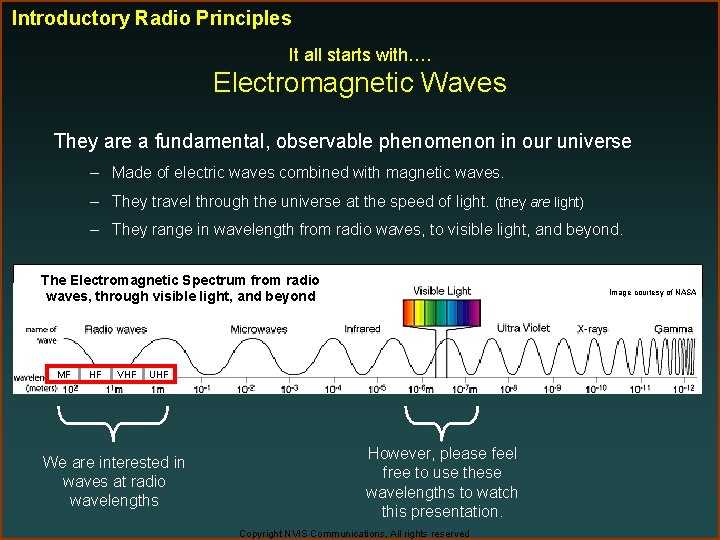
Introductory Radio Principles It all starts with…. Electromagnetic Waves They are a fundamental, observable phenomenon in our universe – Made of electric waves combined with magnetic waves. – They travel through the universe at the speed of light. (they are light) – They range in wavelength from radio waves, to visible light, and beyond. The Electromagnetic Spectrum from radio waves, through visible light, and beyond MF HF VHF Image courtesy of NASA UHF We are interested in waves at radio wavelengths However, please feel free to use these wavelengths to watch this presentation. Copyright NVIS Communications, All rights reserved
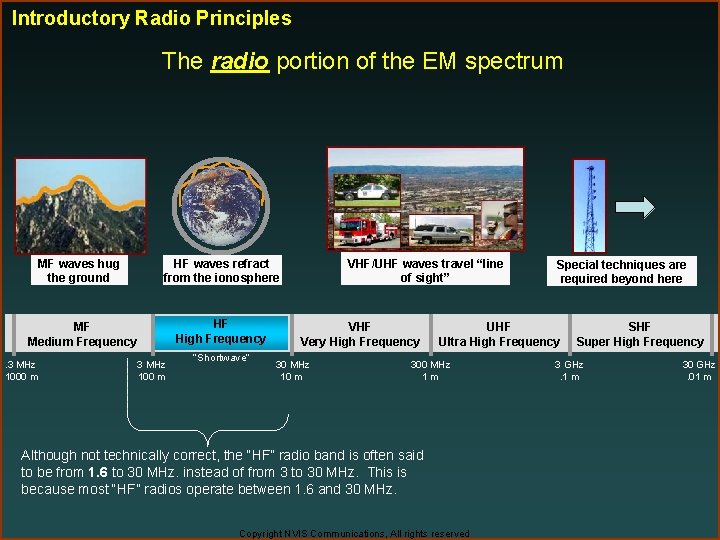
Introductory Radio Principles The radio portion of the EM spectrum MF waves hug the ground HF waves refract from the ionosphere MF Medium Frequency HF High Frequency . 3 MHz 1000 m 3 MHz 100 m “Shortwave” VHF/UHF waves travel “line of sight” VHF Very High Frequency 30 MHz 10 m Special techniques are required beyond here UHF Ultra High Frequency 300 MHz 1 m Although not technically correct, the “HF” radio band is often said to be from 1. 6 to 30 MHz. instead of from 3 to 30 MHz. This is because most “HF” radios operate between 1. 6 and 30 MHz. Copyright NVIS Communications, All rights reserved SHF Super High Frequency 3 GHz. 1 m 30 GHz. 01 m

Introductory Radio Principles About HF (High Frequency) Radio Waves HF radio waves refract and reflect from the ionosphere – If directed toward the horizon they may go long distances – Maybe one hop, maybe many – Maybe short hops, maybe long – Generally includes dead “skip” zones Copyright NVIS Communications, All rights reserved

Introductory Radio Principles About NVIS (Near Vertical Incident Skywave) • An HF signal directed straight up will rain back down from the sky over hundreds of miles An early NVIS mobile Instead of: Copyright NVIS Communications, All rights reserved
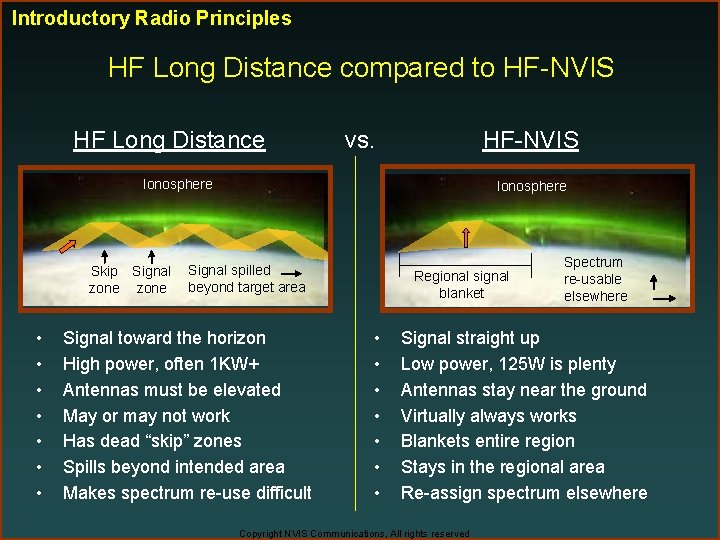
Introductory Radio Principles HF Long Distance compared to HF-NVIS HF Long Distance vs. HF-NVIS Ionosphere Skip Signal zone • • Ionosphere Signal spilled beyond target area Signal toward the horizon High power, often 1 KW+ Antennas must be elevated May or may not work Has dead “skip” zones Spills beyond intended area Makes spectrum re-use difficult Regional signal blanket • • Spectrum re-usable elsewhere Signal straight up Low power, 125 W is plenty Antennas stay near the ground Virtually always works Blankets entire region Stays in the regional area Re-assign spectrum elsewhere Copyright NVIS Communications, All rights reserved
HF Past and Present Why its use faded and has now come back Copyright NVIS Communications, All rights reserved
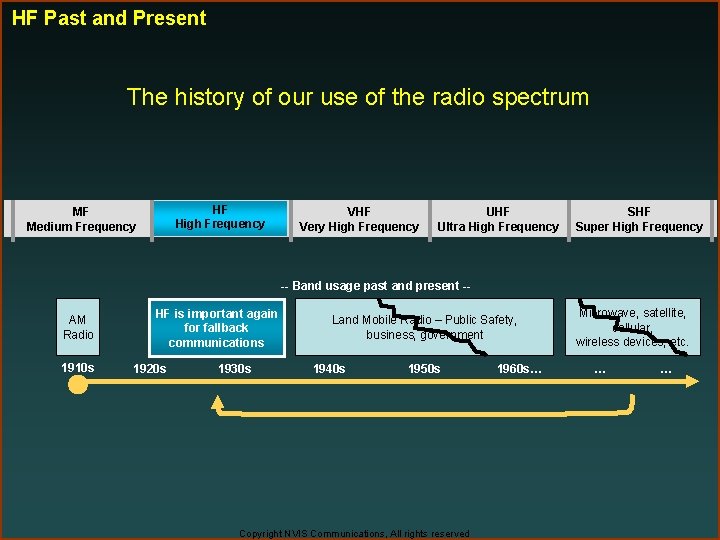
HF Past and Present The history of our use of the radio spectrum HF High Frequency MF Medium Frequency VHF Very High Frequency UHF Ultra High Frequency SHF Super High Frequency -- Band usage past and present -AM Radio 1910 s Amateur Radio, HF is important again Shortwave Broadcast, for fallback Military communications 1920 s 1930 s Land Mobile Radio – Public Safety, business, government 1940 s 1950 s Copyright NVIS Communications, All rights reserved 1960 s… Microwave, satellite, cellular, wireless devices, etc. … …
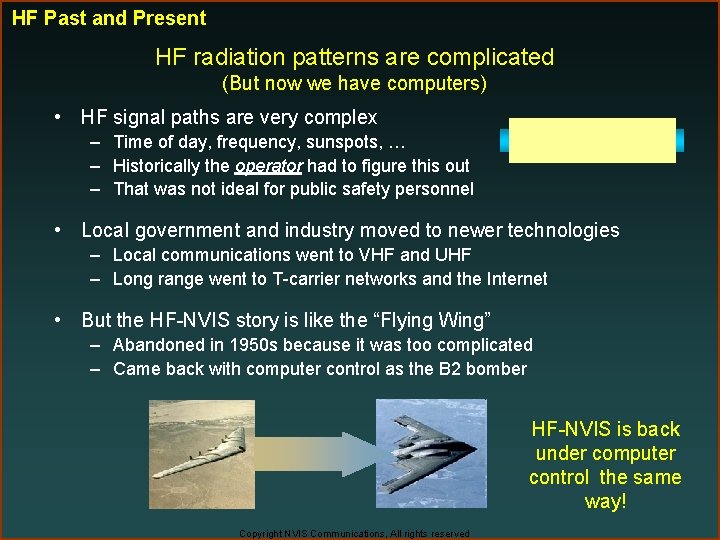
HF Past and Present HF radiation patterns are complicated (But now we have computers) • HF signal paths are very complex – Time of day, frequency, sunspots, … – Historically the operator had to figure this out – That was not ideal for public safety personnel HF frequency range • Local government and industry moved to newer technologies – Local communications went to VHF and UHF – Long range went to T-carrier networks and the Internet • But the HF-NVIS story is like the “Flying Wing” – Abandoned in 1950 s because it was too complicated – Came back with computer control as the B 2 bomber HF-NVIS is back under computer control the same way! Copyright NVIS Communications, All rights reserved
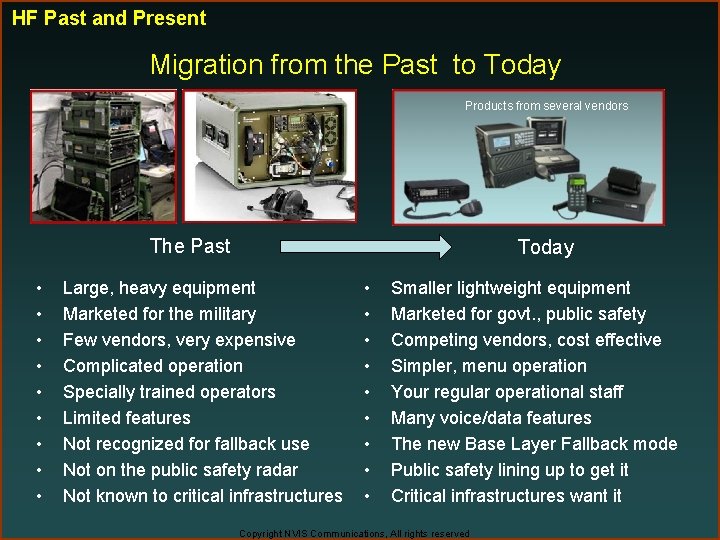
HF Past and Present Migration from the Past to Today Products from several vendors The Past • • • Today Large, heavy equipment Marketed for the military Few vendors, very expensive Complicated operation Specially trained operators Limited features Not recognized for fallback use Not on the public safety radar Not known to critical infrastructures • • • Smaller lightweight equipment Marketed for govt. , public safety Competing vendors, cost effective Simpler, menu operation Your regular operational staff Many voice/data features The new Base Layer Fallback mode Public safety lining up to get it Critical infrastructures want it Copyright NVIS Communications, All rights reserved
Why HF radio is critical for your future • It has always been important for military, shortwave broadcast, and amateur radio. • Now it is important again for government, public safety, and critical infrastructures Copyright NVIS Communications, All rights reserved
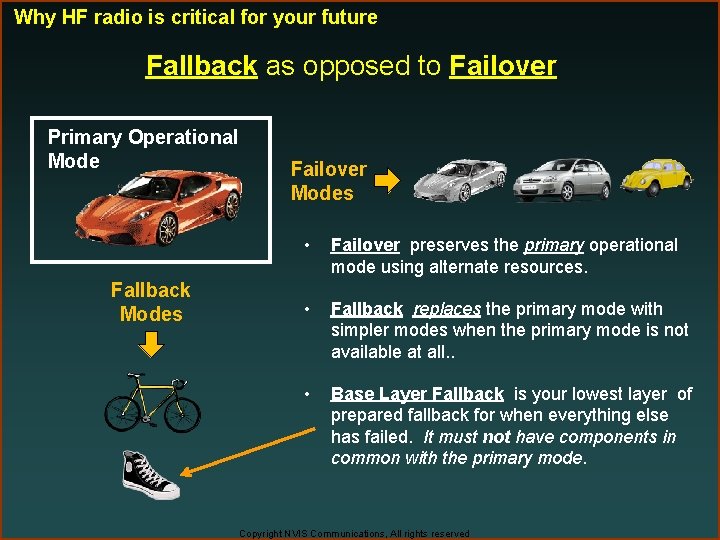
Why HF radio is critical for your future Fallback as opposed to Failover Primary Operational Mode Fallback Modes Failover Modes • Failover preserves the primary operational mode using alternate resources. • Fallback replaces the primary mode with simpler modes when the primary mode is not available at all. . • Base Layer Fallback is your lowest layer of prepared fallback for when everything else has failed. It must not have components in common with the primary mode. Copyright NVIS Communications, All rights reserved
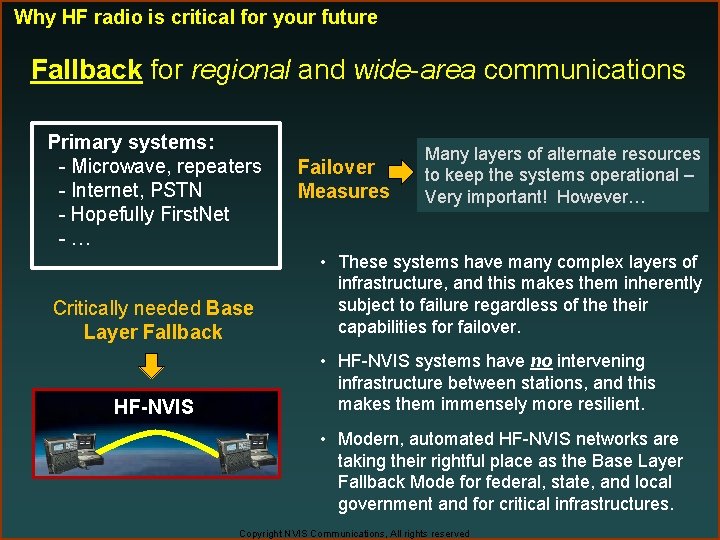
Why HF radio is critical for your future Fallback for regional and wide-area communications Primary systems: - Microwave, repeaters - Internet, PSTN - Hopefully First. Net -… Critically needed Base Layer Fallback HF-NVIS Failover Measures Many layers of alternate resources to keep the systems operational – Very important! However… • These systems have many complex layers of infrastructure, and this makes them inherently subject to failure regardless of their capabilities for failover. • HF-NVIS systems have no intervening infrastructure between stations, and this makes them immensely more resilient. • Modern, automated HF-NVIS networks are taking their rightful place as the Base Layer Fallback Mode for federal, state, and local government and for critical infrastructures. Copyright NVIS Communications, All rights reserved
Why HF radio is critical for your future Why HF-NVIIS has become our nation’s Base Layer Fallback Mode • We now realize how vulnerable our systems are – Lessons from 9 -11, Katrina, Sandy, and others • We now understand our need for Base Layer Fallback • Modern HF systems are available and easy to use – “Simple menu operation for calling – Automatic frequency selection and call connection – Cost effective for public safety use • Leading edge agencies are adopting it! – Federal, state, and local governments – Critical Infrastructure providers – HF-NVIS is becoming our National Fallback. Net Copyright NVIS Communications, All rights reserved
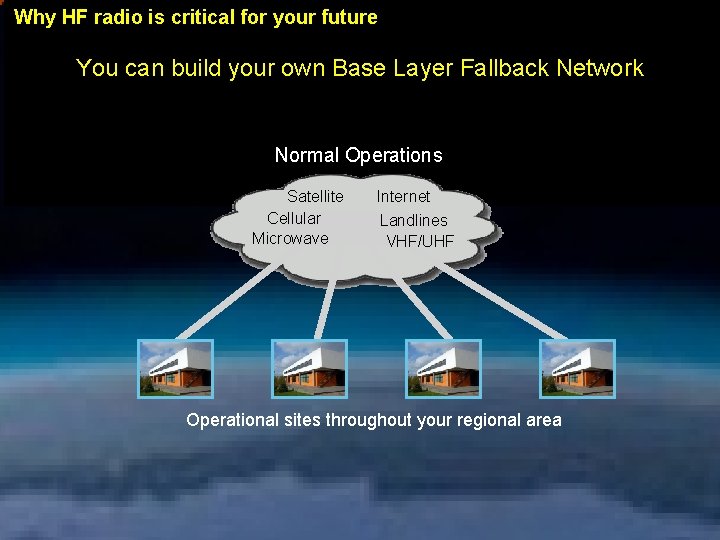
Why HF radio is critical for your future You can build your own Base Layer Fallback Network Normal Operations Internet Satellite Plan for these being Cellular Landlines Microwave compromised VHF/UHF Operational sites throughout your regional area Copyright NVIS Communications, All rights reserved
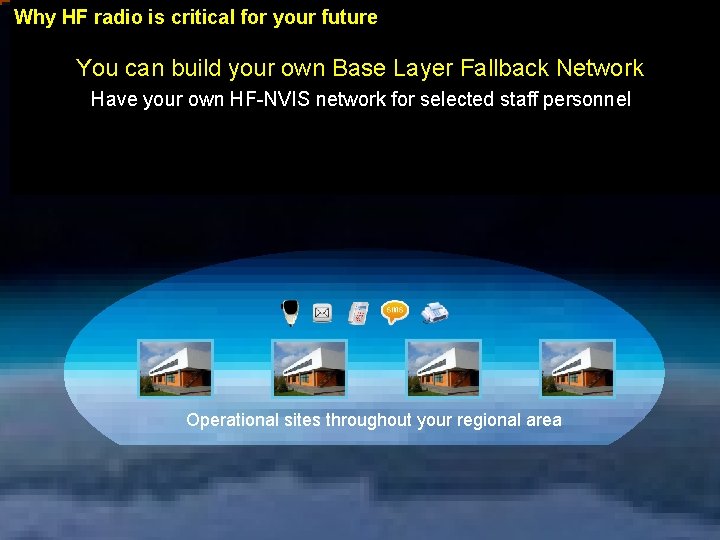
Why HF radio is critical for your future You can build your own Base Layer Fallback Network Have your own HF-NVIS network for selected staff personnel Operational sites throughout your regional area Copyright NVIS Communications, All rights reserved

Why HF radio is critical for your future You can build your own Base Layer Fallback Network Have your own HF-NVIS network for selected staff personnel Interface directly to disaster communications organizations Operational sites throughout your regional area (Licensing restrictions apply) Copyright NVIS Communications, All rights reserved
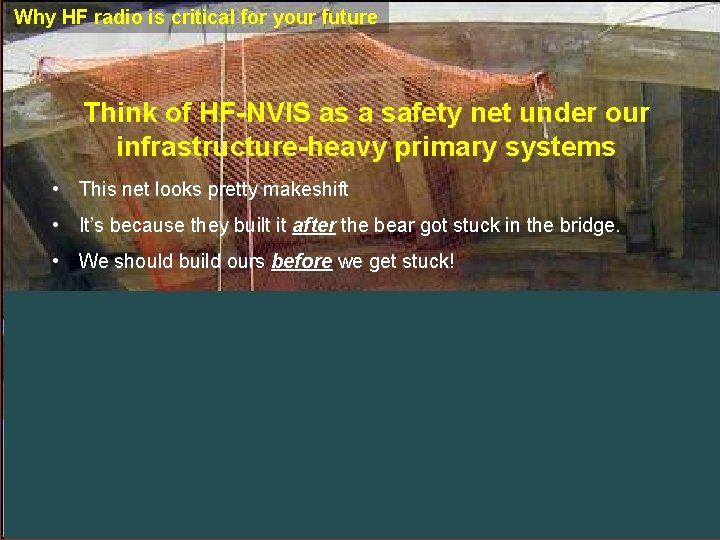
Why HF radio is critical for your future Think of HF-NVIS as a safety net under our infrastructure-heavy primary systems • This net looks pretty makeshift • It’s because they built it after the bear got stuck in the bridge. • We should build ours before we get stuck! From an article by BBC News Copyright NVIS Communications, All rights reserved
Basic HF Radio Technology – Single Sideband (SSB) Modulation – HF antennas and the “dipole” antenna – Automatic Link Establishment (ALE) Copyright NVIS Communications, All rights reserved
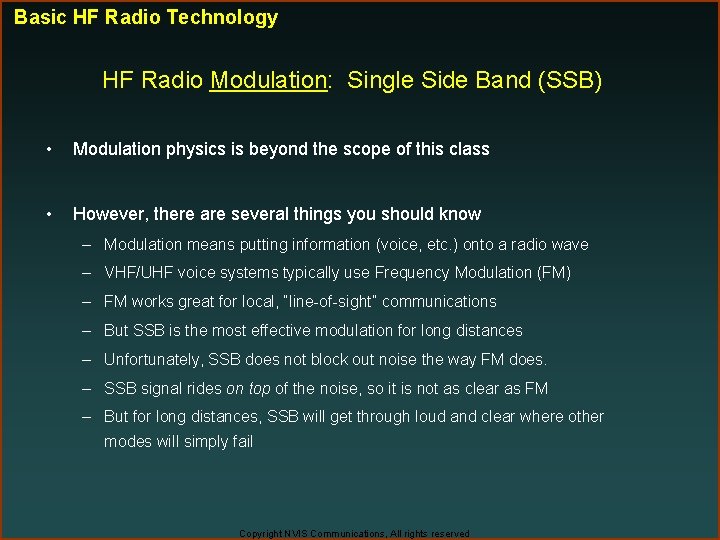
Basic HF Radio Technology HF Radio Modulation: Single Side Band (SSB) • Modulation physics is beyond the scope of this class • However, there are several things you should know – Modulation means putting information (voice, etc. ) onto a radio wave – VHF/UHF voice systems typically use Frequency Modulation (FM) – FM works great for local, “line-of-sight” communications – But SSB is the most effective modulation for long distances – Unfortunately, SSB does not block out noise the way FM does. – SSB signal rides on top of the noise, so it is not as clear as FM – But for long distances, SSB will get through loud and clear where other modes will simply fail Copyright NVIS Communications, All rights reserved
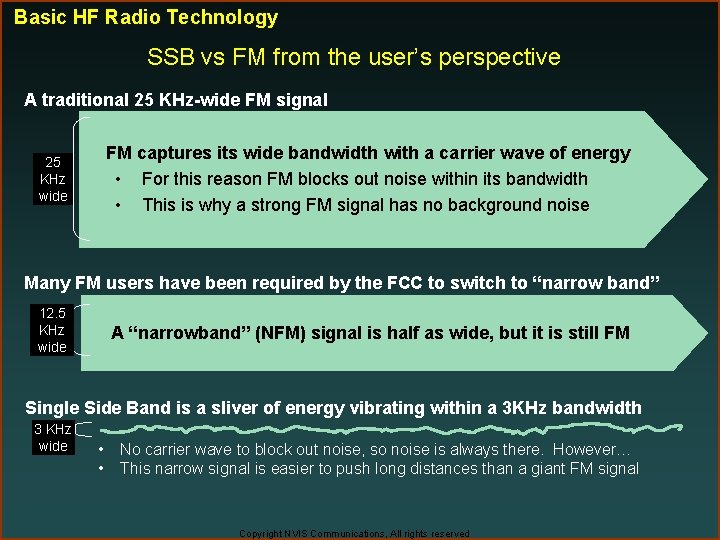
Basic HF Radio Technology SSB vs FM from the user’s perspective A traditional 25 KHz-wide FM signal FM captures its wide bandwidth with a carrier wave of energy • For this reason FM blocks out noise within its bandwidth • This is why a strong FM signal has no background noise 25 KHz wide Many FM users have been required by the FCC to switch to “narrow band” 12. 5 KHz wide A “narrowband” (NFM) signal is half as wide, but it is still FM Single Side Band is a sliver of energy vibrating within a 3 KHz bandwidth 3 KHz wide • • No carrier wave to block out noise, so noise is always there. However… This narrow signal is easier to push long distances than a giant FM signal Copyright NVIS Communications, All rights reserved
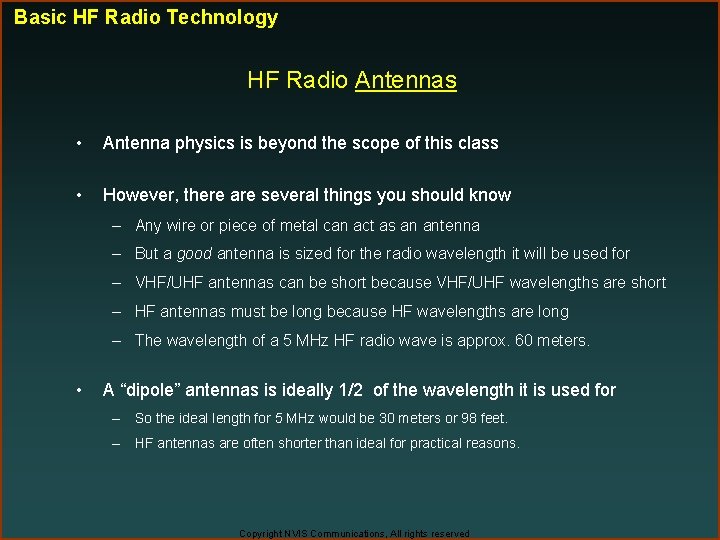
Basic HF Radio Technology HF Radio Antennas • Antenna physics is beyond the scope of this class • However, there are several things you should know – Any wire or piece of metal can act as an antenna – But a good antenna is sized for the radio wavelength it will be used for – VHF/UHF antennas can be short because VHF/UHF wavelengths are short – HF antennas must be long because HF wavelengths are long – The wavelength of a 5 MHz HF radio wave is approx. 60 meters. • A “dipole” antennas is ideally 1/2 of the wavelength it is used for – So the ideal length for 5 MHz would be 30 meters or 98 feet. – HF antennas are often shorter than ideal for practical reasons. Copyright NVIS Communications, All rights reserved

Basic HF Radio Technology The Classic Dipole Antenna Two radiating elements extending in opposite directions. Radiating element • • Radiating element Dipole Antenna Transmission line 1. The radio emits an alternating current at a some frequency. 2. This creates alternating currents in the antenna elements Radio Copyright NVIS Communications, All rights reserved • 3. This causes electromagnetic (radio) waves to radiate into space.
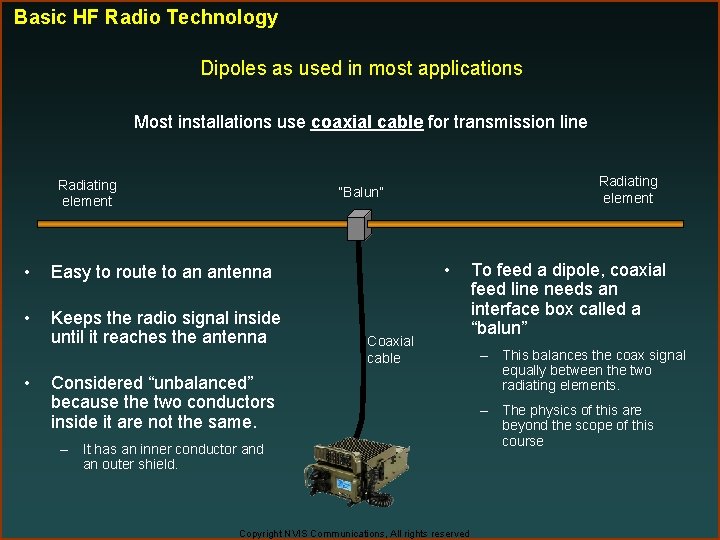
Basic HF Radio Technology Dipoles as used in most applications Most installations use coaxial cable for transmission line Radiating element • Easy to route to an antenna • Keeps the radio signal inside until it reaches the antenna • Radiating element “Balun” • Coaxial cable Considered “unbalanced” because the two conductors inside it are not the same. – It has an inner conductor and an outer shield. Copyright NVIS Communications, All rights reserved To feed a dipole, coaxial feed line needs an interface box called a “balun” – This balances the coax signal equally between the two radiating elements. – The physics of this are beyond the scope of this course
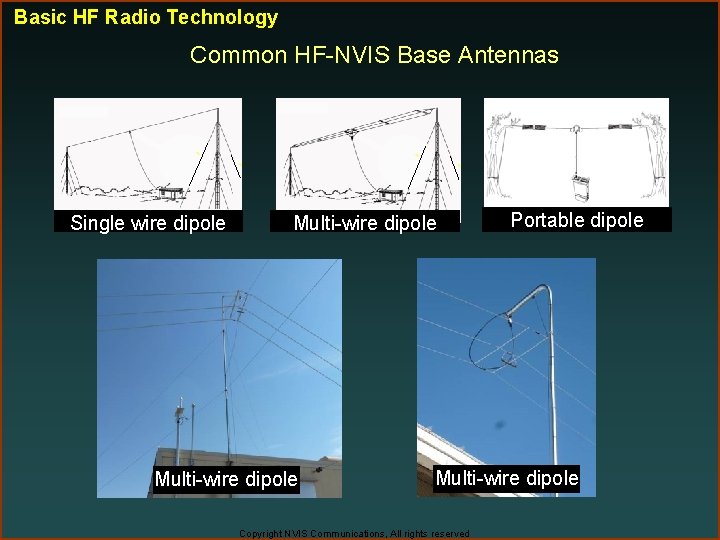
Basic HF Radio Technology Common HF-NVIS Base Antennas ` Single wire dipole ` ` ` Multi-wire dipole Portable dipole Multi-wire dipole Copyright NVIS Communications, All rights reserved

Basic HF Radio Technology Common HF-NVIS Mobile Antennas Base tuned whip folded over Luggage rack half loop Roof mounted half loop Copyright NVIS Communications, All rights reserved

Basic HF Radio Technology Automatic Link Establishment (ALE) F 1 • A peer-to-peer HF network F 2 – Completely inside your radios F 3 F 4 F 5 F 6 Site 1 Site 2 Site 3 Site 4 Copyright NVIS Communications, All rights reserved Your set of authorized HF frequencies that the radios scan
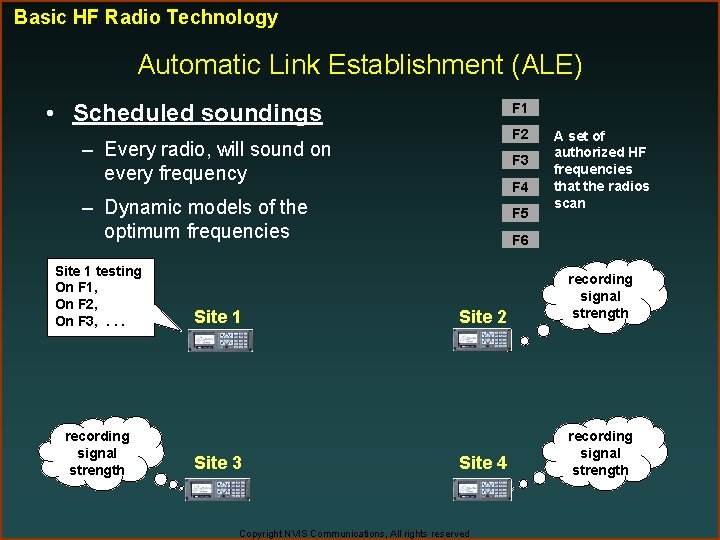
Basic HF Radio Technology Automatic Link Establishment (ALE) • Scheduled soundings F 1 F 2 – Every radio, will sound on every frequency F 3 F 4 – Dynamic models of the optimum frequencies Site 1 testing On F 1, On F 2, On F 3, . . . recording signal strength Site 1 Site 3 F 5 A set of authorized HF frequencies that the radios scan F 6 Site 2 recording signal strength Site 4 recording signal strength Copyright NVIS Communications, All rights reserved
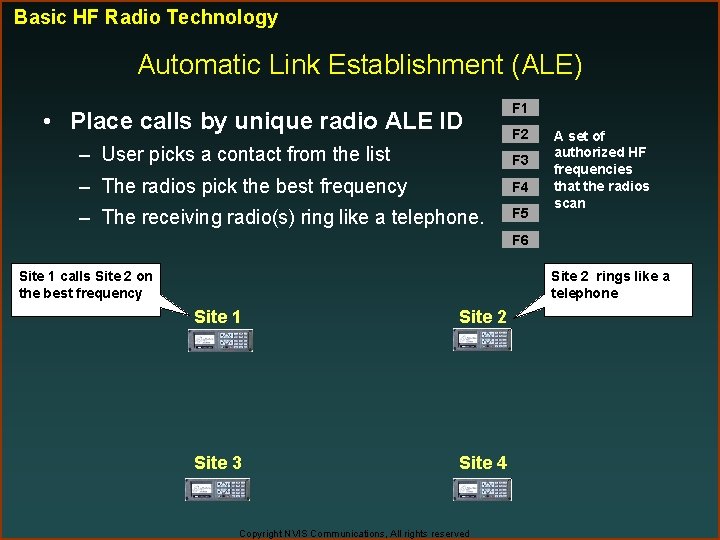
Basic HF Radio Technology Automatic Link Establishment (ALE) • Place calls by unique radio ALE ID F 1 F 2 – User picks a contact from the list F 3 – The radios pick the best frequency F 4 – The receiving radio(s) ring like a telephone. F 5 A set of authorized HF frequencies that the radios scan F 6 Site 1 calls Site 2 on the best frequency Site 2 rings like a telephone Site 1 Site 2 Site 3 Site 4 Copyright NVIS Communications, All rights reserved
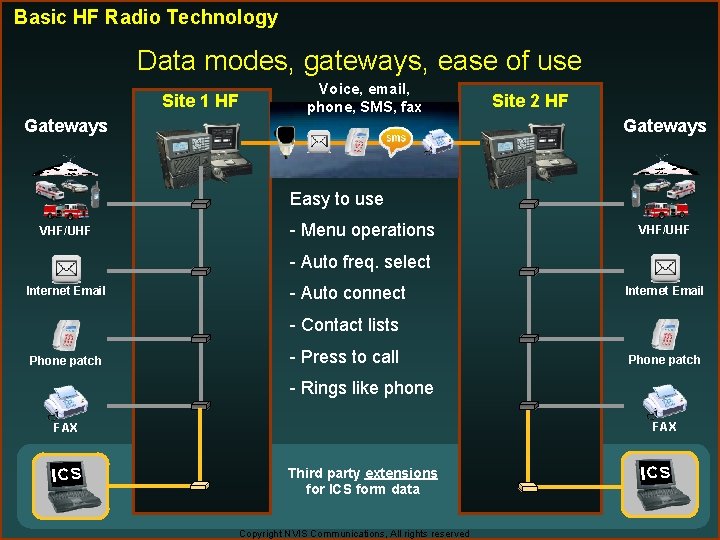
Basic HF Radio Technology Data modes, gateways, ease of use Site 1 HF Voice, email, phone, SMS, fax Gateways Site 2 HF Gateways Easy to use VHF/UHF - Menu operations VHF/UHF - Auto freq. select Internet Email - Auto connect Internet Email - Contact lists Phone patch - Press to call Phone patch - Rings like phone FAX ICS Third party extensions for ICS form data Copyright NVIS Communications, All rights reserved ICS

Basic use of your HF-NVIS system – – – An hypothetical HF-NVIS network Listening to SSB radio Talking on SSB radio Signal reporting on SSB radio Squelch systems on SSB radio Copyright NVIS Communications, All rights reserved

Basic use of your HF-NVIS system An example HF-NVIS network Las Vegas Los Angeles Mobile Reno San Jose Sacramento Copyright NVIS Communications, All rights reserved Direct voice/data among all stations for hundreds of miles
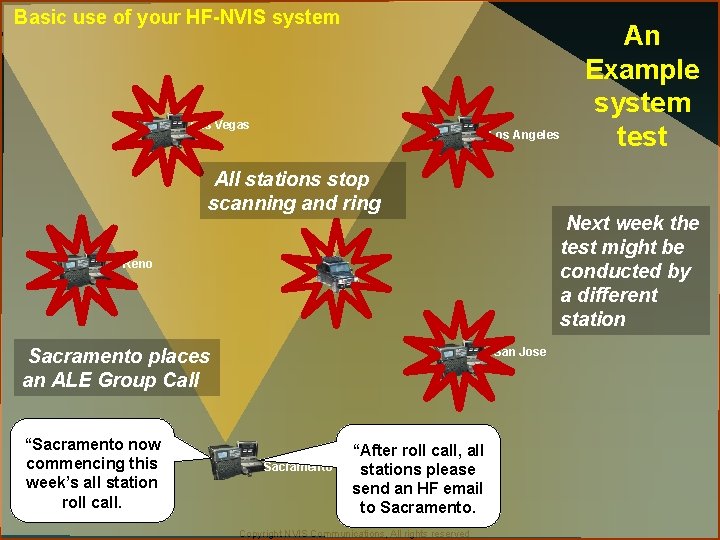
Basic use of your HF-NVIS system Las Vegas Los Angeles All stations stop scanning and ring Next week the test might be conducted by a different station Reno Sacramento places an ALE Group Call “Sacramento now commencing this week’s all station roll call. San Jose Sacramento “After roll call, all stations please send an HF email to Sacramento. Copyright NVIS Communications, All rights reserved An Example system test
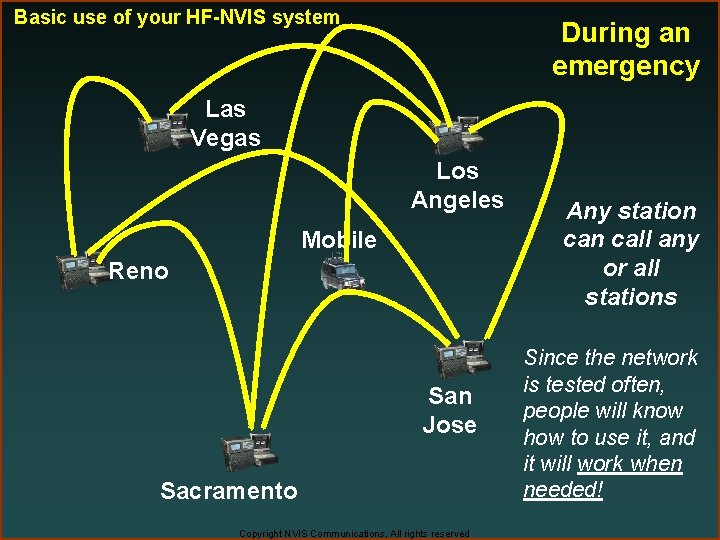
Basic use of your HF-NVIS system During an emergency Las Vegas Los Angeles Mobile Reno San Jose Sacramento Copyright NVIS Communications, All rights reserved Any station call any or all stations Since the network is tested often, people will know how to use it, and it will work when needed!
Basic use of your HF-NVIS system Listening to SSB Radio • You may be used to listening to FM radio – Government and public safety radio is typically FM – With FM the voice volume tends to stay the same whether it is a strong or weak signal – If it is a strong signal, then there is no noise along with the voice. (“full quieting”) – If it a weak signal, then the noise raises in volume until it drowns out the voice • SSB sound characteristics – opposite from FM – With SSB it is the noise volume (rather than the voice volume) that tends to stay the same – If it is a strong signal, then the voice raises in volume and becomes louder than the noise. – If it s weak signal, then the voice is lower in volume until it can no longer be heard through the noise Copyright NVIS Communications, All rights reserved
Basic use of your HF-NVIS system Talking on SSB Radio • Use plain language – No 10 -codes or other service-specific jargon – Remember, you may be talking with different services who do not know your jargon – If talking with other services, identify yourself with a full, descriptive identifier • Example: “ Los Angeles County Sheriff Mobile Command Unit 1” • Learn to say “over” before you release the mike – We do not do this on FM because users can hear when your carrier drops – But remember, there is no carrier for them to hear on SSB! – So tell them when you are releasing the mike by saying “over”. • Signing off – Say your identifier then say “out” or “clear” – On HF people usually use “out”, but either one describes your intention – Saying “over and out” may earn you some chuckles. Copyright NVIS Communications, All rights reserved
Basic use of your HF-NVIS system Signal reports on SSB radio • You may be used to giving signal report s on FM radio: – For example “loud and clear”, “weak and scratchy”, “breaking up”, or “unable to copy”. • But remember that SSB characteristics are different – There is always noise, so saying “scratchy” is not informative – Signal would not normally “break up”, but it may fade slowly in and out – Since the characteristics are different, signal reporting is different. • A commonly used range for SSB signal reporting : – – – “Loud and clear” “Good readable” “Fair readable” “Weak readable” “Unable to copy” (for a very loud signal) Copyright NVIS Communications, All rights reserved
Basic use of your HF-NVIS system Squelch systems for SSB – they • Squelch quiets the speaker when nothing is being received – FM squelch detects the FM carrier of a received signal – SSB has no carrier for a squelch system to detect – SSB squelch therefore has to detect other things • Types of SSB squelch – Audio squelch – tries to detect the characteristics of human voice – Signal squelch – detects increased signal level (could be just noise) – Selective Call – activates only when the digital ID for that station is received • Using SSB squelch – SSB audio squelch and signal squelch are not as effective as FM squelch – Most people leave their radios on Selective Call to receive only calls to them – After Selective Call activates, it typically leaves the speaker ON (no squelch) – Most people leave the speaker on during calls to hear everything – This is in contrast to FM, which squelches the speaker after each received signal Copyright NVIS Communications, All rights reserved
NVIS Communications Training Academy Congratulations on completing the classroom portion of: Basic HF Voice Operator 1 Introduction to HF-NVIS Radio Communications. Practical Exercises for this material will now follow. Subsequent courses will present more advanced topics. Copyright NVIS Communications, All rights reserved
- Slides: 40