
Nuts and Bolts of TLCO Danny Brazzale CRFS
Nuts and Bolts of TLCO Danny Brazzale, CRFS Senior Respiratory Scientist Austin Hospital, Institute for Breathing and Sleep, Melbourne, VIC CRFS Physiology Review Workshop, Perth 2016 Australian & New Zealand Society of Respiratory Science
Click to edit Master title style My Disclosure • • The presentation will NOT include discussion on Clickfollowing to edit Master text styles any commercial products or service and that there are NO • financial Second level interests or relationships with any of the • Commercial Third level Supporters of this years ASM • Fourth level • Fifth level ANZSRS, Perth 2016
Click to edit Master title style Outline • Background • Click Measurement technique to edit Master text styles • Second Calculations level • Third Equipment level QC Standardisation issues • Fourth level – Breath-hold time – Washout and sample collection • Fifth level • Factors affecting TLCO measurement – Submaximal inspiration • Alveolar volume as a measure of TLC ANZSRS, Perth 2016
Click to edit Master title style TLCO • Test used to assess the ability of the lungs to transfer gases from the alveoli to the blood. • Click to edit Master text styles • • First developed in 1914 by M Krogh. Second level • • Several methods available (re-breathing, intra-breath) Third level • • Single Fourthbreath level technique is the most common. Fifth level • • Forster and Roughton (1957) along with Ogilvie (1957) further developed the technique. • CO is used rather than oxygen because – Partial pressure of oxygen in the blood is not zero ANZSRS, Perth 2016
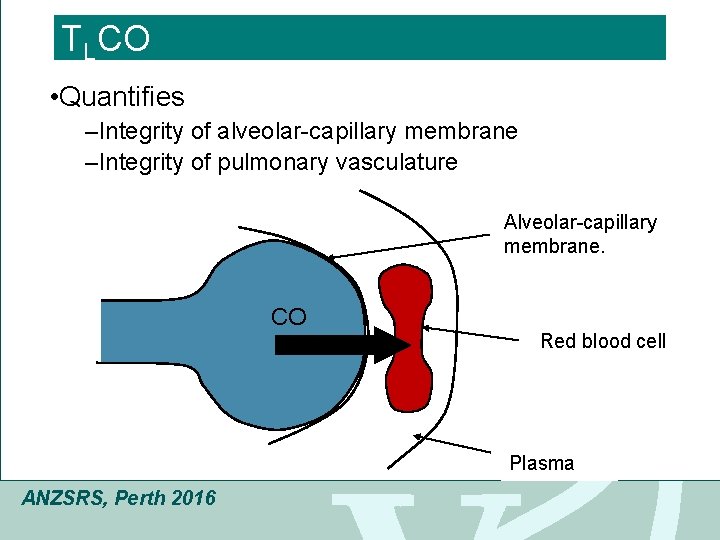
Click T COto edit Master title style L • Quantifies –Integrity of alveolar-capillary membrane • Click to edit Master text styles –Integrity of pulmonary vasculature • Second level • Third level Alveolar-capillary membrane. • Fourth level • Fifth level CO Red blood cell Plasma ANZSRS, Perth 2016
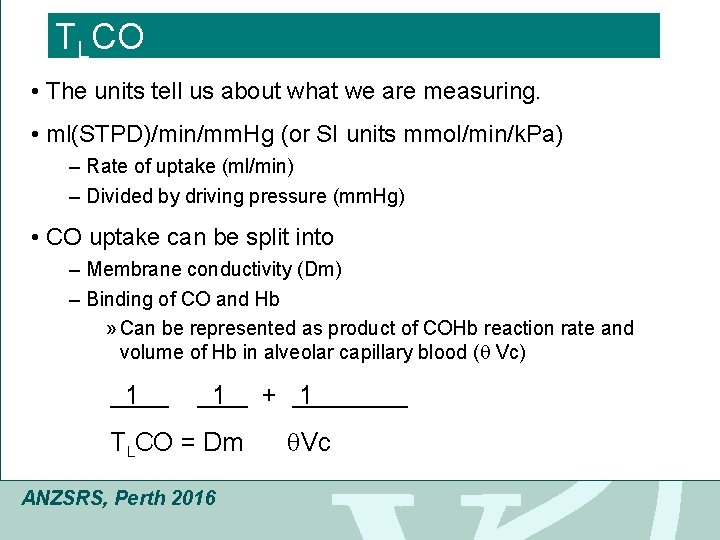
Click T COto edit Master title style L • The units tell us about what we are measuring. • ml(STPD)/min/mm. Hg (orstyles SI units mmol/min/k. Pa) • Click to edit Master text – Rate of uptake (ml/min) – Divided by driving pressure (mm. Hg) • Second level • Third level • CO uptake can be split into • Fourth level – Membrane conductivity (Dm) • –Fifth levelof CO and Hb Binding » Can be represented as product of COHb reaction rate and volume of Hb in alveolar capillary blood ( Vc) 1 1 TLCO = Dm ANZSRS, Perth 2016 + 1 Vc
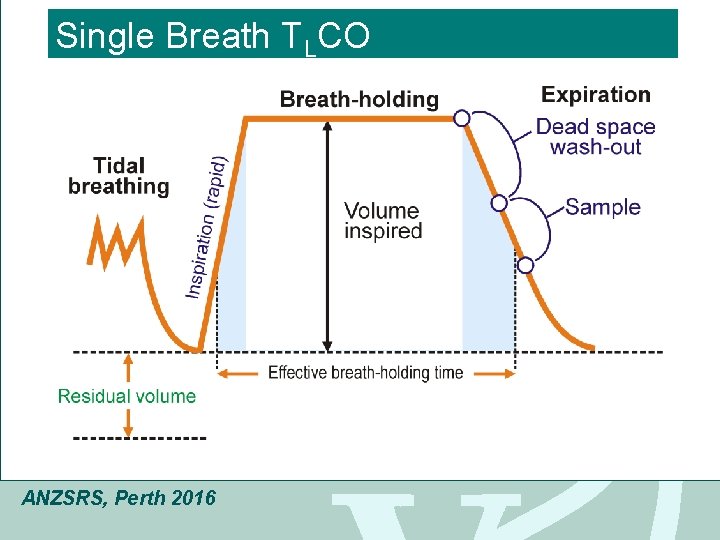
Click to Breath edit Master title style Single T CO L • Click to edit Master text styles • Second level • Third level • Fourth level • Fifth level ANZSRS, Perth 2016
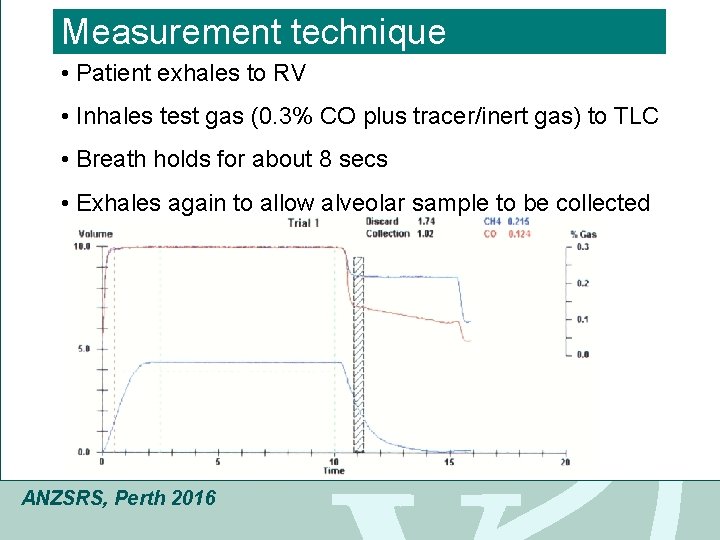
Click to edit Master title style Measurement technique • Patient exhales to RV • Inhales test gas (0. 3% CO plus tracer/inert gas) to TLC • Click to edit Master text styles • Breath holds for about 8 secs • Second level • Exhales again to allow alveolar sample to be collected • Third level • Fourth level • Fifth level ANZSRS, Perth 2016
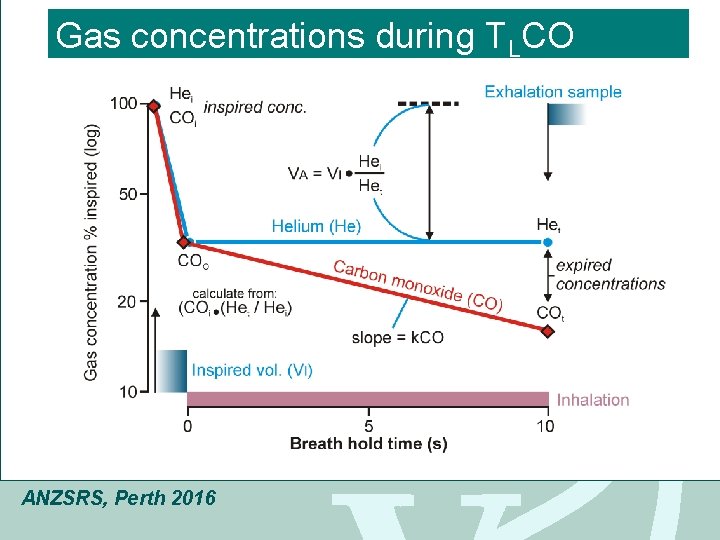
Click to edit Master title style Gas concentrations during • Click to edit Master text styles • Second level • Third level • Fourth level • Fifth level ANZSRS, Perth 2016 TLCO
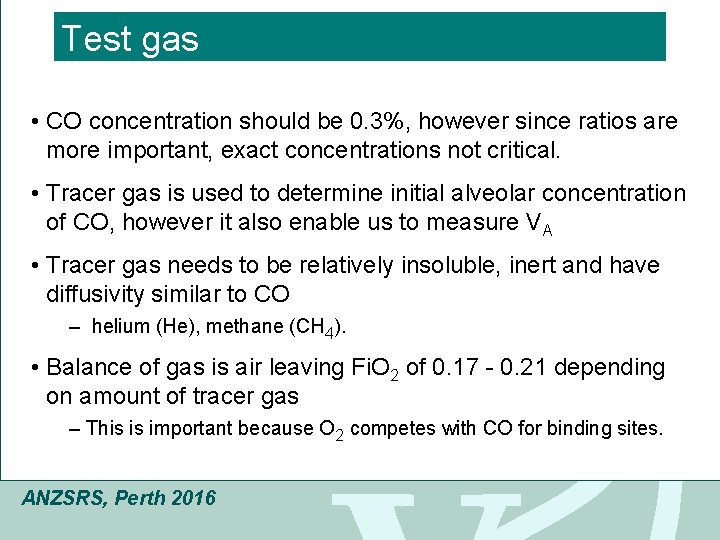
Click edit Master title style Test to gas • CO concentration should be 0. 3%, however since ratios are • Click to edit Master text styles more important, exact concentrations not critical. • Second level • Tracer gas is used to determine initial alveolar concentration level of • Third CO, however it also enable us to measure VA • Fourth level • Tracer gas needs to be relatively insoluble, inert and have diffusivity similar to CO • Fifth level – helium (He), methane (CH 4). • Balance of gas is air leaving Fi. O 2 of 0. 17 - 0. 21 depending on amount of tracer gas – This is important because O 2 competes with CO for binding sites. ANZSRS, Perth 2016
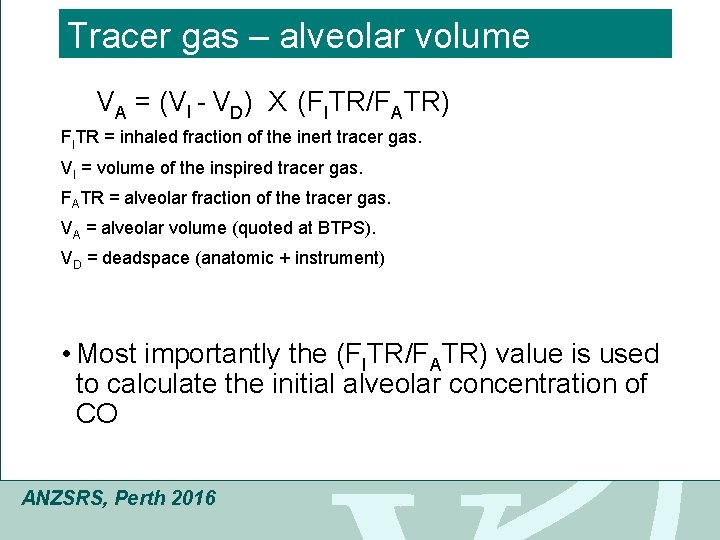
Click to edit title style Tracer gas. Master – alveolar volume VA = (VI - VD) X (FITR/FATR) the inert tracer gas. • FClick to editfraction Masterof text styles ITR = inhaled of the inspired tracer gas. I = volumelevel • VSecond FATR = alveolar fraction of the tracer gas. • VThird level = alveolar volume (quoted at BTPS). A • VFourth level (anatomic + instrument) D = deadspace • Fifth level • Most importantly the (FITR/FATR) value is used to calculate the initial alveolar concentration of CO ANZSRS, Perth 2016

Click to measurement edit Master title style TLCO Transfer factor defined as the rate of gas uptake divided by the driving pressure (units are ml/min/mm. Hg) • Click to edit Master text styles TLCO = VCO • Second level PACO • Third level Where VCO is the rate of carbon monoxide uptake and PACO alveolar • partial Fourth level of CO. pressure • TFifth COlevel = L VA x 60 x Ln(FATRx. FICO) (PB – PH 20) x BHT (FITRx. FACO) where PB is barometric pressure, BHT is breath hold time, FICO is the inspired fraction of CO, FACO is expired fraction of CO, FITR is the inspired fraction of the tracer gas and FATR is expired fraction of the tracer gas, VA at STPD. ANZSRS, Perth 2016
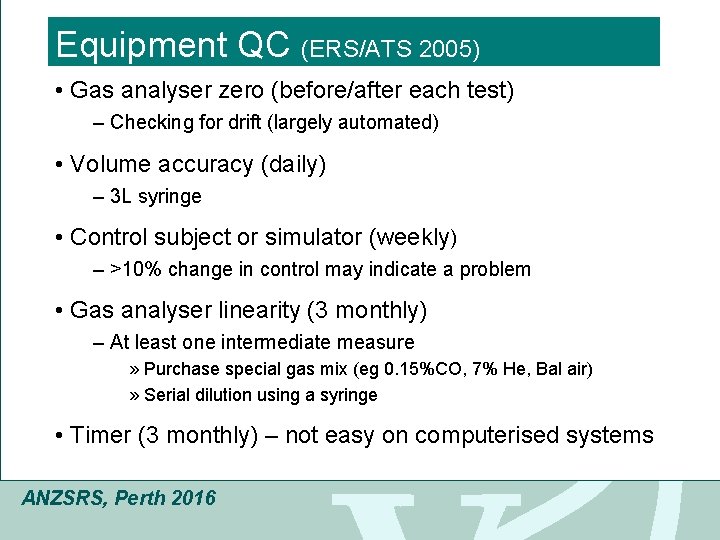
Click to edit Master title style Equipment QC (ERS/ATS 2005) • Gas analyser zero (before/after each test) – Checking for drift (largely automated) • Click to edit Master text styles • Volume accuracy (daily) • Second level – 3 L syringe • Third level • Control subject or simulator (weekly) • Fourth level – >10% change in control may indicate a problem • Fifth level • Gas analyser linearity (3 monthly) – At least one intermediate measure » Purchase special gas mix (eg 0. 15%CO, 7% He, Bal air) » Serial dilution using a syringe • Timer (3 monthly) – not easy on computerised systems ANZSRS, Perth 2016
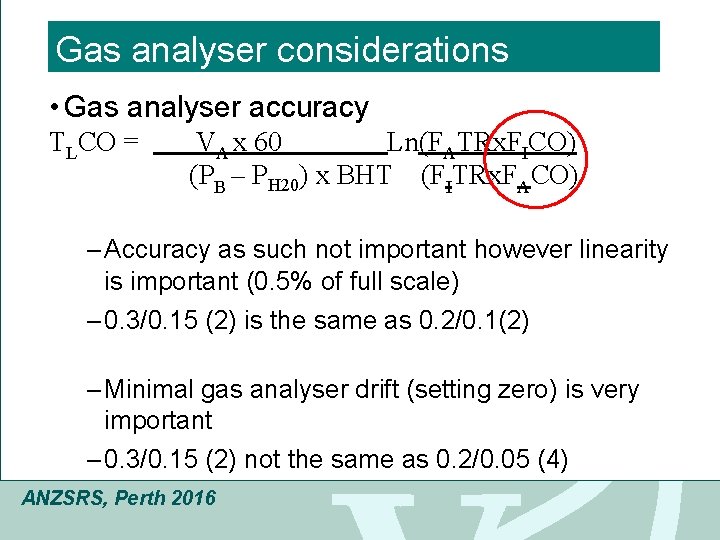
Click to edit Master title style Gas analyser considerations • Gas analyser accuracy to edit Master text styles Ln(F TRx. F CO) T • LClick CO = VA x 60 A I • Second level(PB – PH 20) x BHT (FITRx. FACO) • Third level – Accuracy as such not important however linearity • Fourth level is important (0. 5% of full scale) – 0. 3/0. 15 (2) is the same as 0. 2/0. 1(2) • Fifth level – Minimal gas analyser drift (setting zero) is very important – 0. 3/0. 15 (2) not the same as 0. 2/0. 05 (4) ANZSRS, Perth 2016
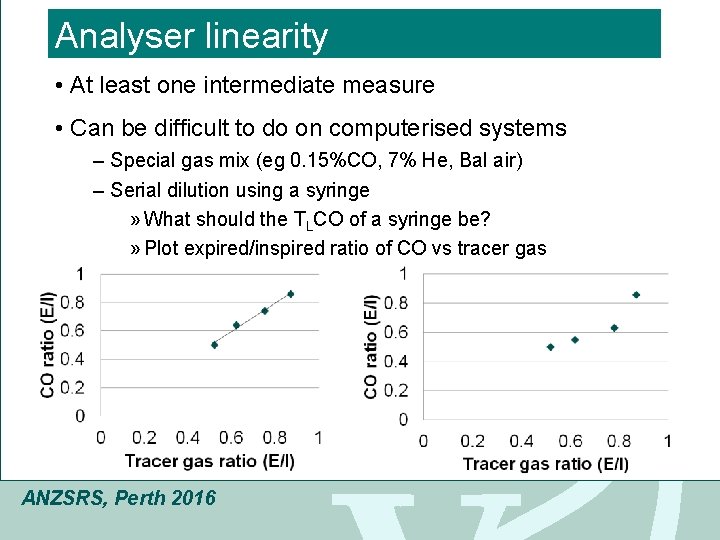
Click to edit Master title style Analyser linearity • At least one intermediate measure Can be difficult to do computerised systems • • Click to edit Master texton styles – Special gas mix (eg 0. 15%CO, 7% He, Bal air) • Second level – Serial dilution using a syringe • Third level » What should the TLCO of a syringe be? Plot expired/inspired ratio of CO vs tracer gas • Fourth» level • Fifth level ANZSRS, Perth 2016
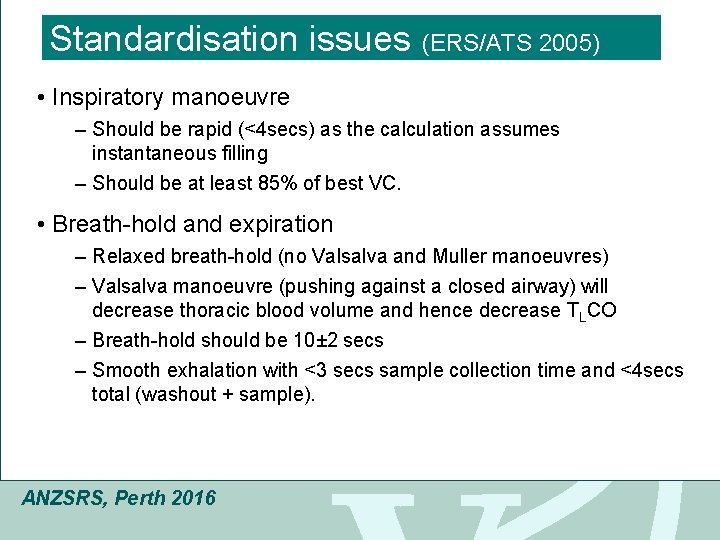
Click to edit Master title style Standardisation issues (ERS/ATS 2005) • Inspiratory manoeuvre – Should be rapid (<4 secs) as the calculation assumes • Click to edit Master text styles instantaneous filling • Second – Shouldlevel be at least 85% of best VC. • Third level and expiration • Breath-hold – Relaxed breath-hold (no Valsalva and Muller manoeuvres) • Fourth level – Valsalva manoeuvre (pushing against a closed airway) will • Fifth level decrease thoracic blood volume and hence decrease TLCO – Breath-hold should be 10± 2 secs – Smooth exhalation with <3 secs sample collection time and <4 secs total (washout + sample). ANZSRS, Perth 2016
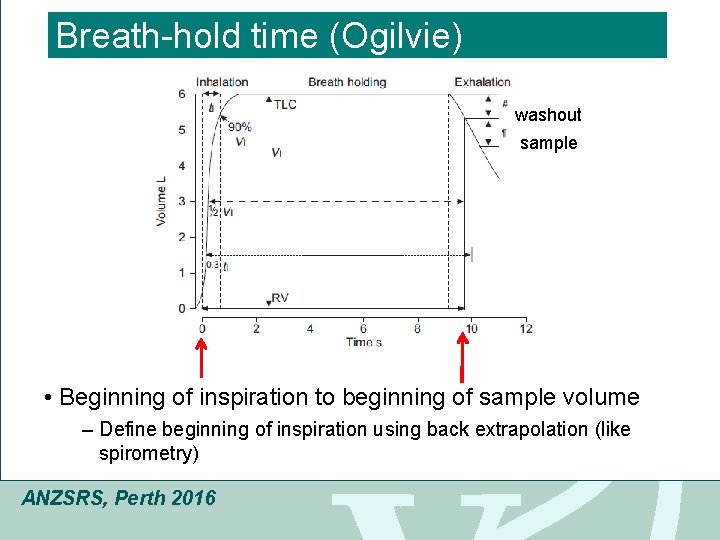
Click to edit Master title style Breath-hold time (Ogilvie) • Click to edit Master text styles washout sample • Second level • Third level • Fourth level • Fifth level • Beginning of inspiration to beginning of sample volume – Define beginning of inspiration using back extrapolation (like spirometry) ANZSRS, Perth 2016
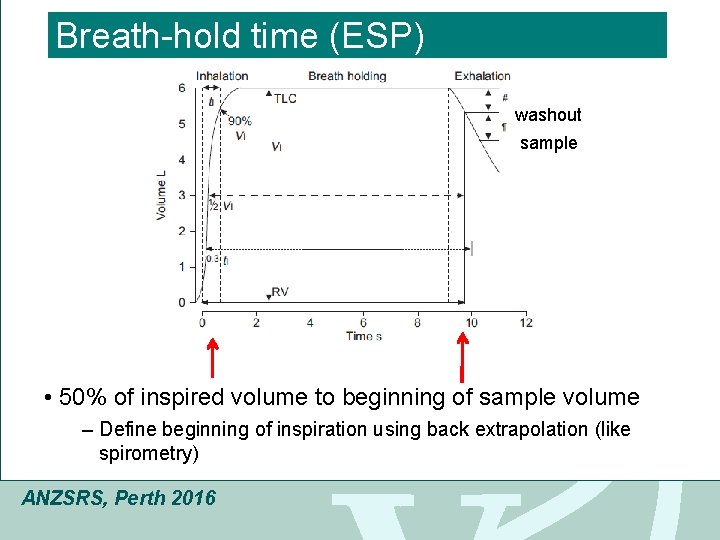
Click to edit Master title style Breath-hold time (ESP) • Click to edit Master text styles washout sample • Second level • Third level • Fourth level • Fifth level • 50% of inspired volume to beginning of sample volume – Define beginning of inspiration using back extrapolation (like spirometry) ANZSRS, Perth 2016
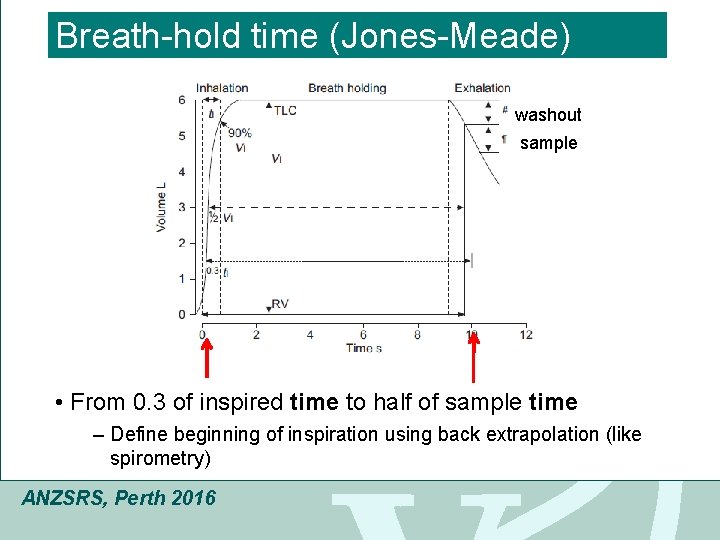
Click to edit Master title style Breath-hold time (Jones-Meade) • Click to edit Master text styles washout sample • Second level • Third level • Fourth level • Fifth level • From 0. 3 of inspired time to half of sample time – Define beginning of inspiration using back extrapolation (like spirometry) ANZSRS, Perth 2016
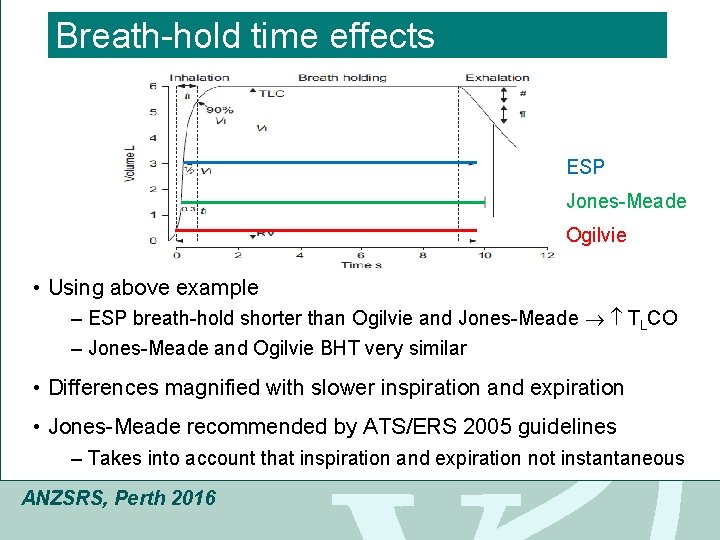
Click to edit Master title style Breath-hold time effects • Click to edit Master text styles • Second level • Third level • Fourth level • Using • Fifthabove level example ESP Jones-Meade Ogilvie – ESP breath-hold shorter than Ogilvie and Jones-Meade TLCO – Jones-Meade and Ogilvie BHT very similar • Differences magnified with slower inspiration and expiration • Jones-Meade recommended by ATS/ERS 2005 guidelines – Takes into account that inspiration and expiration not instantaneous ANZSRS, Perth 2016
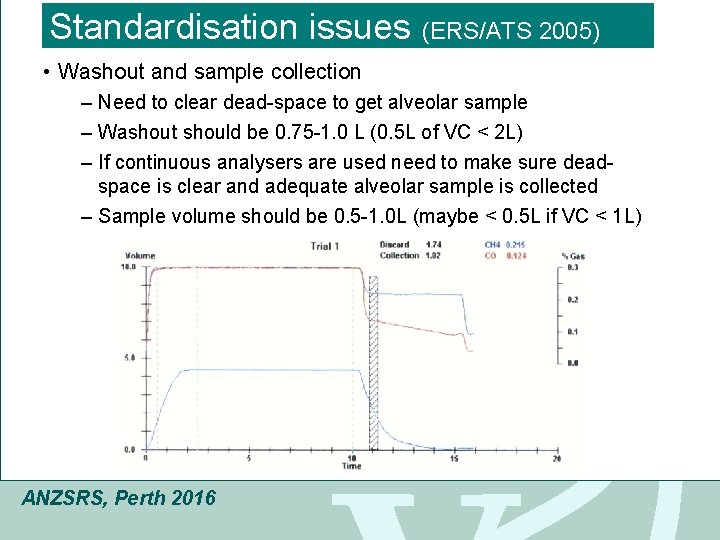
Click to edit Master title style Standardisation issues (ERS/ATS 2005) • Washout and sample collection – Need to clear dead-space to get alveolar sample – Washout 0. 75 -1. 0 • Click to editshould Masterbetext styles. L (0. 5 L of VC < 2 L) – If continuous analysers are used need to make sure dead • Second spacelevel is clear and adequate alveolar sample is collected – Sample • Third levelvolume should be 0. 5 -1. 0 L (maybe < 0. 5 L if VC < 1 L) • Fourth level • Fifth level ANZSRS, Perth 2016
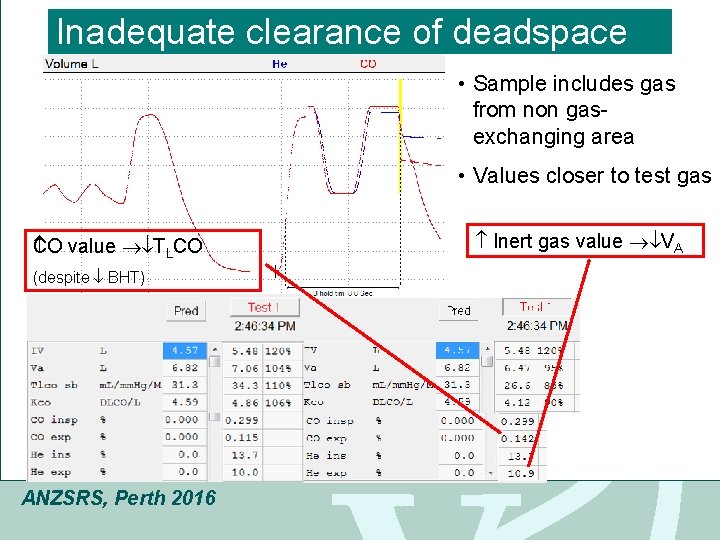
Click to edit Master title style Inadequate clearance of deadspace • Click to edit Master text styles • Sample includes gas from non gasexchanging area • Second level • Values closer to test gas • Third level CO value TLCO • Fourth level (despite BHT) • Fifth level ANZSRS, Perth 2016 Inert gas value VA
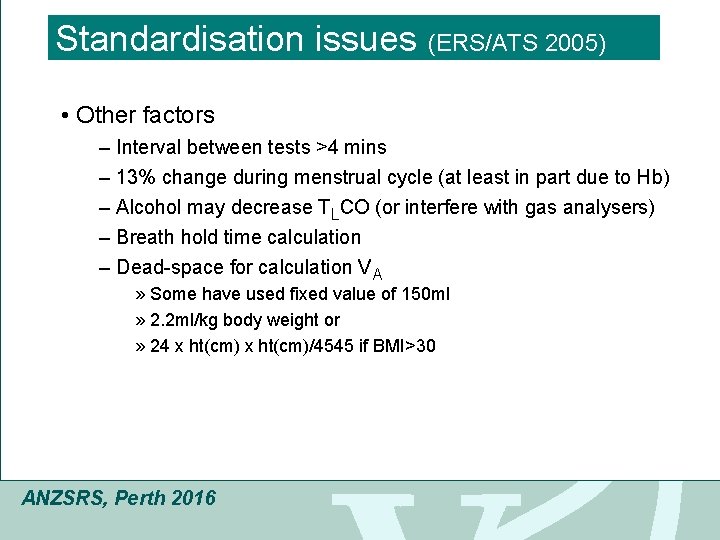
Click to edit Masterissues title style Standardisation (ERS/ATS 2005) • Other factors • Click to edit between Master text – Interval testsstyles >4 mins – 13%level change during menstrual cycle (at least in part due to Hb) • Second – Alcohol may decrease TLCO (or interfere with gas analysers) • Third level – Breath hold time calculation • Fourth level – Dead-space for calculation VA » Some have used fixed value of 150 ml • Fifth level » 2. 2 ml/kg body weight or » 24 x ht(cm)/4545 if BMI>30 ANZSRS, Perth 2016
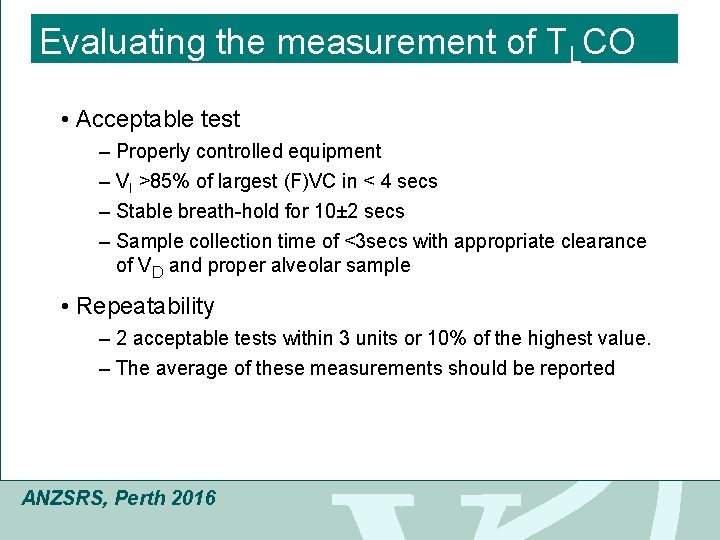
Click to edit Master title style Evaluating the measurement of TLCO • Acceptable test • Click to edit Master text styles – Properly controlled equipment • Second levelof largest (F)VC in < 4 secs – VI >85% – Stable • Third level breath-hold for 10± 2 secs – Sample collection time of <3 secs with appropriate clearance • Fourth level of V D and proper alveolar sample • • Fifth level Repeatability – 2 acceptable tests within 3 units or 10% of the highest value. – The average of these measurements should be reported ANZSRS, Perth 2016
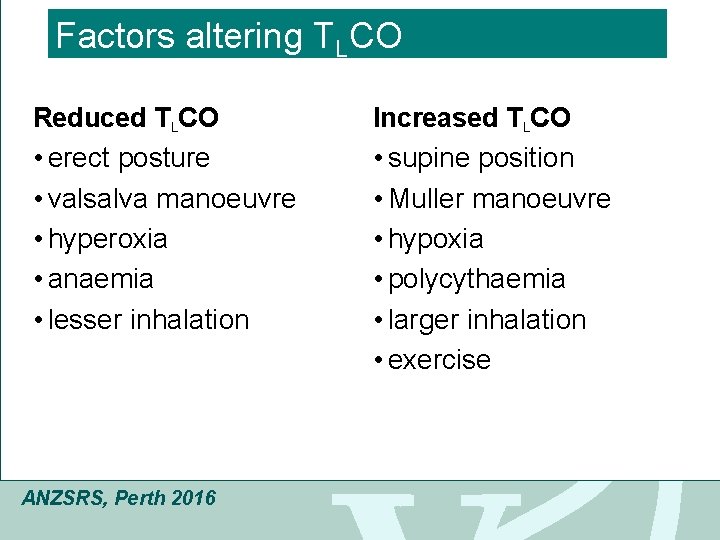
Click to edit Master Factors altering T title COstyle L Reduced TLCO • Click to edit Master text styles • erect posture • Second level • valsalva manoeuvre • Third level • hyperoxia • Fourth level • anaemia • Fifth level • lesser inhalation ANZSRS, Perth 2016 Increased TLCO • supine position • Muller manoeuvre • hypoxia • polycythaemia • larger inhalation • exercise
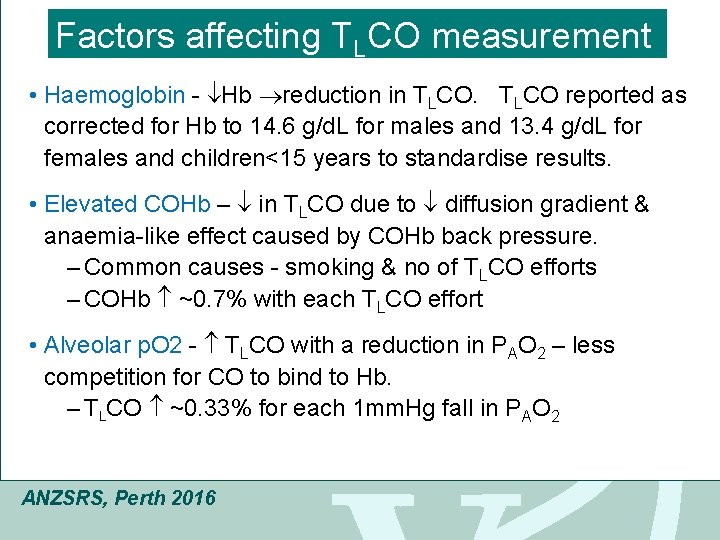
Click to edit Master Ttitle style Factors affecting CO measurement L • Haemoglobin - Hb reduction in TLCO reported as corrected for Hb to 14. 6 • Click to edit Master text g/d. L stylesfor males and 13. 4 g/d. L for females and children<15 years to standardise results. • Second level • Elevated COHb – in TLCO due to diffusion gradient & • Third level anaemia-like effect caused by COHb back pressure. • Fourth level – Common causes - smoking & no of TLCO efforts • –Fifth level ~0. 7% with each TLCO effort COHb • Alveolar p. O 2 - TLCO with a reduction in PAO 2 – less competition for CO to bind to Hb. – TLCO ~0. 33% for each 1 mm. Hg fall in PAO 2 ANZSRS, Perth 2016
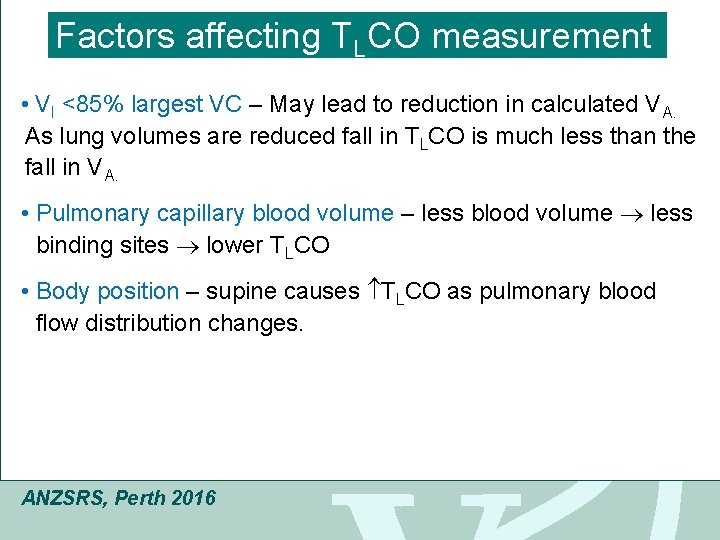
Click to edit Master Ttitle style Factors affecting CO measurement L • VI <85% largest VC – May lead to reduction in calculated VA. As • lung are reduced fall in TLCO is much less than the Clickvolumes to edit Master text styles fall • in. Second VA. level • Pulmonary capillary blood volume – less blood volume less • Third level binding sites • Fourth level lower TLCO • Body position • Fifth level – supine causes TLCO as pulmonary blood flow distribution changes. ANZSRS, Perth 2016
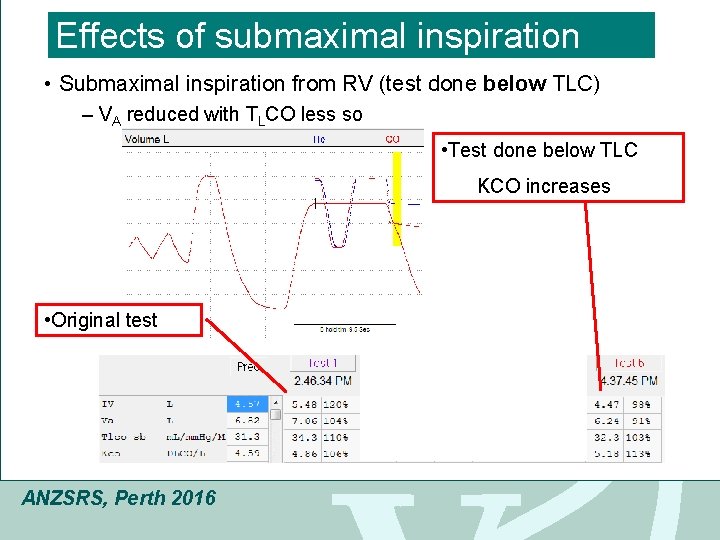
Click to edit Master title style Effects of submaximal inspiration • Submaximal inspiration from RV (test done below TLC) – VA reduced with TLCO less so • Click to edit Master text styles • Second level • Third level • Fourth level • Fifth level • Original test ANZSRS, Perth 2016 • Test done below TLC KCO increases
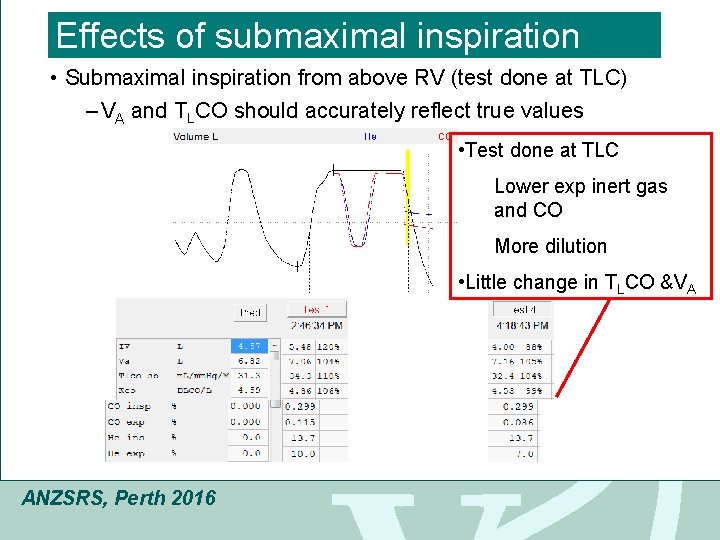
Click to edit Master title style Effects of submaximal inspiration • Submaximal inspiration from above RV (test done at TLC) – VA and TLCO should accurately reflect true values • Click to edit Master text styles • Test done at TLC • Second level • Third level • Fourth level • Fifth level ANZSRS, Perth 2016 Lower exp inert gas and CO More dilution • Little change in TLCO &VA
Click to edit Master title style Effects of submaximal inspiration • Trouble is its difficult to know which happened • • Click styles but Easyto toedit tell Master on the text examples, • Second level • TLCO guidelines suggest deep inspirations prior to • Third level before delivering test gas should not be exhalation it increases the measured TLCO. • done Fourthas level • Fifth level ANZSRS, Perth 2016
Click to edit Masteras title style Alveolar volume a measure of TLC • Alveolar volume - single breath estimate of TLC • In a perfect world (and a perfect subject) • Click to edit Master text styles – patient VD A = TLC • VSecond level Can level we use VA to estimate TLC? • • Third What determines how good this estimate would be? • • Fourth level 1998 level paper by Punjabi et al • • Fifth – 2477 patients – VA measured using standard technique, however did not subtract anatomic deadspace – TLC measured using He dilution lung volumes » Data may be worse when compared to plethysmographic TLC ANZSRS, Perth 2016
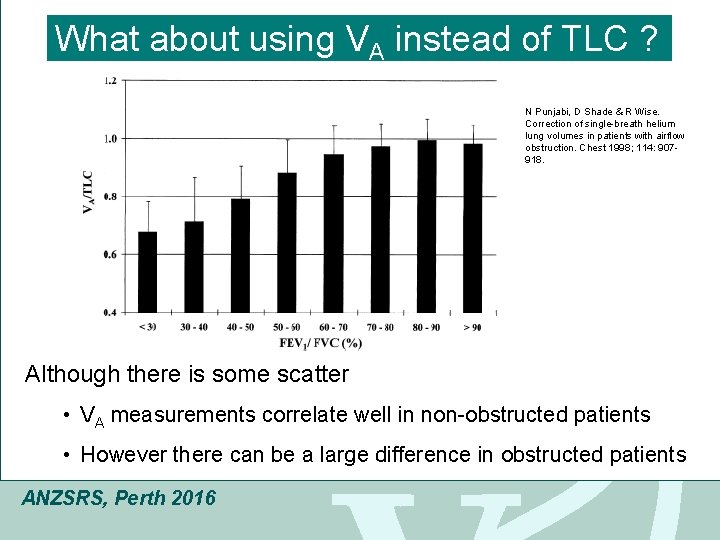
Click toabout edit Master style What using title VA instead of TLC ? • Click to edit Master text styles • Second level N Punjabi, D Shade & R Wise. Correction of single-breath helium lung volumes in patients with airflow obstruction. Chest 1998; 114: 907918. • Third level • Fourth level • Fifth level Although there is some scatter • VA measurements correlate well in non-obstructed patients • However there can be a large difference in obstructed patients ANZSRS, Perth 2016
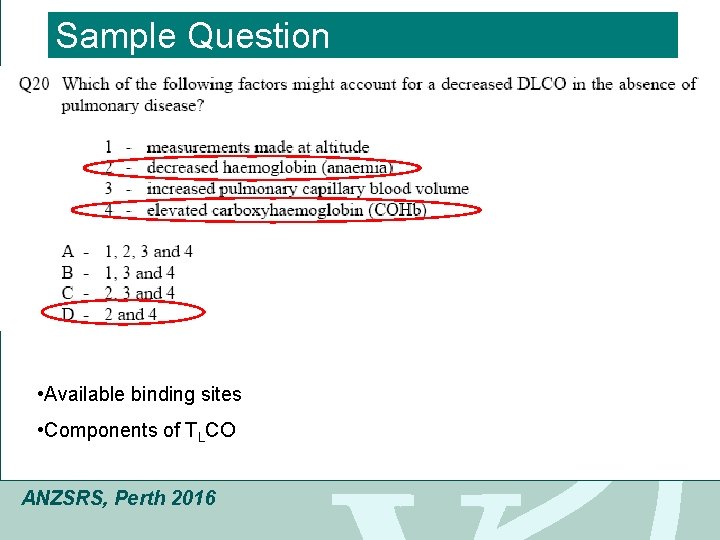
Click to edit Master title style Sample Question • Click to edit Master text styles • Second level • Third level • Fourth level • Fifth level • Available binding sites • Components of TLCO ANZSRS, Perth 2016
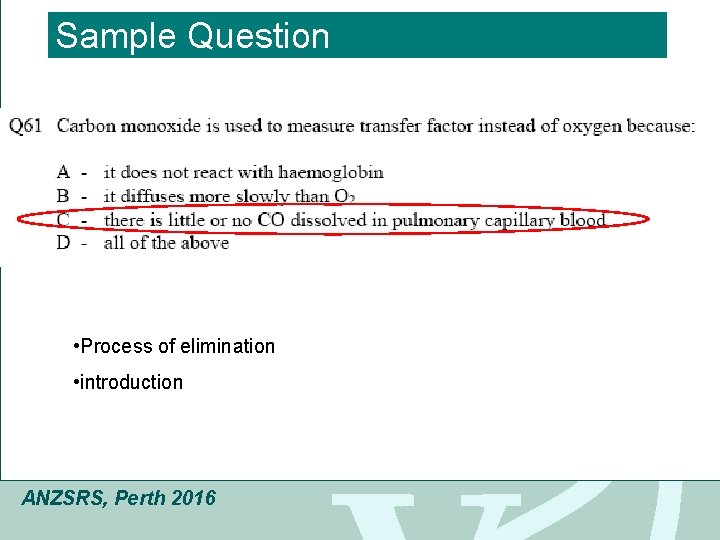
Click to edit Master title style Sample Question • Click to edit Master text styles • Second level • Third level • Fourth level • Fifth level • Process of elimination • introduction ANZSRS, Perth 2016
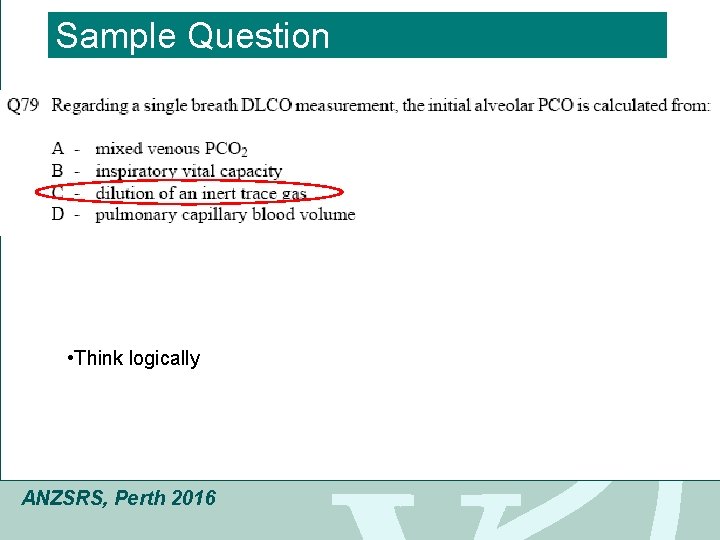
Click to edit Master title style Sample Question • Click to edit Master text styles • Second level • Third level • Fourth level • Fifth level • Think logically ANZSRS, Perth 2016
- Slides: 35