
Nutritional surveillance contents types of nutritional surveillance advantage







- Slides: 16
Nutritional surveillance • contents • types of nutritional surveillance • advantage and disadvantages of nutritional surveillance • importance of nutritional surveillance
defination q. Is the process of monitoring changes in the nutritional status of a population over a period of time. q. Nutrition surveillance involves Data collection, processing, Analyses, Communication Interpretation and
Types/methods of nutritional survillance 1. Large-scale food and nutrition surveys The surveillance system should make an inventory of all large national surveys • related to health, food and nutrition that could act as a basis by breaking data down. • at sub regional, district and village levels. In particular, frequent surveys such as: • Demographic Health Survey • National Nutrition Survey or National Food Security Surveys should be considered. Try to include selected
Advantages and disadvantages • covers a wide range of problems • does not require special arrangement • it is relatively cheap • covers a wider area
disadvantages • The information generated is to a large extent unreliable, incomplete and inaccurate • Most of the time, data from passive surveillance is not available on time • Most of the time, you may not get the kind of information you desire.
Types…. . 2. Repeated small-scale surveys/active type of nutritional survillance üRepeated small-scale surveys are population-based surveys that use standard methods to collect quantitative and qualitative data. üThey assess the type, severity and extent of malnutrition and its causes among a representative sample of the population (children and/or adults).
Con…. üTheir purpose is to support policy-makers and managers to design strategies and prioritize geographical areas at risk and specific types of interventions. üRepeated surveys include national surveys, which are periodically conducted at national level, and small-scale surveys, which are carried out at local level to gather nutrition information at a suitable time.
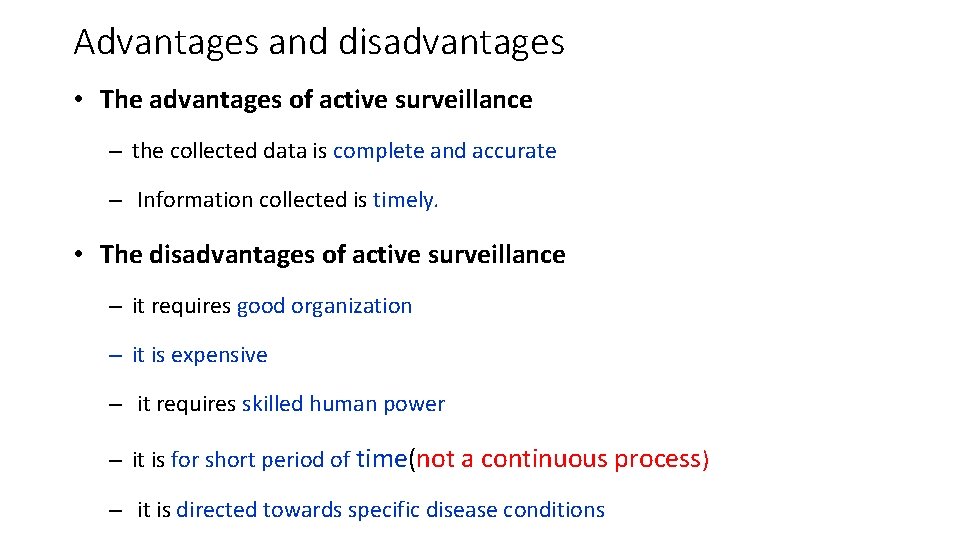
Advantages and disadvantages • The advantages of active surveillance – the collected data is complete and accurate – Information collected is timely. • The disadvantages of active surveillance – it requires good organization – it is expensive – it requires skilled human power – it is for short period of time(not a continuous process) – it is directed towards specific disease conditions
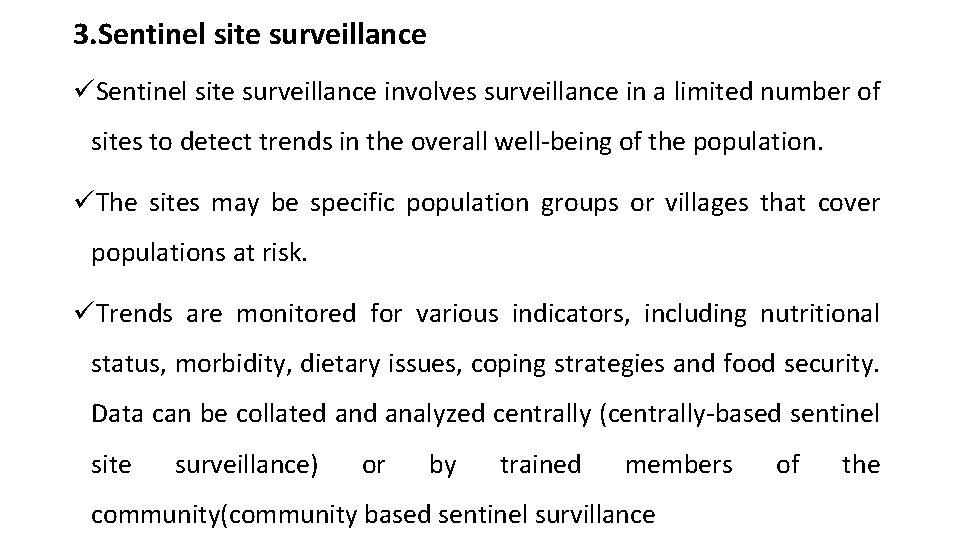
3. Sentinel site surveillance üSentinel site surveillance involves surveillance in a limited number of sites to detect trends in the overall well-being of the population. üThe sites may be specific population groups or villages that cover populations at risk. üTrends are monitored for various indicators, including nutritional status, morbidity, dietary issues, coping strategies and food security. Data can be collated analyzed centrally (centrally-based sentinel site surveillance) or by trained members community(community based sentinel survillance of the
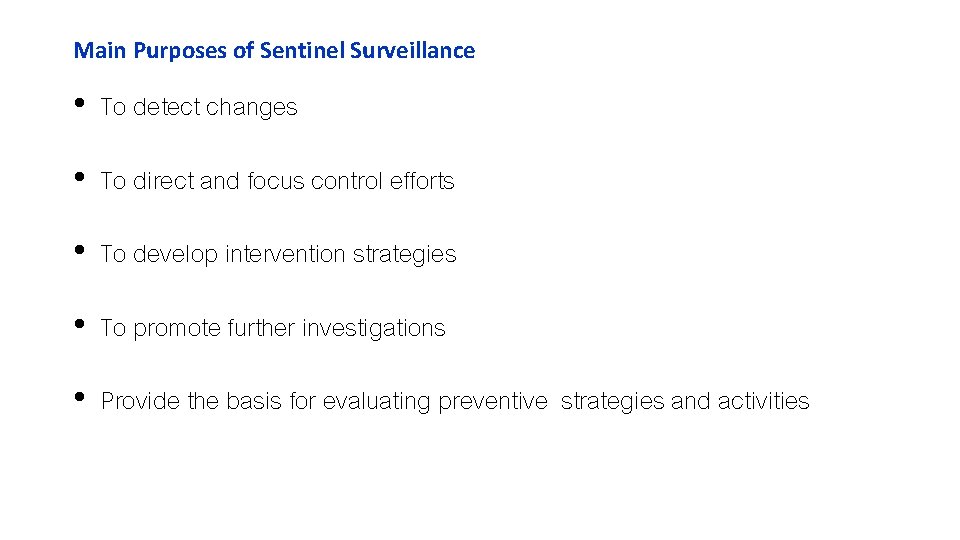
Main Purposes of Sentinel Surveillance • To detect changes • To direct and focus control efforts • To develop intervention strategies • To promote further investigations • Provide the basis for evaluating preventive strategies and activities
Uses and users of nutritional survillance Users of nutritional survillance system • Food and agricultural organization • Food and nutrition management sector • Ministry of management and planning • Ministry of health • NGOs who support nutrition and food program
Uses of nutritional survillance system A. National and sectorial planning and policy design ØPlanning at the national level usually consists of a periodic review of government policies and defining medium- and long-range goals that will contribute positively to designing or adjusting
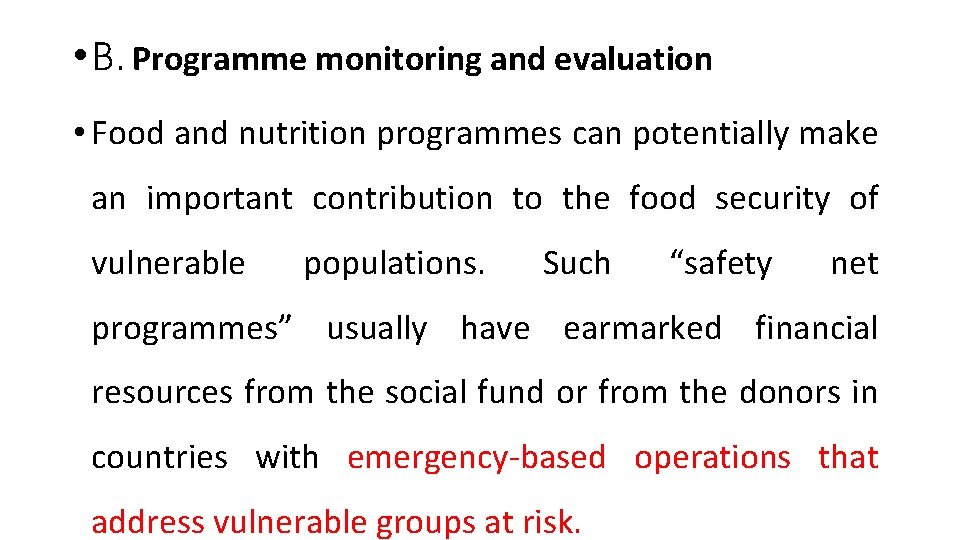
• B. Programme monitoring and evaluation • Food and nutrition programmes can potentially make an important contribution to the food security of vulnerable populations. Such “safety net programmes” usually have earmarked financial resources from the social fund or from the donors in countries with emergency-based operations that address vulnerable groups at risk.
C. Problem identification and advocacy ØIt assists setting priorities for targeting resources to the most “needy” people from deprived communities or subgroups. Ø In addition, a surveillance system serves as evidence to support advocates’ policy or programme proposals. Advocates’ claims benefit from the efficiency, accountability and transparency of the system and their impact is thereby strengthened and more able to attract key partners.
D. Timely warning of food shortages üAn early-warning system is an efficient tool in disaster management. The Region has recently been affected by different crises, such as high food prices, climate change, unexpected floods and droughts, and man-made disasters. üTimely warning systems can be powerful tools for preventing critical food shortages and sudden decrease in access to basic foods in affected countries
Thank you!