
Nutritional Requirements of Nonruminant Animals Created by Barrett
Nutritional Requirements of Non-ruminant Animals Created by: Barrett, Arlene Bratton, Dennis Gumfory, Mariah Vrazel, Haley
Objectives • Evaluate the protein requirements and what is required of a non ruminant animal • State the nutritional requirements of non ruminant animals • Analyze the protein percentages in common feedstuff
Monogastric Nutrition • Pigs, as a general rule, eat to satisfy their energy requirements. • So, how much feed will a G-F pig eat? • Answer: about 5% of body weight. • Actual feed intake, as a percent of body weight, decreases as live weight increases.
Monogastric Nutrition • What is the most common energy feed for swine in the Midwest? • Corn • What would be the second most common energy feed for swine? • Milo also referred to as grain sorghum.

Monogastric • Cereal grains (corn, oats, wheat, etc) as a rule are deficient in protein or more specifically in amino acids. • Lysine requirement for a 40 lb. pig is approximately. 95% of the diet. • Corn contains. 25% lysine.
Protein • Since swine diets consist primarily of cereal grains they need to be supplemented with a protein feed in order to enable optimum performance.

Protein Feeds Other plant and animal proteins are often used in combination with SBM. • Fishmeal (60 -70% CP) (Crude Protein) • Milk products, such as dried skimmed milk (33% CP) and dried whey (13. 3% CP) • Meat and bone meal (50% CP) • Spray dried plasma protein and bloodmeal (86% CP)
Feed Additives • • Increase growth rate Improve feed efficiency Decrease mortality and morbidity caused by disease. Improve the composition in the carcass (decrease fat content; increase lean content).
Monogastric Fiber Diet • Swine producers often add fiber to the gestation diet just prior to farrowing and/or during lactation. • Bulky (high fiber) feeds such as oats, wheat bran or beet pulp are added to the ration to prevent constipation.
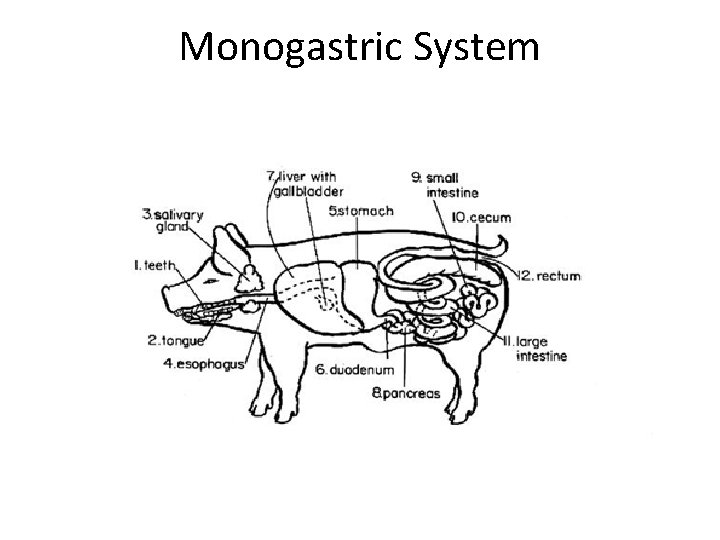
Monogastric System
Review • Evaluate the protein requirements and what is required of a non ruminant animal • State the nutritional requirements of non ruminant animals • Analyze the protein percentages in common feedstuff
Resources Extension. Missouri. edu • http: //agebb. missouri. edu/swine/nutrition/ • http: //www. usporkcenter. org/home/projects/national-swine-nutritionguide. aspx
- Slides: 12