
Nutrition overview Nutrition overview Objectives Understand the different

Nutrition overview

Nutrition overview Objectives • Understand the different types of malnutrition • Be confident in how the different malnutrition indicators and indices work • Work with Z-scores • Be able to identify the nutritional status of children under five years old 2
Nutrition overview Nutrition? 3
Nutrition overview Types of malnutrition 1. Acute malnutrition 2. Chronic malnutrition 3. Micronutrient deficiency 4. Obesity 4
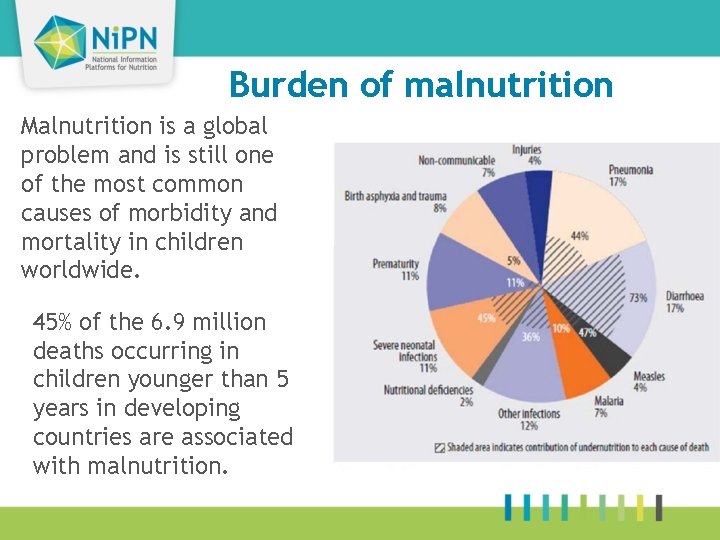
Burden of malnutrition Malnutrition is a global problem and is still one of the most common causes of morbidity and mortality in children worldwide. 45% of the 6. 9 million deaths occurring in children younger than 5 years in developing countries are associated with malnutrition.
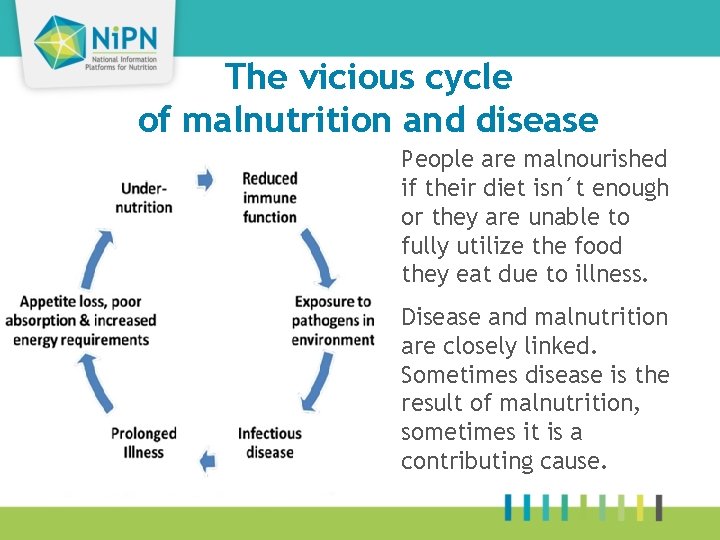
The vicious cycle of malnutrition and disease People are malnourished if their diet isn´t enough or they are unable to fully utilize the food they eat due to illness. Disease and malnutrition are closely linked. Sometimes disease is the result of malnutrition, sometimes it is a contributing cause.

Causes of malnutrition Conceptual framework from The Lancet
Nutrition overview Types of malnutrition 1. Acute malnutrition 2. Chronic malnutrition 3. Micronutrient deficiency 4. Obesity 8
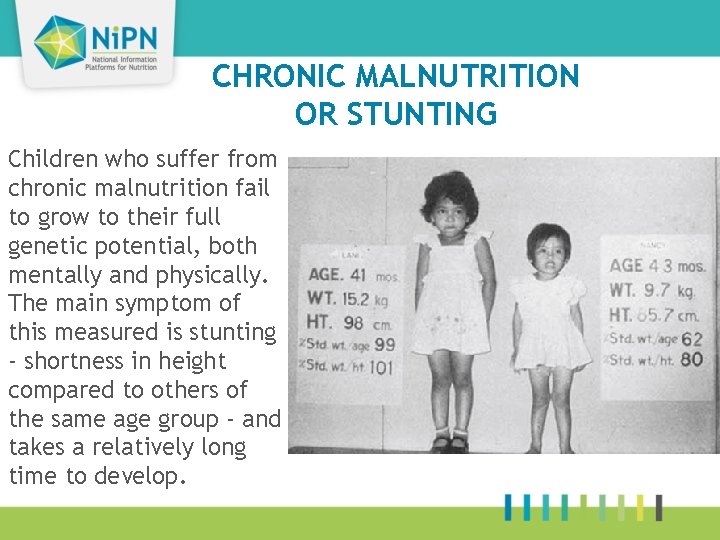
CHRONIC MALNUTRITION OR STUNTING Children who suffer from chronic malnutrition fail to grow to their full genetic potential, both mentally and physically. The main symptom of this measured is stunting - shortness in height compared to others of the same age group - and takes a relatively long time to develop.
Acute malnutrition: Clinical forms • Marasmus – Excessive thinness, also known as “wasting”. – Low weight compared to height/length. – Resulting from a recent and rapid loss of weight or other incapacity to gain weight. – Reversible phenomenon through improvements of life conditions. • Kwashiorkor – Presence of bilateral edema. – Often following weaning, 18 months to 2. 5 years. – Causes remain uncertain.
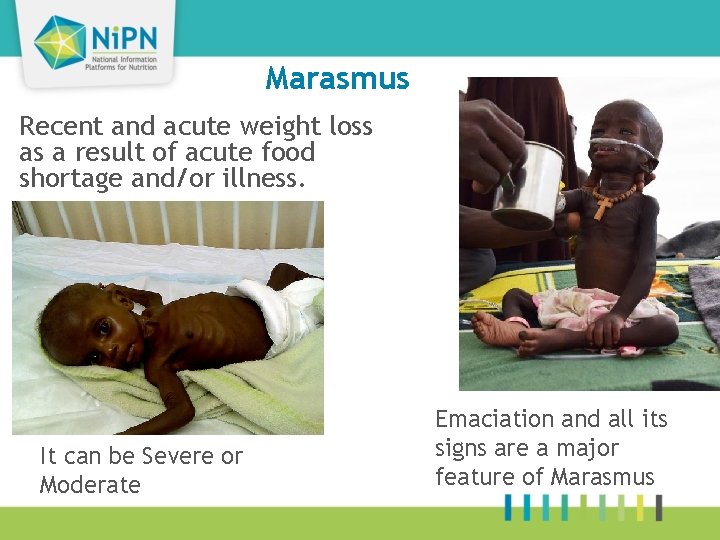
Marasmus Recent and acute weight loss as a result of acute food shortage and/or illness. It can be Severe or Moderate Emaciation and all its signs are a major feature of Marasmus
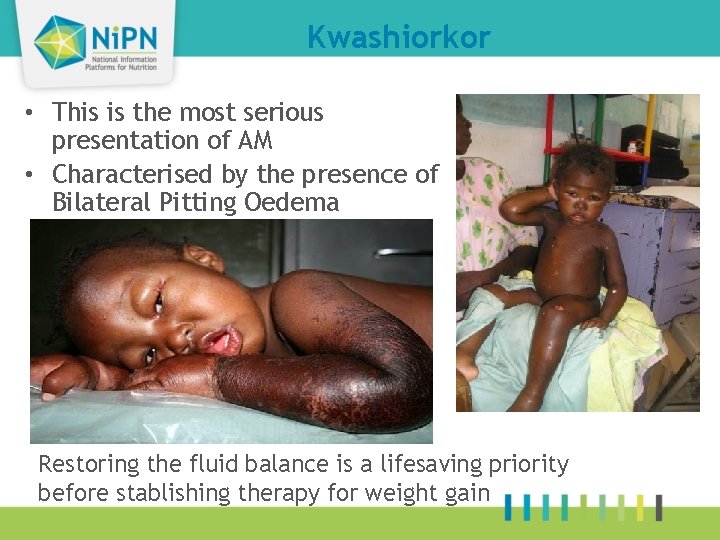
Kwashiorkor • This is the most serious presentation of AM • Characterised by the presence of Bilateral Pitting Oedema Restoring the fluid balance is a lifesaving priority before stablishing therapy for weight gain
13 Stages of Acute Malnutrition ¨ Moderate acute malnutrition = MAM ¨ Severe acute malnutrition = SAM. Global acute malnutrition (GAM) refers to both MAM and SAM.
Diagnostic tools 14 1. Presence of bilateral edema 2. MUAC 3. Anthropometric Indices
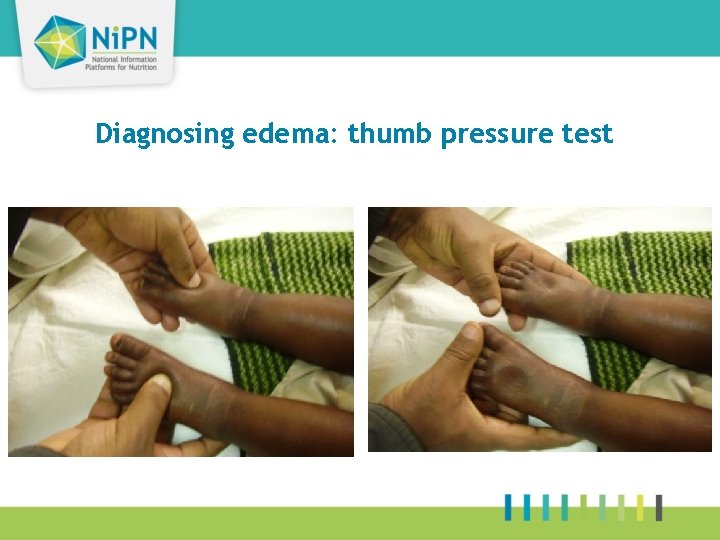
Diagnosing edema: thumb pressure test 15

MUAC
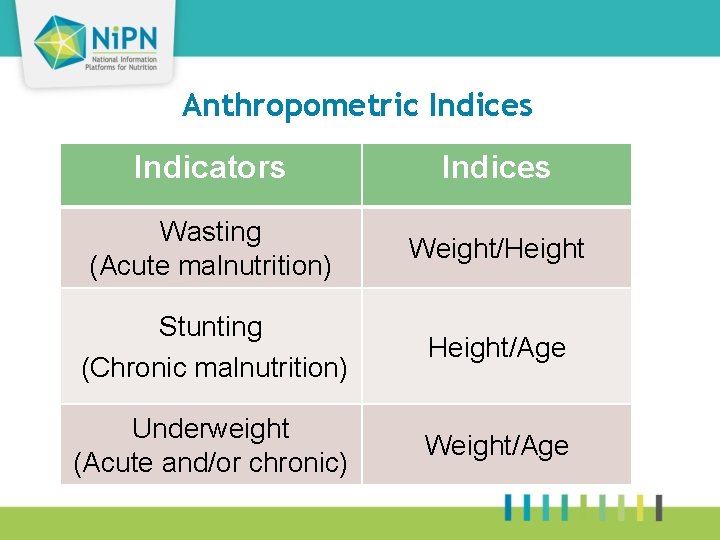
17 Anthropometric Indices Indicators Indices Wasting (Acute malnutrition) Weight/Height Stunting (Chronic malnutrition) Height/Age Underweight (Acute and/or chronic) Weight/Age
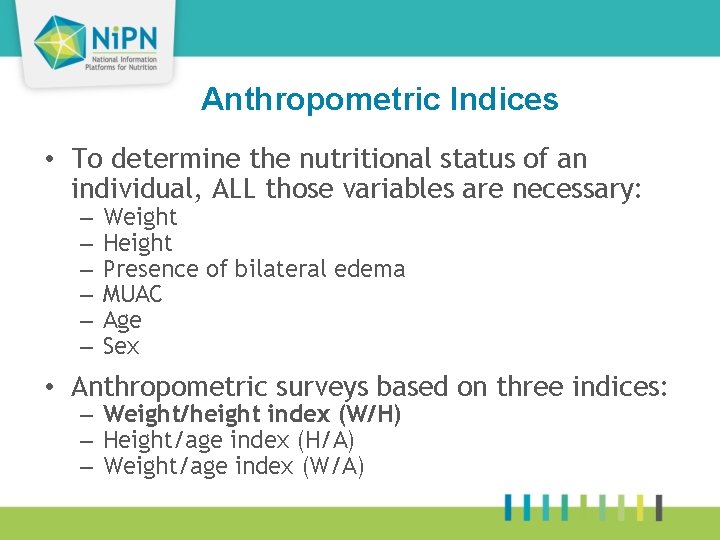
Anthropometric Indices 18 • To determine the nutritional status of an individual, ALL those variables are necessary: – – – Weight Height Presence of bilateral edema MUAC Age Sex • Anthropometric surveys based on three indices: – Weight/height index (W/H) – Height/age index (H/A) – Weight/age index (W/A)
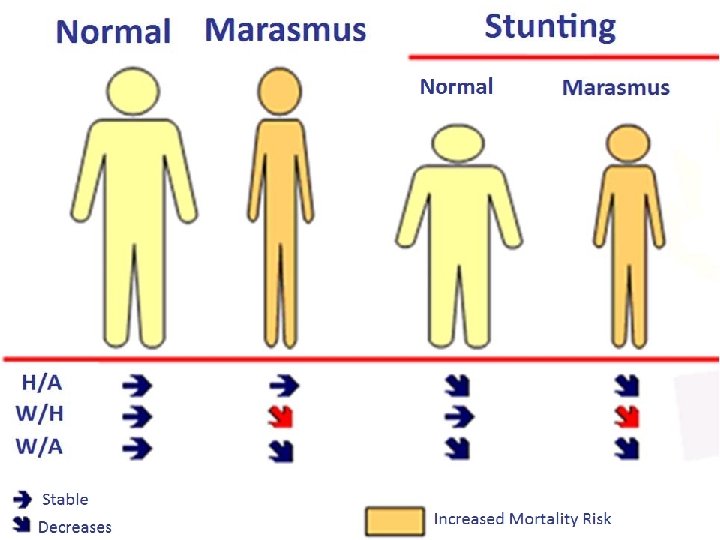
19
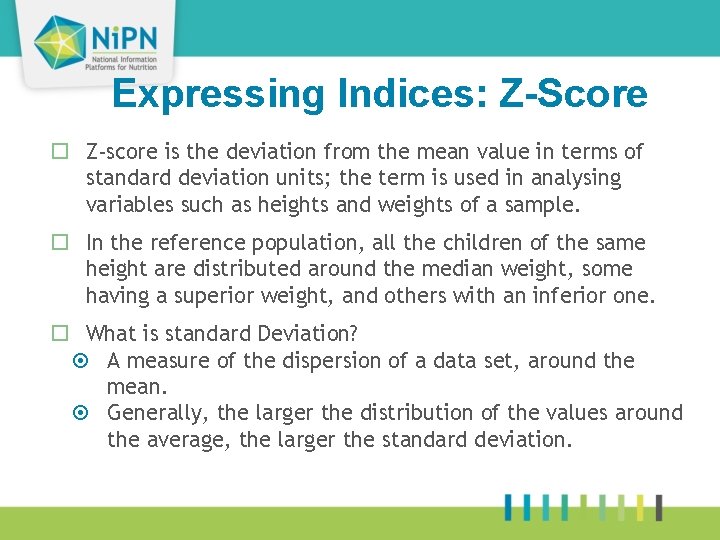
20 Expressing Indices: Z-Score ¨ Z-score is the deviation from the mean value in terms of standard deviation units; the term is used in analysing variables such as heights and weights of a sample. ¨ In the reference population, all the children of the same height are distributed around the median weight, some having a superior weight, and others with an inferior one. ¨ What is standard Deviation? ¤ A measure of the dispersion of a data set, around the mean. ¤ Generally, the larger the distribution of the values around the average, the larger the standard deviation.

Z-Score 21 SD = 1 SD < 1 SD > 1
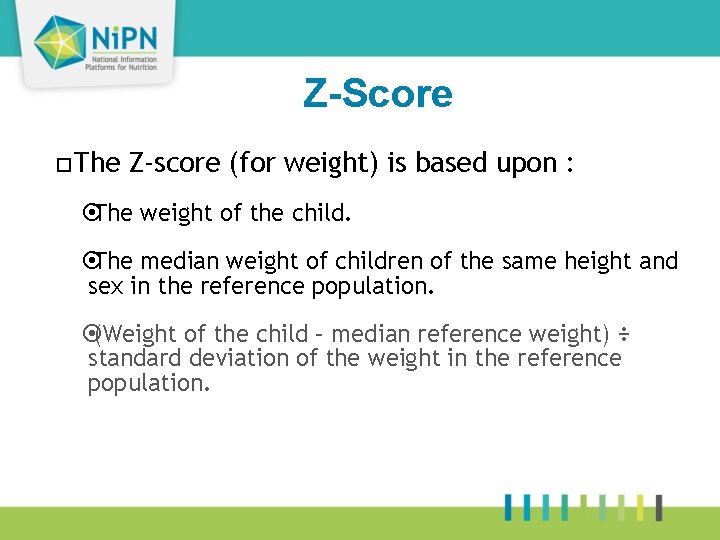
Z-Score 22 ¨The Z-score (for weight) is based upon : ¤The weight of the child. ¤The median weight of children of the same height and sex in the reference population. ¤(Weight of the child – median reference weight) ÷ standard deviation of the weight in the reference population.
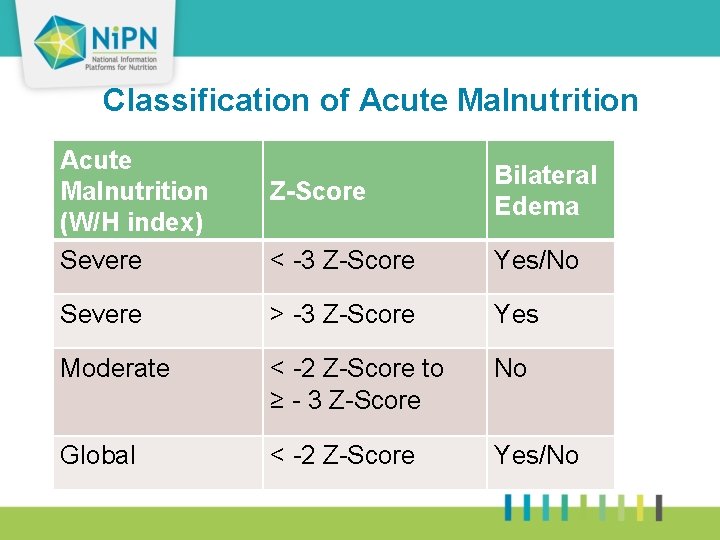
23 Classification of Acute Malnutrition (W/H index) Severe Z-Score Bilateral Edema < -3 Z-Score Yes/No Severe > -3 Z-Score Yes Moderate < -2 Z-Score to ≥ - 3 Z-Score No Global < -2 Z-Score Yes/No
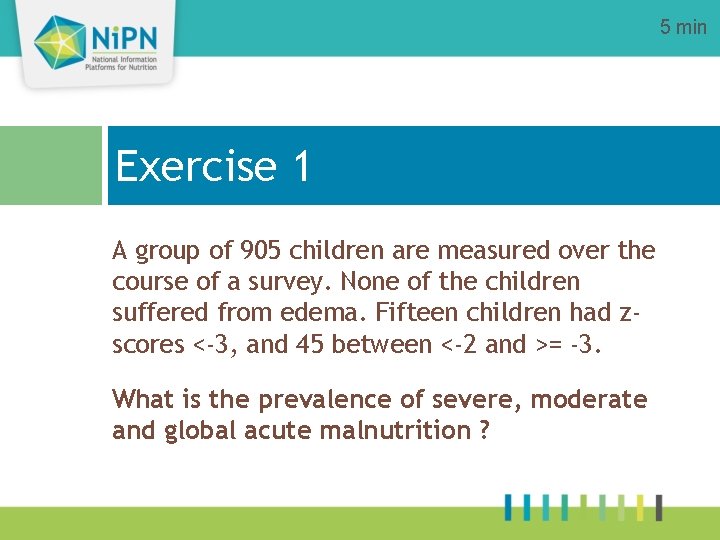
5 min Exercise 1 A group of 905 children are measured over the course of a survey. None of the children suffered from edema. Fifteen children had zscores <-3, and 45 between <-2 and >= -3. What is the prevalence of severe, moderate and global acute malnutrition ?
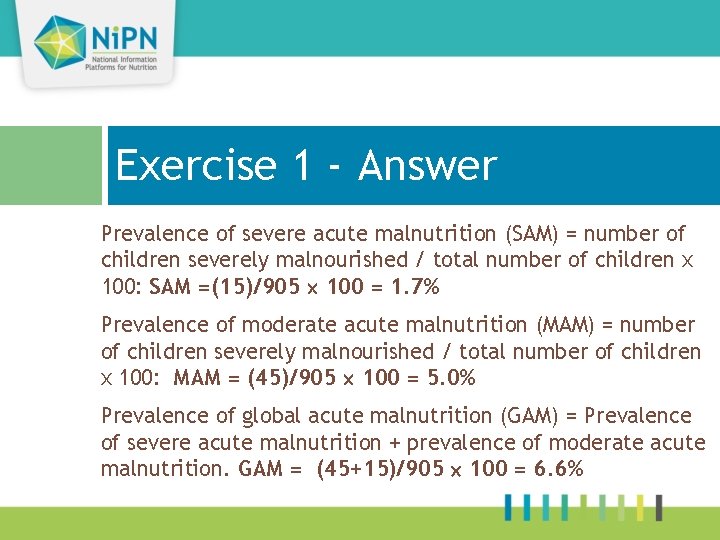
Exercise 1 - Answer Prevalence of severe acute malnutrition (SAM) = number of children severely malnourished / total number of children x 100: SAM =(15)/905 100 = 1. 7% Prevalence of moderate acute malnutrition (MAM) = number of children severely malnourished / total number of children x 100: MAM = (45)/905 100 = 5. 0% Prevalence of global acute malnutrition (GAM) = Prevalence of severe acute malnutrition + prevalence of moderate acute malnutrition. GAM = (45+15)/905 100 = 6. 6%
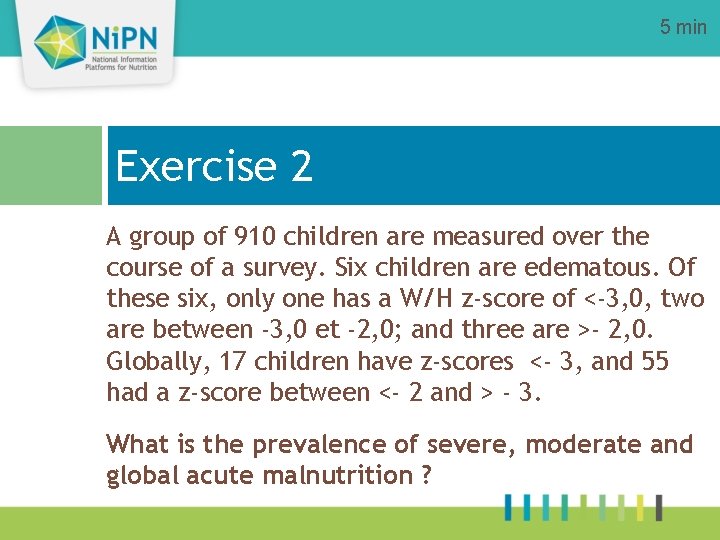
5 min Exercise 2 A group of 910 children are measured over the course of a survey. Six children are edematous. Of these six, only one has a W/H z-score of <-3, 0, two are between -3, 0 et -2, 0; and three are >- 2, 0. Globally, 17 children have z-scores <- 3, and 55 had a z-score between <- 2 and > - 3. What is the prevalence of severe, moderate and global acute malnutrition ?
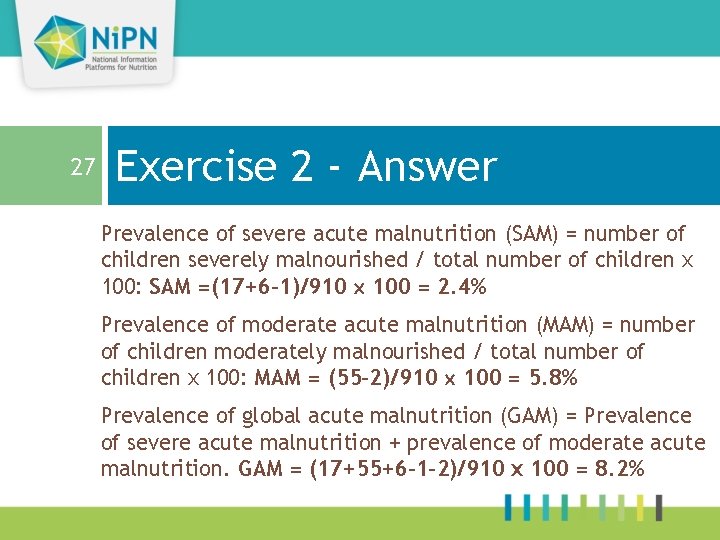
27 Exercise 2 - Answer Prevalence of severe acute malnutrition (SAM) = number of children severely malnourished / total number of children x 100: SAM =(17+6 -1)/910 100 = 2. 4% Prevalence of moderate acute malnutrition (MAM) = number of children moderately malnourished / total number of children x 100: MAM = (55 -2)/910 100 = 5. 8% Prevalence of global acute malnutrition (GAM) = Prevalence of severe acute malnutrition + prevalence of moderate acute malnutrition. GAM = (17+55+6 -1 -2)/910 x 100 = 8. 2%

Nutrition overview How do we treat Acute Malnutrition? 28
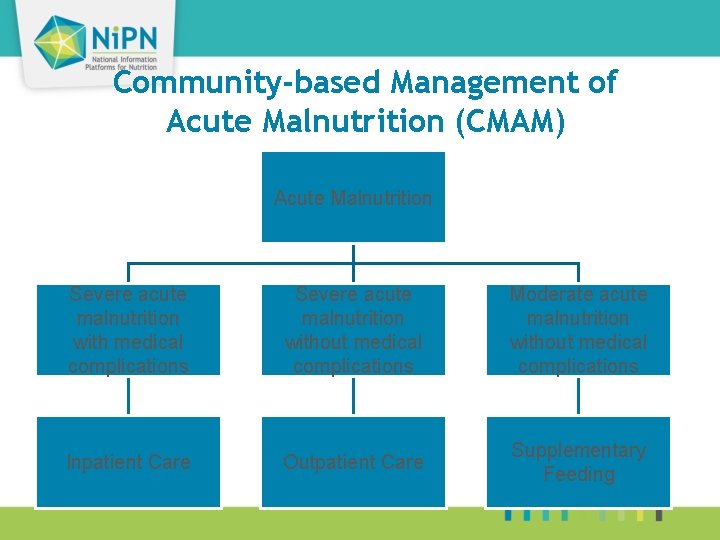
Community-based Management of Acute Malnutrition (CMAM) Acute Malnutrition Severe acute malnutrition with medical complications Severe acute malnutrition without medical complications Moderate acute malnutrition without medical complications Inpatient Care Outpatient Care Supplementary Feeding
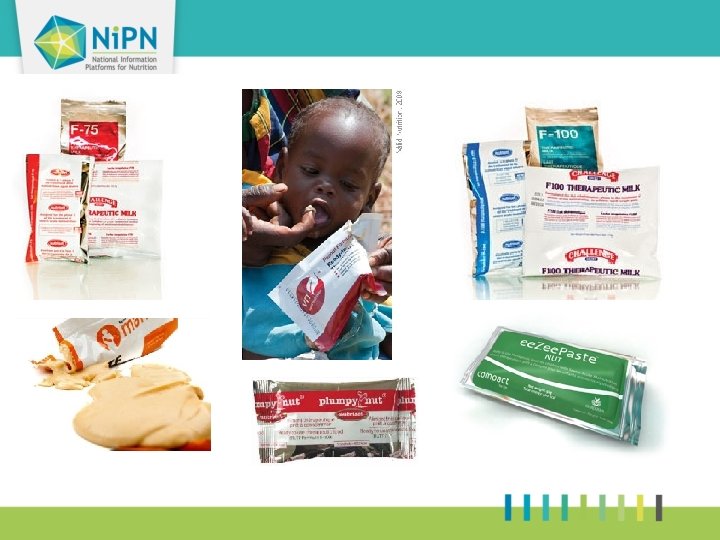

Nutrition overview How do we treat Chronic Malnutrition? 31
Nutrition overview What is IYCF? 32
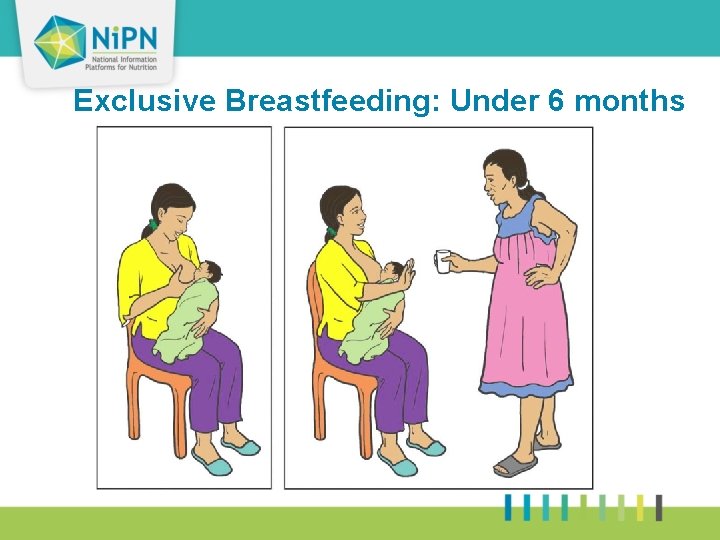
Exclusive Breastfeeding: Under 6 months
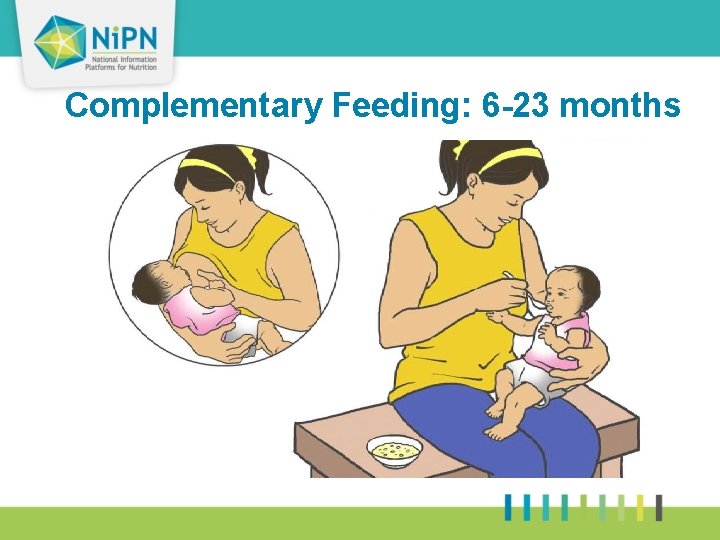
Complementary Feeding: 6 -23 months
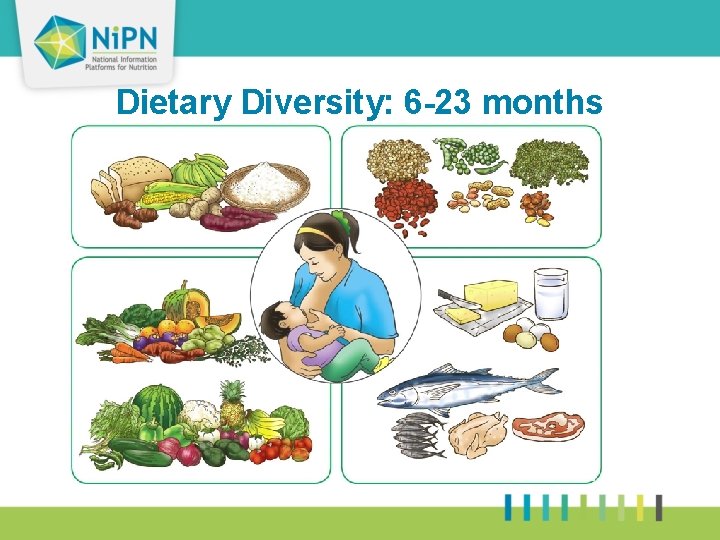
Dietary Diversity: 6 -23 months
Estimating Age 36 • Refer to child’s immunization card or other written document with the child’s age or date of birth written on it. • If the age of a neighbour’s child is known, ask whether or not their child was born before or after the selected child. • Use a local events calendar. • Use height cut-offs.
Estimating Age from Events Calendar 37 • Used when: – Households do not have any reliable document (birth certificate, medical diary, etc. ) confirming the date of birth of the children. – Surveyors must check or confirm an age (1 year, 2 and half years, etc. ) or a birth date given by a member of the household or a neighbour. • Must contain events from the last 60 months. • 4 important sections to have: – – Seasons: beginning of rainy season, dry season, etc. Religious holidays: Tabaski, Christmas, Maouloud, Easter, etc. Other events: elections, national holidays, etc. Local holidays: market days, construction, etc.
38 Estimating Age from Events Calendar • Start by locating the year of birth on the local calendar by refering to: – Some major event that occured that year. – Year of birth of another child. – Number of religious holidays (e. g. Child was born since 3 Christmasses, or 4 Ramadans, etc. ) • Locate the month of birth within that year: – Before or after this major event. – In a specific season (rainy season, dry season, winter, etc. )
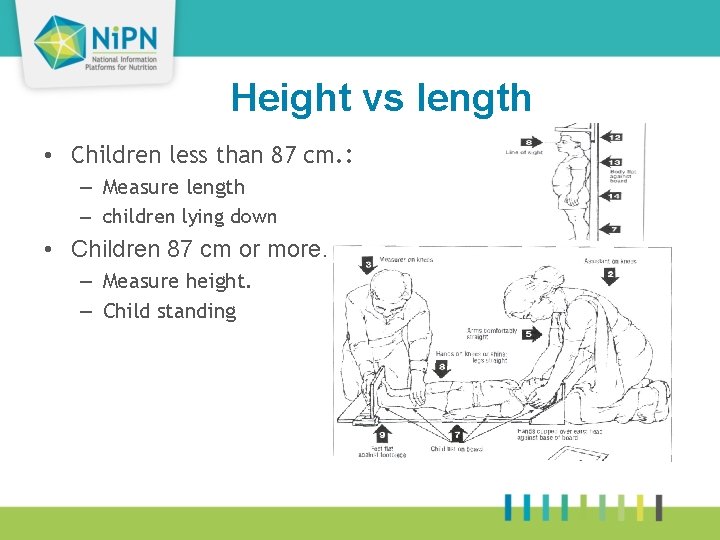
39 Height vs length • Children less than 87 cm. : – Measure length – children lying down • Children 87 cm or more. : – Measure height. – Child standing
Z-score tables 40 Different tables for: • Indices – WHA, HAZ, WFH • Sex – Boys/girls • Age – <2 years (lenght)/>2 years (height)
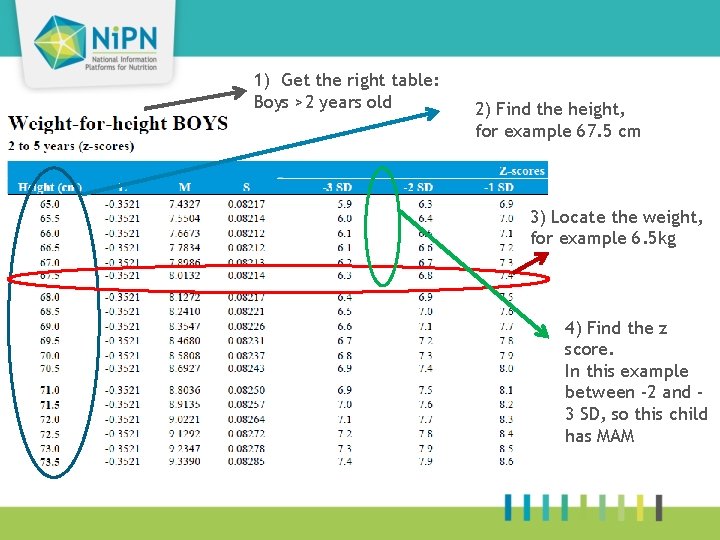
41 1) Get the right table: Boys >2 years old 2) Find the height, for example 67. 5 cm 3) Locate the weight, for example 6. 5 kg 4) Find the z score. In this example between -2 and 3 SD, so this child has MAM
5 min Snapshot Question Why are the 6 -59 months, the most targeted population in anthropometric surveys?
Children 6 to 59 months old 43 ¨ Nutritional Status: Indication of the severity of the situation in the whole population. ¨ In growth period. ¨ Particularly vulnerable to disease and food shortage ¨ Face a higher risk of mortality in cases of crises. ¨ Considered to be the most sensitive to nutritional stress.
44 Children 6 to 59 months • Easier to measure: – Measurement equipment is less bulky. – Possible to undress them when taking measurements. • Generally at home. • Stakeholders are used to this type of data and appropriate response. • Lots of expertise in surveys for this age group. • Anthropometric indicators and references are internationally recognized.
5 min Snapshot Question what types of measurement errors do you think are common when measuring anthropometric indicators?
Excercise 1 • Divide in 4 groups: A, B, C and D • What is the age and nutritional status of these children? • For each child calculate – – Age (you need the events calendar) WFH (you need to use the WFH tables) HAZ (you need to use the HFA tables) Nutritional status: normal, MAM, SAM or stunted 46
- Slides: 46