
Nutrition Nutritional Requirements Components of a Healthy Diet

- Slides: 35
Nutrition
Nutritional Requirements: Components of a Healthy Diet Essential nutrients = substances the body must get from food because it cannot manufacture them at all or fast enough to meet its needs Proteins q Carbohydrates q Fats q Vitamins q Minerals q Water q
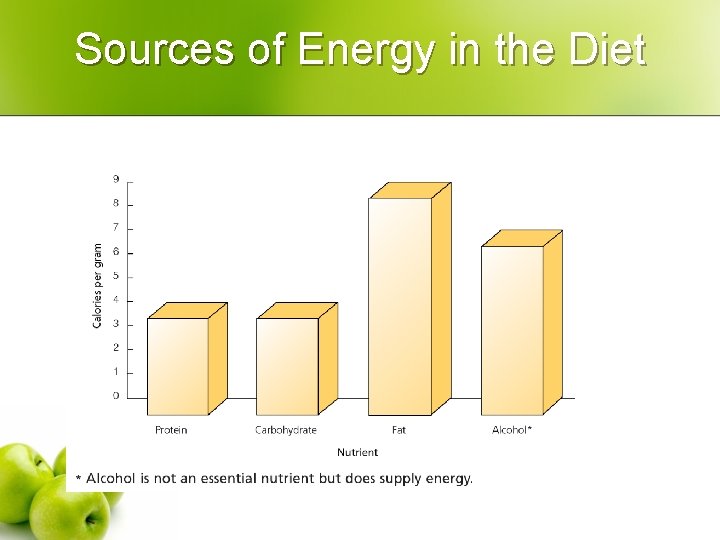
Energy from Food l l Three classes of essential nutrients supply energy Kilocalorie = a measure of energy content in food; the amount of heat it takes to raise the temperature of 1 liter of water 1°C; commonly referred to as “calorie”
Sources of Energy in the Diet
Proteins—The Basis of Body Structure l l l Protein = a compound made of amino acids that contains carbon, hydrogen, oxygen, and nitrogen Of twenty common amino acids in foods, nine are essential Proteins form key parts of the body’s main structural components—muscles and bones—and of blood, enzymes, cell membranes, and some hormones
Complete and Incomplete Proteins l l Complete protein sources = foods that supply all the essential amino acids in adequate amounts l Meat, fish, poultry, eggs, milk, cheese, and soy Incomplete protein sources = foods that supply most but not all essential amino acids l Plants, including legumes, grains, and nuts
Recommended Protein Intake l l Adequate daily intake of protein = 0. 8 gram per kilogram (0. 36 gram per pound) of body weight Acceptable Macronutrient Distribution Range = 10– 35% of total daily calories as protein
Fats—Essential in Small Amounts l l Fats supply energy, insulate the body, support and cushion organs, absorb fat-soluble vitamins, add flavor and texture to foods Essential fats (linoleic acid and alpha-linolenic acid) are key regulators of body process such as the maintenance of blood pressure and the progress of a healthy pregnancy
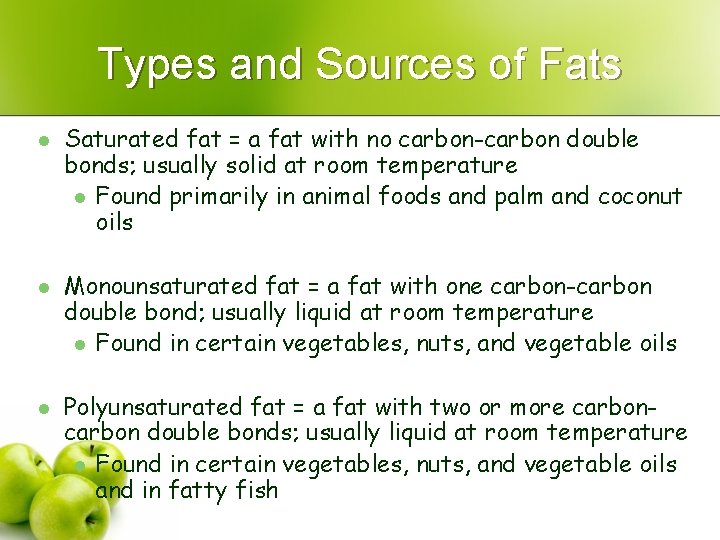
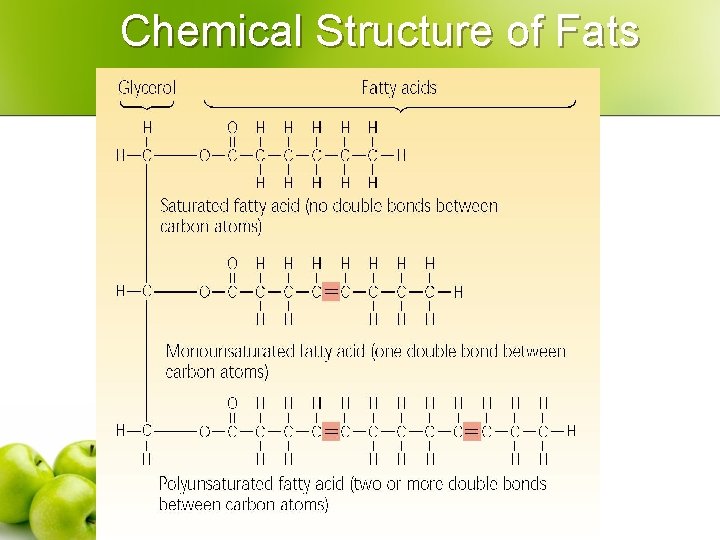
Types and Sources of Fats l l l Saturated fat = a fat with no carbon-carbon double bonds; usually solid at room temperature l Found primarily in animal foods and palm and coconut oils Monounsaturated fat = a fat with one carbon-carbon double bond; usually liquid at room temperature l Found in certain vegetables, nuts, and vegetable oils Polyunsaturated fat = a fat with two or more carbon double bonds; usually liquid at room temperature l Found in certain vegetables, nuts, and vegetable oils and in fatty fish
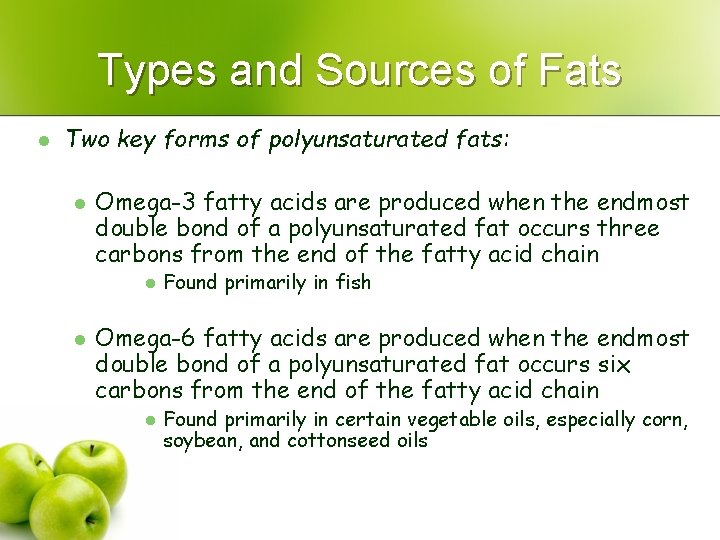
Types and Sources of Fats l Two key forms of polyunsaturated fats: l Omega-3 fatty acids are produced when the endmost double bond of a polyunsaturated fat occurs three carbons from the end of the fatty acid chain l l Found primarily in fish Omega-6 fatty acids are produced when the endmost double bond of a polyunsaturated fat occurs six carbons from the end of the fatty acid chain l Found primarily in certain vegetable oils, especially corn, soybean, and cottonseed oils
Chemical Structure of Fats
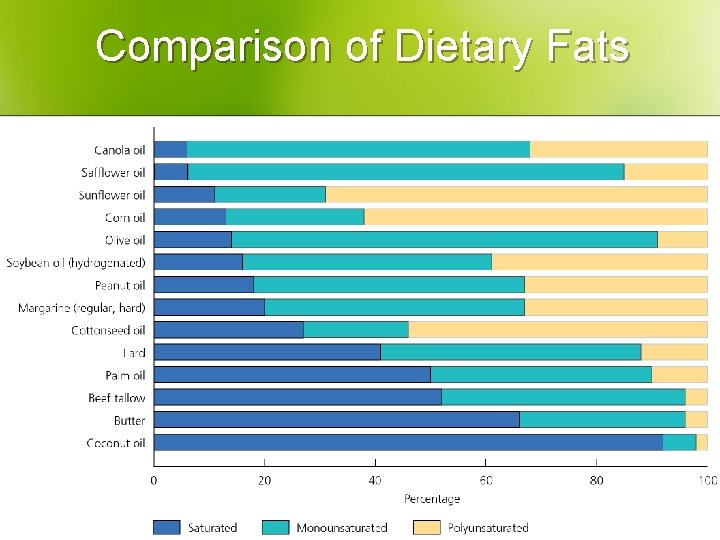
Comparison of Dietary Fats
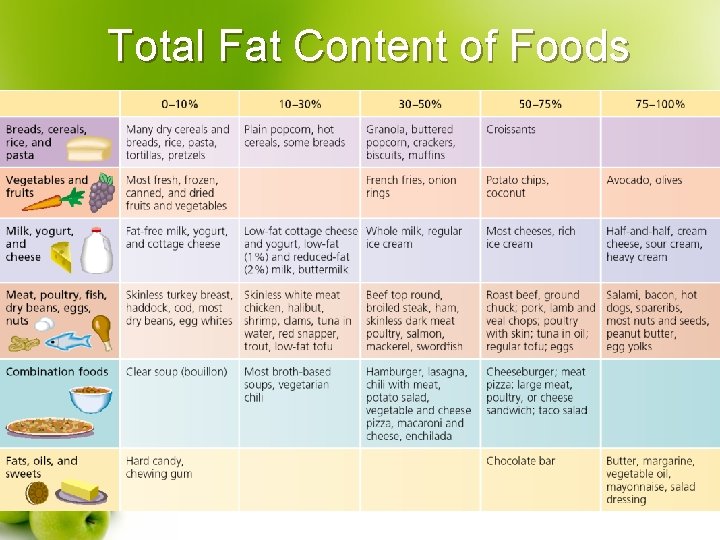
Total Fat Content of Foods
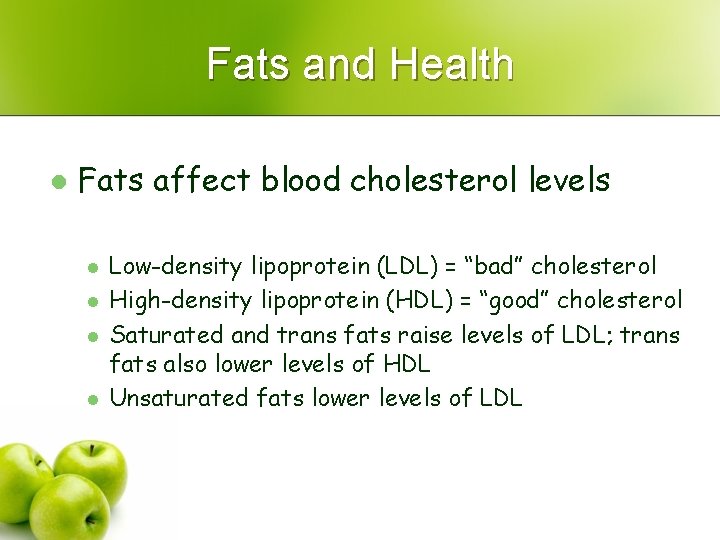
Fats and Health l Fats affect blood cholesterol levels l l Low-density lipoprotein (LDL) = “bad” cholesterol High-density lipoprotein (HDL) = “good” cholesterol Saturated and trans fats raise levels of LDL; trans fats also lower levels of HDL Unsaturated fats lower levels of LDL
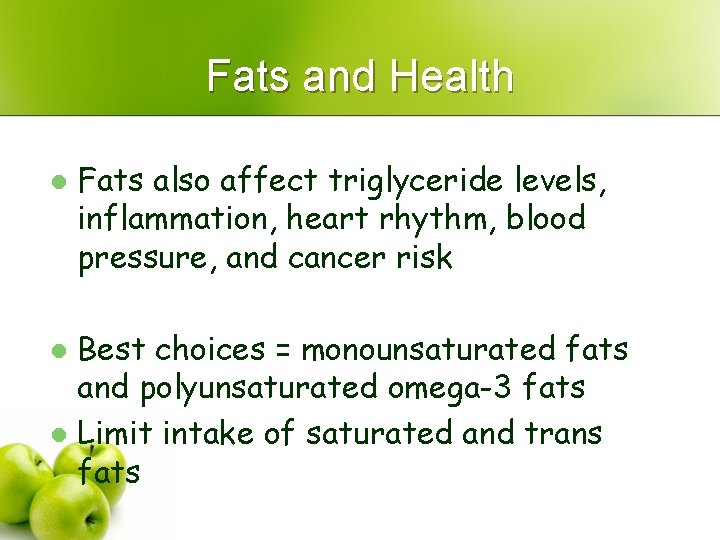
Fats and Health l Fats also affect triglyceride levels, inflammation, heart rhythm, blood pressure, and cancer risk Best choices = monounsaturated fats and polyunsaturated omega-3 fats l Limit intake of saturated and trans fats l
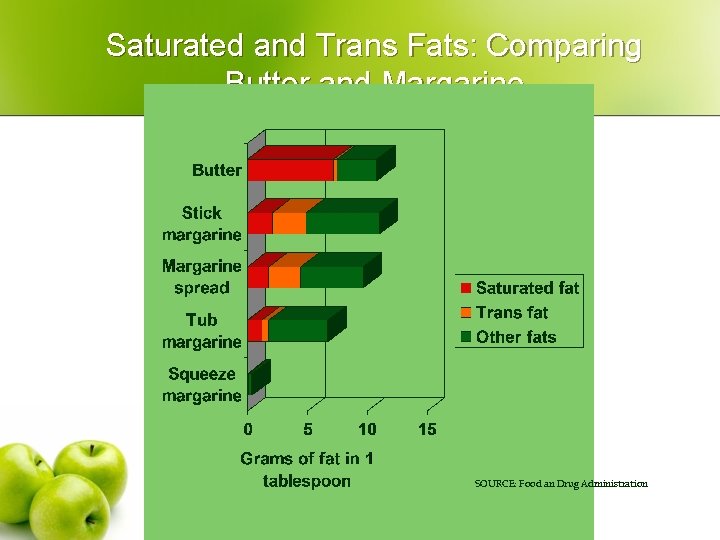
Saturated and Trans Fats: Comparing Butter and Margarine SOURCE: Food an Drug Administration
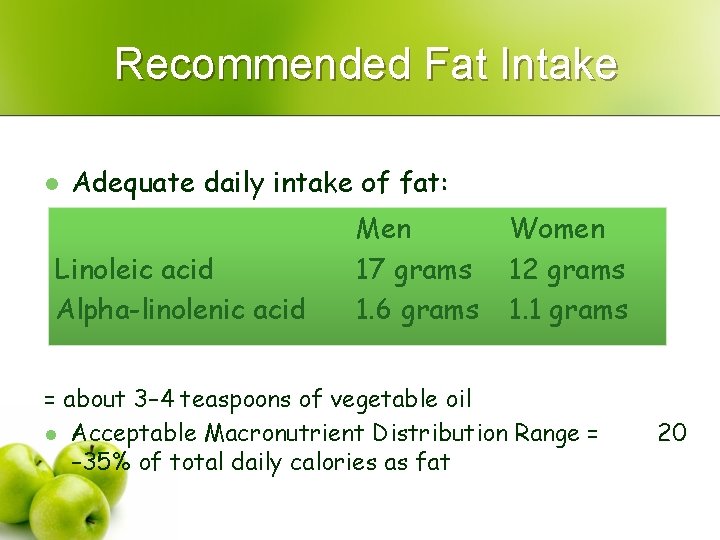
Recommended Fat Intake l Adequate daily intake of fat: Linoleic acid Alpha-linolenic acid Men 17 grams 1. 6 grams Women 12 grams 1. 1 grams = about 3– 4 teaspoons of vegetable oil l Acceptable Macronutrient Distribution Range = – 35% of total daily calories as fat 20
Carbohydrates—An Ideal Source of Energy l l The primary function of dietary carbohydrate is to supply energy to body cells. Some cells, such as those in the brain, nervous system, and blood, use only carbohydrates for fuel During high-intensity exercise, muscles get most of their energy from carbohydrates During digestion, carbohydrates are broken into single sugar molecules such as glucose for absorption; the liver and muscles take up glucose and store it in the form of glycogen
Simple and Complex Carbohydrates l l Simple carbohydrates contain one or two sugar units in each molecule l Found naturally in fruits and milk and added to many other foods l Include sucrose, fructose, maltose, and lactose Complex carbohydrates consist of chains of many sugar molecules l Found in plants, especially grains, legumes, and tubers l Include starches and most types of dietary fiber
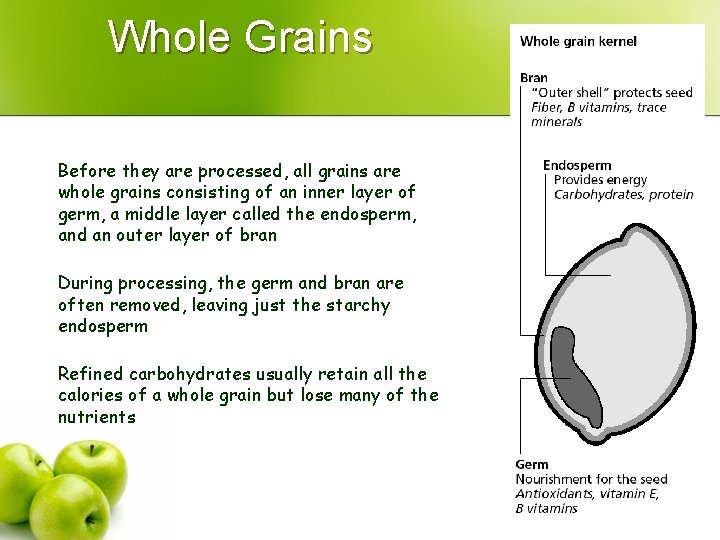
Whole Grains Before they are processed, all grains are whole grains consisting of an inner layer of germ, a middle layer called the endosperm, and an outer layer of bran During processing, the germ and bran are often removed, leaving just the starchy endosperm Refined carbohydrates usually retain all the calories of a whole grain but lose many of the nutrients
Refined Carbohydrates Versus Whole Grains l l l Whole grains are higher than refined carbohydrates in fiber, vitamins, minerals, and other beneficial compounds Whole grains take longer to digest l Make people feel full sooner l Cause a slower rise in glucose levels Choose foods that have a whole grain as the first item on the ingredient list on the food label l Whole wheat, whole rye, whole oats, oatmeal, wholegrain corn, brown rice, popcorn, barley, etc.
Recommended Carbohydrate Intake l l l Adequate daily intake of carbohydrate = 130 grams Acceptable Macronutrient Distribution Range = 45– 65% of total daily calories as carbohydrate Limit on intake of added sugars l Food and Nutrition Board: 25% or less of total daily calories l World Health Organization: 10% or less of total daily calories
Acceptable Macronutrient Distribution Ranges: Summary l Protein = 10– 35% of total daily calories l Fat = 20– 35% of total daily calories l Carbohydrate = 45– 65% of total daily calories
Fiber—A Closer Look l l l Dietary fiber = nondigestible carbohydrates and lignin that are present naturally in plants Functional fiber = nondigestible carbohydrates isolated from natural sources or synthesized in a lab and added to a food or supplement Total fiber = dietary fiber + functional fiber
Sources of Fiber l l All plant foods contain fiber, but processing can remove it Good sources of fiber: l Fruits (especially whole, unpeeled fruits) l Vegetables l Legumes l Oats (especially oat bran) l Whole grains and wheat bran l Psyllium (found in some cereals and laxatives)
Recommended Intake of Fiber Women = 25 grams per day l Men = 38 grams per day l l Americans currently consume about half this amount
Vitamins—Organic Micronutrients l l l Vitamins = organic (carbon-containing) substances needed in small amounts to help promote and regulate chemical reactions and processes in body cells. Four vitamins are fat-soluble (A, D, E, and K) Nine vitamins are water-soluble (C and the eight Bcomplex vitamins: thiamin, riboflavin, niacin, vitamin B-6, folate, vitamin B-12, biotin, and pantothenic acid)
Vitamins l l l Vitamins are abundant in fruits, vegetables, and grains; they are also added to some processed foods If you consume too much or too little of a particular vitamin, characteristic symptoms of excess or deficiency can develop Vitamins commonly lacking in the American diet: l l Vitamin A Vitamin E Vitamin B-6 Vitamin C
Minerals l l If you consume too much or too little of a particular mineral, characteristic symptoms of excess or deficiency can develop Minerals commonly lacking in the American diet: l Iron = low intake can cause anemia l Calcium = low intake linked to osteoporosis l Potassium = low intake linked to elevated blood pressure and bone mineral loss
Water—A Vital Component l l Human body is composed of about 60% water; you can live only a few days without water Foods and fluids you consume provide 80– 90% of your daily water intake Adequate intake to maintain hydration: l Women need to drink about 9 cups of fluid per day l Men need to drink about 13 cups of fluid per day Drink in response to thirst; consume additional fluids for heavy exercise
Should You Take Supplements? l l The Food and Nutrition Board recommends supplements only for certain groups: l Folic acid for women capable of becoming pregnant (400 µg/day) l Vitamin B-12 for people over age 50 (2. 4 mg/day) Other possible situations for supplements: l Vitamin C for smokers l Iron for menstruating women l Vitamin K for newborns l People with certain special health concerns
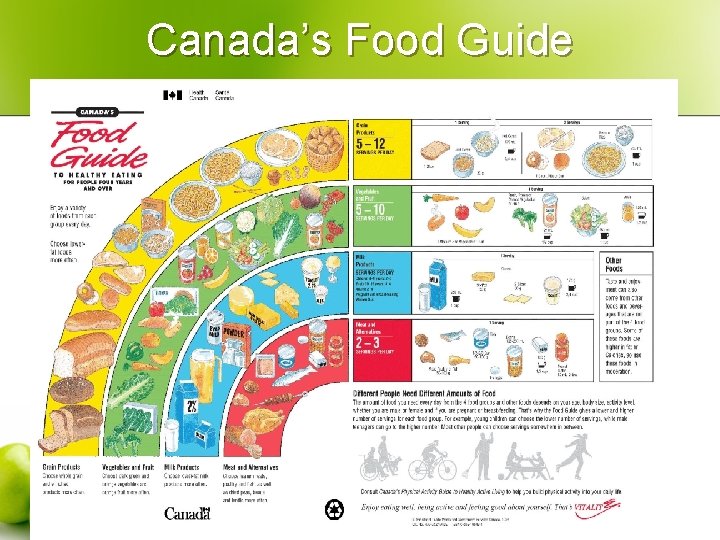
Canada’s Food Guide
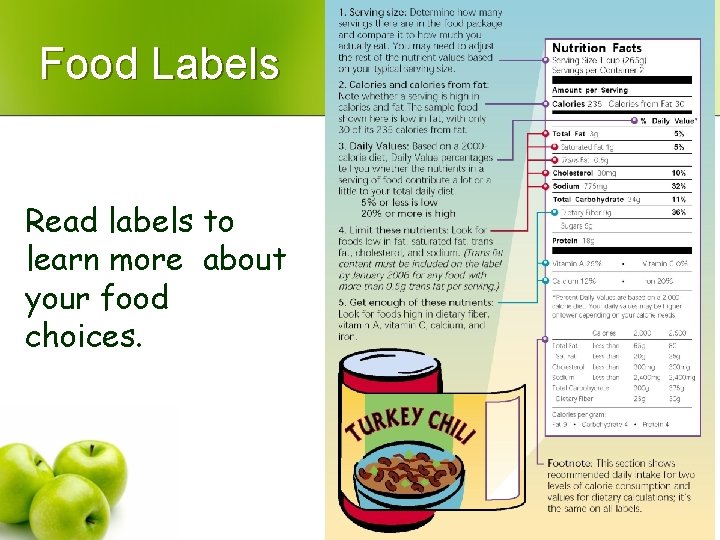
Food Labels Read labels to learn more about your food choices.
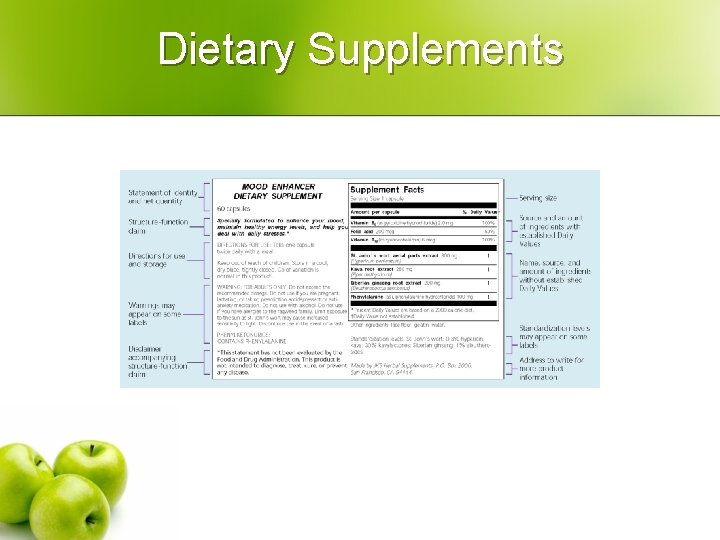
Dietary Supplements May contain powerful bioactive chemicals l Not regulated the way drugs are by the FDA in terms of testing and manufacture l May interact with prescription and overthe-counter drugs and supplements l
Dietary Supplements