
Nutrition Labelling and Children Adolescents Children and Adolescents
Nutrition Labelling and Children & Adolescents
Children and Adolescents n n n Important stage of growth and development Adequate nutrients to meet the needs of growth and development Inadequate nutritional intake ¡ ¡ n delay body growth/ development adversely affect mental development and learning abilities Excessive nutritional intake ¡ ¡ overweight/ obese increase risk of developing chronic diseases 2
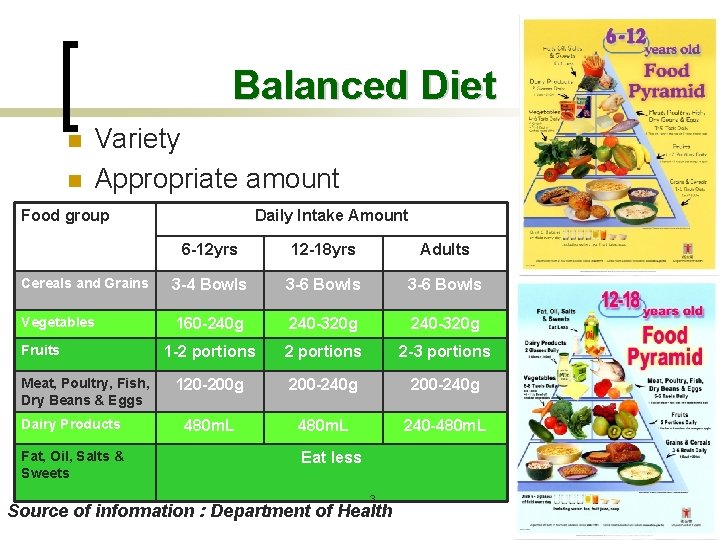
Balanced Diet n n Variety Appropriate amount Food group Daily Intake Amount 6 -12 yrs 12 -18 yrs Adults Cereals and Grains 3 -4 Bowls 3 -6 Bowls Vegetables 160 -240 g 240 -320 g 1 -2 portions 2 -3 portions 120 -200 g 200 -240 g 480 m. L 240 -480 m. L Fruits Meat, Poultry, Fish, Dry Beans & Eggs Dairy Products Fat, Oil, Salts & Sweets Eat less 3 Source of information : Department of Health
Principles of Healthy Eating n n Adopt “ 3 Low 1 High” Healthy Eating Principles Choose food low in fat, sodium and sugars as well as high in dietary fibre 4
Growth and Development n n Children and adolescents at stage of puberty Rapid growing n Important stage of muscle, bone and teeth development ¡ Bone development occurs during childhood and adolescence ¡ The higher the density of the bones formed, the lower is the risk of developing osteoporosis n Balanced diet ¡ ¡ E. g. choose food rich in calcium Get enough energy and protein 5
Childhood Obesity n n Obesity has become more and more common in both developed and developing countries Affecting children/adolescent. The prevalence is on the rise Consequences/Impact of childhood obesity: ¡ ¡ ¡ More likely to stay obese into adulthood Increase the risk of developing chronic diseases such as diabetes, high blood pressure and heart diseases at a younger age May have lower self-esteem and poorer body image 6
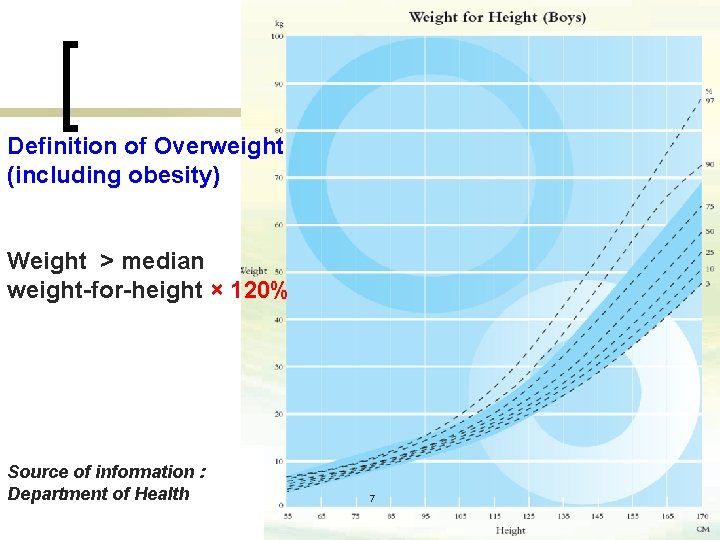
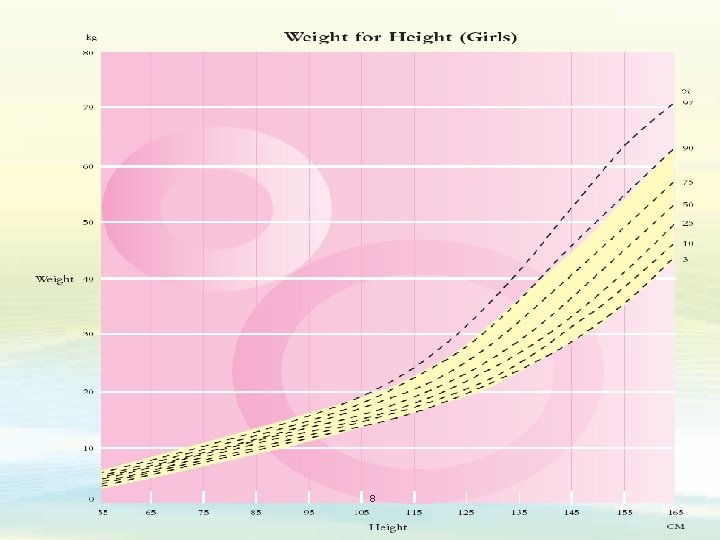
Definition of Overweight (including obesity) Weight > median weight-for-height × 120% Source of information : Department of Health 7
8
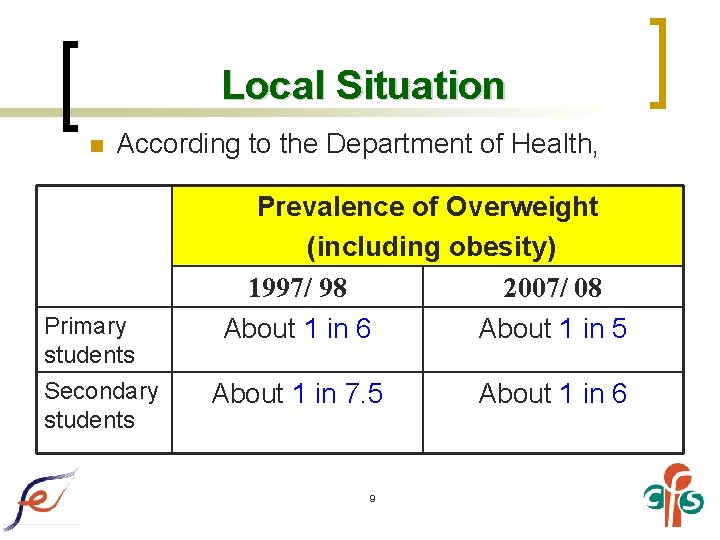
Local Situation n According to the Department of Health, Primary students Secondary students Prevalence of Overweight (including obesity) 1997/ 98 2007/ 08 About 1 in 6 About 1 in 5 About 1 in 7. 5 9 About 1 in 6
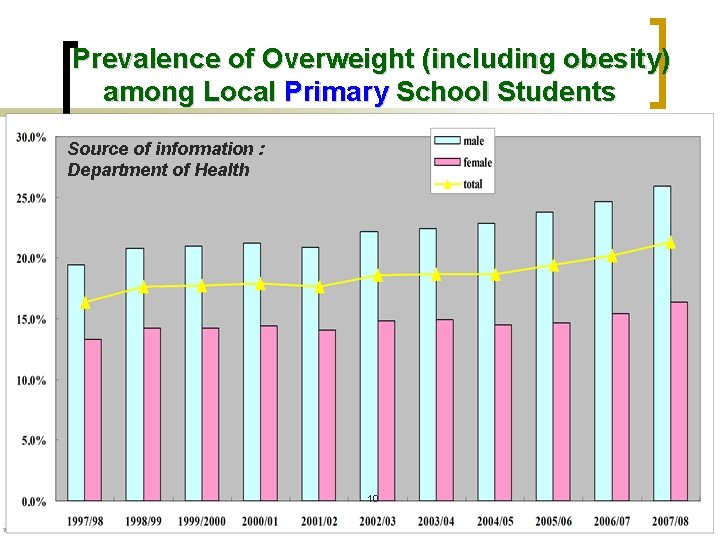
Prevalence of Overweight (including obesity) among Local Primary School Students Source of information : Department of Health 10
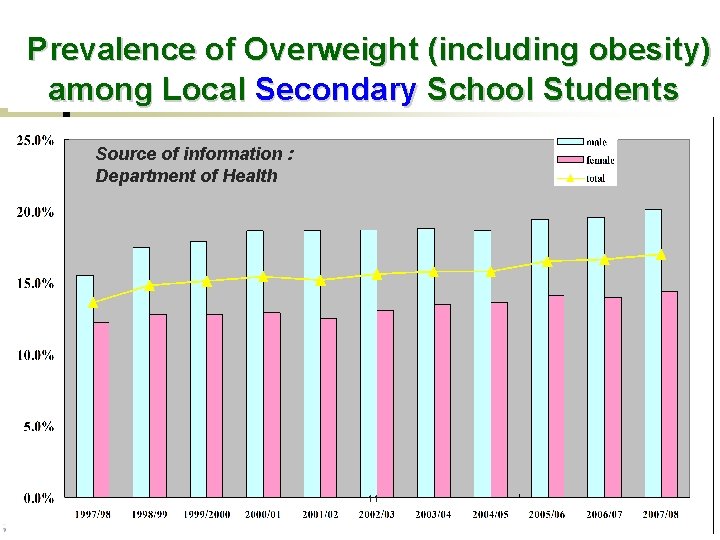
Prevalence of Overweight (including obesity) among Local Secondary School Students Source of information : Department of Health 11
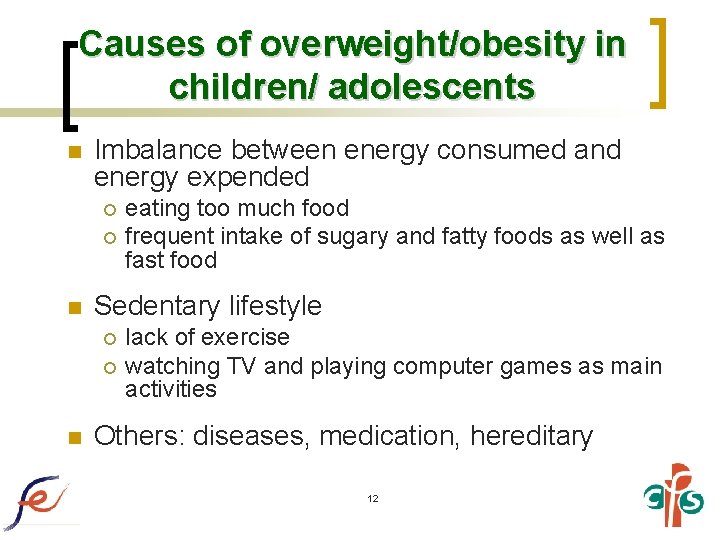
Causes of overweight/obesity in children/ adolescents n Imbalance between energy consumed and energy expended ¡ ¡ n Sedentary lifestyle ¡ ¡ n eating too much food frequent intake of sugary and fatty foods as well as fast food lack of exercise watching TV and playing computer games as main activities Others: diseases, medication, hereditary 12
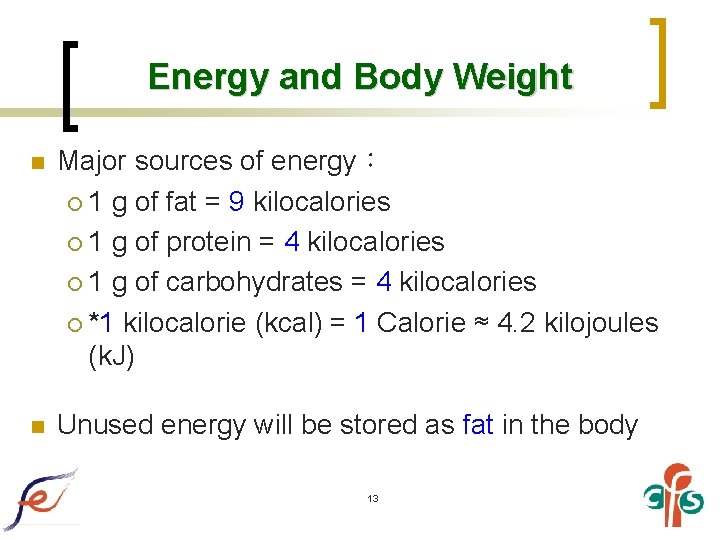
Energy and Body Weight n Major sources of energy: ¡ 1 g of fat = 9 kilocalories ¡ 1 g of protein = 4 kilocalories ¡ 1 g of carbohydrates = 4 kilocalories ¡ *1 kilocalorie (kcal) = 1 Calorie ≈ 4. 2 kilojoules (k. J) n Unused energy will be stored as fat in the body 13
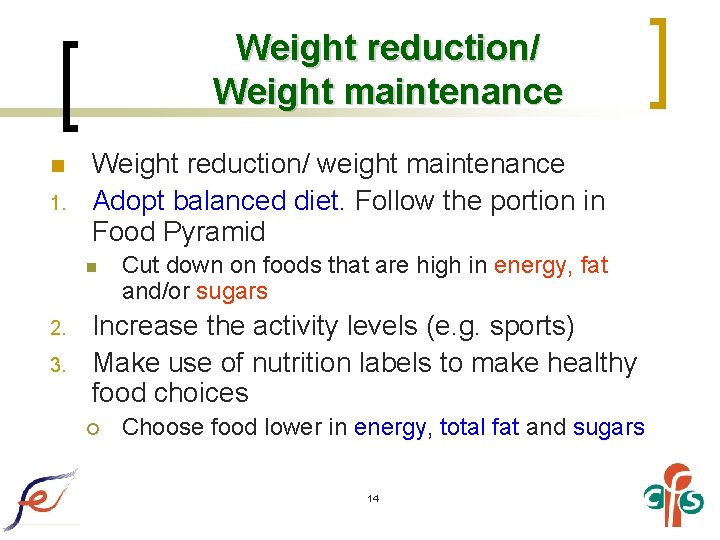
Weight reduction/ Weight maintenance n 1. Weight reduction/ weight maintenance Adopt balanced diet. Follow the portion in Food Pyramid n 2. 3. Cut down on foods that are high in energy, fat and/or sugars Increase the activity levels (e. g. sports) Make use of nutrition labels to make healthy food choices ¡ Choose food lower in energy, total fat and sugars 14
Read and Use Nutrition Labels
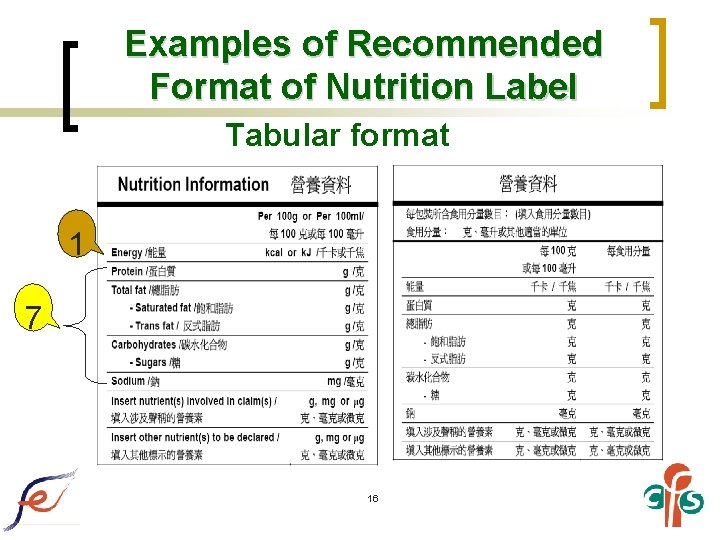
Examples of Recommended Format of Nutrition Label Tabular format 1 7 16
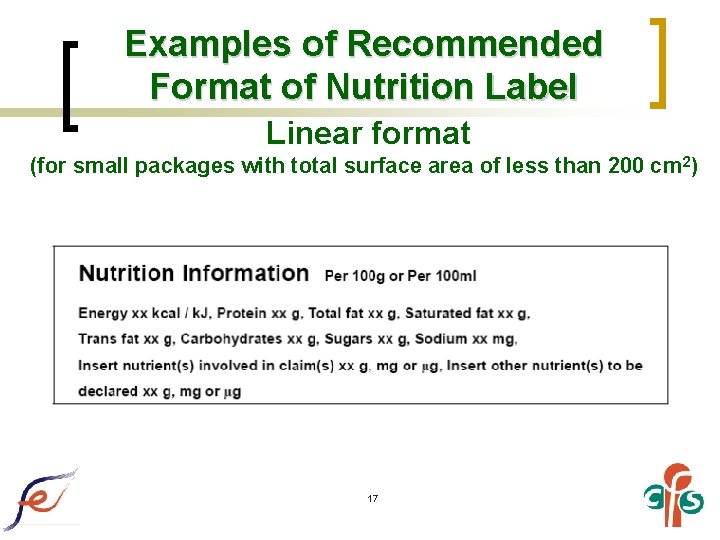
Examples of Recommended Format of Nutrition Label Linear format (for small packages with total surface area of less than 200 cm 2) 17
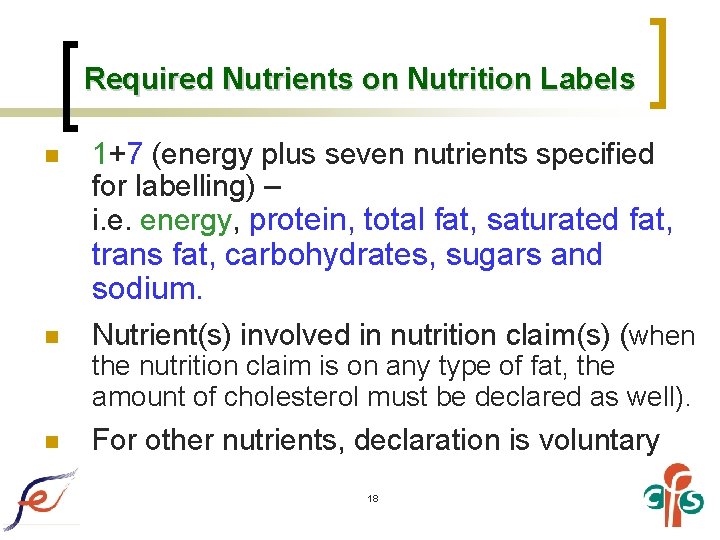
Required Nutrients on Nutrition Labels n 1+7 (energy plus seven nutrients specified for labelling) – i. e. energy, protein, total fat, saturated fat, trans fat, carbohydrates, sugars and sodium. n Nutrient(s) involved in nutrition claim(s) (when the nutrition claim is on any type of fat, the amount of cholesterol must be declared as well). n For other nutrients, declaration is voluntary 18
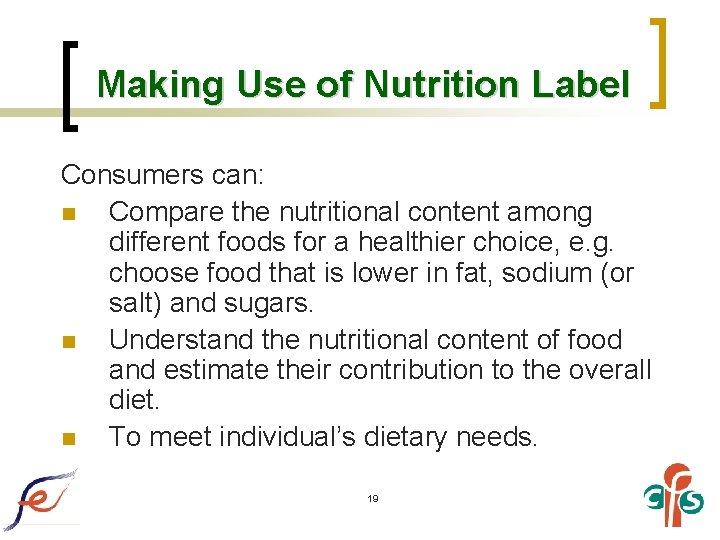
Making Use of Nutrition Label Consumers can: n Compare the nutritional content among different foods for a healthier choice, e. g. choose food that is lower in fat, sodium (or salt) and sugars. n Understand the nutritional content of food and estimate their contribution to the overall diet. n To meet individual’s dietary needs. 19
Three Simple Steps to Read Nutrition Label
Three Simple Steps to Read Nutrition Label Step 1 n Take note of the reference amount of food being used in the nutrition label Step 2 n Read the energy and nutrient content together with the reference amount Step 3 n Refer to the percentage Nutrient Reference Value (%NRV), if available, to see if the food contains a lot or a little of energy or a nutrient in the food 21
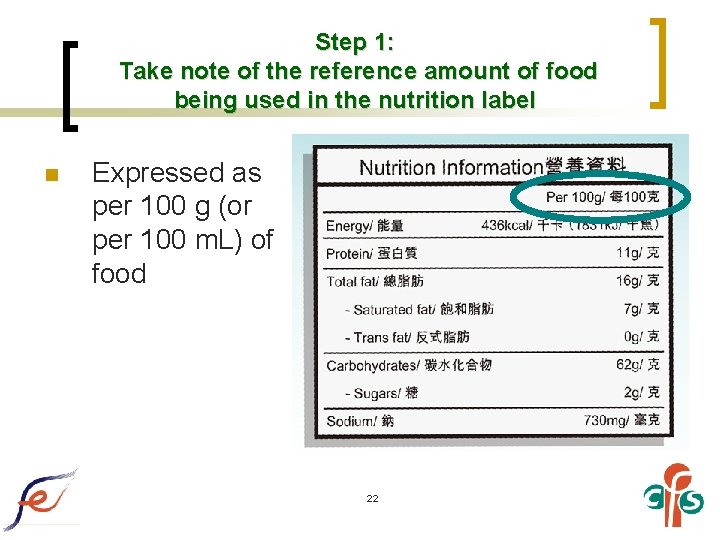
Step 1: Take note of the reference amount of food being used in the nutrition label n Expressed as per 100 g (or per 100 m. L) of food 22
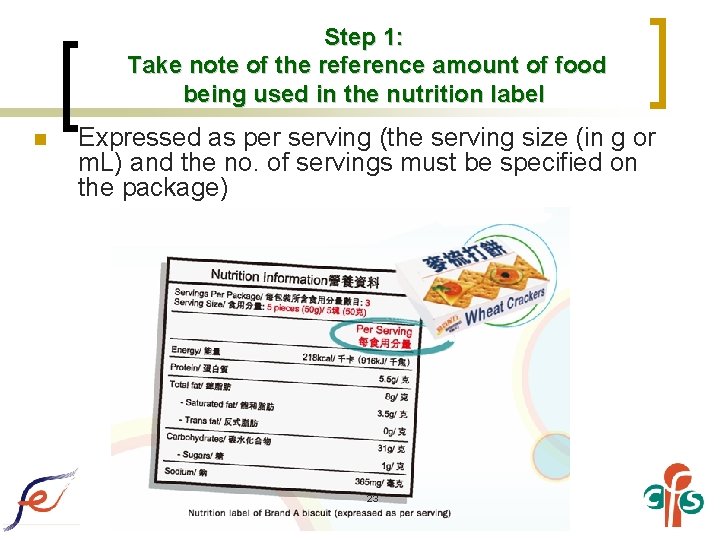
Step 1: Take note of the reference amount of food being used in the nutrition label n Expressed as per serving (the serving size (in g or m. L) and the no. of servings must be specified on the package) 23
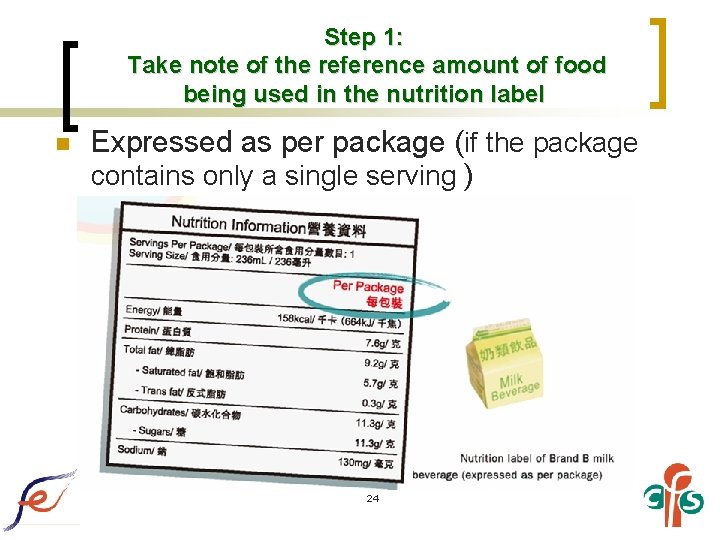
Step 1: Take note of the reference amount of food being used in the nutrition label n Expressed as per package (if the package contains only a single serving ) 24
Step 2: Read the energy and nutrient content together with the reference amount A) Use nutrition label to compare between products B) Use nutrition label to calculate the amount of energy and nutrients you get from food 25
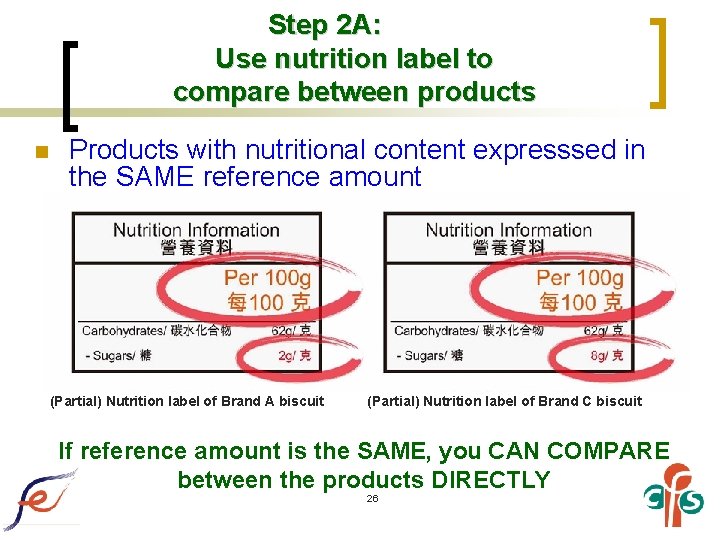
Step 2 A: Use nutrition label to compare between products n Products with nutritional content expresssed in the SAME reference amount (Partial) Nutrition label of Brand A biscuit (Partial) Nutrition label of Brand C biscuit If reference amount is the SAME, you CAN COMPARE between the products DIRECTLY 26
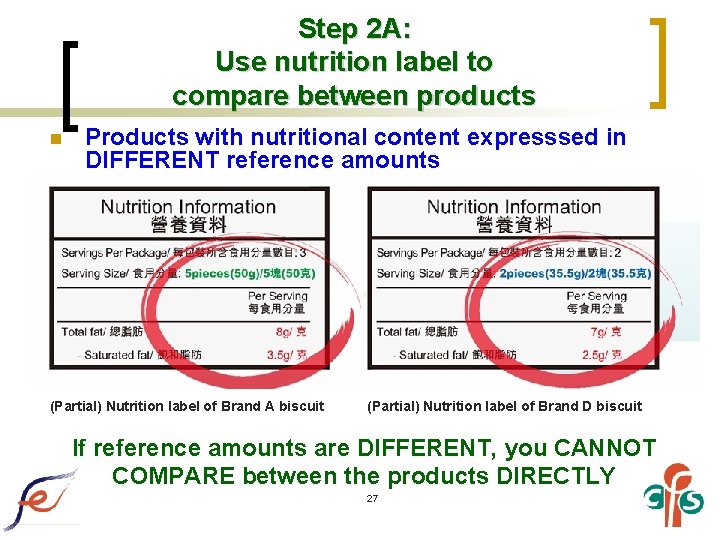
Step 2 A: Use nutrition label to compare between products n Products with nutritional content expresssed in DIFFERENT reference amounts (Partial) Nutrition label of Brand A biscuit (Partial) Nutrition label of Brand D biscuit If reference amounts are DIFFERENT, you CANNOT COMPARE between the products DIRECTLY 27
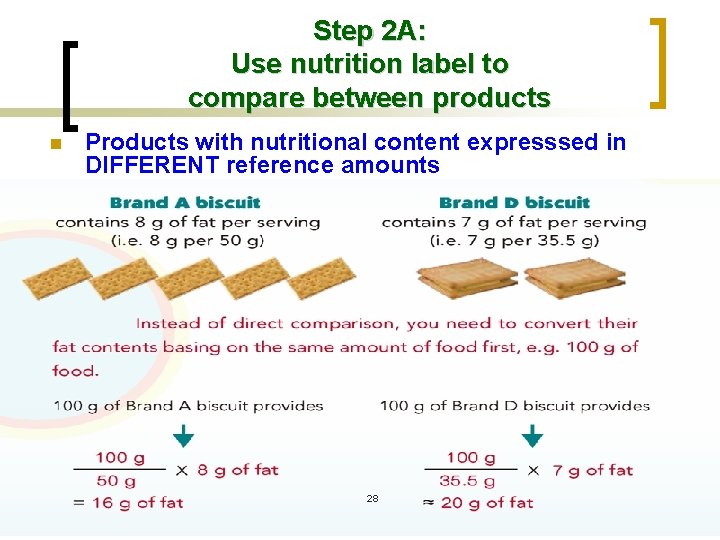
Step 2 A: Use nutrition label to compare between products n Products with nutritional content expresssed in DIFFERENT reference amounts 28
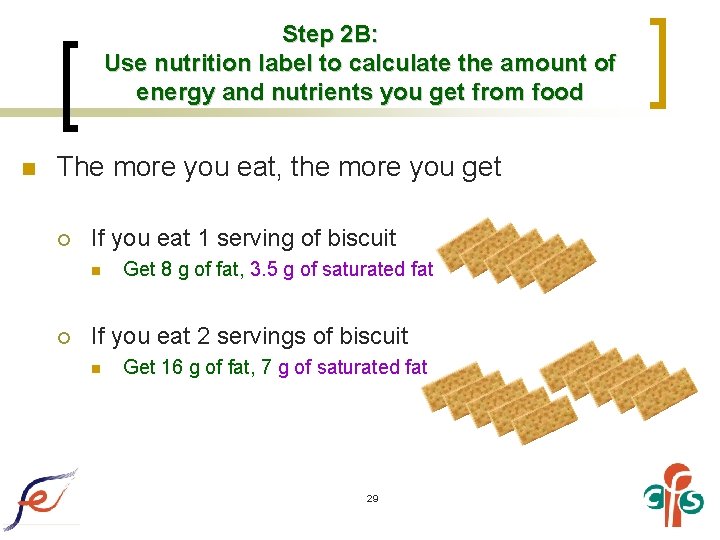
Step 2 B: Use nutrition label to calculate the amount of energy and nutrients you get from food n The more you eat, the more you get ¡ If you eat 1 serving of biscuit n ¡ Get 8 g of fat, 3. 5 g of saturated fat If you eat 2 servings of biscuit n Get 16 g of fat, 7 g of saturated fat 29
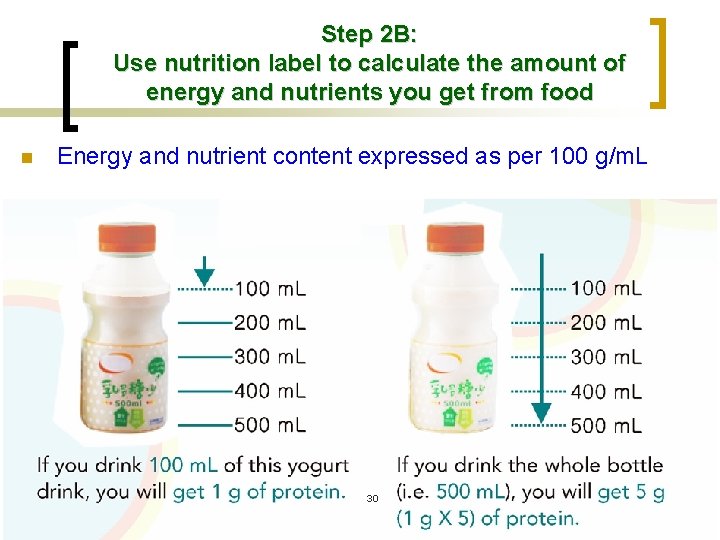
Step 2 B: Use nutrition label to calculate the amount of energy and nutrients you get from food n Energy and nutrient content expressed as per 100 g/m. L 30
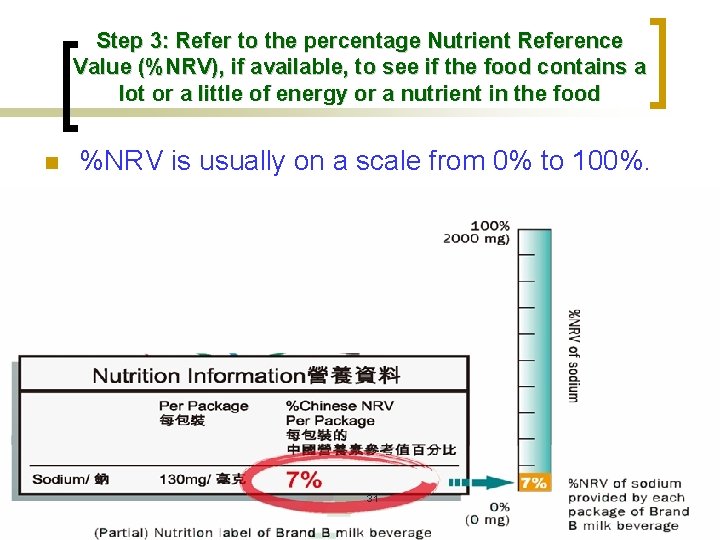
Step 3: Refer to the percentage Nutrient Reference Value (%NRV), if available, to see if the food contains a lot or a little of energy or a nutrient in the food n %NRV is usually on a scale from 0% to 100%. 31
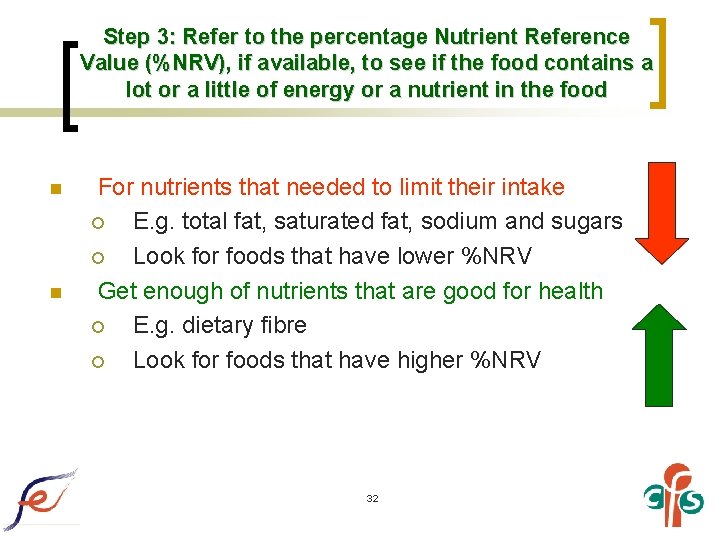
Step 3: Refer to the percentage Nutrient Reference Value (%NRV), if available, to see if the food contains a lot or a little of energy or a nutrient in the food n n For nutrients that needed to limit their intake ¡ E. g. total fat, saturated fat, sodium and sugars ¡ Look for foods that have lower %NRV Get enough of nutrients that are good for health ¡ E. g. dietary fibre ¡ Look for foods that have higher %NRV 32
Use Nutrition Label to Choose Prepackaged Food for Children/Adolescents
Nutrition Labelling is a Useful Tool for Practising Healthy Eating n Nutrition label and nutrition claim can help children/adolescents choose suitable prepackaged food in accordance with healthy eating principles and their own physical conditions, e. g. ¡ ¡ Choose food higher in calcium For weight control, choose food lower in energy, total fat and sugars 34
How to Choose Prepackaged Food for Children/Adolescents 1. Use nutrition claim as a quick screening tool; and 2. Take three simple steps to read nutrition label 35
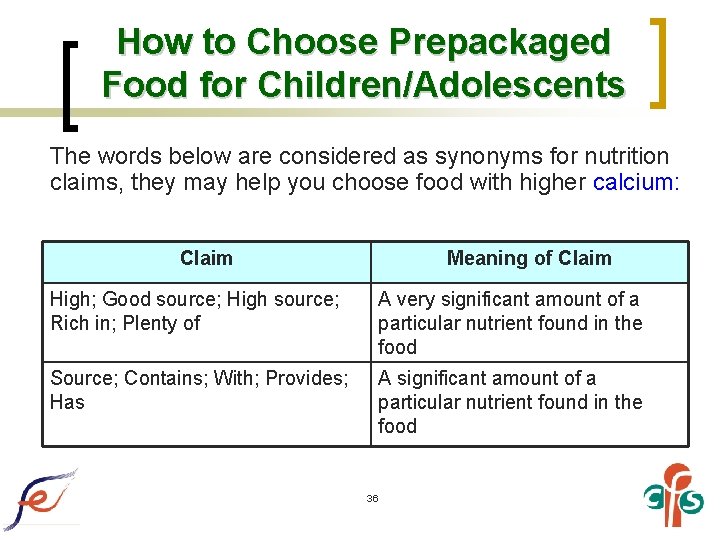
How to Choose Prepackaged Food for Children/Adolescents The words below are considered as synonyms for nutrition claims, they may help you choose food with higher calcium: Claim Meaning of Claim High; Good source; High source; Rich in; Plenty of A very significant amount of a particular nutrient found in the food Source; Contains; With; Provides; Has A significant amount of a particular nutrient found in the food 36
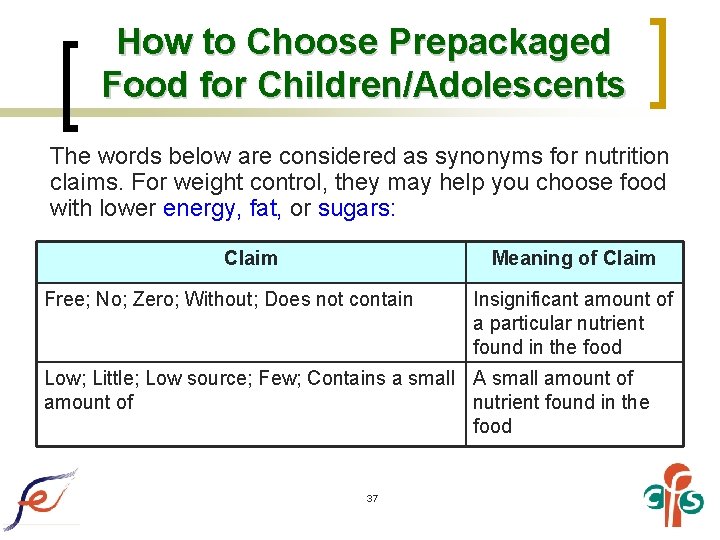
How to Choose Prepackaged Food for Children/Adolescents The words below are considered as synonyms for nutrition claims. For weight control, they may help you choose food with lower energy, fat, or sugars: Claim Meaning of Claim Free; No; Zero; Without; Does not contain Insignificant amount of a particular nutrient found in the food Low; Little; Low source; Few; Contains a small A small amount of nutrient found in the food 37
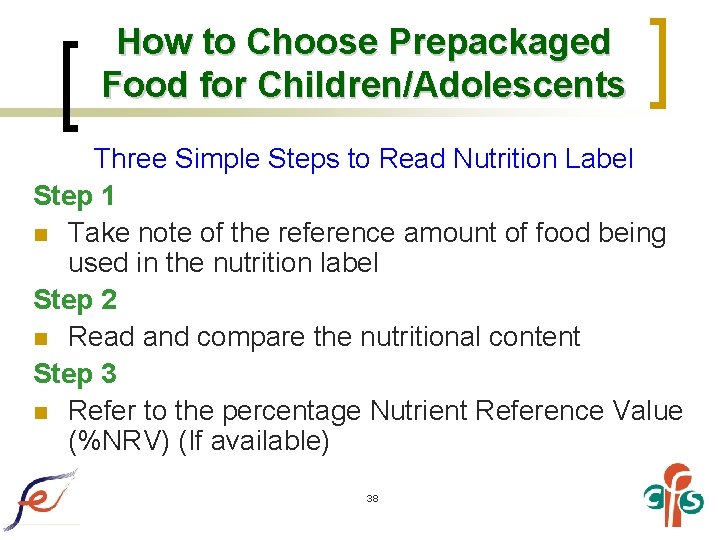
How to Choose Prepackaged Food for Children/Adolescents Three Simple Steps to Read Nutrition Label Step 1 n Take note of the reference amount of food being used in the nutrition label Step 2 n Read and compare the nutritional content Step 3 n Refer to the percentage Nutrient Reference Value (%NRV) (If available) 38
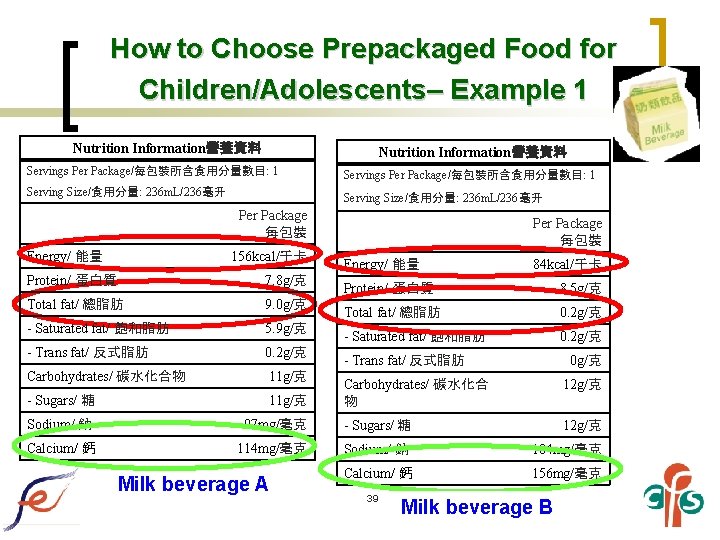
How to Choose Prepackaged Food for Children/Adolescents– Example 1 Nutrition Information營養資料 Servings Per Package/每包裝所含食用分量數目: 1 Serving Size/食用分量: 236 m. L/236毫升 Per Package 每包裝 Energy/ 能量 156 kcal/千卡 Protein/ 蛋白質 7. 8 g/克 Total fat/ 總脂肪 9. 0 g/克 - Saturated fat/ 飽和脂肪 5. 9 g/克 - Trans fat/ 反式脂肪 0. 2 g/克 Carbohydrates/ 碳水化合物 11 g/克 - Sugars/ 糖 11 g/克 Sodium/ 鈉 Calcium/ 鈣 Per Package 每包裝 Energy/ 能量 84 kcal/千卡 Protein/ 蛋白質 8. 5 g/克 Total fat/ 總脂肪 0. 2 g/克 - Saturated fat/ 飽和脂肪 0. 2 g/克 - Trans fat/ 反式脂肪 0 g/克 Carbohydrates/ 碳水化合 物 12 g/克 97 mg/毫克 - Sugars/ 糖 12 g/克 114 mg/毫克 Sodium/ 鈉 104 mg/毫克 Calcium/ 鈣 156 mg/毫克 Milk beverage A 39 Milk beverage B
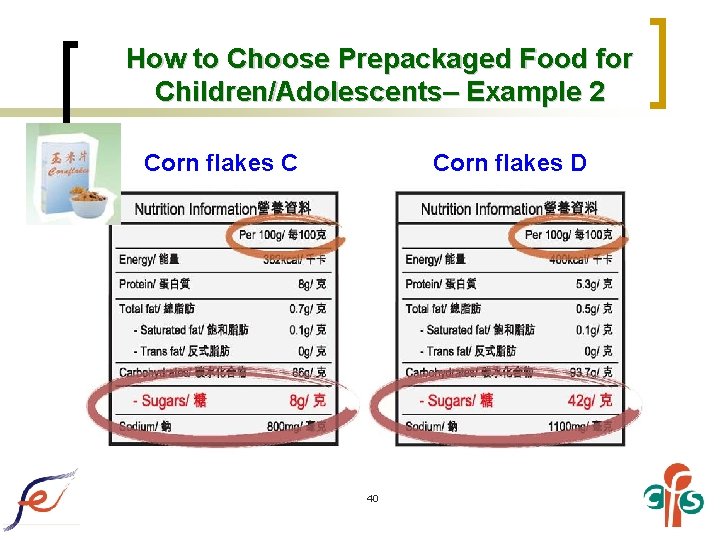
How to Choose Prepackaged Food for Children/Adolescents– Example 2 Corn flakes C Corn flakes D 40
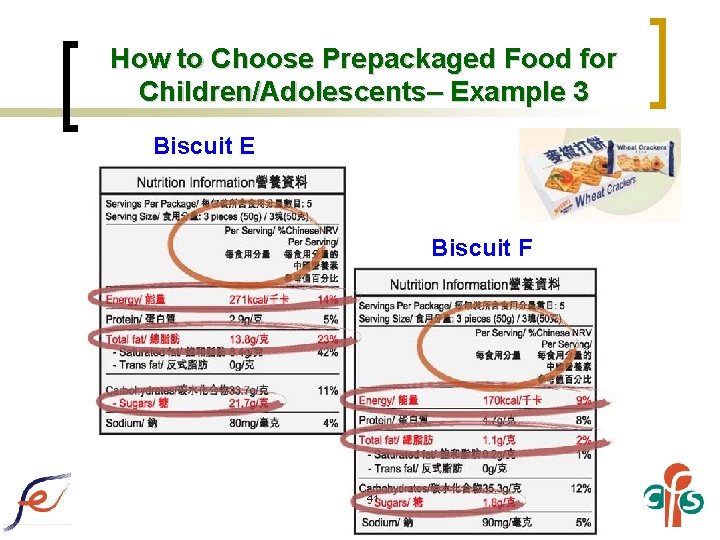
How to Choose Prepackaged Food for Children/Adolescents– Example 3 Biscuit E Biscuit F 41
Healthy Snacks n Healthy Snacks ¡ replenish the water and energy lost during daily activities ¡ Make up for those food groups and nutrients absent in main meals n Tips for eating snacks Snack between main meals. At least having 1. 5 - 2 hours between two intakes. - Snacks should be small in amount so as to avoid spoiling the appetite for the next main meal Choose more fresh and natural food For prepackaged food, choose those “ 3 Low” products – Lower in fat, sodium (salt) and sugars - 42
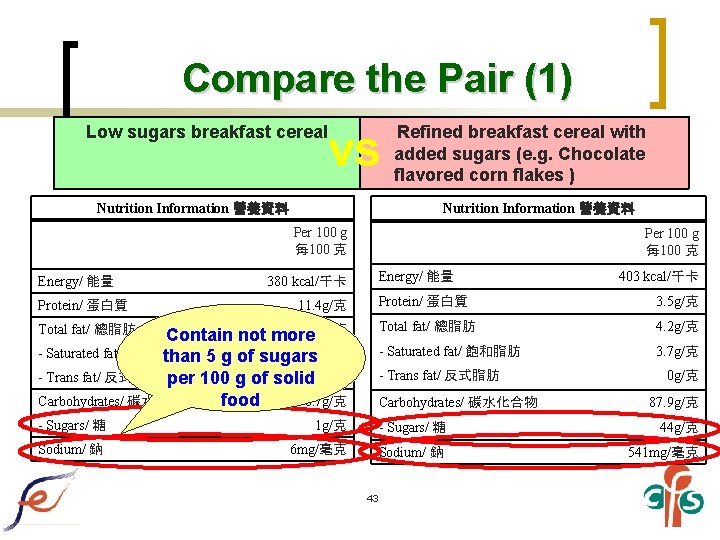
Compare the Pair (1) Low sugars breakfast cereal Refined breakfast cereal with added sugars (e. g. Chocolate flavored corn flakes ) vs Nutrition Information 營養資料 Per 100 g 每 100 克 Energy/ 能量 380 kcal/千卡 403 kcal/千卡 Protein/ 蛋白質 3. 5 g/克 2. 2 g/克 Contain not more - Saturated fat/ 飽和脂肪 0. 5 g/克 than 5 g of sugars - Trans fat/ 反式脂肪 per 100 g of solid 0 g/克 food Carbohydrates/ 碳水化合物 78. 7 g/克 Total fat/ 總脂肪 4. 2 g/克 - Saturated fat/ 飽和脂肪 3. 7 g/克 - Sugars/ 糖 1 g/克 - Sugars/ 糖 44 g/克 Sodium/ 鈉 6 mg/毫克 Sodium/ 鈉 541 mg/毫克 Protein/ 蛋白質 11. 4 g/克 Total fat/ 總脂肪 - Trans fat/ 反式脂肪 Carbohydrates/ 碳水化合物 43 0 g/克 87. 9 g/克
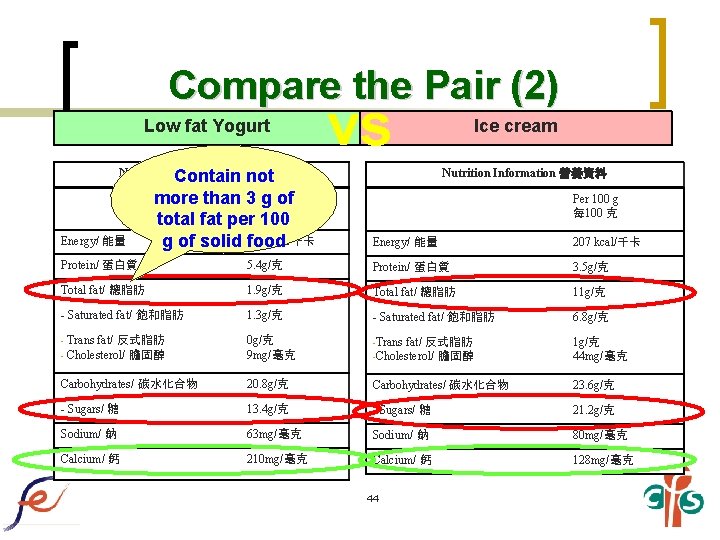
Compare the Pair (2) Low fat Yogurt vs Nutrition Information 營養資料 Contain not Energy/ 能量 Per 100 g more than 3 g of 每 100 克 total fat per 100 122 kcal/千卡 g of solid food Ice cream Nutrition Information 營養資料 Per 100 g 每 100 克 Energy/ 能量 207 kcal/千卡 Protein/ 蛋白質 5. 4 g/克 Protein/ 蛋白質 3. 5 g/克 Total fat/ 總脂肪 1. 9 g/克 Total fat/ 總脂肪 11 g/克 - Saturated fat/ 飽和脂肪 1. 3 g/克 - Saturated fat/ 飽和脂肪 6. 8 g/克 - Trans fat/ 反式脂肪 - Cholesterol/ 膽固醇 0 g/克 9 mg/毫克 -Trans fat/ 反式脂肪 -Cholesterol/ 膽固醇 1 g/克 44 mg/毫克 Carbohydrates/ 碳水化合物 20. 8 g/克 Carbohydrates/ 碳水化合物 23. 6 g/克 - Sugars/ 糖 13. 4 g/克 - Sugars/ 糖 21. 2 g/克 Sodium/ 鈉 63 mg/毫克 Sodium/ 鈉 80 mg/毫克 Calcium/ 鈣 210 mg/毫克 Calcium/ 鈣 128 mg/毫克 44
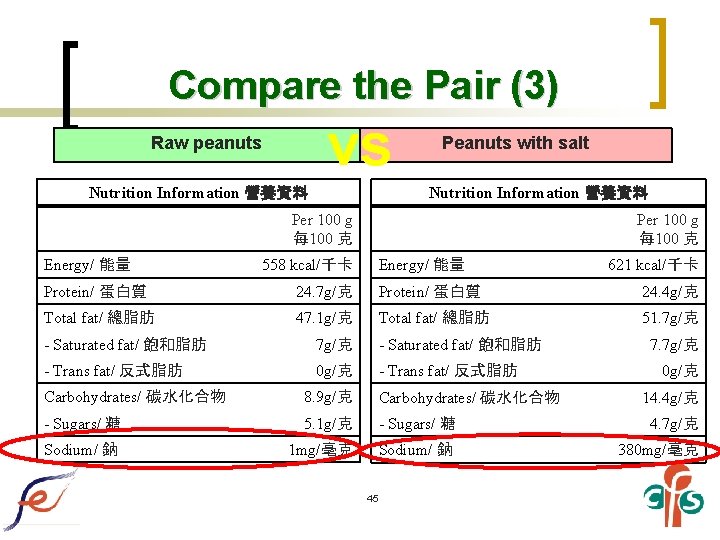
Compare the Pair (3) vs Raw peanuts Nutrition Information 營養資料 Peanuts with salt Nutrition Information 營養資料 Per 100 g 每 100 克 Energy/ 能量 Per 100 g 每 100 克 558 kcal/千卡 Energy/ 能量 621 kcal/千卡 Protein/ 蛋白質 24. 7 g/克 Protein/ 蛋白質 24. 4 g/克 Total fat/ 總脂肪 47. 1 g/克 Total fat/ 總脂肪 51. 7 g/克 - Saturated fat/ 飽和脂肪 - Trans fat/ 反式脂肪 0 g/克 - Trans fat/ 反式脂肪 7. 7 g/克 0 g/克 Carbohydrates/ 碳水化合物 8. 9 g/克 Carbohydrates/ 碳水化合物 - Sugars/ 糖 5. 1 g/克 - Sugars/ 糖 4. 7 g/克 Sodium/ 鈉 1 mg/毫克 Sodium/ 鈉 380 mg/毫克 45 14. 4 g/克
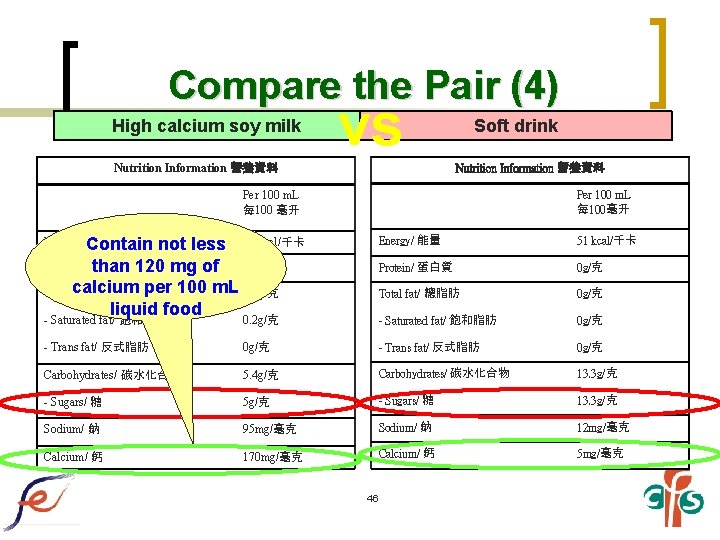
Compare the Pair (4) High calcium soy milk vs Nutrition Information 營養資料 Soft drink Nutrition Information 營養資料 Per 100 m. L 每 100 毫升 Per 100 m. L 每 100毫升 Energy/ 能量 Contain not less 41 kcal/千卡 Energy/ 能量 51 kcal/千卡 Protein/ 蛋白質 than 120 mg of Protein/ 蛋白質 0 g/克 calcium per 100 m. L 1. 5 g/克 Total fat/ 總脂肪 0 g/克 - Saturated fat/ 飽和脂肪 0. 2 g/克 - Saturated fat/ 飽和脂肪 0 g/克 - Trans fat/ 反式脂肪 0 g/克 Carbohydrates/ 碳水化合物 5. 4 g/克 Carbohydrates/ 碳水化合物 13. 3 g/克 - Sugars/ 糖 5 g/克 - Sugars/ 糖 13. 3 g/克 Sodium/ 鈉 95 mg/毫克 Sodium/ 鈉 12 mg/毫克 Calcium/ 鈣 170 mg/毫克 Calcium/ 鈣 5 mg/毫克 liquid food 1. 4 g/克 46
End
- Slides: 47