
Nutrition Day 1 Food Guide Plate Definition The

- Slides: 27
Nutrition Day 1 – Food Guide Plate Definition: The study of what people eat and of eating habits and how these affect health status.
Nutrition • Objectives: – The students will learn about the Food Guide Plate. – The students will understand the different food groups and the importance of each. – The students will plan a healthy diet composed of the different food groups. • SOL's: 9. 1 a, 9. 1 b, 9. 1 d, 9. 1 f, 9. 2 a, 9. 2 b, 9. 2 c, 9. 3 c, 9. 4 a, 9. 4 b, 9. 5 a
Why Teach Nutrition? • Only 2 percent of children meet the Daily Food Guide Plate recommendations. • The number of overweight children has nearly doubled in the last decade. One out of four children is overweight or at risk for becoming overweight. • Sixty percent of children ages 5 to 10 have one or more heart disease risk factors. • Only 29 percent of children attend daily physical education classes. • Type II diabetes, once considered an adult disease, is becoming more common in overweight children.
Video Clip Food Guide
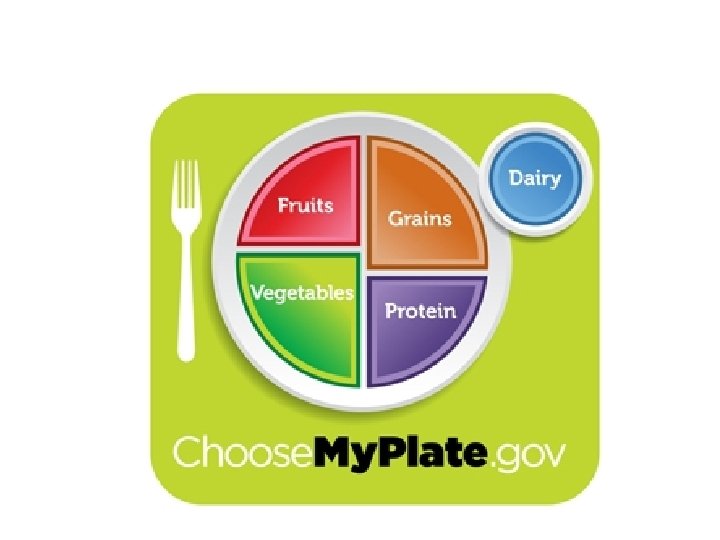
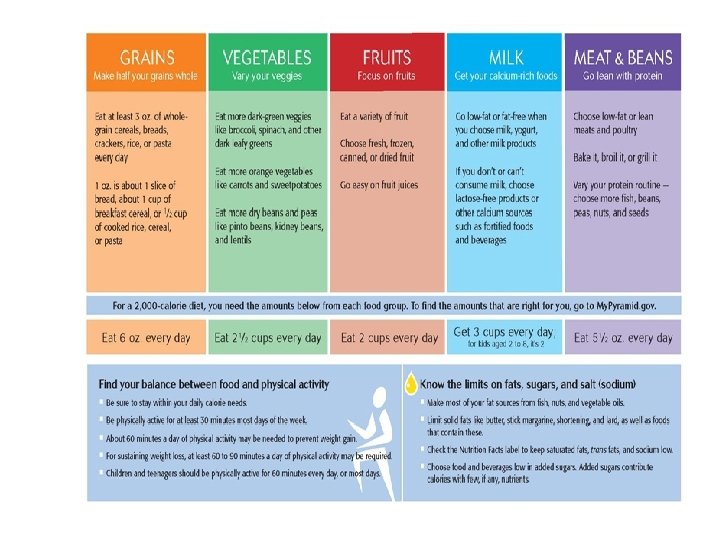
Copy Slide The Food Guide Plate • This is a guide that tells you how many servings from each food group are recommended each day. • The number of servings recommended for you depends on your age, sex, size, and activity level. • Five Food Groups, Grain, Vegetables, Fruits, Protein, Dairy
www. myplate. gov Lets learn about the food groups
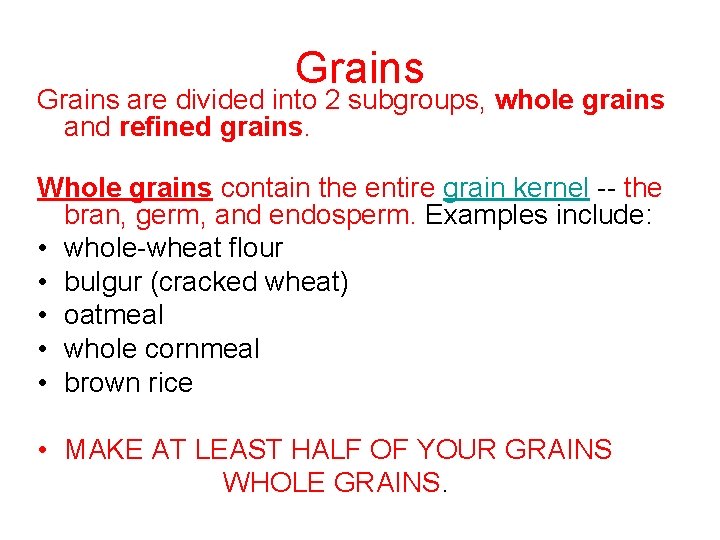
Grains are divided into 2 subgroups, whole grains and refined grains. Whole grains contain the entire grain kernel -- the bran, germ, and endosperm. Examples include: • whole-wheat flour • bulgur (cracked wheat) • oatmeal • whole cornmeal • brown rice • MAKE AT LEAST HALF OF YOUR GRAINS WHOLE GRAINS.
Grains Refined grains have been milled, a process that removes the bran and germ. This is done to give grains a finer texture and improve their shelf life, but it also removes dietary fiber, iron, and many B vitamins. Some examples of refined grain products are: • white flour • degermed cornmeal • white bread • white rice
Grain Group • Grain Group foods are excellent sources of complex carbohydrates and add fiber to our diets. • Complex carbohydrates are an important source of energy. • B vitamins (found in whole grain) also help to keep our blood, skin and nervous systems healthy.
Grain Group • Iron, which is an important part of red blood cells, carries oxygen to all parts of the body. • Whole-grain products provide more fiber than highly-processed grain products. • Fiber helps promote regular digestion and may reduce the risk for certain cancers.
www. myplate. gov Lets learn about the food groups
Vegetables • Any vegetable or 100% vegetable juice counts as a member of the vegetable group. • Vegetables may be raw or cooked; fresh, frozen, canned, or dried/dehydrated; and may be whole, cut-up, or mashed.
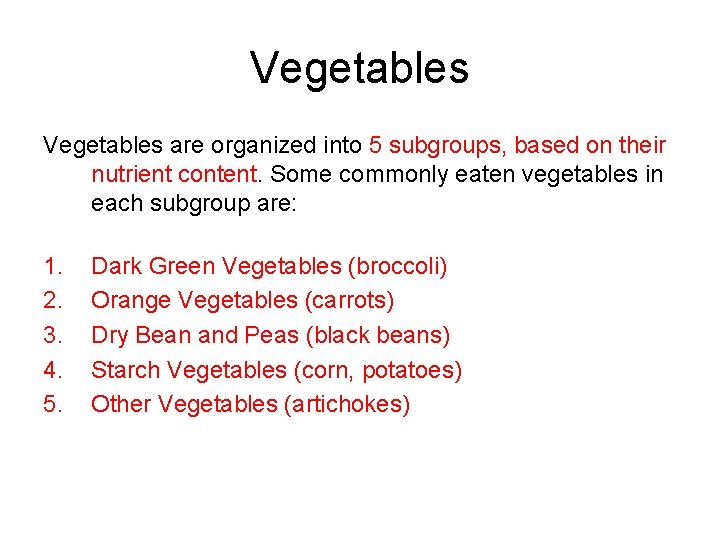
Vegetables are organized into 5 subgroups, based on their nutrient content. Some commonly eaten vegetables in each subgroup are: 1. 2. 3. 4. 5. Dark Green Vegetables (broccoli) Orange Vegetables (carrots) Dry Bean and Peas (black beans) Starch Vegetables (corn, potatoes) Other Vegetables (artichokes)
www. myplate. gov Lets learn about the food groups
Fruits • Any fruit or 100% fruit juice counts as part of the fruit group. Fruits may be fresh, canned, frozen, or dried, and may be whole, cut-up, or pureed. Some commonly eaten fruits are: Apples, Apricots, Bananas, strawberries, blue berries, raspberries, grapes, kiwi, lemons, cantaloupe, honeydew, watermelon, nectarines, oranges, peaches, pears, plums, tangerines, and 100% fruit juice.
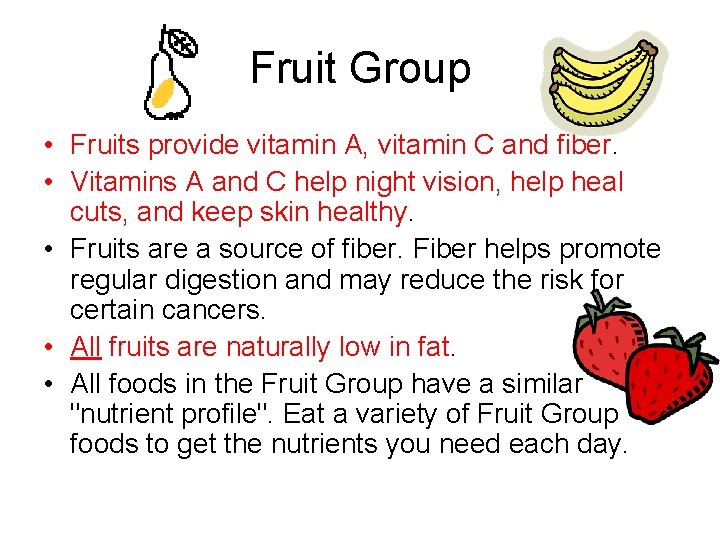
Fruit Group • Fruits provide vitamin A, vitamin C and fiber. • Vitamins A and C help night vision, help heal cuts, and keep skin healthy. • Fruits are a source of fiber. Fiber helps promote regular digestion and may reduce the risk for certain cancers. • All fruits are naturally low in fat. • All foods in the Fruit Group have a similar "nutrient profile". Eat a variety of Fruit Group foods to get the nutrients you need each day.
www. myplate. gov Lets learn about the food groups
Dairy Group • All fluid milk products and many foods made from milk are considered part of this food group. • Foods made from milk that retain their calcium content are part of the group, while foods made from milk that have little to no calcium, such as cream cheese, cream, and butter, are not. • Most milk group choices should be fat-free or low -fat.
www. myplate. gov Lets learn about the food groups
Protein Foods Group • All foods made from meat, poultry, fish, dry beans or peas, eggs, nuts, and seeds are considered part of this group. Dry beans and peas are part of this group as well as the vegetable group. • Most meat and poultry choices should be lean or low-fat. Fish, nuts, and seeds contain healthy oils, so choose these foods frequently instead of meat or poultry.
Oils are fats that are liquid at room temperature, like the vegetable oils used in cooking. Oils come from many different plants and from fish. Some common oils are: – – – – canola oil corn oil cottonseed oil olive oil safflower oil soybean oil sunflower oil Some oils are used mainly as flavorings, such as walnut oil and sesame oil. A number of foods are naturally high in oils, like: – – nuts olives some fish avocados
Oils Solid fats are fats that are solid at room temperature, like butter and shortening. Solid fats come from many animal foods and can be made from vegetable oils through a process called hydrogenation. Some common solid fats are: – – – butter beef fat (tallow, suet) chicken fat pork fat (lard) stick margarine shortening Amounts of trans fat will be required on labels as of 2006.
Class Work #1 – Create a Diet • Get in a Group of 3 • Think about what you have had to eat in the past 24 hours. • List each food and about how much. – Estimate (ex – breakfast – 1 cup of cereal, ½ cup of milk. – Don’t forget about the extras (ketchup, mayonnaise, sugar)
Is Your Diet Healthy? • Was there something you ate a lot of? • Did you eat fruits and vegetables? How many? What kinds? • Did you have choices with the foods you ate? • Could you have made healthier choices? • Did you have fast food?
Create A Diet Create a diet for your teacher & for yourself. For a week • Share your diets • Why did you choose the foods you did? • Could or should your teacher eat a similar diet everyday?