
Nutrition Calories Metabolism Nutrients Vital 1 2 3
Nutrition, Calories, & Metabolism
Nutrients �Vital 1. 2. 3. 4. 5. 6. Nutrients we all need are: Carbohydrates Fats Proteins Vitamins Minerals Water
Carbohydrates �Essential source of energy �Complex Carbohydrates = found in whole grains, pasta, rice; must be broken down into simple sugars to absorb �Simple Carbohydrates = found in fruits, juices, all “sweet stuff” �Indigestible: cellulose = fiber; no calories, but cleans out intestinal tract, lowers cholesterol
Fats � Functions: • Essential source of energy • Protection • Insulates body from cold • Important for production of hormones and cell membranes � Found in meats, nuts, dairy products, & cooking oils � Two Types: unsaturated and saturated • Unsaturated = “Good Fats”, easier to break down • Saturated = “Bad Fats”, hard to break down, causes high cholesterol
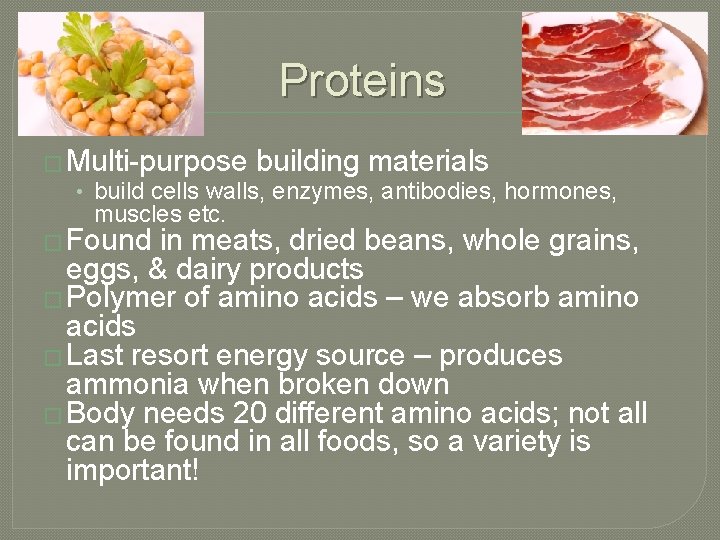
Proteins � Multi-purpose building materials • build cells walls, enzymes, antibodies, hormones, muscles etc. � Found in meats, dried beans, whole grains, eggs, & dairy products � Polymer of amino acids – we absorb amino acids � Last resort energy source – produces ammonia when broken down � Body needs 20 different amino acids; not all can be found in all foods, so a variety is important!
Vitamins � Not an energy source � Organic � Essential to enzyme function in the body � Found in fruits, veggies, and grains � More is not always better! � 2 types: • fat soluble – can only be absorbed when eaten with fat – A, D, E, K. Excess stored in fat tissue. • water soluble – absorbed with water, excess is excreted in urine – C, B vit’s, Folic Acid, Biotin � Examples: • Vitamin C – not a cure-all! Little evidence it cures colds. Lack results in scurvy. • Folic Acid – lack causes birth defects as soon as 1 -2 weeks after conception.
Minerals � Not an energy source � Inorganic � Needed to build cells/cells parts, nervous system function � Found in: vegetables, fruits, grains, meat, dairy � Examples: • Sodium: absolutely essential in small amounts. Too much can make some types of high blood pressure worse. • Calcium: three glasses of milk/slices of cheese, 3 servings tofu, or 10 cups green veggies/day! Essential for strong bones, esp. women! • Iron – essential part of red blood cells. Lack causes anemia, fainting. Big problem for women!
Water �Most abundant substance in the body �Used: • • In chemical reactions In digestion Allows nutrients to enter cells Regulates body temp �You lose about 3 liters a day
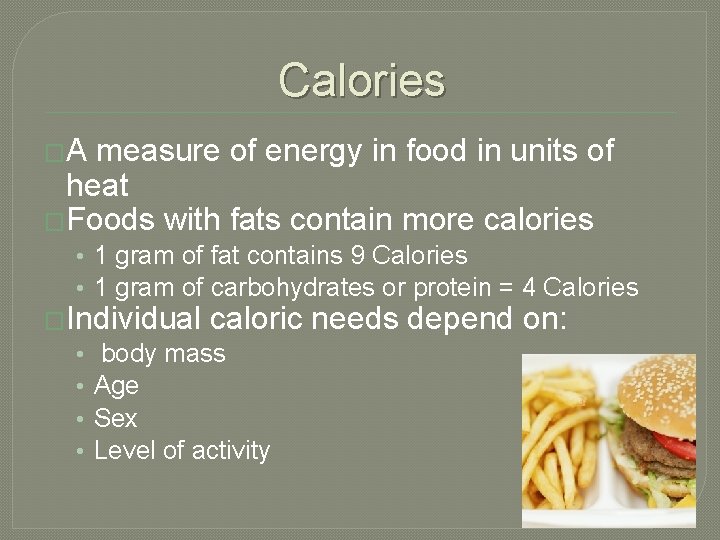
Calories �A measure of energy in food in units of heat �Foods with fats contain more calories • 1 gram of fat contains 9 Calories • 1 gram of carbohydrates or protein = 4 Calories �Individual caloric • body mass • Age • Sex • Level of activity needs depend on:
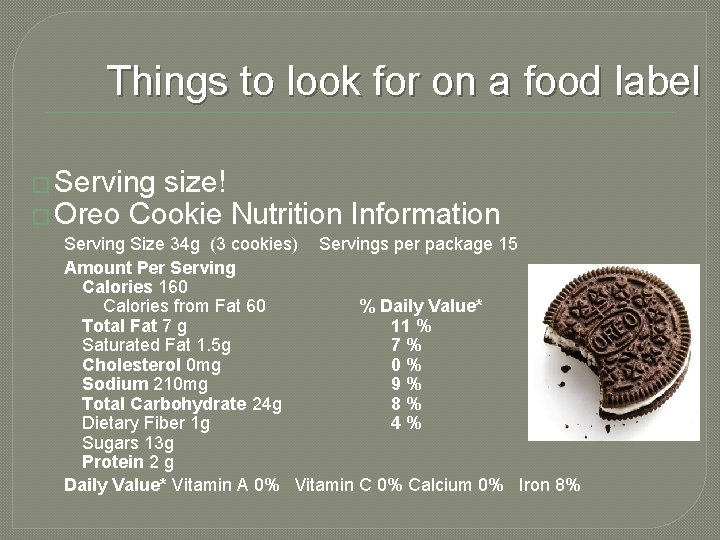
Things to look for on a food label � Serving size! � Oreo Cookie Nutrition Information Serving Size 34 g (3 cookies) Servings per package 15 Amount Per Serving Calories 160 Calories from Fat 60 % Daily Value* Total Fat 7 g 11 % Saturated Fat 1. 5 g 7% Cholesterol 0 mg 0% Sodium 210 mg 9% Total Carbohydrate 24 g 8% Dietary Fiber 1 g 4% Sugars 13 g Protein 2 g Daily Value* Vitamin A 0% Vitamin C 0% Calcium 0% Iron 8%
What other things can we learn by looking at the food labels? �Calories �Fat �Carbohydrates (Fiber and sugars) �Protein �Vitamins and Minerals �Ingredients in food
Calculating Calories �Calories from Fat • Multiply grams of fat by 9 (calories per 1 g of fat) �Calories from carbohydrates • Multiply grams of carbohydrates by 4 (calories per 1 g of carbohydrate) �Calories from protein • Multiply grams of protein by 4 (calories per 1 g of protein) • Add all 3 together to equal total calories.
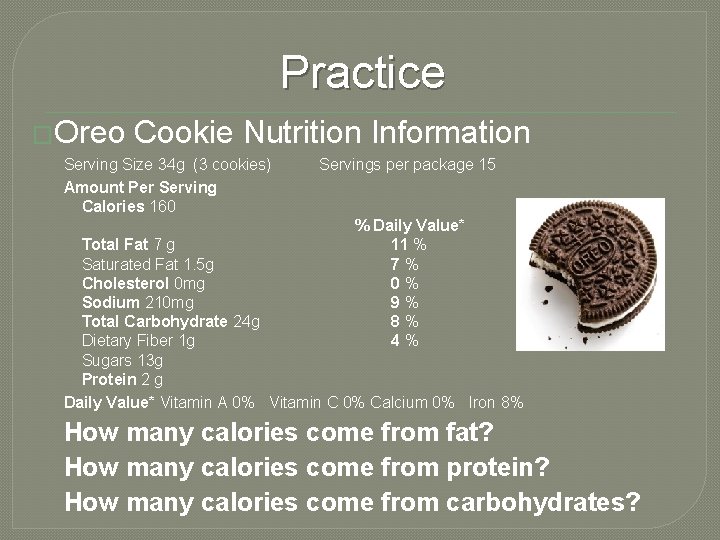
Practice �Oreo Cookie Nutrition Information Serving Size 34 g (3 cookies) Amount Per Serving Calories 160 Servings per package 15 % Daily Value* 11 % 7% 0% 9% 8% 4% Total Fat 7 g Saturated Fat 1. 5 g Cholesterol 0 mg Sodium 210 mg Total Carbohydrate 24 g Dietary Fiber 1 g Sugars 13 g Protein 2 g Daily Value* Vitamin A 0% Vitamin C 0% Calcium 0% Iron 8% How many calories come from fat? How many calories come from protein? How many calories come from carbohydrates?
Percent Daily Values �For nutrient listed there is a %DV �The daily value is the recommended amount of the nutrient you should intake every day based on a 2, 000 calorie daily diet. �Example: If 6. 5 g of fat has a %DV of 10%. How many g of fat should you intake each day? 65!
- Slides: 14