
Nutrition and Menu Planning MENUS QUALITY AND VARIETY
- Slides: 36
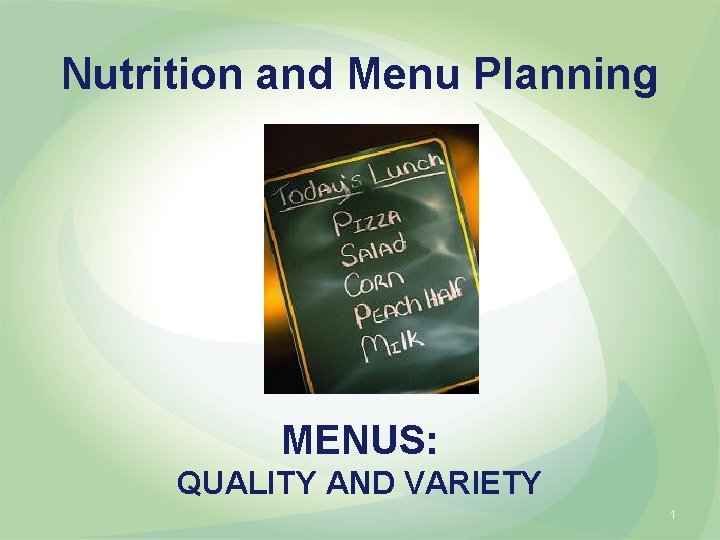
Nutrition and Menu Planning MENUS: QUALITY AND VARIETY 1
MENU QUALITY To prevent childhood obesity, serve: 1. MORE whole grains 2. MORE fruits and vegetables 3. LESS juice 2
MENU QUALITY MORE Whole grains – Whole grain bread has 14 more nutrients than white bread – Fiber – regulates blood sugar and keeps you feeling fuller longer 3
Nutritional Quality of Menus • Serve more whole grains – At least half of the daily grains and breads should be whole grain – Make all grains at breakfast whole grains • Oatmeal, whole wheat pancakes or waffles, whole grain English muffins, whole wheat toast, whole grain breakfast cereal – Mix whole and refined grains to help children get used to new textures and flavors, (i. e. pasta, rice, bread, cereal) – Serve less refined grain foods at snack • crackers, cookies, pretzels, chips, etc. 4
MENU QUALITY MORE Fruits and vegetables • Fruits and vegetables are filled with vitamins and other nutrients • Children ages 2 -5 should be offered 1 - 1 ½ cups of vegetables and 11 ½ cups fruit each day • The amount of fruit and vegetables served at lunch is not enough to meet the daily amount 5
Nutritional Quality of Menus • Serve more whole fruits and vegetables at breakfast and snack – Start Small: If you serve a fruit or vegetable at snack one time per week, increase to two times per week, then increase to three times per week, etc. 6
Nutritional Quality of Menus • Introduce a variety of healthy fruits and vegetables – Healthy and Homemade: Serve oven baked homemade potato or sweet potato wedges with skin intact, roasted or steamed vegetables, incorporate into other dishes (i. e. casseroles, homemade pizzas, salads, tacos, etc. ) – Taste Test: Introduce new fruits and vegetables to children outside of meal time. Begin to include these into your menu. 7
MENU QUALITY • Serve less juice – Recommendation is 4 -6 oz per day (both at home and at daycare) – Review how much juice is served on your menus • Juice has fewer nutrients and more sugar than actual fruit • May cause tooth decay • Overconsumption may contribute to childhood obesity 8
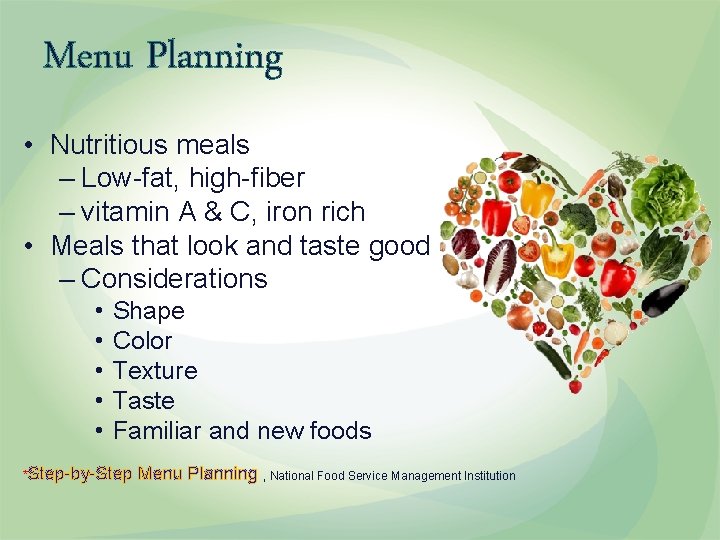
Menu Planning • Nutritious meals – Low-fat, high-fiber – vitamin A & C, iron rich • Meals that look and taste good – Considerations • • • Shape Color Texture Taste Familiar and new foods *Step-by-Step Menu Planning , National Food Service Management Institution
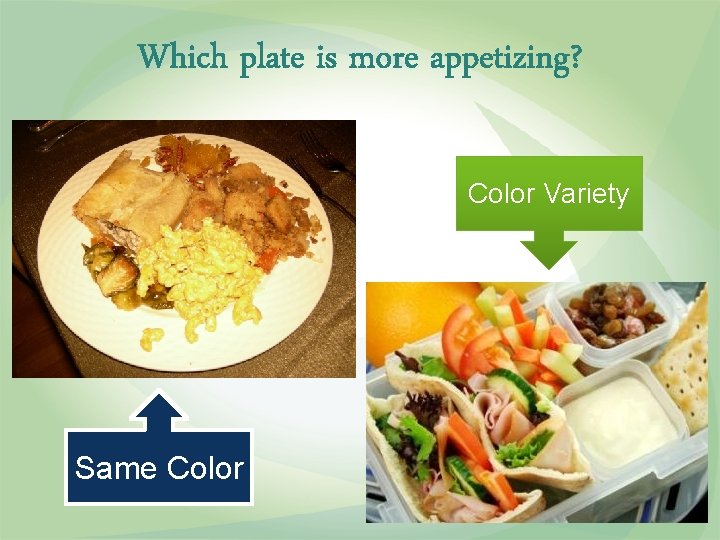
Which plate is more appetizing? Color Variety Same Color
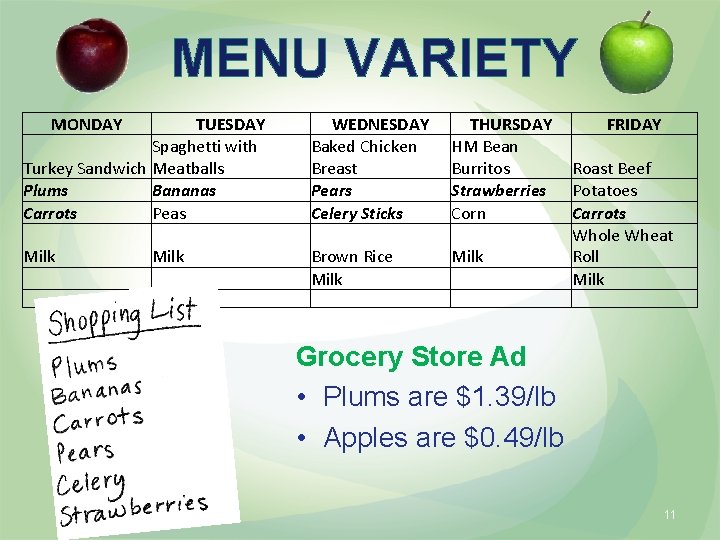
MENU VARIETY MONDAY TUESDAY Spaghetti with Turkey Sandwich Meatballs Plums Bananas Carrots Peas WEDNESDAY Baked Chicken Breast Pears Celery Sticks THURSDAY HM Bean Burritos Strawberries Corn FRIDAY Milk Brown Rice Milk Roast Beef Potatoes Carrots Whole Wheat Roll Milk Grocery Store Ad • Plums are $1. 39/lb • Apples are $0. 49/lb 11
MENU VARIETY Q: Are you tempted to buy a lot of one food when it on sale as long as it will meet the program requirements of the meal pattern? 12
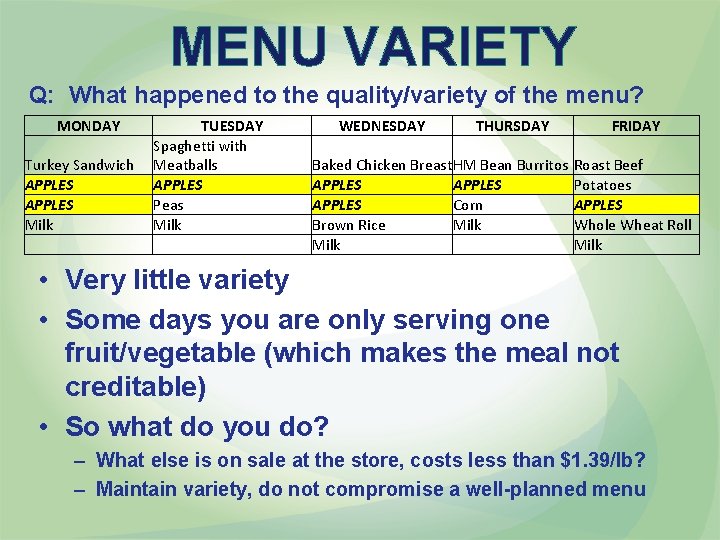
MENU VARIETY Q: What happened to the quality/variety of the menu? MONDAY Turkey Sandwich APPLES Milk TUESDAY Spaghetti with Meatballs APPLES Peas Milk WEDNESDAY THURSDAY Baked Chicken Breast. HM Bean Burritos APPLES Corn Brown Rice Milk FRIDAY Roast Beef Potatoes APPLES Whole Wheat Roll Milk • Very little variety • Some days you are only serving one fruit/vegetable (which makes the meal not creditable) • So what do you do? – What else is on sale at the store, costs less than $1. 39/lb? – Maintain variety, do not compromise a well-planned menu
Nutrition and Menus: What are you serving children in your center? MENUS: RECIPE MODIFICATIONS 14
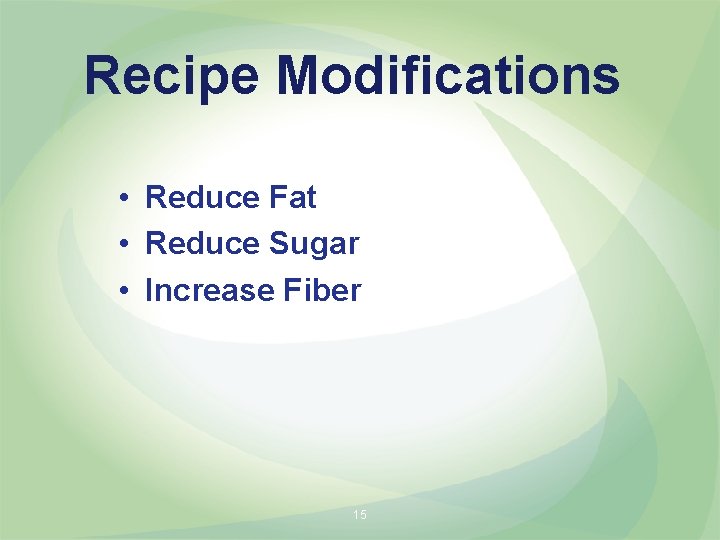
Recipe Modifications • Reduce Fat • Reduce Sugar • Increase Fiber 15
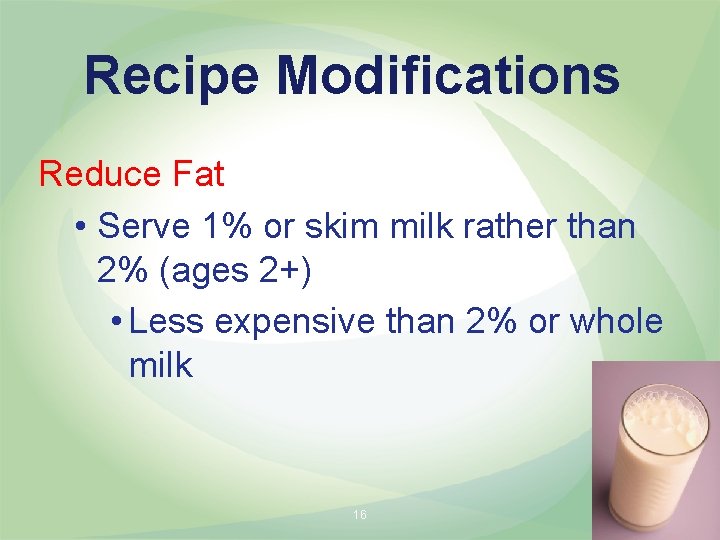
Recipe Modifications Reduce Fat • Serve 1% or skim milk rather than 2% (ages 2+) • Less expensive than 2% or whole milk 16
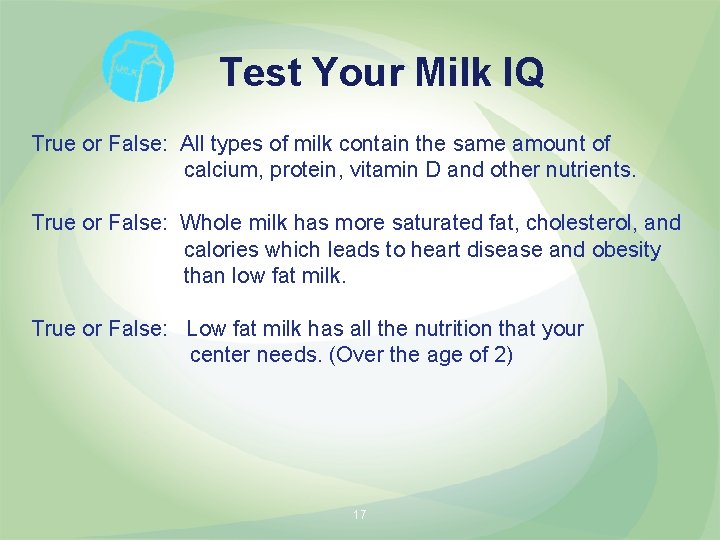
Test Your Milk IQ True or False: All types of milk contain the same amount of calcium, protein, vitamin D and other nutrients. True or False: Whole milk has more saturated fat, cholesterol, and calories which leads to heart disease and obesity than low fat milk. True or False: Low fat milk has all the nutrition that your center needs. (Over the age of 2) 17
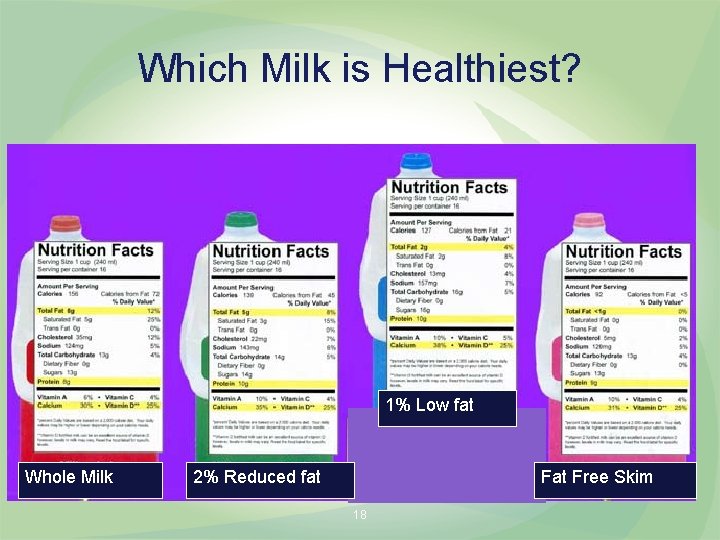
Which Milk is Healthiest? 1% Low fat Whole Milk 2% Reduced fat Free Skim 18
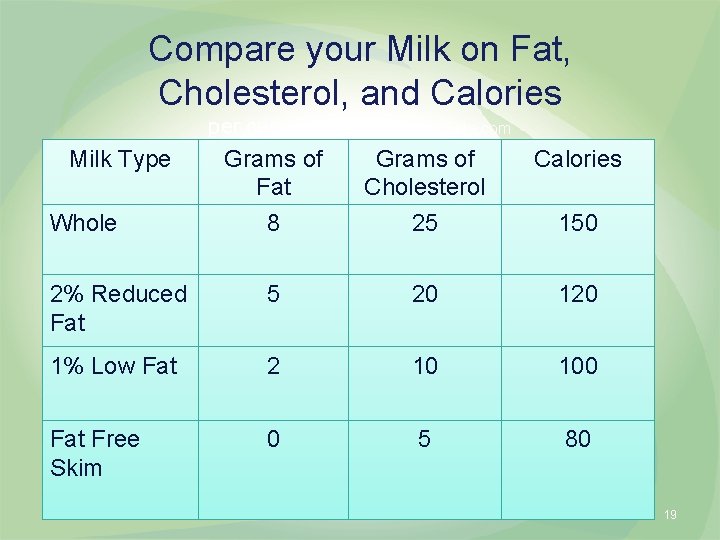
Compare your Milk on Fat, Cholesterol, and Calories per cup (8 oz) www. Nutrition. Data. com Milk Type Grams of Fat Grams of Cholesterol Calories Whole 8 25 150 2% Reduced Fat 5 20 1% Low Fat 2 10 100 Fat Free Skim 0 5 80 19
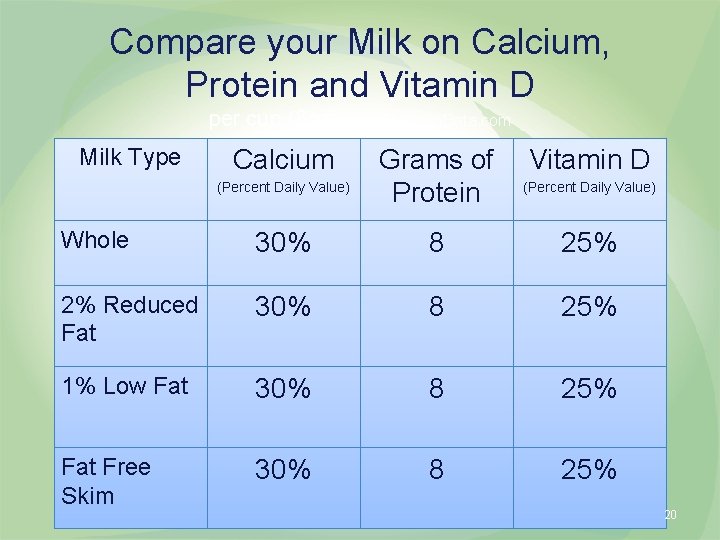
Compare your Milk on Calcium, Protein and Vitamin D per cup (8 oz) www. Nutrition. Data. com Milk Type Calcium (Percent Daily Value) Grams of Protein Vitamin D (Percent Daily Value) Whole 30% 8 25% 2% Reduced Fat 30% 8 25% 1% Low Fat 30% 8 25% Fat Free Skim 30% 8 25% 20
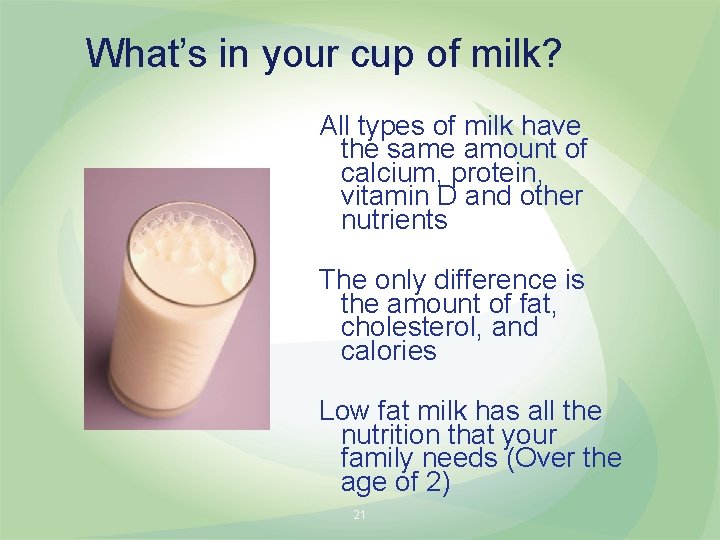
What’s in your cup of milk? All types of milk have the same amount of calcium, protein, vitamin D and other nutrients The only difference is the amount of fat, cholesterol, and calories Low fat milk has all the nutrition that your family needs (Over the age of 2) 21
Why low fat milk? Because…saturated fat and cholesterol found in whole and 2% milk can lead to heart disease Because…the extra calories found in whole and 2% milk can lead to overweight and obesity 22
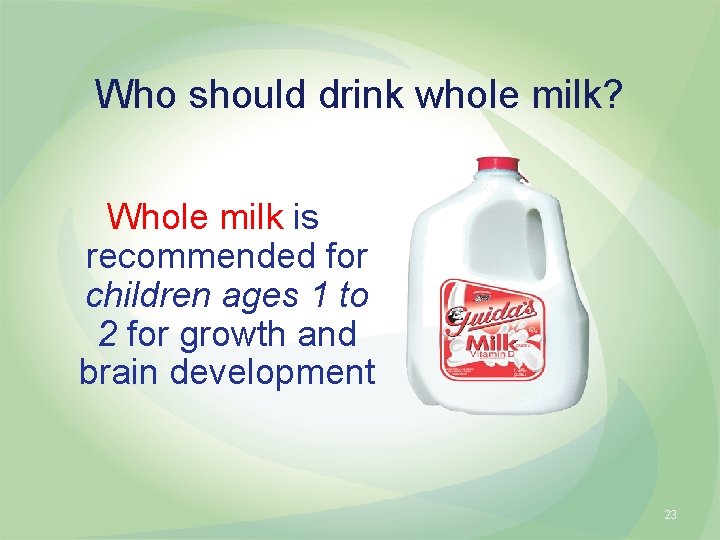
Who should drink whole milk? Whole milk is recommended for children ages 1 to 2 for growth and brain development 23
Test Your Milk IQ True or False: All types of milk contain the same amount of calcium, protein, vitamin D and other nutrients. True or False: Whole milk has more saturated fat, cholesterol, and calories which leads to heart disease and obesity than low fat milk. True or False: Low fat milk has all the nutrition that your center needs. (Over the age of 2) 24
All Statements are True! 1. True! All milk types are equal when it comes to nutrition. The only difference is the amount of fat. 2. True! Whole milk has more saturated fat, cholesterol, and calories than low fat milk which can lead to heart disease and obesity. 3. True! Low fat or fat free milk is the best choice for your family and children’s health. (Over the age of 2) 25
Recipe Modifications Reduce Fat • Meat • Replace hotdogs, bologna and other processed meat with lean meat, poultry or fish – Refrain from serving combination food items like corndogs & chicken nuggets – make items from scratch instead • Choose ground meat that is at least 80% lean (less than 20% fat) • Remove skin from poultry and trim fat, serve chicken breasts 26
Recipe Modifications Reduce Fat • Bake, broil or roast meat rather than fry • Substitute 2 egg whites for each whole egg • Substitute applesauce for ½ butter or margarine in recipe for cookies, cakes and muffins • Use spices, herbs and lemon juice on vegetables (instead of butter) 27
Recipe Modifications Reduce Sugar • Use 1/3 less sugar in recipes for cookies, muffins, etc. • Serve fruit/vegetable for snack instead of cookies, other high-sugar snacks • Limit the use of jams and jellies (they often have added sugar and are not creditable anyways) – serve a whole fruit with breakfast instead 28
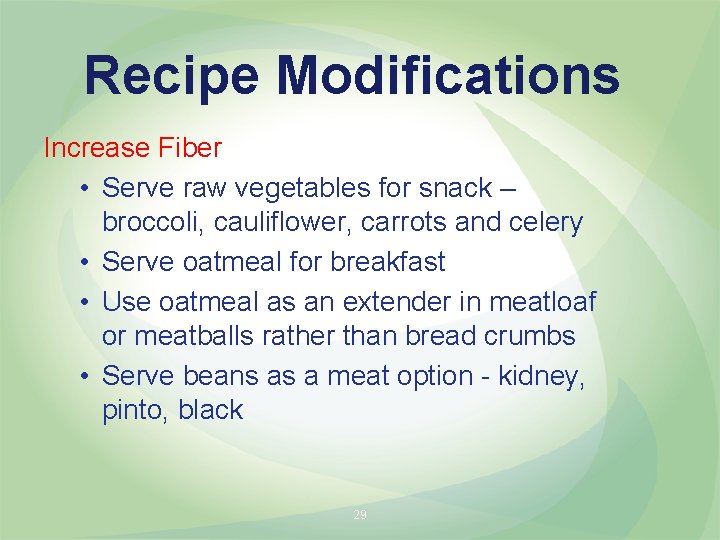
Recipe Modifications Increase Fiber • Serve raw vegetables for snack – broccoli, cauliflower, carrots and celery • Serve oatmeal for breakfast • Use oatmeal as an extender in meatloaf or meatballs rather than bread crumbs • Serve beans as a meat option - kidney, pinto, black 29
Cycle Menus & Production Records • Save time planning menus • Purchasing becomes regular – becomes easier to project how much product needs to be purchased, shopping takes less time • Recipes become familiar and staff become more efficient in producing them • Become efficient with food preparation = less food waste and less $$$ waste 30
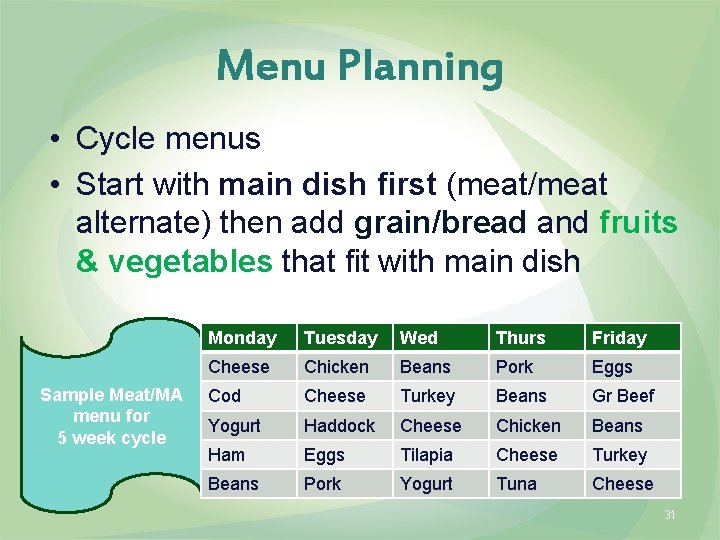
Menu Planning • Cycle menus • Start with main dish first (meat/meat alternate) then add grain/bread and fruits & vegetables that fit with main dish Sample Meat/MA menu for 5 week cycle Monday Tuesday Wed Thurs Friday Cheese Chicken Beans Pork Eggs Cod Cheese Turkey Beans Gr Beef Yogurt Haddock Cheese Chicken Beans Ham Eggs Tilapia Cheese Turkey Beans Pork Yogurt Tuna Cheese 31
Cycle Menus & Production Records • Production records help make accurate projections of how much food to purchase and prepare, eliminating costly over-buying or over-preparing • You are serving hamburgers for lunch to 30 kids ranging in ages from 1 -5. You have 4 -oz hamburgers (cooked). Do you prepare and serve 30 hamburgers? 32
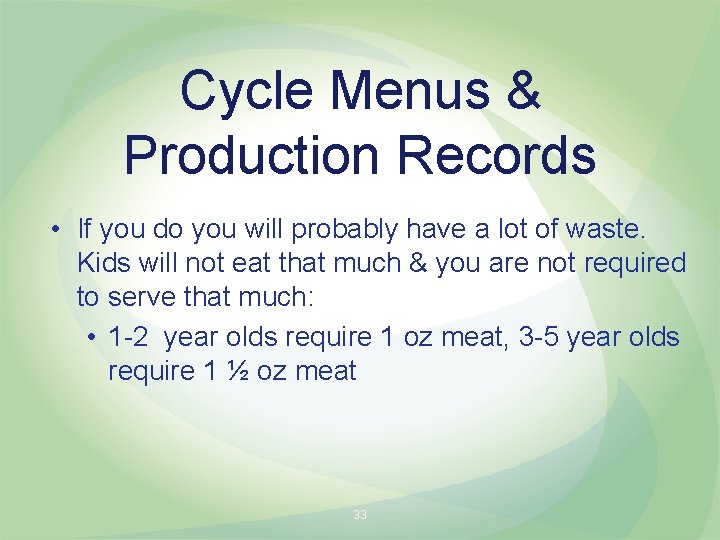
Cycle Menus & Production Records • If you do you will probably have a lot of waste. Kids will not eat that much & you are not required to serve that much: • 1 -2 year olds require 1 oz meat, 3 -5 year olds require 1 ½ oz meat 33
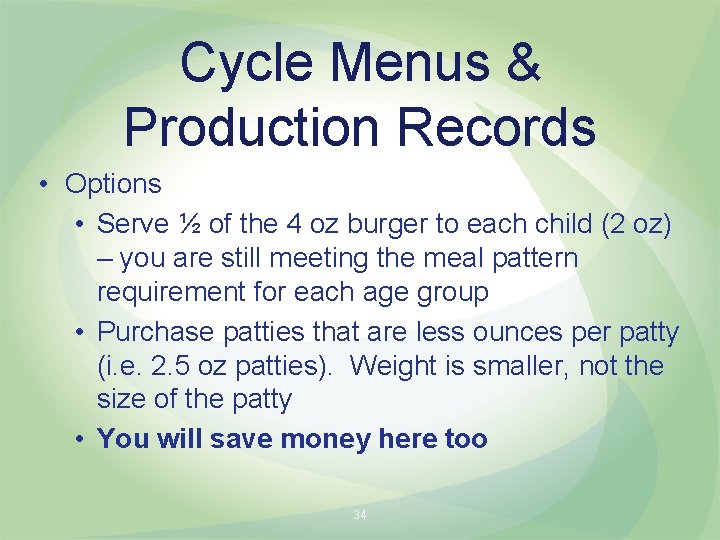
Cycle Menus & Production Records • Options • Serve ½ of the 4 oz burger to each child (2 oz) – you are still meeting the meal pattern requirement for each age group • Purchase patties that are less ounces per patty (i. e. 2. 5 oz patties). Weight is smaller, not the size of the patty • You will save money here too 34
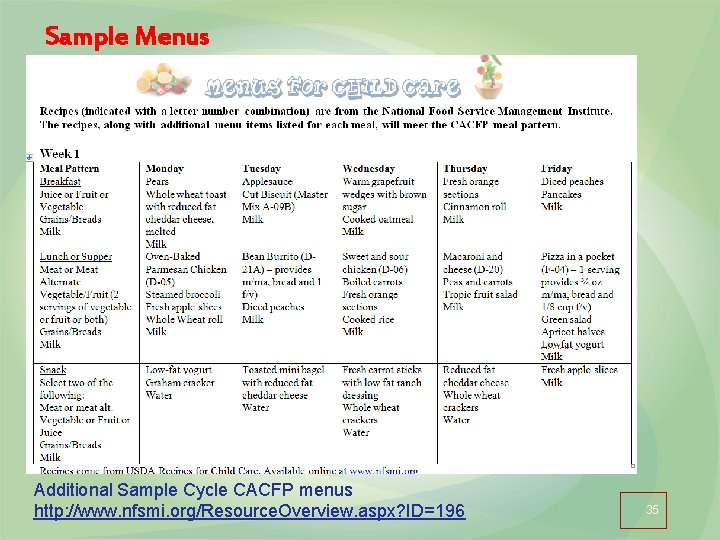
Sample Menus Additional Sample Cycle CACFP menus http: //www. nfsmi. org/Resource. Overview. aspx? ID=196 35
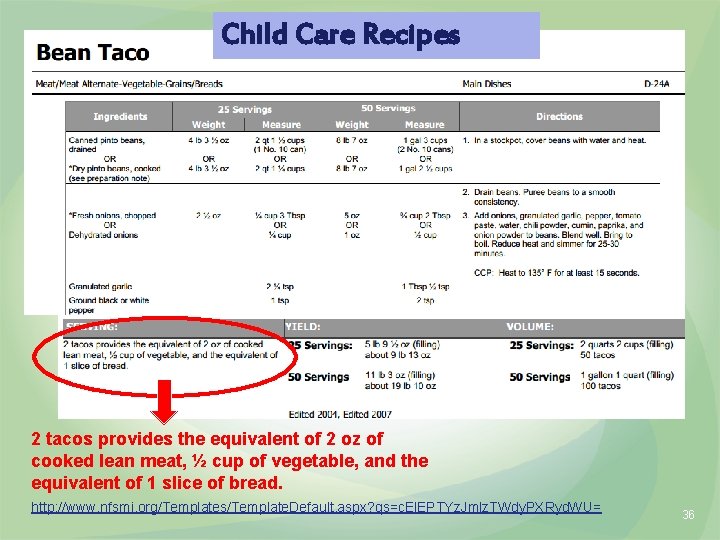
Child Care Recipes 2 tacos provides the equivalent of 2 oz of cooked lean meat, ½ cup of vegetable, and the equivalent of 1 slice of bread. http: //www. nfsmi. org/Templates/Template. Default. aspx? qs=c. El. EPTYz. Jmlz. TWdy. PXRyd. WU= 36