
NUTRITION AND MEDIA OF MICROORGANISMS INTRODUCTION Microbial cells
NUTRITION AND MEDIA OF MICRO-ORGANISMS
INTRODUCTION �Microbial cells are structurally complex. � Organisms need nutrients & a source of energy, also known as ‘MICROBIAL NUTRITION’ to carry out numerous functions. �NUTRIENTS are substances used in biosynthesis of bacteria. �So that microbial nutrition is directly proportional to the microbial growth. �Therefore Growth is impossible without nutrition.
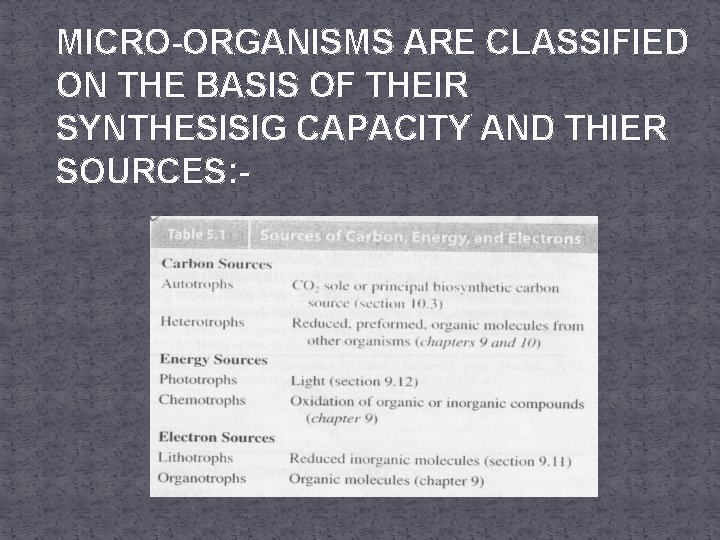
MICRO-ORGANISMS ARE CLASSIFIED ON THE BASIS OF THEIR SYNTHESISIG CAPACITY AND THIER SOURCES: -

NUTRITIONAL REQUIREMENTS OF BACTERIA: THESE NUTRIENTS ARE CATEGORISED AS: 1. MACRO-NUTRIENTS OR MACRO-ELEMENTS 2. OTHER MACRO-NUTRIENTS 3. MICRO-NUTIENTS OR TRACE EEMENTS 4. ORGANIC GROWTH FACTORS 5. LIGHT 6. WATER 1. THE MACRO-NUTRIENTS OR MACRO-ELEMENTS: o o o carbon, hydrogen, oxygen, nitrogen, phosphorus and sulphur. They are essential elements because they required in large amounts. They contain 95% of dry weight of the microbial cells.

MACRONUTRIENTS FUNCTIONS CARBON Needed for the skeletons & backbones of all the organisms, molecules from which organisms are built. OXYGEN & HYDROGEN Available from water added to culture media for growth and found in organic molecules NITROGEN Nature component of protein & nucleic acid. Sources are organic & inorganic nitrgeneous compound. PHOSPHORU S needed as a part of nucleic acid, co-enzyme NAD & FLAVIN & ATP. SULPHUR It forms apart from the structure of several co-enzyme. They all are components of carbohydrates, lipids, proteins, nucleic acids.
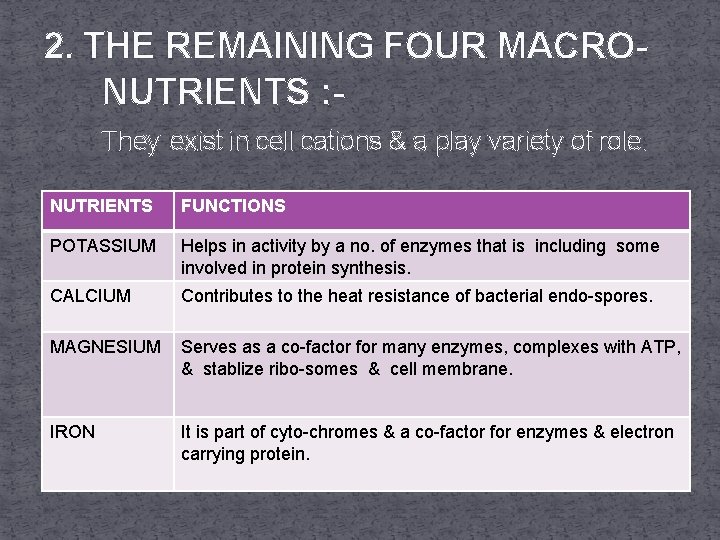
2. THE REMAINING FOUR MACRONUTRIENTS : They exist in cell cations & a play variety of role. NUTRIENTS FUNCTIONS POTASSIUM Helps in activity by a no. of enzymes that is including some involved in protein synthesis. CALCIUM Contributes to the heat resistance of bacterial endo-spores. MAGNESIUM Serves as a co-factor for many enzymes, complexes with ATP, & stablize ribo-somes & cell membrane. IRON It is part of cyto-chromes & a co-factor for enzymes & electron carrying protein.
4. MICRO-NUTRIENTS OR TRACE ELEMENTS �Micro-nutrients are needed in small amounts. �These nutrients are: - Magnese, zinc, cobalt, nickel & copper. �Cells require such small amounts that contaminates from water, regular media components often are adequate for the growth. �They are normally a part of enzymes & co-factors. � They aid in the catalysis of reactions & maintainence of protein structure.
ORGANIC GROWTH FACTORS: Organic compounds that are essential cell compounds or precursors of such components are called ‘Growth factors’. The major classes of growth factors are: 1. AMINO ACIDS: - Needed for protein synthesis. 2. PURINE & PYRIMIDINE: - Helps in nucleic acid synthesis.
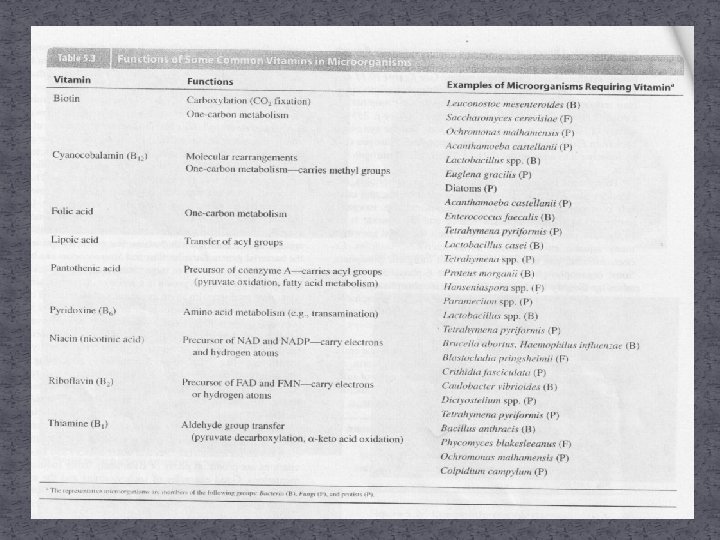
Cotd. � VITAMINS: - They are small organic molecules that usually make up all or part of enzyme, co-factor & are needed in only very small amounts to sustain growth, also known as ‘bacterial vitamins’. �Some bacteria’s synthesis their own vitamins & while other need to take them from outside. � This varies from bacteria to bacteria.
5. LIGHT � Micro-organisms need light ( 250 - 250 nm) for the photosynthesis of vitamins & minerals & for pigments. 6. WATER � Water is important, because all nutrients should be in solution form before they can enter in organisms. ENVIRONMENT FACTORS: � There are some environment factors which also influenced to microbial growth. These factors are like: � Air , Temperature, p. H, Radiations, Osmotic pressure etc.
CULTURE MEDIA INTRODUCTION: �A Nutrient material prepared for the growth of microorganisms in a lab. Is called a ‘culture medium’. �Some bacteria can grow well on just about any culture medium. �Others require special media & still others cannot grow on any non-living medium yet developed. �When microbes are introduces into a culture medium to initiate growth, they are called an ‘inoculum’. �The microbes that grow & multiply in or on a culture medium , are referred to as ‘culture’.
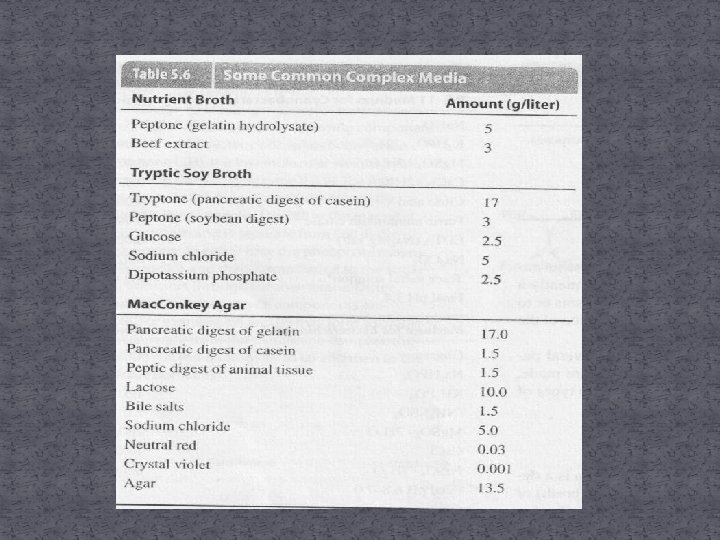
�CULTURE MEDIA can be constructed completely from chemically defined components (defined media or synthetic media) or constituents like peptones & yeast extract(complex media). �Culture media can be solidifying by the addition of agar, a complex polysaccharide from red algae.
CONSTITUENTS OF CULTURE MEDIA � Culture media is needed to grow the organisms & the constituents are: 1. Water: - i. e. source of hydrogen & oxygen. 2. Electrolytes: - i. e. sodium chloride. 3. Peptone: - it is a complex mixture of partially digest protein. 4. Meat extract 5. Blood or serum 6. Agar: - which is used in 2 -3% constituent. A small amount of protein & many inorganic compounds.
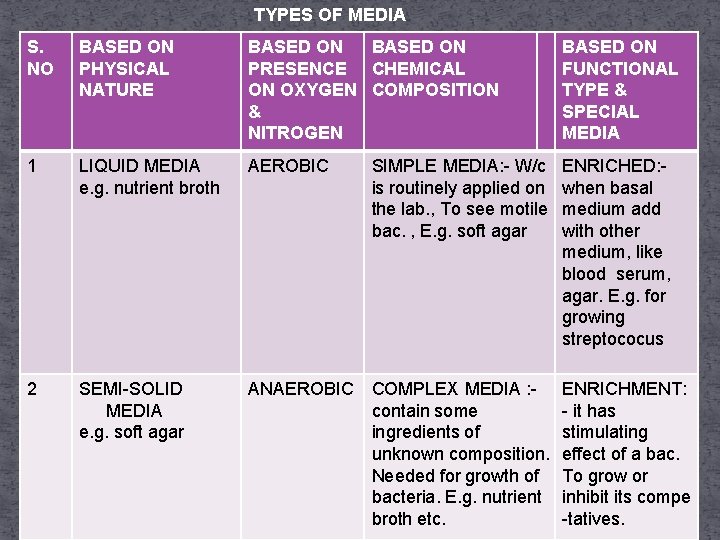
TYPES OF MEDIA S. NO BASED ON PHYSICAL NATURE BASED ON PRESENCE CHEMICAL ON OXYGEN COMPOSITION & NITROGEN BASED ON FUNCTIONAL TYPE & SPECIAL MEDIA 1 LIQUID MEDIA e. g. nutrient broth AEROBIC ENRICHED: when basal medium add with other medium, like blood serum, agar. E. g. for growing streptococus 2 SEMI-SOLID MEDIA e. g. soft agar ANAEROBIC COMPLEX MEDIA : contain some ingredients of unknown composition. Needed for growth of bacteria. E. g. nutrient broth etc. SIMPLE MEDIA: - W/c is routinely applied on the lab. , To see motile bac. , E. g. soft agar ENRICHMENT: - it has stimulating effect of a bac. To grow or inhibit its compe -tatives.
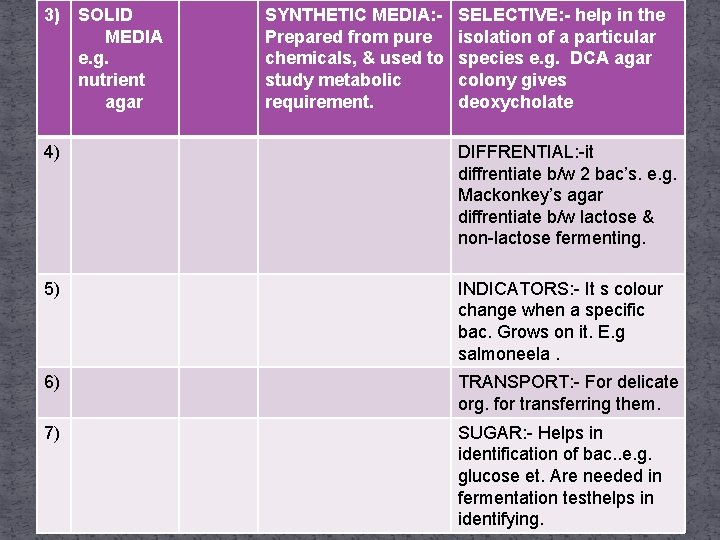
3) SOLID MEDIA e. g. nutrient agar SYNTHETIC MEDIA: Prepared from pure chemicals, & used to study metabolic requirement. SELECTIVE: - help in the isolation of a particular species e. g. DCA agar colony gives deoxycholate 4) DIFFRENTIAL: -it diffrentiate b/w 2 bac’s. e. g. Mackonkey’s agar diffrentiate b/w lactose & non-lactose fermenting. 5) INDICATORS: - It s colour change when a specific bac. Grows on it. E. g salmoneela. 6) TRANSPORT: - For delicate org. for transferring them. 7) SUGAR: - Helps in identification of bac. . e. g. glucose et. Are needed in fermentation testhelps in identifying.

THANKS
- Slides: 18