
Nutrition and Health Food Groups Topics What is







- Slides: 49
Nutrition and Health Food Groups
Topics • • • What is Food? Why Do We Need Food? What is a Balanced Diet? Food Groups Grains Fruits Vegetables Meat, Fish, Egg and Alternatives Milk and Alternatives Fat/Oil, Salt and Sugar Fluids 2
What is Food? • Food is what we eat everyday to keep our body alive and healthy • Food contains nutrients which our body needs 3
What is Food? • Throughout the world there are differences in food consumption due to: – socioeconomic conditions – food availability – culture, religion, belief • A variety of food consumed in sufficient quantities can promote health • Malnutrition (poorly nourished and over nourished) may cause nutrition-related diseases 4
Why Do We Need Food? 1. Growth and repair (body-building food) – Food contains nutrients – Nutrients provide us with materials to build our body and to keep us growing – When we are fully grown, we still need foods to repair damaged tissues – Nutrients needed for growth and repair are: proteins, minerals and vitamins 5
Why Do We Need Food? 2. Energy (energy-giving food) – Nutrients in food provide us with energy – Energy is used for performing daily activities, such as sitting, standing and running – Energy is also used in maintaining proper functions of organs, such as breathing, heartbeating and digesting – Energy is also used in keeping our body warm – Nutrients needed for energy are: carbohydrates, fats and proteins 6
Why Do We Need Food? 3. Health and protection (protective food) – Nutrients in food help to protect us from illness and keep our body healthy – Nutrients needed for health and protection are: vitamins and minerals 7
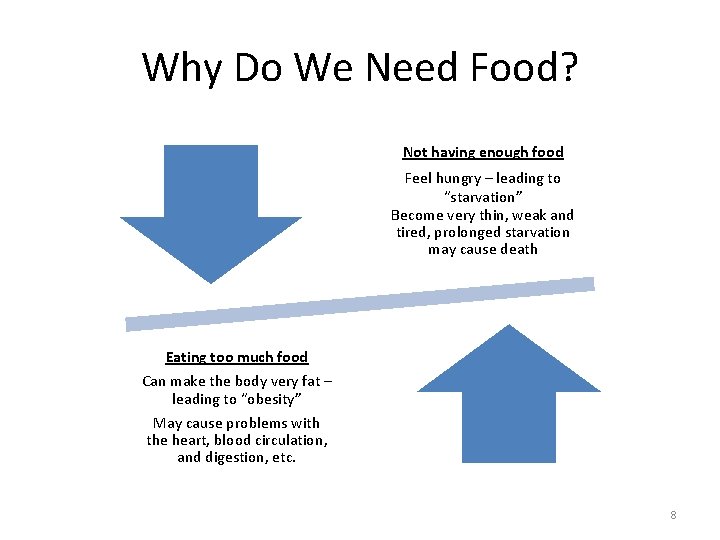
Why Do We Need Food? Not having enough food Feel hungry – leading to “starvation” Become very thin, weak and tired, prolonged starvation may cause death Eating too much food Can make the body very fat – leading to “obesity” May cause problems with the heart, blood circulation, and digestion, etc. 8
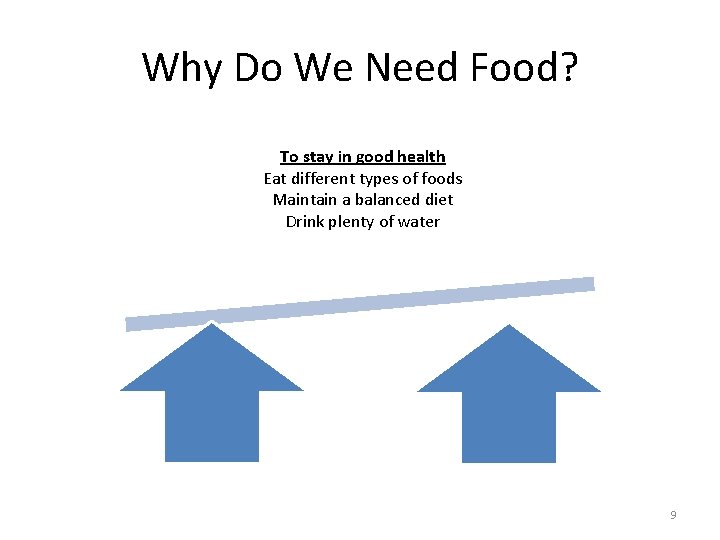
Why Do We Need Food? To stay in good health Eat different types of foods Maintain a balanced diet Drink plenty of water 9
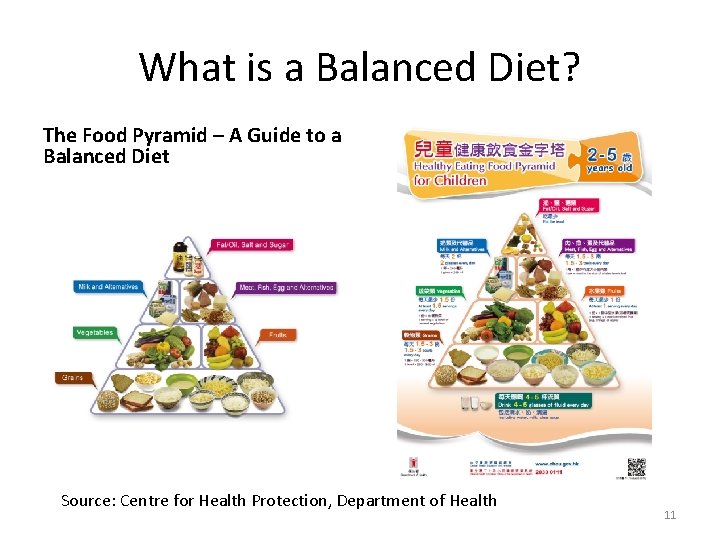
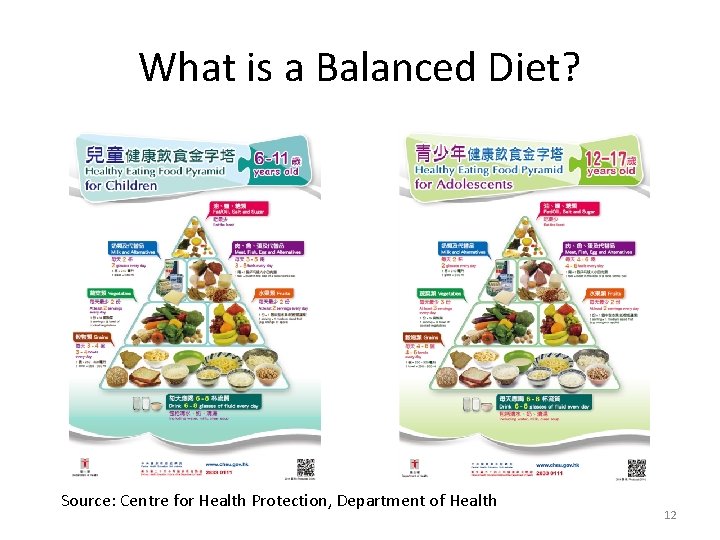
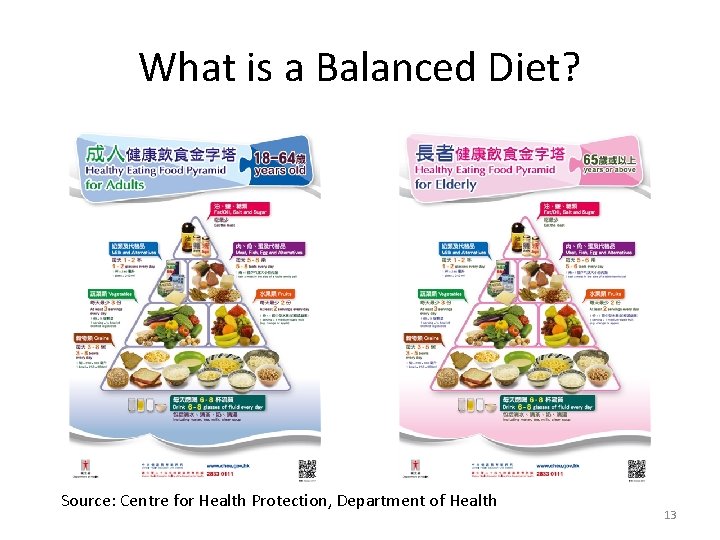
What is a Balanced Diet? Principles of Healthy Eating • Choose a variety of food and eat grains as the largest portion of food in every meal • Eat a lot of vegetables and fruits • Eat a moderate amount of milk, meat, fish, egg and their alternatives (including dry beans) • Reduce intake of foods with high fat/oil, salt and sugar content as well as preserved and processed foods • Drink adequate amount of fluid every day (including water, tea, clear soup, etc. ) • Have regular meals at regular times Source: Centre for Health Protection, Department of Health 10
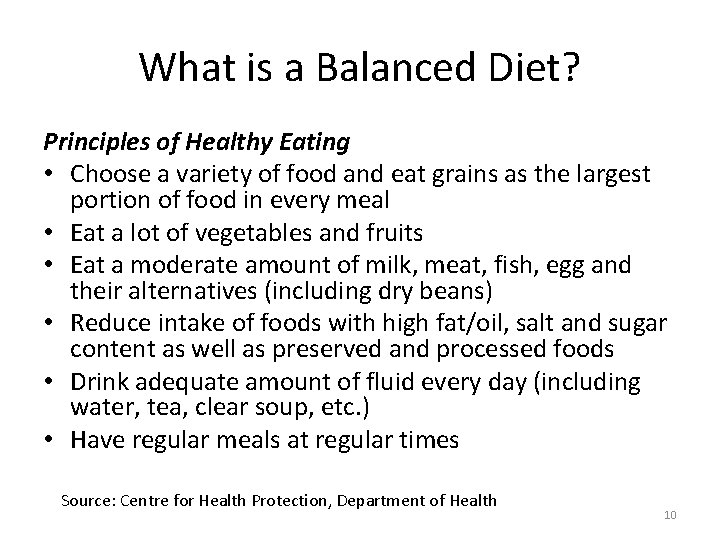
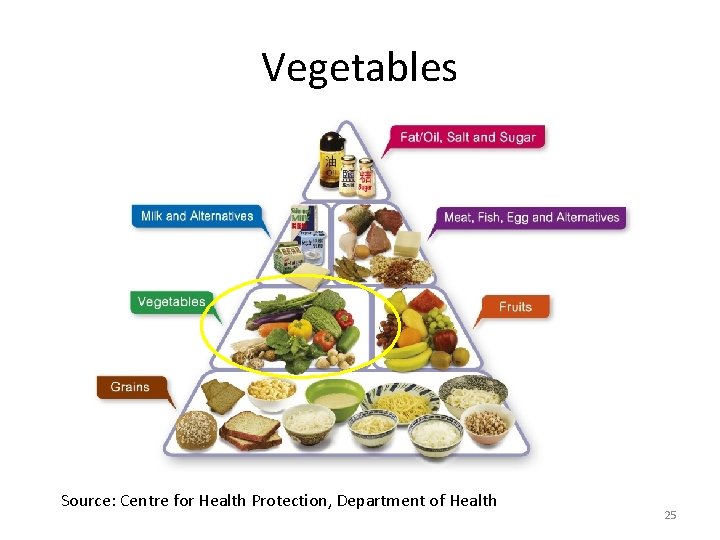
What is a Balanced Diet? The Food Pyramid – A Guide to a Balanced Diet Source: Centre for Health Protection, Department of Health 11
What is a Balanced Diet? Source: Centre for Health Protection, Department of Health 12
What is a Balanced Diet? Source: Centre for Health Protection, Department of Health 13
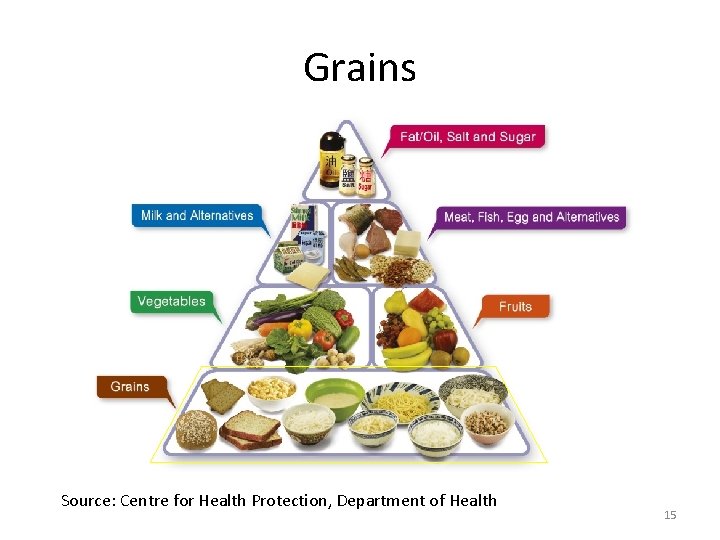
Food Groups • Different food groups serve different purposes • To maintain health, we must choose a variety of food daily • Food groups: – – – – grains fruits vegetables meat, fish, egg and alternatives milk and alternatives fat/oil, salt and sugar fluids Source: Centre for Health Protection, Department of Health 14
Grains Source: Centre for Health Protection, Department of Health 15
Grains Nutritional Value • Rich source of carbohydrates • Traces of vitamin B 1 and B 6 • Source of plant protein • Whole grains are rich in dietary fibre Source: Centre for Health Protection, Department of Health 16
Grains Major Functions • Carbohydrates serve as the major source of energy • Vitamin B 1 helps our body utilise energy generated from carbohydrates • Vitamin B 6 helps in protein metabolism and red blood cells production • Protein promotes body growth and repairs cells • Dietary fibre can help prevent constipation, stabilise blood sugar level and increase satiety Source: Centre for Health Protection, Department of Health 17
Grains Food Sources • Rice, noodles, spaghetti, bread, crackers, macaroni, brown rice, red rice, oatmeal, wholemeal bread, etc. Definition of Serving Size • 1 serving is approximately equivalent to: bowl of boiled rice (white or brown rice), 1 bowl of boiled rice is equivalent to 5 servings of grains – 1/ bowl of cooked vermicelli or udon (without soup) 5 – 1/ bowl of cooked spaghetti or macaroni 3 – ½ bowl of congee – ½ slice of bread with skin (white or wheat) – 1/ 5 • Remark: 1 bowl is about 250 - 300 ml Source: Centre for Health Protection, Department of Health 18
Grains Health Tips • People who are physically active such as teenagers and athletes have increased requirement for this food group • Increase dietary fibre consumption by choosing whole grains such as brown rice, wholemeal bread, wheat crackers, oatmeal and whole grain cereals • Choose grains that are low fat or non-deep fried • Reduce consumption of grains that are added with fats or oils such as fried rice, fried noodles, instant noodles, pastries, cakes, crackers with cream filling and toasts with butter, margarine or peanut butter Source: Centre for Health Protection, Department of Health 19
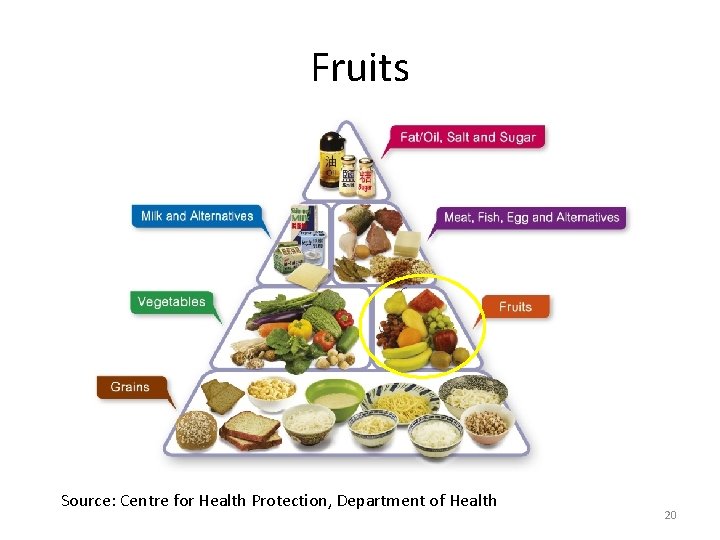
Fruits Source: Centre for Health Protection, Department of Health 20
Fruits Nutritional Value • Supply vitamins and minerals such as vitamin A, vitamin C, folate and potassium • Rich in sugar and dietary fibre Major Functions • Dietary fibre promotes digestion, prevents constipation and intestinal diseases • The vitamins, minerals and other nutrients in fruits work together to protect us from many chronic diseases such as diabetes, hypertension, cardiovascular diseases and certain cancers Source: Centre for Health Protection, Department of Health 21
Fruits Food Sources • Fresh, frozen or canned fruit in juice • Dried fruits and dates without added sugar or salt • Pure fruit juice without added sugar Source: Centre for Health Protection, Department of Health 22
Fruits Definition of Serving Size • 1 serving is approximately equivalent to: 2 pieces of small-sized fruits (e. g. plum, kiwifruit) 1 piece of medium-sized fruit (e. g. orange, apple) ½ piece of large-sized fruit (e. g. banana, grapefruit, star fruit) ½ bowl of fruit cuts or mini-sized fruit (e. g. watermelon, grapes, strawberries) – 1 tablespoon of dried fruits without added sugar or salt (e. g. raisin, pitted prune) – ¾ cup of pure fruit juice without added sugar (e. g. fresh orange juice with pulp) – – • Remark: 1 bowl is about 250 - 300 ml; 1 cup is about 240 ml; 1 tablespoon is about 15 ml Source: Centre for Health Protection, Department of Health 23
Fruits Health Tips • Eat a variety of fruit with different colours to get different nutrients • Fresh fruits are better choices than canned, frozen or dried fruits and fruit juices • Eat plenty of orange or yellowi fruits such as orange, papaya and mango because they are rich in vitamin A and C • Compared with a whole fruit, fruit juice contains less dietary fibre but a much higher sugar content • Reduce intake of fruits which are combined with high-fat ingredients, for examples, fruit tarts, fruited ice cream and fruit cake with whipped cream • Reduce the use of fruit with added sugar such as canned fruit in syrup, fruit desserts, sweetened dried fruits and fruit juice made from concentrate Source: Centre for Health Protection, Department of Health 24
Vegetables Source: Centre for Health Protection, Department of Health 25
Vegetables Nutritional Value • Different types of vegetables offer a wide variety of vitamins, minerals and antioxidants. For example, vitamin A, vitamin C, folate, magnesium and potassium etc. • Some of them are also rich in dietary fibre Major Functions • The vitamins, minerals and other nutrients in vegetables work together to strengthen our immune system and protect us from chronic diseases such as diabetes, hypertension and cardiovascular diseases • Dietary fibre can improve intestinal function and prevent constipation Source: Centre for Health Protection, Department of Health 26
Vegetables Food Sources • Fresh, canned or frozen vegetables • Root and gourd vegetables • Beans, peas, mushrooms, fungus, seaweeds and sprouts • Pure vegetable juice without added sugar Source: Centre for Health Protection, Department of Health 27
Vegetables Definition of Serving Size • 1 serving is approximately equivalent to: – 1 bowl of raw leafy vegetables (e. g. lettuce, cabbage) – ½ bowl of cooked vegetables, sprouts, gourds, beans or mushrooms (e. g. Chinese flowering cabbage, Chinese kale, spinach, white cabbage, bean sprouts, eggplant, carrot, snow pea, Enokitake mushroom) – ¾ cup of fresh vegetable juice without added sugar (e. g. fresh tomato juice) • Remark: 1 bowl is about 250 - 300 ml; 1 cup is about 240 ml Source: Centre for Health Protection, Department of Health 28
Vegetables Health Tips • Eat a variety of vegetables with different colours to get different nutrients • Choose fresh vegetables whenever possible • Eat plenty of green leafy vegetables and orange or yellow vegetables which are rich in vitamin A and C. For example: Chinese flowering cabbage, carrot, tomato • Do not overcook vegetables, the nutrients may be damaged or lost • Most vegetables are naturally low in fat but they are sometimes added with extra oil during cooking and should be consumed only in moderation. For example: salad with dressing, corn with butter and deep-fried vegetables • Reduce intake of preserved vegetables, such as salted and pickled vegetables Source: Centre for Health Protection, Department of Health 29
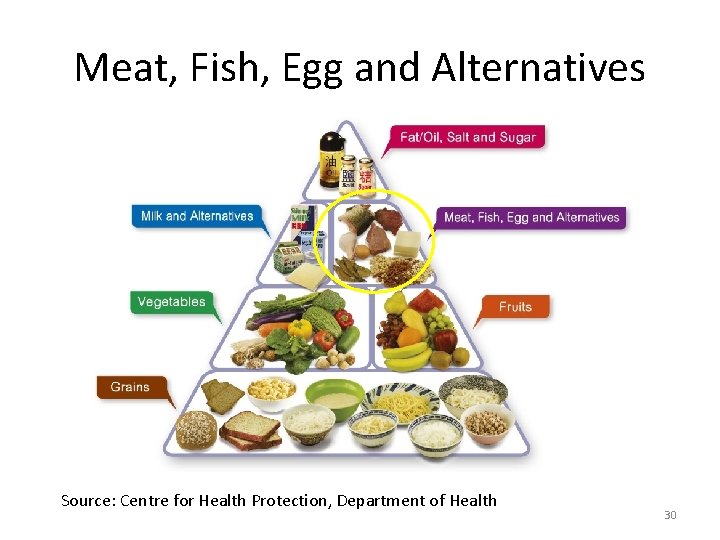
Meat, Fish, Egg and Alternatives Source: Centre for Health Protection, Department of Health 30
Meat, Fish, Egg and Alternatives Nutritional Value • Rich in protein, zinc and vitamin B complex • Red meat, eggs, dry beans, soya bean products, nuts and seeds are rich in iron Major Functions • Protein promotes body growth and repairs cells • Zinc is important for healing wounds and maintenance of the body’s immune system • Iron forms an essential component of red blood cells which prevents anaemia Source: Centre for Health Protection, Department of Health 31
Meat, Fish, Egg and Alternatives Food Sources • Meat (e. g. pork, beef and mutton) • Poultry (e. g. chicken, duck and goose) • Fish and seafood (e. g. shrimp and crab) • Eggs • Dry beans, soya bean products (e. g. bean curd/tofu, bean curd sheet and soya milk), nuts and seeds Source: Centre for Health Protection, Department of Health 32
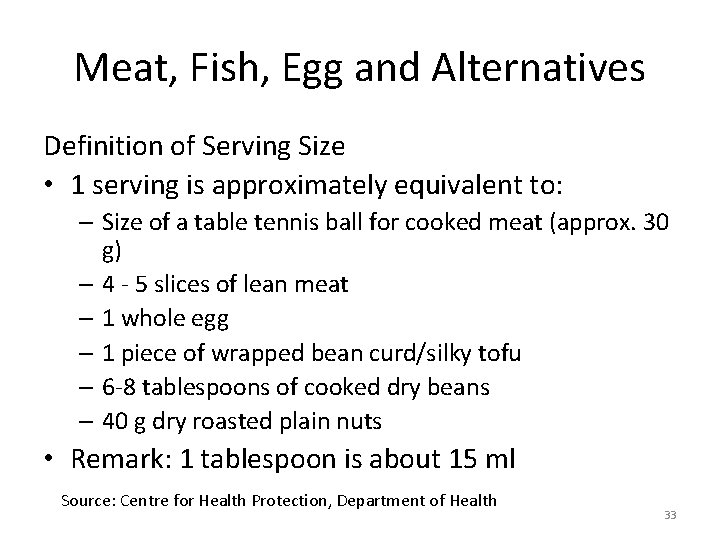
Meat, Fish, Egg and Alternatives Definition of Serving Size • 1 serving is approximately equivalent to: – Size of a table tennis ball for cooked meat (approx. 30 g) – 4 - 5 slices of lean meat – 1 whole egg – 1 piece of wrapped bean curd/silky tofu – 6 -8 tablespoons of cooked dry beans – 40 g dry roasted plain nuts • Remark: 1 tablespoon is about 15 ml Source: Centre for Health Protection, Department of Health 33
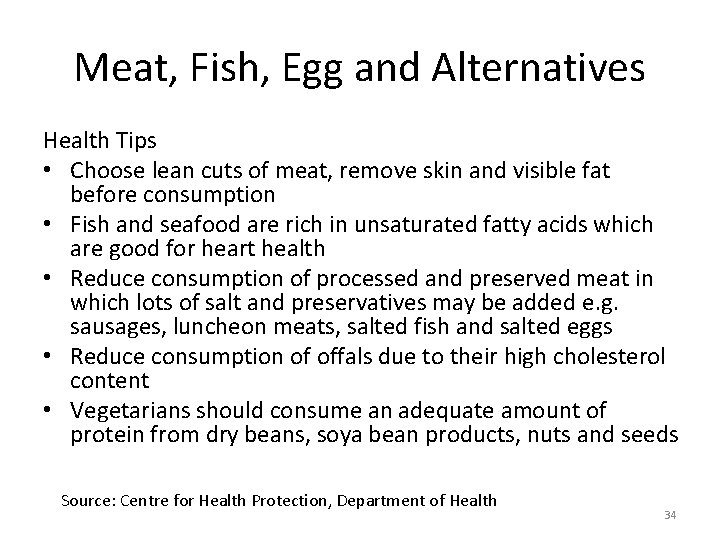
Meat, Fish, Egg and Alternatives Health Tips • Choose lean cuts of meat, remove skin and visible fat before consumption • Fish and seafood are rich in unsaturated fatty acids which are good for heart health • Reduce consumption of processed and preserved meat in which lots of salt and preservatives may be added e. g. sausages, luncheon meats, salted fish and salted eggs • Reduce consumption of offals due to their high cholesterol content • Vegetarians should consume an adequate amount of protein from dry beans, soya bean products, nuts and seeds Source: Centre for Health Protection, Department of Health 34
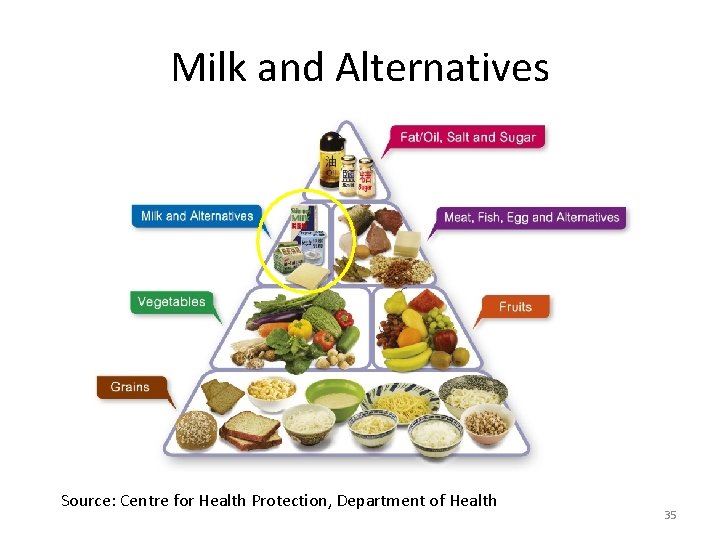
Milk and Alternatives Source: Centre for Health Protection, Department of Health 35
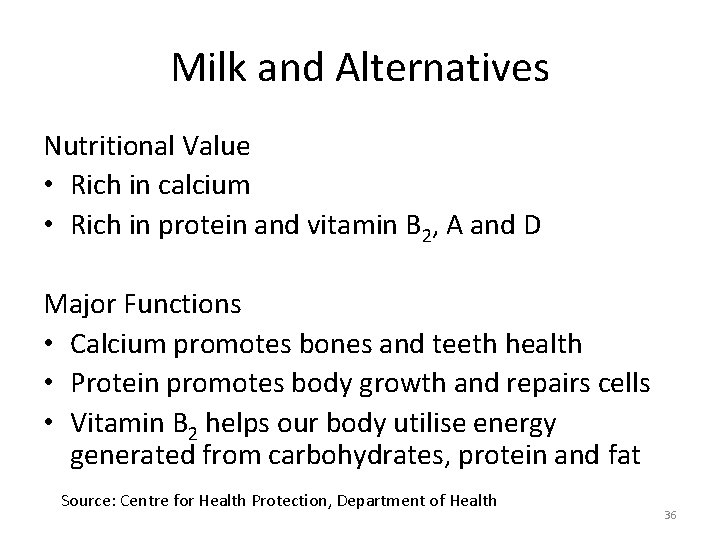
Milk and Alternatives Nutritional Value • Rich in calcium • Rich in protein and vitamin B 2, A and D Major Functions • Calcium promotes bones and teeth health • Protein promotes body growth and repairs cells • Vitamin B 2 helps our body utilise energy generated from carbohydrates, protein and fat Source: Centre for Health Protection, Department of Health 36
Milk and Alternatives Food Sources • Milk, milk powder • Alternatives include cheese, yoghurt, calcium-fortified soya milk, etc. Definition of Serving Size • 1 serving is approximately equivalent to: – 1 cup of low-fat/ skimmed milk or calcium-fortified soya milk – 2 slices of low-fat cheese – 1 pot (150 g) of plain yoghurt • Remark: 1 cup is about 240 ml Source: Centre for Health Protection, Department of Health 37
Milk and Alternatives Health Tips • Choose low-fat or fat-free dairy products • Reduce the use of dairy products with high fat or high sugar content. For example: whipped cream, ice cream, condensed milk and milk shakes Source: Centre for Health Protection, Department of Health 38
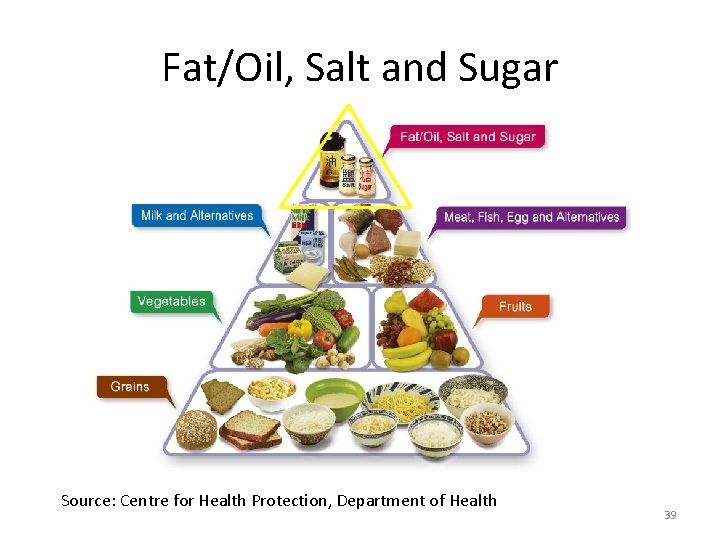
Fat/Oil, Salt and Sugar Source: Centre for Health Protection, Department of Health 39
Fat/Oil, Salt and Sugar Nutritional value and functions: • The fat or oil in food is a source of fatty acids for the body; it helps the body absorb fatsoluble vitamins such as vitamin A, D, E and K. • Sugar provides energy • Salt provides sodium Source: Centre for Health Protection, Department of Health 40
Fat/Oil, Salt and Sugar Food Sources • Fat/Oil - fats from animal source, e. g. lard and butter - oil from plant source, e. g. peanut oil, coconut oil, olive oil, corn oil, canola oil and sesame oil • Salt - sea salt and table salt - seasonings and sauces - salted food, e. g. salted fish • Sugar - natural sugars, e. g. cane sugar, honey and syrup - seasonings and sauces - sweetened foods and drinks, e. g. candied fruits, chocolate, ice-cream and soft drinks 41
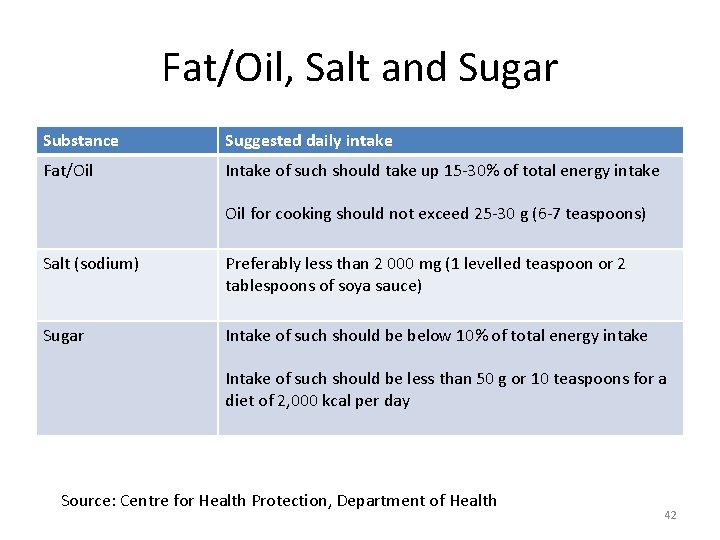
Fat/Oil, Salt and Sugar Substance Suggested daily intake Fat/Oil Intake of such should take up 15 -30% of total energy intake Oil for cooking should not exceed 25 -30 g (6 -7 teaspoons) Salt (sodium) Preferably less than 2 000 mg (1 levelled teaspoon or 2 tablespoons of soya sauce) Sugar Intake of such should be below 10% of total energy intake Intake of such should be less than 50 g or 10 teaspoons for a diet of 2, 000 kcal per day Source: Centre for Health Protection, Department of Health 42
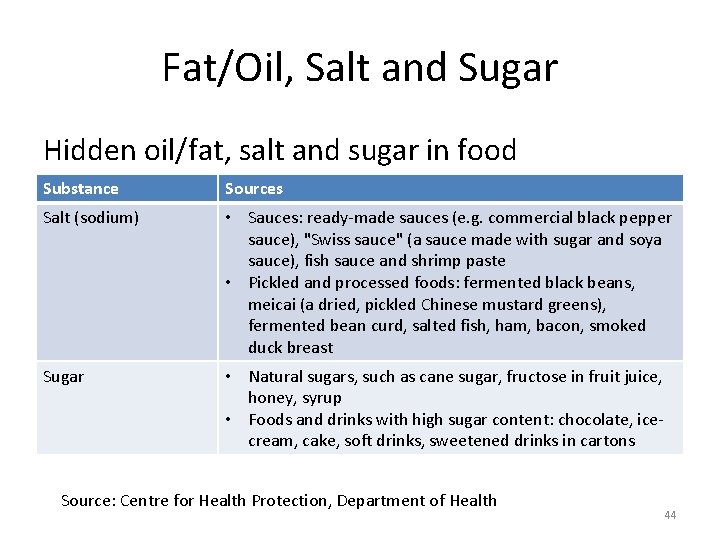
Fat/Oil, Salt and Sugar Hidden oil/fat, salt and sugar in food • Fat/Oil, salt and sugar are hidden in a lot of foods, in particular pre-packaged foods • Choose products with lower content of fat, sugar and sodium (i. e. salt) Substance Sources Fat/Oil • Deep-fried foods: instant noodles, oil noodles (yau mien), deep-fried bean curd • Meat cut with high fat content, and processed meat: short ribs, lamb brisket, sausage, luncheon meat, Chinese preserved meat, pork balls • Others: pastries, waffle biscuits, coconut paste Source: Centre for Health Protection, Department of Health 43
Fat/Oil, Salt and Sugar Hidden oil/fat, salt and sugar in food Substance Sources Salt (sodium) • Sauces: ready-made sauces (e. g. commercial black pepper sauce), "Swiss sauce" (a sauce made with sugar and soya sauce), fish sauce and shrimp paste • Pickled and processed foods: fermented black beans, meicai (a dried, pickled Chinese mustard greens), fermented bean curd, salted fish, ham, bacon, smoked duck breast Sugar • Natural sugars, such as cane sugar, fructose in fruit juice, honey, syrup • Foods and drinks with high sugar content: chocolate, icecream, cake, soft drinks, sweetened drinks in cartons Source: Centre for Health Protection, Department of Health 44
Fluids Source: Centre for Health Protection, Department of Health 45
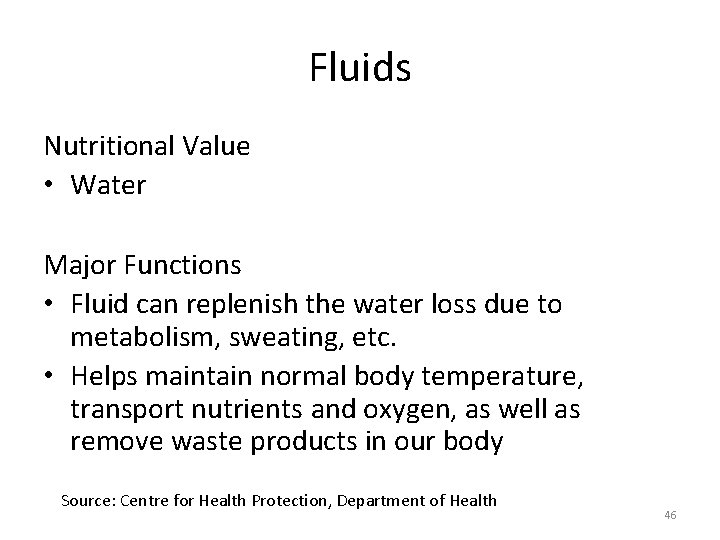
Fluids Nutritional Value • Water Major Functions • Fluid can replenish the water loss due to metabolism, sweating, etc. • Helps maintain normal body temperature, transport nutrients and oxygen, as well as remove waste products in our body Source: Centre for Health Protection, Department of Health 46
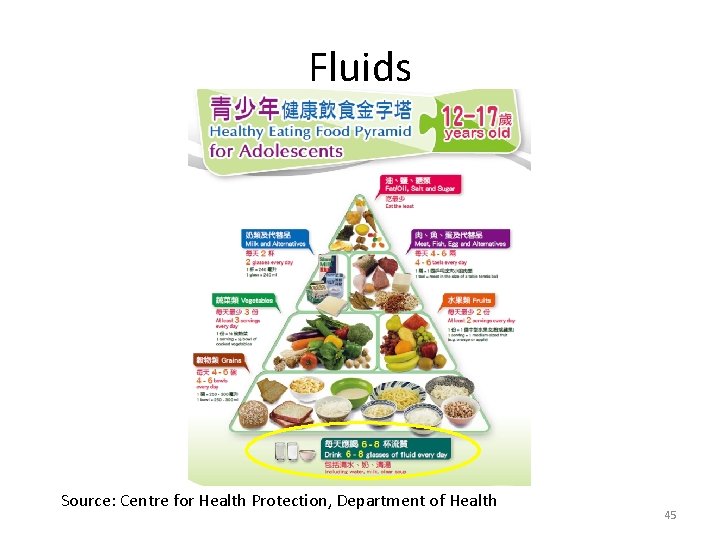
Fluids Recommended daily serving • It is recommended to drink at least 6 to 8 cups of fluid every day • Extra fluid should be consumed in hot weather due to the significant amount of water loss from sweating. • Remark: 1 cup = 240 ml Source: Centre for Health Protection, Department of Health 47
Fluids Health Tips • Reduce the consumption of beverages with added sugar such as soft drinks and fruit juice made from concentrate • Caffeine has diuretic effect, drink extra water when drinking caffeine-containing beverages such as coffee and tea • Alcoholic drinks are not considered as a source of fluids Source: Centre for Health Protection, Department of Health 48
References • Centre for Health Protection, Department of Health - Diet and Nutrition. (n. d. ). • Insel, P. M. , Ross, D. , Mc. Mahon, K. , & Bernstein, M. (2019). Discovering nutrition. Burlington, MA: Jones & Bartlett Learning. • Nutrient Information Inquiry. (n. d. ). 49