
Nutrients Objectives Name the six classes of nutrients
Nutrients
Objectives • Name the six classes of nutrients. • Identify the functions and food sources of all six nutrients. • Describe the need for enough fiber in your diet. • Identify one health disorder linked to high levels of saturated fats in the diet. • Describe how diet can influence health.
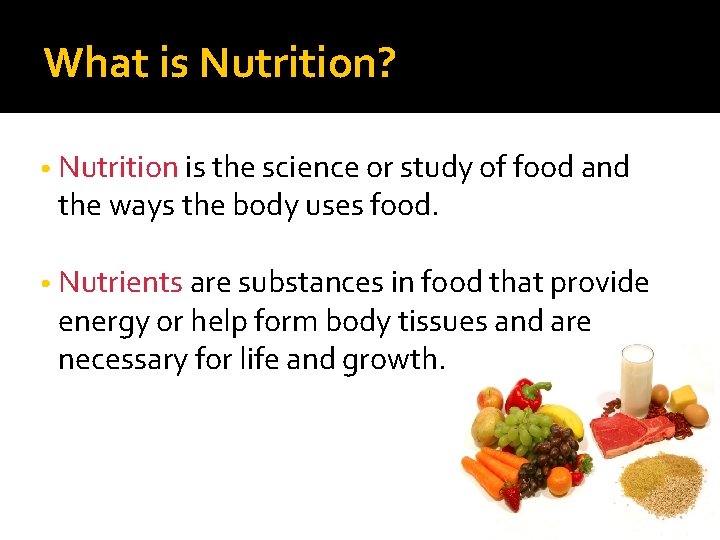
What is Nutrition? • Nutrition is the science or study of food and the ways the body uses food. • Nutrients are substances in food that provide energy or help form body tissues and are necessary for life and growth.
There are SIX Essential Nutrients 1. 2. 3. 4. 5. 6. Carbohydrates Fats Proteins Vitamins Minerals Water • A Balanced Diet To be healthy, you need the right amount of nutrients from each class.
Carbohydrates (CARBS) � Why do we need Carbohydrates? Carbohydrates are the body’s and brain’s main source for energy. � What if I eat too many? Weight gain! Carbohydrates that go unused are stored as fat! Increased risk of diabetes. � What if I do not eat enough (complex) carbs? Fatigue and energy loss. Cancer and heart disease- A diet with healthy amounts of fruits, veggies, and whole grains will lessen the risk for these diseases.

2 Major Types of Carbohydrates Simple Carbs (Sugars) Usually pretty sweet Complex Carbs and burn very quick! Glucose, Fructose, Sucrose, Lactose, Syrup Take longer to burn and are good sources of longlasting energy

Simple Carbs (Food Examples) Simple: Milk, cookies, cake, donuts, candies, soft drinks, juice, fruit, some veggies Empty Calories are calories without nutrition!
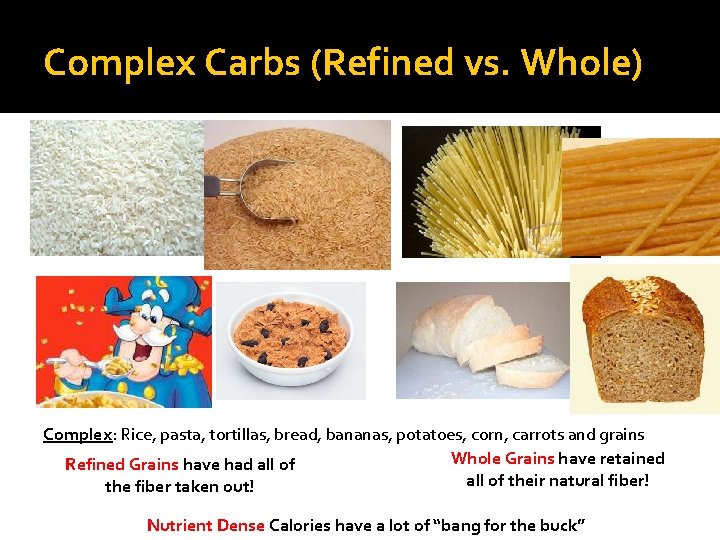
Complex Carbs (Refined vs. Whole) Complex: Rice, pasta, tortillas, bread, bananas, potatoes, corn, carrots and grains Whole Grains have retained Refined Grains have had all of their natural fiber! the fiber taken out! Nutrient Dense Calories have a lot of “bang for the buck”
Types of Complex Carbs � Starches are more complex carbohydrates that can be broken down into sugars. � Starches are the major energy source for plants (e. g. potatoes, rice, wheat, etc. ) � Fiber provides little energy and cannot be digested. � Fiber is a carbohydrate from plants that goes mostly undigested. Instead, it works like a sticky pipe cleaner for our system, cleaning out our digestive tract
Carbohydrates �Carbs should be 60% of caloric intake. �Try to limit added simple sugars (pop, candy, sugar, syrups, etc. ) �Make sure to eat fruits and veggies (fiber)! �Try to replace refined grains with whole grains.
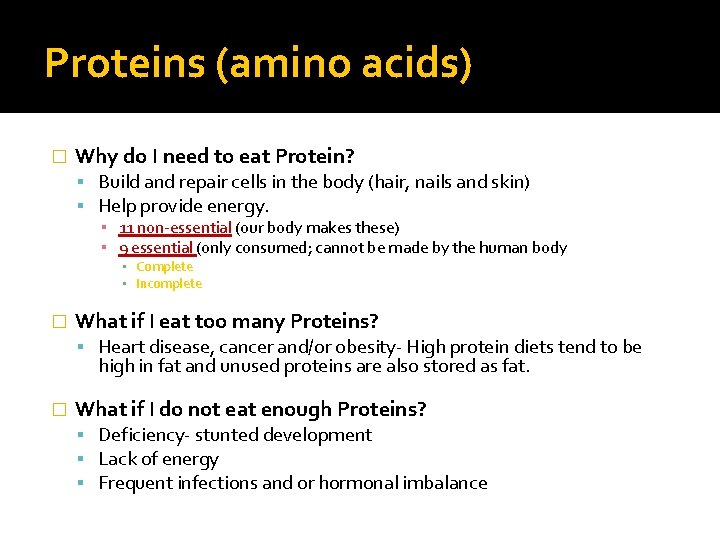
Proteins (amino acids) � Why do I need to eat Protein? Build and repair cells in the body (hair, nails and skin) Help provide energy. ▪ 11 non-essential (our body makes these) ▪ 9 essential (only consumed; cannot be made by the human body ▪ Complete ▪ Incomplete � What if I eat too many Proteins? Heart disease, cancer and/or obesity- High protein diets tend to be high in fat and unused proteins are also stored as fat. � What if I do not eat enough Proteins? Deficiency- stunted development Lack of energy Frequent infections and or hormonal imbalance
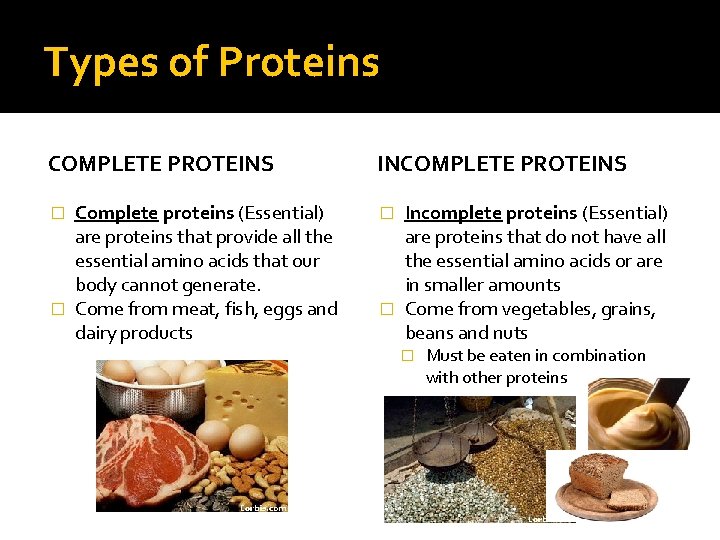
Types of Proteins COMPLETE PROTEINS INCOMPLETE PROTEINS Complete proteins (Essential) are proteins that provide all the essential amino acids that our body cannot generate. � Come from meat, fish, eggs and dairy products � � Incomplete proteins (Essential) are proteins that do not have all the essential amino acids or are in smaller amounts � Come from vegetables, grains, beans and nuts � Must be eaten in combination with other proteins
Proteins �Proteins should be 10% of your caloric intake. �Increase the amount of lean meats and incomplete proteins, and decrease the amount of fatty meats in your diet
Fats � Why do I need Fat? Fat is the body’s main source of long-term energy storage. Helps circulate blood to cells and liver. Fat in the digestive tract helps your body absorb the fat- soluble vitamins. Fat cushions the body- keeps us comfortable. Maintains body temperature-keeps us warm! � What if I eat too much Fat? Heart Disease- Clogged Arteries (over-worked heart) Cancer- increased risk, especially with high intake of trans-fatty acids Obesity- When we don’t use it for energy, we store it as fat! � What if I do not eat enough Fat? Eating disorders Lack of development (especially at young ages) Fatigue
Types of Fats �Good Guys Unsaturated Fat: Olive, peanut and corn oil and fish ▪ Mono-saturated fat ▪ Poly-saturated fat �Bad Guys Saturated Fat: Meat and dairy products and some kinds of vegetable oils. ▪ Trans Fat

Unsaturated Fats (Helpful more than hurtful) � Mono-Unsaturated fats are usually found in plant products such as cooking oils and almonds and peanuts, avocado and olives � Poly-Unsaturated fats are usually found in fish, walnuts, sunflowerr seeds, and oils! Decrease the risk of heart disease and reduce bad cholesterol Better than mono-sat.
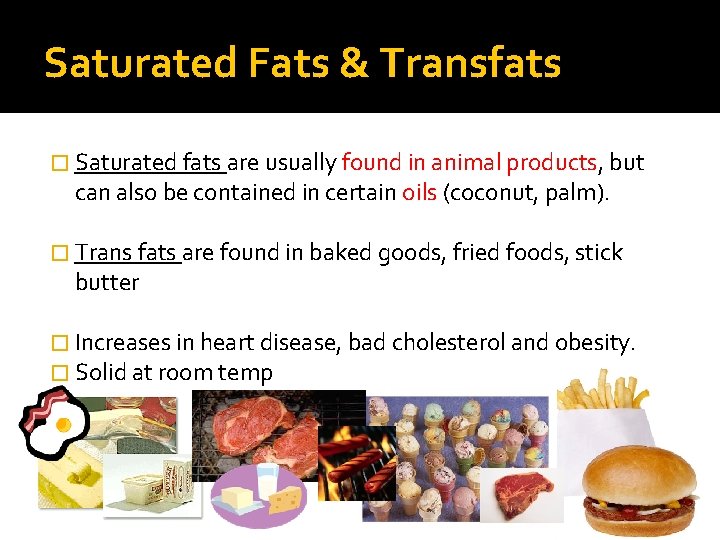
Saturated Fats & Transfats � Saturated fats are usually found in animal products, but can also be contained in certain oils (coconut, palm). � Trans fats are found in baked goods, fried foods, stick butter � Increases in heart disease, bad cholesterol and obesity. � Solid at room temp
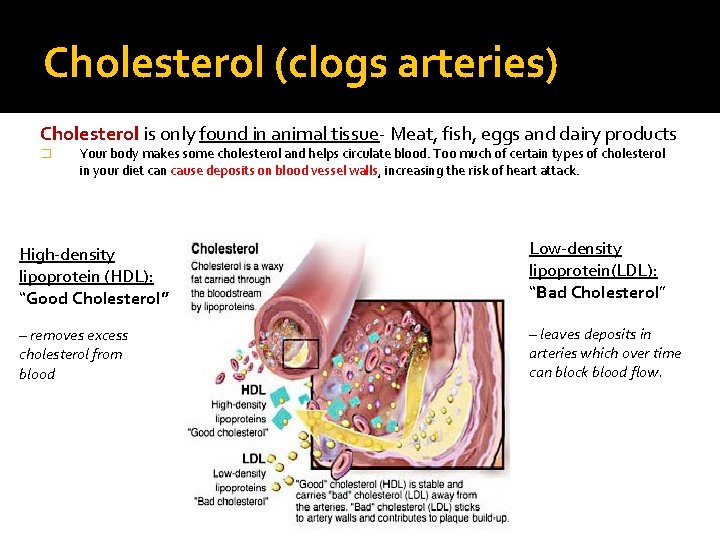
Cholesterol (clogs arteries) Cholesterol is only found in animal tissue- Meat, fish, eggs and dairy products � Your body makes some cholesterol and helps circulate blood. Too much of certain types of cholesterol in your diet can cause deposits on blood vessel walls, increasing the risk of heart attack. High-density lipoprotein (HDL): “Good Cholesterol” Low-density lipoprotein(LDL): “Bad Cholesterol” – removes excess cholesterol from blood – leaves deposits in arteries which over time can block blood flow.
Fats � Limit your fats to 30% of your daily caloric intake � 1 Gram of Fat contains 9 calories per gram! That’s over twice as much as Carbohydrates and Proteins! � Reduce intake of fats overall, but: limit saturated fats to 1/3 of all fats consumed � Trim visible fat from meats and reduce the use of butter, dressings, and oils
Vitamins �Why do we need Vitamins? Vitamins are carbon-containing nutrients that are needed in small amounts to maintain health and allow growth and development. Although they do not contain calories, they assist in the breakdown of carbs, protein, and fat for energy.
2 Types of Vitamins � Water-soluble vitamins dissolve in water. They are not stored in the body very well. They move freely throughout the bloodstream. Kidneys detect levels and remove excess Unlikely to reach toxic levels Needed in frequent, small doses ▪ Vitamin C and the B Vitamins � Fat-soluble vitamins dissolve in fat. Stored in the body for a long time. Less readily excreted; tend to remain in fat Likely to reach toxic levels if overeaten Needed in periodic doses ▪ Vitamins A, D, E, and K
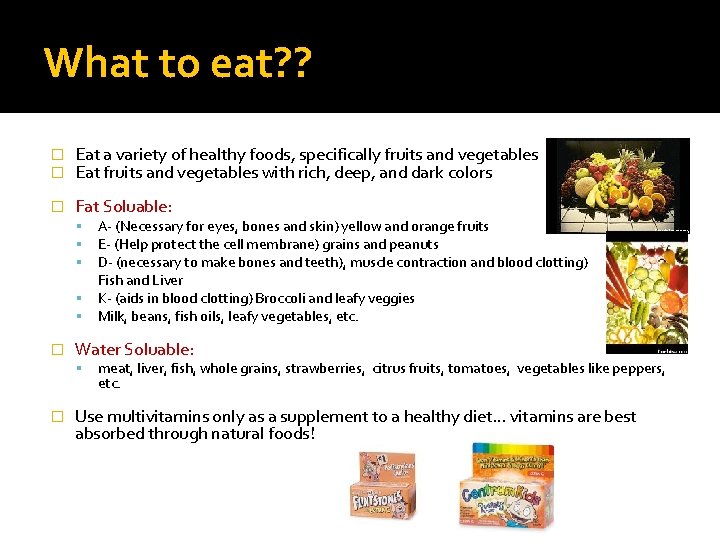
What to eat? ? � � Eat a variety of healthy foods, specifically fruits and vegetables Eat fruits and vegetables with rich, deep, and dark colors � Fat Soluable: � Water Soluable: � A- (Necessary for eyes, bones and skin) yellow and orange fruits E- (Help protect the cell membrane) grains and peanuts D- (necessary to make bones and teeth), muscle contraction and blood clotting) Fish and Liver K- (aids in blood clotting) Broccoli and leafy veggies Milk, beans, fish oils, leafy vegetables, etc. meat, liver, fish, whole grains, strawberries, citrus fruits, tomatoes, vegetables like peppers, etc. Use multivitamins only as a supplement to a healthy diet… vitamins are best absorbed through natural foods!
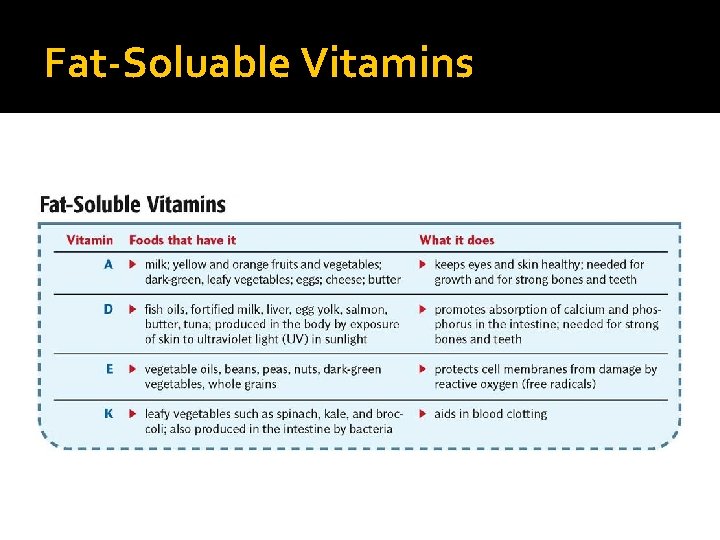
Fat-Soluable Vitamins
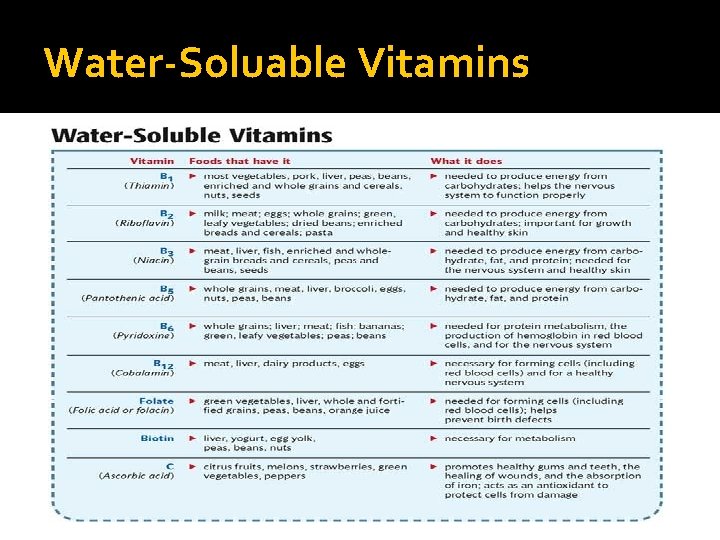
Water-Soluable Vitamins
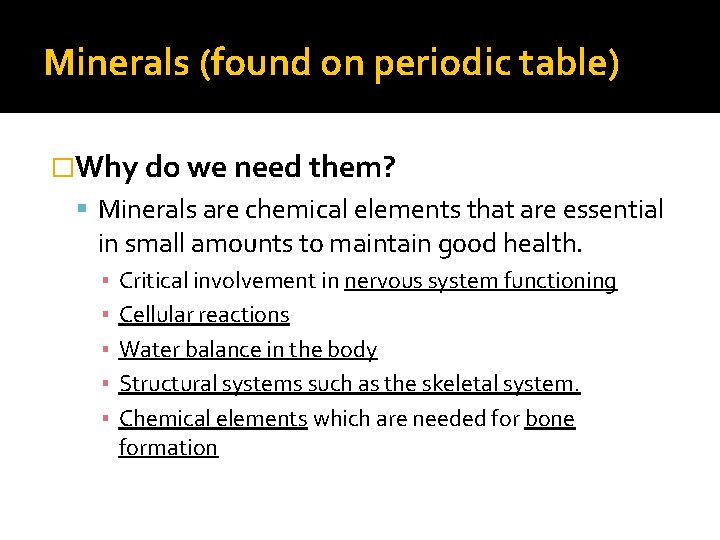
Minerals (found on periodic table) �Why do we need them? Minerals are chemical elements that are essential in small amounts to maintain good health. ▪ ▪ ▪ Critical involvement in nervous system functioning Cellular reactions Water balance in the body Structural systems such as the skeletal system. Chemical elements which are needed for bone formation
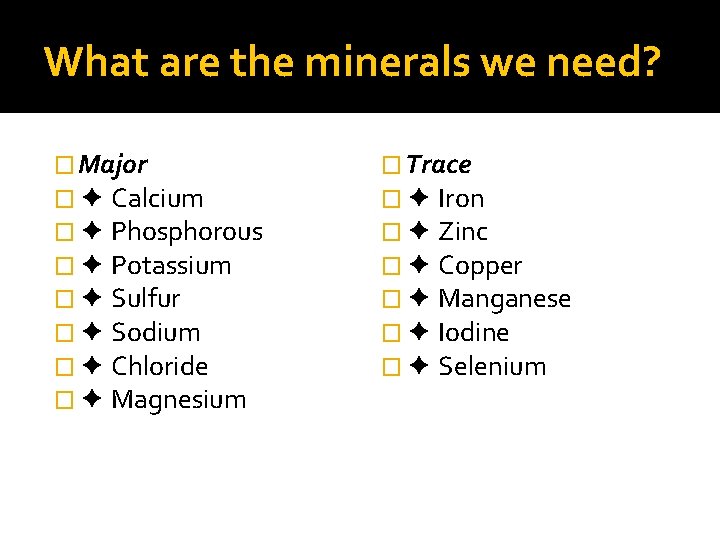
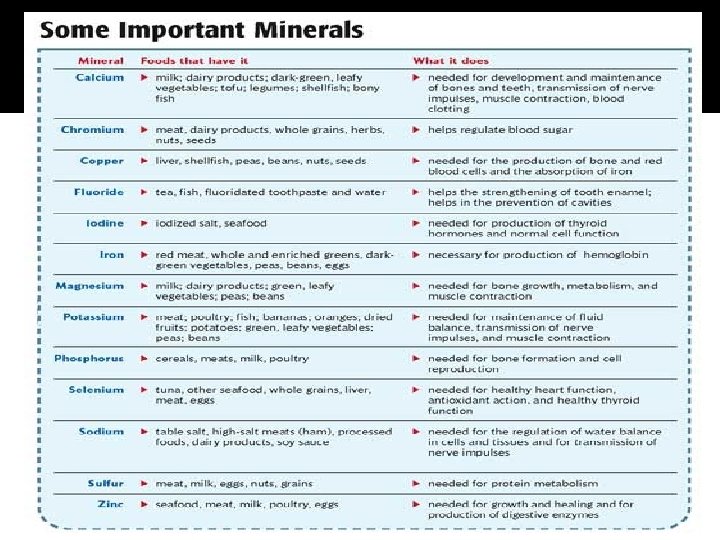
What are the minerals we need? � Major � ✦ Calcium � ✦ Phosphorous � ✦ Potassium � ✦ Sulfur � ✦ Sodium � ✦ Chloride � ✦ Magnesium � Trace � ✦ Iron � ✦ Zinc � ✦ Copper � ✦ Manganese � ✦ Iodine � ✦ Selenium
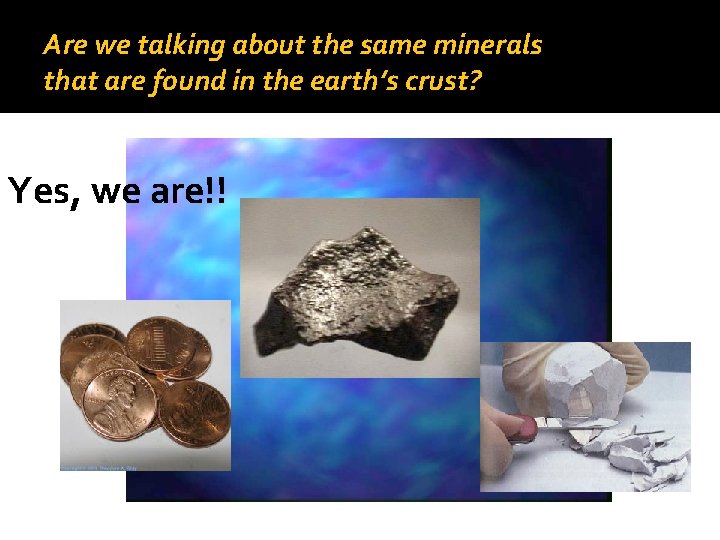
Are we talking about the same minerals that are found in the earth’s crust? Yes, we are!!
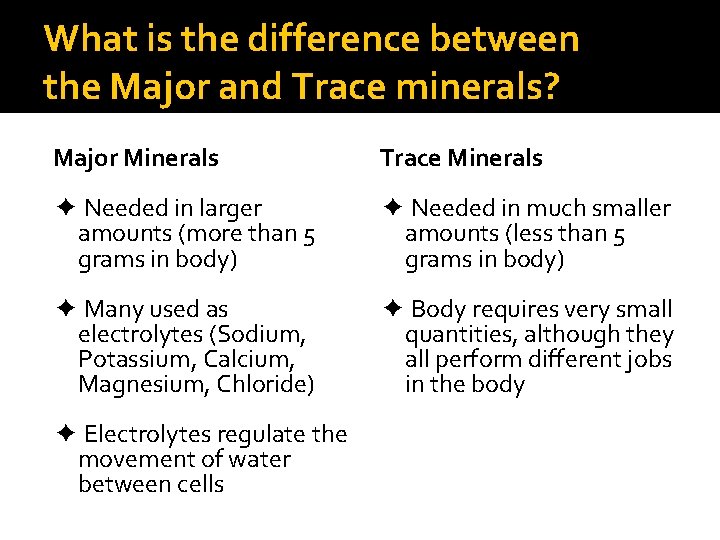
What is the difference between the Major and Trace minerals? Major Minerals Trace Minerals ✦ Needed in larger amounts (more than 5 grams in body) ✦ Needed in much smaller amounts (less than 5 grams in body) ✦ Many used as electrolytes (Sodium, Potassium, Calcium, Magnesium, Chloride) ✦ Body requires very small quantities, although they all perform different jobs in the body ✦ Electrolytes regulate the movement of water between cells
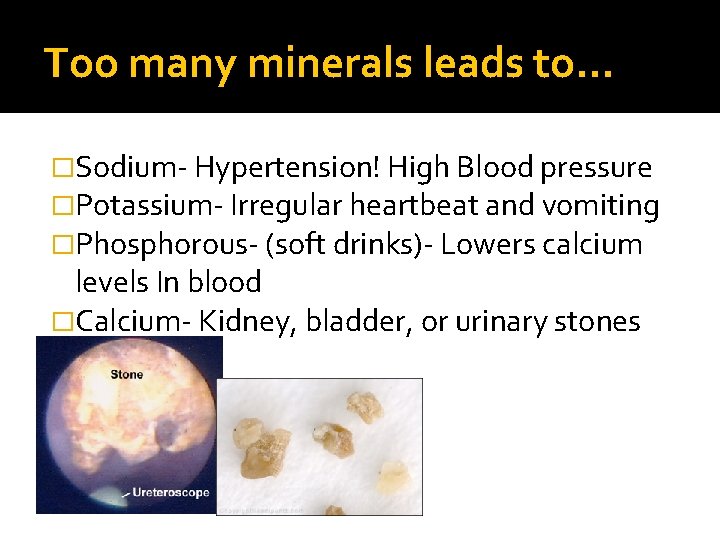
Too many minerals leads to… �Sodium- Hypertension! High Blood pressure �Potassium- Irregular heartbeat and vomiting �Phosphorous- (soft drinks)- Lowers calcium levels In blood �Calcium- Kidney, bladder, or urinary stones
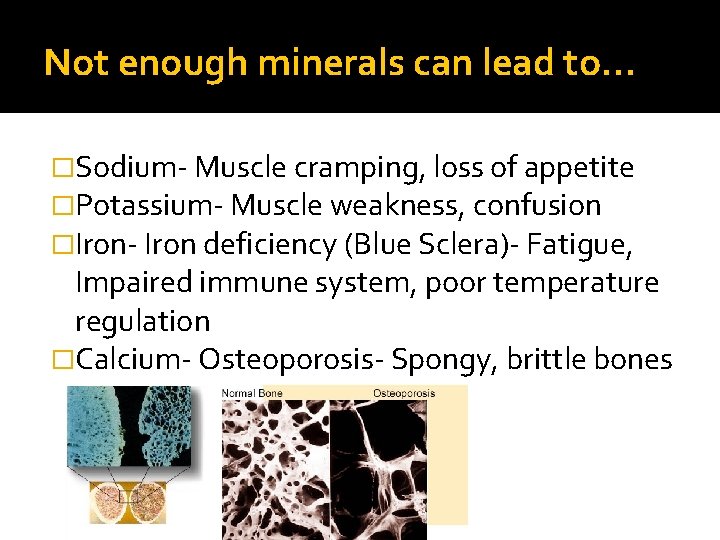
Not enough minerals can lead to… �Sodium- Muscle cramping, loss of appetite �Potassium- Muscle weakness, confusion �Iron- Iron deficiency (Blue Sclera)- Fatigue, Impaired immune system, poor temperature regulation �Calcium- Osteoporosis- Spongy, brittle bones
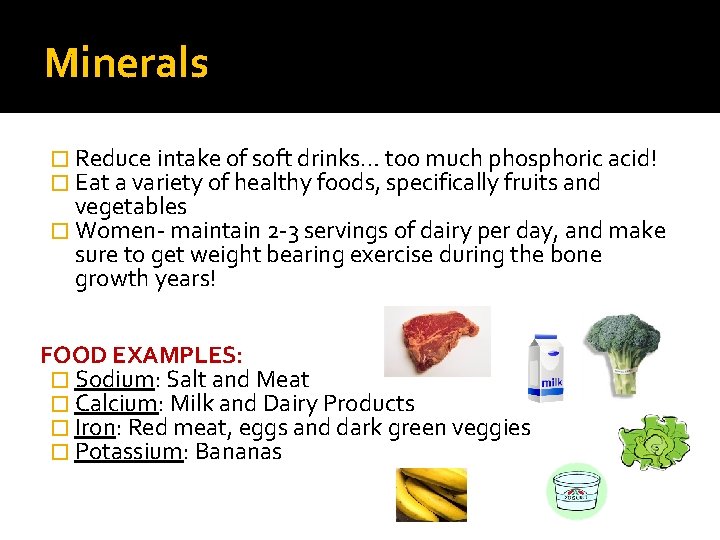
Minerals � Reduce intake of soft drinks… too much phosphoric acid! � Eat a variety of healthy foods, specifically fruits and vegetables � Women- maintain 2 -3 servings of dairy per day, and make sure to get weight bearing exercise during the bone growth years! FOOD EXAMPLES: � Sodium: Salt and Meat � Calcium: Milk and Dairy Products � Iron: Red meat, eggs and dark green veggies � Potassium: Bananas
WATER � Why do I need Water? � What if I do not drink enough Water? � Transports nutrients and oxygen and gets rid of waste. Provides a proper environment for chemical reaction. Regulates temperature. Water lubricates and cushions our joints. Water makes up most of our blood volume. Dehydration! Mild dehydration can interfere with mental and physical performance. Severe dehydration can have very serious consequences, including death. Heat exhaustion or heatstroke Weakness & Fatigue Electrolyte imbalance Can I drink too much Water? Lack of appetite Water intoxication
Water Single largest component of your body. About 60 percent of your body is water. To be healthy, you should take in at least 2. 5 quarts of water each day (about 8 glasses). This makes up for water lost through excretion and evaporation. ▪ Take your weight in pounds, cut it in half, and label it as ounces.
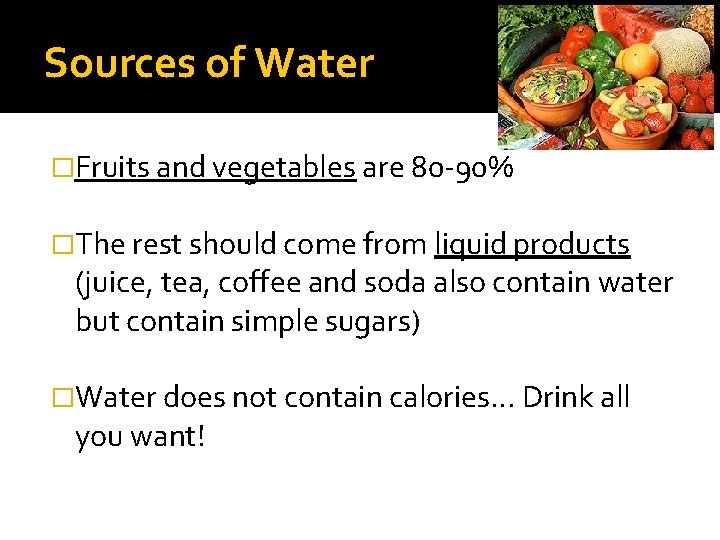
Sources of Water �Fruits and vegetables are 80 -90% �The rest should come from liquid products (juice, tea, coffee and soda also contain water but contain simple sugars) �Water does not contain calories… Drink all you want!

Review �White boards
Extension • Plan a dinner menu based on your favorite meal. Then use what you now know about nutrition to improve the nutritional value of your meal.
- Slides: 37