
Nutrient Intake Recommended Dietary Allowance RDAs Food Guide
- Slides: 9
Nutrient Intake
Recommended Dietary Allowance (RDAs) • • • Food Guide Pyramid Published in 1943 National Academy of Science The first official set of dietary standards Replaced by DRIs
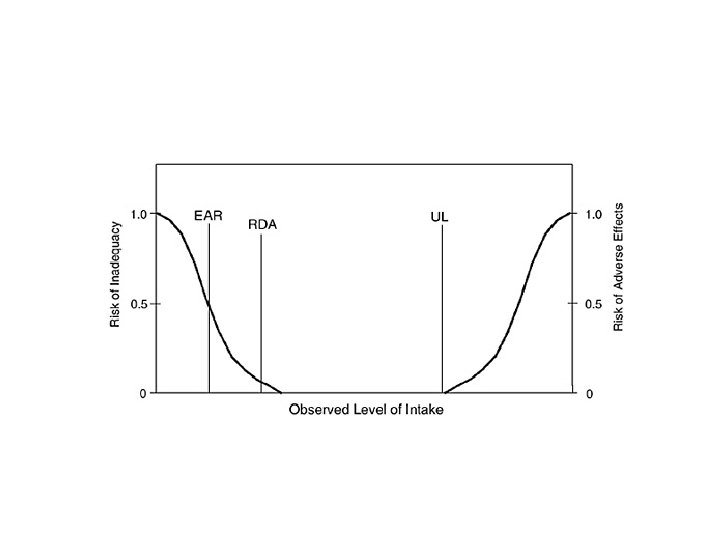
Dietary Reference Intakes (DRIs) • • • Choose My Plate Published in 1994 - 51 years after the RDAs National Academy of Sciences Include 4 sets of standards Depends on sex and life stages – other factors Estimation of nutrient requirement and intake goals in a healthy population
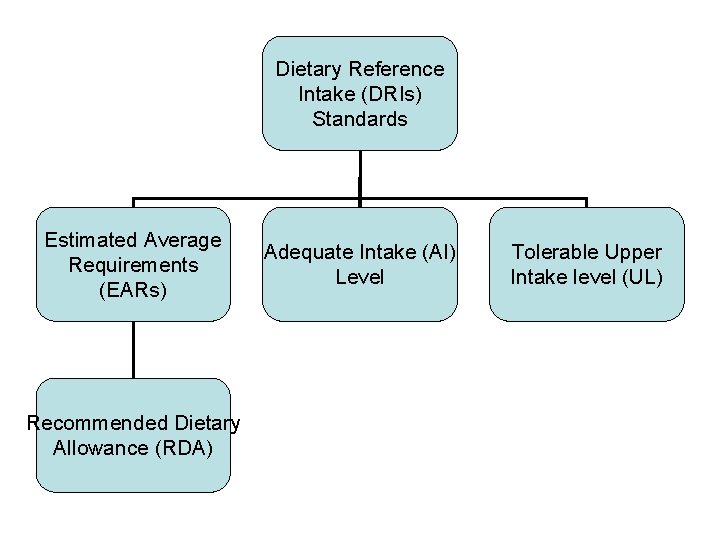
Dietary Reference Intake (DRIs) Standards Estimated Average Requirements (EARs) Recommended Dietary Allowance (RDA) Adequate Intake (AI) Level Tolerable Upper Intake level (UL)
Energy Intake
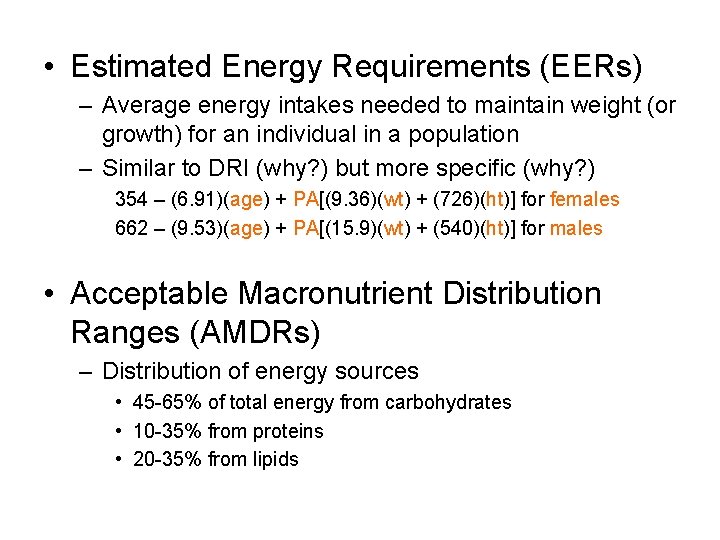
• Estimated Energy Requirements (EERs) – Average energy intakes needed to maintain weight (or growth) for an individual in a population – Similar to DRI (why? ) but more specific (why? ) 354 – (6. 91)(age) + PA[(9. 36)(wt) + (726)(ht)] for females 662 – (9. 53)(age) + PA[(15. 9)(wt) + (540)(ht)] for males • Acceptable Macronutrient Distribution Ranges (AMDRs) – Distribution of energy sources • 45 -65% of total energy from carbohydrates • 10 -35% from proteins • 20 -35% from lipids
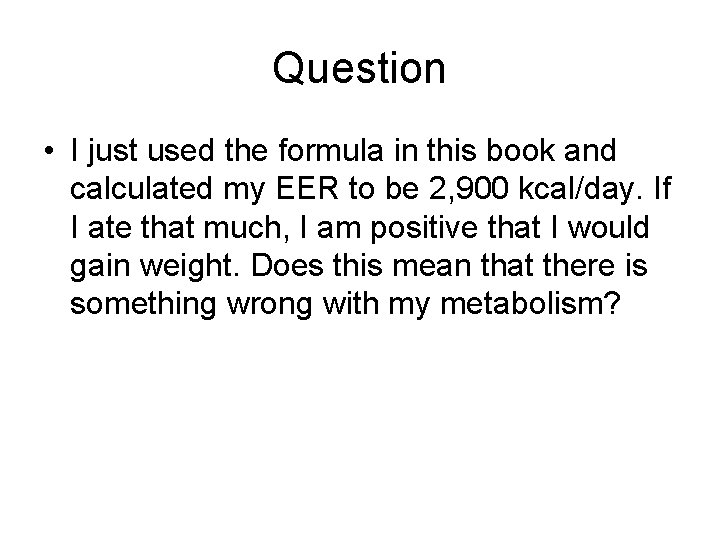
Question • I just used the formula in this book and calculated my EER to be 2, 900 kcal/day. If I ate that much, I am positive that I would gain weight. Does this mean that there is something wrong with my metabolism?
Answer • No. Keep in mind that the EER represent the Estimated Energy Requirements for individuals of similar sex, weight, height, and activity patterns. Your individual energy requirement may be somewhat more or less depending on other factors such as body composition and genetic factors.