
Nurturing Resilience Positive Mindsets and Islands of Competence

- Slides: 45
Nurturing Resilience, Positive Mindsets, and Islands of Competence www. drrobertbrooks. com contact@drrobertbrooks. com twitter: @drrobertbrooks
Connecting the dots backwards An experience that proved to be a major catalyst for me to adopt a strength-based approach in my clinical and educational activities, especially with youngsters with special needs
The power of mindsets Mindsets: The assumptions and expectations we have for ourselves and others that guide our behavior. Mindsets play a powerful role in impacting on our behaviors in all situations and our interactions with others
The power of mindsets In the 1990 s I began to use the concept of a “resilient mindset” that highlighted the importance of social-emotional and interpersonal factors in nurturing resilience
The power of mindsets Others, such as Julian Rotter (locus of control theory), Bernard Weiner (attribution theory), Carol Dweck (fixed and growth mindsets), Albert Bandura (self-efficacy), Martin Seligman (learned helplessness and learned optimism), and Angela Duckworth (grit), have also proposed different theories that would fall under the label of mindsets
The power of mindsets Many of these theories place heavy emphasis on achievement; based on my experiences I felt that equal emphasis should be given to the significance of interpersonal relationships and social-emotional variables when we describe the impact of mindsets on our behaviors
The power of mindsets For example, a prominent theory has been advanced by Angela Duckworth about the concept of “grit” Duckworth notes, “Having a great coach or teacher matters tremendously, but my theory doesn’t address these outside forces. ”
The power of mindsets In her book Grit Duckworth emphasizes in describing the concept of grit, “It’s about the psychology of achievement, but because psychology isn’t all that matters, it’s incomplete. ” However, I would argue that having a great teacher, coach, or mentor is all about psychology
The power of mindsets A theory of mindsets that includes social-emotional factors has been proposed by Shawn Achor as described in his book The Happiness Advantage Achor: happiness precedes success rather than happiness being the outcome of success
The power of mindsets How is happiness defined? “As the experience of positive emotions— pleasure combined with deeper feelings of meaning and purpose. Happiness implies a positive mood in the present and a positive outlook for the future. ”
The power of mindsets A focus on positive emotions should not be interpreted to imply that feelings such as anger, sadness, or disappointment expressed by students not be minimized or ignored. Such feelings have to be discussed and managed
The power of mindsets Achor stresses that positive emotions— which I believe are housed in a positive relationship—enhance brain development and “enable us to think more quickly and creatively, become more skilled at complex analysis and problem solving, and see and invent new ways of doing things. ”
The power of mindsets Achor’s work parallels that of Barbara Fredrickson, a psychologist at the University of North Carolina at Chapel Hill and author of the book Positivity Fredrickson has proposed the “broaden and build theory” of positive emotions, a theory that has major implications for the quality of the relationships we develop with students and the climate we create in our schools
The power of mindsets Fredrickson contends that negative emotions narrow one’s thinking and behavior while positive emotions such as “joy, contentment, and interest” broaden the “range of cognitions and behaviors”; positive emotions help us to experience seemingly stressful tasks as less threatening and also, to cope more effectively with stress
The power of mindsets Richard Davidson, a renowned expert in the study of emotions and brain activity and founder of the Center for Healthy Minds at the University of Wisconsin-Madison, has highlighted the impact of positive emotions in children and adults
The power of mindsets Davidson notes, “There is now a plethora of data showing that when individuals engage in generous and altruistic behavior, they actually activate circuits in the brain that are key to fostering well-being. ”
The power of mindsets Davidson continues, “These circuits in the brain get activated in a way that is more enduring than the way we respond to positive incentives, such as winning a game or earning a prize. ”
The power of mindsets So what is one key message to be taken from the research of Achor, Fredrickson, and Davidson? The reinforcement of positive emotions, positive relationships, and purpose serves as the foundation for creating an effective learning environment
The power of mindsets This task of creating positivity and purpose is made much more difficult given the uncertainties, anxieties, and ramifications of COVID-19 and to what extent remote learning will be in use from the beginning of the new school year
The impact of a charismatic adult The foundation for resilience: the significance of what the late psychologist Julius Segal called a “charismatic adult, ” an adult from whom children “gather strength”
The impact of a charismatic adult “The single most common factor for children who develop resilience is at least one stable and committed relationship with a supportive parent, caregiver, or other adult. ” Center on the Developing Child, Harvard University
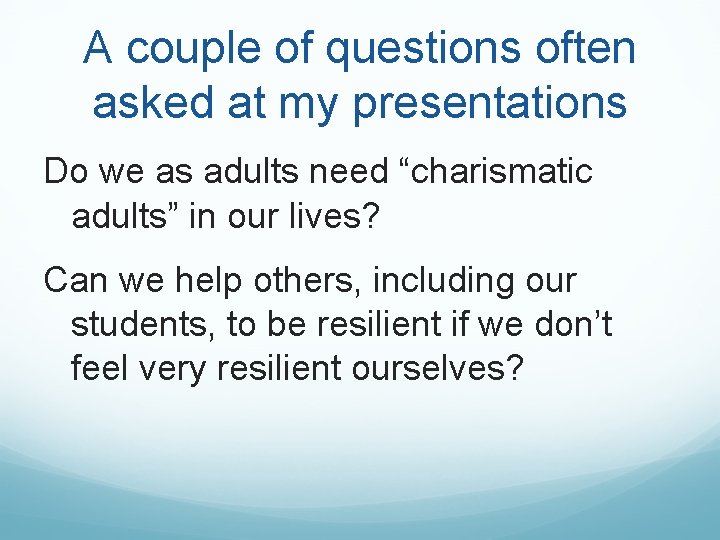
A couple of questions often asked at my presentations Do we as adults need “charismatic adults” in our lives? Can we help others, including our students, to be resilient if we don’t feel very resilient ourselves?
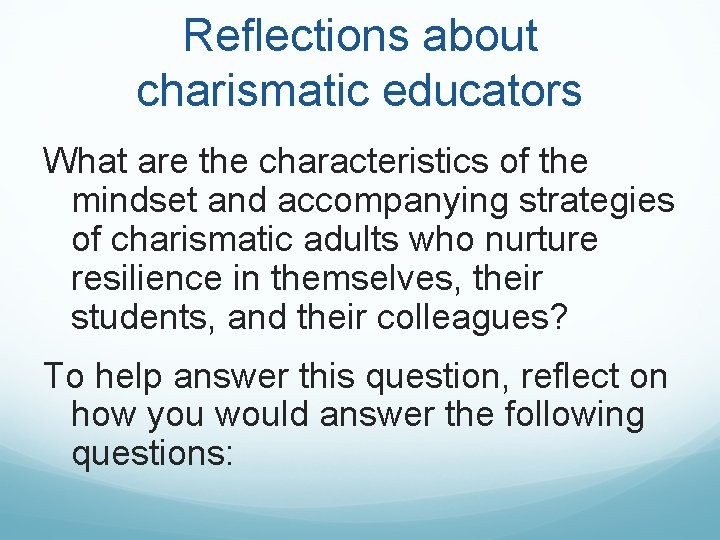
Reflections about charismatic educators What are the characteristics of the mindset and accompanying strategies of charismatic adults who nurture resilience in themselves, their students, and their colleagues? To help answer this question, reflect on how you would answer the following questions:
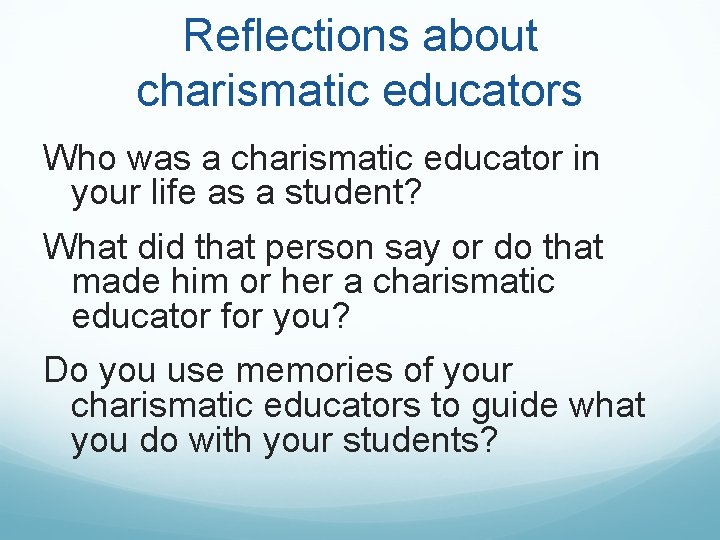
Reflections about charismatic educators Who was a charismatic educator in your life as a student? What did that person say or do that made him or her a charismatic educator for you? Do you use memories of your charismatic educators to guide what you do with your students?
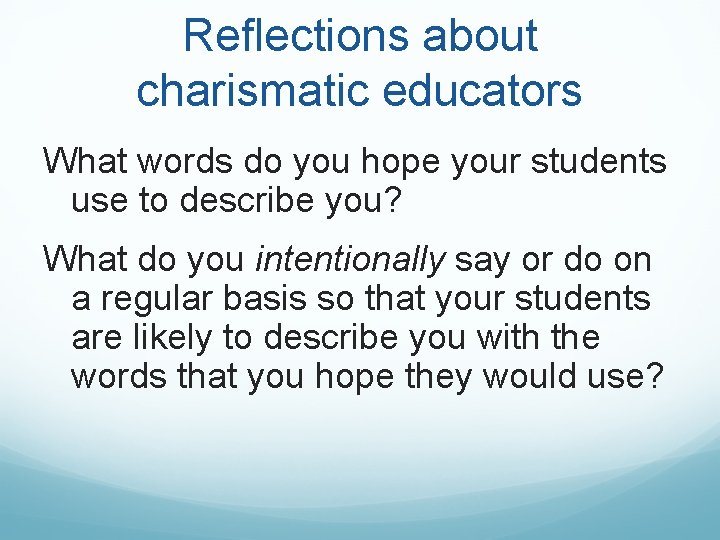
Reflections about charismatic educators What words do you hope your students use to describe you? What do you intentionally say or do on a regular basis so that your students are likely to describe you with the words that you hope they would use?
The mindset and behaviors of charismatic educators To focus on “personal control” and expend our time and energy on situations over which we have influence rather than on situations that are beyond our control; to strive to become the “authors of our own lives”
The mindset and behaviors of charismatic educators While maintaining an attitude of personal control is increasingly challenging during crises, it is even more essential that we attempt to do so and adopt the perspective that existing problems represent events to be solved rather than overwhelmed by
The mindset and behaviors of charismatic educators To believe that all children from birth want to learn and be successful: Robert White emphasized an inborn “drive for effectiveness” If such a drive exists, why do so many students seem unmotivated?
The mindset and behaviors of charismatic educators To believe that all students are motivated, but unfortunately, some are dominated by “avoidance motivation” as a way of protecting themselves from situations that they believe will lead to failure and humiliation and/or emotional and physical exhaustion
The mindset and behaviors of charismatic educators Thus, rather than asserting that students are lazy or unmotivated or resistant, we should ask, “How do we lessen avoidance motivation in students who use it? ” or in keeping with the tenets of personal control “What changes should we make in the strategies we use to lessen avoidance motivation? ”
The mindset and behaviors of charismatic educators The National Council on the Developing Child asserts, “When overcoming the odds is erroneously viewed as simply a matter of individual motivation or grit, the failure to succeed is perceived as the fault of the individual, and ‘blaming the victim’ becomes the most frequent response. ”
The mindset and behaviors of charismatic educators Educator Linda Nathan advances a similar view in her thought-provoking book When Grit Isn’t Enough. She contends, “Grit puts the focus on student initiative, often ignoring social and economic factors that can undermine even the best of efforts. ” I would add psychological and learning factors occasioned by COVID-19 to Nathan’s list
The mindset and behaviors of charismatic educators What theory of motivation guides your interventions? How do we create “motivating environments” that nurture learning, student engagement, intrinsic motivation, self-discipline, caring, and resilience? One framework is Deci’s focus on basic needs that apply to administrators, staff, and students— guideposts for action
The mindset and behaviors of charismatic educators Deci’s framework overlaps with (a) Glasser’s “choice theory” and (b) the Circle of Courage model advocated by Brendtro, Brokenleg, and Van Bockern As we review Deci’s model of motivation, we must adapt it to the disruptive realities imposed by COVID -19
The mindset and strategies of charismatic educators The need to belong and feel connected (and let’s add the word welcome): positive relationships provide the foundation for learning and emotional and physical well-being
The mindset and strategies of charismatic educators Clayton Cook at the University of Minnesota studied impact of Positive Greetings at the Door (PGDs) for 200 middle school students in 10 classrooms PGDs were expressed in the following ways:
The mindset and strategies of charismtic educators Say the student’s name Make eye contact Use a friendly greeting, such as a handshake, high five, or thumbs up Give a few words of encouragement Ask how their day is going
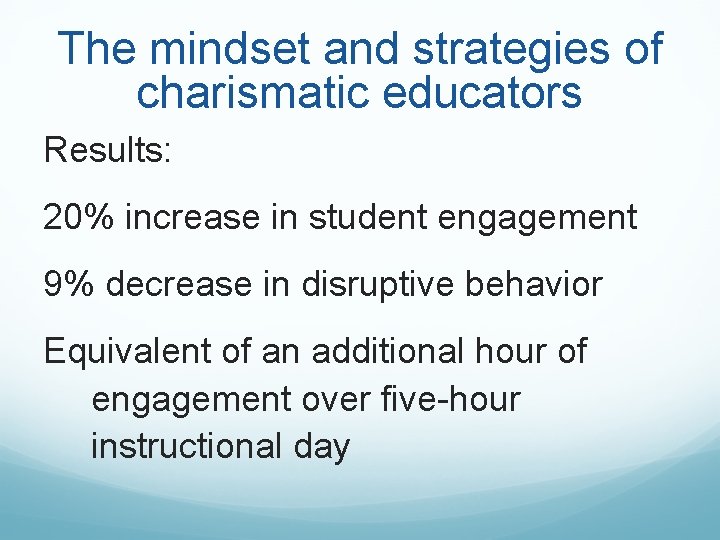
The mindset and strategies of charismatic educators Results: 20% increase in student engagement 9% decrease in disruptive behavior Equivalent of an additional hour of engagement over five-hour instructional day
The mindset and strategies of charismatic educators How can we respond to this need for belonging and connectedness in a time of remote learning?
The mindset and strategies of charismatic educators The need for self-determination, which is a significant feature of a sense of ownership, self-discipline, and resilience and reinforces problemsolving skills: What input and choices do all members of a school community feel they have?
The mindset and strategies of charismatic educators How can we respond to this need for self-determination in a time of remote learning?
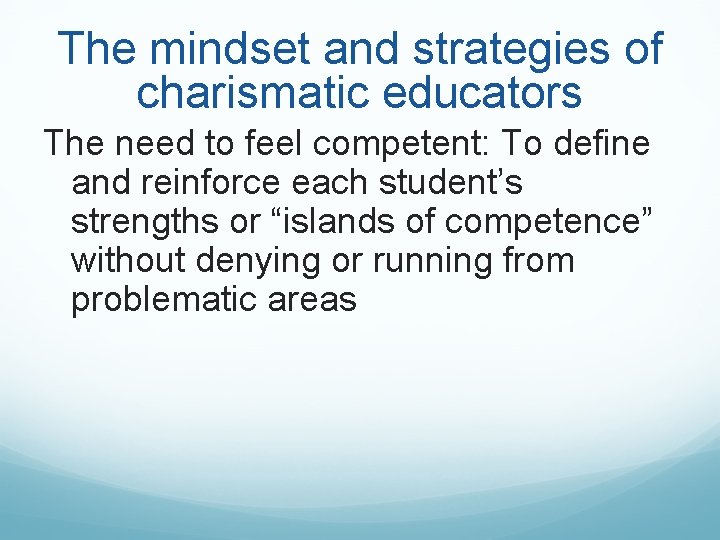
The mindset and strategies of charismatic educators The need to feel competent: To define and reinforce each student’s strengths or “islands of competence” without denying or running from problematic areas
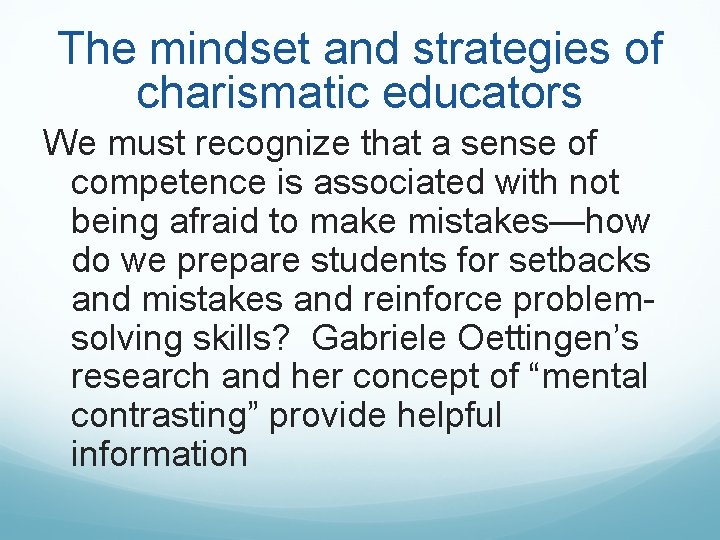
The mindset and strategies of charismatic educators We must recognize that a sense of competence is associated with not being afraid to make mistakes—how do we prepare students for setbacks and mistakes and reinforce problemsolving skills? Gabriele Oettingen’s research and her concept of “mental contrasting” provide helpful information
The mindset and strategies of charismatic educators How can we respond to this need to feel competent (and less fearful of making mistakes) in a time of remote learning?
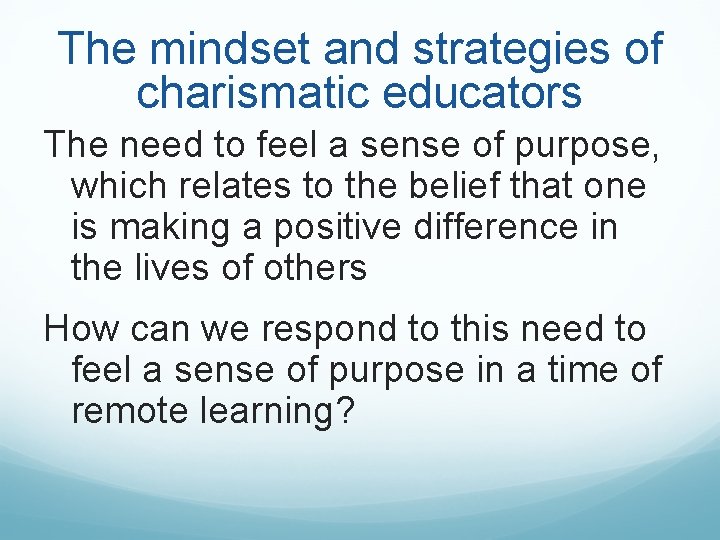
The mindset and strategies of charismatic educators The need to feel a sense of purpose, which relates to the belief that one is making a positive difference in the lives of others How can we respond to this need to feel a sense of purpose in a time of remote learning?