
Nursing Workforce Diversity Project ESL Enhancing Student Learning
- Slides: 1
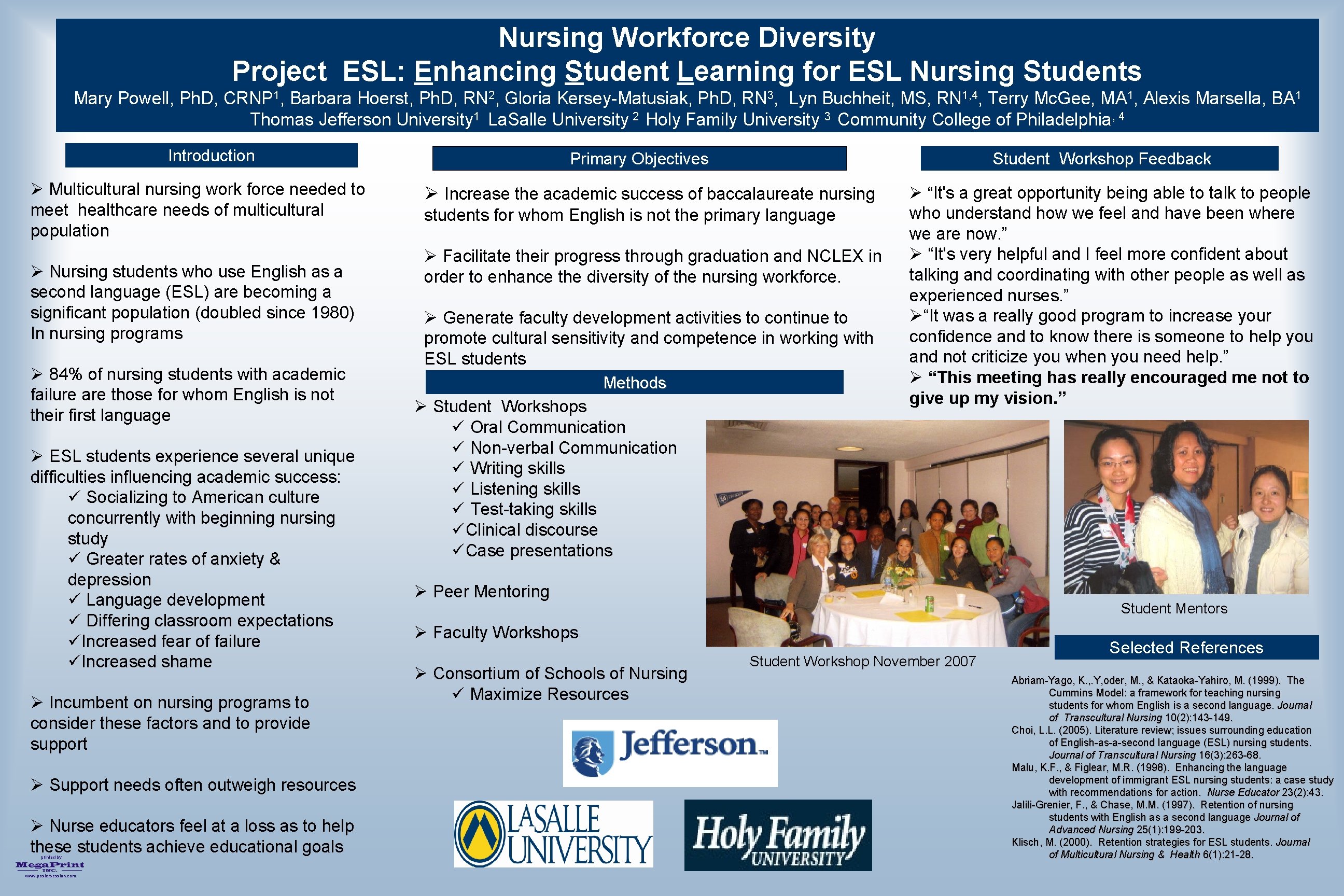
Nursing Workforce Diversity Project ESL: Enhancing Student Learning for ESL Nursing Students Mary Powell, Ph. D, CRNP 1, Barbara Hoerst, Ph. D, RN 2, Gloria Kersey-Matusiak, Ph. D, RN 3, Lyn Buchheit, MS, RN 1, 4, Terry Mc. Gee, MA 1, Alexis Marsella, BA 1 Thomas Jefferson University 1 La. Salle University 2 Holy Family University 3 Community College of Philadelphia, 4 Introduction Ø Multicultural nursing work force needed to meet healthcare needs of multicultural population Ø Nursing students who use English as a second language (ESL) are becoming a significant population (doubled since 1980) In nursing programs Ø 84% of nursing students with academic failure are those for whom English is not their first language Ø ESL students experience several unique difficulties influencing academic success: ü Socializing to American culture concurrently with beginning nursing study ü Greater rates of anxiety & depression ü Language development ü Differing classroom expectations üIncreased fear of failure üIncreased shame Ø Incumbent on nursing programs to consider these factors and to provide support Ø Support needs often outweigh resources Ø Nurse educators feel at a loss as to help these students achieve educational goals printed by www. postersession. com Primary Objectives Student Workshop Feedback Ø Increase the academic success of baccalaureate nursing students for whom English is not the primary language Ø Facilitate their progress through graduation and NCLEX in order to enhance the diversity of the nursing workforce. Ø Generate faculty development activities to continue to promote cultural sensitivity and competence in working with ESL students Methods Ø Student Workshops ü Oral Communication ü Non-verbal Communication ü Writing skills ü Listening skills ü Test-taking skills üClinical discourse üCase presentations Ø “It's a great opportunity being able to talk to people who understand how we feel and have been where we are now. ” Ø “It's very helpful and I feel more confident about talking and coordinating with other people as well as experienced nurses. ” Ø“It was a really good program to increase your confidence and to know there is someone to help you and not criticize you when you need help. ” Ø “This meeting has really encouraged me not to give up my vision. ” ØMmm ØMmm Ømmm Ø Peer Mentoring Student Mentors Ø Faculty Workshops Ø Consortium of Schools of Nursing ü Maximize Resources Student Workshop November 2007 Selected References Abriam-Yago, K. , . Y, oder, M. , & Kataoka-Yahiro, M. (1999). The Cummins Model: a framework for teaching nursing students for whom English is a second language. Journal of Transcultural Nursing 10(2): 143 -149. Choi, L. L. (2005). Literature review; issues surrounding education of English-as-a-second language (ESL) nursing students. Journal of Transcultural Nursing 16(3): 263 -68. Malu, K. F. , & Figlear, M. R. (1998). Enhancing the language development of immigrant ESL nursing students: a case study with recommendations for action. Nurse Educator 23(2): 43. Jalili-Grenier, F. , & Chase, M. M. (1997). Retention of nursing students with English as a second language Journal of Advanced Nursing 25(1): 199 -203. Klisch, M. (2000). Retention strategies for ESL students. Journal of Multicultural Nursing & Health 6(1): 21 -28.