
Nursing Sensitive Indicators Catheter Acquired Urinary Tract Infections
- Slides: 6
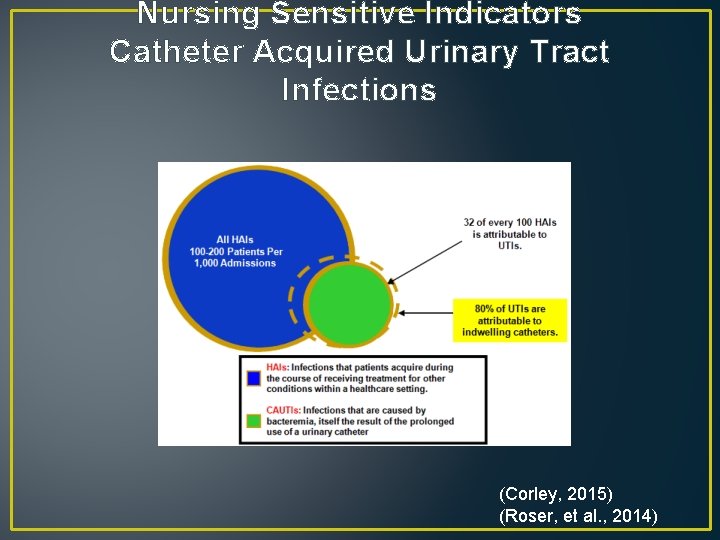
Nursing Sensitive Indicators Catheter Acquired Urinary Tract Infections (Corley, 2015) (Roser, et al. , 2014)
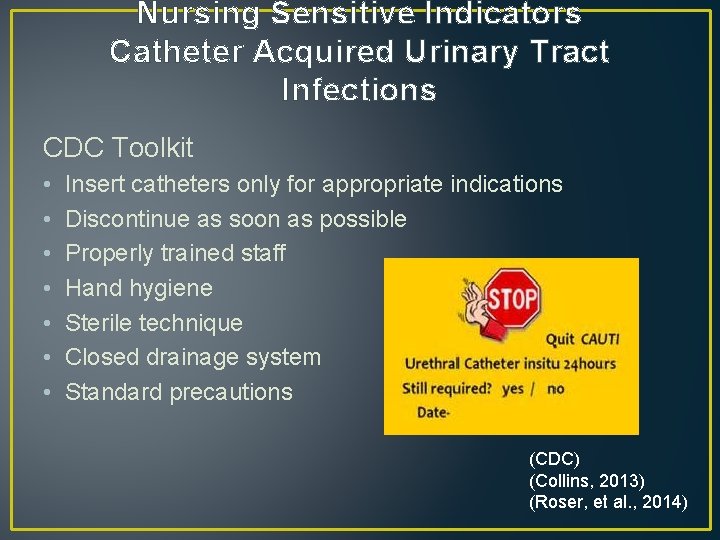
Nursing Sensitive Indicators Catheter Acquired Urinary Tract Infections CDC Toolkit • • Insert catheters only for appropriate indications Discontinue as soon as possible Properly trained staff Hand hygiene Sterile technique Closed drainage system Standard precautions (CDC) (Collins, 2013) (Roser, et al. , 2014)
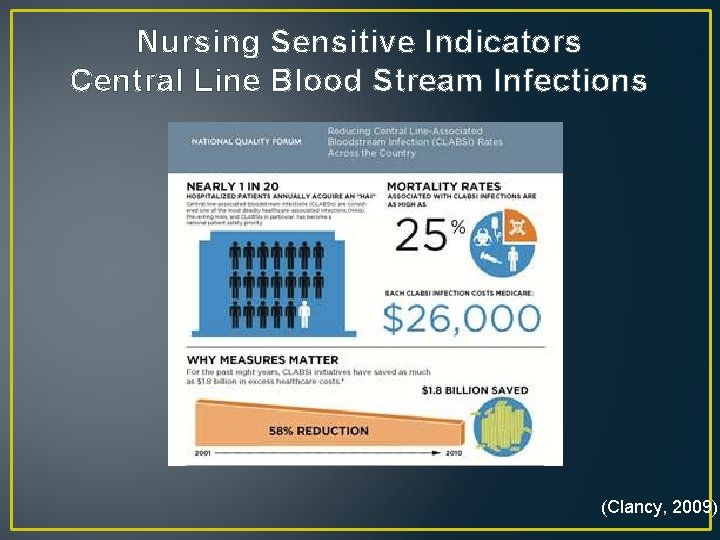
Nursing Sensitive Indicators Central Line Blood Stream Infections (Clancy, 2009)
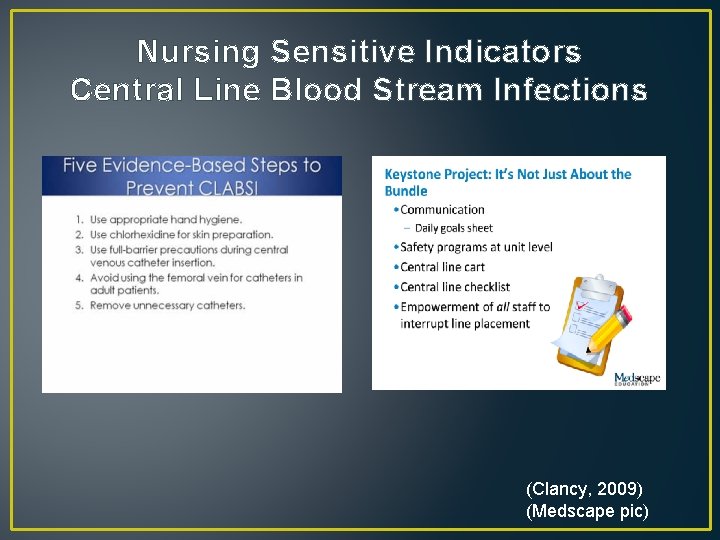
Nursing Sensitive Indicators Central Line Blood Stream Infections (Clancy, 2009) (Medscape pic)
QSEN – Quality Improvement – “Use data to monitor the outcomes of care processes and use improvement methods to design and test changes to continuously improve the quality and safety of health care systems” (QSEN, 2014). • CDC • John Hopkins University • MHA Keystone (CDC) (Sadler, 2015) (Sherwood & Barnsteiner, 2012)
REFERENCES • Center for Disease Control and Prevention. (n. d. ). Catheterassociated urinary tract infection (CAUTI) toolkit. Retrieved from http: //www. cdc. gov/HAI/ca_uti/uti. html • Clancy, C. M. (2009, June). Reducing central line-related bloodstream infections. AORN, 89, 1123 -1125. • Collins, T. (2013, December 1). Two major studies show benefits of CAUTI reduction measures. The Hospitalist. Retrieved from http: //www. the-hospitalist. org/article/two-major-studies-show-benefits -of-cauti-reduction-measures/ • Corley, L. (2015, January). CAUTI awakenings. Nursing 2015, 20 -21. • Roser, L. P. , Piercy, E. C. , & Allpeter, T. (2014, December). Targeting Zero: One hospital’s journey to reduce CAUTI. Nursing Management, 18 -20. • Sherwood, G. , & Barnsteiner, J. (2012). Quality and safety in nursing: A competency approach to improving outcomes (1 ed. ). West Sussex, UK: Wiley-Blackwell.