
Nursing Process Outcome Identification and Planning Implementing Evaluating






- Slides: 48
Nursing Process Outcome Identification and Planning Implementing Evaluating Chapter 16, 17, and 18 Copyright © 2011 Wolters Kluwer Health | Lippincott Williams & Wilkins
Zoom link for the recorded lecture (part 1) with audio transcript v https: //virginia. zoom. us/rec/share/w 4 bm. Sqjc. H 4 IJuy 4 f. M 7 kmxt. Lz. Nq 2 sq. Uj. Srtt. XW 1 tz. OW 67 Emnpz. M 8 h 6 CQkgg 8 Zxa. Jp. j 0 a 1 Zf. Igc. Eafo. No 1 v Access Passcode: Care 1# Copyright © 2019 Wolters Kluwer • All Rights Reserved
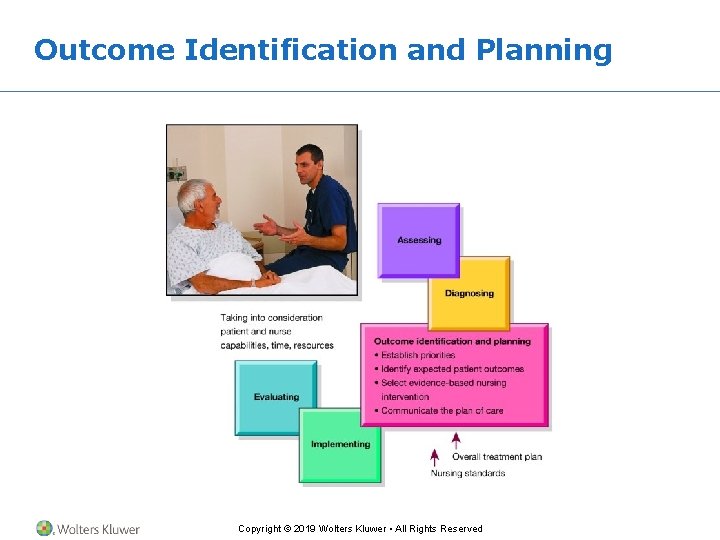
Outcome Identification and Planning Copyright © 2019 Wolters Kluwer • All Rights Reserved
Goal of Outcome Identification and Planning Step v Establish priorities. v Identify and write expected patient outcomes. v Select evidence-based nursing interventions. v Communicate the care plan. Copyright © 2019 Wolters Kluwer • All Rights Reserved
A Formal Care Plan Allows the Nurse to: v Set priorities v Individualize care that maximizes outcome achievement v Promote continuity of high-quality, cost-effective care v Coordinate care v Facilitate communication among nursing personnel and colleagues v Evaluate patient response to nursing care v Create a record used for evaluation, research, reimbursement, and legal reasons v Promote nurse’s professional development Copyright © 2019 Wolters Kluwer • All Rights Reserved
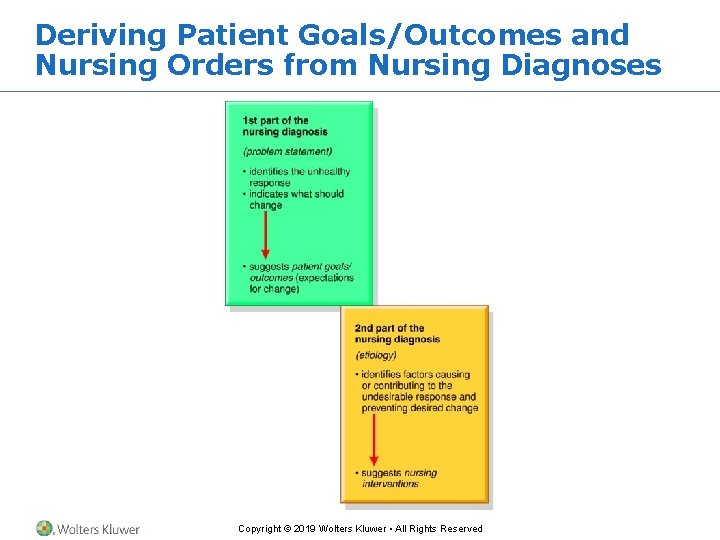
Deriving Patient Goals/Outcomes and Nursing Orders from Nursing Diagnoses Copyright © 2019 Wolters Kluwer • All Rights Reserved
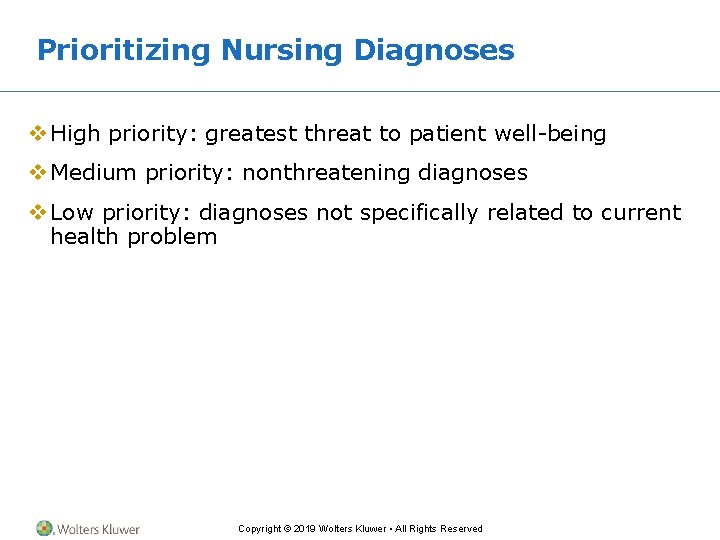
Prioritizing Nursing Diagnoses v High priority: greatest threat to patient well-being v Medium priority: nonthreatening diagnoses v Low priority: diagnoses not specifically related to current health problem Copyright © 2019 Wolters Kluwer • All Rights Reserved
Question #2 Which nursing diagnosis would most likely be considered a high priority? A. Disturbed personal identity B. Impaired gas exchange C. Risk for powerlessness D. Activity intolerance Copyright © 2019 Wolters Kluwer • All Rights Reserved
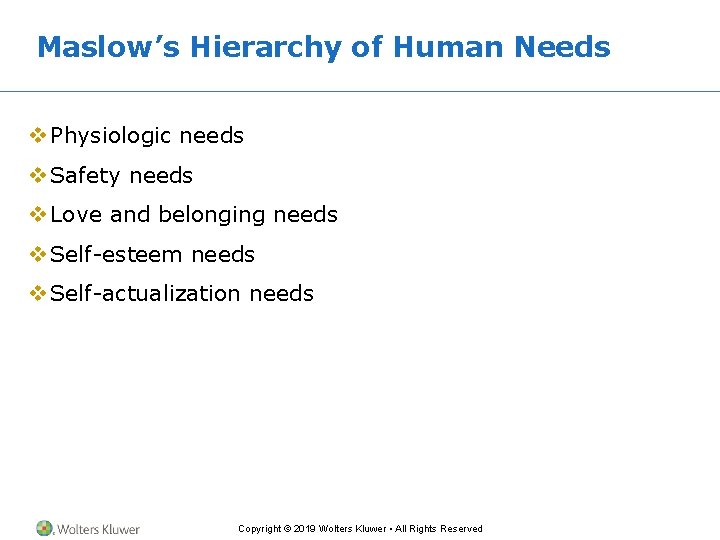
Maslow’s Hierarchy of Human Needs v Physiologic needs v Safety needs v Love and belonging needs v Self-esteem needs v Self-actualization needs Copyright © 2019 Wolters Kluwer • All Rights Reserved
Three Elements of Comprehensive Planning v Initial v Ongoing v Discharge Copyright © 2019 Wolters Kluwer • All Rights Reserved
Question Which nursing action would most likely occur during the ongoing planning stage of the comprehensive care plan? A. The nurse collects new data and uses them to update the plan and resolve health problems. B. The nurse uses teaching and counseling skills to help the patient carry out self-care behaviors at home. C. The nurse who performs the admission nursing history develops a patient care plan. D. The nurse consults standardized care plans to identify nursing diagnoses, outcomes, and interventions. Copyright © 2019 Wolters Kluwer • All Rights Reserved
Initial Planning v Developed by the nurse who performs the nursing history and physical assessment v Addresses each problem listed in the prioritized nursing diagnoses v Identifies appropriate patient goals and related nursing care Copyright © 2019 Wolters Kluwer • All Rights Reserved
Ongoing Planning v Carried out by any nurse who interacts with patient v Keeps the plan up to date, manages risk factors, promotes function v States nursing diagnoses more clearly v Develops new diagnoses v Makes outcomes more realistic and develops new outcomes as needed v Identifies nursing interventions to accomplish patient goals Copyright © 2019 Wolters Kluwer • All Rights Reserved
Discharge Planning v Carried out by the nurse who worked most closely with the patient v Begins when the patient is admitted for treatment v Uses teaching and counseling skills effectively to ensure that home care behaviors are performed competently Copyright © 2019 Wolters Kluwer • All Rights Reserved
Long-Term vs. Short-Term Outcomes v Long-term outcomes require a longer period to be achieved and may be used as discharge goals. v Short-term outcomes may be accomplished in a specified period of time. Copyright © 2019 Wolters Kluwer • All Rights Reserved
IOM’s Six Aims to be Met by Health Care Systems Regarding Quality of Care v. Safe v. Effective v. Efficient v. Patient-centered v. Timely v. Equitable Copyright © 2019 Wolters Kluwer • All Rights Reserved
Four Types of Outcomes v Cognitive: increase in patient knowledge v Psychomotor: patient’s achievement of new skills v Affective: changes in patient values, beliefs, and attitudes v Physiologic: physical changes in the patient Copyright © 2019 Wolters Kluwer • All Rights Reserved
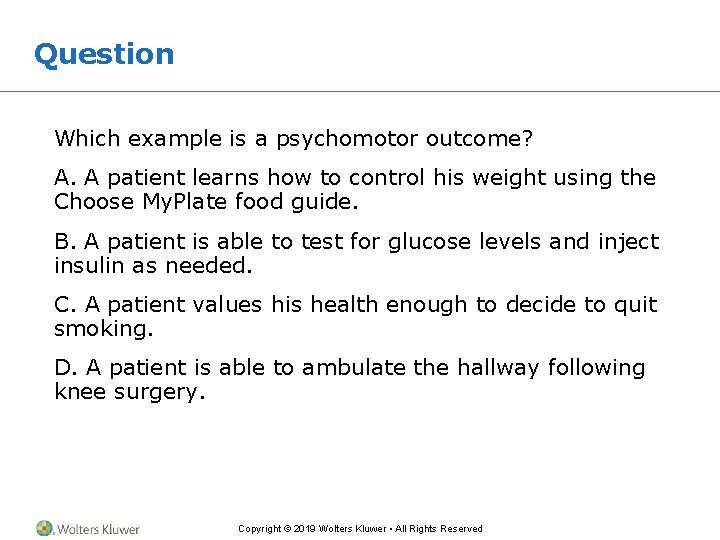
Question Which example is a psychomotor outcome? A. A patient learns how to control his weight using the Choose My. Plate food guide. B. A patient is able to test for glucose levels and inject insulin as needed. C. A patient values his health enough to decide to quit smoking. D. A patient is able to ambulate the hallway following knee surgery. Copyright © 2019 Wolters Kluwer • All Rights Reserved
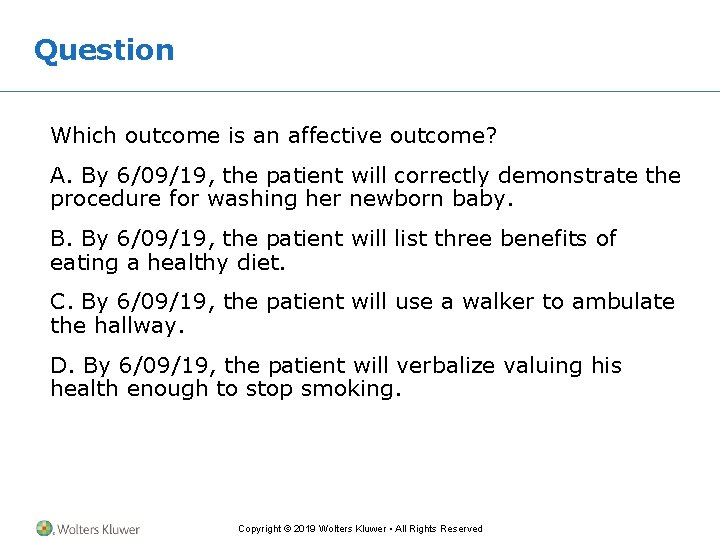
Question Which outcome is an affective outcome? A. By 6/09/19, the patient will correctly demonstrate the procedure for washing her newborn baby. B. By 6/09/19, the patient will list three benefits of eating a healthy diet. C. By 6/09/19, the patient will use a walker to ambulate the hallway. D. By 6/09/19, the patient will verbalize valuing his health enough to stop smoking. Copyright © 2019 Wolters Kluwer • All Rights Reserved
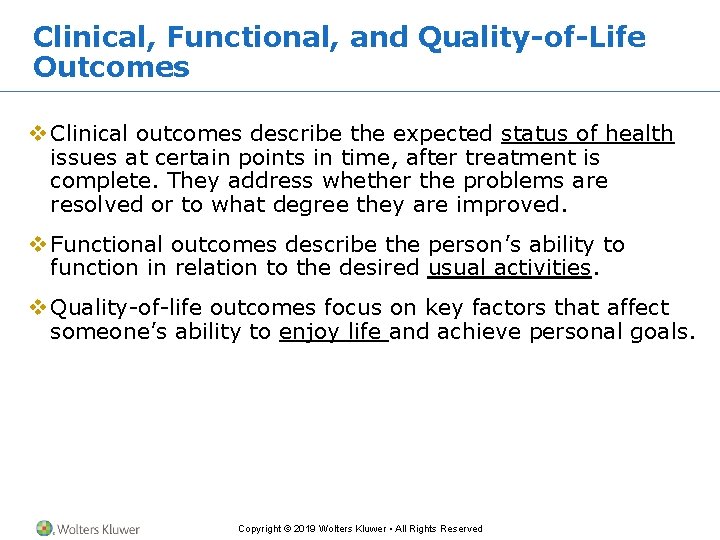
Clinical, Functional, and Quality-of-Life Outcomes v Clinical outcomes describe the expected status of health issues at certain points in time, after treatment is complete. They address whether the problems are resolved or to what degree they are improved. v Functional outcomes describe the person’s ability to function in relation to the desired usual activities. v Quality-of-life outcomes focus on key factors that affect someone’s ability to enjoy life and achieve personal goals. Copyright © 2019 Wolters Kluwer • All Rights Reserved
Parts of a Measurable Outcome v Subject v Verb v Conditions v Performance criteria v Target time Copyright © 2019 Wolters Kluwer • All Rights Reserved
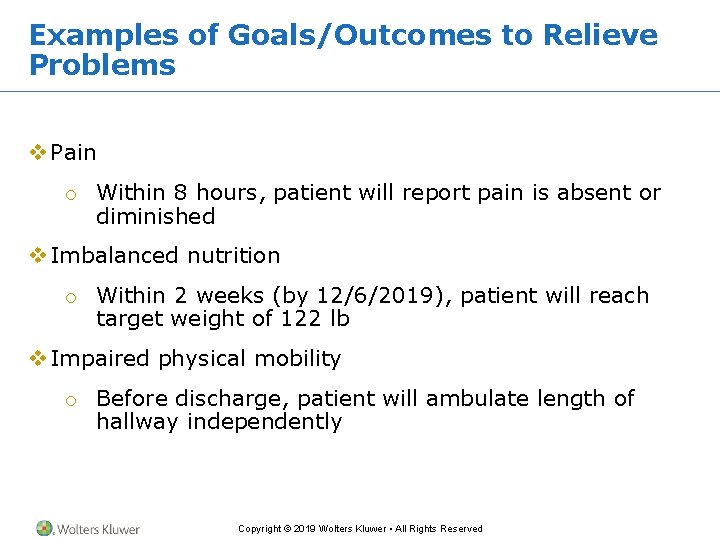
Examples of Goals/Outcomes to Relieve Problems v Pain o Within 8 hours, patient will report pain is absent or diminished v Imbalanced nutrition o Within 2 weeks (by 12/6/2019), patient will reach target weight of 122 lb v Impaired physical mobility o Before discharge, patient will ambulate length of hallway independently Copyright © 2019 Wolters Kluwer • All Rights Reserved
Common Errors in Writing Patient Outcomes v Expressing patient outcome as nursing intervention v Writing vague outcomes v Using verbs that are not observable or measurable v Including more than one patient behavior or manifestation in short-term outcomes Copyright © 2019 Wolters Kluwer • All Rights Reserved
Question Tell whether the following statement is true or false. A collaborative intervention is an intervention initiated by a physician in response to a medical diagnosis but carried out by a nurse in response to a physician’s order. A. True B. False Copyright © 2019 Wolters Kluwer • All Rights Reserved
Types of Nursing Interventions v Nurse-initiated: actions performed by a nurse without a physician’s order v Physician-initiated: actions initiated by a physician in response to a medical diagnosis but carried out by a nurse under doctor’s orders v Collaborative: treatments initiated by other providers and carried out by a nurse Copyright © 2019 Wolters Kluwer • All Rights Reserved
Actions Performed in Nurse-Initiated Interventions (Alfaro, 2002) v Monitor health status. v Reduce risks. v Resolve, prevent, or manage a problem. v Facilitate independence or assist with ADLs. v Promote optimum sense of physical, psychological, and spiritual well-being. Copyright © 2019 Wolters Kluwer • All Rights Reserved
Zoom link for the recorded lecture (part 2) with audio transcript v https: //virginia. zoom. us/rec/share/R_LN 2 sx 0 i 0 r. Jc. Ntbagu. Tpj. B 7 k. LEg 7 H-4 Mb 6 u. Q 33 w. Bf. YAxw 4 Da. D 32 u 0 Pu. VOzy 2 D. a. F 6 S 9 QHto 93 BRb. O v Access Passcode: Care 1# Copyright © 2019 Wolters Kluwer • All Rights Reserved
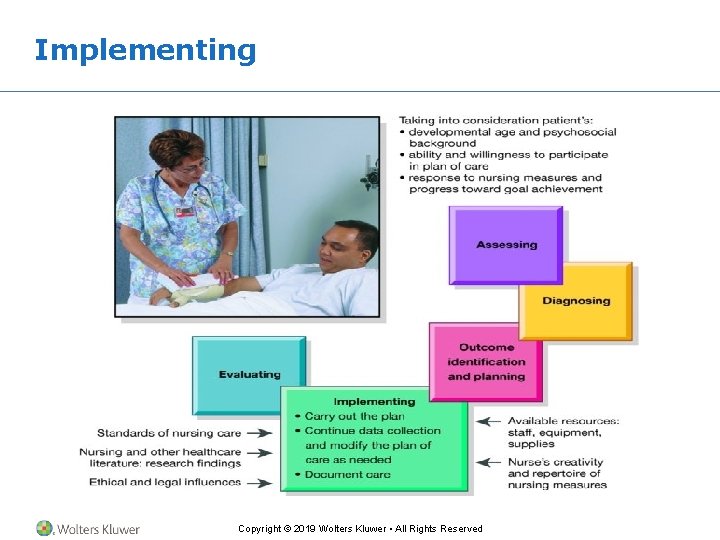
Implementing Copyright © 2019 Wolters Kluwer • All Rights Reserved
Purposes of Implementation v Help the patient achieve valued health outcomes. v Promote health. v Prevent disease and illness. v Restore health. v Facilitate coping with altered functioning. Copyright © 2019 Wolters Kluwer • All Rights Reserved
Question Tell whether the following statement is true or false. One of the advantages of using Nursing Intervention Classifications in nursing practice is to ensure appropriate reimbursement for nursing services. A. True B. False Copyright © 2019 Wolters Kluwer • All Rights Reserved
Checklist for Organizing Student Clinical Responsibilities v Patient profile and name by which patient is addressed v Patient’s chief complaint and reason for admission v Patient’s current health status v Routine assistance to meet basic human needs v Priorities for nursing care and special daily events v Special teaching, counseling, or advocacy needs v Special family needs Copyright © 2019 Wolters Kluwer • All Rights Reserved
Implementing Guidelines #1 v Act in partnership with the patient/family. v Before implementing, reassess the patient to determine whether the action is still needed. v Approach the patient competently. v Approach the patient caringly. v Modify nursing interventions according to the patient’s (1) developmental and psychosocial background (2) ability and willingness to participate in the care plan, (3) responses to previous nursing measures and progress toward goal/outcome achievement. Copyright © 2019 Wolters Kluwer • All Rights Reserved
Implementing Guidelines #2 v Check to make sure that the nursing interventions selected are consistent with standards of care and within legal and ethical guides to practice. v Always question that the nursing intervention selected is the best of all possible alternatives. v Develop a repertoire of skilled nursing interventions. The more options one can choose from, the greater the likelihood of success. Copyright © 2019 Wolters Kluwer • All Rights Reserved
Types of Nursing Interventions v Those providing direct and indirect care v Those aimed at individuals, family, and community v Those for nurse-initiated and other provider-initiated treatments Copyright © 2019 Wolters Kluwer • All Rights Reserved
Question Which one of the following nursing interventions is an indirect care intervention? A. A nurse explains available birth control measures to a young couple. B. A nurse meets with the collaborative care team to plan nursing measures for a patient. C. A nurse prays with a patient prior to surgery. D. A nurse administers pain medication to a patient with end-stage renal cancer. Copyright © 2019 Wolters Kluwer • All Rights Reserved
Common Reasons for Noncompliance v Lack of family support v Lack of understanding about the benefits v Low value attached to outcomes v Adverse physical or emotional effects of treatment v Inability to afford treatment v Limited access to treatment Copyright © 2019 Wolters Kluwer • All Rights Reserved
Question Tell whether the following statement is true or false. When a patient fails to cooperate with the care plan despite the nurse’s best efforts, it is time to reassign the patient to another caretaker. A. True B. False Copyright © 2019 Wolters Kluwer • All Rights Reserved
Five Rights of Delegation v Right task v Right circumstances v Right person v Right directions and communication v Right supervision and evaluation Copyright © 2019 Wolters Kluwer • All Rights Reserved
Evaluating Copyright © 2019 Wolters Kluwer • All Rights Reserved
Question Tell whether the following statement is true or false. The purpose of evaluation is to allow the patient’s achievement of expected outcomes to direct future nurse –patient interactions. A. True B. False Copyright © 2019 Wolters Kluwer • All Rights Reserved
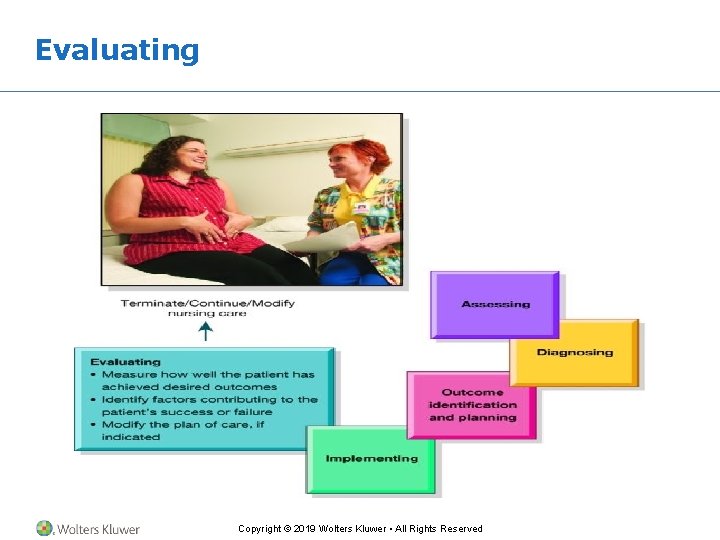
Evaluating Step v Nurse and patient together measure how well the patient has achieved the outcomes specified in the care plan. v The nurse identifies factors that contribute to the patient's ability to achieve expected outcomes and, when necessary, modifies the care plan. v The purpose of evaluation is to allow the patient's achievement of expected outcomes to direct future nurse –patient interactions Copyright © 2019 Wolters Kluwer • All Rights Reserved
Question Which action should the nurse take when a patient has achieved each expected outcome in the care plan? A. Terminate the care plan. B. Modify the care plan. C. Continue the care plan. Copyright © 2019 Wolters Kluwer • All Rights Reserved
Actions Based on Patient Response to Care Plan v Terminate the care plan when each expected outcome is achieved. v Modify the care plan if there are difficulties achieving the outcomes. v Continue the care plan if more time is needed to achieve the outcomes. Copyright © 2019 Wolters Kluwer • All Rights Reserved
Variables Affecting Outcome Achievement v Patient o For example, a patient gives up and refuses treatment v Nurse o For example, a nurse is suffering from burnout v Health care system o For example, inadequate staffing Copyright © 2019 Wolters Kluwer • All Rights Reserved
Evaluative Statements v Decide how well outcome was met (met, partially met, or not met). v List patient data or behaviors that support this decision. Copyright © 2019 Wolters Kluwer • All Rights Reserved
Revisions in the care plan v Delete or modify the nursing diagnosis. v Change nursing interventions. v Make the outcome statement more realistic. v Increase the complexity of the outcome statement. v Adjust time criteria in the outcome statement. Copyright © 2019 Wolters Kluwer • All Rights Reserved
Seven Crucial Conversations in Health Care v Broken rules v Mistakes v Lack of support v Incompetence v Poor teamwork v Disrespect v Micromanagement Copyright © 2019 Wolters Kluwer • All Rights Reserved
Elements of Healthy Work Environments v Skilled communication v True collaboration v Effective decision making v Authentic leadership v Meaningful recognition v Appropriate staffing Copyright © 2019 Wolters Kluwer • All Rights Reserved