
NURSING PROCESS LOGO Benefit of the Nursing Process
������ NURSING PROCESS LOGO
Benefit of the Nursing Process ) Seaback, Wanda. (2006). Nursing Process: Concepts & App; ication. 2 nd ed. ) v Promotes improved quality and continuity of care v Promotes and encourages client participation LOGO
Benefit of the Nursing Process ) Seaback, Wanda. (2006). Nursing Process: Concepts & App; ication. 2 nd ed. ) Delivery of care and problem solving are organized , continuous, and systematic Time and resources are utilized more efficiently LOGO
Benefit of the Nursing Process v Delivery of care meeting expectations of both health care consumer and standards of the nursing profession v Holds all nurses accountable and responsible for assessment, diagnosis, planning, implementation, and evaluation of client care. LOGO
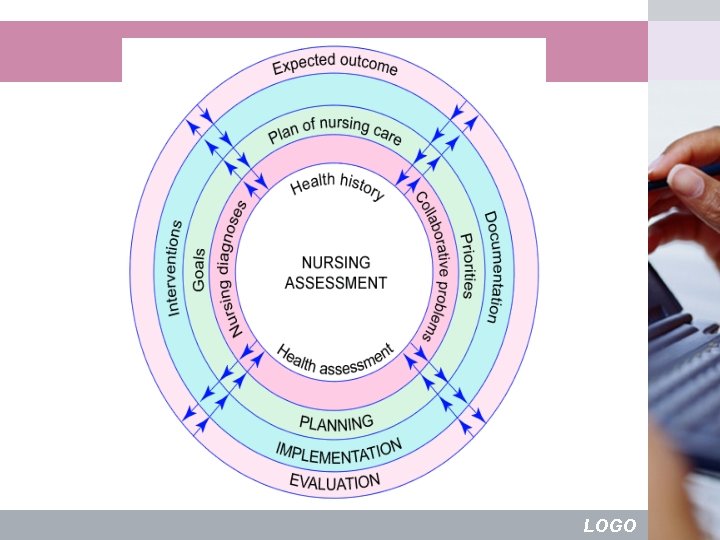
STEPS OF THE NURSING PROCESS The nursing process consists of five dynamic and interrelated phases: ADPIE 1. Assessment 2. Diagnosis 3. Planning 4. Implementation 5. Evaluation. LOGO
������ � ASSESSMENT : LOGO
������� �� 1. The care plan is developed based on data gathered from the assessment. 2. Assessment = data collection, verification, organization, interpretation, and documentation. LOGO
������� �� S ----- S : Subjective data are stated O ----- O : Objective data are observable LOGO
Nursing Tip : ������� 3. Just state the facts. Do not state opinions and do not jump to the conclusions. 4. Assessment is the key step in the nursing process. LOGO
������ 5. People differ in many way : age, gender, ��� educational level, language, occupation, residence (rural, urban, suburban), socioeconomic status, functional abilities, cognitive abilities, racial composition, nationality, family structure and ties. LOGO
Nursing Tip : ������� 6. Ask questions and then allow time for response. 7. Do not rely on memory. Write it down. LOGO
Nursing Tip : ������� 8. Choose a method for organizing your assessment, e. g. , head to toe, body system. 9. Roles of the nurse : caregiver, counselor, teacher, client advocate, change agent, team member, resource person. LOGO
STEP 2 OF THE NURSING PROCESS ������� NURSING DIAGNOSIS : LOGO
LOGO
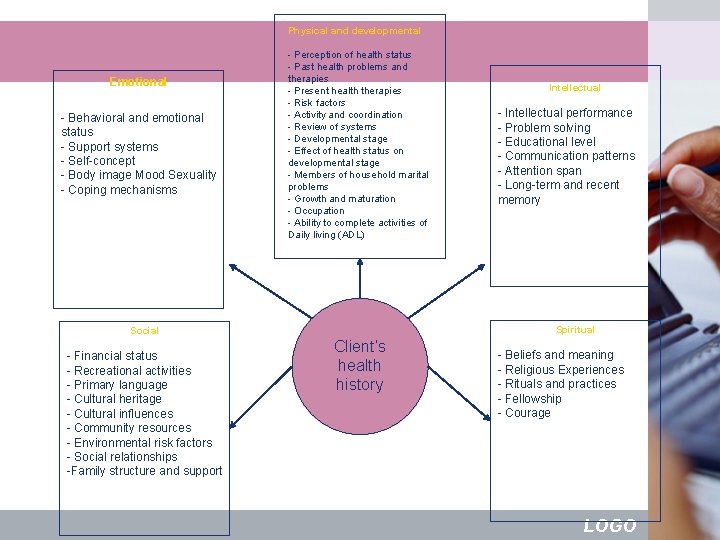
Physical and developmental Emotional - Behavioral and emotional status - Support systems - Self-concept - Body image Mood Sexuality - Coping mechanisms - Perception of health status - Past health problems and therapies - Present health therapies - Risk factors - Activity and coordination - Review of systems - Developmental stage - Effect of health status on developmental stage - Members of household marital problems - Growth and maturation - Occupation - Ability to complete activities of Daily living (ADL) - Intellectual performance - Problem solving - Educational level - Communication patterns - Attention span - Long-term and recent memory Spiritual Social - Financial status - Recreational activities - Primary language - Cultural heritage - Cultural influences - Community resources - Environmental risk factors - Social relationships -Family structure and support Intellectual Client’s health history - Beliefs and meaning - Religious Experiences - Rituals and practices - Fellowship - Courage LOGO
Nursing Diagnosis: Definition v. A clinical judgment about individual, family, or community responses to actual and potential health problems/life processes, nursing diagnoses provide the basis for selection of nursing interventions to achieve outcomes for which the nurse is accountable. (NANDA) LOGO
Nursing Diagnosis: Definition Nursing diagnoses provide the basis for selection of nursing interventions to achieve outcomes for which the nurse is accountable. (NANDA) LOGO
www. themegallery. com Components of nursing diagnosis v. A working nursing diagnosis may have two or three parts. v. The two part system consists of the nursing diagnosis and the “related to” (r/t statement) LOGO
www. themegallery. com Components of nursing diagnosis v. The two part system is often used when the defining characteristics, or signs and symptoms identified in the assessment. LOGO
www. themegallery. com Components of nursing diagnosis v. The three part system consists of the nursing diagnosis, the “related to” (r/t statement), and the defining characteristics, or signs and symptoms identified in the assessment. LOGO
Components of nursing diagnosis v. Nursing diagnosis consists of three components as the PES system : v. P (Problem)- the nursing diagnosis label : a concise term or phrase that represent a pattern of related cues. ND is taken from the official NANDA list. LOGO
Components of nursing diagnosis v. E (etiology)- “Related to” (r/t) phrases or etiology: related cause or contributor to the problem. LOGO
Components of nursing diagnosis v. S (signs and symptoms)Defining characteristics phrase : signs and symptoms that nurse identified in the assessment LOGO
Actual nursing diagnosis Actual nursing describes human responses to health conditions/life processes/ an illness/disease that exist in an individual, family or group or community. LOGO
Actual nursing diagnosis are developed when an existing response to an illness, disease, or condition is present at the time of the nursing assessment. The problem actually exists. LOGO
v. Actual nursing diagnosis is supported by defining characteristics and related factors. www. themegallery. com LOGO
Actual nursing diagnosis - The client is demonstrating subjective and/or objective data to support the conclusion. -Actual nursing diagnosis are based on the presence of associated signs and symptoms. LOGO
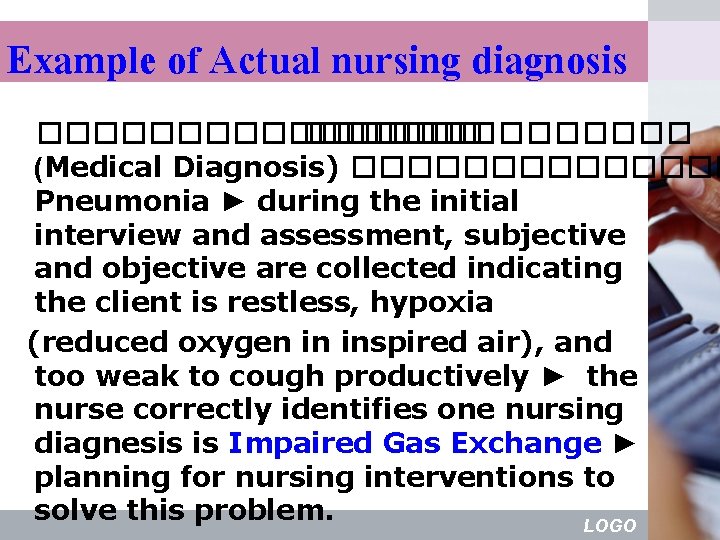
Example of Actual nursing diagnosis �������� (Medical Diagnosis) ������� Pneumonia ► during the initial interview and assessment, subjective and objective are collected indicating the client is restless, hypoxia (reduced oxygen in inspired air), and too weak to cough productively ► the nurse correctly identifies one nursing diagnesis is Impaired Gas Exchange ► planning for nursing interventions to solve this problem. LOGO
Example of Actual nursing diagnosis v Hyperthermia, client’s temperature is 104. 6 degree F. v Impaired Gas Exchange, client’s oxygen saturation in arterial blood gas is 92 % v Pain, client states pain level “eight” on scale of zero to ten v Anxiety, client states he is experiencing anxiety v Self-Care Deficit, client is unable to perform ADLs LOGO
Risk Nursing Diagnosis v. Risk Nursing Diagnosis: describe a clinical judgment about human experience /response to health conditions/life processes that have a high probability of developing in a vulnerable individual, family group, or community. LOGO
www. themegallery. com The risk nursing diagnosis is supported by risk factors. Defining characteristics and related factors are not available because there are no problem as yet, though they are likely to develop. LOGO
Example of Risk nursing diagnosis v. An elderly client experiencing vertigo and difficulty walking and refuses to call for assistance with ambulation ► the appropriate problem would be identified and label as Risk for Injury LOGO
v. Example of Risk nursing diagnosis v. Client who is unconscious, vomiting, v. Risk for Aspiration R/T reduced level of consciousness, vomiting LOGO
Example of Risk nursing diagnosis v. Cancer patient, v. Risk for Infection R/T inadequate secondary defense, immunosuppression LOGO
Example of Risk nursing diagnosis - Unsteady gait, refuses to call for assistance, v Risk for Injury R/T impaired mobility, lack of knowledge regarding safety precaution - Neonate unable to maintain his body temperature, parent does not keep the child covered, v Risk for Hypothermia R/T inadequate clothing LOGO
STEP 3 OF THE NURSING PROCESS PLANNING : LOGO
STEP 4 OF THE NURSING PROCESS Implementation: LOGO
Nursing Documentation โดย ดร. เปรวด คฤหเดช DEFINITION LOGO
Nursing Documentation - Nurses create and edit patient records many times during any work โดย ดร. เปรวด คฤหเดช day. -We may even complain that we spend more time charting than we do with our patients. LOGO
Nursing Documentation Although that may be true, we โดย ดร. เปรวด คฤหเดช should remember that patient care isn’t just “hands-on. ” (Lanette Anderson, 2012. ) LOGO
Nursing Documentation Nursing documentation is a vital โดย ดร. เปรวด คฤหเดช component of safe, ethical and effective nursing practice, regardless of the context of practice or whether the documentation is paper-based or electronic. LOGO
Nursing Documentation Universally registered nurses โดย ดร. เปรวด คฤหเดช are legally and ethically required to practice nursing in accordance with the Registered Nurses Act and Regulations of each country. LOGO
Definition: Documentation is anything written or electronically generated that โดย ดร. เปรวด คฤหเดช describes the status of a client or the care or services given to that client (Perry, A. G. , Potter, P. A. , 2010). LOGO
Definition: Nursing documentation refers to written or electronically generated โดย ดร. เปรวด คฤหเดช client information obtained through the nursing process. LOGO
Definition: Documentation is an integral part of nursing practice and professional โดย ดร. เปรวด คฤหเดช patient care rather than something that takes away from patient care. Documentation is not optional. LOGO
Definition: Accurate record keeping and careful documentation is an essential part of nursing โดย practice. Good record keeping ดร. เปรวด คฤหเดช helps to protect the welfare of patients and clients which of course is a fundamental aim for nurses everywhere. LOGO
Why Documentation -We learn in nursing school that a patient record is a legal document. -We also learn that “if it isn’t โดย ดร. เปรวด คฤหเดช charted, it isn’t done. ” -We should consider these facts in practical terms and not just as something our instructors repeated numerous times. LOGO
Why Documentation -The standards of nursing care include the principle that any of your โดย ดร. เปรวด คฤหเดช coworkers should be able to pick up a chart and understand the status of that patient’s condition and care (Lanette Anderson (2012). - ��������� LOGO
Why Documentation This is importance since quality care is a team effort. The team must be able to work together and ensure that each โดย ดร. เปรวด คฤหเดช patient’s individual needs are clearly communicated to each other. LOGO
Why Documentation Another issue with regards to documentation is financial reimbursement. Third party payers evaluate the โดย ดร. เปรวด คฤหเดช documentation in a patient record to determine whether payment is appropriate. LOGO
Purposes of Documentation โดย ดร. เปรวด คฤหเดช LOGO
Purposes of Documentation -The two primary purposes for documentation are professional responsibility and accountability. โดย ดร. เปรวด คฤหเดช -The professional responsibility of all health care practitioners, documentation provides evidence of the practitioner's accountability to the client, the institution, the profession, and society. LOGO
Purposes of Documentation Other purposes are communication, legal and practice standards, education, research, and auditing. โดย ดร. เปรวด คฤหเดช LOGO
Purposes of Documentation 1. Communication Documentation is a communication ดร. เปรวด คฤหเดช methodโดยthat confirms the care provided to the client and clearly outlines all important information regarding the client. LOGO
Thorough documentation provides : 1. Accurate data to plan care and ensure continuity of care. โดย ดร. เปรวด คฤหเดช 2. Communication to health care team members involved in the client's care. LOGO
Thorough documentation provides : 3. Evidence of things done to or for the client, the client's โดย ดร. เปรวด response, andคฤหเดช revisions made in the plan of care. 4. Evidence of compliance with professional practice standards. LOGO
Thorough documentation provides : 5. Evidence of compliance with accreditation criteria. 6. A resource for reimbursement, โดย ดร. เปรวด คฤหเดช education, and research. 7. A written legal record to protect the client, institution, and practitioner. LOGO
Purposes of Documentation 2. Practice and Legal Standards The medical record is a legal document, โดย ดร. เปรวด it คฤหเดช and in a lawsuit, is the record that serves as the description of exactly what happened to a client. In 80% to 85% of client care lawsuits, the determining factor in providing proof of significant events is the medical record. LOGO

The legal aspects of documentation require: 1. Writing, legible and neat. 2. Spelling and grammar, properly โดย ดร. เปรวด คฤหเดช used. 3. Authorized abbreviations. 4. Time-sequenced, and factual descriptive entries. LOGO
Purposes of Documentation 3. Education -Health care students use the medical record โดย asดร. aเปรวด toolคฤหเดช to learn about disease processes, medical and nursing diagnoses, complications, and interventions. LOGO
Purposes of Documentation 3. Education -The results of laboratory and โดย ดร. เปรวด คฤหเดชand physical diagnostic testing examinations provide valuable information about specific diagnoses and interventions. LOGO
Purposes of Documentation Nursing students can enhance their critical-thinking skills by examining and analyzing the records of the health care โดย ดร. เปรวด คฤหเดช team's plan of care, including the way the care plan was developed, implemented, and evaluated. LOGO
Purposes of Documentation However, all health care professionals including students must maintain confidentiality when reading any client's โดย ดร. เปรวด คฤหเดช chart. LOGO
Purposes of Documentation 4. Research The client's medical record is used by researchers to determine whether a client โดย ดร. เปรวด คฤหเดช meets the research criteria for a study. Documentation can also indicate a need for research. For example, if documentation shows an increased rate of falls on certain nursing units, researchers can look for and study the variables associated with the increased fall rate. LOGO
Purposes of Documentation 5. Nursing Audit A nursing audit is a method of ดร. เปรวด คฤหเดช of care provided evaluatingโดยthe quality to clients. A nursing audit can focus on implementation of the nursing process, on client outcomes, or on both in order to evaluate the quality of care provided. LOGO
Purposes of Documentation The nursing audit is follow-up evaluation that not only evaluates the quality of care of an individual client โดย ดร. เปรวด คฤหเดช but also provides an evaluation of overall care given in that health care facility. LOGO
Purposes of Documentation - During a nursing audit, the evaluators look for documentation of all five components of the nursing process in โดย ดร. เปรวด คฤหเดช the client records. - The nursing audit committee reviews client records after discharge of the clients. LOGO
System of Documentation Systems of recording and reporting data pertinent to client care have evolved โดย ดร. เปรวด คฤหเดช primarily in response to demands that health care practitioners be held to societal norms, professional standards of practice, legal and regulatory standards, and institutional policies and standards. LOGO
System of Documentation The documentation โดย ดร. เปรวด คฤหเดช systems used today reflect specific needs and preferences of the many health care agencies. LOGO
Basicly, among the many systems used for documentation are the following: 1. Narrative charting 2. Source-oriented charting โดย ดร. เปรวด คฤหเดช 3. Problem- Oriented Medical Record (POMR) charting 4. SOAPIE/SOAPIER 4. PIE charting 5. Focus charting 6. Charting by exception 7. Computerized documentation 8. Critical pathways LOGO
1. Narrative charting: Traditional method of nursing documentation is a chronologic ดร. เปรวด คฤหเดชin paragraphs accountโดยwritten that describe client status, interventions and treatments, and the client's response to treatments. LOGO
1. Narrative charting: Features: a. Narrative documentation is the most flexibleโดยof all systems and is usable in ดร. เปรวด คฤหเดช any clinical setting. b. The relationship between nursing interventions and client's responses is clearly shown. LOGO
1. Narrative charting: Defects: a. Client problems may be difficult to โดย ดร. เปรวด track because theคฤหเดช same information may not be consistently documented. b. The client's progress may be difficult to identify. c. Narrative charting often fails to reflect the nursing process. LOGO
3. Problem-Oriented Medical Record (POMR): - Employs a structured, logical format and focuses on the client's problem. โดย ดร. เปรวด คฤหเดช - There are four critical components of POMR: a. Database (assessment data) b. Problem list (client's problems numbered according to when identified) LOGO
3. Problem-Oriented Medical Record (POMR): There are four critical components of POMR: ดร. เปรวด คฤหเดช c. Initialโดยplan (outline of goals, expected outcomes, and learning needs and further data, if needed) d. Progress notes (charting based on the SOAP, SOAPIE, or SOAPIER format) LOGO
3. Problem-Oriented Medical Record (POMR): The format โดย ดร. in เปรวดwhich คฤหเดช progress notes are written includes SOAP, SOAPIE, or SOAPIER: LOGO
3. Problem-Oriented Medical Record (POMR): Features: a. An entry need not be made for each โดย ดร. คฤหเดช component ofเปรวด SOAPIER at every documentation. b. Each problem must have a complete note every 24 hours if unresolved or whenever the client's condition changes. LOGO
3. Problem-Oriented Medical Record (POMR): Features: c. Continuity of คฤหเดช care is shown when โดย ดร. เปรวด the plan of care and interventions performed are documented together. d. Some physicians use this format when writing progress notes. LOGO
4. SOAP/SOAPIER charting is a problem-oriented approach to โดย ดร. เปรวด คฤหเดช documentation whereby the nurse identifies and lists client problems; documentation then follows according to the identified problems. LOGO
4. SOAP/SOAPIER charting Documentation is generally organized according to the โดย ดร. เปรวด คฤหเดช following headings: S: Subjective data (what the client or family states) (e. g. , how does the client feel? ) LOGO
4. SOAP/SOAPIER charting O: Objective data (what is observed/inspected) โดย ดร. เปรวด คฤหเดช (e. g. , results of the physical exam, relevant vital signs) LOGO
4. SOAP/SOAPIER charting A : Assessment (conclusion reached on the basis of data โดย ดร. เปรวด คฤหเดช formulated as client problem or nursing diagnosis) (e. g. , what is the client’s status? ) LOGO
4. SOAP/SOAPIER charting P : Plan (expected outcomes and actionsโดยto be taken) ดร. เปรวด คฤหเดช (e. g. , does the plan stay the same? is a change needed? ) LOGO
4. SOAP/SOAPIER charting I : Intervention (e. g. , what occurred? what did the nurse โดย ดร. เปรวด คฤหเดช do? ) LOGO
4. SOAP/SOAPIER charting E : Evaluation (e. g. , what is the client outcome following the โดย ดร. เปรวด คฤหเดช intervention? ) LOGO
4. SOAP/SOAPIER charting R : Revision (e. g. , what changes are needed to the care plan? ) โดย ดร. เปรวด คฤหเดช Similar to focus charting, flow sheets and checklists are frequently used as an adjunct to document routine and ongoing assessments and observations. LOGO
8. Computerized documentation : Health care facilities have been โดย ดร. เปรวด คฤหเดช using computers for many years to order diagnostic tests and medications and to receive results of diagnostic tests. LOGO
8. Computerized documentation : Issues to be addressed when considering computerized client ดร. เปรวด คฤหเดช recordsโดยinclude: a. Data standards—include length of fields, how dates and times are shown. LOGO
8. Computerized documentation : b. Vocabularies—the most commonly used are the combination of the NANDA-International nursing diagnoses, Nursing Interventions Classification (NIC) nursing interventions, and Nursing Outcomes Classification (NOC) nursing outcomes. LOGO
8. Computerized documentation : SHOW TEXT BOOK: Nursing Diagnosis Handbook: โดย ดร. เปรวด คฤหเดช An Evidence – Based Guide to Planning Care - NANDA LOGO
8. Computerized documentation : Issues to be addressed when considering computerized client records include: c. Security—includes privacy, confidentiality, who has access to which data, how errors are to be corrected, and protection against data loss. d. Legal issues—electronic signatures. e. Costs—include planning, hardware, software, and training for all users. LOGO
8. Computerized documentation : Features: 1) Reducing documentation time 2) Increasing accuracy, 3) Computerized charting increases legibility, 4) Stores and retrieves information quickly and easily, LOGO
8. Computerized documentation : Features: 5) Helps link diverse sources of client information, 6) Uses standardized terminology, 7) Planners for health care, researchers, lawyers LOGO
8. Computerized documentation : Defects: 1) Used incorrectly, 2) Client information may be mixed up. 3) Security measures are neglected, LOGO
8. Computerized documentation : Defects: 4) Client confidentiality may be compromised. 5) Users (e. g. , nurses, physicians) should never share computer ID numbers or passwords with anyone. LOGO
General Documentation Guidelines : โดย ดร. เปรวด คฤหเดช LOGO
General Documentation Guidelines : 1. Ensure that you have the correct client record or chart and that the client's โดย ดร. เปรวด name คฤหเดช and identifying information are on every page of the record. LOGO
General Documentation Guidelines : 2. Document as soon as the client encounter is concluded โดย ดร. เปรวด คฤหเดช to ensure accurate recall of data. LOGO
General Documentation Guidelines : 3. Date and time each entry. 4. Sign each entry with your full legal name with your โดย ดร. and เปรวด คฤหเดช professional credentials, per your institutional policy. 5. Do not leave space between entries. LOGO
General Documentation Guidelines : 6. If an error is made while documenting, use a single line to cross out the error, then date, time, and sign โดย ดร. เปรวด คฤหเดช the correction (follow institutional policy); avoid erasing, crossing out, or using correction fluid. 7. Never change another person's entry, even if it is incorrect. LOGO
General Documentation Guidelines : 8. The first entry of the shift should be made early (e. g. , at 7: 30 A. M. for the 7 -3 shift, โดย asดร. opposed to 11: 30 A. M. or เปรวด คฤหเดช 12 P. M. ). Chart at least every 2 hours, or per institutional policy. 9. Use quotation marks to indicate direct client responses (e. g. , "I feel lousy"). LOGO
General Documentation Guidelines : 10. Document in chronological order; if chronological order is not used, state why. โดย ดร. เปรวด คฤหเดช 11. Write legibly. 12. Use a permanent-ink pen (black is usually preferable because it photocopies well). LOGO
General Documentation Guidelines : 13. Document in a complete but concise manner by using phrases and โดย ดร. เปรวดasคฤหเดช abbreviations appropriate. 14. Document all telephone calls that you make or receive that are related to a client's case. LOGO
General Documentation Guidelines : 15. Nursing documentation based on the nursing process facilitates ดร. เปรวดbecause คฤหเดช effectiveโดยcare client needs can be traced from assessment, through identification of the problems to the care plan, implementation, and evaluation. LOGO
Effective documentation elements If documenting on paper forms, the elements for effective documentation are: โดย ดร. เปรวด คฤหเดช 1. Document accurately, completely, and objectively including any errors that occurred 2. Note date and time 3. Use appropriate forms 4. Identify the client LOGO
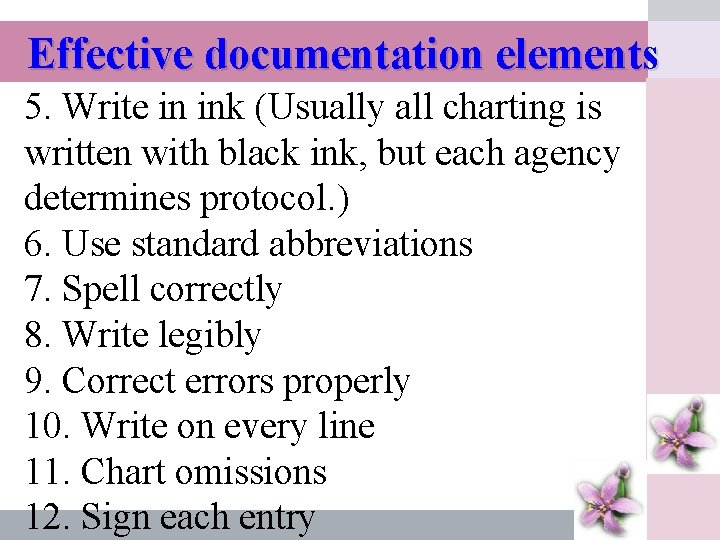
Effective documentation elements 5. Write in ink (Usually all charting is written with black ink, but each agency determines protocol. ) โดย ดร. เปรวด คฤหเดช 6. Use standard abbreviations 7. Spell correctly 8. Write legibly 9. Correct errors properly 10. Write on every line 11. Chart omissions 12. Sign each entry LOGO
If documenting electronically, the guidelines are the same in documenting accurately, completely, and objectively. However, many of the issues of paper charting are โดย ดร. เปรวด คฤหเดช completed automatically on an electronic health record, such as not needing to use ink to chart, writing legibly, and signing each entry. A nurse cannot obtain a client's electronic health record without logging on to the computer, which automatically signifies the writer, date, time, and entry. LOGO
If documenting electronically, the guidelines are the same in documenting accurately, completely, and objectively. However, many of the issues of paper charting are โดย ดร. เปรวด คฤหเดช completed automatically on an electronic health record, such as not needing to use ink to chart, writing legibly, and signing each entry. A nurse cannot obtain a client's electronic health record without logging on to the computer, which automatically signifies the writer, date, time, and entry. LOGO
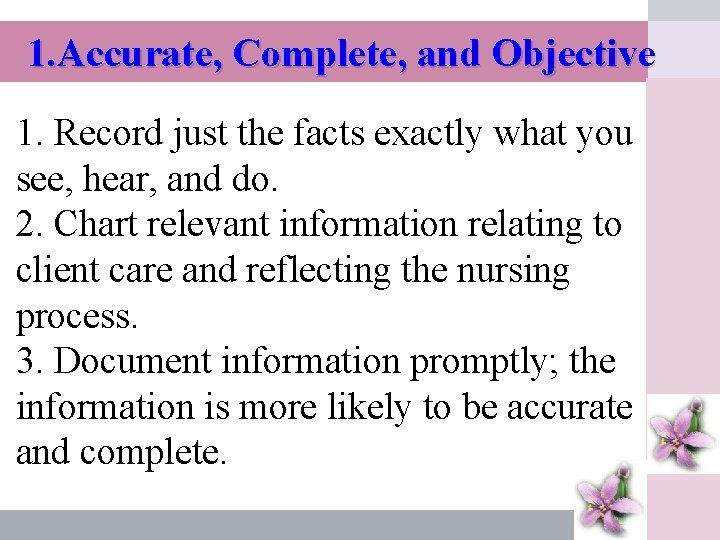
1. Accurate, Complete, and Objective 1. Record just the facts exactly what you see, hear, and do. 2. Chart relevant information relating to โดย ดร. เปรวด คฤหเดช client care and reflecting the nursing process. 3. Document information promptly; the information is more likely to be accurate and complete. LOGO
1. Accurate, Complete, and Objective 4. Important details may be forgotten if charting is left until the end of the shift, and thoseโดยdetails ดร. เปรวด may คฤหเดช later become a legal issue. 5. Chart medications immediately after administration. This prevents errors such as another nurse administering pain medication when the first dose was not charted. LOGO

1. Accurate, Complete, and Objective 6. Avoid subjective statements such as "client is uncooperative. " Record the client's exact words using quotation โดย ดร. เปรวด คฤหเดช marks, for example, Client stated, “I don't want to take a bath, and I don't want any breakfast. ” LOGO
2. Date and Time - Be sure each entry is dated and has a specific time. Especially note the exact time of sudden changes in a client's โดย ดร. เปรวด คฤหเดช condition, nursing actions, and other significant events. - Do not chart in blocks of time, such as 7 A. M. to 11 A. M. This is vague and sounds like the client has had no attention during that time frame. LOGO
3. Use Appropriate Forms Use the appropriate forms as required by the facility's policy manual. The forms used are โดย notดร. the เปรวด same คฤหเดช in every facility. Some facilities use flow sheets instead of progress notes. LOGO
4. Identify the Client Each page of the client's record should have the client's name on it. This aids in preventing confusion and helps ensure โดย ดร. เปรวด คฤหเดช that information is charted on the correct record. LOGO
5. Write in Ink The client's record is a permanent document, and โดย ดร. เปรวด คฤหเดช information should be charted in ink or printed out from a computer. Only black ink should be used because it will photocopy well. LOGO
6. Use Standard Abbreviations Each health care facility has a list of approved abbreviations โดย ดร. เปรวด คฤหเดช and symbols for documenting information on its client records. LOGO
7. Spell Correctly Misspelled words on client records maybe confusing and certainly ดร. เปรวด คฤหเดช convey aโดยsense of unprofessionalism. They may generate questions about the quality of the care provided, increase the chance of liability, and produce a loss of the writer's credibility. LOGO
8. Write Legibly -Legible handwriting is imperative for effective documentation. ดร. เปรวด คฤหเดช Sloppy โดย writing hinders communication, and errors in client care can occur. LOGO
8. Write Legibly Trying to decipher illegible writing wastes time, also โดย ดร. เปรวด คฤหเดช impression of creates a poor the person who did the writing and damages that person's credibility. Print rather than use cursive writing; it is usually easier to read. LOGO
9. Correct Error Properly Promptly correct any error you make in documenting on a client's ดร. เปรวด and คฤหเดช follow your record. โดย Know facility's policy for correcting errors. Generally, it is acceptable to draw a single line through the mistaken entry so that was written can still be read. LOGO
10. Write on Every Line - Fill each line completely. Leave no blank lines or partially blank fines. Draw a line โดย ดร. เปรวด คฤหเดชthrough the empty part of the line. -This prevents others from inserting information later that may change the meaning of the original documentation. LOGO
11. Chart Omissions Charting is supposed to show implementation of the medical and nursing โดย plans care. Whenever a ดร. เปรวดof คฤหเดช part of the plan is omitted, document the reason for the omission. For example, a treatment is not provided or medication is not administered because the client was in x-ray. LOGO
12. Sign Each Entry - Each entry on the nurse's notes (progress notes) is to be signed with your first name or initial, full last โดย ดร. เปรวด คฤหเดช name, and professional licensure (i. e. , LVN, LPN, RN). - The signature should be at the end of the entry on the far right side. LOGO
13. Documenting a Medication Error -The medication given in error should be recorded on the Medication Administration Record (MAR) and in โดย ดร. เปรวด คฤหเดช the nurse's progress notes. - Remember, the purpose of the medical record is to report any care or treatment the client receives; this includes any errors made. LOGO
13. Documenting a Medication Error - Document in the nurse's notes the name and dosage of the medication, time it was given, client's response to โดย ดร. เปรวด คฤหเดช the medication, time and name of the practitioner notified of the error, nursing interventions or medical treatment to counteract the error, and client's response to treatment. LOGO
Forms for documentation Forms for recording data include โดย ดร. เปรวด คฤหเดช Kardex, flow sheets, nurse's progress notes, and discharge summaries. They are designed to facilitate record keeping and allow quick, easy access to information. LOGO
1. A Kardex : - A brief worksheet with basic client care information that traditionally is โดย ดร. เปรวด คฤหเดช not part of the medical record. - The Kardex is used as a reference throughout the shift and during change-of-shift reports. It comes in various sizes, shapes, and types, including computer-generated. LOGO
The Kardex usually contains the following information : a. Client name, age, marital status, religious preference, physician, family โดย ดร. เปรวด คฤหเดช contact with phone number b. Medical diagnoses: listed by priority c. Nursing diagnoses: listed by priority d. Allergies LOGO
The Kardex usually contains the following information : e. Medical orders: diet, medications, intravenous (IV) therapy, treatments, diagnostic tests and procedures (including โดย ดร. เปรวด คฤหเดช dates and results), consultations, DNR (do -not-resuscitate) order (when appropriate) f. Activities permitted: functional limitations, assistance needed in activities of daily living, and safety precautions LOGO
2. Flow sheets: -With vertical or horizontal columns for recording date, time, and assessment data and intervention information, make โดย ดร. เปรวด คฤหเดช it easy to track the client's changes in condition. LOGO
2. Flow sheets: -Special equipment used in client teaching and IV therapy are other parts of the flow sheet. These forms usually โดย ดร. เปรวด คฤหเดช contain legends identifying the approved abbreviations for charting data because they have small spaces for recording. LOGO
3. Nurse’s progress notes : Used to document the client's condition, problems, and complaints; interventions; the client's response to interventions; and achievement of outcomes. LOGO
3. Nurse’s progress notes : Documents falling under the general heading of nurse's progress notes include: a. Nurse's notes, b. Personal care flow sheets, c. Teaching records, LOGO
3. Nurse’s progress notes : Documents falling under the general heading of nurse's progress notes include: d. Vital sign records, e. Intake and output forms, f. Specialty forms (e. g. , diabetic flow sheet or neurologic assessment form). LOGO
4. Discharge summary Used The client's illness and course of care highlighted in the discharge summary. A narrative discharge summary in the progress notes includes: a. Client status on admission and discharge b. A brief summary of the client's care c. Intervention and education outcomes LOGO
4. Discharge summary d. Resolved problems and continuing care needs for unresolved problems, including referrals e. Client instructions about medications, diet, food-drug interactions, activity, treatments, follow-up, and other special needs LOGO
Conclusion -Quality documentation is an integral part of professional RN practice. -It reflects the application of nursing knowledge, skills and judgment, the clients’ perspective and interdisciplinary communications. LOGO
Conclusion -These guidelines will support RN’s to contribute to the development of agency policy and promote evidenceinformed practice, which enables RNs to meet the Standards of Practice for Registered Nurses every day in client care. LOGO

LOGO
- Slides: 148