
NURSING PROCESS AND CRITICAL THINKING LEARNING OBJECTIVES q

NURSING PROCESS AND CRITICAL THINKING
LEARNING OBJECTIVES q. Describe the nursing process cycle q. Apply the nursing process cycle in the clinical situations, using case studies. q. Describe how critical thinking is used in the nursing process q. Compare and contrast the terms delegation and supervision
PURPOSES OF NURSING PROCESS 1. To identify patient needs or health care needs 2. To plan nursing care to meet those needs 3. To carry out nursing interventions designed to meet those needs 4. To assure that the nursing care has achieved the appropriate standard 12/25/2021 3
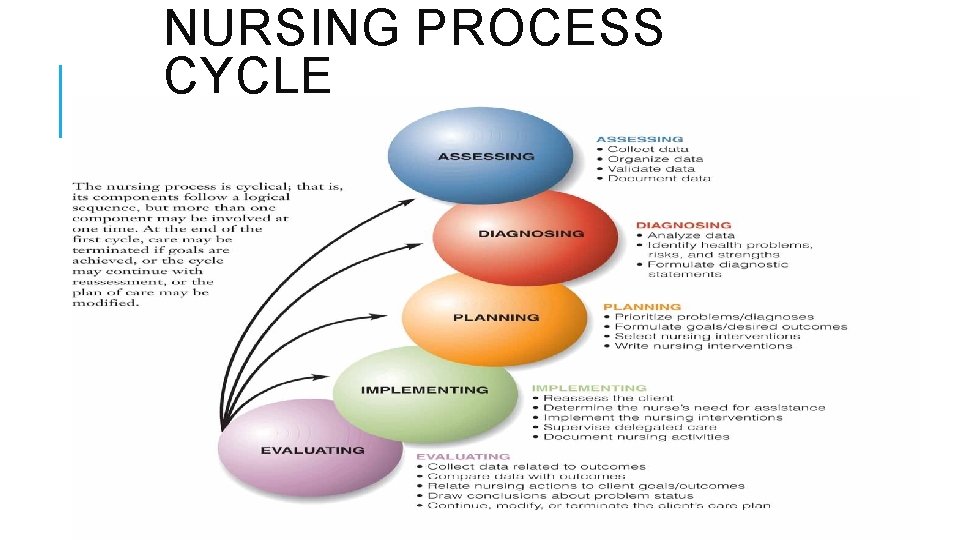
NURSING PROCESS CYCLE
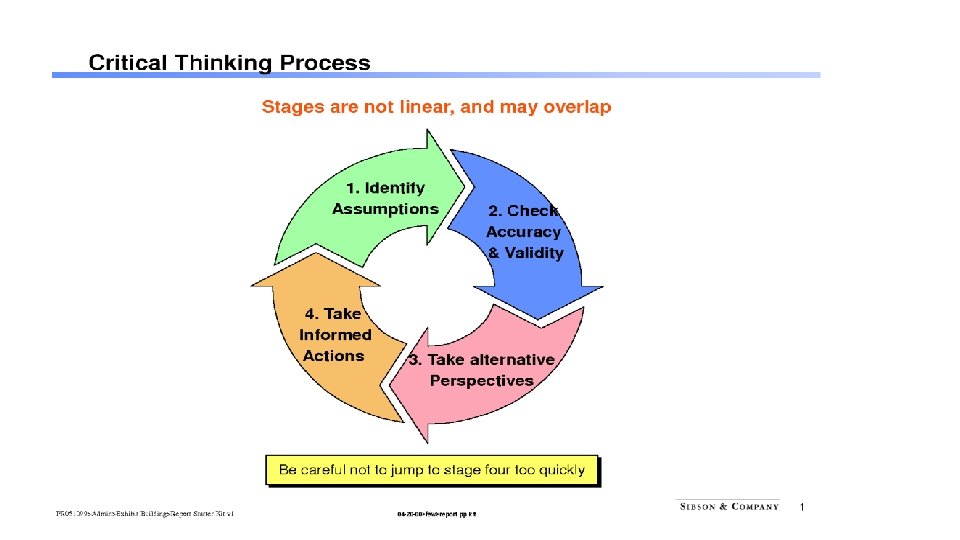
CRITICAL THINKING TERMS Critical thinking; a combination of reasoning thinking, an openness to alternatives, an ability to reflect, and a desire to seek truth. a broad term, includes reasoning both outside and inside of the clinical setting. Clinical reasoning and clinical judgment are key pieces of critical thinking in nursing. Clinical reasoning; a specific term, usually refers to ways of thinking about patient care issues (e. g. , managing patient problems. For reasoning about other clinical issues (e. g. , streamlining work flow), nurses usually use the term critical thinking. Clinical judgment refers to the result (outcome) of critical thinking or clinical reasoning 12/25/2021 5
12/25/2021 6
HISTORY OF NURSING PROCESS 1955: Hall originated the term 1967: Yura and Walsh described 4 steps: assessment, implementation, and evaluation planning, 1973: ANA added Diagnosis 1982: State Boards required to use the nursing process as an organizing concept In early 90’s JCAHO required care must be documented base on nursing process 7
NURSING PROCESS: ASSESSMENT Assessment is the systematic gathering of information related to the physical, mental, spiritual, socioeconomic, and cultural status of an individual, group, or community Nursing assessments focus on the client’s responses to illness COPYRIGHT © 2018. F. A. DAVIS COMPANY
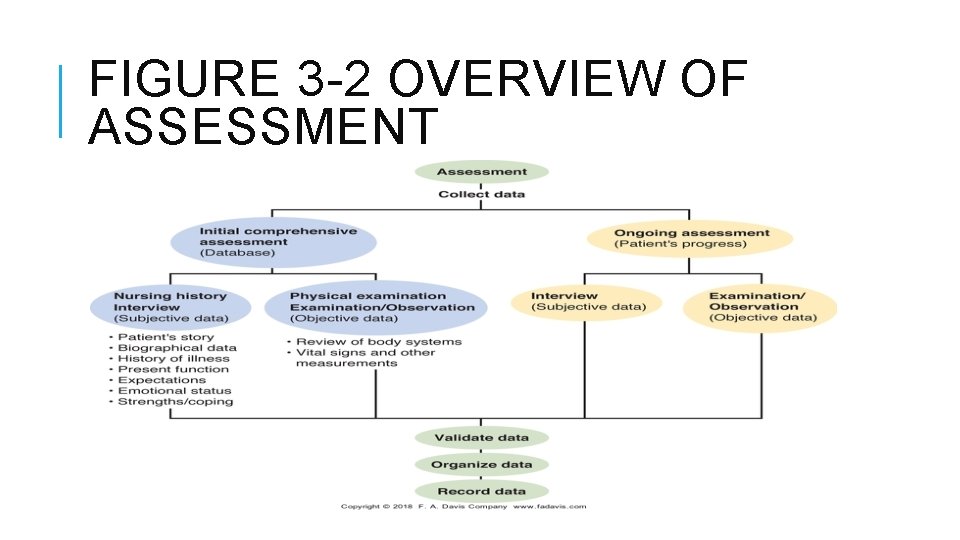
FIGURE 3 -2 OVERVIEW OF ASSESSMENT
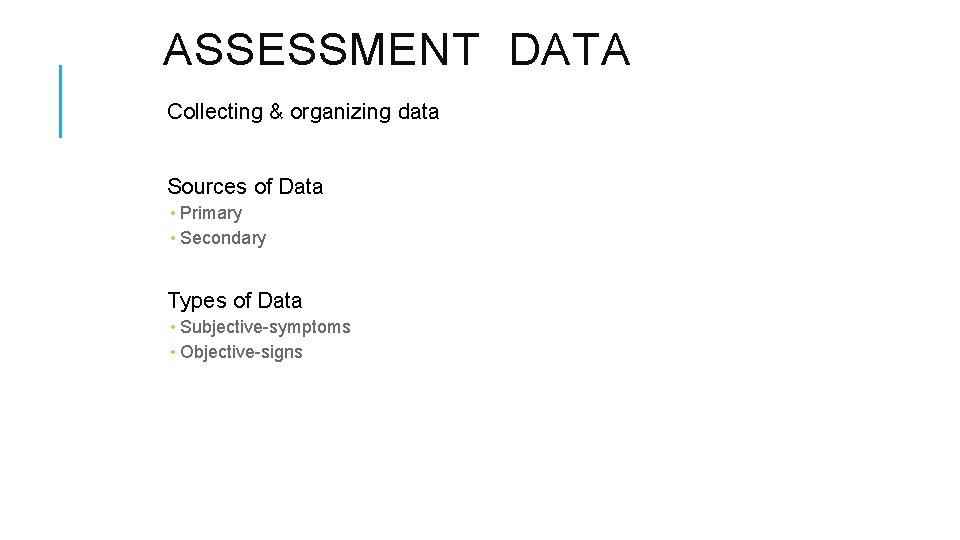
ASSESSMENT DATA Collecting & organizing data Sources of Data • Primary • Secondary Types of Data • Subjective-symptoms • Objective-signs
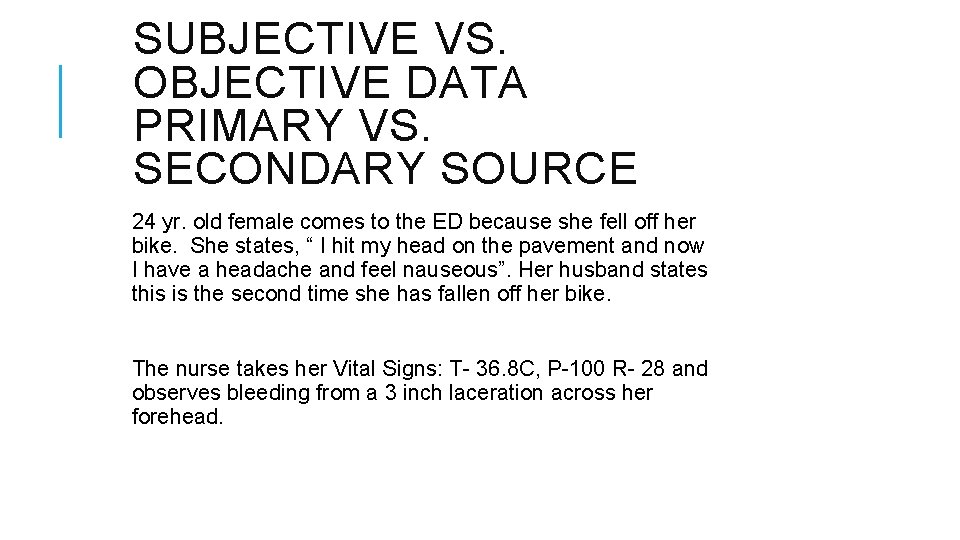
SUBJECTIVE VS. OBJECTIVE DATA PRIMARY VS. SECONDARY SOURCE 24 yr. old female comes to the ED because she fell off her bike. She states, “ I hit my head on the pavement and now I have a headache and feel nauseous”. Her husband states this is the second time she has fallen off her bike. The nurse takes her Vital Signs: T- 36. 8 C, P-100 R- 28 and observes bleeding from a 3 inch laceration across her forehead.
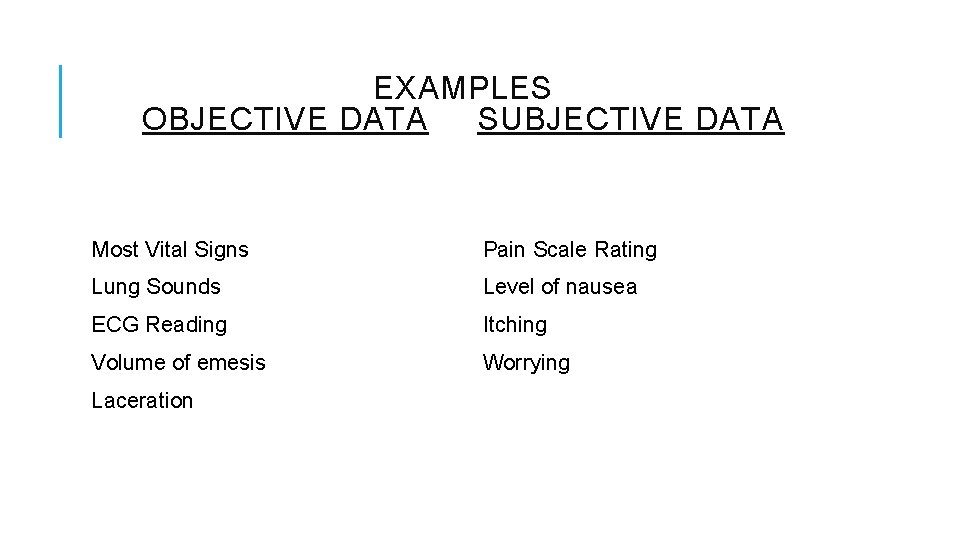
EXAMPLES OBJECTIVE DATA SUBJECTIVE DATA Most Vital Signs Pain Scale Rating Lung Sounds Level of nausea ECG Reading Itching Volume of emesis Worrying Laceration
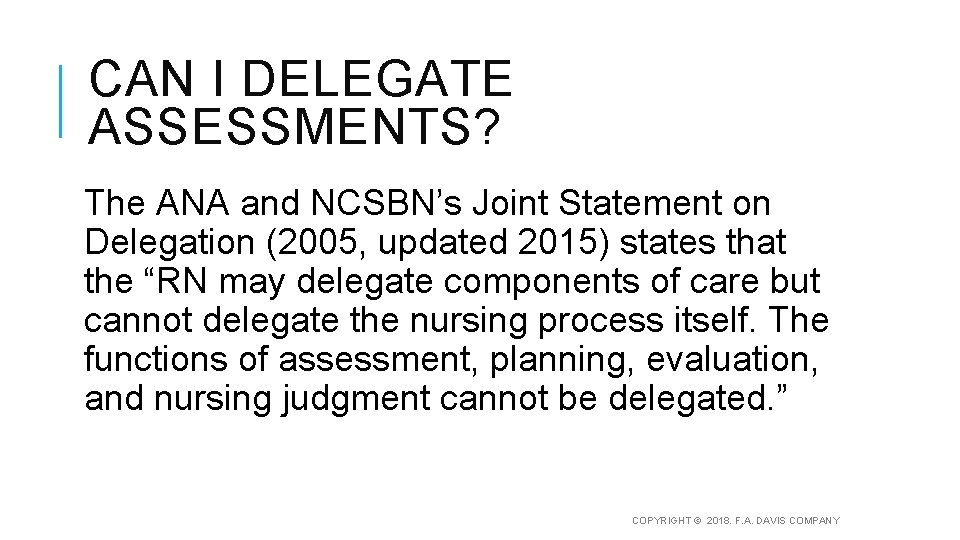
CAN I DELEGATE ASSESSMENTS? The ANA and NCSBN’s Joint Statement on Delegation (2005, updated 2015) states that the “RN may delegate components of care but cannot delegate the nursing process itself. The functions of assessment, planning, evaluation, and nursing judgment cannot be delegated. ” COPYRIGHT © 2018. F. A. DAVIS COMPANY
ORGANIZING ASSESSMENT DATA Nursing models Gordon’s Functional Health Patterns The NANDA-International Nursing Diagnosis Taxonomy Ⅱ Roy Adaptation Model Orem’s Self-Care Model Non-nursing models Maslow’s Hierarchy of Needs COPYRIGHT © 2018. F. A. DAVIS COMPANY
NURSING DIAGNOSIS §Statement of a health problem that the nurse identifies, prevents, or treats independently §Written in terms of human response §NANDA officially defined nursing diagnosis §“A clinical judgment about individual, family, or community experiences/responses to actual or potential health problems/life processes” COPYRIGHT © 2018. F. A. DAVIS COMPANY
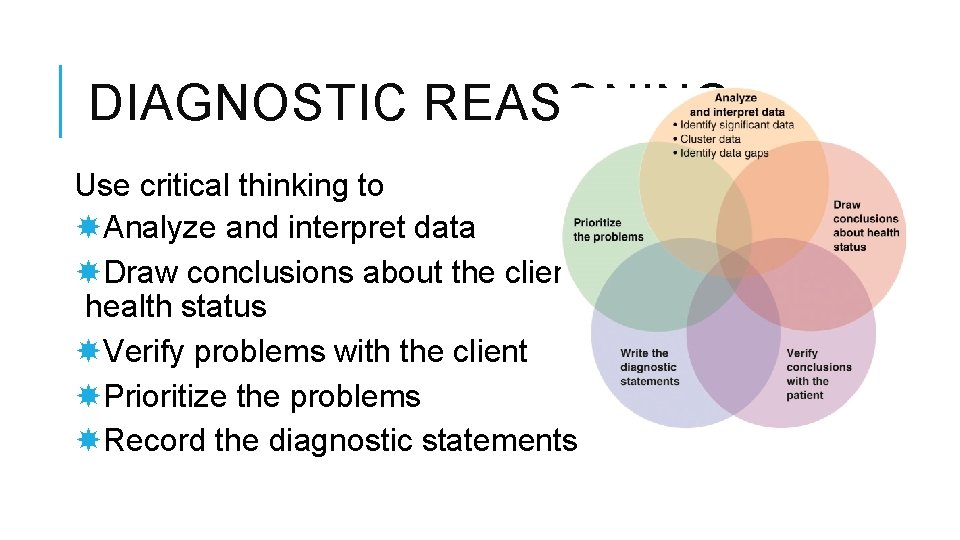
DIAGNOSTIC REASONING Use critical thinking to Analyze and interpret data Draw conclusions about the client’s health status Verify problems with the client Prioritize the problems Record the diagnostic statements
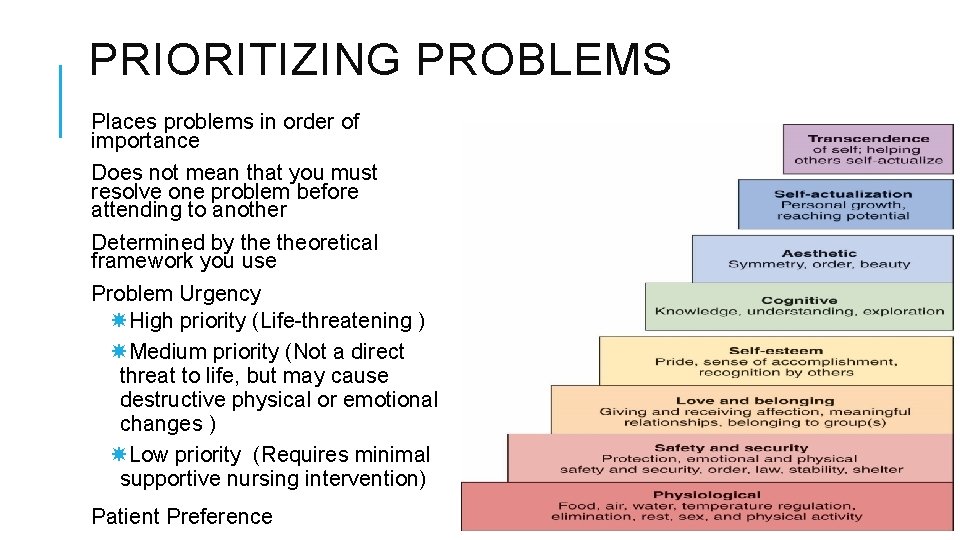
PRIORITIZING PROBLEMS Places problems in order of importance Does not mean that you must resolve one problem before attending to another Determined by theoretical framework you use Problem Urgency High priority (Life-threatening ) Medium priority (Not a direct threat to life, but may cause destructive physical or emotional changes ) Low priority (Requires minimal supportive nursing intervention) Patient Preference COPYRIGHT © 2018. F. A. DAVIS COMPANY
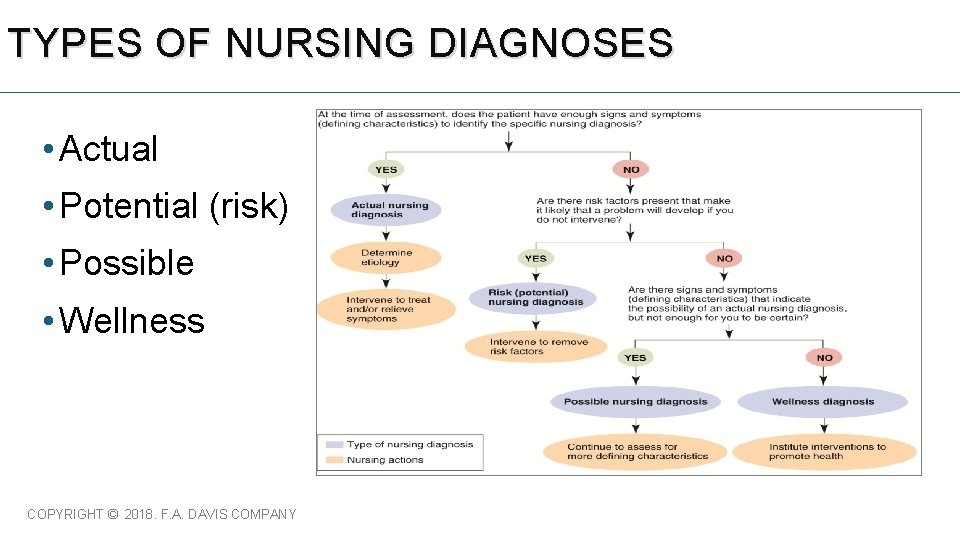
TYPES OF NURSING DIAGNOSES • Actual • Potential (risk) • Possible • Wellness COPYRIGHT © 2018. F. A. DAVIS COMPANY
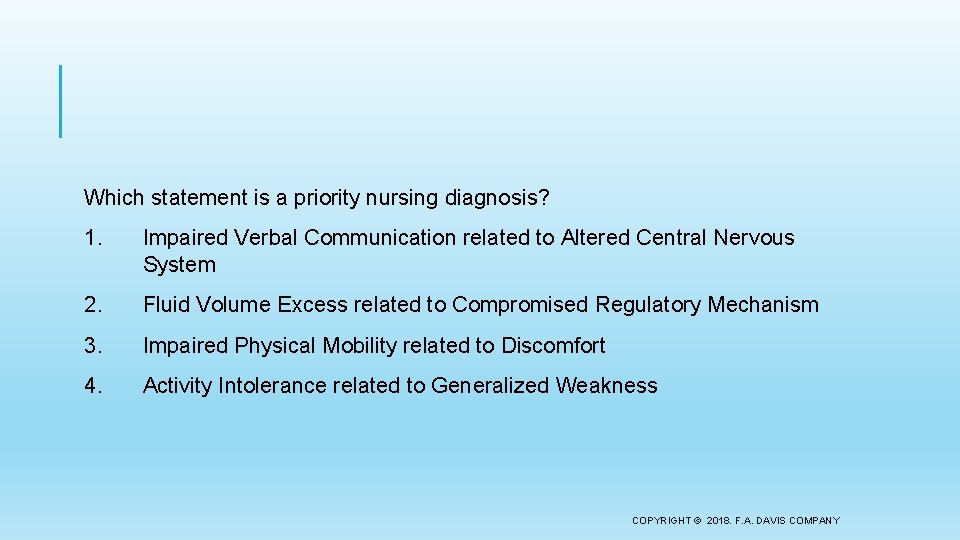
Which statement is a priority nursing diagnosis? 1. Impaired Verbal Communication related to Altered Central Nervous System 2. Fluid Volume Excess related to Compromised Regulatory Mechanism 3. Impaired Physical Mobility related to Discomfort 4. Activity Intolerance related to Generalized Weakness COPYRIGHT © 2018. F. A. DAVIS COMPANY
NANDA-I NURSING DIAGNOSIS: COMPONENTS §Diagnostic label §Definition §Defining characteristics §Related factors §Risk factors COPYRIGHT © 2018. F. A. DAVIS COMPANY
NANDA NURSING DIAGNOSES q. North American Nursing Diagnosis Association (1973) q. NANDA taxonomy of nursing diagnoses q. Provides a standardized nursing language q. Uses nursing terminology rather than medical terminology q. NANDA diagnostic labelqstandardized NANDA name for nursing diagnoses q. NANDA nursing diagnostic label qualifiers q. Impaired q. Deficient q. Ineffective q. Decreased
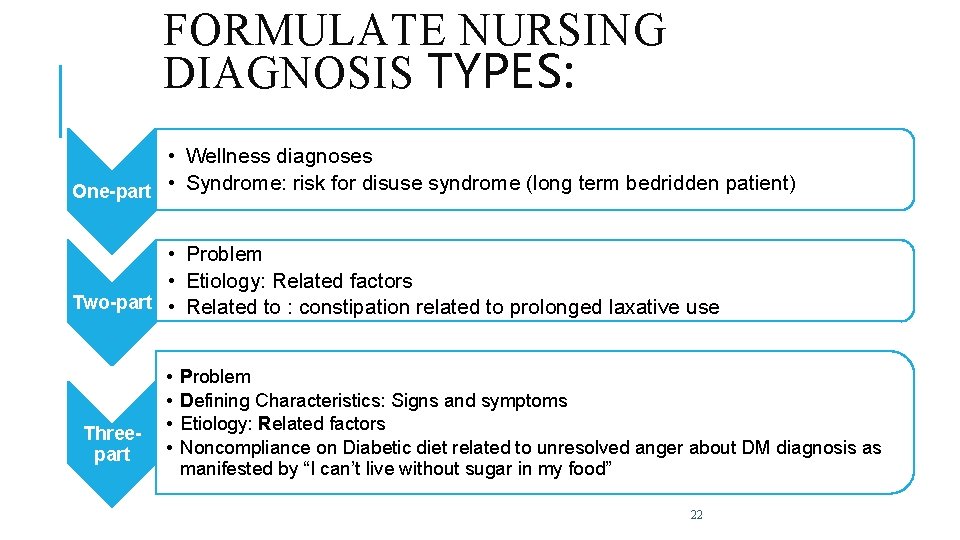
FORMULATE NURSING DIAGNOSIS TYPES: • Wellness diagnoses One-part • Syndrome: risk for disuse syndrome (long term bedridden patient) • Problem • Etiology: Related factors Two-part • Related to : constipation related to prolonged laxative use Threepart • • Problem Defining Characteristics: Signs and symptoms Etiology: Related factors Noncompliance on Diabetic diet related to unresolved anger about DM diagnosis as manifested by “I can’t live without sugar in my food” 22
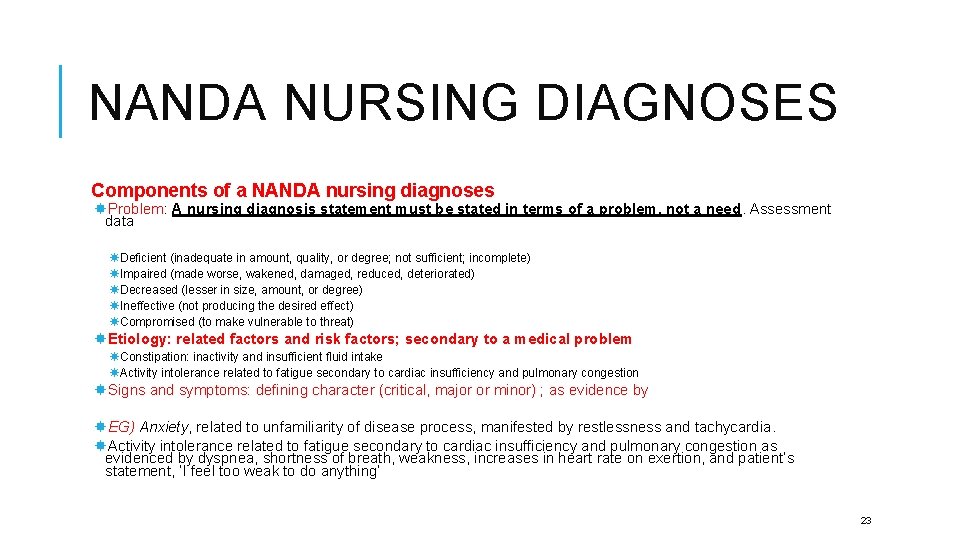
NANDA NURSING DIAGNOSES Components of a NANDA nursing diagnoses Problem: A nursing diagnosis statement must be stated in terms of a problem, not a need. Assessment data Deficient (inadequate in amount, quality, or degree; not sufficient; incomplete) Impaired (made worse, wakened, damaged, reduced, deteriorated) Decreased (lesser in size, amount, or degree) Ineffective (not producing the desired effect) Compromised (to make vulnerable to threat) Etiology: related factors and risk factors; secondary to a medical problem Constipation: inactivity and insufficient fluid intake Activity intolerance related to fatigue secondary to cardiac insufficiency and pulmonary congestion Signs and symptoms: defining character (critical, major or minor) ; as evidence by EG) Anxiety, related to unfamiliarity of disease process, manifested by restlessness and tachycardia. Activity intolerance related to fatigue secondary to cardiac insufficiency and pulmonary congestion as evidenced by dyspnea, shortness of breath, weakness, increases in heart rate on exertion, and patient’s statement, ‘I feel too weak to do anything’ 23
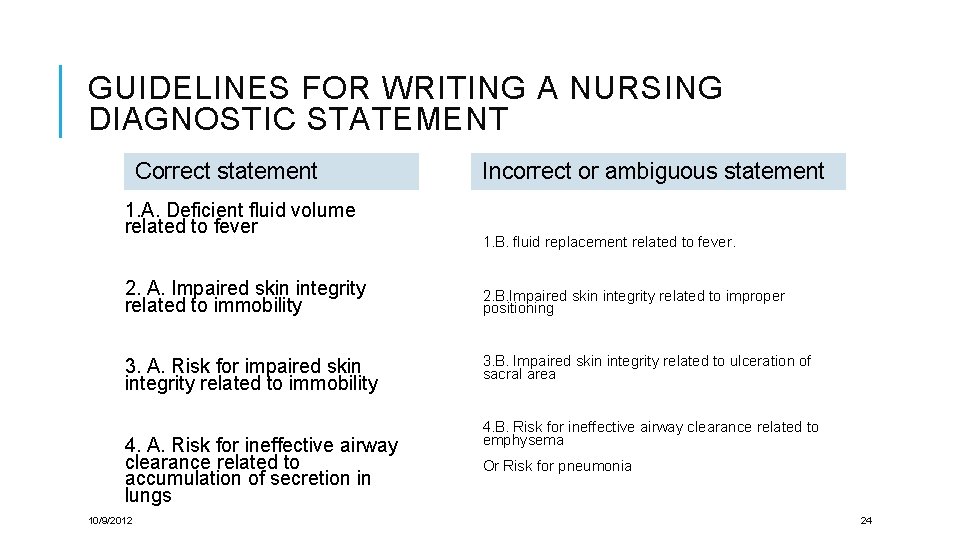
GUIDELINES FOR WRITING A NURSING DIAGNOSTIC STATEMENT Correct statement 1. A. Deficient fluid volume related to fever Incorrect or ambiguous statement 1. B. fluid replacement related to fever. 2. A. Impaired skin integrity related to immobility 2. B. Impaired skin integrity related to improper positioning 3. A. Risk for impaired skin integrity related to immobility 3. B. Impaired skin integrity related to ulceration of sacral area 4. A. Risk for ineffective airway clearance related to accumulation of secretion in lungs 10/9/2012 4. B. Risk for ineffective airway clearance related to emphysema Or Risk for pneumonia 24
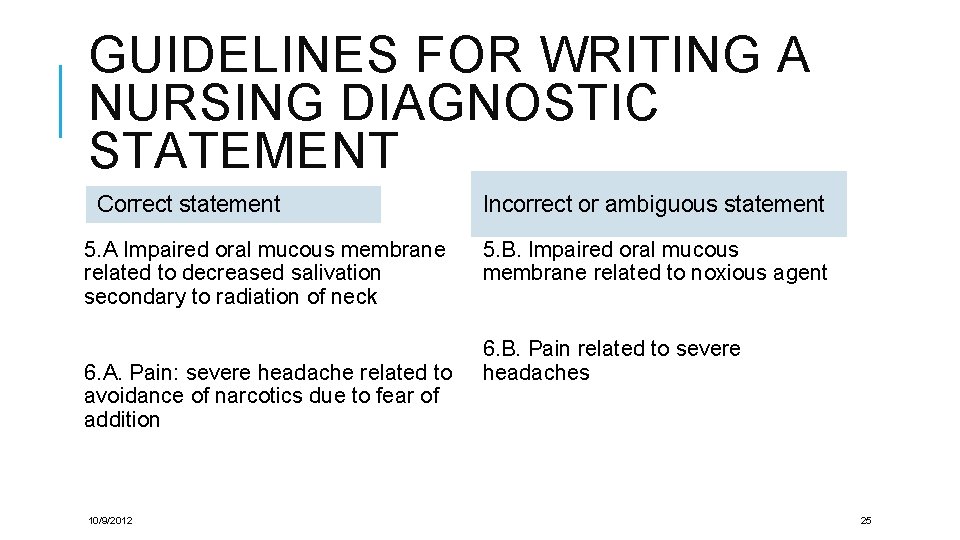
GUIDELINES FOR WRITING A NURSING DIAGNOSTIC STATEMENT Correct statement 5. A Impaired oral mucous membrane related to decreased salivation secondary to radiation of neck 6. A. Pain: severe headache related to avoidance of narcotics due to fear of addition 10/9/2012 Incorrect or ambiguous statement 5. B. Impaired oral mucous membrane related to noxious agent 6. B. Pain related to severe headaches 25
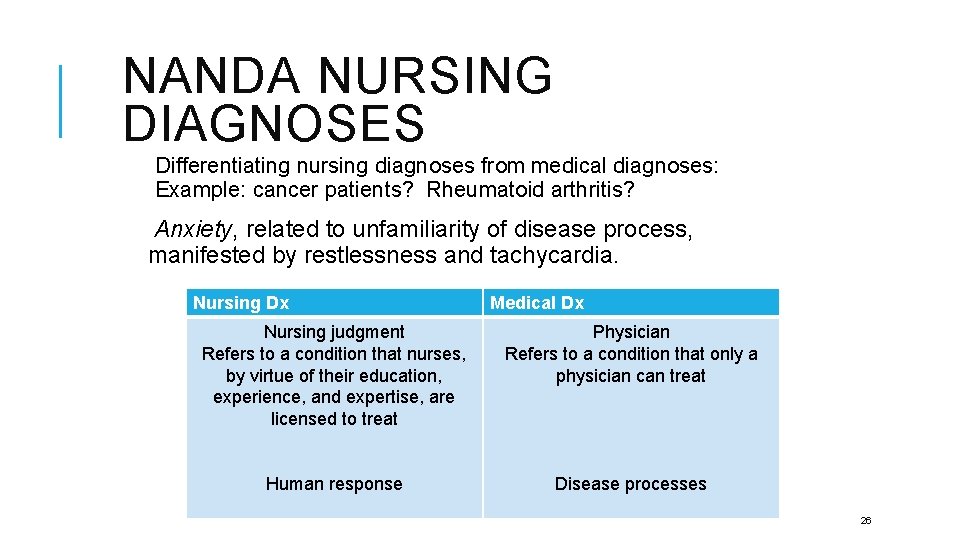
NANDA NURSING DIAGNOSES Differentiating nursing diagnoses from medical diagnoses: Example: cancer patients? Rheumatoid arthritis? Anxiety, related to unfamiliarity of disease process, manifested by restlessness and tachycardia. Nursing Dx Medical Dx Nursing judgment Refers to a condition that nurses, by virtue of their education, experience, and expertise, are licensed to treat Physician Refers to a condition that only a physician can treat Human response Disease processes 26
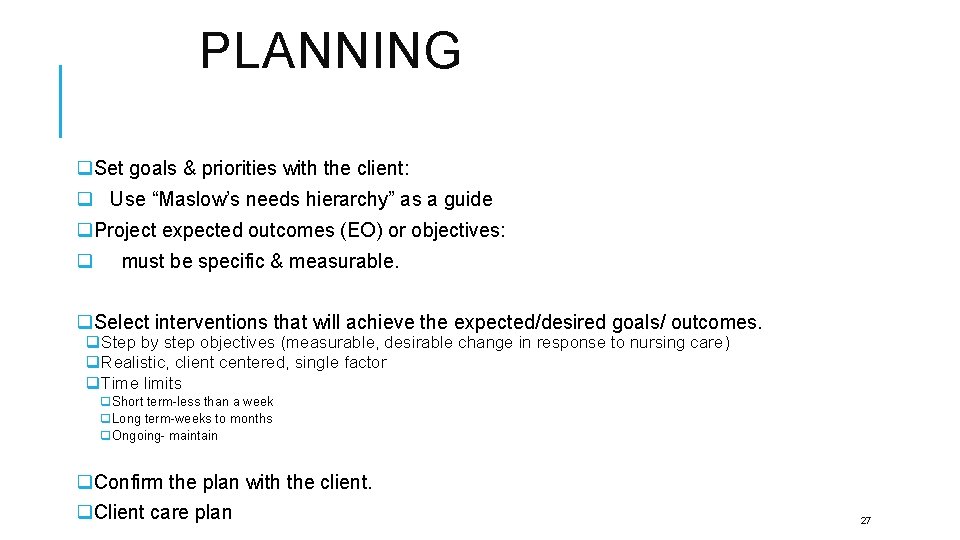
PLANNING q. Set goals & priorities with the client: q Use “Maslow’s needs hierarchy” as a guide q. Project expected outcomes (EO) or objectives: q must be specific & measurable. q. Select interventions that will achieve the expected/desired goals/ outcomes. q. Step by step objectives (measurable, desirable change in response to nursing care) q. Realistic, client centered, single factor q. Time limits q. Short term-less than a week q. Long term-weeks to months q. Ongoing- maintain q. Confirm the plan with the client. q. Client care plan 27
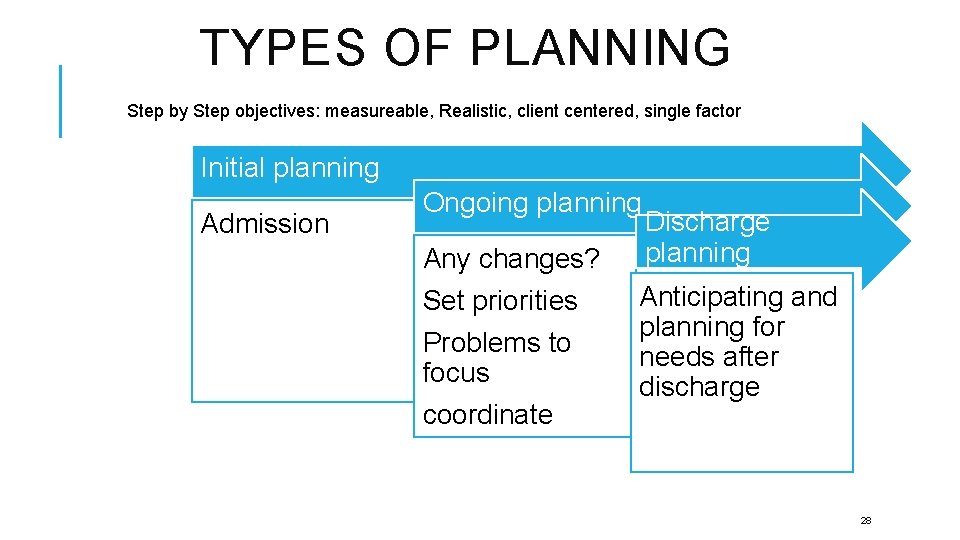
TYPES OF PLANNING Step by Step objectives: measureable, Realistic, client centered, single factor Initial planning Admission Ongoing planning Any changes? Set priorities Problems to focus coordinate Discharge planning Anticipating and planning for needs after discharge 28
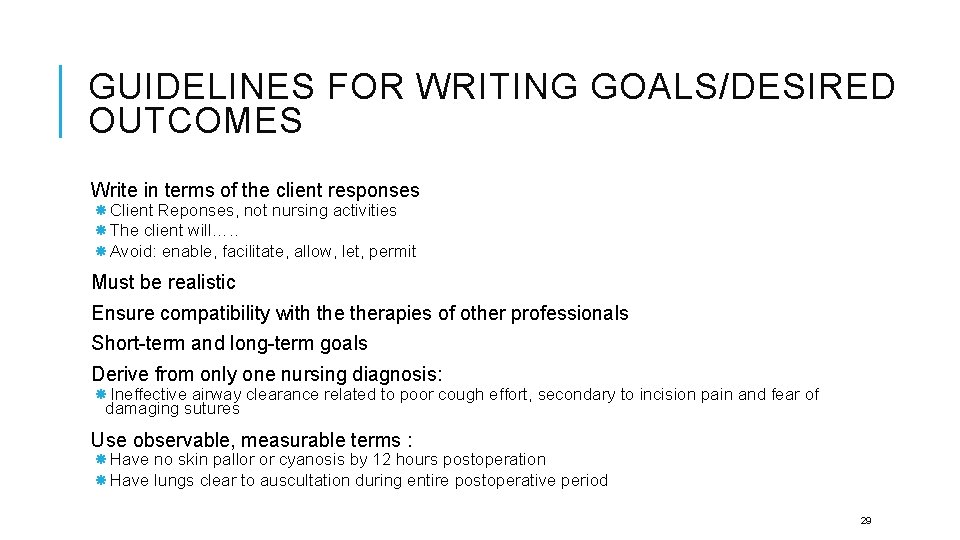
GUIDELINES FOR WRITING GOALS/DESIRED OUTCOMES Write in terms of the client responses Client Reponses, not nursing activities The client will…. . Avoid: enable, facilitate, allow, let, permit Must be realistic Ensure compatibility with therapies of other professionals Short-term and long-term goals Derive from only one nursing diagnosis: Ineffective airway clearance related to poor cough effort, secondary to incision pain and fear of damaging sutures Use observable, measurable terms : Have no skin pallor or cyanosis by 12 hours postoperation Have lungs clear to auscultation during entire postoperative period 29
TYPES OF NURSING INTERVENTIONS Independent interventions Those activities nurses are licensed to initiate (i. e. , physical care, ongoing assessment) Dependent interventions §Activities carried out under physician’s orders or supervision, or according to specified routines Collaborative or interdependent interventions Actions nurse carries out in collaboration with other health team members Reflect overlapping responsibilities of health care team 30
STANDARDIZED LANGUAGE FOR INTERVENTIONS q. There are 12 ANA-recognized standardized languages. q. Currently, these three are the most frequently used in electronic health records (EHRs). q. Clinical Care Classification (CCC) q. The OMAHA System q. Nursing Interventions Classification (NIC) q. Consists of a label, a definition, and a list of specific activities q. NIC interventions are linked to NANDA-Ⅰ diagnoses and NOC outcome labels. q. NIC includes interventions applicable to all settings. COPYRIGHT © 2018. F. A. DAVIS COMPANY
WRITING NURSING ORDERS q. Nursing orders are instructions that describe how and when nursing interventions are to be implemented. q. A nursing order contains Date Subject Action verb Times and limits Signature COPYRIGHT © 2018. F. A. DAVIS COMPANY

FIVE RIGHTS OF DELEGATION q. Right task q. Right circumstance q. Right person q. Right direction/communication q. Right supervision COPYRIGHT © 2018. F. A. DAVIS COMPANY
EVALUATION The final step of the nursing process q. Evaluate q. Client’s progress toward goals q. Judge goal achievement. q. Effectiveness of nursing care plan q. Collect reassessment data. q. Record the evaluative statement. q. Evaluate collaborative problems. q. Quality of care in the healthcare setting COPYRIGHT © 2018. F. A. DAVIS COMPANY
ESTABLISHING EXPECTED OUTCOMES q. Purpose of EOs: q. State clearly & specifically what is to be achieved q. Serves as criteria for judging patient progress q. Allows patient & nurse to know when problem is resolved q. Components of EOs: q. Subject-patient, family member, community q. Action verb-what subject will do q. Conditions-under what circumstances q. Criterion-how much, to what degree
- Slides: 35