
Nursing in Family Systems Developmental Perspectives on the
- Slides: 51
Nursing in Family Systems Developmental Perspectives on the Family
Development Perspectives Families grow and develop over time Families experience the developmental stages of their members Development of individual members influence family development Though similar, it is not standard or linear
Family Interaction Model Family career: 1. Stages and tasks 2. Transitions Individual development Patterns of health, disease and illness
Family Career Dynamic process of change Similar to family life cycle— includes stages and tasks Also includes transitions Allows for diverse and unique experiences: divorce, remarriage
Stages of Family Development Child-bearing family Pre-school family School age family Teenage family Launching family Middle-aged family Aging family
Family Tasks Provide shelter, food, clothing Nurture emotional development Ensure socialization in community and other environment Contribute to the next generation Promote health of family members
Family Transitions Events that trigger changes 1. Developmental 2. Situational—non-normative
Individual Development across the life span Attachment Identity formation Cognitive development Moral development Spiritual development
Attachment Theory: Bowlby and Ainsworth Foundations: Psychoanalysis l Psychobiology l General Systems Theory l Cognitive Development l Ethology l
Attachment Definition: An affectional tie that one person forms to another specific person over time and that endures into adulthood
Attachment Goal: to attain or maintain proximity to and communication with the attachment figure (mother, father, grandmother).
Attachment: Behavioral System The infant develops an “inner working model” (a cognitive map) of the mother’s behavior. Early “goal directed behavior” changes to “ goal corrected behavior” based on feedback from mother’s responses
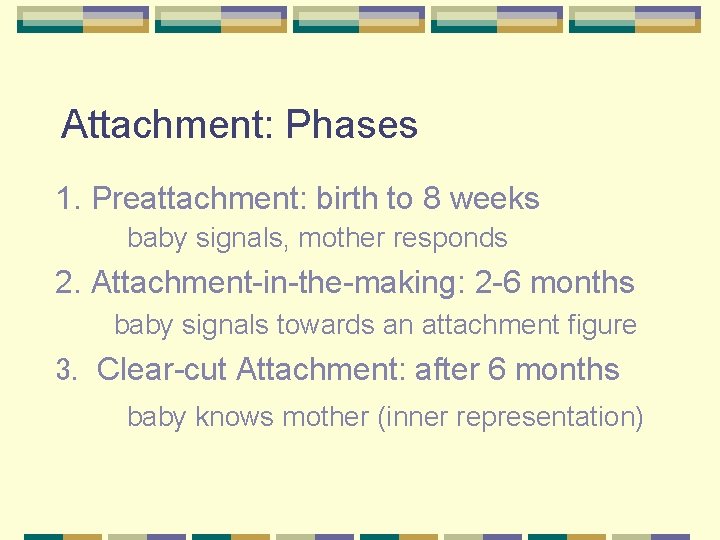
Attachment: Phases 1. Preattachment: birth to 8 weeks baby signals, mother responds 2. Attachment-in-the-making: 2 -6 months baby signals towards an attachment figure 3. Clear-cut Attachment: after 6 months baby knows mother (inner representation)
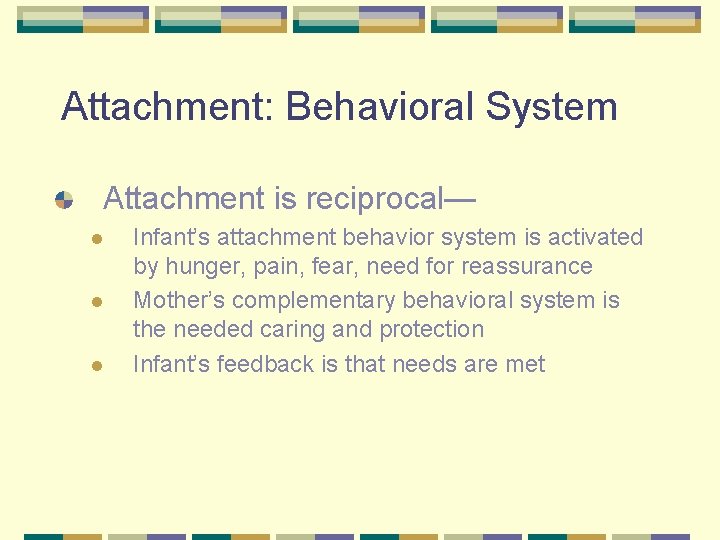
Attachment: Behavioral System Attachment is reciprocal— l l l Infant’s attachment behavior system is activated by hunger, pain, fear, need for reassurance Mother’s complementary behavioral system is the needed caring and protection Infant’s feedback is that needs are met
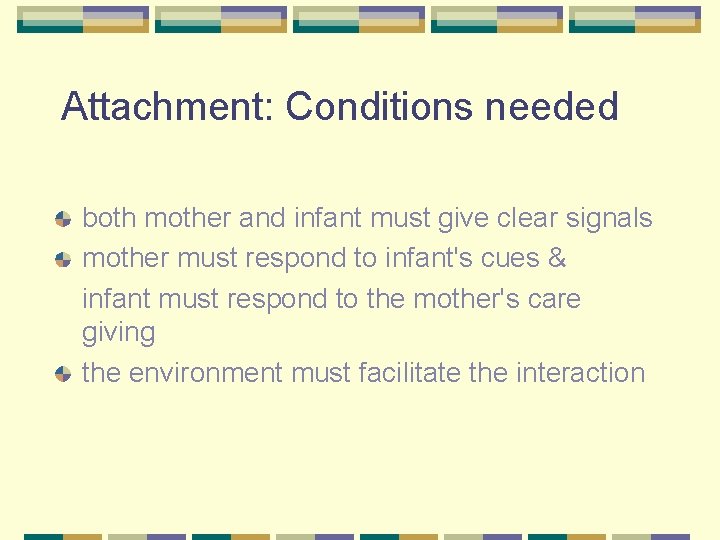
Attachment: Conditions needed both mother and infant must give clear signals mother must respond to infant's cues & infant must respond to the mother's care giving the environment must facilitate the interaction
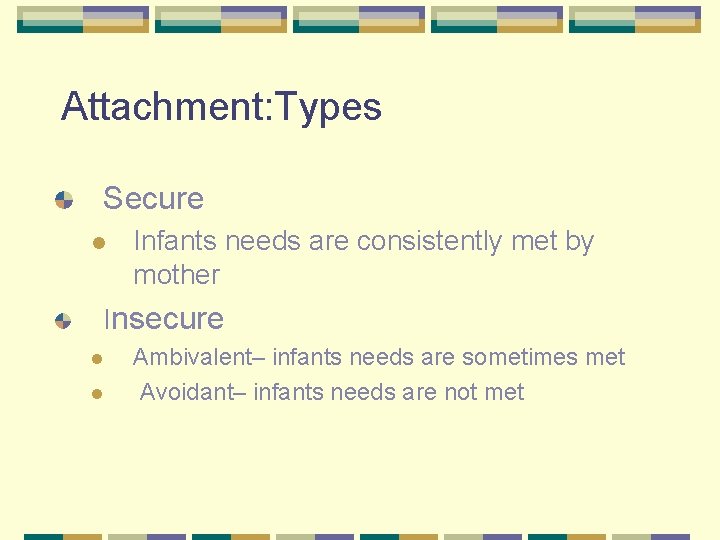
Attachment: Types Secure l Infants needs are consistently met by mother Insecure l l Ambivalent– infants needs are sometimes met Avoidant– infants needs are not met
Attachment Stability If interaction between infant and mother remains stable, attachment will remain stable If conditions change, attachment may change (insecure -> secure)
Attachment & Separation Anxiety When stage 3 of attachment is achieved, separation from mother results in great anxiety, distress, anger, and loss. If prolonged separation occurs, the young child may show phases of protest, despair, and detachment.
Attachment beyond infancy Attachment behaviors: l l l Are present through the life cycle May not always be evident Are not pathological in adults
Attachment Adult Relationships Early attachment is the basis for affectional bonds to others later in life Internal working models (of self and mother) guide these later bonds Secure attachment facilitates positive relationship Insecure may interfere with relationships
Attachment & Parenting Internal working models of self and mother directs attachment to own child If own attachment was insecure, this pattern may be changed by changing behaviors
Attachment & Parenting The best environment for a child is a stable, warm, family with a positive relationship and secure attachment between the infant and mother.
Identity Formation: Erikson Development of theory: 1950 Theoretical bases: l l l psychoanalytic (Freud) Social & cultural values = Psychosocial development
Identity Formation: Erikson 8 stages: l l Occur in a set order Common to all humans Occur at a set time Involves a psychosocial skill to be achieved
Identity: Stage I Age: infant (0 -1 year) Task/Crisis: Trust Vs Mistrust Significant relationship: mother Event: Feeding Outcome: infant must form a trusting relationship with caregiver or develop a sense of mistrust
Identity: Stage II Age: Toddler (2 -3 years) Task/Crisis: Autonomy vs Shame & Doubt Significant relationship: parents Event: toilet training Outcome: Child learns control but may develop shame if not handled well
Identity: Stage III Age: Preschooler (3 -6 years) Task/Crisis: Initiative vs Guilt Significant relationship: family Event: Independence Outcome: Child become assertive and take initiative, but may be too forceful, leading to guilt
Identity: Stage IV Age: School-age (7 -12 years) Task/Crisis: Industry vs Inferiority Significant relationship: Neighbors & school Event: school Outcome: Child learns new skills, but risks failure and sense of inferiority
Identity: Stage V Age: Adolescence (12 -19 years) Task/Crisis: Identity Vs Role confusion Significant relationship: Peers, role models Event: Peer relationships Outcome: Adolescent must achieve sense of identity in work, hobbies, sex roles, & religion
Identity: Stage VI Age: young adult (20 -40 years) Task/Crisis: Intimacy vs Isolation Significant relationship: Partners, friends Event: love relationship Outcome: young adult develops intimate relationships or a sense of isolation
Identity: Stage VII Age: middle adult (40 -65 years) Task/Crisis: Generativity vs Self. Absorption Significant relationship: Family, friends at work Event: Parenting Outcome: Adult must find a way to satisfy & support next generation
Identity: Stage VIII Age: older adult (65 and beyond) Task/Crisis: Integrity vs Despair Significant relationship: Mankind Event: Reflection on and acceptance of own life Outcome: A sense of fulfillment and unity or sense of despair and fear
Cognitive Development: Piaget Development of theory: 1920’s & on Studied how children’s thinking changes over time and how it differs from adult thinking. Demonstrated that children’s thinking is qualitatively different than adults
Cognitive Development (Piaget) Period I: Sensorimotor (birth – 2 years) Series of 6 stages l Uses senses, motor skills and reflexes to explore l Develop object permanence l
Cognitive Development (Piaget) Period II: Preoperational (2 -7 years) Only considers events from own point of view l Begin to use symbols l Cannot yet use mental operations/actions to understand world l
Cognitive Development (Piaget) Period III: Concrete Operations (7 -11 years) Uses beginning logic to understand world l Develops sense of fairness, collaboration, and competition l
Cognitive Development (Piaget) Period IV: Formal Operations (12 years and on) Able to view world from many different perspectives l Thought is abstract & flexible l Can manipulate symbols l Forms hypotheses, theories l
Cognitive Development: Alternate Views Piaget’s stages are not as stable and structured as he proposed. Children can reason earlier than he proposed. Not all adults reach formal operations Learning is dependent on experience – Information Processing– not age & stage
Moral Development: Kohlberg Development began in later 1950’s Theoretical basis: Piaget’s work on moral development Focused on through process in decision making, not the final decision Studied mainly boys & men
Moral Development: Kohlberg Stage 0: Premoral No idea of right or wrong, rules or authority. l Good = what is pleasant or exciting l Bad = what is painful or fearful l Impulses rule behavior l
Moral Development: Kohlberg Level 1: Preconventional Morality Stage 1: Obedience-Punishment orientation Morality is what adults say they should do Stage 2: Individualism / relativism Right behavior is acting in one’s own best interests
Moral Development: Kohlberg Level II: Conventional Morality l Stage 3: Good boy, good girl Do what gains approval of others l Stage IV: Law and order Obey the law, do one’s duty, show respect for authority, maintain the social order
Moral Development: Kohlberg Level III: Post-conventional Morality l Stage V: Social contract Understanding of social mutuality and interest in welfare of others (acts from legal viewpoint but open to change if needed for social utility) l Stage VI: Principled conscience Respect for universal principle and demands of individual conscience
Faith Development: Fowler Developed in 1974 Theoretical bases: Erikson, Kohlberg Term “faith” used to mean Spiritual development
Faith Development: Fowler Stage 0: Undifferentiated (Infancy) Development of trust forms the beginning of faith development l Trust develops through relationship with primary caregiver (attachment) l
Faith Development: Fowler Stage 1: Intuitive-Projective (3 -7 years) Children follow parental beliefs as part of daily life Toddlers imitative spiritual behaviors of others l Preschoolers begin development of values and beliefs l
Faith Development: Fowler Stage 2: Mythical-literal (school-age) Spiritual development parallels cognitive development l Strong interest in religion l Belief in reward for being “good” and punishment for being “bad” l
Faith Development: Fowler Stage 3: Synthetic-conventional Has a system of values and beliefs l Has not personally examined this system through critical thinking l Faith consists of mainly conventional beliefs l Fowler found ¼ of adults to be at this stage or lower l
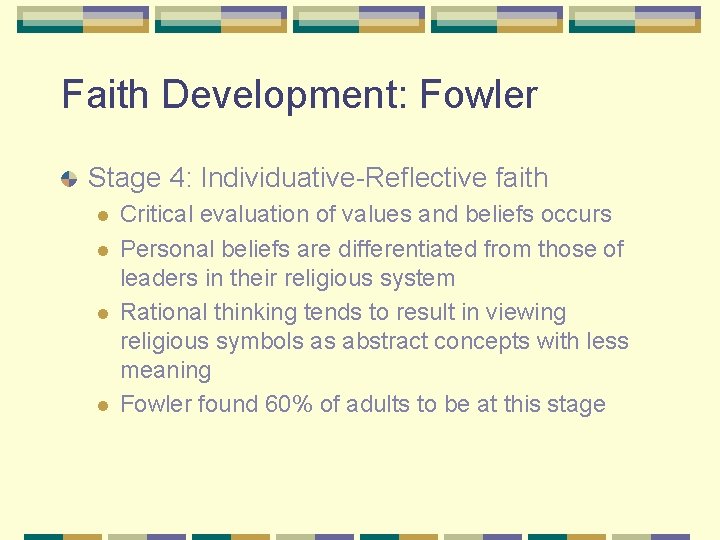
Faith Development: Fowler Stage 4: Individuative-Reflective faith l l Critical evaluation of values and beliefs occurs Personal beliefs are differentiated from those of leaders in their religious system Rational thinking tends to result in viewing religious symbols as abstract concepts with less meaning Fowler found 60% of adults to be at this stage
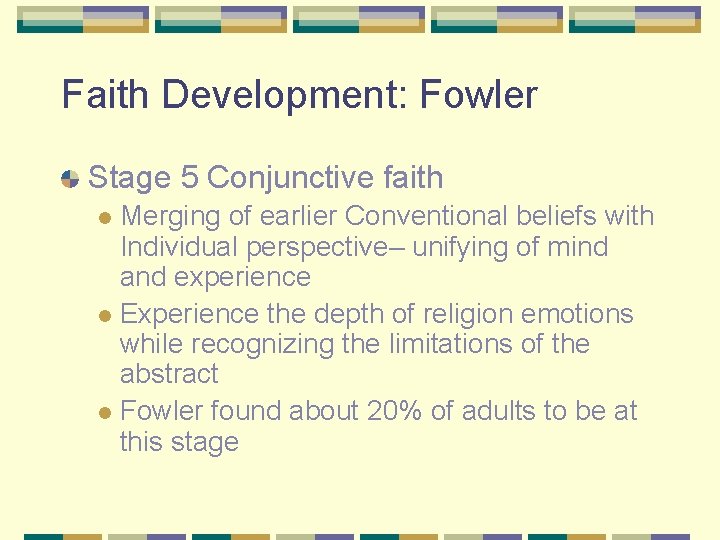
Faith Development: Fowler Stage 5 Conjunctive faith Merging of earlier Conventional beliefs with Individual perspective– unifying of mind and experience l Experience the depth of religion emotions while recognizing the limitations of the abstract l Fowler found about 20% of adults to be at this stage l
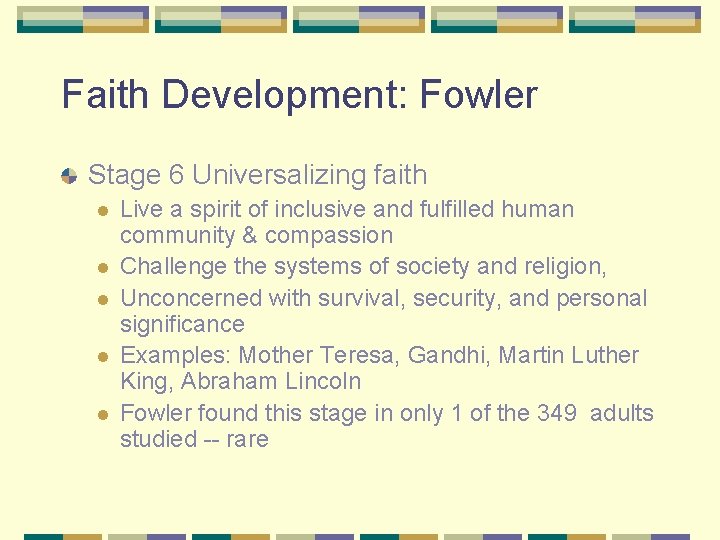
Faith Development: Fowler Stage 6 Universalizing faith l l l Live a spirit of inclusive and fulfilled human community & compassion Challenge the systems of society and religion, Unconcerned with survival, security, and personal significance Examples: Mother Teresa, Gandhi, Martin Luther King, Abraham Lincoln Fowler found this stage in only 1 of the 349 adults studied -- rare