
Nursing Home Antimicrobial Stewardship Guide Help Clinicians Choose

Nursing Home Antimicrobial Stewardship Guide Help Clinicians Choose the Right Antibiotic Toolkit 3. How To Develop and Implement an Antibiogram Program Phase 3. Implementation Training Slides for Nursing Home Nurses www. ahrq. gov/NH-ASPGuide ● May 2014 AHRQ Pub. No. 14 -0023 -6 -EF
Background: Prescribing Antibiotics • Antibiotics are prescribed frequently in nursing homes. – Among antibiotic prescriptions, broad-spectrum antibiotics are often prescribed. • Initial decisions on prescribing antibiotics often are made before culture and sensitivity results are available. • Clinicians’ judgment is based on: – Patient factors (e. g. , age, symptoms, allergies) – Facility factors (type of nursing home, historical experience) – Preference/knowledge
Background: Antibiograms • An antibiogram is a tool to provide clinicians with facility-specific historical information on sensitivity data to assist in initial prescribing. • Antibiograms aggregate information for an entire institution over a period of several months or a year. • Antibiograms display the organisms present in clinical specimens sent for laboratory testing as well as the susceptibility of each organism to an array of antibiotics.
Background: Antibiograms • Antibiograms are prepared and used routinely in hospitals. • Antibiograms recently have been introduced in nursing homes. • Hospitals have used antibiograms to: – Identify important local resistance patterns. – Increase recommended antibiotic prescribing for acute infections.
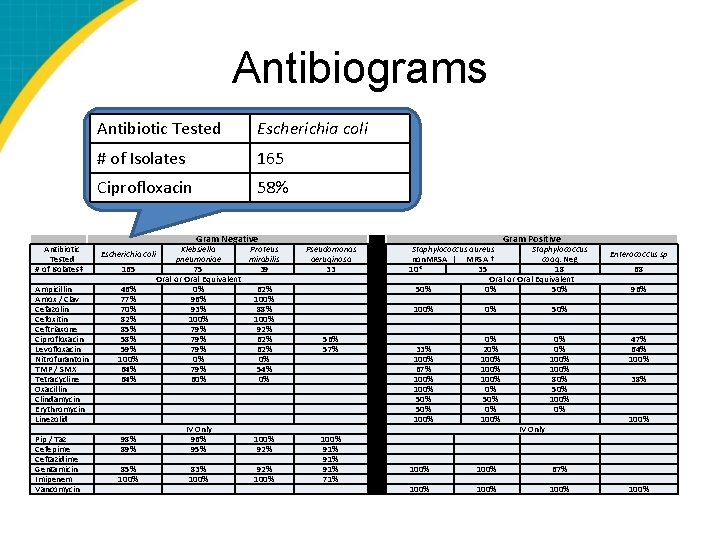
Antibiograms Antibiotic Tested # of Isolates‡ Ampicillin Amox / Clav Cefazolin Cefoxitin Ceftriaxone Ciprofloxacin Levofloxacin Nitrofurantoin TMP / SMX Tetracycline Oxacillin Clindamycin Erythromycin Linezolid Pip / Taz Cefepime Ceftazidime Gentamicin Imipenem Vancomycin Antibiotic Tested Escherichia coli # of Isolates 165 Ciprofloxacin 58% Gram Negative Klebsiella Proteus Escherichia coli pneumoniae mirabilis 165 75 39 Oral or Oral Equivalent 46% 0% 62% 77% 96% 100% 70% 93% 88% 82% 100% 85% 79% 92% 58% 79% 62% 59% 79% 62% 100% 0% 0% 64% 79% 54% 60% 0% IV Only 98% 96% 100% 89% 95% 92% 85% 83% 92% 100% Pseudomonas aeruginosa 33 56% 57% 100% 91% 91% 71% Gram Positive Staphylococcus aureus Staphylococcus non. MRSA | MRSA † coag. Neg 10* 35 18 Oral or Oral Equivalent 50% 0% 50% 100% 0% 50% 0% 0% 33% 20% 0% 100% 67% 100% 80% 100% 0% 50% 50% 100% 50% 0% 0% 100% IV Only 100% 67% 100% Enterococcus sp 68 96% 47% 64% 100% 38% 100%
Key Findings From Antibiogram • • Insert data description from facility’s antibiogram Sample format Most of the data come from xxxx cultures. Of # cultures used to make the antibiograms, – x% were urine cultures. – x% were wound cultures. – x% were sputum cultures. • The antibiograms will be most applicable when selecting antibiotics to treat XXX infections. • The leading organisms responsible for positive XXX cultures were:
Limitations • Source of infection – “Hospital-acquired”: Microbiology is less applicable. – “Facility-acquired”: Acquired while at this nursing home; therefore, antibiogram is more applicable.

Questions?
- Slides: 8