
NURSING GRAND THEORY Student Names INTRODUCTION Conserving means
- Slides: 17
NURSING GRAND THEORY Student Names:
INTRODUCTION • Conserving means keeping together, intact. • Conservation describes how complex systems continue to function despite facing challenges. • Individuals are able to confront obstacles, adapt accordingly & maintain their uniqueness. • This requires strength and good health in order to confront disability. • However, integrity & the conservation laws hold in all situations (Erickson, Tomlin & Swain, 2014).
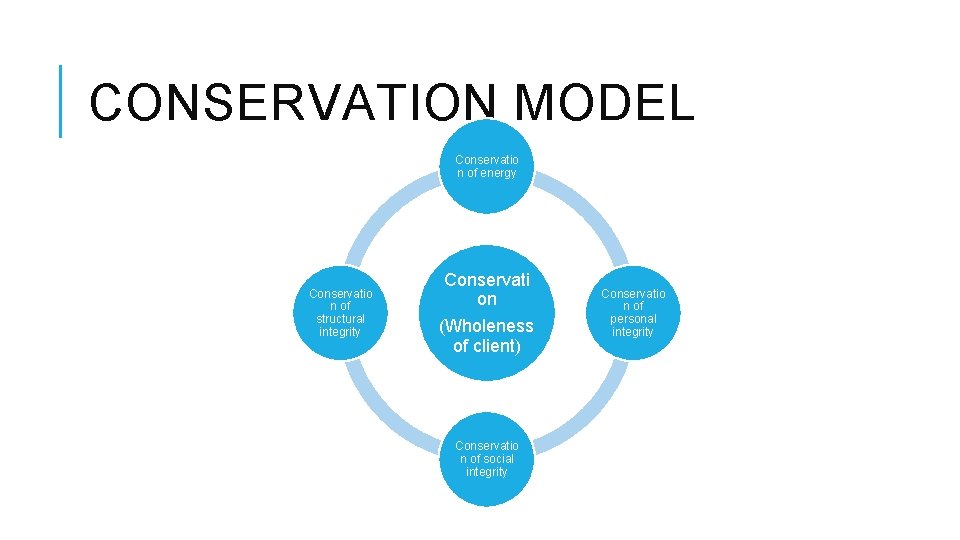
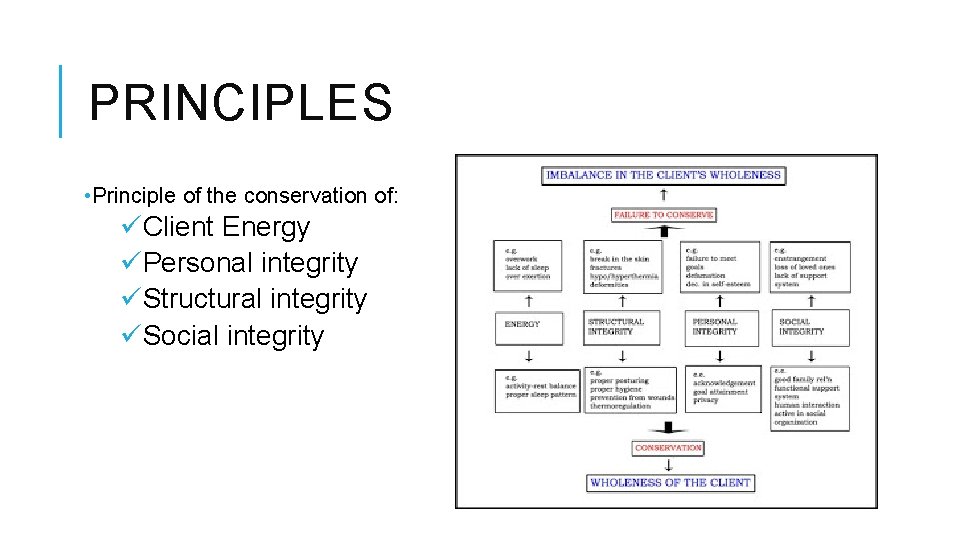
CONSERVATION MODEL • Nursing intervention is a conservation activity. • Conservation of energy is the main concern. • Guides nurses to focus on the influences & responses at the organismic level. • Goals of the model accomplished through the conservation of energy, structure, personal & social integrity. • Patients have different adaptive responses based on personal factors like gender, age & illness. • A patient in the conservation phase has been able to adapt to health challenges using very small effort.
CONSERVATION MODEL Conservatio n of energy Conservatio n of structural integrity Conservati on (Wholeness of client) Conservatio n of social integrity Conservatio n of personal integrity
PRINCIPLES • Principle of the conservation of: üClient Energy üPersonal integrity üStructural integrity üSocial integrity
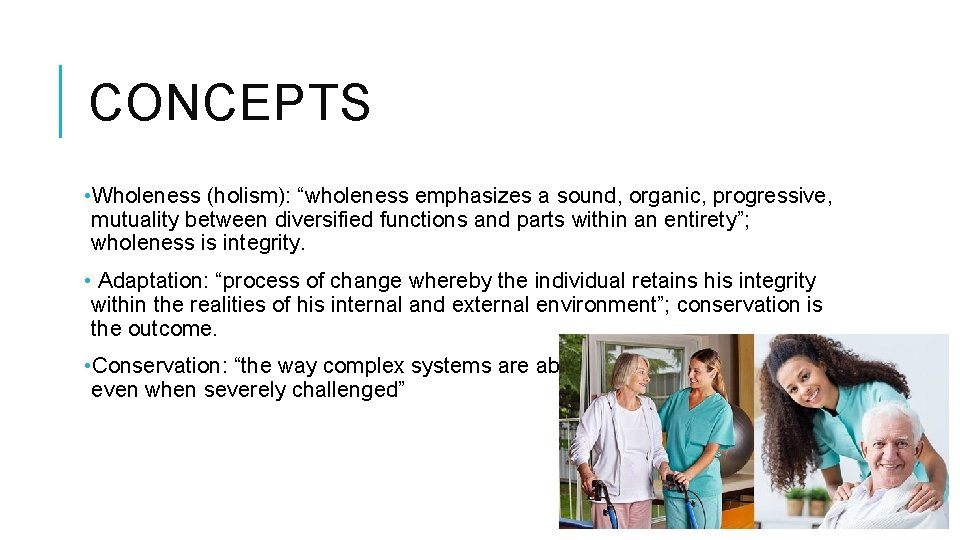
CONCEPTS • Wholeness (holism): “wholeness emphasizes a sound, organic, progressive, mutuality between diversified functions and parts within an entirety”; wholeness is integrity. • Adaptation: “process of change whereby the individual retains his integrity within the realities of his internal and external environment”; conservation is the outcome. • Conservation: “the way complex systems are able to continue to function even when severely challenged”
LEVINE’S THEORY IN NURSING • Nursing involves engaging or interacting with human beings. • The interaction requires proper communication while delivering care. • The quality of the interaction will have an impact on the patient in terms of recovery. • This should promote adaptation and at the same time enhancing wholeness.
LEVINE’S THEORY IN HEALTH • Disease is “unregulated & undisciplined change”. • It must be stopped or else death will ensue. • Health is the avenue of return to the daily activities compromised by ill health. • The encroachment of the disability is completely set aside and the individual is free to operate without encountering constraints. • It is a return to selfhood.
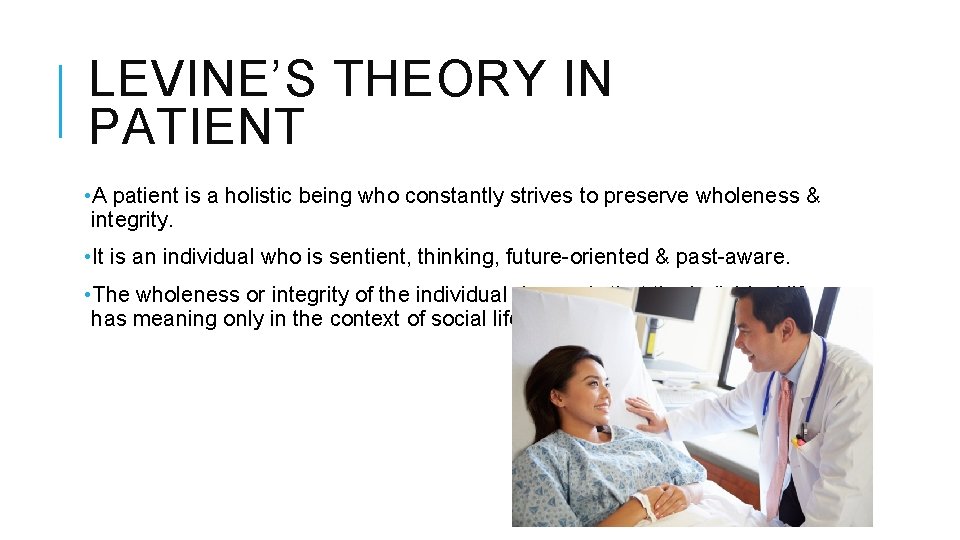
LEVINE’S THEORY IN PATIENT • A patient is a holistic being who constantly strives to preserve wholeness & integrity. • It is an individual who is sentient, thinking, future-oriented & past-aware. • The wholeness or integrity of the individual demands that the individual life has meaning only in the context of social life.
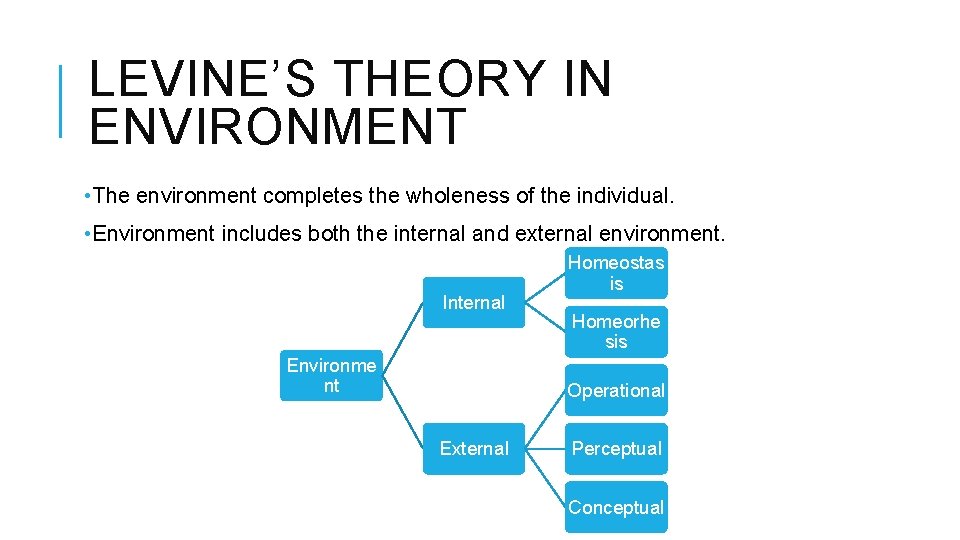
LEVINE’S THEORY IN ENVIRONMENT • The environment completes the wholeness of the individual. • Environment includes both the internal and external environment. Internal Environme nt Homeostas is Homeorhe sis Operational External Perceptual Conceptual
RELATIONSHIP BETWEEN CONCEPTS • Conservation of energy is based on nursing interventions to conserve energy through a deliberate decision as to the balance between activity and the person’s available energy. • Conservation of structural integrity is the basis for nursing interventions to limit the amount of tissue involvement. • Conservation of personal integrity is based on nursing interventions that permit the individual to make decisions for himself or herself or to participate in the decisions. • Conservation of social integrity is based on nursing interventions to preserve the client’s interactions with family and the social system to which they belong.
USEFULNESS OF THEORY • Mefford (2004) based her theory of health promotion for preterm infants on Levine’s conservation model. • Used to develop a nursing undergraduate program at Allentown College of Saint Francis de Sales in Center Valley, Pennsylvania. • A concept analysis was published using Levine’s conservation model to refine the concept of creativity for nursing practice. • Used in the graduate program at Allentown College of Saint Francis de Sales in Center Valley, Pennsylvania as the framework for development of the content of the graduate nursing courses. • Neswick (1997) suggested Levine’s model as theoretic basis for enterostomal therapy (ET) nursing. She found Levine’s framework useful because of its holistic approach. • The four conservation principles of Levine’s model were used in the emergency department at the Hospital of the University of Pennsylvania as an organizing framework for nursing practice. a) Strenghthened communication b) Improved nursing care c) Used in the directing of nursing care of children d) Conservation of personal and social integrity important in healing ill children
TESTABILITY • Piccoli and Galvao (2005) investigated methods of assessing and preparing perioperative nursing patients, focusing on Levine’s four conservation principles. • The Canadian Association of Critical Care Nursing, which published the abstract of Vandall-Walker, Jensen, and Oberle (2006), cited Levine in their investigation of nursing support of family members of critically ill adults. • Conserving the cognitive integrity of hospitalized elderly was the focus of a research study by Foreman (1991). In that study, 71 participants were administered several cognitive measures by an interview process. The researchers stated that the four conservation principles were supported in their study. The model has been the guide for qualitative studies to understand clients in their whole state. Extracted from: Schaefer, K. & Pond, B. (1993). Levine’s conservation model: A framework for nursing practice (pp. 134– 149). Philadelphia: Davis. • Schaefer (1991 b) reported a case study of a patient with congestive heart failure and found the model “pragmatic and parsimonious in studying the subject” (p. 130). • Mock and colleagues (2007) stated that the model “provided a useful framework” (p. 509) for their investigation of nursing interventions to manage fatigue in cancer patients.
PARSIMONY • The model is fairly parsimonious. • Has many concepts with unspecified relationships and unstated assumptions. • According to Levine (1991), redundancy of the domains makes it simple to configure interventions by providing multiple means. However, when domain redundancy is lost by the seriousness of disease, the options for intervention are limited. • This makes it difficult for practitioners and researchers using the model to configure ways in which the model will be used or studied and to derive theoretical structures that proceed from the model.
VALUE IN EXTENDING NURSING SCIENCE • This model has value in guiding education and in implementing practice • Levine’s Conservation Model has provided 4 defining principles that are sufficiently universal to allow research and practice in a large number of situations. • The concept of holism was proposed at an early stage in nursing’s scientific history and has made an important difference in the care of clients.
ASSUMPTIONS • Each individual is an active participant in interactions with the environment. • The individual is a sentient being. • Change is the essence of life. • Change is unceasing as long as life goes on. Change is characteristic of life. • The decisions for nursing intervention must be based on the unique behavior of the individual patient. • Every man is a unique individual, and as such he requires a unique constellation of skills, techniques and ideas designed specifically for him.
REFERENCES • Alligood, M. & Tomney, A. (2015). Nursing Theory: Utilization & Application. St. Louis: Mosby. • Erickson, H. , Tomlin, E. & Swain, M. (2014). Modeling and Role Modeling: A Theory and Paradigm for Nursing. Columbia: R. L Bryan. • Meleis, A. (2013). Theoretical Nursing: Development and Progress. London: Lippincott Williams & Wilkins. • Roy, C. (2014). Generating middle Range Theory: From Evidence to Practice. New York: Springer. • Sitzman, K. & Eichelberger, L. (2011). Understanding the Work of Nurse Theorists: A Creative Beginning. Burlington. Jones and Bartlett.