
Nursing Care of Postpartum Mother and Infant By
Nursing Care of Postpartum Mother and Infant By Sheryl Duncan, Ashley Halliwill, and Dawn Simon September 30 th, 2008

Patient Background Age: 30 Religion: Christian Education: Attending 2 nd year of nursing school. Works as an STNA and goes to college. African American Married
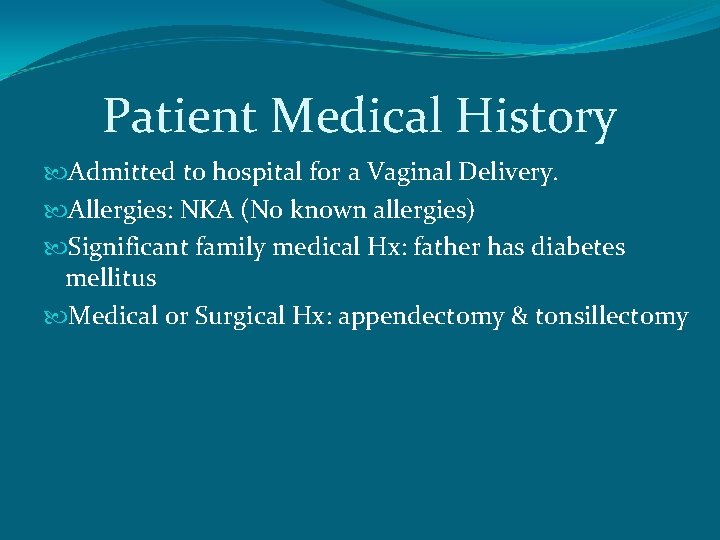
Patient Medical History Admitted to hospital for a Vaginal Delivery. Allergies: NKA (No known allergies) Significant family medical Hx: father has diabetes mellitus Medical or Surgical Hx: appendectomy & tonsillectomy
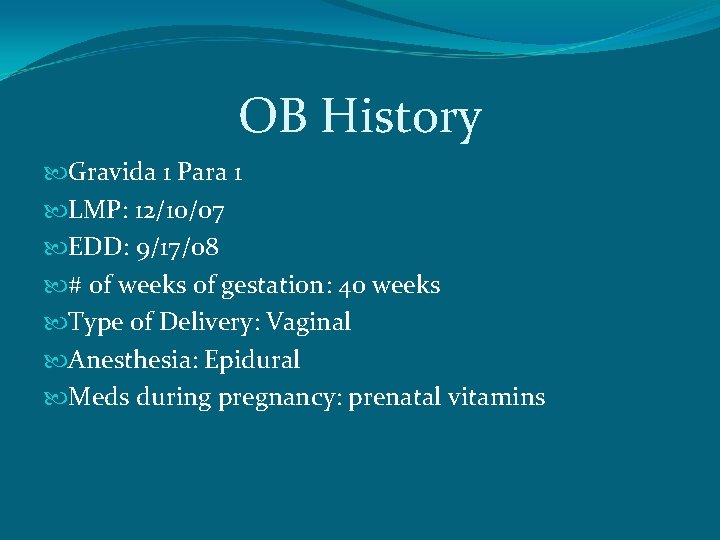
OB History Gravida 1 Para 1 LMP: 12/10/07 EDD: 9/17/08 # of weeks of gestation: 40 weeks Type of Delivery: Vaginal Anesthesia: Epidural Meds during pregnancy: prenatal vitamins
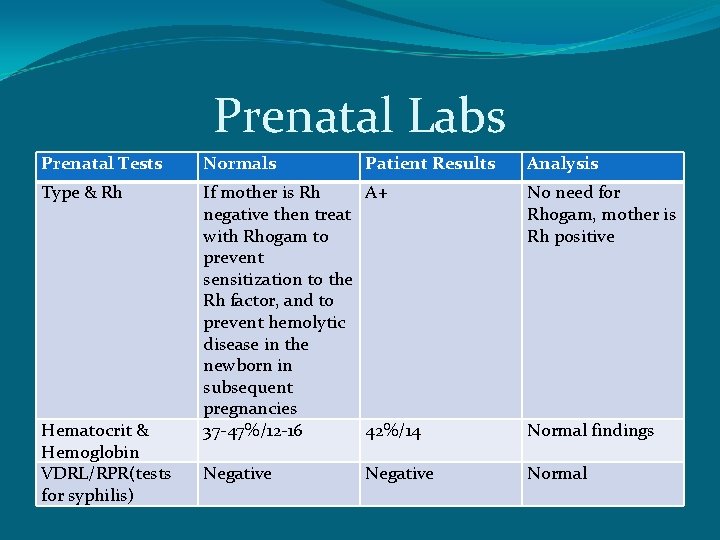
Prenatal Labs Prenatal Tests Normals Type & Rh If mother is Rh A+ negative then treat with Rhogam to prevent sensitization to the Rh factor, and to prevent hemolytic disease in the newborn in subsequent pregnancies 37 -47%/12 -16 42%/14 No need for Rhogam, mother is Rh positive Negative Normal Hematocrit & Hemoglobin VDRL/RPR(tests for syphilis) Patient Results Negative Analysis Normal findings

Prenatal Labs (Cont. ’d) Prenatal Tests Normals Patient Results Analysis Rubella Immune Normal Urine C & S Negative for asymptomatic bacteria Absence of sickle cell hemoglobin Negative for Chlamydia trachomatis/Neiss eria gonorrhoeae No abnormal cells found Normal levels of HCG Negative Normal Absent Normal Negative Normal Sickle Cell Chlamydia/ Gonorrhea PAP Test Quad Screen No abnormal cells Normal found 452, 000 IU/24 hr Normal
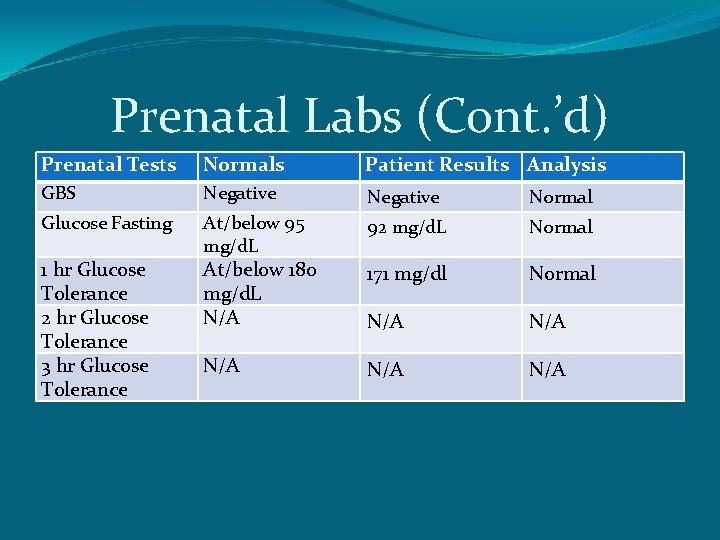
Prenatal Labs (Cont. ’d) Prenatal Tests Normals Patient Results Analysis GBS Negative Normal Glucose Fasting At/below 95 mg/d. L 92 mg/d. L Normal At/below 180 mg/d. L N/A 171 mg/dl Normal N/A N/A N/A 1 hr Glucose Tolerance 2 hr Glucose Tolerance 3 hr Glucose Tolerance
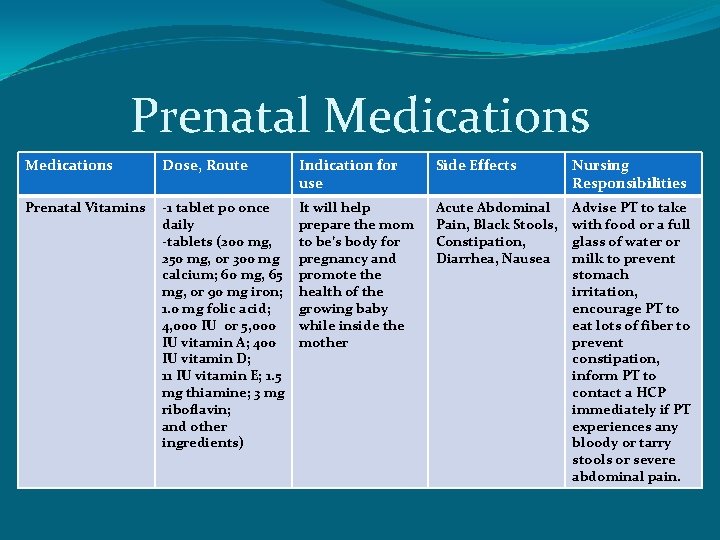
Prenatal Medications Dose, Route Indication for use Side Effects Nursing Responsibilities Prenatal Vitamins -1 tablet po once daily -tablets (200 mg, 250 mg, or 300 mg calcium; 60 mg, 65 mg, or 90 mg iron; 1. 0 mg folic acid; 4, 000 IU or 5, 000 IU vitamin A; 400 IU vitamin D; 11 IU vitamin E; 1. 5 mg thiamine; 3 mg riboflavin; and other ingredients) It will help prepare the mom to be’s body for pregnancy and promote the health of the growing baby while inside the mother Acute Abdominal Pain, Black Stools, Constipation, Diarrhea, Nausea Advise PT to take with food or a full glass of water or milk to prevent stomach irritation, encourage PT to eat lots of fiber to prevent constipation, inform PT to contact a HCP immediately if PT experiences any bloody or tarry stools or severe abdominal pain.
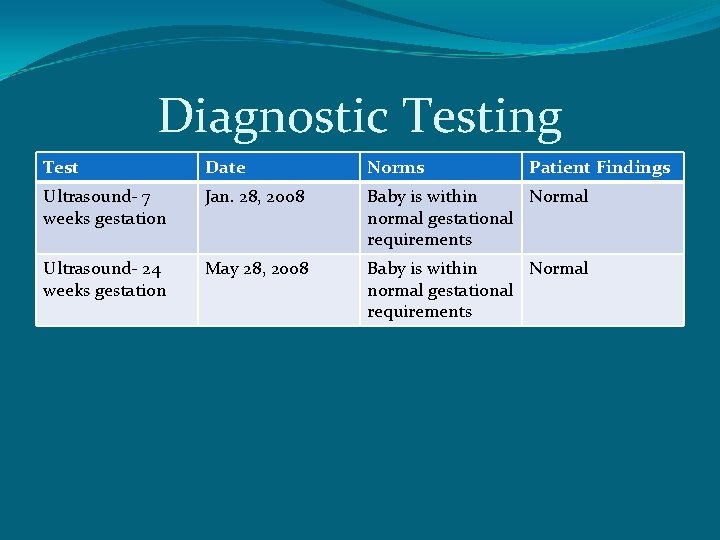
Diagnostic Testing Test Date Norms Patient Findings Ultrasound- 7 weeks gestation Jan. 28, 2008 Baby is within Normal normal gestational requirements Ultrasound- 24 weeks gestation May 28, 2008 Baby is within Normal normal gestational requirements
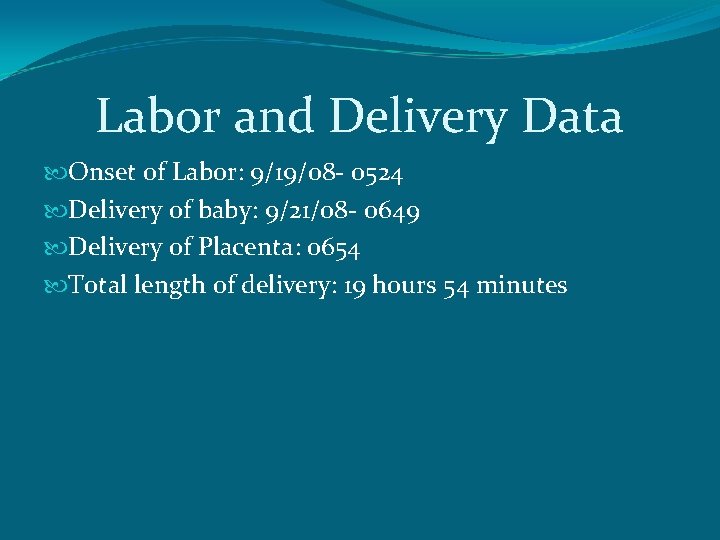
Labor and Delivery Data Onset of Labor: 9/19/08 - 0524 Delivery of baby: 9/21/08 - 0649 Delivery of Placenta: 0654 Total length of delivery: 19 hours 54 minutes
Labor and Delivery Data (Cont. ’d) 9/21 Upon arrival: 0217 - FHR 140’s, moderate variability, no decelerations. Toco q 2 -4 min Cervical effacement: 80% dilated: 3 -4 cm Stationed: -3 Bulging bag of fluid

Labor and Delivery Data (Cont. ’d) 0403 – FHR 130’s, moderate variablility, no decelerations. Toco q 3 -4 min Cervical effacement: 90%; dilated 7 cm Stationed at -2
Labor and Delivery Data (Cont. ’d) 0602 - FHR 140’s Toco q 2 -3 min Cervical effacement: 100%; dilated 10 cm Stationed at 0 AROM at 0 station Monitoring closely AROM : Clear liquid
Labor and Delivery Data (Cont. ’d) 0656 at +1 and then +2 station Patient labored well Bilateral superficial para urethral lacerations which did not require repair.
OB Complications No complications as evidenced by: - BMI within normal range - normal vitals - no history of disease - normal labs - within normal limits of recommended age for pregnancy
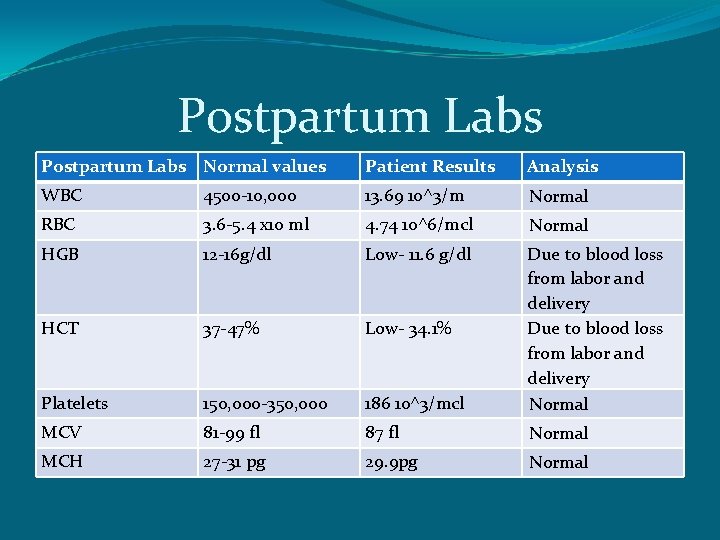
Postpartum Labs Normal values Patient Results Analysis WBC 4500 -10, 000 13. 69 10^3/m Normal RBC 3. 6 -5. 4 x 10 ml 4. 74 10^6/mcl Normal HGB 12 -16 g/dl Low- 11. 6 g/dl HCT 37 -47% Low- 34. 1% Platelets 150, 000 -350, 000 186 10^3/mcl Due to blood loss from labor and delivery Normal MCV 81 -99 fl 87 fl Normal MCH 27 -31 pg 29. 9 pg Normal
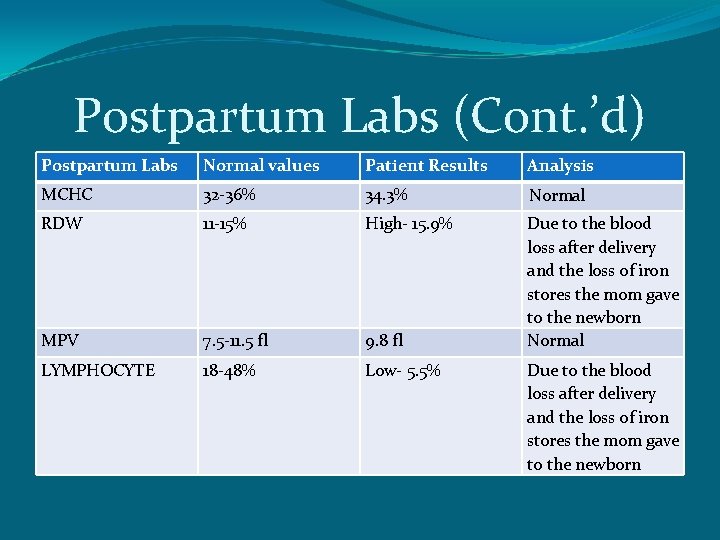
Postpartum Labs (Cont. ’d) Postpartum Labs Normal values Patient Results Analysis MCHC 32 -36% 34. 3% Normal RDW 11 -15% High- 15. 9% MPV 7. 5 -11. 5 fl 9. 8 fl Due to the blood loss after delivery and the loss of iron stores the mom gave to the newborn Normal LYMPHOCYTE 18 -48% Low- 5. 5% Due to the blood loss after delivery and the loss of iron stores the mom gave to the newborn
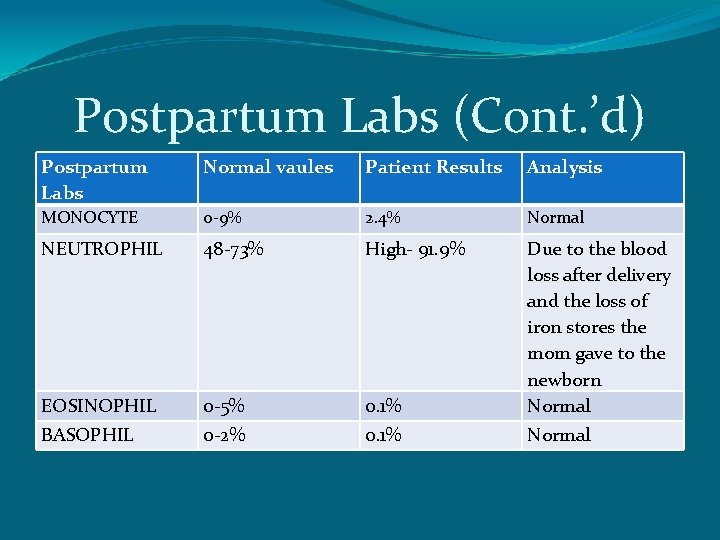
Postpartum Labs (Cont. ’d) Postpartum Labs Normal vaules Patient Results Analysis MONOCYTE 0 -9% 2. 4% Normal NEUTROPHIL 48 -73% High- 91. 9% EOSINOPHIL 0 -5% 0. 1% Due to the blood loss after delivery and the loss of iron stores the mom gave to the newborn Normal BASOPHIL 0 -2% 0. 1% Normal
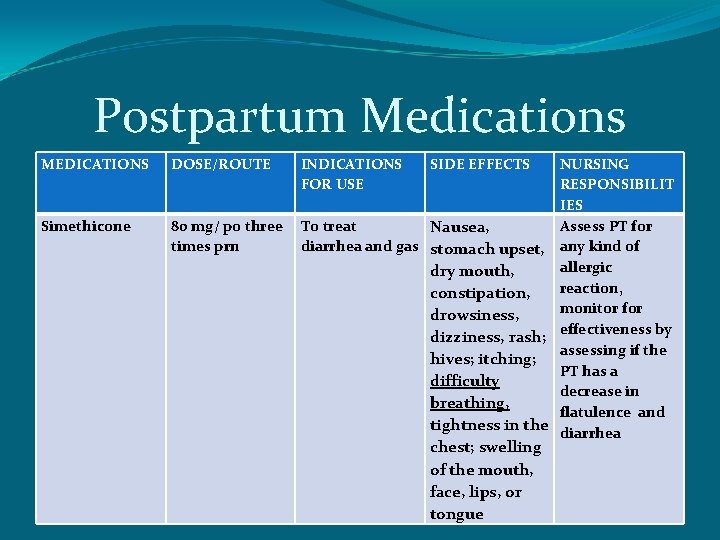
Postpartum Medications MEDICATIONS DOSE/ROUTE Simethicone 80 mg/ po three times prn INDICATIONS FOR USE SIDE EFFECTS NURSING RESPONSIBILIT IES To treat Assess PT for Nausea, diarrhea and gas stomach upset, any kind of allergic dry mouth, reaction, constipation, monitor for drowsiness, dizziness, rash; effectiveness by assessing if the hives; itching; PT has a difficulty decrease in breathing, flatulence and tightness in the diarrhea chest; swelling of the mouth, face, lips, or tongue
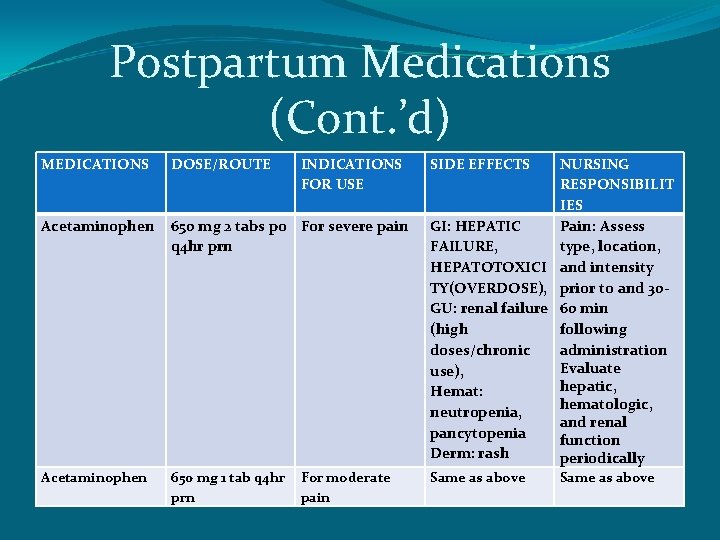
Postpartum Medications (Cont. ’d) MEDICATIONS DOSE/ROUTE INDICATIONS FOR USE Acetaminophen 650 mg 2 tabs po For severe pain q 4 hr prn Acetaminophen 650 mg 1 tab q 4 hr prn For moderate pain SIDE EFFECTS NURSING RESPONSIBILIT IES GI: HEPATIC Pain: Assess FAILURE, type, location, HEPATOTOXICI and intensity TY(OVERDOSE), prior to and 30 GU: renal failure 60 min (high following doses/chronic administration Evaluate use), hepatic, Hemat: hematologic, neutropenia, and renal pancytopenia function Derm: rash periodically Same as above

Postpartum Medications (Cont. ’d) MEDICATIONS DOSE/ROUTE INDICATIONS FOR USE SIDE EFFECTS Acetaminophen 325 mg 2 tabs po q 4 hrs prn 600 mg po q 6 hrs prn pain Same as above Can be given along with acetaminophen for pain Headache, dizziness, drowsiness, psychic disturbances, EENT: amblyopia, blurred vision, arrhythmias, GI BLEEDING, HEPATITIS, dyspepsia, nausea, vomiting Ibuprofen (Motrin) NURSING RESPONSIBILITI ES Same as above BUN, serum creatinine, CBC, and liver function tests should be evaluated periodically; Assess pain 1 -2 hrs prior and following administration. May cause prolonged bleeding time.
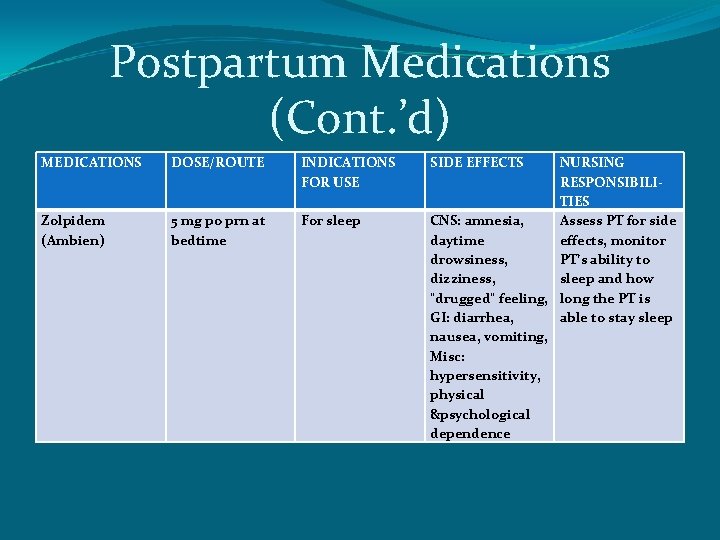
Postpartum Medications (Cont. ’d) MEDICATIONS DOSE/ROUTE INDICATIONS FOR USE Zolpidem (Ambien) 5 mg po prn at bedtime For sleep SIDE EFFECTS NURSING RESPONSIBILITIES CNS: amnesia, Assess PT for side daytime effects, monitor drowsiness, PT’s ability to dizziness, sleep and how "drugged" feeling, long the PT is GI: diarrhea, able to stay sleep nausea, vomiting, Misc: hypersensitivity, physical &psychological dependence
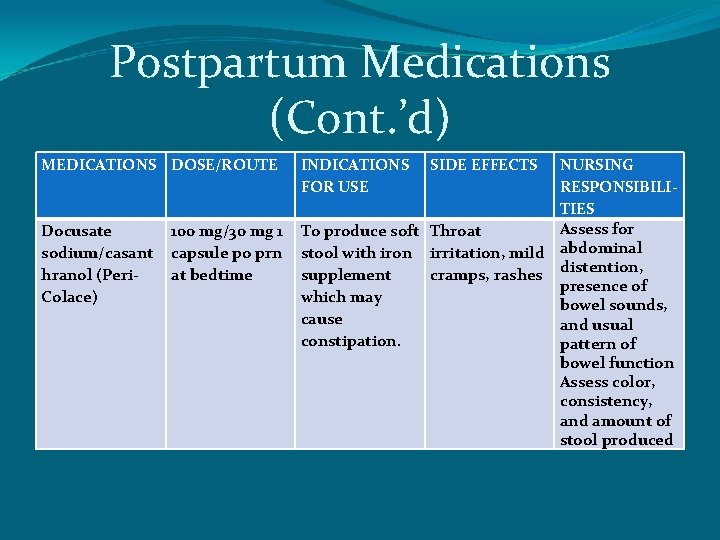
Postpartum Medications (Cont. ’d) MEDICATIONS DOSE/ROUTE Docusate sodium/casant hranol (Peri. Colace) 100 mg/30 mg 1 capsule po prn at bedtime INDICATIONS FOR USE SIDE EFFECTS NURSING RESPONSIBILITIES Assess for To produce soft Throat stool with iron irritation, mild abdominal distention, supplement cramps, rashes presence of which may bowel sounds, cause and usual constipation. pattern of bowel function Assess color, consistency, and amount of stool produced
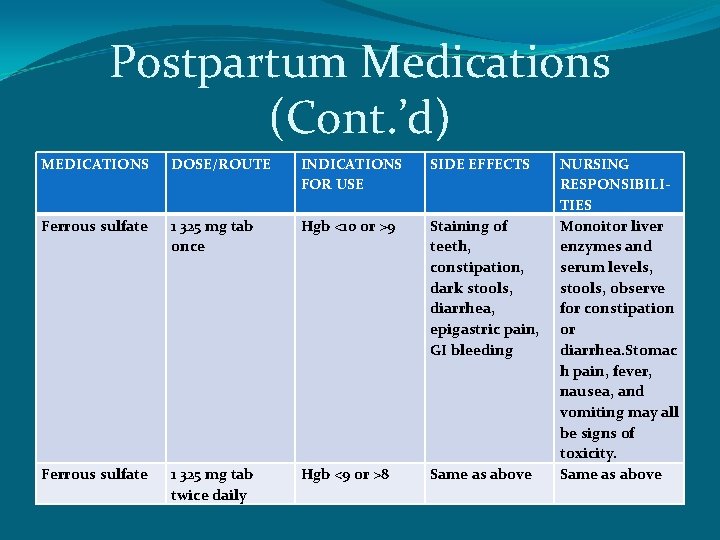
Postpartum Medications (Cont. ’d) MEDICATIONS DOSE/ROUTE INDICATIONS FOR USE SIDE EFFECTS Ferrous sulfate 1 325 mg tab once Hgb <10 or >9 Staining of teeth, constipation, dark stools, diarrhea, epigastric pain, GI bleeding Ferrous sulfate 1 325 mg tab twice daily Hgb <9 or >8 Same as above NURSING RESPONSIBILITIES Monoitor liver enzymes and serum levels, stools, observe for constipation or diarrhea. Stomac h pain, fever, nausea, and vomiting may all be signs of toxicity. Same as above
Postpartum Procedures and Treatments Newborn to breast immediately p birth Ice applied to perineum Ambulate as tolerated Pain medication prn Tucks pads offered Nursing bra for support
Postpartum Nutritional Assessment Physical Appearance: appears well groomed and BMI of 21. Prepregnant weight: 144 lbs/65 kg Weight gain during pregnancy: 30 lbs Weight during pregnancy : 174 lbs/79 kgs
Newborn History Blood type: A positive Hep B Screen: Hep B vaccine since mothers screen was not available at time. VDRL/RPR: negative Rubella: negative Glucose Screen: 73
Newborn Physical Assessment Infant Gender: Male Feeding: Breastfeeding Apgar Score: 1 min. = 9 5 min. = 9 Birth weight: 6 lbs. /3 oz Head to heel: 50. 2 cm 19. 8 in Head circumference: 35. 6 cm 14 in
Newborn Physical Assessment (Cont. ’d) Skin- dry Mouth- moist Moro, suck, rooting, and babinski reflex all present Abdomen- soft Bowel sounds- present Fontanels- soft, level Tone- good Cry-vigorous Extremities-symmetrical
Newborn Physical Assessment (Cont. ’d) Respiratory- Even and clear p suction Cardiovascular- Regular Sensor- intact Procedures- PKU, circumcision, and heel stick blood glucose Pain assessment- 0
Newborn Record Aspiration of amniotic fluid, excess suctioning required Failure to latch first 24 h
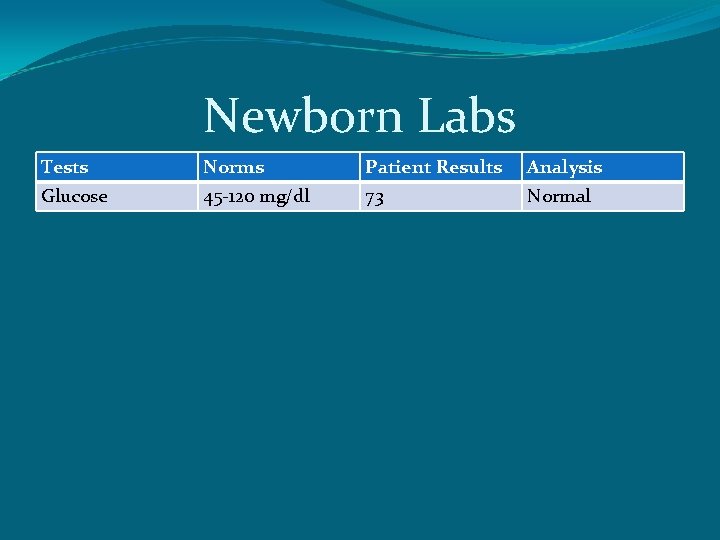
Newborn Labs Tests Norms Patient Results Analysis Glucose 45 -120 mg/dl 73 Normal
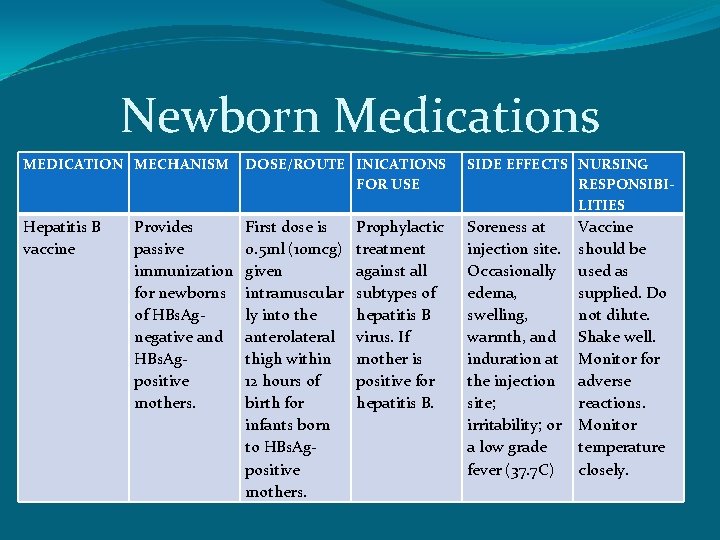
Newborn Medications MEDICATION MECHANISM DOSE/ROUTE INICATIONS FOR USE SIDE EFFECTS NURSING RESPONSIBILITIES Hepatitis B vaccine First dose is 0. 5 ml (10 mcg) given intramuscular ly into the anterolateral thigh within 12 hours of birth for infants born to HBs. Agpositive mothers. Soreness at injection site. Occasionally edema, swelling, warmth, and induration at the injection site; irritability; or a low grade fever (37. 7 C) Provides passive immunization for newborns of HBs. Agnegative and HBs. Agpositive mothers. Prophylactic treatment against all subtypes of hepatitis B virus. If mother is positive for hepatitis B. Vaccine should be used as supplied. Do not dilute. Shake well. Monitor for adverse reactions. Monitor temperature closely.
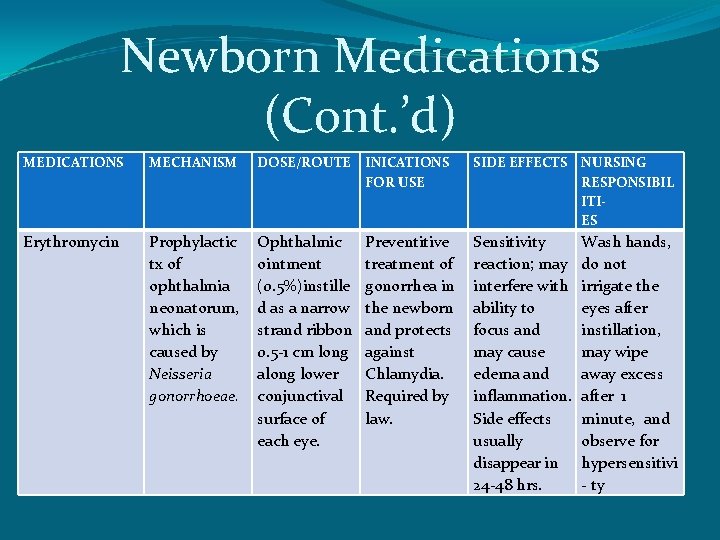
Newborn Medications (Cont. ’d) MEDICATIONS MECHANISM DOSE/ROUTE INICATIONS FOR USE SIDE EFFECTS NURSING RESPONSIBIL ITIES Erythromycin Prophylactic tx of ophthalmia neonatorum, which is caused by Neisseria gonorrhoeae. Ophthalmic ointment (0. 5%)instille d as a narrow strand ribbon 0. 5 -1 cm long along lower conjunctival surface of each eye. Preventitive treatment of gonorrhea in the newborn and protects against Chlamydia. Required by law. Sensitivity reaction; may interfere with ability to focus and may cause edema and inflammation. Side effects usually disappear in 24 -48 hrs. Wash hands, do not irrigate the eyes after instillation, may wipe away excess after 1 minute, and observe for hypersensitivi - ty
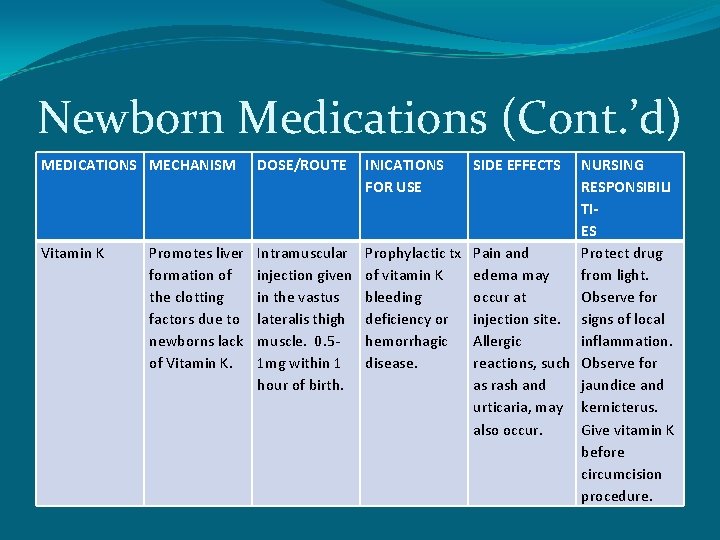
Newborn Medications (Cont. ’d) MEDICATIONS MECHANISM Vitamin K DOSE/ROUTE INICATIONS FOR USE SIDE EFFECTS NURSING RESPONSIBILI TIES Promotes liver Intramuscular Prophylactic tx Pain and Protect drug formation of injection given of vitamin K edema may from light. the clotting in the vastus bleeding occur at Observe for factors due to lateralis thigh deficiency or injection site. signs of local newborns lack muscle. 0. 5 hemorrhagic Allergic inflammation. of Vitamin K. 1 mg within 1 disease. reactions, such Observe for hour of birth. as rash and jaundice and urticaria, may kernicterus. also occur. Give vitamin K before circumcision procedure.
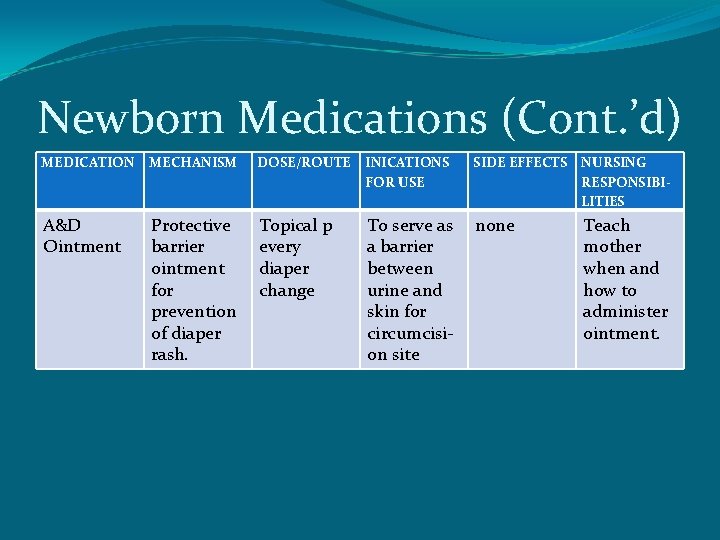
Newborn Medications (Cont. ’d) MEDICATION MECHANISM DOSE/ROUTE INICATIONS FOR USE SIDE EFFECTS NURSING RESPONSIBILITIES A&D Ointment Protective barrier ointment for prevention of diaper rash. Topical p every diaper change To serve as a barrier between urine and skin for circumcision site none Teach mother when and how to administer ointment.
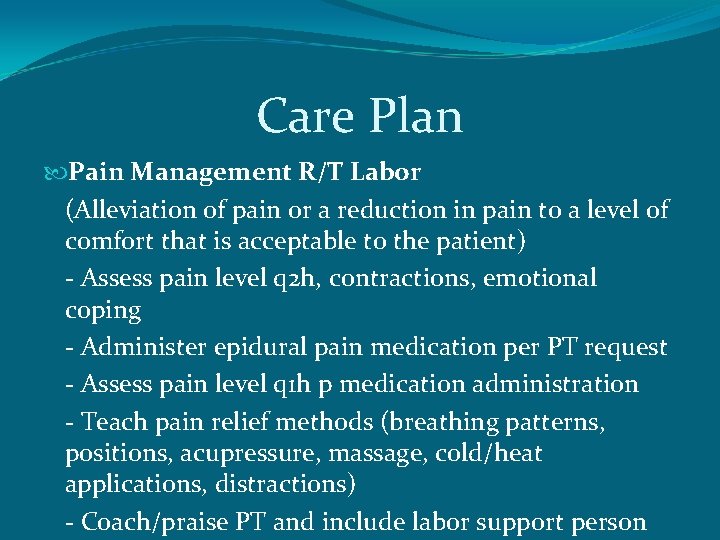
Care Plan Pain Management R/T Labor (Alleviation of pain or a reduction in pain to a level of comfort that is acceptable to the patient) - Assess pain level q 2 h, contractions, emotional coping - Administer epidural pain medication per PT request - Assess pain level q 1 h p medication administration - Teach pain relief methods (breathing patterns, positions, acupressure, massage, cold/heat applications, distractions) - Coach/praise PT and include labor support person
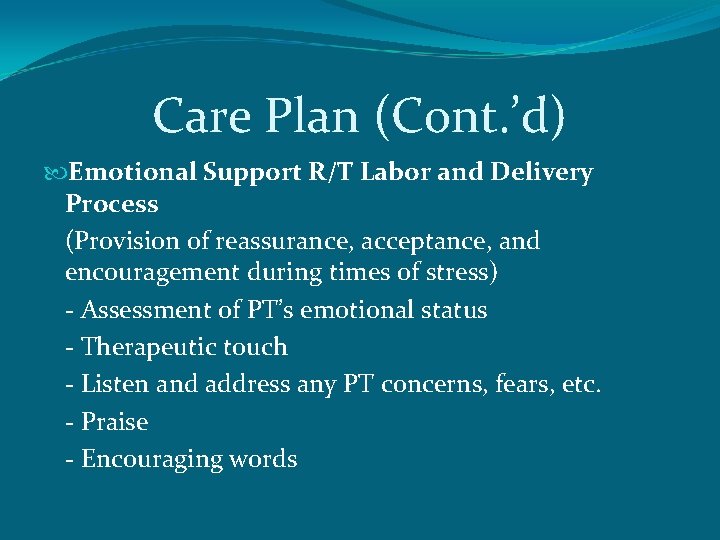
Care Plan (Cont. ’d) Emotional Support R/T Labor and Delivery Process (Provision of reassurance, acceptance, and encouragement during times of stress) - Assessment of PT’s emotional status - Therapeutic touch - Listen and address any PT concerns, fears, etc. - Praise - Encouraging words
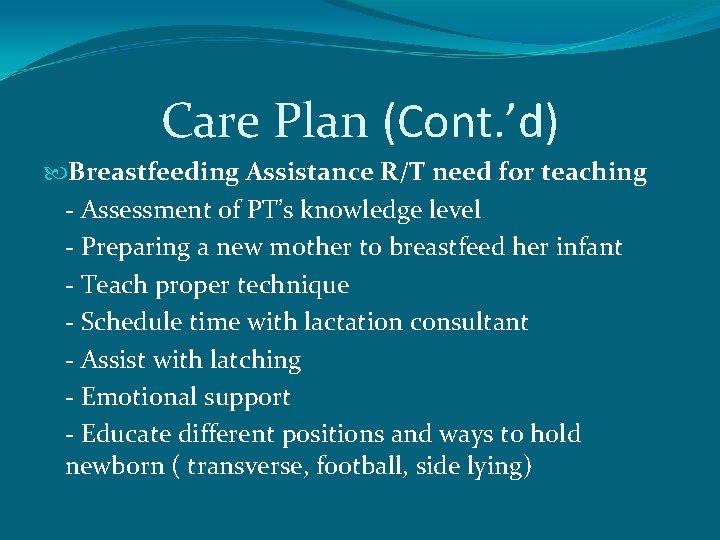
Care Plan (Cont. ’d) Breastfeeding Assistance R/T need for teaching - Assessment of PT’s knowledge level - Preparing a new mother to breastfeed her infant - Teach proper technique - Schedule time with lactation consultant - Assist with latching - Emotional support - Educate different positions and ways to hold newborn ( transverse, football, side lying)
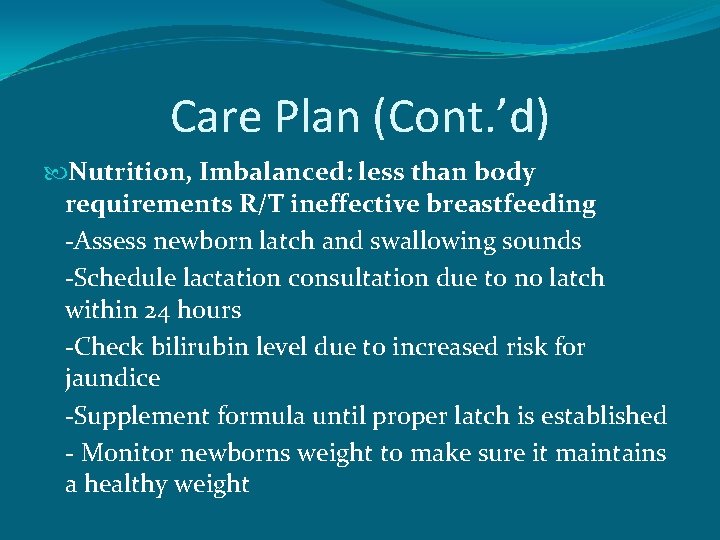
Care Plan (Cont. ’d) Nutrition, Imbalanced: less than body requirements R/T ineffective breastfeeding -Assess newborn latch and swallowing sounds -Schedule lactation consultation due to no latch within 24 hours -Check bilirubin level due to increased risk for jaundice -Supplement formula until proper latch is established - Monitor newborns weight to make sure it maintains a healthy weight

Thanks For Listening!!!
- Slides: 41