
Nursing A ConceptBased Approach to Learning VOLUME TWO
Nursing: A Concept-Based Approach to Learning VOLUME TWO EDITION VOLUME TWO || SECOND EDITION MODULE 36 Clinical Decision Making Nursing: A Concept-Based Approach to Learning Volume Two, Second Edition Copyright © 2015, 2011 by Pearson Education, Inc. All Rights Reserved
The Concept of Clinical Decision Making Nursing: A Concept-Based Approach to Learning Volume Two, Second Edition Copyright © 2015, 2011 by Pearson Education, Inc. All Rights Reserved
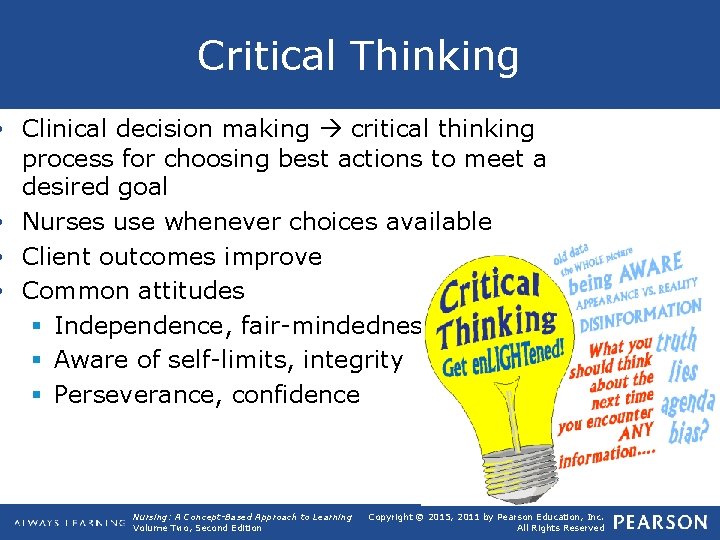
Critical Thinking • Clinical decision making critical thinking process for choosing best actions to meet a desired goal • Nurses use whenever choices available • Client outcomes improve • Common attitudes § Independence, fair-mindedness § Aware of self-limits, integrity § Perseverance, confidence Nursing: A Concept-Based Approach to Learning Volume Two, Second Edition Copyright © 2015, 2011 by Pearson Education, Inc. All Rights Reserved
Intellect • Ability to learn, understand knowledge • Capacity for thinking, reasoning intelligently • Salient cues § Indicate negative, positive change in client's health status § Varies from norms of client population § Indicates developmental delay Nursing: A Concept-Based Approach to Learning Volume Two, Second Edition Copyright © 2015, 2011 by Pearson Education, Inc. All Rights Reserved
Creativity • Outlet for imagination § Take what can be seen in mind, make tangible • Finding unique solutions to unique problems when traditional interventions ineffective • "Thinking out of the box" • Increases number of alternatives • Requires knowledge of the problem Nursing: A Concept-Based Approach to Learning Volume Two, Second Edition Copyright © 2015, 2011 by Pearson Education, Inc. All Rights Reserved
Inquiry • Search for knowledge, facts • To gain clarification, find solutions to problems • Differs from query § Merely asking question, requesting information Nursing: A Concept-Based Approach to Learning Volume Two, Second Edition Copyright © 2015, 2011 by Pearson Education, Inc. All Rights Reserved
Reasoning • Deductive reasoning § "Top down" approach § Start with conclusion • Inductive reasoning § "Bottom up" approach § Start with significant cues • Clinical reasoning § Ability to reflect on previous situations, decisions Nursing: A Concept-Based Approach to Learning Volume Two, Second Edition Copyright © 2015, 2011 by Pearson Education, Inc. All Rights Reserved
Reflection • Action of making sense of occurrences, situations, or decisions by carefully considering totality of experience • Debriefing (reflective thinking) § Helps transfer book knowledge to practice application Nursing: A Concept-Based Approach to Learning Volume Two, Second Edition Copyright © 2015, 2011 by Pearson Education, Inc. All Rights Reserved
Intuition • "Gut reaction" • Use of nursing knowledge, experience, expertise for understanding without conscious use of reasoning • Process of continual analyzing § Clustering patterns, similarities • Not recommended for new nurses, students Nursing: A Concept-Based Approach to Learning Volume Two, Second Edition Copyright © 2015, 2011 by Pearson Education, Inc. All Rights Reserved
Clinical Decision Making • Types of decisions made during process of solving problems § § Value decisions Time management decisions Scheduling decisions Priority decisions • Nurses help clients make decisions. • Strong clinical decision-making skills needed Nursing: A Concept-Based Approach to Learning Volume Two, Second Edition Copyright © 2015, 2011 by Pearson Education, Inc. All Rights Reserved
Clinical Decision Making, continued • Common steps § § § Identify situation or problem List possible alternatives Compare, evaluate pros and cons of each Select best one to try Put it into action Evaluate success Nursing: A Concept-Based Approach to Learning Volume Two, Second Edition Copyright © 2015, 2011 by Pearson Education, Inc. All Rights Reserved
Choosing Between Alternatives • • Use intellect, intuition, reasoning Recognize significant clues, patterns Plan of action based on past experience Apply knowledge, skills Nursing: A Concept-Based Approach to Learning Volume Two, Second Edition Copyright © 2015, 2011 by Pearson Education, Inc. All Rights Reserved
Problem Solving • Apply phases of nursing process § Assessment, nursing diagnosis, planning, implementing, evaluation • Trial and error • Intuition • Scientific method Nursing: A Concept-Based Approach to Learning Volume Two, Second Edition Copyright © 2015, 2011 by Pearson Education, Inc. All Rights Reserved
Clinical Judgment • Nurse's determination, provision of appropriate care to client • Dynamic cognitive process Nursing: A Concept-Based Approach to Learning Volume Two, Second Edition Copyright © 2015, 2011 by Pearson Education, Inc. All Rights Reserved
Exemplar 36. 1 The Nursing Process Nursing: A Concept-Based Approach to Learning Volume Two, Second Edition Copyright © 2015, 2011 by Pearson Education, Inc. All Rights Reserved
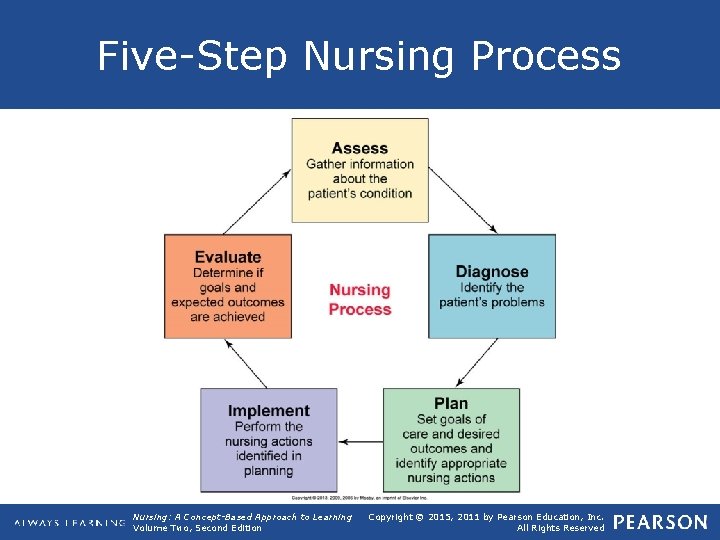
Five-Step Nursing Process Nursing: A Concept-Based Approach to Learning Volume Two, Second Edition Copyright © 2015, 2011 by Pearson Education, Inc. All Rights Reserved
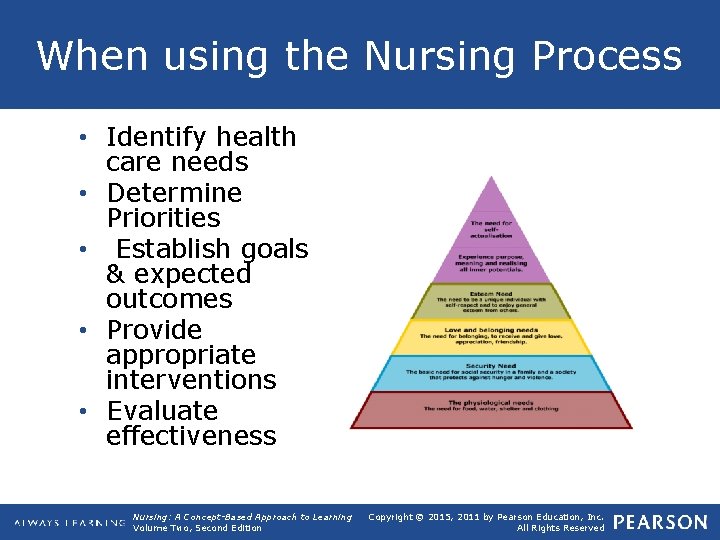
When using the Nursing Process • Identify health care needs • Determine Priorities • Establish goals & expected outcomes • Provide appropriate interventions • Evaluate effectiveness Nursing: A Concept-Based Approach to Learning Volume Two, Second Edition Copyright © 2015, 2011 by Pearson Education, Inc. All Rights Reserved
Assessment • Systematic, continuous data collection • Carried on through all phases of nursing process • Focused on client's response to a health problem Nursing: A Concept-Based Approach to Learning Volume Two, Second Edition • Types of data § Subjective • Client, family § Objective • Physical examination • Database § All information about client § Includes past histor Copyright © 2015, 2011 by Pearson Education, Inc. All Rights Reserved
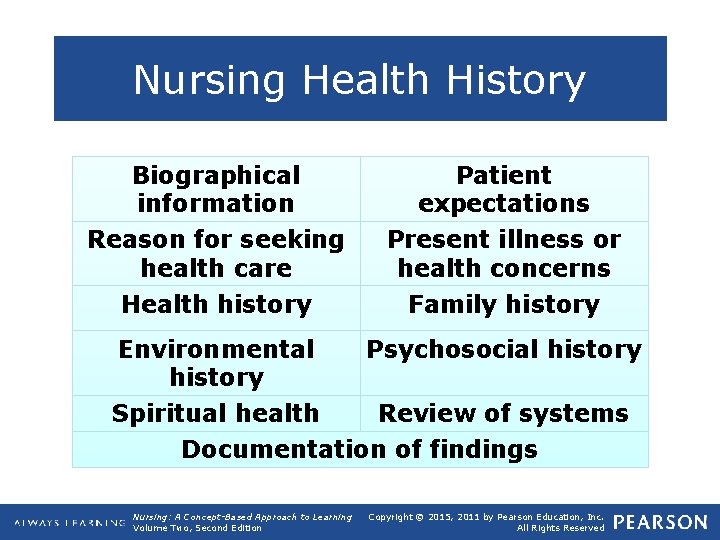
Nursing Health History Biographical information Reason for seeking health care Health history Patient expectations Present illness or health concerns Family history Environmental history Psychosocial history Spiritual health Review of systems Documentation of findings Nursing: A Concept-Based Approach to Learning Volume Two, Second Edition Copyright © 2015, 2011 by Pearson Education, Inc. All Rights Reserved
Assessment, continued • Organizing data § Nursing models • Gordon's 11 functional health patterns • Roy's adaptation model • Maslow's hierarchy of needs § Non-nursing model • Body systems Nursing: A Concept-Based Approach to Learning Volume Two, Second Edition Copyright © 2015, 2011 by Pearson Education, Inc. All Rights Reserved

Cues and Inferences Nursing: A Concept-Based Approach to Learning Volume Two, Second Edition Copyright © 2015, 2011 by Pearson Education, Inc. All Rights Reserved
Diagnosis • Use critical thinking skills to: § Cluster assessment data § Identify problems • Ongoing development of nursing diagnoses § NANDA's Taxonomy II • Domains • Classes • Nursing diagnoses Nursing: A Concept-Based Approach to Learning Volume Two, Second Edition Copyright © 2015, 2011 by Pearson Education, Inc. All Rights Reserved
Common Terms • Diagnosis, diagnosing § Conclusion regarding nature of phenomenon, process used to formulate conclusion • Diagnostic labels § Standardized NANDA names for diagnoses • Risk factors § Factors that cause client to be vulnerable to developing health problem Nursing: A Concept-Based Approach to Learning Volume Two, Second Edition Copyright © 2015, 2011 by Pearson Education, Inc. All Rights Reserved
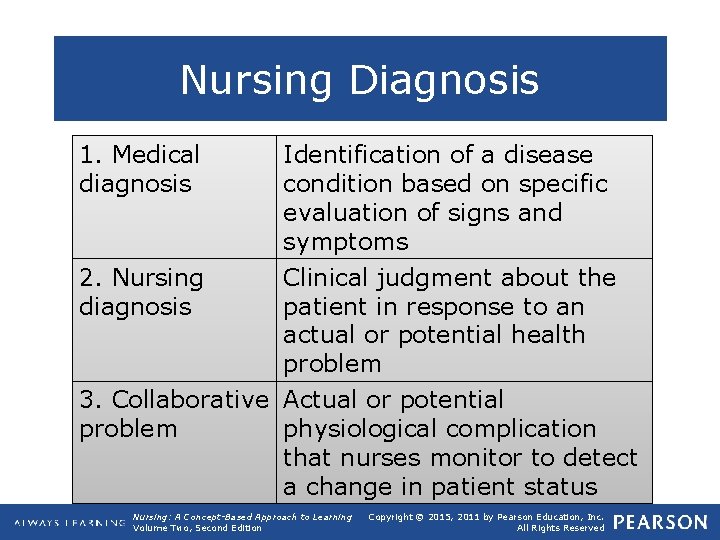
Nursing Diagnosis 1. Medical diagnosis Identification of a disease condition based on specific evaluation of signs and symptoms 2. Nursing diagnosis Clinical judgment about the patient in response to an actual or potential health problem 3. Collaborative Actual or potential problem physiological complication that nurses monitor to detect a change in patient status Nursing: A Concept-Based Approach to Learning Volume Two, Second Edition Copyright © 2015, 2011 by Pearson Education, Inc. All Rights Reserved
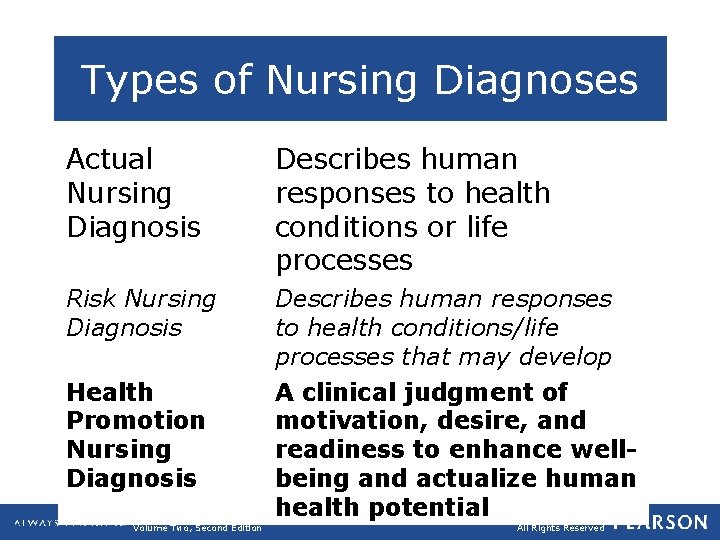
Types of Nursing Diagnoses Actual Nursing Diagnosis Describes human responses to health conditions or life processes Risk Nursing Diagnosis Describes human responses to health conditions/life processes that may develop Health Promotion Nursing Diagnosis A clinical judgment of motivation, desire, and readiness to enhance wellbeing and actualize human health potential Nursing: A Concept-Based Approach to Learning Volume Two, Second Edition Copyright © 2015, 2011 by Pearson Education, Inc. All Rights Reserved
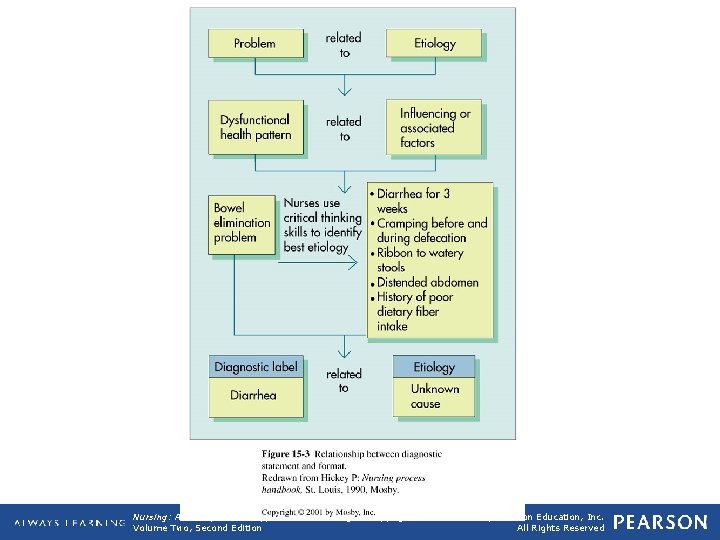
Components of a Nursing Diagnosis • Diagnostic label (problem) § Approved by NANDA § Qualifiers give additional meaning • Etiology (related factors and risk factors) § One or more probable causes of health problem • Defining characteristics § Cluster of signs, symptoms that indicate presence of a particular diagnostic label Nursing: A Concept-Based Approach to Learning Volume Two, Second Edition Copyright © 2015, 2011 by Pearson Education, Inc. All Rights Reserved
Nursing: A Concept-Based Approach to Learning Volume Two, Second Edition Copyright © 2015, 2011 by Pearson Education, Inc. All Rights Reserved
Writing a Nursing Diagnosis Statement • Basic two-part statement § Problem, etiology • Basic three-part statement § Problem, etiology, signs and symptoms • Basic one-part statement § NANDA label only • Common variations § Unknown etiology, complex factors, "secondary to" Nursing: A Concept-Based Approach to Learning Volume Two, Second Edition Copyright © 2015, 2011 by Pearson Education, Inc. All Rights Reserved
Avoiding Errors in Diagnostic Statements • Verify • Build good knowledge base, acquire clinical experience • Have working knowledge of what is normal • Consult resources • Recognize patterns Nursing: A Concept-Based Approach to Learning Volume Two, Second Edition Copyright © 2015, 2011 by Pearson Education, Inc. All Rights Reserved
Planning • Deliberate, systematic phase • Client goals formulated § Basis for nursing interventions § To prevent, reduce, eliminate, or improve nursing diagnosis situation • Involves decision making, problem solving • Client support necessary for effectiveness Nursing: A Concept-Based Approach to Learning Volume Two, Second Edition Copyright © 2015, 2011 by Pearson Education, Inc. All Rights Reserved
Planning, continued • Goals and desired outcomes § Goals are broad statements about the client's status. § Desired outcomes are more specific, observable criteria used to evaluate whether the goals have been met. • Purpose of goals and desired outcomes § Provide direction for planning interventions § Serve as criteria for evaluating progress Nursing: A Concept-Based Approach to Learning Volume Two, Second Edition Copyright © 2015, 2011 by Pearson Education, Inc. All Rights Reserved
Goals of Care Patient-centered goal: A specific and measurable behavior or response that reflects a patient’s highest possible level of wellness and independence in function Short-term goal: An objective behavior or response expected within hours to a week Long-term goal: An objective behavior or response expected within days, weeks, or months Nursing: A Concept-Based Approach to Learning Volume Two, Second Edition Copyright © 2015, 2011 by Pearson Education, Inc. All Rights Reserved
Goals of Care (cont’d) Always partner with patients when setting their individualized goals. For patients to participate in goal setting, they need to be alert and must have some degree of independence in completing activities of daily living, problem solving, and decision making. Patients need to understand see the value of nursing therapies, even though they are often totally dependent on you as the nurse. Nursing: A Concept-Based Approach to Learning Volume Two, Second Edition Copyright © 2015, 2011 by Pearson Education, Inc. All Rights Reserved
Developing a Goal • Questions to ask § What needs to be changed? § Is there a healthy response to correct problem stated in diagnosis? § How will client look, behave if healthy response achieved? § What action must client do? • How well must client do it to demonstrate achievement? Nursing: A Concept-Based Approach to Learning Volume Two, Second Edition Copyright © 2015, 2011 by Pearson Education, Inc. All Rights Reserved
Seven Guidelines for Writing Goals Patient centered Singular goal or outcome Observable Measurable Time limited Mutual factors Realistic Nursing: A Concept-Based Approach to Learning Volume Two, Second Edition Copyright © 2015, 2011 by Pearson Education, Inc. All Rights Reserved
Writing a Goal, continued • Guidelines for writing a goal, desired outcome § Write in terms of the client responses § Must be realistic § Ensure compatibility with therapies of other professionals § Derive from only one nursing diagnosis § Use observable, measurable terms § Make sure client considers them to be important, values them Nursing: A Concept-Based Approach to Learning Volume Two, Second Edition Copyright © 2015, 2011 by Pearson Education, Inc. All Rights Reserved
Writing a Goal, continued • Components of goal, desired outcome statements § § Subject Verb Condition or modifier Criterion of desired performance Nursing: A Concept-Based Approach to Learning Volume Two, Second Edition Copyright © 2015, 2011 by Pearson Education, Inc. All Rights Reserved
Implementation • Action phase • Relationship to other phases § Take data from first three phases § Determine appropriate interventions • Two-step process § Identify best priority intervention § Implement these interventions Nursing: A Concept-Based Approach to Learning Volume Two, Second Edition Copyright © 2015, 2011 by Pearson Education, Inc. All Rights Reserved
Nursing Interventions • Actions nurse performs to achieve goals • Types of nursing interventions § Independent • Nurses licensed to initiate § Dependent • Carried out under physician's orders, supervision § Collaborative • Reflect overlapping responsibilities of healthcare team Nursing: A Concept-Based Approach to Learning Volume Two, Second Edition Copyright © 2015, 2011 by Pearson Education, Inc. All Rights Reserved
Nursing Interventions, continued • Considerations when selecting interventions § Determine pros, cons of each § Client-centered, realistic, relevant toward goal § Interventions need to be: • Safe, appropriate for client's age, health, condition • Achievable with resources available Nursing: A Concept-Based Approach to Learning Volume Two, Second Edition Copyright © 2015, 2011 by Pearson Education, Inc. All Rights Reserved
Nursing Interventions, continued • Considerations when selecting interventions § Interventions need to be: • Congruent with client's values, beliefs, culture • Congruent with otherapies, standards of care • Based on current best nursing research evidence Nursing: A Concept-Based Approach to Learning Volume Two, Second Edition Copyright © 2015, 2011 by Pearson Education, Inc. All Rights Reserved
Nursing Interventions, continued • Writing a nursing intervention § § § Is client-centered Has specific, concise action Includes detailed information Is realistic to individual client Is relevant to helping client reach goal Lists only top 3– 5 priority interventions Nursing: A Concept-Based Approach to Learning Volume Two, Second Edition Copyright © 2015, 2011 by Pearson Education, Inc. All Rights Reserved
Implementation • • • Preassessment of client Determining nurse's need for assistance Implementing nursing interventions Delegation Documentation Nursing: A Concept-Based Approach to Learning Volume Two, Second Edition Copyright © 2015, 2011 by Pearson Education, Inc. All Rights Reserved
Skills Necessary for Implementation • Cognitive § Problem solving, decision making, critical thinking, creativity • Interpersonal § Verbal, nonverbal communication methods • Technical § Purposeful, "hands-on" skills § Manipulating equipment, giving injections § Manual dexterity Nursing: A Concept-Based Approach to Learning Volume Two, Second Edition Copyright © 2015, 2011 by Pearson Education, Inc. All Rights Reserved
Relationship to Other Nursing Process Phases • Assessment, nursing diagnosis, goal planning provide basis for actions performed during implementation • While implementing: § Continue to reassess client at every contact § Some routine nursing activities present new assessment data Nursing: A Concept-Based Approach to Learning Volume Two, Second Edition Copyright © 2015, 2011 by Pearson Education, Inc. All Rights Reserved
Evaluation • • Last phase Planned, ongoing, purposeful activity Relationship to other phases Clients and healthcare professionals determine § Client's progress toward achieving goals § Effectiveness of nursing plan of care • Evaluation continues until goals achieved or client discharged Nursing: A Concept-Based Approach to Learning Volume Two, Second Edition Copyright © 2015, 2011 by Pearson Education, Inc. All Rights Reserved
Drawing Conclusions • Conclusions about client goals § Actual problem resolved, potential problem prevented with no risk factors § Risk problem prevented but risk factors still present § Actual problem still exists even though some goals met • Revise if partially resolved • Do not revise if client needs more time Nursing: A Concept-Based Approach to Learning Volume Two, Second Edition Copyright © 2015, 2011 by Pearson Education, Inc. All Rights Reserved
Developing an Evaluation • Collect objective, subjective data § Recorded concisely, accurately • Possible conclusions § Goal was met • Client response same as desired outcome § Goal was partially met § Goal was not met • Within time frame Nursing: A Concept-Based Approach to Learning Volume Two, Second Edition Copyright © 2015, 2011 by Pearson Education, Inc. All Rights Reserved
Writing an Evaluation • Evaluation statement § Date, time of evaluation § Conclusion statement about goal • Met, partially met, not met § Supporting statement giving results of how client did, did not achieve goal Nursing: A Concept-Based Approach to Learning Volume Two, Second Edition Copyright © 2015, 2011 by Pearson Education, Inc. All Rights Reserved
Continuing, Modifying, or Terminating the Nursing Plan of Care • • • Assessment Nursing diagnosis Revising client goals Redesigning nursing interventions Method of implementation Nursing: A Concept-Based Approach to Learning Volume Two, Second Edition Copyright © 2015, 2011 by Pearson Education, Inc. All Rights Reserved
Exemplar 36. 2 The Nursing Plan of Care Nursing: A Concept-Based Approach to Learning Volume Two, Second Edition Copyright © 2015, 2011 by Pearson Education, Inc. All Rights Reserved
Overview • Guideline that organizes information about client's or family's care • Begins with first client contact • Constantly updated • Continues until nurse–client relationship ends (discharge) § Included in client's permanent record Nursing: A Concept-Based Approach to Learning Volume Two, Second Edition Copyright © 2015, 2011 by Pearson Education, Inc. All Rights Reserved
Accessibility • Supports communication with others for better continuity of care • Commonly kept with medical record • Kardex system § Quick reference for nursing care needs Nursing: A Concept-Based Approach to Learning Volume Two, Second Edition Copyright © 2015, 2011 by Pearson Education, Inc. All Rights Reserved
Guidelines for Writing a Nursing Care Plan • Date, sign the plan • Use category headings • Use standardized, approved medical or English symbols and key words • Be specific • Refer to procedure book or other sources rather than including steps • Tailor the plan to the client Nursing: A Concept-Based Approach to Learning Volume Two, Second Edition Copyright © 2015, 2011 by Pearson Education, Inc. All Rights Reserved
Guidelines for Writing a Nursing Care Plan, continued • Incorporate prevention, health maintenance • Include ongoing assessment • Include collaborative activities • Include discharge planning, home care needs Nursing: A Concept-Based Approach to Learning Volume Two, Second Edition Copyright © 2015, 2011 by Pearson Education, Inc. All Rights Reserved
Guidelines • Can be computerized or written • Format determined by individual facility • Four types § § Column plan Concept map Standardized plan Clinical pathway Nursing: A Concept-Based Approach to Learning Volume Two, Second Edition Copyright © 2015, 2011 by Pearson Education, Inc. All Rights Reserved
Guidelines • Uses columns to categorize data § § Nursing diagnosis Goals/desired outcomes Nursing interventions Evaluation Nursing: A Concept-Based Approach to Learning Volume Two, Second Edition Copyright © 2015, 2011 by Pearson Education, Inc. All Rights Reserved
Concept Map • Holistic view of client • Visual representation § Keep it simple § Post-it notes, software • Patterned diagram with data, ideas Nursing: A Concept-Based Approach to Learning Volume Two, Second Edition Copyright © 2015, 2011 by Pearson Education, Inc. All Rights Reserved
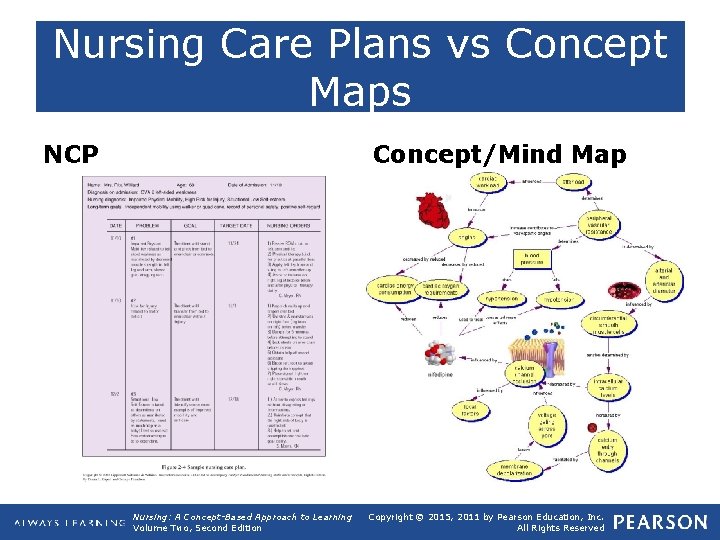
Nursing Care Plans vs Concept Maps NCP Concept/Mind Map Nursing: A Concept-Based Approach to Learning Volume Two, Second Edition Copyright © 2015, 2011 by Pearson Education, Inc. All Rights Reserved
Standardized Plan • Specify care for groups of clients with common needs • Frequently include: § Checklists, blank lines, or empty spaces § Allows nurse to individualize goals, interventions • Categorized by specific age group, client problem, specialty categories • Written from perspective of what care the client can expect Nursing: A Concept-Based Approach to Learning Volume Two, Second Edition Copyright © 2015, 2011 by Pearson Education, Inc. All Rights Reserved
Standardized Plan, continued • Different from standards of care, which include the following: § Describe nursing actions for clients with similar medical conditions § Describe achievable rather than ideal nursing care § Define interventions for which nurses accountable § Written from the perspective of nurse's responsibilities Nursing: A Concept-Based Approach to Learning Volume Two, Second Edition Copyright © 2015, 2011 by Pearson Education, Inc. All Rights Reserved
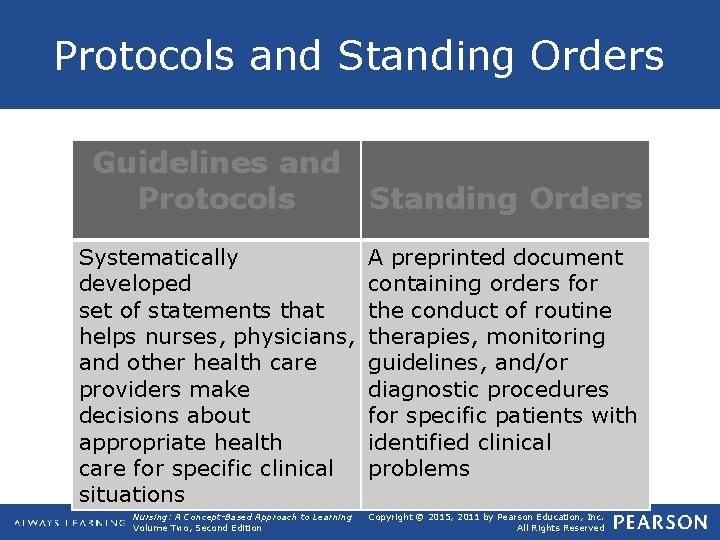
Protocols and Standing Orders Guidelines and Protocols Standing Orders Systematically developed set of statements that helps nurses, physicians, and other health care providers make decisions about appropriate health care for specific clinical situations Nursing: A Concept-Based Approach to Learning Volume Two, Second Edition A preprinted document containing orders for the conduct of routine therapies, monitoring guidelines, and/or diagnostic procedures for specific patients with identified clinical problems Copyright © 2015, 2011 by Pearson Education, Inc. All Rights Reserved
Clinical Pathway • Standardized, multidisciplinary • Outlines expected care for clients with common conditions • Physician writes an order for it • Sequence of care daily through projected length of stay for specific condition • Also called collaborative or case management plan Nursing: A Concept-Based Approach to Learning Volume Two, Second Edition Copyright © 2015, 2011 by Pearson Education, Inc. All Rights Reserved
Exemplar 36. 3 Prioritizing Care Nursing: A Concept-Based Approach to Learning Volume Two, Second Edition Copyright © 2015, 2011 by Pearson Education, Inc. All Rights Reserved
Overview • Priority § Given attention before competing alternatives • Prioritizing care § Helps nurses manage time § Establish order Nursing: A Concept-Based Approach to Learning Volume Two, Second Edition Copyright © 2015, 2011 by Pearson Education, Inc. All Rights Reserved
Assessment Observe for cues about staff emotions Make quick safety check of clients Become aware of clients at risk Make note of time constraints on routine responsibilities • Know how many, what level of nursing staff available for delegation of tasks • • Nursing: A Concept-Based Approach to Learning Volume Two, Second Edition Copyright © 2015, 2011 by Pearson Education, Inc. All Rights Reserved
Assessment, continued • Note resources on unit • Client preferences • ABCs: airway, breathing, circulation Nursing: A Concept-Based Approach to Learning Volume Two, Second Edition Copyright © 2015, 2011 by Pearson Education, Inc. All Rights Reserved
Nursing Process • Cluster assessment data to identify diagnoses • Select interventions to achieve client outcomes • Maslow's hierarchy of needs § Organize client needs § Highest priorities at bottom level Nursing: A Concept-Based Approach to Learning Volume Two, Second Edition Copyright © 2015, 2011 by Pearson Education, Inc. All Rights Reserved
Maslow's Hierarchy of Needs • Organize client needs § Needs motivate behaviors • Highest priorities at bottom level • Think critically about order of resolving problems Nursing: A Concept-Based Approach to Learning Volume Two, Second Edition Copyright © 2015, 2011 by Pearson Education, Inc. All Rights Reserved
Time Constraints • Deadlines • Administration of scheduled medications • Planning to do things at expected times to avoid potential negative consequences for clients Nursing: A Concept-Based Approach to Learning Volume Two, Second Edition Copyright © 2015, 2011 by Pearson Education, Inc. All Rights Reserved
The Urgency Factor • Time priority • How much time can safely elapse without compromising client outcomes • Nonacute • Acute • Critical • Imminent death Nursing: A Concept-Based Approach to Learning Volume Two, Second Edition Copyright © 2015, 2011 by Pearson Education, Inc. All Rights Reserved
Ranking Activities • Priority 1 or must do • Priority 2 or should do § Not essential • Priority 3 or nice to do § Only after priority 2, 3 actions have been done Nursing: A Concept-Based Approach to Learning Volume Two, Second Edition Copyright © 2015, 2011 by Pearson Education, Inc. All Rights Reserved
Triage • Identifying priorities for implementing care • Emergent (or immediate) § For life-threatening issues • Urgent (or delayed) § Serious conditions where delay would not result in life-threatening situation • Nonurgent (or minor) § Client can ambulate, is stable Nursing: A Concept-Based Approach to Learning Volume Two, Second Edition Copyright © 2015, 2011 by Pearson Education, Inc. All Rights Reserved
Factors to Consider When Prioritizing Care • Most important interventions get done. • Lesser priority activities may get done. • Least important activities may not get done at all. Nursing: A Concept-Based Approach to Learning Volume Two, Second Edition Copyright © 2015, 2011 by Pearson Education, Inc. All Rights Reserved
Ethics • Principles of justice, fairness • Difference among clients is urgency of needs § Life-threatening problem priority over psychosocial problem Nursing: A Concept-Based Approach to Learning Volume Two, Second Edition Copyright © 2015, 2011 by Pearson Education, Inc. All Rights Reserved
Safety • Doing no harm • Environment that supports quality care • Medications § High priority to administer safely Nursing: A Concept-Based Approach to Learning Volume Two, Second Edition Copyright © 2015, 2011 by Pearson Education, Inc. All Rights Reserved
Time Management • Proficient nurses develop sense of how long it takes to complete interventions • Take into account specific considerations § § Client health preferences Changes in client's condition Unexpected occurrences Appropriate delegation of tasks Nursing: A Concept-Based Approach to Learning Volume Two, Second Edition Copyright © 2015, 2011 by Pearson Education, Inc. All Rights Reserved
Multiple Clients • Taking care of more than one client at a time • Setting priorities § Time constraints • Medication administration § Pathophysiology of clients Nursing: A Concept-Based Approach to Learning Volume Two, Second Edition Copyright © 2015, 2011 by Pearson Education, Inc. All Rights Reserved
Client Preferences • Incorporate religious, cultural practices • Extra nursing effort required • Goal is win–win situation § Honor client's wishes § Complete interventions as needed Nursing: A Concept-Based Approach to Learning Volume Two, Second Edition Copyright © 2015, 2011 by Pearson Education, Inc. All Rights Reserved
Change in Client Condition • Continuous monitoring • Nurses communicate with each other • Assessment ongoing § Change may require reevaluating priorities, changing planned order of interventions Nursing: A Concept-Based Approach to Learning Volume Two, Second Edition Copyright © 2015, 2011 by Pearson Education, Inc. All Rights Reserved
The Unexpected • Pop-ups § Require time, attention § Take nurse away from plan § Rearrange priorities Nursing: A Concept-Based Approach to Learning Volume Two, Second Edition Copyright © 2015, 2011 by Pearson Education, Inc. All Rights Reserved
Nurse Self-Care • Short breaks need to be a priority § "I'll go when I finish this" sometimes neverending • Quality time to refresh, reenergize, take care of body functions • Break up intensity of work environment Nursing: A Concept-Based Approach to Learning Volume Two, Second Edition Copyright © 2015, 2011 by Pearson Education, Inc. All Rights Reserved
Delegation • LPNs, UAPs • Legal responsibilities § Task must be within scope of practice for staff asked to do it Nursing: A Concept-Based Approach to Learning Volume Two, Second Edition Copyright © 2015, 2011 by Pearson Education, Inc. All Rights Reserved
Pitfalls of Prioritization • Hidden trap catching people unaware, undermining plans • May not know all possible pitfalls § Some can be recognized, avoided Nursing: A Concept-Based Approach to Learning Volume Two, Second Edition Copyright © 2015, 2011 by Pearson Education, Inc. All Rights Reserved
Prioritizing Without Assessment • Incomplete assessment • Relying solely on another's assessment • Failing to do periodic reassessments Nursing: A Concept-Based Approach to Learning Volume Two, Second Edition Copyright © 2015, 2011 by Pearson Education, Inc. All Rights Reserved
Poor Time Management • Some actions taking longer than expected • Some time restraints may not be altered • Making plans § Night before shift § Beginning of shift Nursing: A Concept-Based Approach to Learning Volume Two, Second Edition Copyright © 2015, 2011 by Pearson Education, Inc. All Rights Reserved
Not Involving Clients in Their Care • Not including client preferences • Ask clients about needs § Recognize individuality • Observe client behavior Nursing: A Concept-Based Approach to Learning Volume Two, Second Edition Copyright © 2015, 2011 by Pearson Education, Inc. All Rights Reserved
Inappropriate Delegation • Tasks outside of scope of practice • Accountability still on nurse who delegated task • Immediate ramifications for client § Intervention done again § May result in harm Nursing: A Concept-Based Approach to Learning Volume Two, Second Edition Copyright © 2015, 2011 by Pearson Education, Inc. All Rights Reserved
Doing the Easiest Tasks First • Easy tasks before important, necessary tasks does not make professional sense • Takes practice to determine best order of implementation Nursing: A Concept-Based Approach to Learning Volume Two, Second Edition Copyright © 2015, 2011 by Pearson Education, Inc. All Rights Reserved
- Slides: 89