
Nurse Driven Electrolyte Replacement Protocol Jens Langsjoen Research
- Slides: 12
Nurse Driven Electrolyte Replacement Protocol Jens Langsjoen Research Club 4/21/15
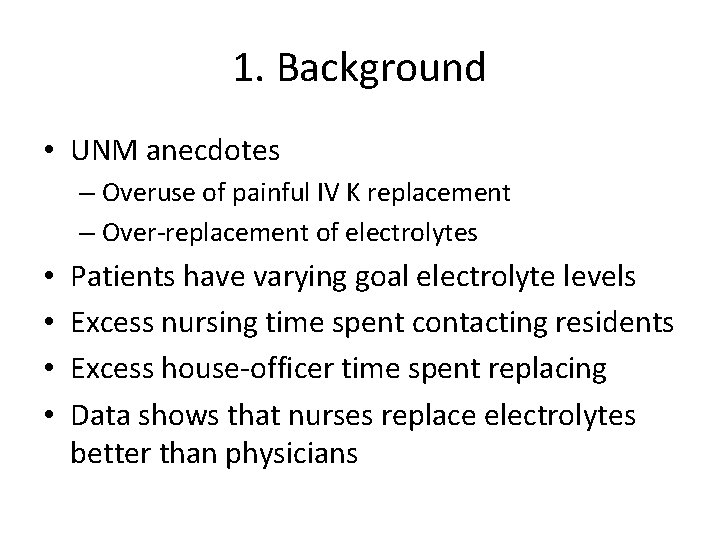
1. Background • UNM anecdotes – Overuse of painful IV K replacement – Over-replacement of electrolytes • • Patients have varying goal electrolyte levels Excess nursing time spent contacting residents Excess house-officer time spent replacing Data shows that nurses replace electrolytes better than physicians
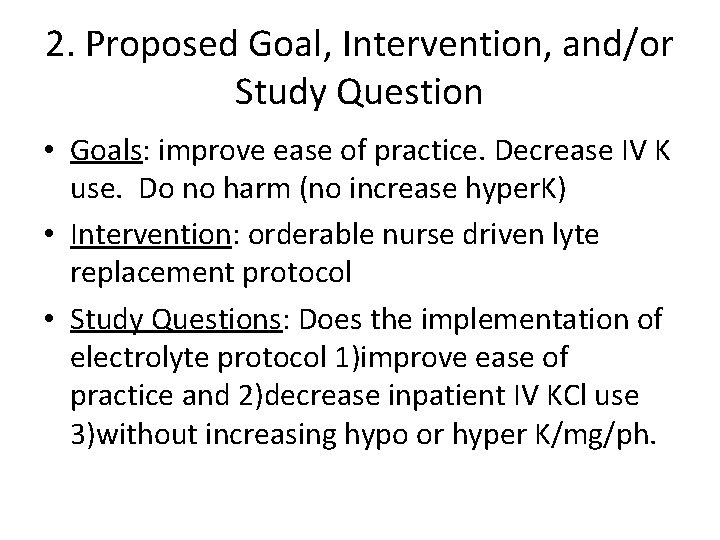
2. Proposed Goal, Intervention, and/or Study Question • Goals: improve ease of practice. Decrease IV K use. Do no harm (no increase hyper. K) • Intervention: orderable nurse driven lyte replacement protocol • Study Questions: Does the implementation of electrolyte protocol 1)improve ease of practice and 2)decrease inpatient IV KCl use 3)without increasing hypo or hyper K/mg/ph.
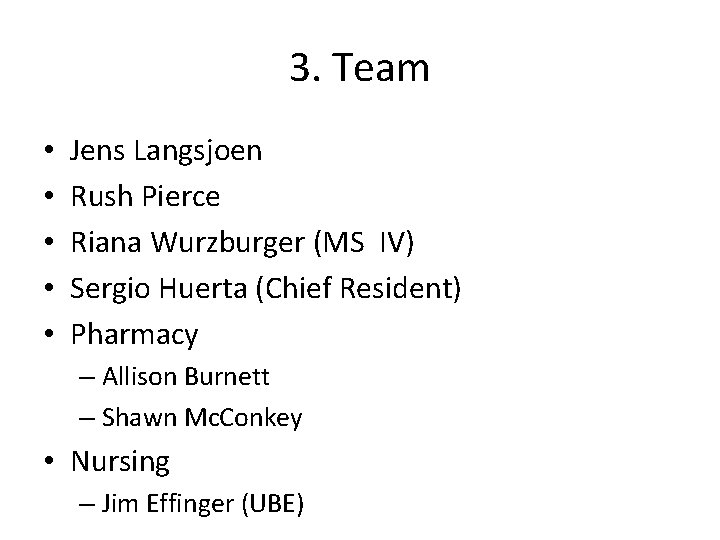
3. Team • • • Jens Langsjoen Rush Pierce Riana Wurzburger (MS IV) Sergio Huerta (Chief Resident) Pharmacy – Allison Burnett – Shawn Mc. Conkey • Nursing – Jim Effinger (UBE)
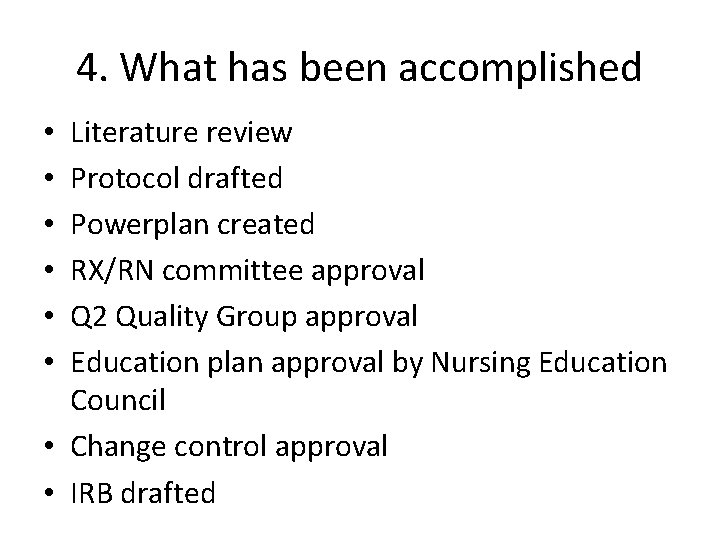
4. What has been accomplished Literature review Protocol drafted Powerplan created RX/RN committee approval Q 2 Quality Group approval Education plan approval by Nursing Education Council • Change control approval • IRB drafted • • •
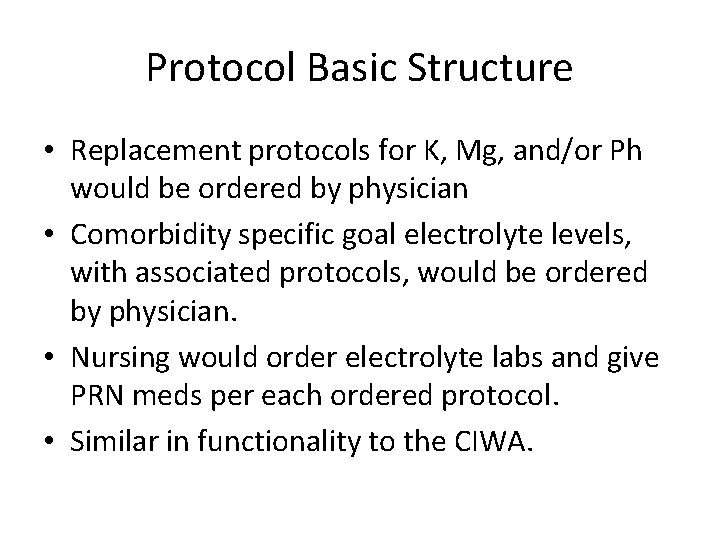
Protocol Basic Structure • Replacement protocols for K, Mg, and/or Ph would be ordered by physician • Comorbidity specific goal electrolyte levels, with associated protocols, would be ordered by physician. • Nursing would order electrolyte labs and give PRN meds per each ordered protocol. • Similar in functionality to the CIWA.
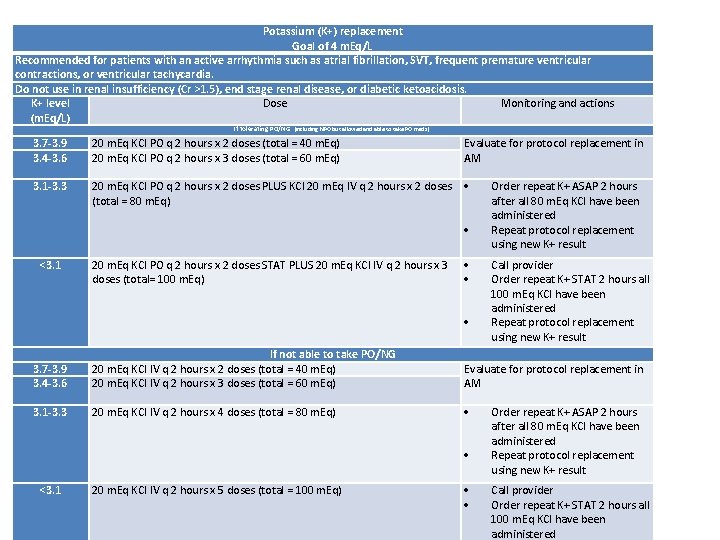
Potassium (K+) replacement Goal of 4 m. Eq/L Recommended for patients with an active arrhythmia such as atrial fibrillation, SVT, frequent premature ventricular contractions, or ventricular tachycardia. Do not use in renal insufficiency (Cr >1. 5), end stage renal disease, or diabetic ketoacidosis. K+ level Dose Monitoring and actions (m. Eq/L) If tolerating PO/NG (including NPO but allowed and able to take PO meds): 3. 7 -3. 9 3. 4 -3. 6 20 m. Eq KCl PO q 2 hours x 2 doses (total = 40 m. Eq) 20 m. Eq KCl PO q 2 hours x 3 doses (total = 60 m. Eq) Evaluate for protocol replacement in AM 3. 1 -3. 3 20 m. Eq KCl PO q 2 hours x 2 doses PLUS KCl 20 m. Eq IV q 2 hours x 2 doses (total = 80 m. Eq) <3. 1 20 m. Eq KCl PO q 2 hours x 2 doses STAT PLUS 20 m. Eq KCl IV q 2 hours x 3 doses (total= 100 m. Eq) Order repeat K+ ASAP 2 hours after all 80 m. Eq KCl have been administered Repeat protocol replacement using new K+ result Call provider Order repeat K+ STAT 2 hours all 100 m. Eq KCl have been administered Repeat protocol replacement using new K+ result 3. 7 -3. 9 3. 4 -3. 6 If not able to take PO/NG 20 m. Eq KCl IV q 2 hours x 2 doses (total = 40 m. Eq) 20 m. Eq KCl IV q 2 hours x 3 doses (total = 60 m. Eq) Evaluate for protocol replacement in AM 3. 1 -3. 3 20 m. Eq KCl IV q 2 hours x 4 doses (total = 80 m. Eq) <3. 1 20 m. Eq KCl IV q 2 hours x 5 doses (total = 100 m. Eq) Order repeat K+ ASAP 2 hours after all 80 m. Eq KCl have been administered Repeat protocol replacement using new K+ result Call provider Order repeat K+ STAT 2 hours all 100 m. Eq KCl have been administered
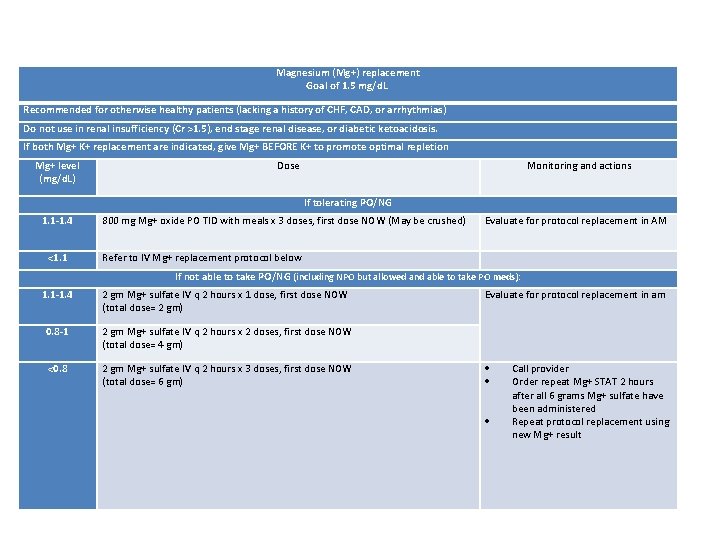
Magnesium (Mg+) replacement Goal of 1. 5 mg/d. L Recommended for otherwise healthy patients (lacking a history of CHF, CAD, or arrhythmias) Do not use in renal insufficiency (Cr >1. 5), end stage renal disease, or diabetic ketoacidosis. If both Mg+ K+ replacement are indicated, give Mg+ BEFORE K+ to promote optimal repletion Mg+ level (mg/d. L) Dose Monitoring and actions If tolerating PO/NG 1. 1 -1. 4 <1. 1 800 mg Mg+ oxide PO TID with meals x 3 doses, first dose NOW (May be crushed) Evaluate for protocol replacement in AM Refer to IV Mg+ replacement protocol below If not able to take PO/NG (including NPO but allowed and able to take PO meds): 1. 1 -1. 4 2 gm Mg+ sulfate IV q 2 hours x 1 dose, first dose NOW (total dose= 2 gm) 0. 8 -1 2 gm Mg+ sulfate IV q 2 hours x 2 doses, first dose NOW (total dose= 4 gm) <0. 8 2 gm Mg+ sulfate IV q 2 hours x 3 doses, first dose NOW (total dose= 6 gm) Evaluate for protocol replacement in am Call provider Order repeat Mg+ STAT 2 hours after all 6 grams Mg+ sulfate have been administered Repeat protocol replacement using new Mg+ result
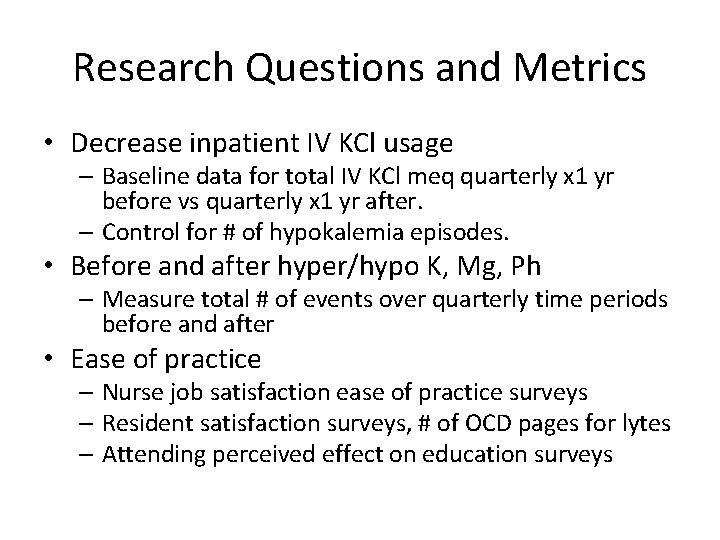
Research Questions and Metrics • Decrease inpatient IV KCl usage – Baseline data for total IV KCl meq quarterly x 1 yr before vs quarterly x 1 yr after. – Control for # of hypokalemia episodes. • Before and after hyper/hypo K, Mg, Ph – Measure total # of events over quarterly time periods before and after • Ease of practice – Nurse job satisfaction ease of practice surveys – Resident satisfaction surveys, # of OCD pages for lytes – Attending perceived effect on education surveys
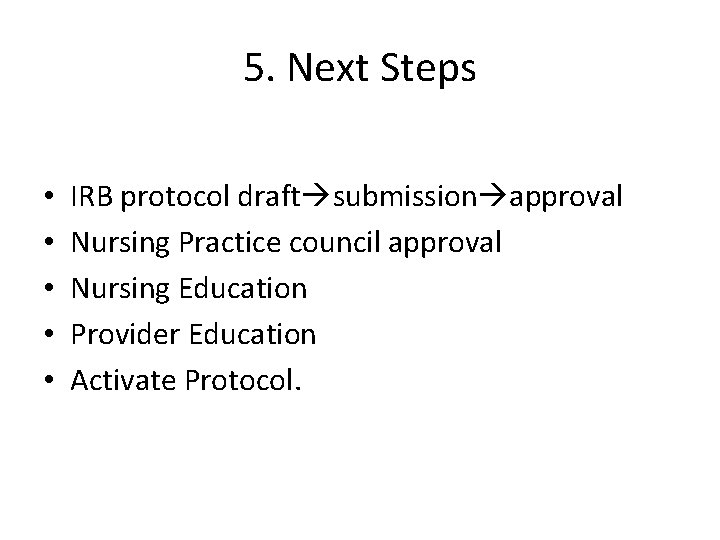
5. Next Steps • • • IRB protocol draft submission approval Nursing Practice council approval Nursing Education Provider Education Activate Protocol.
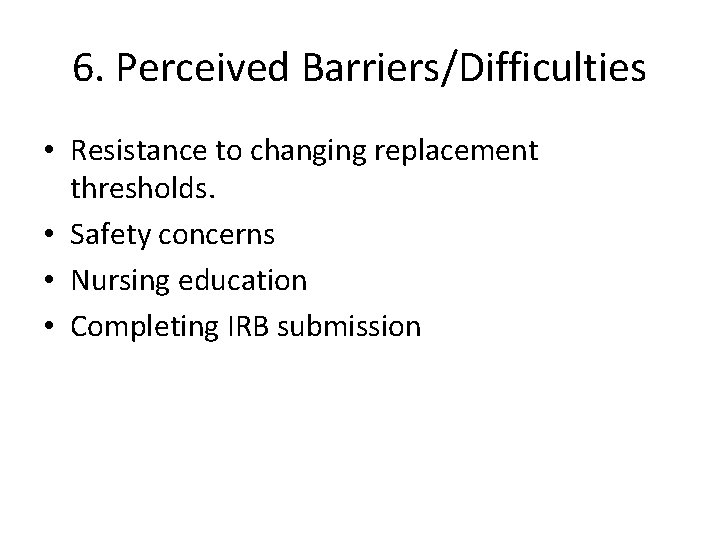
6. Perceived Barriers/Difficulties • Resistance to changing replacement thresholds. • Safety concerns • Nursing education • Completing IRB submission
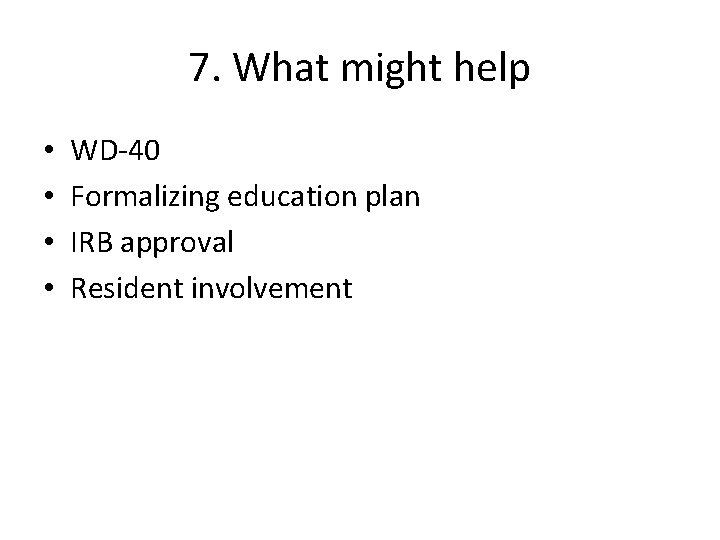
7. What might help • • WD-40 Formalizing education plan IRB approval Resident involvement