
NUMGE Norwegian Union of Municipal and General Employees

- Slides: 13
NUMGE – Norwegian Union of Municipal and General Employees
Norway’s largest trade union q Almost 360. 000 members q More than 80 % of the members are women q NUMGE is affiliated to the Norwegian Confederation of Trade Unions – LO q About 500 local branches q County organisations q Region offices
Established in 2003 The final decision about establishing NUMGE was made in 2003. It was decided to merge the two trade unions: q The Norwegian Union of Municipal Employees (established 1920) and: q The Norwegian Association of Health and Care personnel. (established 1965) q The new merged trade union was named: Fagforbundet, The Norwegian Union of Municipal and General Employees (NUMGE)
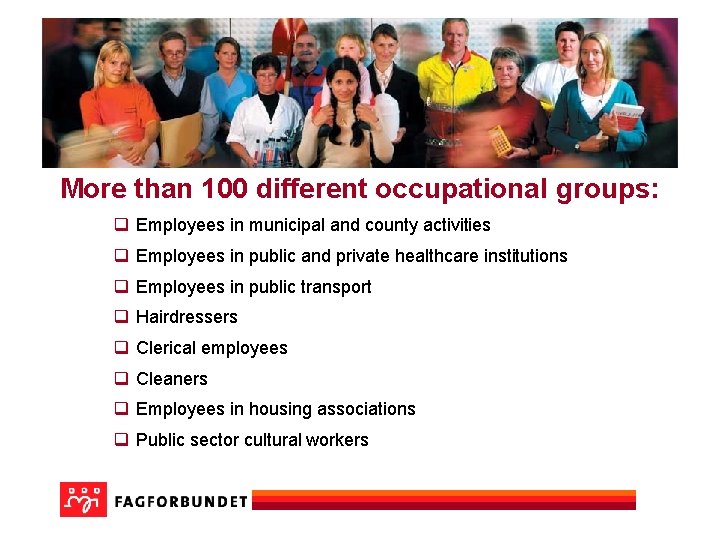
More than 100 different occupational groups: q Employees in municipal and county activities q Employees in public and private healthcare institutions q Employees in public transport q Hairdressers q Clerical employees q Cleaners q Employees in housing associations q Public sector cultural workers
Membership q All Employees in the Municipalities and the Health sector can be members in the NUMGE. q Approximately 50 % of the employees within our organsational area are members of Fagforbundet. q NUMGE also organises apprentices, pupils and students within the union’s organisational area. Pupils in the upper Secondary school receives free membership.
NUMGE is working for: q Decent pay, pensions and working conditions q A strong, dynamic and available public sector q Universal welfare schemes q Full employment q A sustainable environment for ourselves and for coming generations q International solidarity q Equal rights
The structure of NUMGE q The nine members of the Executive Committee are responsible for the day-to-day operation of the union. q The Executive Board meets once a month, and consists of the members of the Executive Committee and 15 other representatives. q Every four years the National Congress is held. q Between the Congresses it is the National Board that is NUMGEs highest governing body, consisting of 74 members. Meets four times a year.
4 Divisions q Division for Health and Social Services q Division for Office and Administration q Division for Public Transport and Technical Staff q Division for Church, Culture, Children and Youth
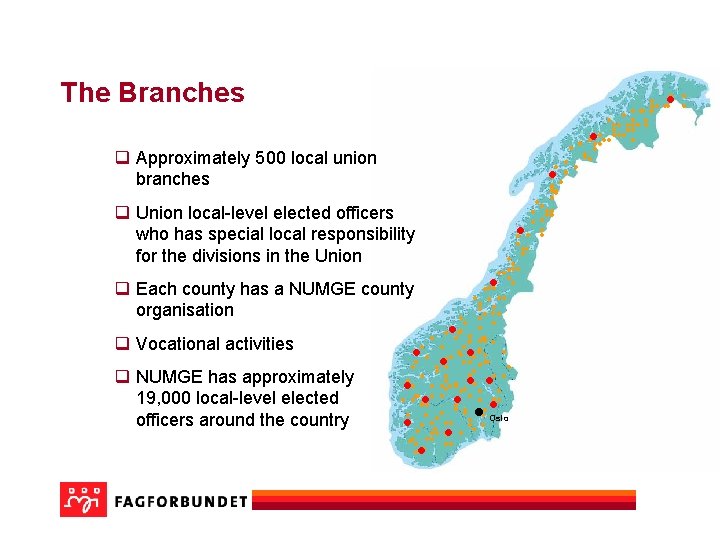
The Branches • • • • • • • q • • • • q • • • • • • • • • • • • • • • • • Approximately 500 local union • • • branches • • • • • Union local-level elected officers • • • who has special local responsibility • • • for the divisions in the Union • • • • • • • Each county has a NUMGE county • • • • organisation • • • • • Vocational activities • • • • • • • NUMGE has approximately • • • • 19, 000 local-level elected • • • • • • • • • • Oslo • • officers around the country • • • • •
Union magazines, digital newsletters, websites and social media q All members receive the Union magazine Fagbladet free each month. q A digital newsletter to the members minimum 3 times a week. q There is also a free journal for local-level elected officers. Eight editions each year. q A digital newsletter two times a week to the representatives. q Several occupational groups receive their own electronic newsletters. q fagforbundet. no; facebook, twitter, youtube and instagram
Bank and Insurance q The Banking and Insurance company Sparebank 1 is partly owned by The Norwegian Confederation of Trade Unions (LO). q This gives NUMGE members a number of special benefits, such as LO’s collective home insurance scheme, and good terms for loans and deposits.
Affiliates q The Union is affiliated to and cooperates with several national organisations in order to promote the interests of our members within the framework of our strategic programme. – The Norwegian Confederation of Trade Unions – The Norwegian Federation of State Employees' Unions – The Workers' Educational Association – The People's Correspondence School – The Norwegian People's Aid
International affiliates q ILO - International Labour Organisation q ICFTU The International Confederation of Free Trade Unions q PSI – Public Services International q EPSU - European Public Service Union q ITF - International Transport Workers' Federation q KNS - Nordic Association of Municipal Employees