
Numerical Weather Prediction Parametrization of diabatic processes Convection
Numerical Weather Prediction Parametrization of diabatic processes Convection I: an overview Peter Bechtold NWP Training Course Convection I: An Overview Slide 1
Convection Parametrisation and Dynamics Text Books • • • Yano&Plant (Editors), 2015: Parameterization of atmospheric convection. World scientific, Imperial College Press Emanuel, 1994: Atmospheric convection, OUP Houze R. , 1993: Coud dynamics, AP Holton, 2004: An introduction to Dynamic Meteorology, AP Bluestein, 1993: Synoptic-Dynamic meteorology in midlatitudes, Vol II. OUP Peixoto and Ort, 1992: The physics of climate. American Institute of Physics Emanuel and Raymond, 1993: The representation of cumulus convection in numerical models. AMS Meteor. Monogr. Smith, 1997: The physics and parametrization of moist atmospheric convection. Kluwer Dufour et v. Mieghem: Thermodynamique de l’Atmosphère, 1975: Institut Royal météorologique de Belgique Anbaum, 2010: Thermal Physics of the atmosphere. J Wiley Publishers AP=Academic Press; OUP=Oxford University Press NWP Training Course Convection I: An Overview Slide 2
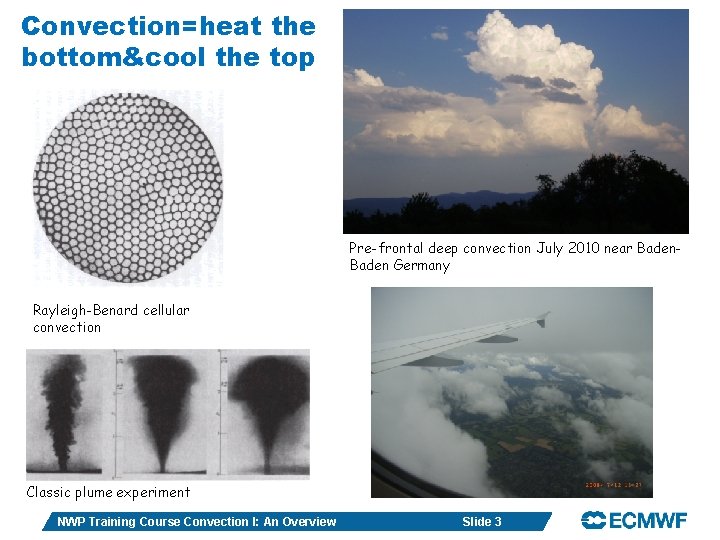
Convection=heat the bottom&cool the top Pre-frontal deep convection July 2010 near Baden Germany Rayleigh-Benard cellular convection Classic plume experiment NWP Training Course Convection I: An Overview Slide 3
Outline General: • Convection and tropical circulations • Tropical waves • Middle latitude Convection Useful concepts and tools: • Buoyancy • Convective Available Potential Energy • Soundings and thermodynamic diagrams • Convective quasi-equilibrium • Large-scale observational budgets NWP Training Course Convection I: An Overview Slide 4
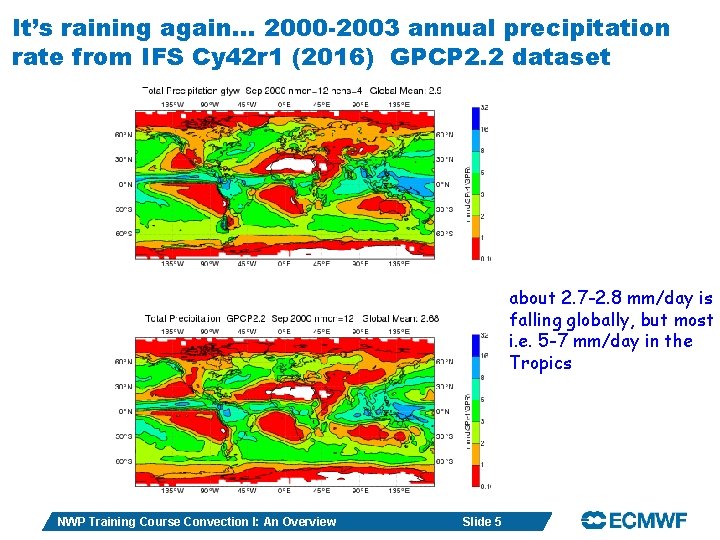
It’s raining again… 2000 -2003 annual precipitation rate from IFS Cy 42 r 1 (2016) GPCP 2. 2 dataset about 2. 7 -2. 8 mm/day is falling globally, but most i. e. 5 -7 mm/day in the Tropics NWP Training Course Convection I: An Overview Slide 5
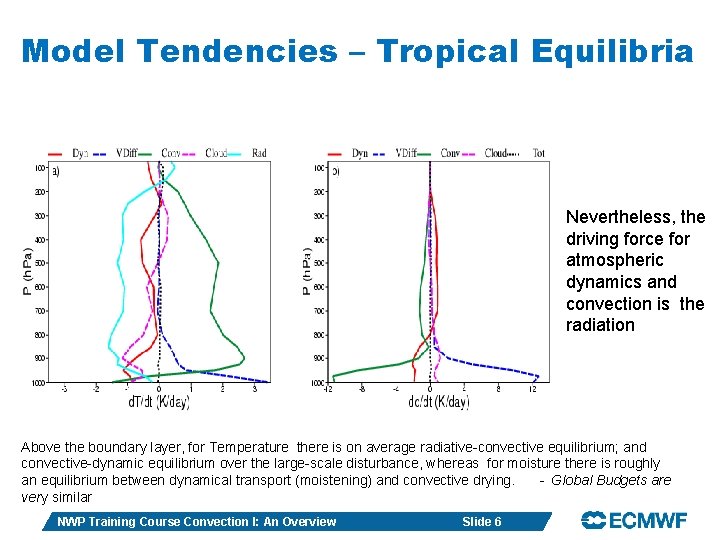
Model Tendencies – Tropical Equilibria Nevertheless, the driving force for atmospheric dynamics and convection is the radiation Above the boundary layer, for Temperature there is on average radiative-convective equilibrium; and convective-dynamic equilibrium over the large-scale disturbance, whereas for moisture there is roughly an equilibrium between dynamical transport (moistening) and convective drying. - Global Budgets are very similar NWP Training Course Convection I: An Overview Slide 6
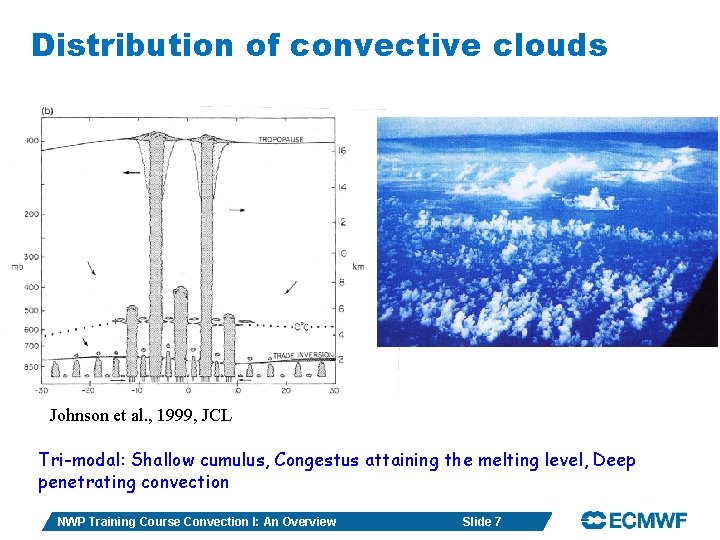
Distribution of convective clouds Johnson et al. , 1999, JCL Tri-modal: Shallow cumulus, Congestus attaining the melting level, Deep penetrating convection NWP Training Course Convection I: An Overview Slide 7
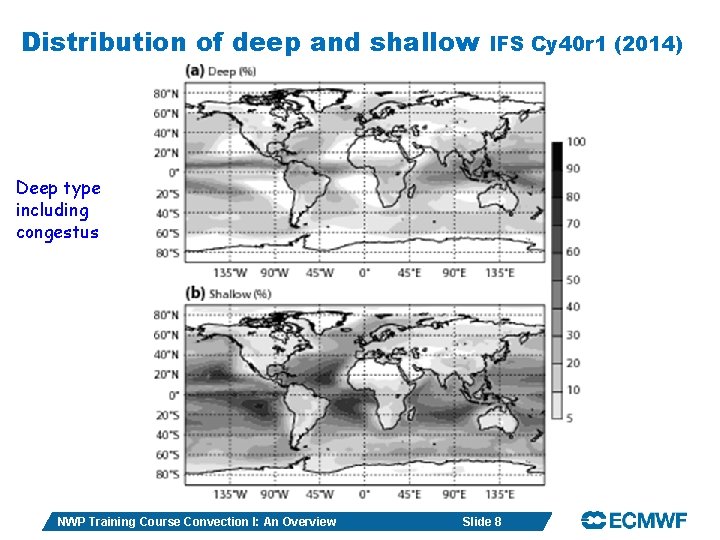
Distribution of deep and shallow IFS Cy 40 r 1 (2014) Deep type including congestus NWP Training Course Convection I: An Overview Slide 8
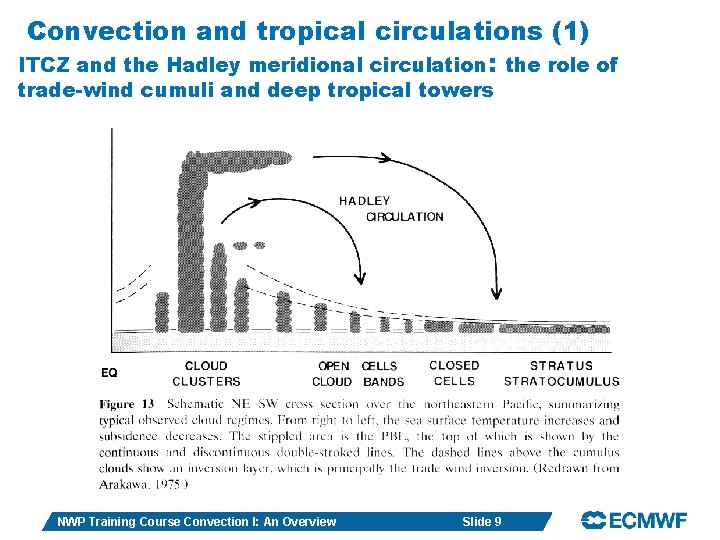
Convection and tropical circulations (1) ITCZ and the Hadley meridional circulation: the role of trade-wind cumuli and deep tropical towers NWP Training Course Convection I: An Overview Slide 9
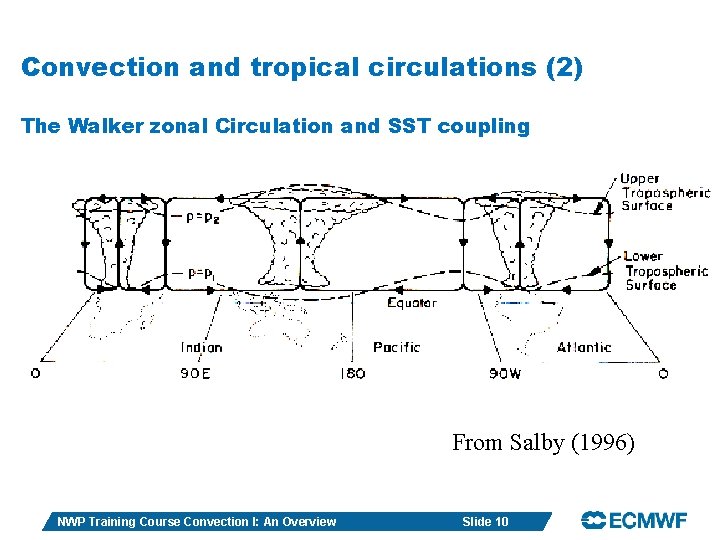
Convection and tropical circulations (2) The Walker zonal Circulation and SST coupling From Salby (1996) NWP Training Course Convection I: An Overview Slide 10
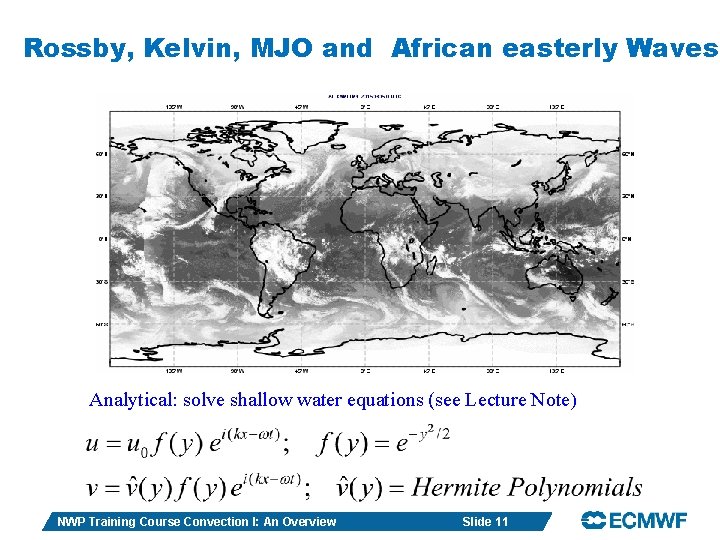
Rossby, Kelvin, MJO and African easterly Waves Analytical: solve shallow water equations (see Lecture Note) NWP Training Course Convection I: An Overview Slide 11
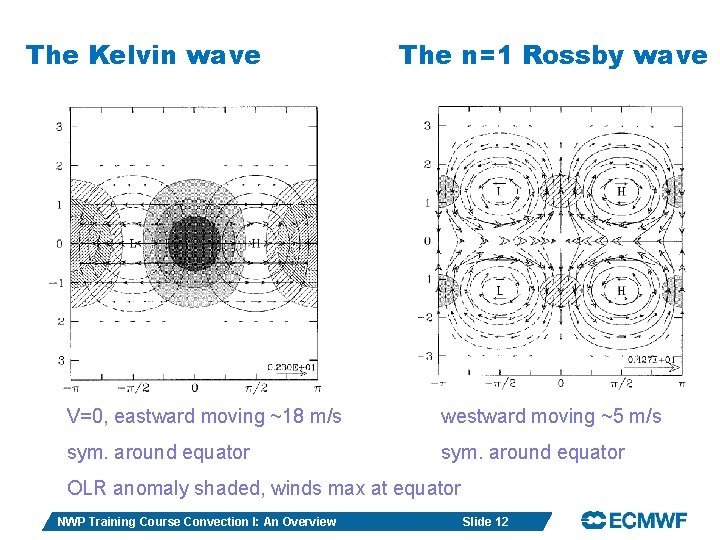
The Kelvin wave The n=1 Rossby wave V=0, eastward moving ~18 m/s westward moving ~5 m/s sym. around equator OLR anomaly shaded, winds max at equator NWP Training Course Convection I: An Overview Slide 12
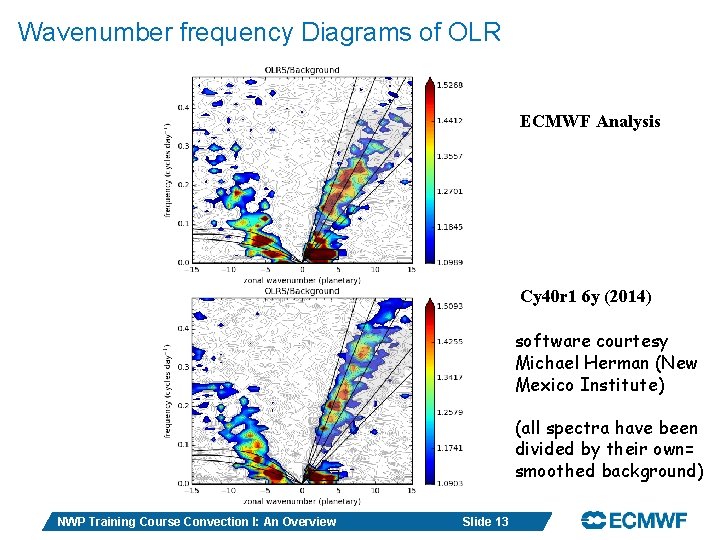
Wavenumber frequency Diagrams of OLR ECMWF Analysis Cy 40 r 1 6 y (2014) software courtesy Michael Herman (New Mexico Institute) (all spectra have been divided by their own= smoothed background) NWP Training Course Convection I: An Overview Slide 13
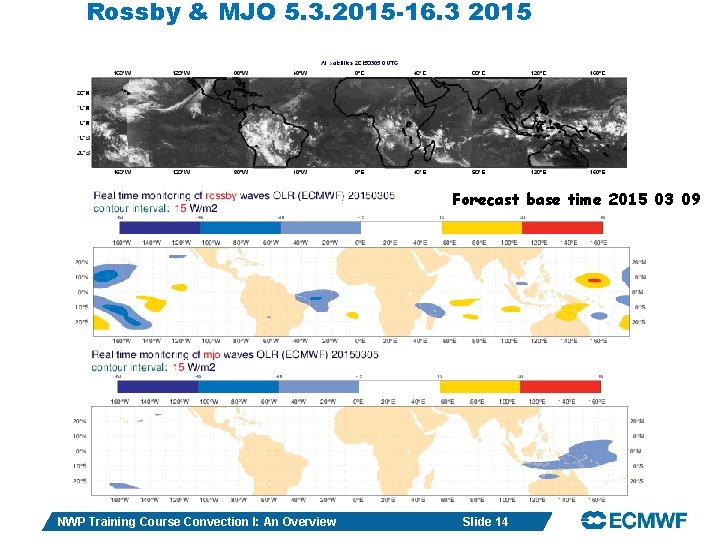
Rossby & MJO 5. 3. 2015 -16. 3 2015 Forecast base time 2015 03 09 NWP Training Course Convection I: An Overview Slide 14
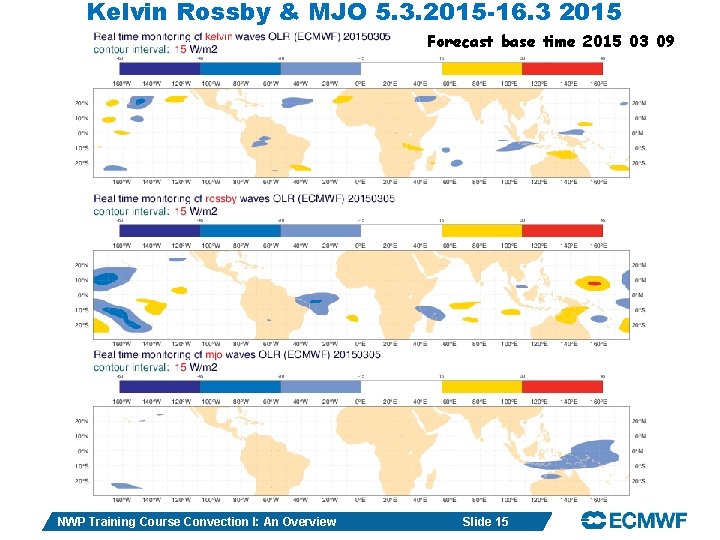
Kelvin Rossby & MJO 5. 3. 2015 -16. 3 2015 Forecast base time 2015 03 09 NWP Training Course Convection I: An Overview Slide 15
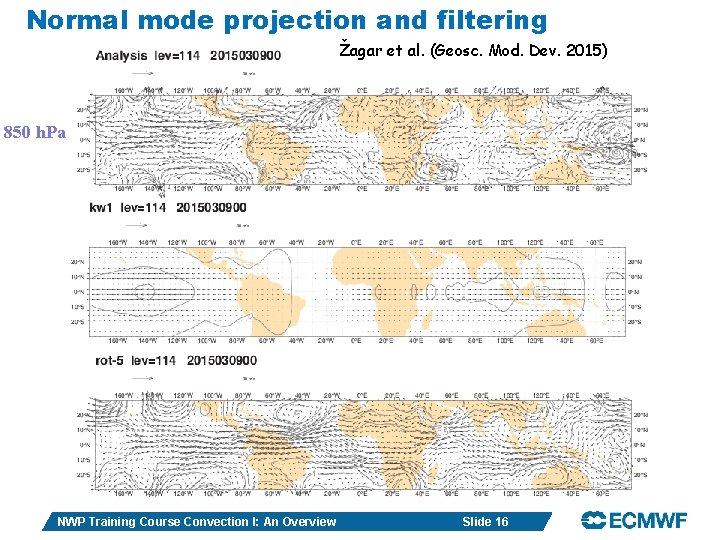
Normal mode projection and filtering Žagar et al. (Geosc. Mod. Dev. 2015) 850 h. Pa NWP Training Course Convection I: An Overview Slide 16
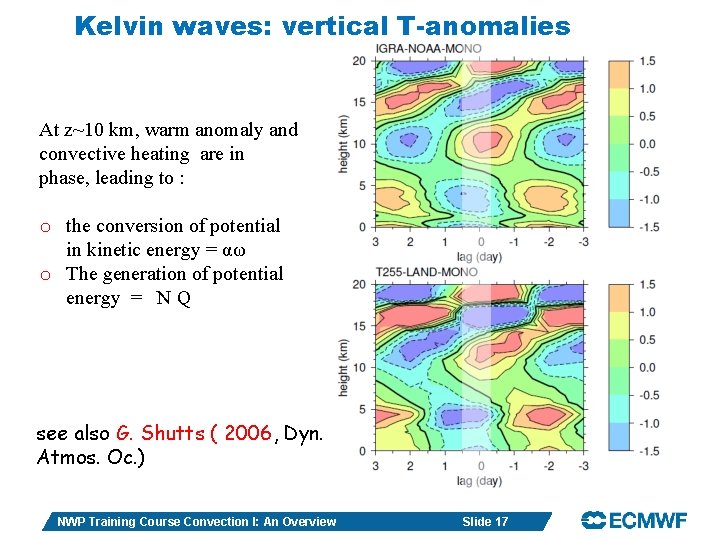
Kelvin waves: vertical T-anomalies At z~10 km, warm anomaly and convective heating are in phase, leading to : o the conversion of potential in kinetic energy = αω o The generation of potential energy = N Q see also G. Shutts ( 2006, Dyn. Atmos. Oc. ) NWP Training Course Convection I: An Overview Slide 17
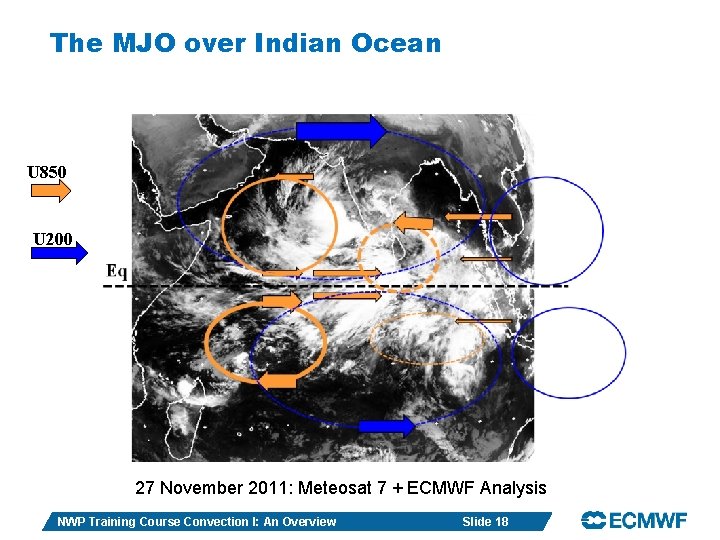
The MJO over Indian Ocean U 850 U 200 27 November 2011: Meteosat 7 + ECMWF Analysis NWP Training Course Convection I: An Overview Slide 18
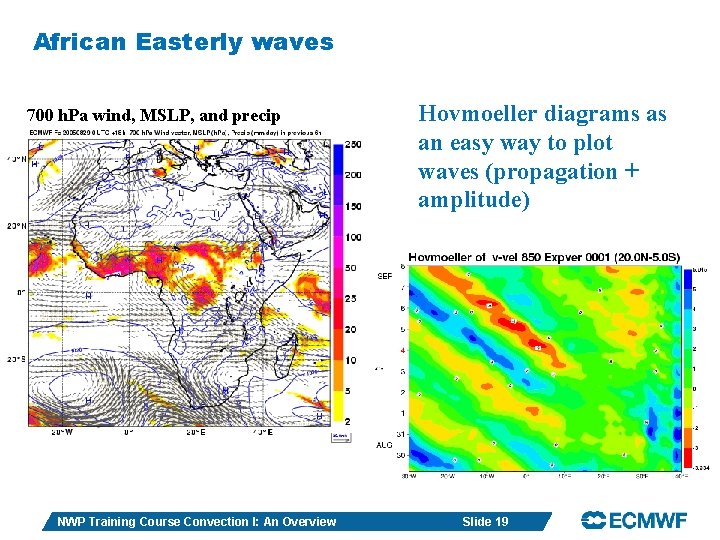
African Easterly waves 700 h. Pa wind, MSLP, and precip NWP Training Course Convection I: An Overview Hovmoeller diagrams as an easy way to plot waves (propagation + amplitude) Slide 19
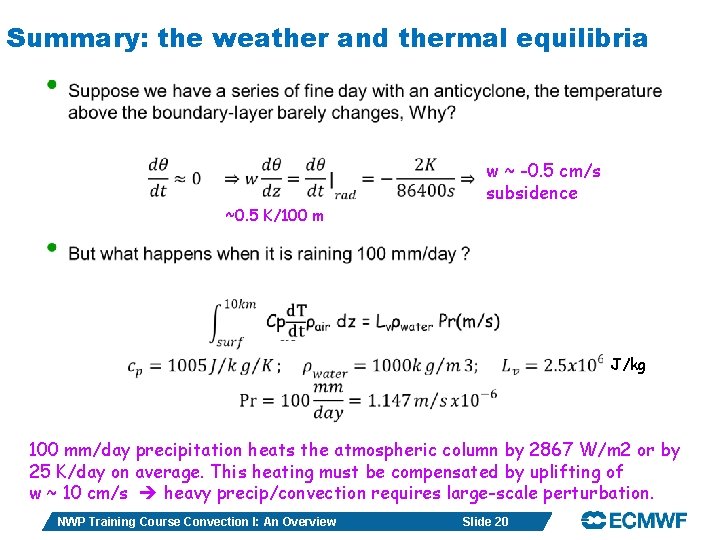
Summary: the weather and thermal equilibria ~0. 5 K/100 m w ~ -0. 5 cm/s subsidence J/kg 100 mm/day precipitation heats the atmospheric column by 2867 W/m 2 or by 25 K/day on average. This heating must be compensated by uplifting of w ~ 10 cm/s heavy precip/convection requires large-scale perturbation. NWP Training Course Convection I: An Overview Slide 20
Summary: effects and cause of convection • • • Convection transports heat, water vapor, momentum … and chemical constituents upwards …. Water vapor then condenses and falls out -> net convective heating/drying Deep Convection (precipitating convection) stabilizes the environment, an approximate picture (not true for diurnal cycle convection!) is to consider it as reacting to the large-scale environment (e. g. tropical waves, midlatitude frontal systems) =“quasi-equilibrium”; shallow convection redistributes moisture and heat The effect of convection (local heat source) is fundamentally different in the middle latitudes and the Tropics. In the Tropics the Rossby radius of deformation R=N H/f (N=Brunt Vaisala Freq, f=Coriolis parameter, H=tropopause height) is infinite, and therefore the effects are not locally bounded, but spread globally via gravity waves – “throwing a stone in a lake” NWP Training Course Convection I: An Overview Slide 21
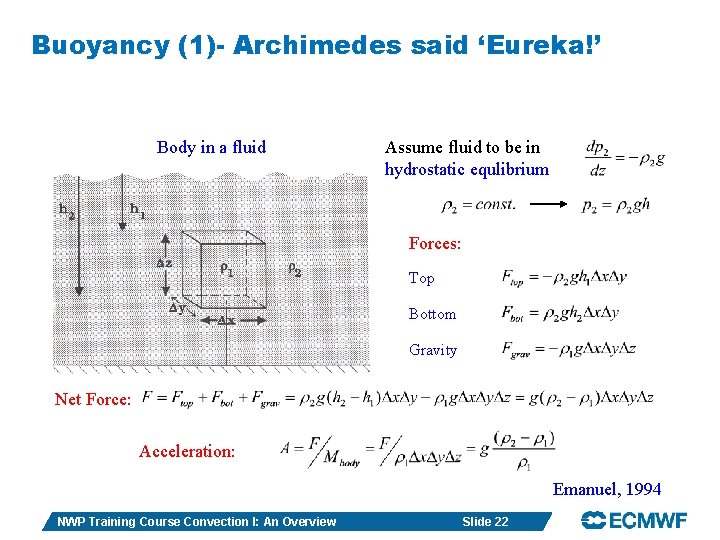
Buoyancy (1)- Archimedes said ‘Eureka!’ Body in a fluid Assume fluid to be in hydrostatic equlibrium Forces: Top Bottom Gravity Net Force: Acceleration: Emanuel, 1994 NWP Training Course Convection I: An Overview Slide 22
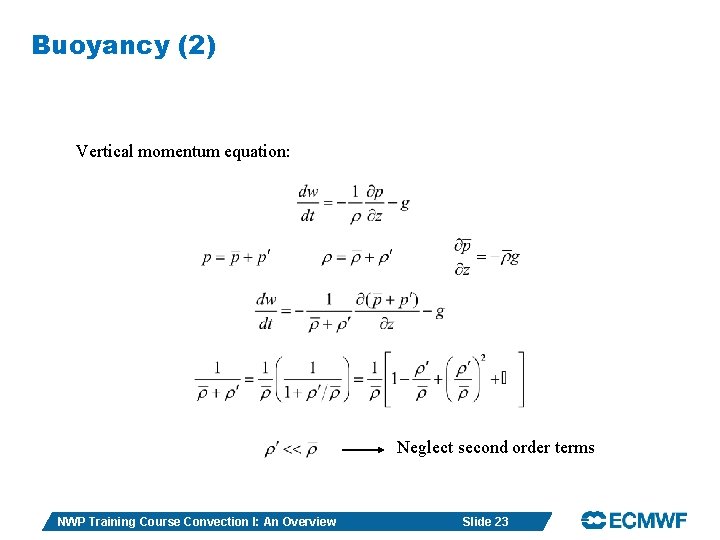
Buoyancy (2) Vertical momentum equation: Neglect second order terms NWP Training Course Convection I: An Overview Slide 23
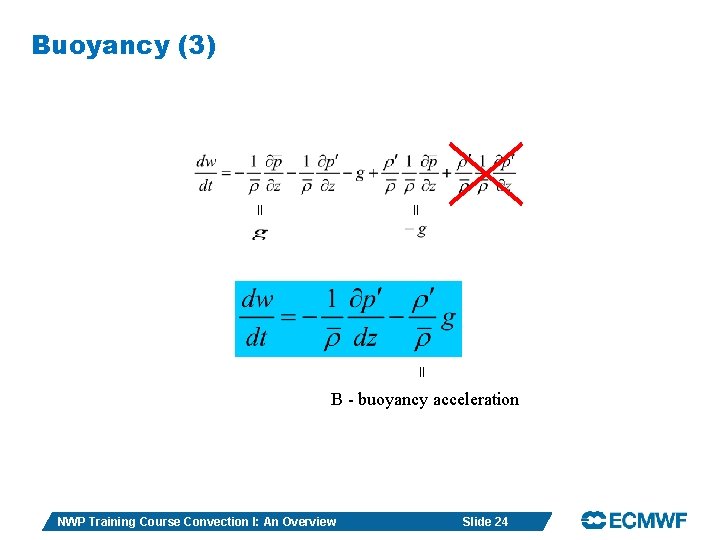
Buoyancy (3) = = = B - buoyancy acceleration NWP Training Course Convection I: An Overview Slide 24
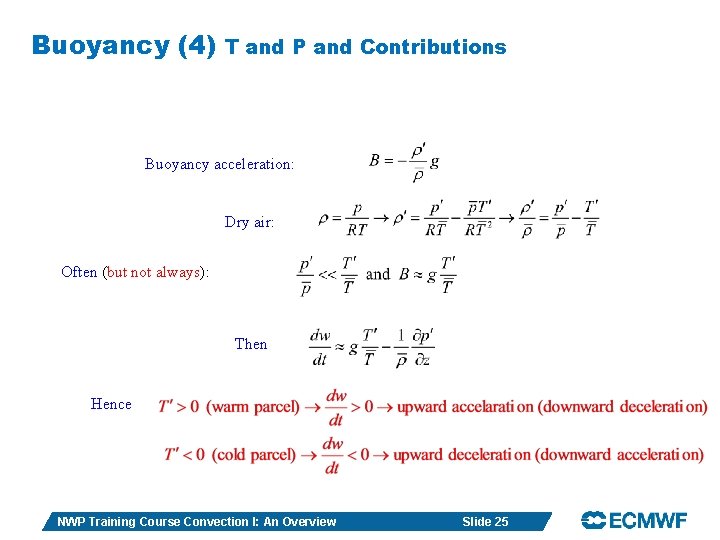
Buoyancy (4) T and P and Contributions Buoyancy acceleration: Dry air: Often (but not always): Then Hence NWP Training Course Convection I: An Overview Slide 25
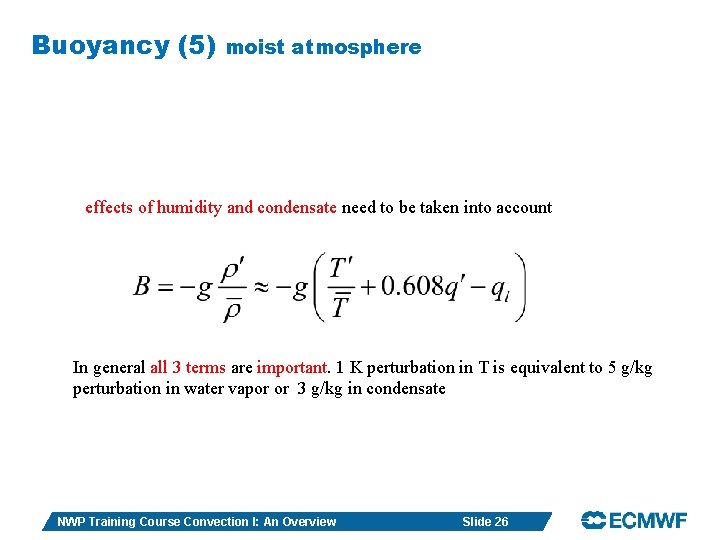
Buoyancy (5) moist atmosphere effects of humidity and condensate need to be taken into account In general all 3 terms are important. 1 K perturbation in T is equivalent to 5 g/kg perturbation in water vapor or 3 g/kg in condensate NWP Training Course Convection I: An Overview Slide 26
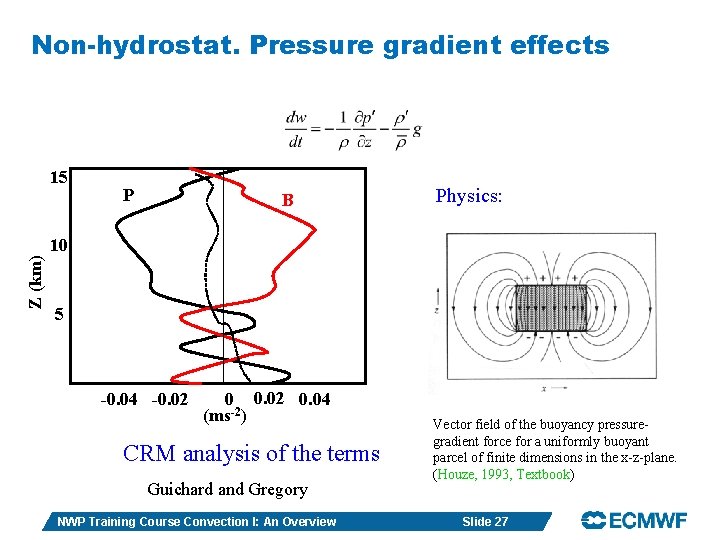
Non-hydrostat. Pressure gradient effects 15 P B Physics: Z (km) 10 5 -0. 04 -0. 02 0. 04 (ms-2) CRM analysis of the terms Guichard and Gregory NWP Training Course Convection I: An Overview Vector field of the buoyancy pressuregradient force for a uniformly buoyant parcel of finite dimensions in the x-z-plane. (Houze, 1993, Textbook) Slide 27
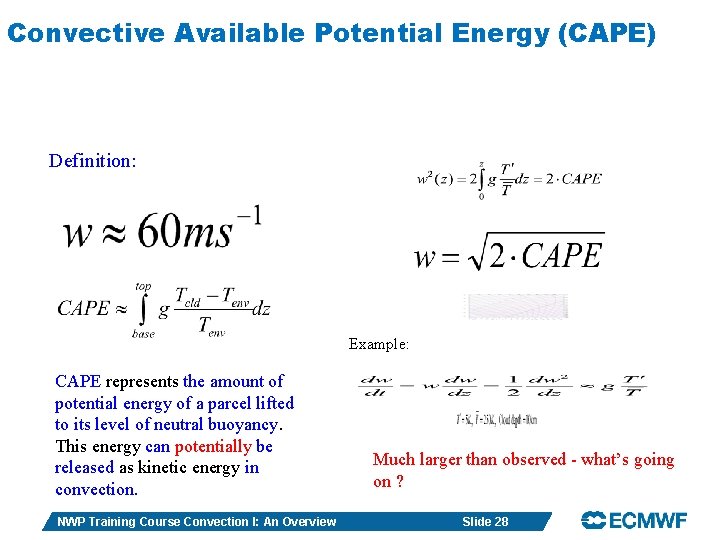
Convective Available Potential Energy (CAPE) Definition: Example: CAPE represents the amount of potential energy of a parcel lifted to its level of neutral buoyancy. This energy can potentially be released as kinetic energy in convection. NWP Training Course Convection I: An Overview Much larger than observed - what’s going on ? Slide 28
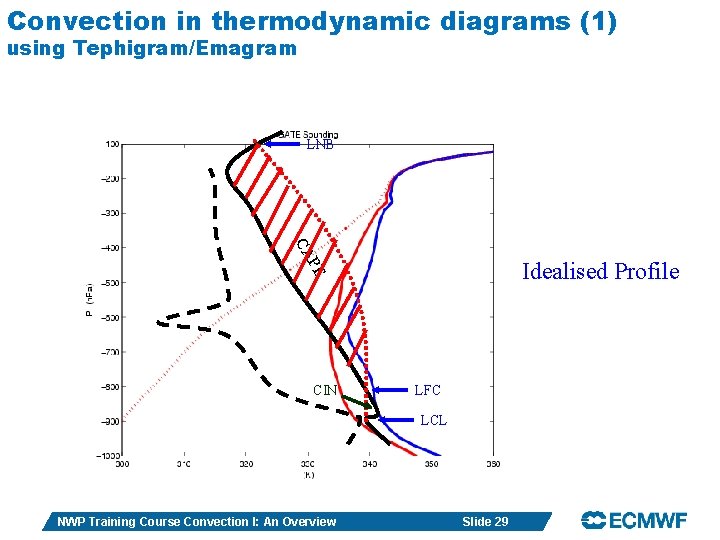
Convection in thermodynamic diagrams (1) using Tephigram/Emagram LNB P CA E Idealised Profile CIN LFC LCL NWP Training Course Convection I: An Overview Slide 29
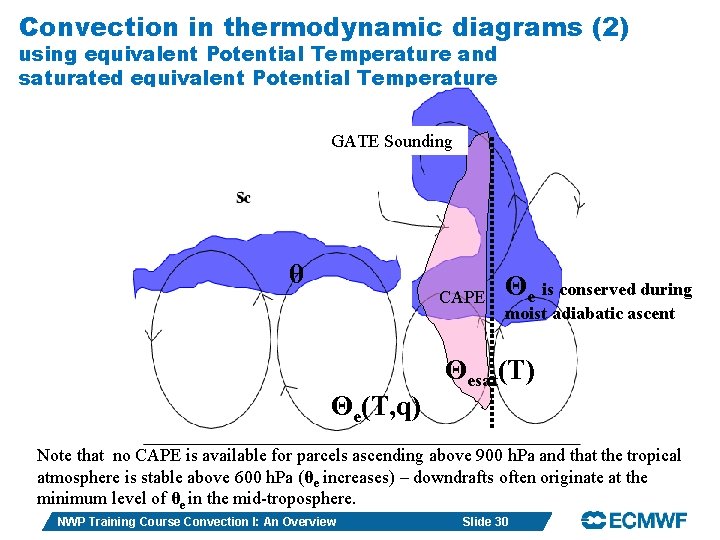
Convection in thermodynamic diagrams (2) using equivalent Potential Temperature and saturated equivalent Potential Temperature GATE Sounding θ CAPE Θe is conserved during moist adiabatic ascent Θesat(T) Θe(T, q) Note that no CAPE is available for parcels ascending above 900 h. Pa and that the tropical atmosphere is stable above 600 h. Pa (θe increases) – downdrafts often originate at the minimum level of θe in the mid-troposphere. NWP Training Course Convection I: An Overview Slide 30
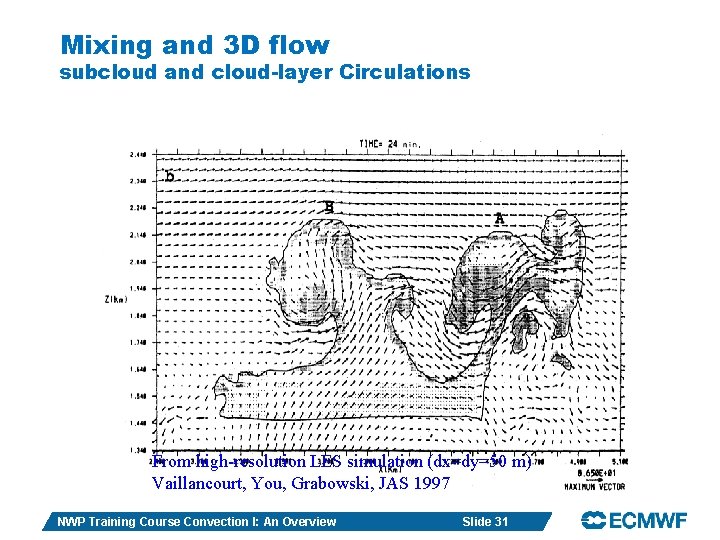
Mixing and 3 D flow subcloud and cloud-layer Circulations From high-resolution LES simulation (dx=dy=50 m) Vaillancourt, You, Grabowski, JAS 1997 NWP Training Course Convection I: An Overview Slide 31
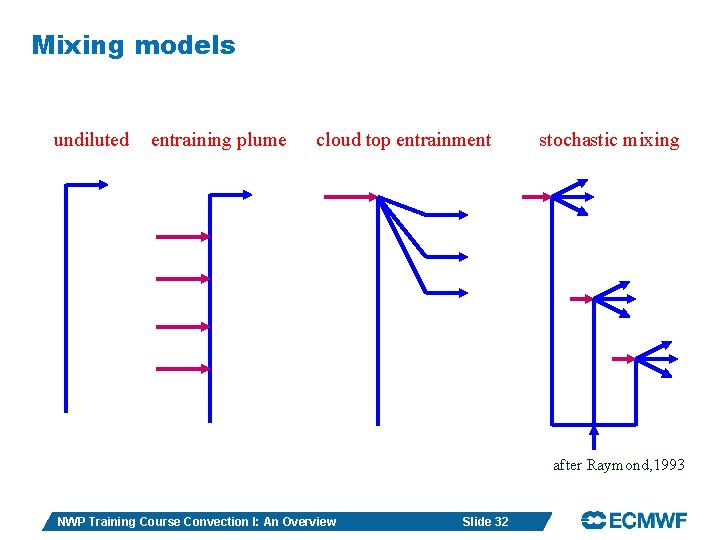
Mixing models undiluted entraining plume cloud top entrainment stochastic mixing after Raymond, 1993 NWP Training Course Convection I: An Overview Slide 32
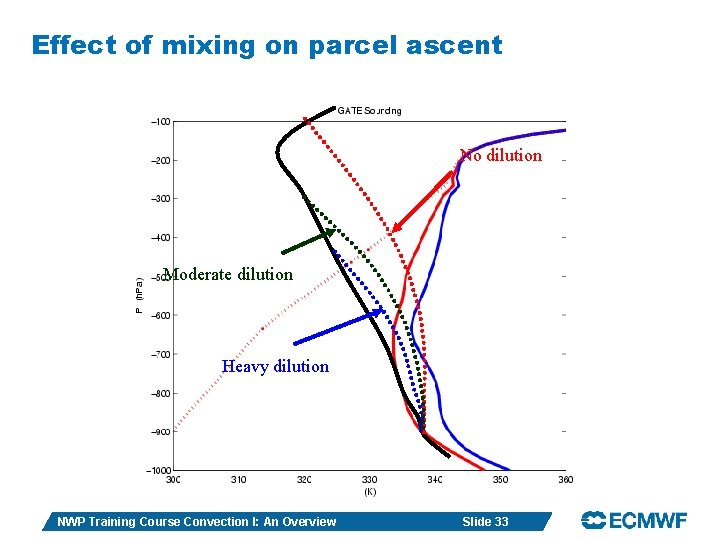
Effect of mixing on parcel ascent No dilution Moderate dilution Heavy dilution NWP Training Course Convection I: An Overview Slide 33
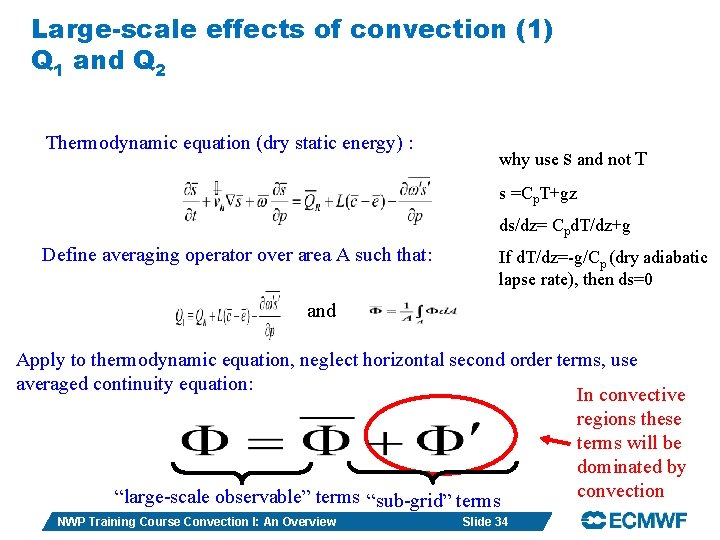
Large-scale effects of convection (1) Q 1 and Q 2 Thermodynamic equation (dry static energy) : why use s and not T s =Cp. T+gz ds/dz= Cpd. T/dz+g Define averaging operator over area A such that: If d. T/dz=-g/Cp (dry adiabatic lapse rate), then ds=0 and Apply to thermodynamic equation, neglect horizontal second order terms, use averaged continuity equation: In convective regions these terms will be dominated by convection “large-scale observable” terms “sub-grid” terms NWP Training Course Convection I: An Overview Slide 34
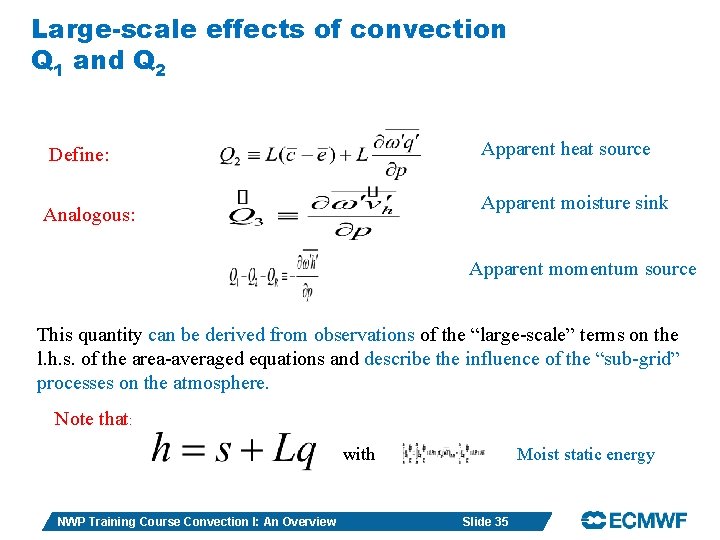
Large-scale effects of convection Q 1 and Q 2 Apparent heat source Define: Apparent moisture sink Analogous: Apparent momentum source This quantity can be derived from observations of the “large-scale” terms on the l. h. s. of the area-averaged equations and describe the influence of the “sub-grid” processes on the atmosphere. Note that: with NWP Training Course Convection I: An Overview Moist static energy Slide 35
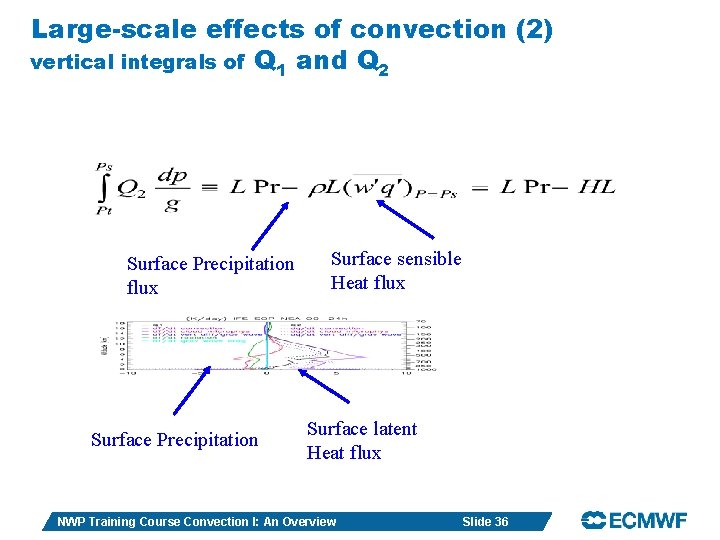
Large-scale effects of convection (2) vertical integrals of Q 1 and Q 2 Surface Precipitation flux Surface Precipitation Surface sensible Heat flux Surface latent Heat flux NWP Training Course Convection I: An Overview Slide 36
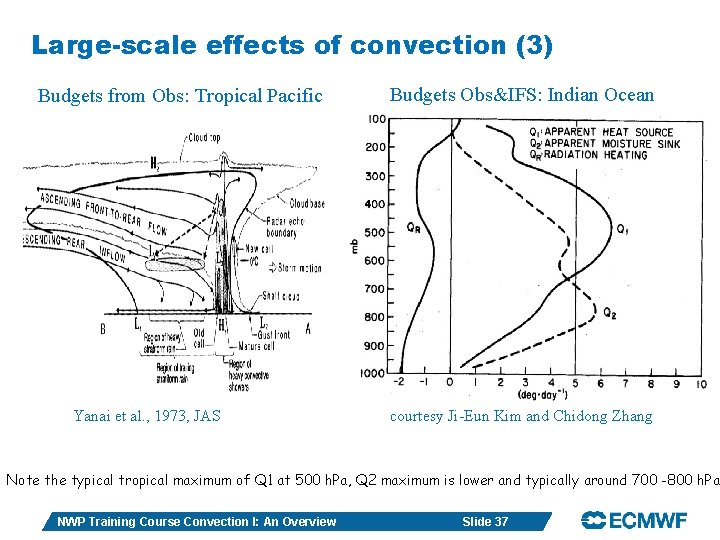
Large-scale effects of convection (3) Budgets from Obs: Tropical Pacific Yanai et al. , 1973, JAS Budgets Obs&IFS: Indian Ocean courtesy Ji-Eun Kim and Chidong Zhang Note the typical tropical maximum of Q 1 at 500 h. Pa, Q 2 maximum is lower and typically around 700 -800 h. Pa NWP Training Course Convection I: An Overview Slide 37
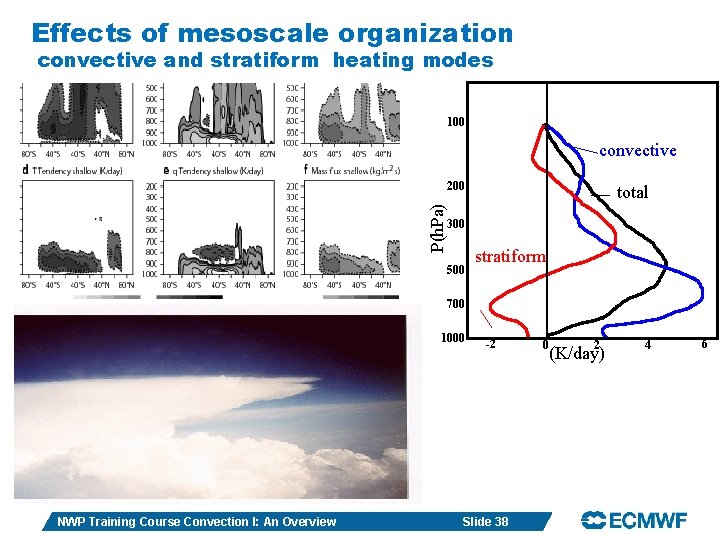
Effects of mesoscale organization convective and stratiform heating modes 100 convective P(h. Pa) 200 total 300 500 stratiform 700 1000 NWP Training Course Convection I: An Overview -2 Slide 38 0 2 (K/day) 4 6
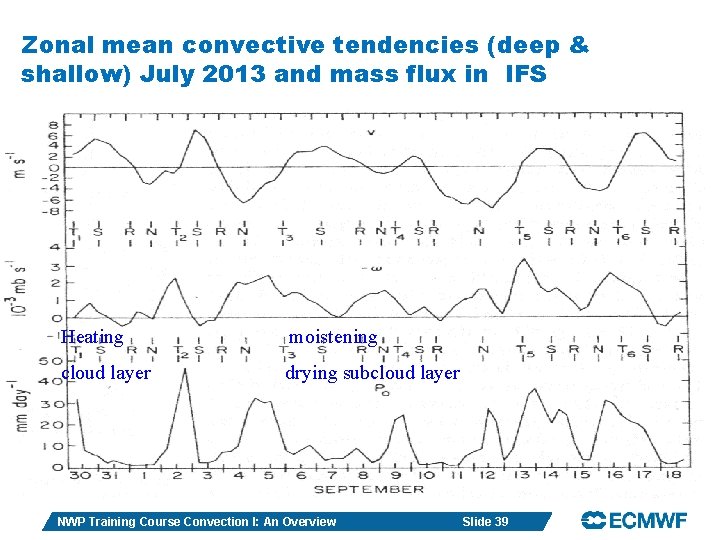
Zonal mean convective tendencies (deep & shallow) July 2013 and mass flux in IFS Heating moistening cloud layer drying subcloud layer NWP Training Course Convection I: An Overview Slide 39
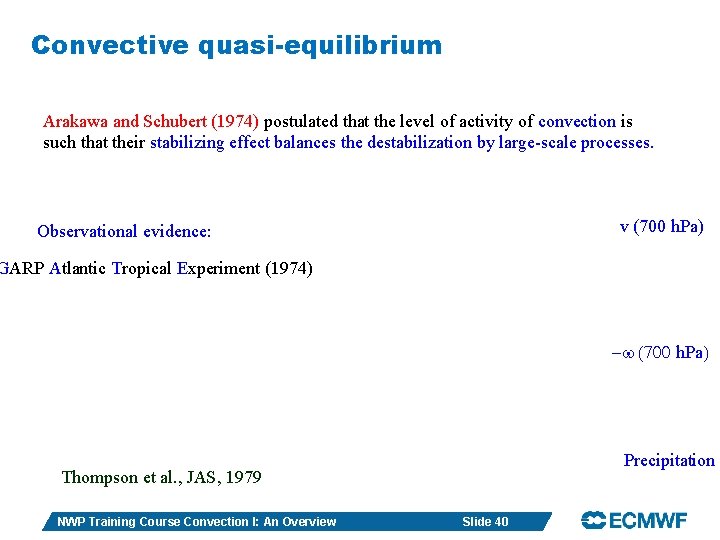
Convective quasi-equilibrium Arakawa and Schubert (1974) postulated that the level of activity of convection is such that their stabilizing effect balances the destabilization by large-scale processes. v (700 h. Pa) Observational evidence: GARP Atlantic Tropical Experiment (1974) -w (700 h. Pa) Precipitation Thompson et al. , JAS, 1979 NWP Training Course Convection I: An Overview Slide 40
Summary • • • Convection affects the atmosphere through condensation / evaporation and eddy transports On large horizontal scales convection is in quasi-equilibrium with the large-scale forcing Q 1, Q 2 and Q 3 are quantities that reflect the time and space average effect of convection (“unresolved scale”) and stratiform heating/drying (“resolved scale”) An important parameter for the strength of convection is CAPE Shallow convection is present over very large (oceanic) areas, it determines the redistribution of the surface fluxes and the transport of vapor and momentum from the subtropics to the ITCZ NWP Training Course Convection I: An Overview Slide 41
- Slides: 41