
Numerical study of dualcycle cardiac 4 D CT
- Slides: 1
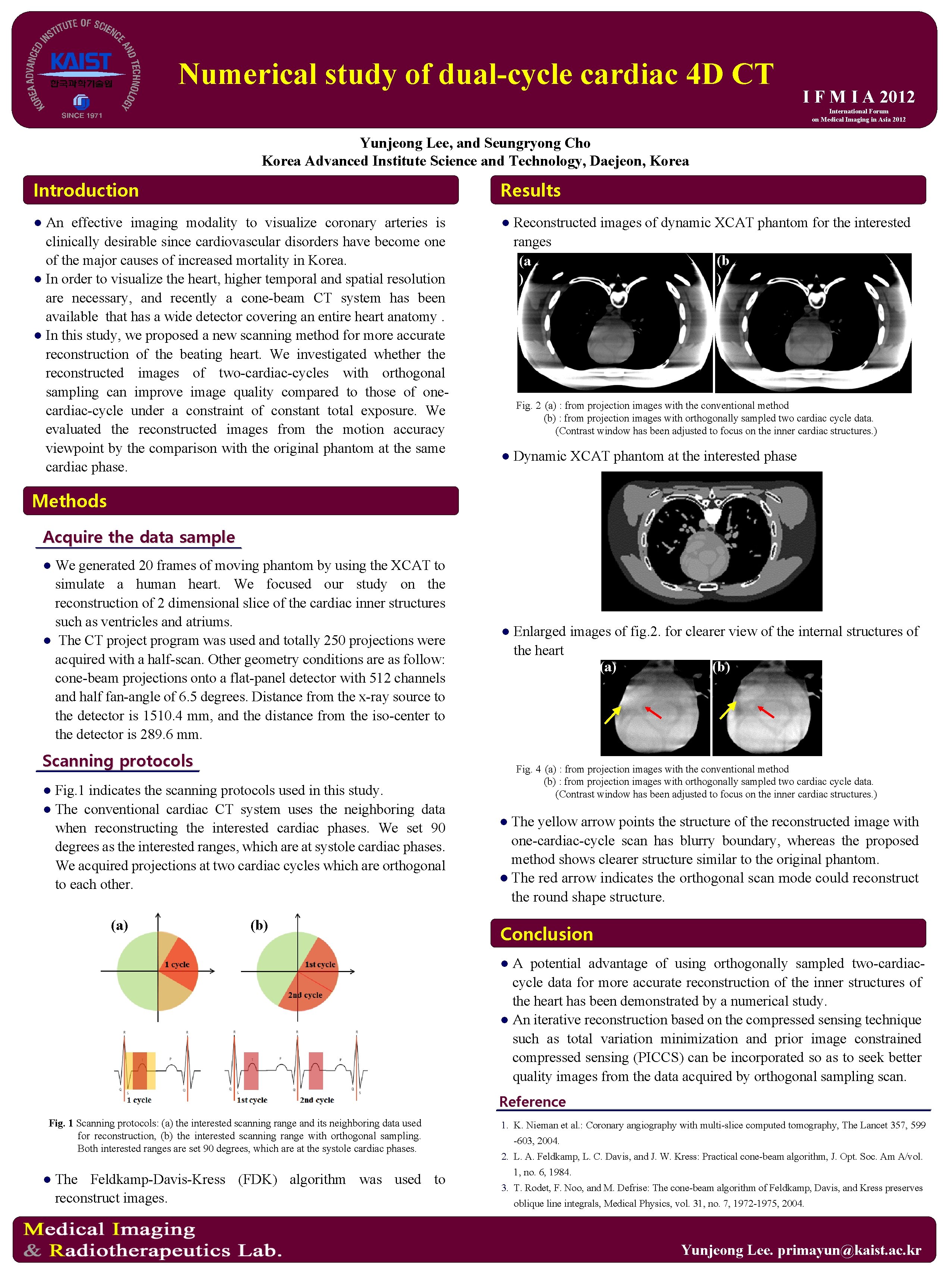
Numerical study of dual-cycle cardiac 4 D CT I F M I A 2012 International Forum on Medical Imaging in Asia 2012 Yunjeong Lee, and Seungryong Cho Korea Advanced Institute Science and Technology, Daejeon, Korea Introduction Results ● An effective imaging modality to visualize coronary arteries is clinically desirable since cardiovascular disorders have become one of the major causes of increased mortality in Korea. ● In order to visualize the heart, higher temporal and spatial resolution are necessary, and recently a cone-beam CT system has been available that has a wide detector covering an entire heart anatomy. ● In this study, we proposed a new scanning method for more accurate reconstruction of the beating heart. We investigated whether the reconstructed images of two-cardiac-cycles with orthogonal sampling can improve image quality compared to those of onecardiac-cycle under a constraint of constant total exposure. We evaluated the reconstructed images from the motion accuracy viewpoint by the comparison with the original phantom at the same cardiac phase. ● Reconstructed images of dynamic XCAT phantom for the interested ranges (b (a ) ) Fig. 2 (a) : from projection images with the conventional method (b) : from projection images with orthogonally sampled two cardiac cycle data. (Contrast window has been adjusted to focus on the inner cardiac structures. ) ● Dynamic XCAT phantom at the interested phase Methods Acquire the data sample ● We generated 20 frames of moving phantom by using the XCAT to simulate a human heart. We focused our study on the reconstruction of 2 dimensional slice of the cardiac inner structures such as ventricles and atriums. ● The CT project program was used and totally 250 projections were acquired with a half-scan. Other geometry conditions are as follow: cone-beam projections onto a flat-panel detector with 512 channels and half fan-angle of 6. 5 degrees. Distance from the x-ray source to the detector is 1510. 4 mm, and the distance from the iso-center to the detector is 289. 6 mm. Scanning protocols ● Fig. 1 indicates the scanning protocols used in this study. ● The conventional cardiac CT system uses the neighboring data when reconstructing the interested cardiac phases. We set 90 degrees as the interested ranges, which are at systole cardiac phases. We acquired projections at two cardiac cycles which are orthogonal to each other. (a) (b) ● Enlarged images fig. 2. atfor clearer phase. view(Contrast of the window internal of Fig. 3. Dynamic XCATof phantom the interested hasstructures been adjusted. ) the heart (a) (b) Fig. 4 (a) : from projection images with the conventional method (b) : from projection images with orthogonally sampled two cardiac cycle data. (Contrast window has been adjusted to focus on the inner cardiac structures. ) ● The yellow arrow points the structure of the reconstructed image with one-cardiac-cycle scan has blurry boundary, whereas the proposed method shows clearer structure similar to the original phantom. ● The red arrow indicates the orthogonal scan mode could reconstruct the round shape structure. Conclusion ● A potential advantage of using orthogonally sampled two-cardiaccycle data for more accurate reconstruction of the inner structures of the heart has been demonstrated by a numerical study. ● An iterative reconstruction based on the compressed sensing technique such as total variation minimization and prior image constrained compressed sensing (PICCS) can be incorporated so as to seek better quality images from the data acquired by orthogonal sampling scan. Reference Fig. 1 Scanning protocols: (a) the interested scanning range and its neighboring data used for reconstruction, (b) the interested scanning range with orthogonal sampling. Both interested ranges are set 90 degrees, which are at the systole cardiac phases. ● The Feldkamp-Davis-Kress (FDK) algorithm was used to reconstruct images. 1. K. Nieman et al. : Coronary angiography with multi-slice computed tomography, The Lancet 357, 599 -603, 2004. 2. L. A. Feldkamp, L. C. Davis, and J. W. Kress: Practical cone-beam algorithm, J. Opt. Soc. Am A/vol. 1, no. 6, 1984. 3. T. Rodet, F. Noo, and M. Defrise: The cone-beam algorithm of Feldkamp, Davis, and Kress preserves oblique line integrals, Medical Physics, vol. 31, no. 7, 1972 -1975, 2004. Yunjeong Lee. primayun@kaist. ac. kr