
Numerical Simulation of FluidStructure Interaction for a Simplified





- Slides: 24
Numerical Simulation of Fluid-Structure Interaction for a Simplified Model of the Soft Palate M. Khalili 1, M. Larsson 2, B. Müller 1 1 Norwegian University of Science and Technology Department of Energy and Process Engineering 2 SINTEF Materials and Chemistry, Trondheim, Norway COUPLED PROBLEMS, San Servolo Island, Venice, Italy, May 2015 Norwegian University of Science and Technology
Outline q q q Introduction Ø Motivation Ø Anatomy of upper airway Ø Obstructive Sleep Apnea / Snoring Ø Assumptions Ø Computational Challenges Fluid Ø Governing Equations Ø Computational Model Structure Ø Governing Equation Ø Computational Model FSI Ø ALE Formulation Ø Algorithm Results Conclusions and Outlook Norwegian University of Science and Technology 2
Motivation q q The current study is motivated by the intention to further understand upper airway dynamics aiming to explore computational modelling as a tool in diagnosis and treatment of Obstructive Sleep Apnea Syndrome (OSAS). OSAS affects an estimated 2 -4% of the adults and about 10% of snorers being at risk of obstructive sleep apnea. 3 Norwegian University of Science and Technology
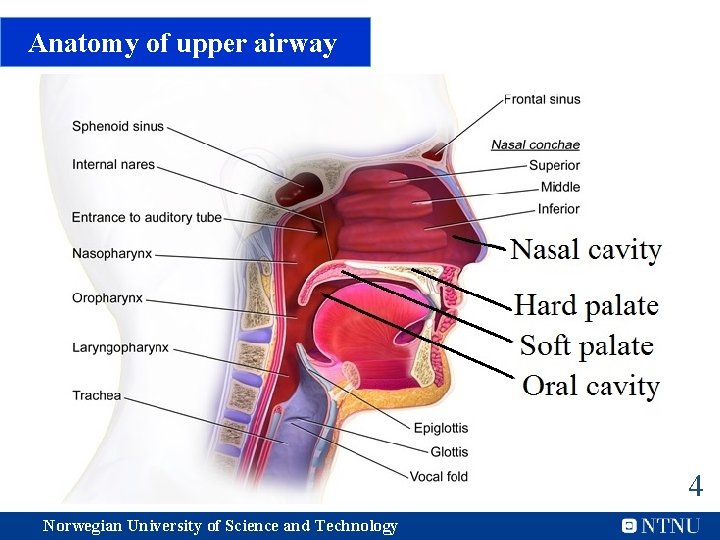
Anatomy of upper airway 4 Norwegian University of Science and Technology
OSAS / Snoring You can find the difference between Snoring and Obstructive Sleep Apnea in below link. https: //www. youtube. com/watch? v=inmop 4 Kv 8 PI 5 Norwegian University of Science and Technology
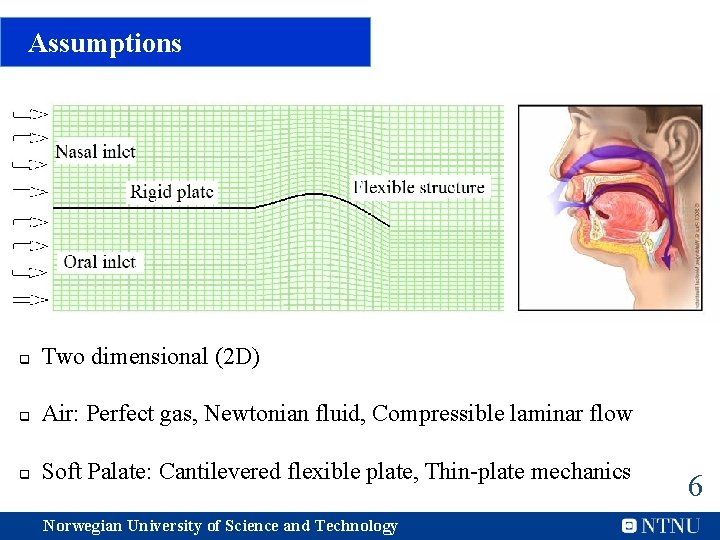
Assumptions q Two dimensional (2 D) q Air: Perfect gas, Newtonian fluid, Compressible laminar flow q Soft Palate: Cantilevered flexible plate, Thin-plate mechanics Norwegian University of Science and Technology 6
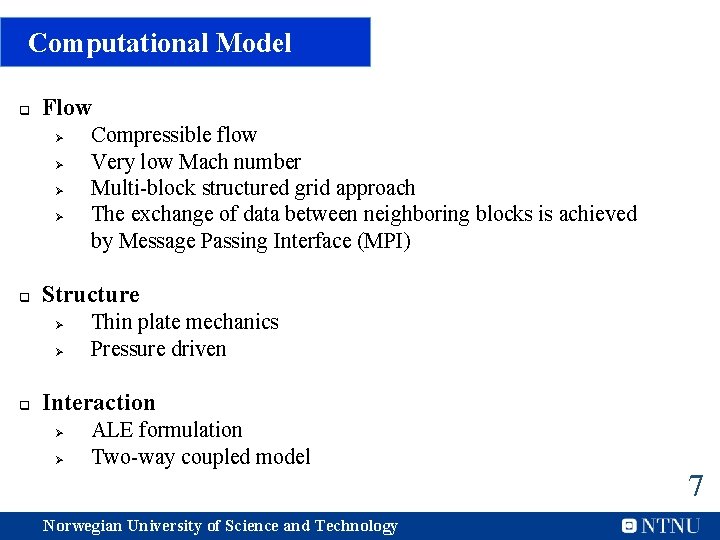
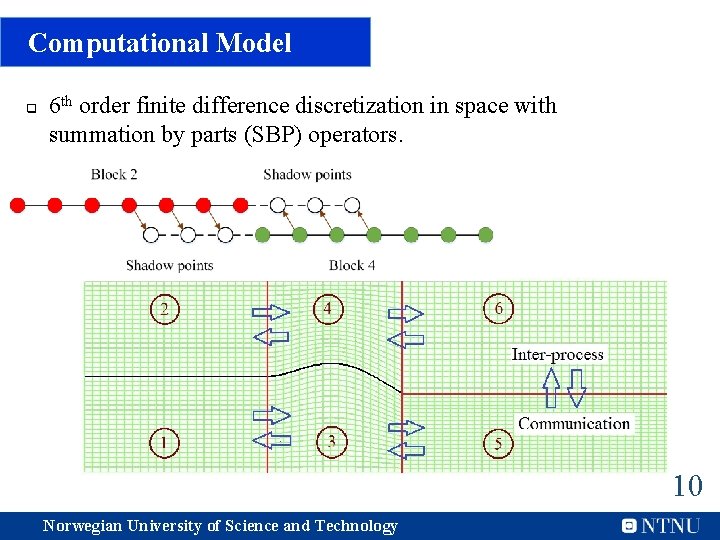
Computational Model q Flow Ø Ø q Structure Ø Ø q Compressible flow Very low Mach number Multi-block structured grid approach The exchange of data between neighboring blocks is achieved by Message Passing Interface (MPI) Thin plate mechanics Pressure driven Interaction Ø Ø ALE formulation Two-way coupled model Norwegian University of Science and Technology 7
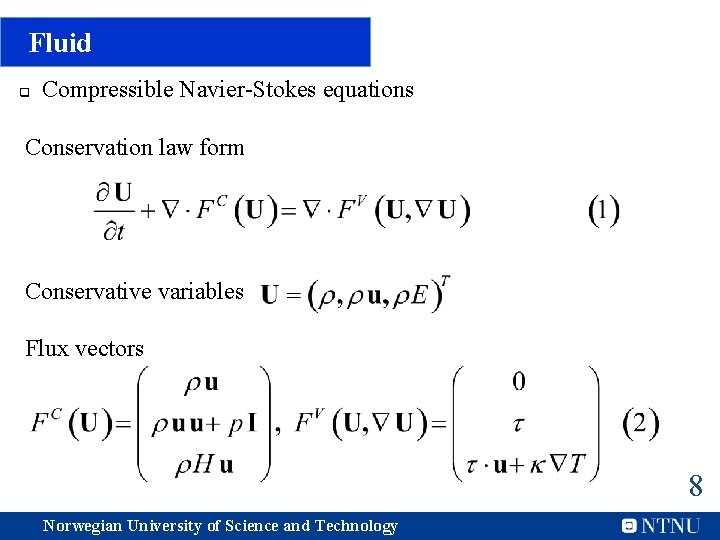
Fluid q Compressible Navier-Stokes equations Conservation law form Conservative variables Flux vectors 8 Norwegian University of Science and Technology
Computational Model q Equations solved in a non-dimensional perturbation form. q 4 th order explicit Runge-Kutta method in time. q 6 th order explicit filter applied at the end of each time step to suppress undamped modes. 9 Norwegian University of Science and Technology
Computational Model q 6 th order finite difference discretization in space with summation by parts (SBP) operators. 10 Norwegian University of Science and Technology
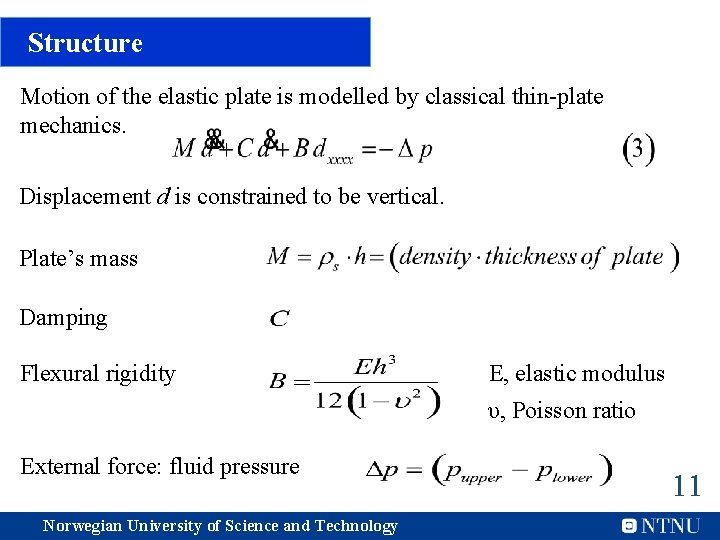
Structure Motion of the elastic plate is modelled by classical thin-plate mechanics. Displacement d is constrained to be vertical. Plate’s mass Damping Flexural rigidity E, elastic modulus υ, Poisson ratio External force: fluid pressure Norwegian University of Science and Technology 11
Computational Model q q Newmark time integration method is employed for solving implicit transient dynamics in the finite difference discretization. Central difference discretization is used for dxxxx. 12 Norwegian University of Science and Technology
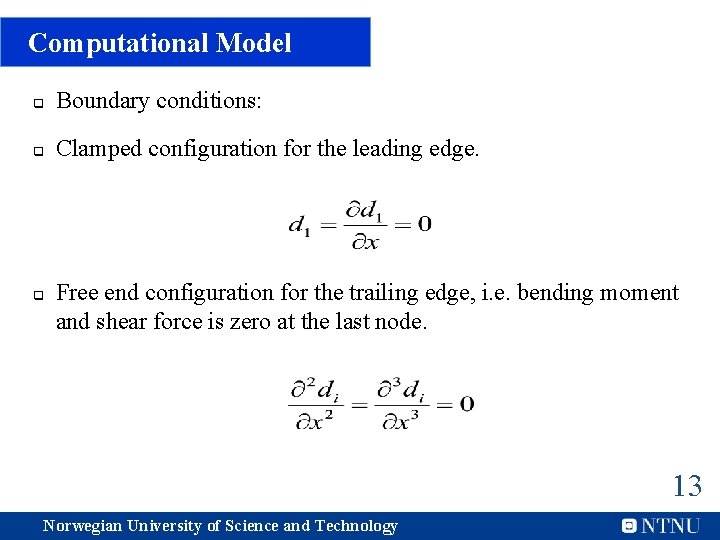
Computational Model q Boundary conditions: q Clamped configuration for the leading edge. q Free end configuration for the trailing edge, i. e. bending moment and shear force is zero at the last node. 13 Norwegian University of Science and Technology
Fluid-Structure Coupling q ALE formulation for Navier-Stokes equations. The grid point velocity is subtracted from the material velocity u inside the convective derivative. q Solving flow problems in a moving mesh described in an ALE framework needs the numerical scheme involved in the solver to obey the Geometric Conservation Law (GCL) for mathematical consistency. 14 Norwegian University of Science and Technology
Fluid-Structure Coupling In mesh updating, the positions and velocities of the grid points in the fluid domain are linear interpolation of the positions and velocities of the structure. 15 Norwegian University of Science and Technology
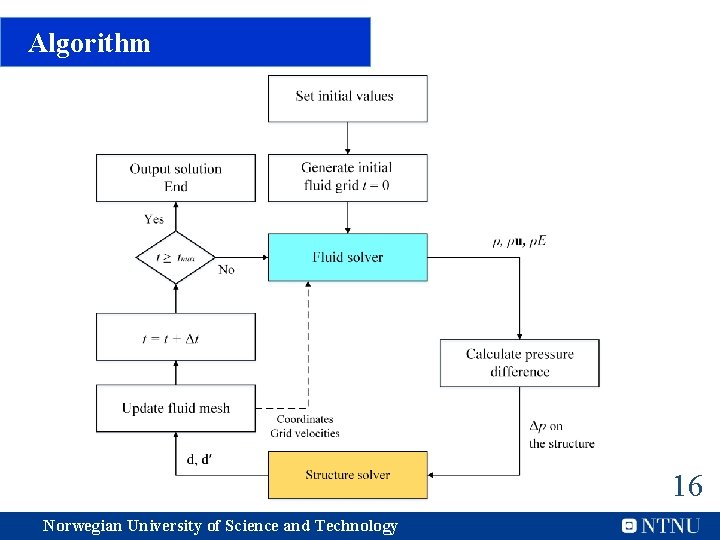
Algorithm 16 Norwegian University of Science and Technology
Fluid-Structure Coupling The displacement and velocities are matched. Ø yf and ds represent the fluid grid and structural displacement at the interface. and are the grid velocity and structural velocity at the interface. Ø The aerodynamic traction is simply the pressure acting on the plate surface. 17 Norwegian University of Science and Technology
Results An inlet velocity of 0. 32 m/s is applied at Re = 378, which has been shown to promote cantilever plate instability in channel flow, corresponding to previous work in Balint & Lucey [2] Balint, T. S. & Lucey, A. D. 2005 Instability of a cantilevered flexible plate in viscous channel flow. Journal of Fluids and Structures 20, 893 -912. Norwegian University of Science and Technology 18
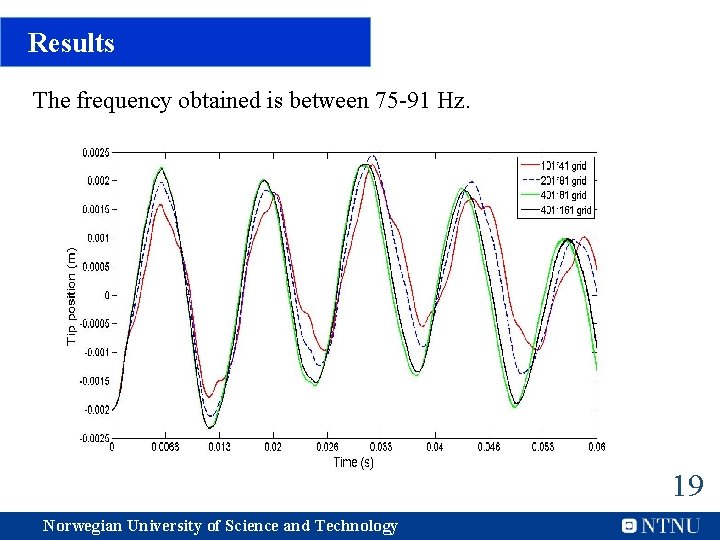
Results The frequency obtained is between 75 -91 Hz. 19 Norwegian University of Science and Technology
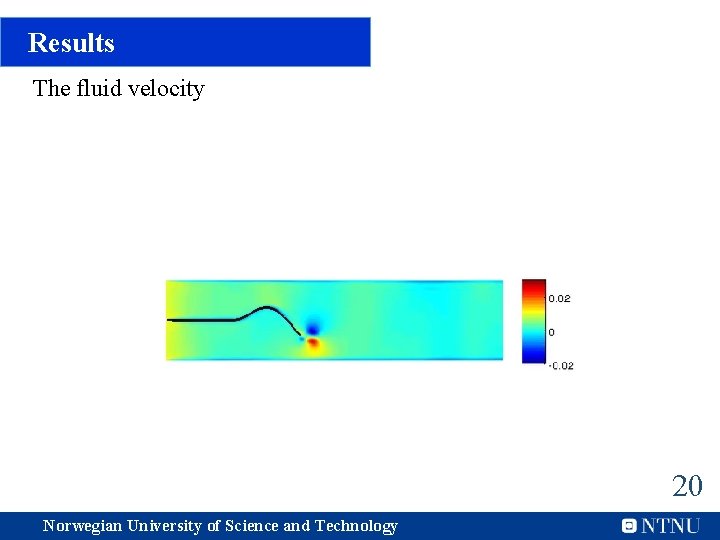
Results The fluid velocity 20 Norwegian University of Science and Technology
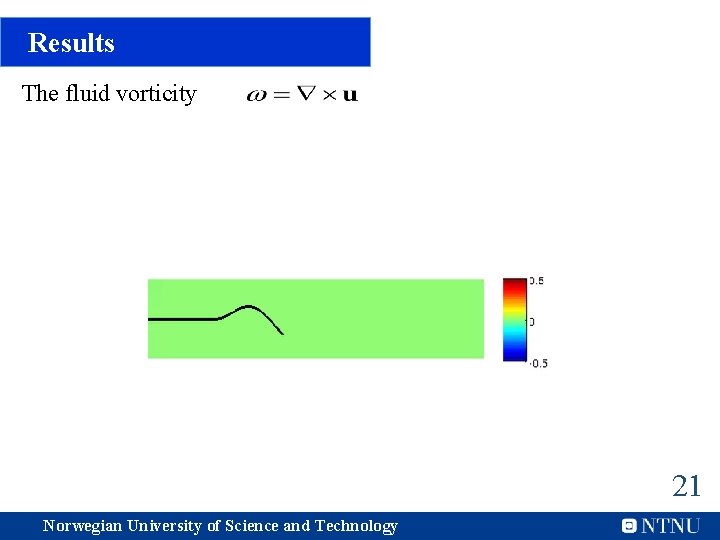
Results The fluid vorticity 21 Norwegian University of Science and Technology
Conclusions and Outlook q Conclusions ü ü q It is found that the numerical model used here is suitable to investigate elastic deformation of the plate. The numerical model is verified by previous work. Outlook ü ü Validation is needed. More realistic soft palate properties need to be applied for better correlation with clinically measured data. 22 Norwegian University of Science and Technology
End q Acknowledgments The current research is part of a larger research project entitled “Modeling of obstructive sleep apnea by fluidstructure interaction in the upper airways” which has been funded by the Research Council of Norway. Thanks for your attention. 23
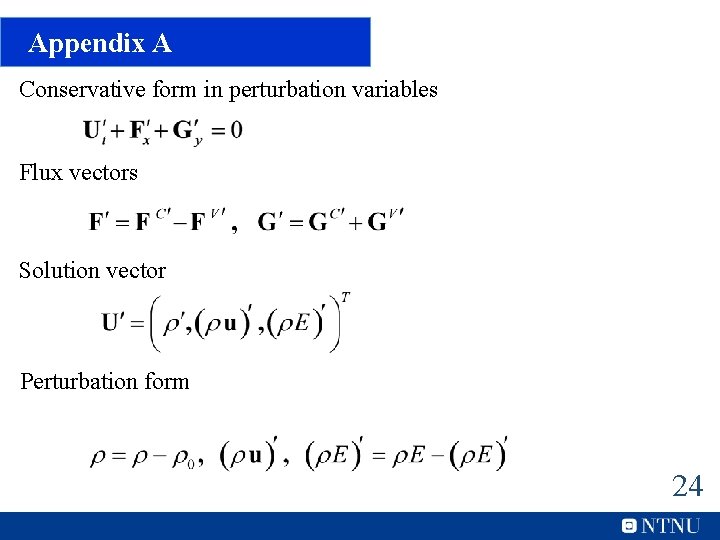
Appendix A Conservative form in perturbation variables Flux vectors Solution vector Perturbation form 24