
NUMERICAL MODELLING OF TURBULENT FLOWS E Serre Laboratoire
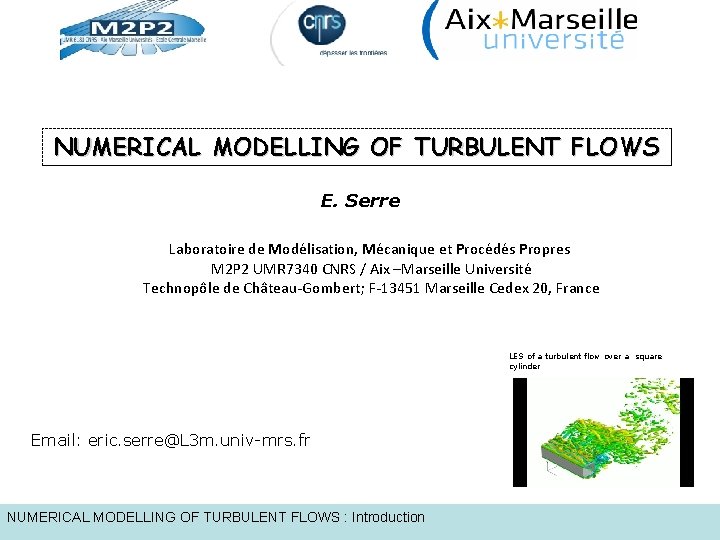
NUMERICAL MODELLING OF TURBULENT FLOWS E. Serre Laboratoire de Modélisation, Mécanique et Procédés Propres M 2 P 2 UMR 7340 CNRS / Aix –Marseille Université Technopôle de Château-Gombert; F-13451 Marseille Cedex 20, France LES of a turbulent flow over a square cylinder Email: eric. serre@L 3 m. univ-mrs. fr NUMERICAL MODELLING OF TURBULENT FLOWS : Introduction
• BOOKS: Pope (2003, Cambridge). Part I provides a general introduction to turbulent flows: behaviour, quantitative description, fundamental physical processes… Part II is concerned with different approaches for modeling and simulating, turbulent flows. NUMERICAL MODELLING OF TURBULENT FLOWS : Introduction
Lesieur (1997) Reviews the main characteristics and general theorems of rotational fluids (liquids or gases), with applications to aerodynamics and geophysical fluid dynamics. Emphasis is placed both on unpredictability, mixing, and coherent vortices or structures. NUMERICAL MODELLING OF TURBULENT FLOWS : Introduction
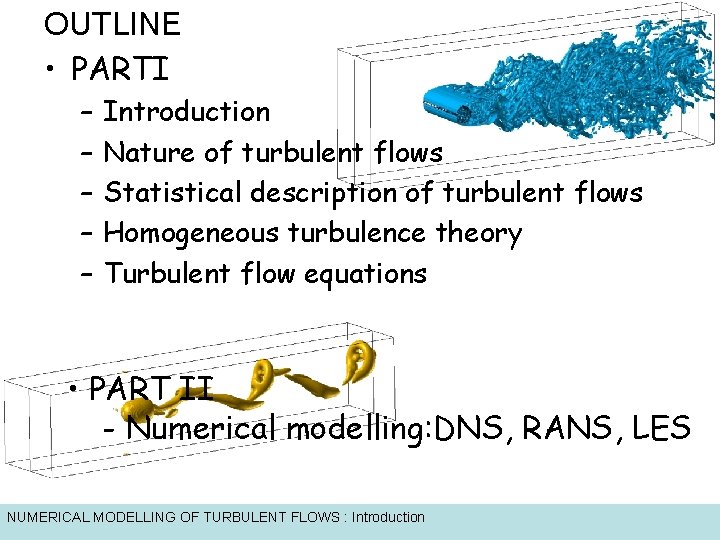
OUTLINE • PARTI – – – Introduction Nature of turbulent flows Statistical description of turbulent flows Homogeneous turbulence theory Turbulent flow equations • PART II - Numerical modelling: DNS, RANS, LES NUMERICAL MODELLING OF TURBULENT FLOWS : Introduction
Introduction NUMERICAL MODELLING OF TURBULENT FLOWS : Introduction
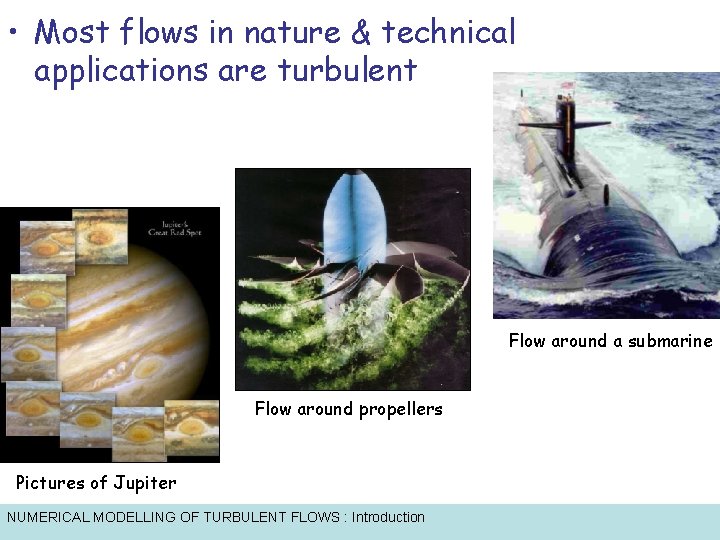
• Most flows in nature & technical applications are turbulent Flow around a submarine Flow around propellers Pictures of Jupiter NUMERICAL MODELLING OF TURBULENT FLOWS : Introduction
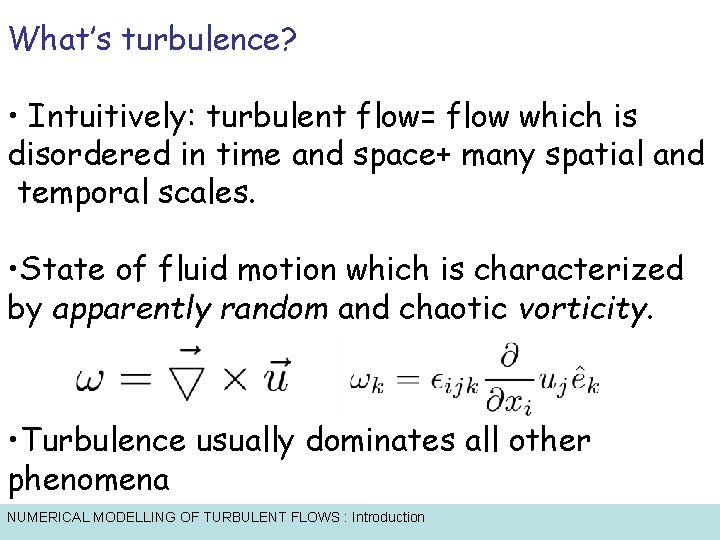
What’s turbulence? • Intuitively: turbulent flow= flow which is disordered in time and space+ many spatial and temporal scales. • State of fluid motion which is characterized by apparently random and chaotic vorticity. • Turbulence usually dominates all other phenomena NUMERICAL MODELLING OF TURBULENT FLOWS : Introduction
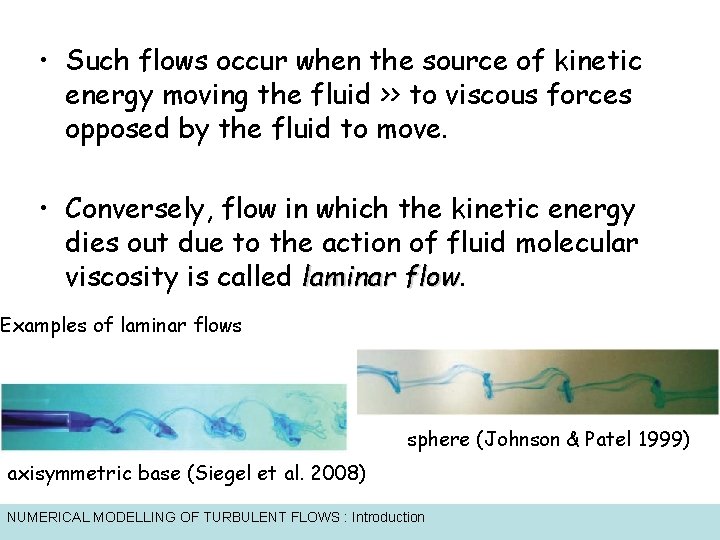
• Such flows occur when the source of kinetic energy moving the fluid >> to viscous forces opposed by the fluid to move. • Conversely, flow in which the kinetic energy dies out due to the action of fluid molecular viscosity is called laminar flow Examples of laminar flows sphere (Johnson & Patel 1999) axisymmetric base (Siegel et al. 2008) NUMERICAL MODELLING OF TURBULENT FLOWS : Introduction

• You are a fluid dynamicist visiting the Louvre in Paris and are asked by the curator to comment on the paintings below. What do you say? NUMERICAL MODELLING OF TURBULENT FLOWS : Introduction
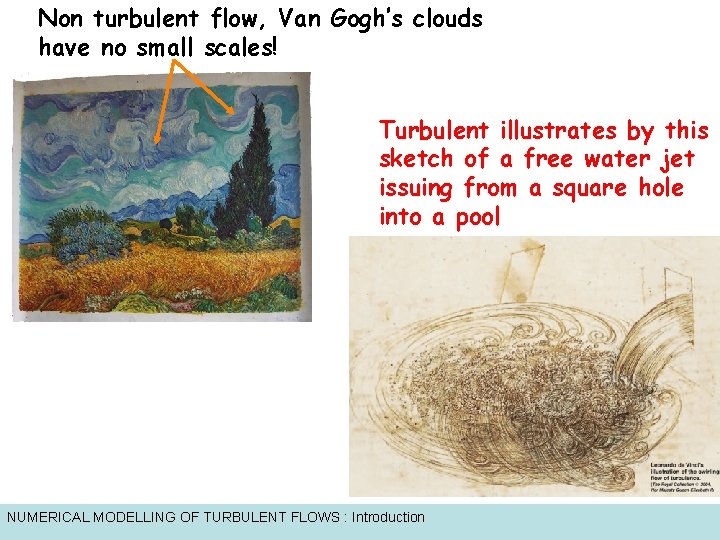
Non turbulent flow, Van Gogh’s clouds have no small scales! Turbulent illustrates by this sketch of a free water jet issuing from a square hole into a pool NUMERICAL MODELLING OF TURBULENT FLOWS : Introduction
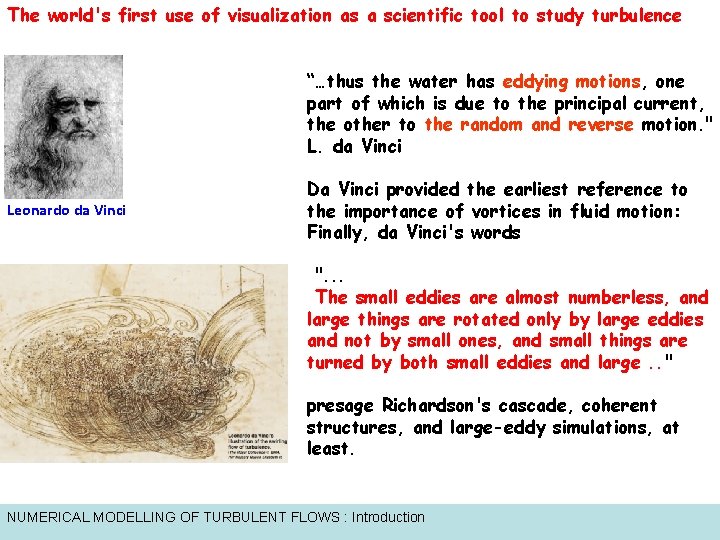
The world's first use of visualization as a scientific tool to study turbulence “…thus the water has eddying motions, one part of which is due to the principal current, the other to the random and reverse motion. " L. da Vinci Leonardo da Vinci Da Vinci provided the earliest reference to the importance of vortices in fluid motion: Finally, da Vinci's words ". . . The small eddies are almost numberless, and large things are rotated only by large eddies and not by small ones, and small things are turned by both small eddies and large. . " presage Richardson's cascade, coherent structures, and large-eddy simulations, at least. NUMERICAL MODELLING OF TURBULENT FLOWS : Introduction
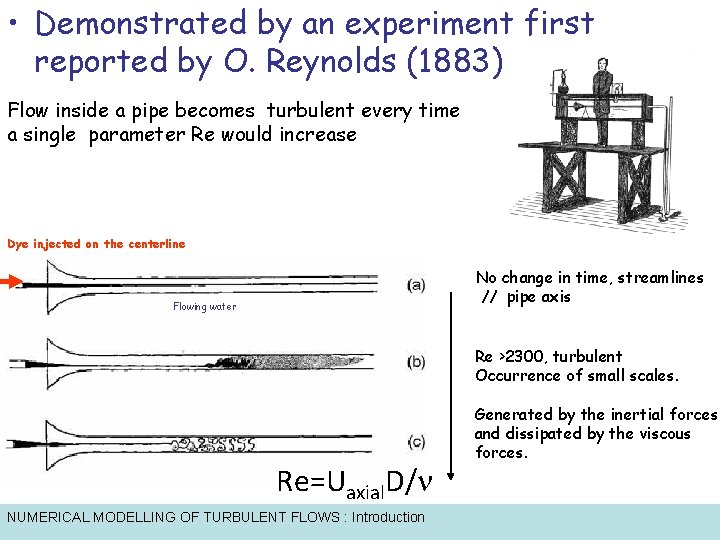
• Demonstrated by an experiment first reported by O. Reynolds (1883) Flow inside a pipe becomes turbulent every time a single parameter Re would increase Dye injected on the centerline No change in time, streamlines // pipe axis Flowing water Re >2300, turbulent Occurrence of small scales. Re=Uaxial. D/n NUMERICAL MODELLING OF TURBULENT FLOWS : Introduction Generated by the inertial forces and dissipated by the viscous forces.
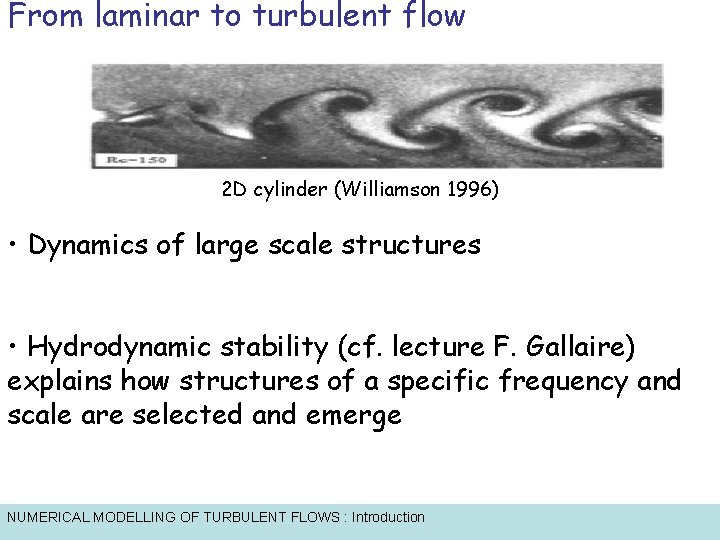
From laminar to turbulent flow 2 D cylinder (Williamson 1996) • Dynamics of large scale structures • Hydrodynamic stability (cf. lecture F. Gallaire) explains how structures of a specific frequency and scale are selected and emerge NUMERICAL MODELLING OF TURBULENT FLOWS : Introduction
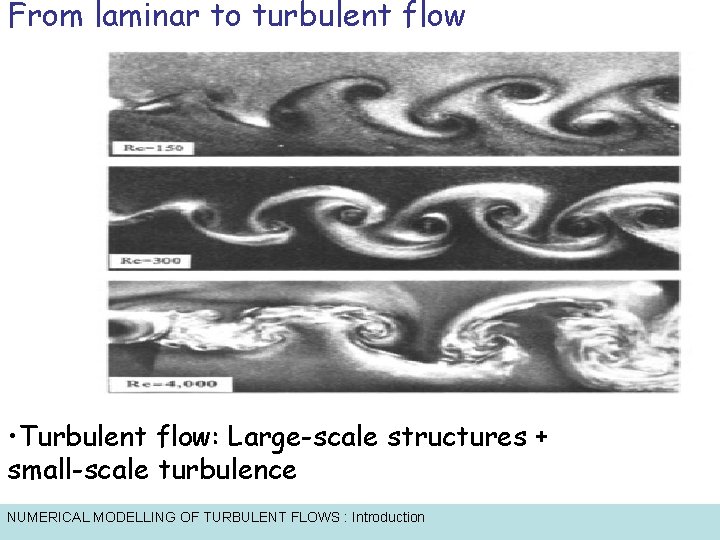
From laminar to turbulent flow • Turbulent flow: Large-scale structures + small-scale turbulence NUMERICAL MODELLING OF TURBULENT FLOWS : Introduction
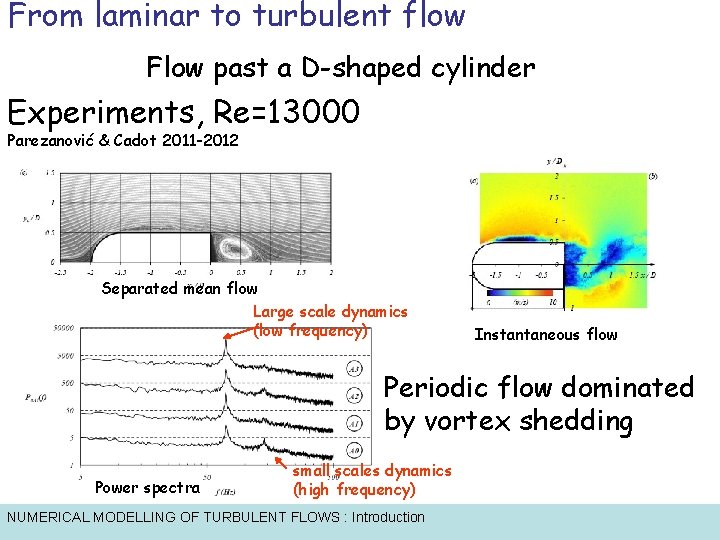
From laminar to turbulent flow Flow past a D-shaped cylinder Experiments, Re=13000 Parezanović & Cadot 2011 -2012 Separated mean flow Large scale dynamics (low frequency) Instantaneous flow Periodic flow dominated by vortex shedding Power spectra small scales dynamics (high frequency) NUMERICAL MODELLING OF TURBULENT FLOWS : Introduction
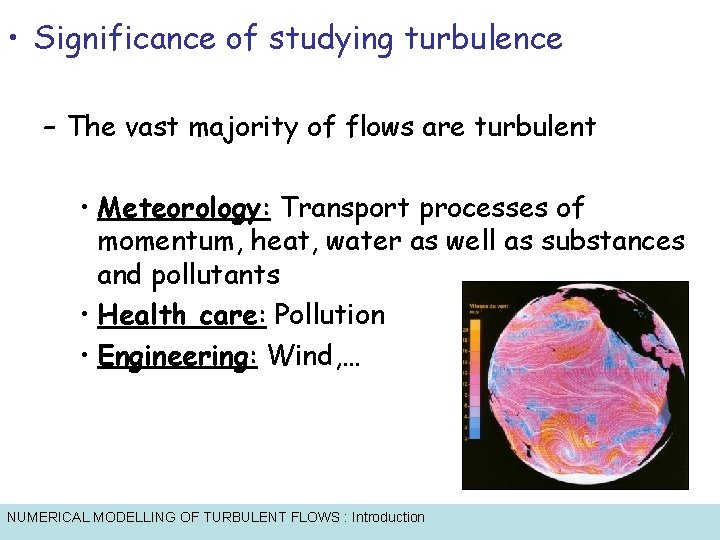
• Significance of studying turbulence – The vast majority of flows are turbulent • Meteorology: Transport processes of momentum, heat, water as well as substances and pollutants • Health care: Pollution • Engineering: Wind, … NUMERICAL MODELLING OF TURBULENT FLOWS : Introduction
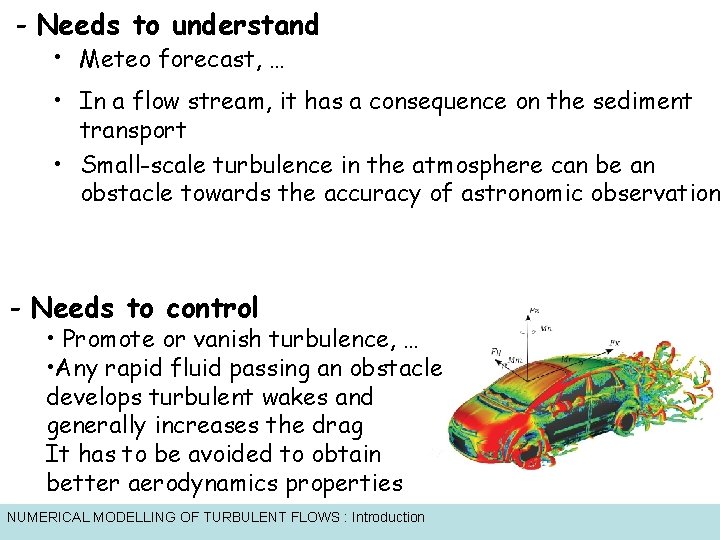
- Needs to understand • Meteo forecast, … • In a flow stream, it has a consequence on the sediment transport • Small-scale turbulence in the atmosphere can be an obstacle towards the accuracy of astronomic observation - Needs to control • Promote or vanish turbulence, … • Any rapid fluid passing an obstacle develops turbulent wakes and generally increases the drag It has to be avoided to obtain better aerodynamics properties NUMERICAL MODELLING OF TURBULENT FLOWS : Introduction
The study of turbulent flows • Discovery: expe or simulation to provide qualitative and quantitative information • Modelling: theoretical or modelling studies to dv tractable mathematical models that can predict properties • Control: to manipulate or control the flow or the turbulence in a beneficial way NUMERICAL MODELLING OF TURBULENT FLOWS : Introduction
Numerical modelling • Any complete solution must resolve accurately these finescale motions + the large scale overall flow picture Only feasible for relatively simple turbulent flows • Two broad strategies for modelling engineering flows - Large-eddy simulation (LES): one resolves as large a proportion of the turbulent fluctuations as one judges necessary (or can afford) and applies a model - Reynolds averaged Navier-Stokes (RANS): the effect of all turbulent fluctuations are subsumed within the model NUMERICAL MODELLING OF TURBULENT FLOWS : Introduction
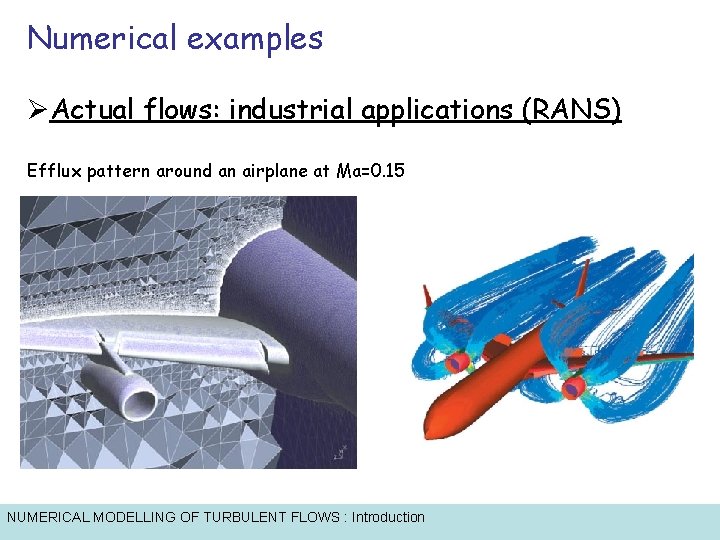
Numerical examples ØActual flows: industrial applications (RANS) Efflux pattern around an airplane at Ma=0. 15 NUMERICAL MODELLING OF TURBULENT FLOWS : Introduction
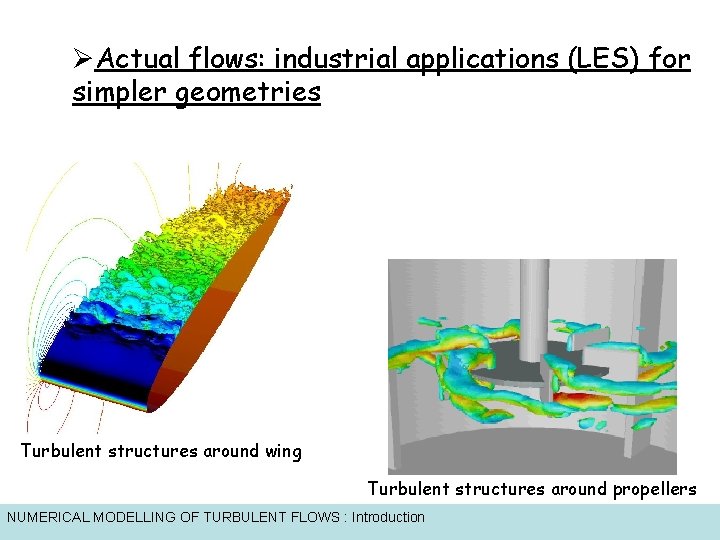
ØActual flows: industrial applications (LES) for simpler geometries Turbulent structures around wing Turbulent structures around propellers NUMERICAL MODELLING OF TURBULENT FLOWS : Introduction
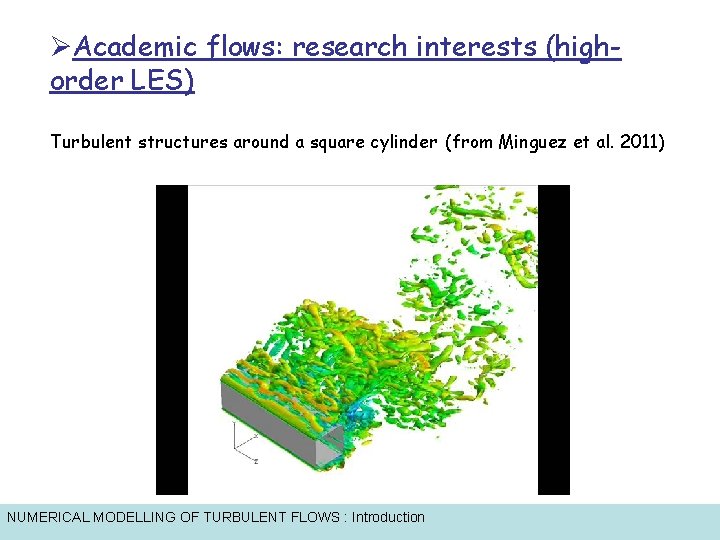
ØAcademic flows: research interests (highorder LES) Turbulent structures around a square cylinder (from Minguez et al. 2011) NUMERICAL MODELLING OF TURBULENT FLOWS : Introduction
In summary: NUMERICAL MODELLING OF TURBULENT FLOWS : Introduction
- Slides: 23