
Numerical Modelling of the Strain Pattern of Folds
- Slides: 1
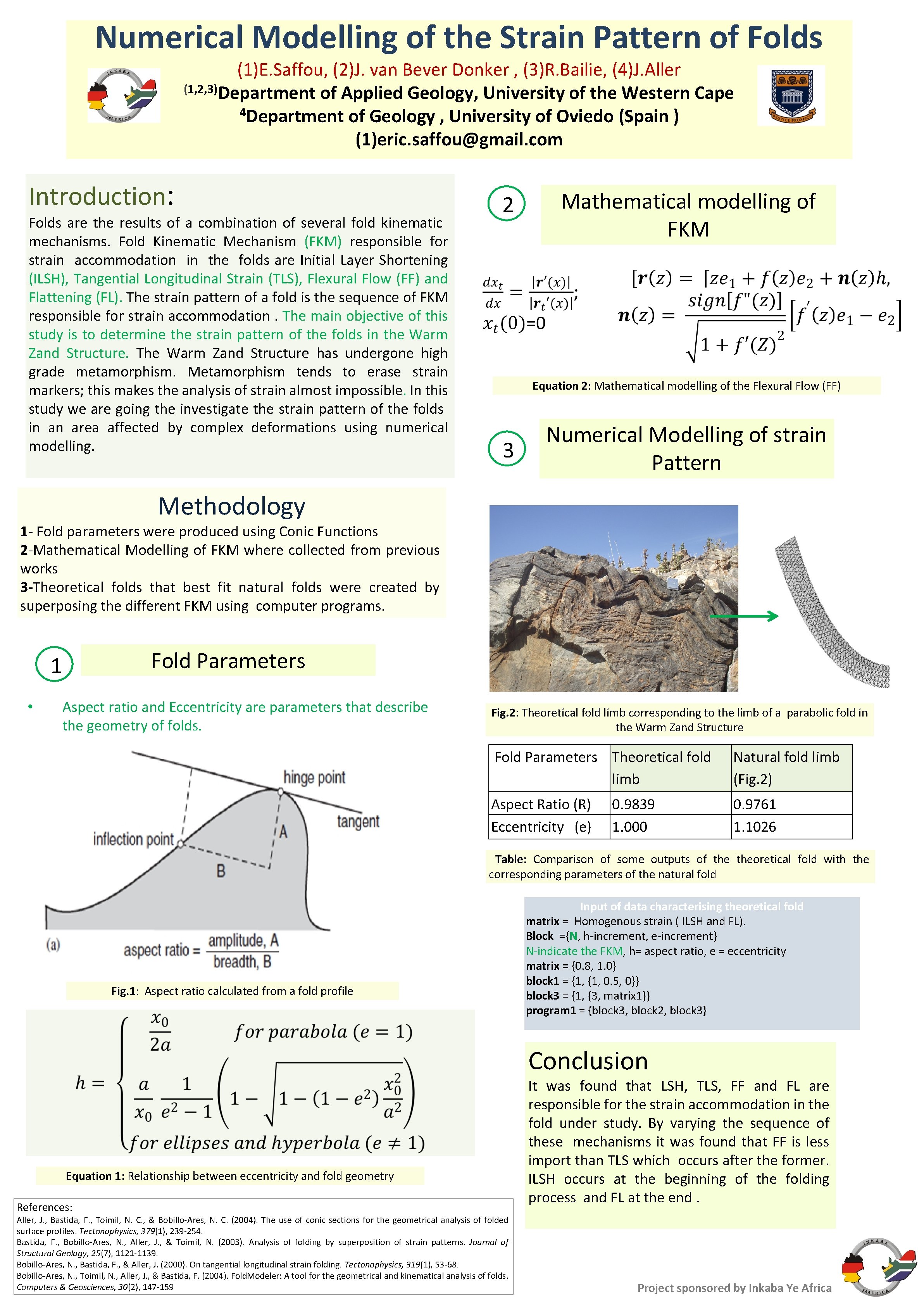
Numerical Modelling of the Strain Pattern of Folds (1)E. Saffou, (2)J. van Bever Donker , (3)R. Bailie, (4)J. Aller (1, 2, 3)Department of Applied Geology, University of the Western Cape 4 Department of Geology , University of Oviedo (Spain ) (1)eric. saffou@gmail. com Introduction: Folds are the results of a combination of several fold kinematic mechanisms. Fold Kinematic Mechanism (FKM) responsible for strain accommodation in the folds are Initial Layer Shortening (ILSH), Tangential Longitudinal Strain (TLS), Flexural Flow (FF) and Flattening (FL). The strain pattern of a fold is the sequence of FKM responsible for strain accommodation. The main objective of this study is to determine the strain pattern of the folds in the Warm Zand Structure. The Warm Zand Structure has undergone high grade metamorphism. Metamorphism tends to erase strain markers; this makes the analysis of strain almost impossible. In this study we are going the investigate the strain pattern of the folds in an area affected by complex deformations using numerical modelling. 2 Mathematical modelling of FKM Equation 2: Mathematical modelling of the Flexural Flow (FF) 3 Numerical Modelling of strain Pattern Methodology 1 - Fold parameters were produced using Conic Functions 2 -Mathematical Modelling of FKM where collected from previous works 3 -Theoretical folds that best fit natural folds were created by superposing the different FKM using computer programs. Fold Parameters 1 • Aspect ratio and Eccentricity are parameters that describe the geometry of folds. Fig. 2: Theoretical fold limb corresponding to the limb of a parabolic fold in the Warm Zand Structure Fold Parameters Theoretical fold limb Natural fold limb (Fig. 2) Aspect Ratio (R) Eccentricity (e) 0. 9761 1. 1026 0. 9839 1. 000 Table: Comparison of some outputs of theoretical fold with the corresponding parameters of the natural fold Fig. 1: Aspect ratio calculated from a fold profile Input of data characterising theoretical fold matrix = Homogenous strain ( ILSH and FL). Block ={N, h-increment, e-increment} N-indicate the FKM, h= aspect ratio, e = eccentricity matrix = {0. 8, 1. 0} block 1 = {1, 0. 5, 0}} block 3 = {1, {3, matrix 1}} program 1 = {block 3, block 2, block 3} Conclusion Equation 1: Relationship between eccentricity and fold geometry References: Aller, J. , Bastida, F. , Toimil, N. C. , & Bobillo-Ares, N. C. (2004). The use of conic sections for the geometrical analysis of folded surface profiles. Tectonophysics, 379(1), 239 -254. Bastida, F. , Bobillo-Ares, N. , Aller, J. , & Toimil, N. (2003). Analysis of folding by superposition of strain patterns. Journal of Structural Geology, 25(7), 1121 -1139. Bobillo-Ares, N. , Bastida, F. , & Aller, J. (2000). On tangential longitudinal strain folding. Tectonophysics, 319(1), 53 -68. Bobillo-Ares, N. , Toimil, N. , Aller, J. , & Bastida, F. (2004). Fold. Modeler: A tool for the geometrical and kinematical analysis of folds. Computers & Geosciences, 30(2), 147 -159 It was found that LSH, TLS, FF and FL are responsible for the strain accommodation in the fold under study. By varying the sequence of these mechanisms it was found that FF is less import than TLS which occurs after the former. ILSH occurs at the beginning of the folding process and FL at the end. Project sponsored by Inkaba Ye Africa