
Numerical geometry of nonrigid shapes Spectral Methods Tutorial
- Slides: 33
Numerical geometry of non-rigid shapes Spectral Methods Tutorial. 1 Spectral Methods Tutorial 6 © Maks Ovsjanikov tosca. cs. technion. ac. il/book Numerical geometry of non-rigid shapes Stanford University, Winter 2009
Numerical geometry of non-rigid shapes Spectral Methods Tutorial. Outline On a Connection between Kernel PCA and Metric Multidimensional Scaling Williams C. , Advances in Neural Information Proc. Sys. , 2001 1. Classic MDS and PCA review. 2. Metric MDS. 3. Kernel PCA, kernel trick, relation to Metric MDS. 4. Summary. Articulated Shape Matching by Robust Alignment of Embedded Representations Mateus D. et al. , Workshop on 3 DRR, 2007 Laplace-Beltrami Eigenfunctions for Deformation Invariant Shape Representation Rustamov R. , SGP, 2007 2
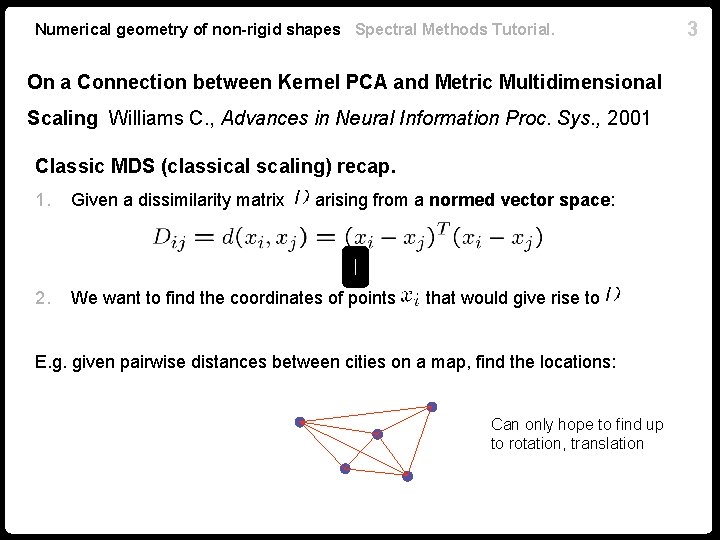
Numerical geometry of non-rigid shapes Spectral Methods Tutorial. On a Connection between Kernel PCA and Metric Multidimensional Scaling Williams C. , Advances in Neural Information Proc. Sys. , 2001 Classic MDS (classical scaling) recap. 1. Given a dissimilarity matrix 2. We want to find the coordinates of points arising from a normed vector space: that would give rise to E. g. given pairwise distances between cities on a map, find the locations: Can only hope to find up to rotation, translation 3
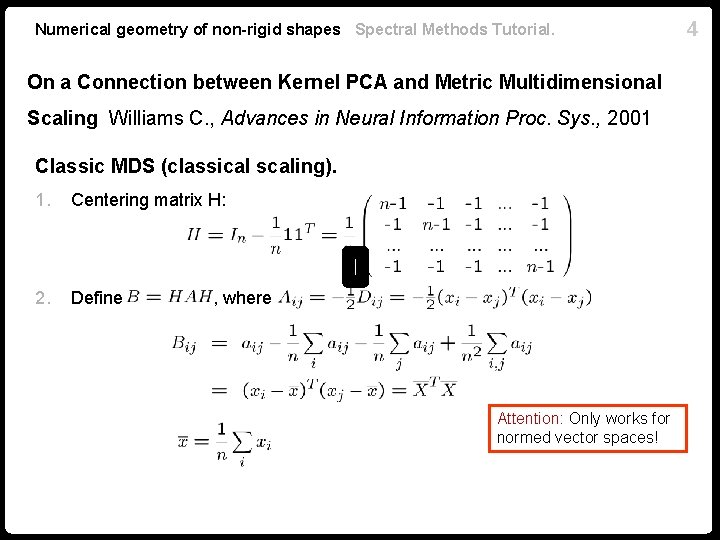
Numerical geometry of non-rigid shapes Spectral Methods Tutorial. On a Connection between Kernel PCA and Metric Multidimensional Scaling Williams C. , Advances in Neural Information Proc. Sys. , 2001 Classic MDS (classical scaling). 1. Centering matrix H: 2. Define , where Attention: Only works for normed vector spaces! 4
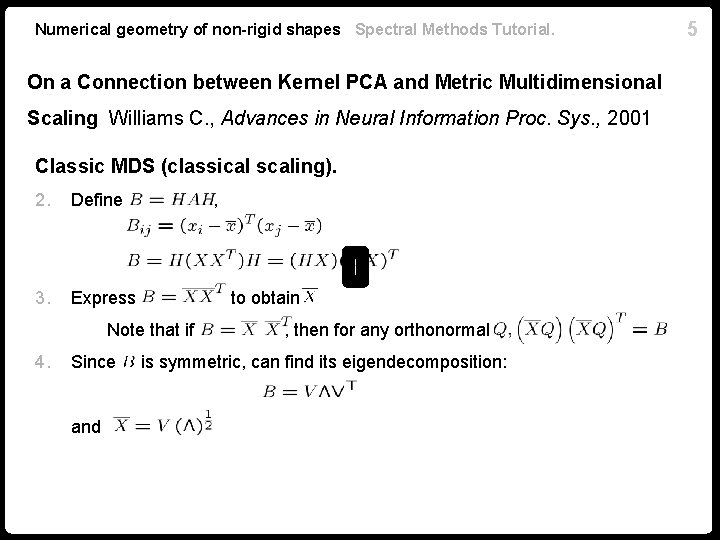
Numerical geometry of non-rigid shapes Spectral Methods Tutorial. On a Connection between Kernel PCA and Metric Multidimensional Scaling Williams C. , Advances in Neural Information Proc. Sys. , 2001 Classic MDS (classical scaling). 2. Define 3. Express , to obtain Note that if 4. Since and , then for any orthonormal is symmetric, can find its eigendecomposition: 5
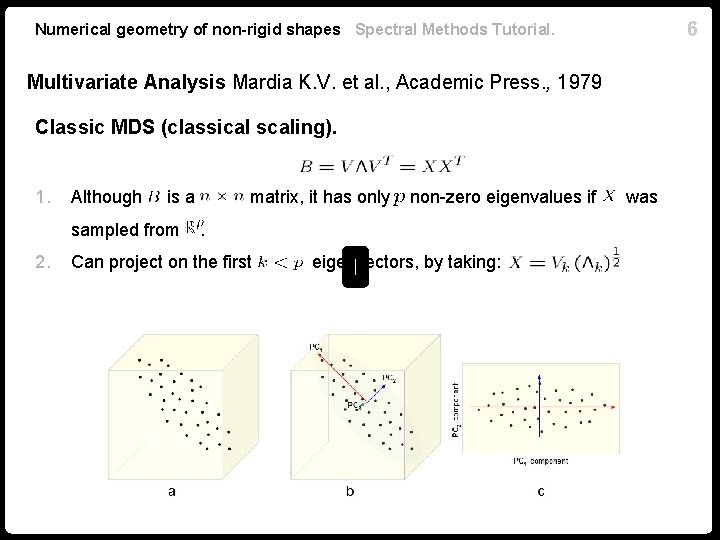
6 Numerical geometry of non-rigid shapes Spectral Methods Tutorial. Multivariate Analysis Mardia K. V. et al. , Academic Press. , 1979 Classic MDS (classical scaling). 1. Although is a sampled from 2. matrix, it has only non-zero eigenvalues if . Can project on the first eigenvectors, by taking: was
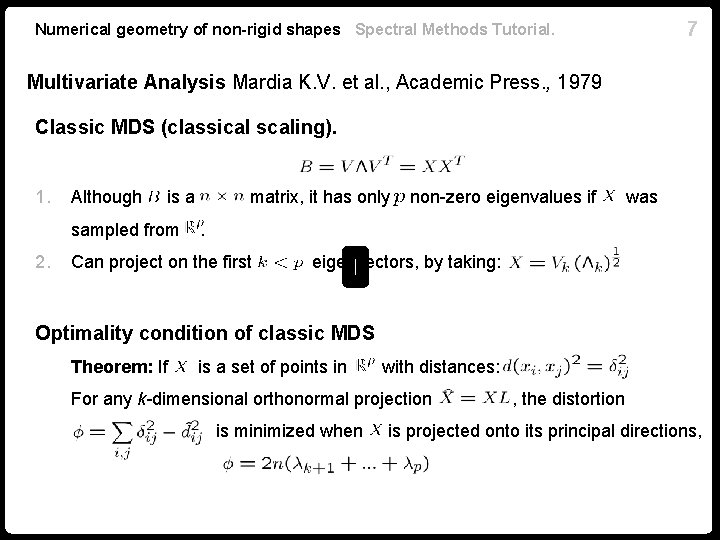
7 Numerical geometry of non-rigid shapes Spectral Methods Tutorial. Multivariate Analysis Mardia K. V. et al. , Academic Press. , 1979 Classic MDS (classical scaling). 1. Although is a sampled from 2. matrix, it has only non-zero eigenvalues if was . Can project on the first eigenvectors, by taking: Optimality condition of classic MDS Theorem: If is a set of points in with distances: For any k-dimensional orthonormal projection is minimized when , the distortion is projected onto its principal directions,
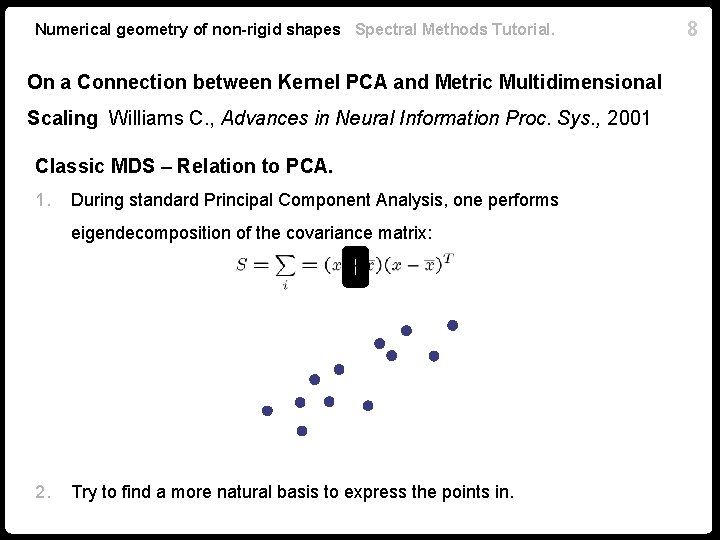
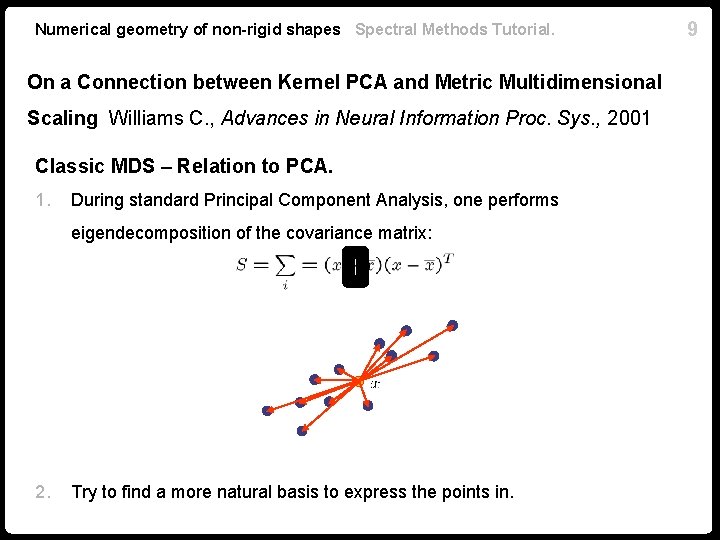
Numerical geometry of non-rigid shapes Spectral Methods Tutorial. On a Connection between Kernel PCA and Metric Multidimensional Scaling Williams C. , Advances in Neural Information Proc. Sys. , 2001 Classic MDS – Relation to PCA. 1. During standard Principal Component Analysis, one performs eigendecomposition of the covariance matrix: 2. Try to find a more natural basis to express the points in. 8
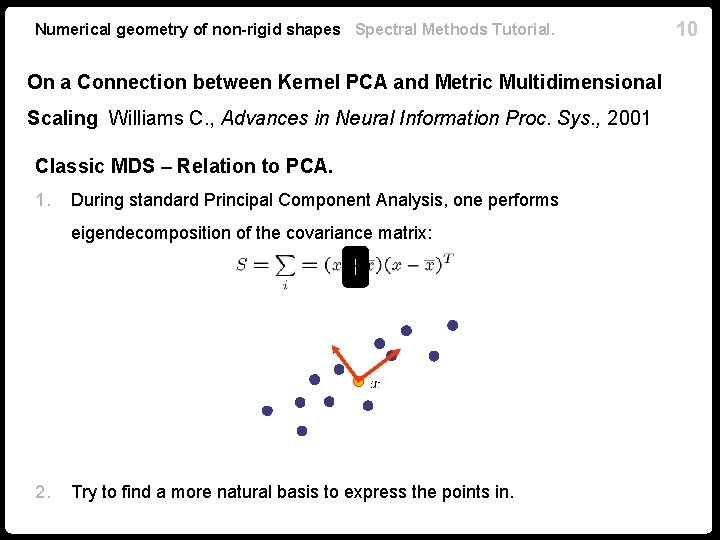
Numerical geometry of non-rigid shapes Spectral Methods Tutorial. On a Connection between Kernel PCA and Metric Multidimensional Scaling Williams C. , Advances in Neural Information Proc. Sys. , 2001 Classic MDS – Relation to PCA. 1. During standard Principal Component Analysis, one performs eigendecomposition of the covariance matrix: 2. Try to find a more natural basis to express the points in. 9
Numerical geometry of non-rigid shapes Spectral Methods Tutorial. On a Connection between Kernel PCA and Metric Multidimensional Scaling Williams C. , Advances in Neural Information Proc. Sys. , 2001 Classic MDS – Relation to PCA. 1. During standard Principal Component Analysis, one performs eigendecomposition of the covariance matrix: 2. Try to find a more natural basis to express the points in. 10
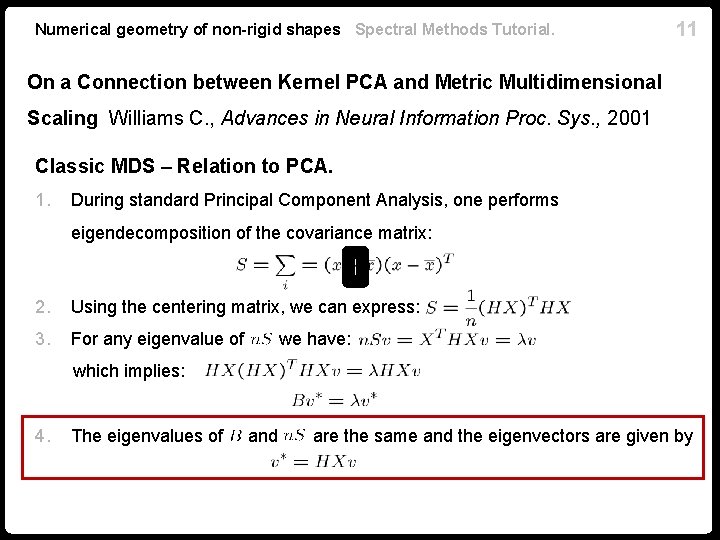
Numerical geometry of non-rigid shapes Spectral Methods Tutorial. 11 On a Connection between Kernel PCA and Metric Multidimensional Scaling Williams C. , Advances in Neural Information Proc. Sys. , 2001 Classic MDS – Relation to PCA. 1. During standard Principal Component Analysis, one performs eigendecomposition of the covariance matrix: 2. Using the centering matrix, we can express: 3. For any eigenvalue of we have: which implies: 4. The eigenvalues of and are the same and the eigenvectors are given by
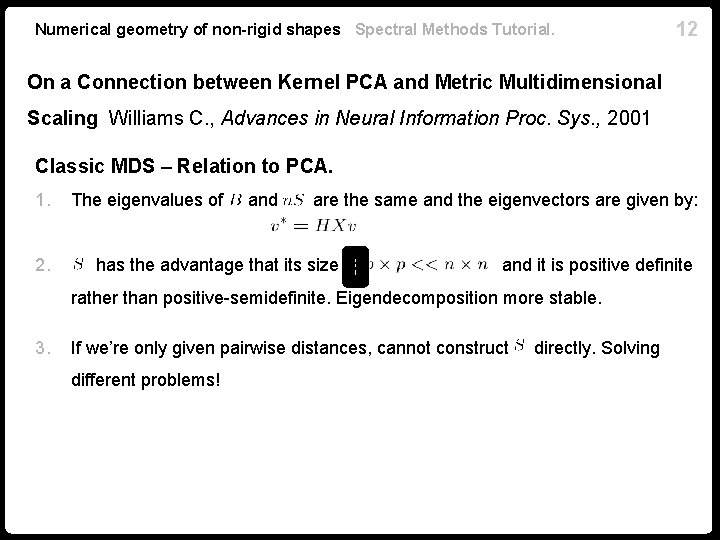
Numerical geometry of non-rigid shapes Spectral Methods Tutorial. 12 On a Connection between Kernel PCA and Metric Multidimensional Scaling Williams C. , Advances in Neural Information Proc. Sys. , 2001 Classic MDS – Relation to PCA. 1. 2. The eigenvalues of and are the same and the eigenvectors are given by: has the advantage that its size is and it is positive definite rather than positive-semidefinite. Eigendecomposition more stable. 3. If we’re only given pairwise distances, cannot construct different problems! directly. Solving
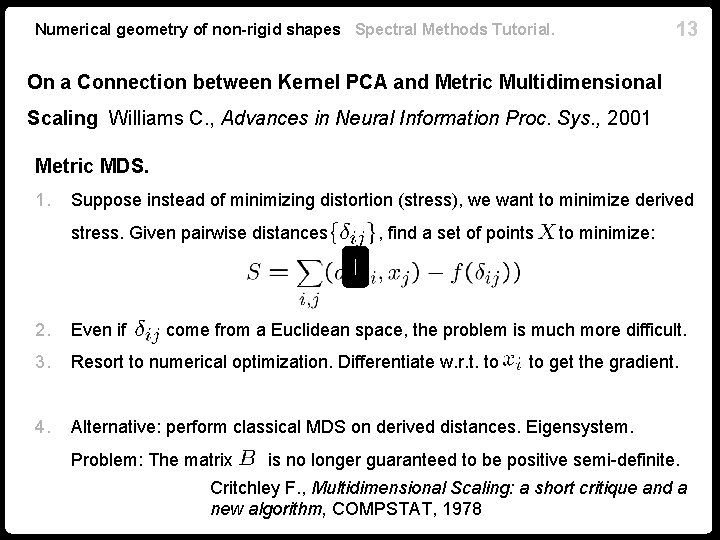
13 Numerical geometry of non-rigid shapes Spectral Methods Tutorial. On a Connection between Kernel PCA and Metric Multidimensional Scaling Williams C. , Advances in Neural Information Proc. Sys. , 2001 Metric MDS. 1. Suppose instead of minimizing distortion (stress), we want to minimize derived stress. Given pairwise distances , find a set of points to minimize: 2. Even if 3. Resort to numerical optimization. Differentiate w. r. t. to 4. Alternative: perform classical MDS on derived distances. Eigensystem. come from a Euclidean space, the problem is much more difficult. Problem: The matrix to get the gradient. is no longer guaranteed to be positive semi-definite. Critchley F. , Multidimensional Scaling: a short critique and a new algorithm, COMPSTAT, 1978
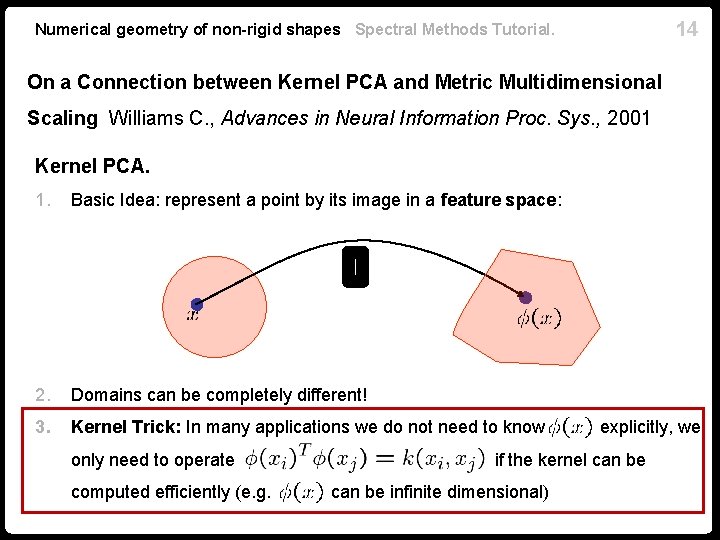
14 Numerical geometry of non-rigid shapes Spectral Methods Tutorial. On a Connection between Kernel PCA and Metric Multidimensional Scaling Williams C. , Advances in Neural Information Proc. Sys. , 2001 Kernel PCA. 1. Basic Idea: represent a point by its image in a feature space: 2. Domains can be completely different! 3. Kernel Trick: In many applications we do not need to know only need to operate computed efficiently (e. g. explicitly, we if the kernel can be infinite dimensional)
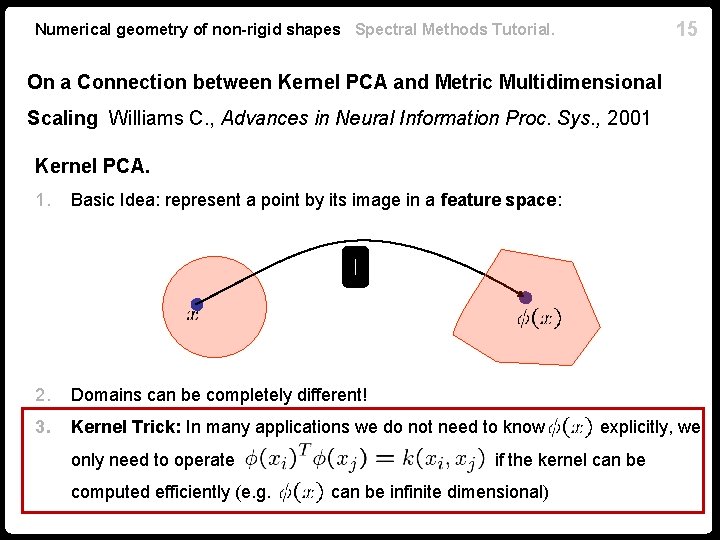
15 Numerical geometry of non-rigid shapes Spectral Methods Tutorial. On a Connection between Kernel PCA and Metric Multidimensional Scaling Williams C. , Advances in Neural Information Proc. Sys. , 2001 Kernel PCA. 1. Basic Idea: represent a point by its image in a feature space: 2. Domains can be completely different! 3. Kernel Trick: In many applications we do not need to know only need to operate computed efficiently (e. g. explicitly, we if the kernel can be infinite dimensional)
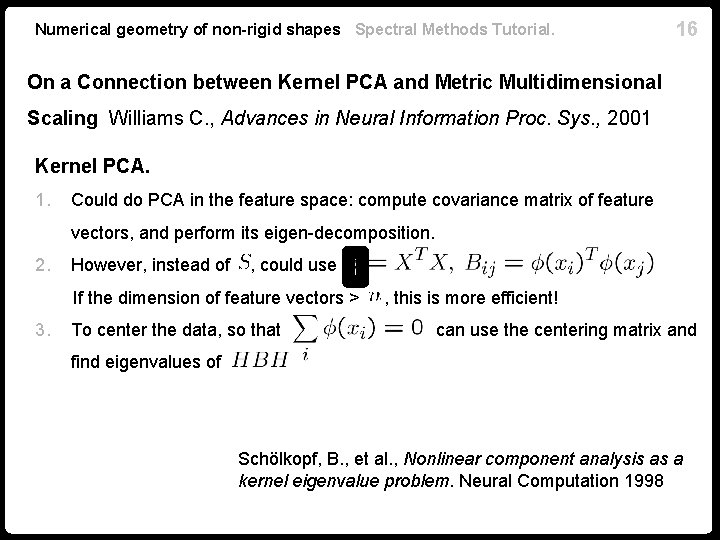
Numerical geometry of non-rigid shapes Spectral Methods Tutorial. 16 On a Connection between Kernel PCA and Metric Multidimensional Scaling Williams C. , Advances in Neural Information Proc. Sys. , 2001 Kernel PCA. 1. Could do PCA in the feature space: compute covariance matrix of feature vectors, and perform its eigen-decomposition. 2. However, instead of , could use If the dimension of feature vectors > 3. To center the data, so that , this is more efficient! can use the centering matrix and find eigenvalues of Schölkopf, B. , et al. , Nonlinear component analysis as a kernel eigenvalue problem. Neural Computation 1998
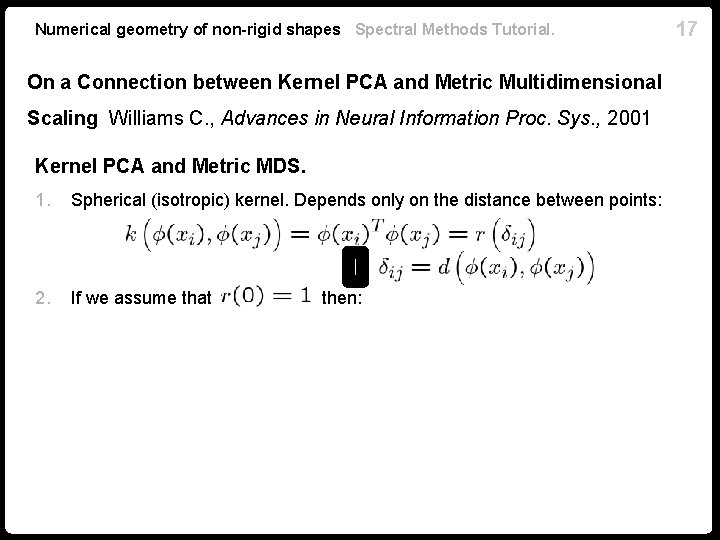
Numerical geometry of non-rigid shapes Spectral Methods Tutorial. On a Connection between Kernel PCA and Metric Multidimensional Scaling Williams C. , Advances in Neural Information Proc. Sys. , 2001 Kernel PCA and Metric MDS. 1. Spherical (isotropic) kernel. Depends only on the distance between points: 2. If we assume that then: 17
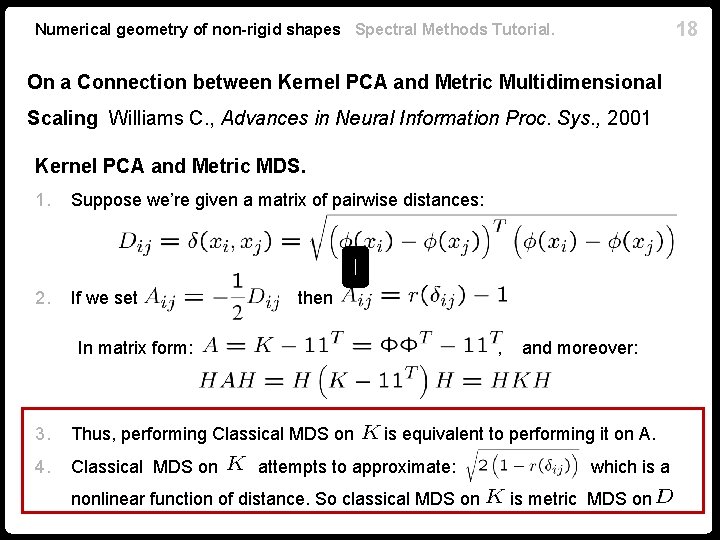
18 Numerical geometry of non-rigid shapes Spectral Methods Tutorial. On a Connection between Kernel PCA and Metric Multidimensional Scaling Williams C. , Advances in Neural Information Proc. Sys. , 2001 Kernel PCA and Metric MDS. 1. Suppose we’re given a matrix of pairwise distances: 2. If we set then In matrix form: , 3. Thus, performing Classical MDS on 4. Classical MDS on and moreover: is equivalent to performing it on A. attempts to approximate: nonlinear function of distance. So classical MDS on which is a is metric MDS on
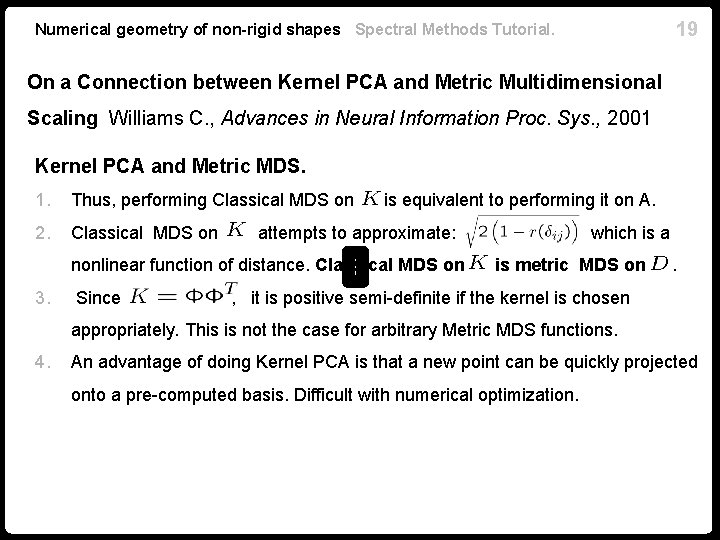
19 Numerical geometry of non-rigid shapes Spectral Methods Tutorial. On a Connection between Kernel PCA and Metric Multidimensional Scaling Williams C. , Advances in Neural Information Proc. Sys. , 2001 Kernel PCA and Metric MDS. 1. Thus, performing Classical MDS on 2. Classical MDS on is equivalent to performing it on A. attempts to approximate: nonlinear function of distance. Classical MDS on 3. Since which is a is metric MDS on . , it is positive semi-definite if the kernel is chosen appropriately. This is not the case for arbitrary Metric MDS functions. 4. An advantage of doing Kernel PCA is that a new point can be quickly projected onto a pre-computed basis. Difficult with numerical optimization.
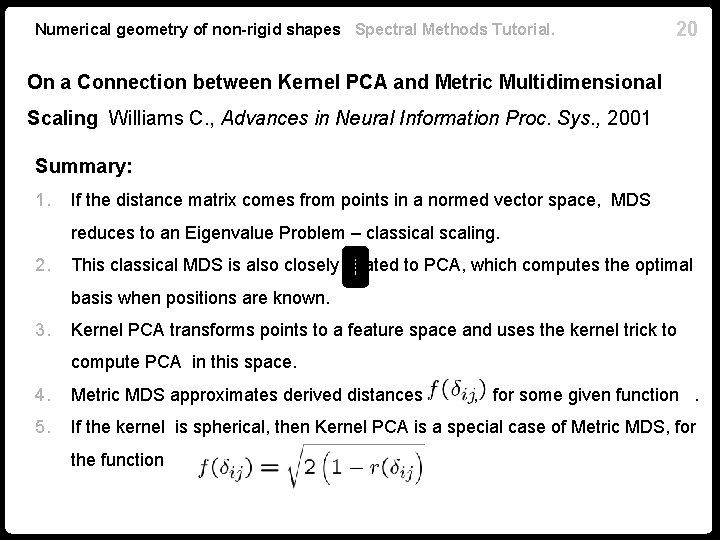
Numerical geometry of non-rigid shapes Spectral Methods Tutorial. 20 On a Connection between Kernel PCA and Metric Multidimensional Scaling Williams C. , Advances in Neural Information Proc. Sys. , 2001 Summary: 1. If the distance matrix comes from points in a normed vector space, MDS reduces to an Eigenvalue Problem – classical scaling. 2. This classical MDS is also closely related to PCA, which computes the optimal basis when positions are known. 3. Kernel PCA transforms points to a feature space and uses the kernel trick to compute PCA in this space. 4. Metric MDS approximates derived distances 5. If the kernel is spherical, then Kernel PCA is a special case of Metric MDS, for the function , for some given function.
Numerical geometry of non-rigid shapes Spectral Methods Tutorial. Outline On a Connection between Kernel PCA and Metric Multidimensional Scaling Williams C. , Advances in Neural Information Proc. Sys. , 2001 1. Classic MDS and PCA review. 2. Metric MDS. 3. Kernel PCA, kernel trick, relation to Metric MDS. 4. Summary. Articulated Shape Matching by Robust Alignment of Embedded Representations Mateus D. et al. , Workshop on 3 DRR, 2007 Laplace-Beltrami Eigenfunctions for Deformation Invariant Shape Representation Rustamov R. , SGP, 2007 21
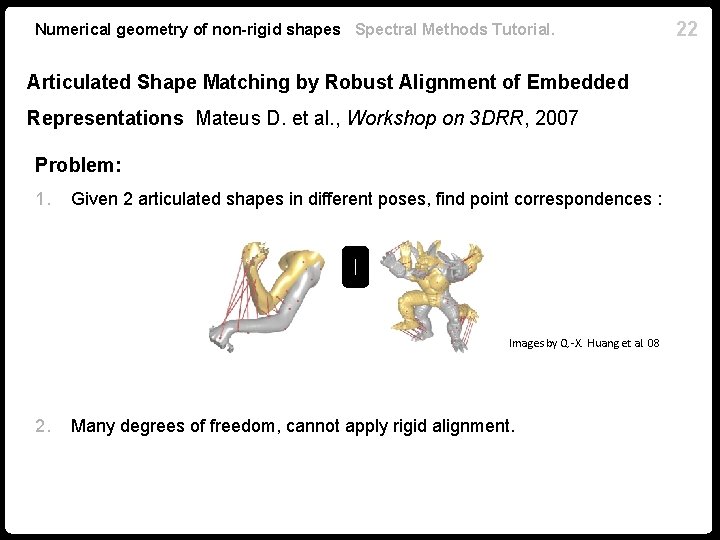
Numerical geometry of non-rigid shapes Spectral Methods Tutorial. Articulated Shape Matching by Robust Alignment of Embedded Representations Mateus D. et al. , Workshop on 3 DRR, 2007 Problem: 1. Given 2 articulated shapes in different poses, find point correspondences : Images by Q. -X. Huang et al. 08 2. Many degrees of freedom, cannot apply rigid alignment. 22
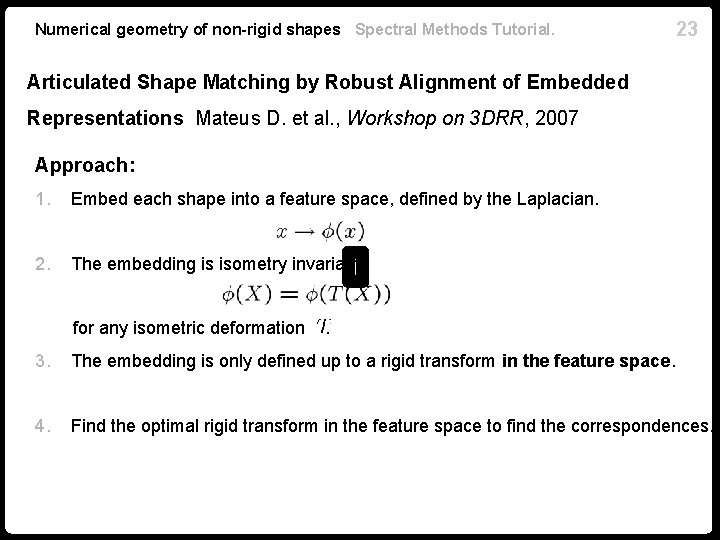
Numerical geometry of non-rigid shapes Spectral Methods Tutorial. 23 Articulated Shape Matching by Robust Alignment of Embedded Representations Mateus D. et al. , Workshop on 3 DRR, 2007 Approach: 1. Embed each shape into a feature space, defined by the Laplacian. 2. The embedding is isometry invariant: for any isometric deformation . 3. The embedding is only defined up to a rigid transform in the feature space. 4. Find the optimal rigid transform in the feature space to find the correspondences.
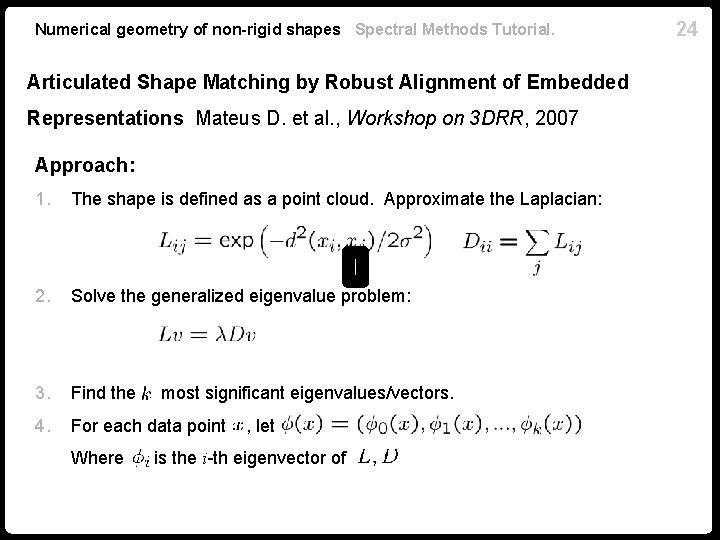
Numerical geometry of non-rigid shapes Spectral Methods Tutorial. Articulated Shape Matching by Robust Alignment of Embedded Representations Mateus D. et al. , Workshop on 3 DRR, 2007 Approach: 1. The shape is defined as a point cloud. Approximate the Laplacian: 2. Solve the generalized eigenvalue problem: 3. Find the 4. For each data point Where most significant eigenvalues/vectors. , let is the i-th eigenvector of 24
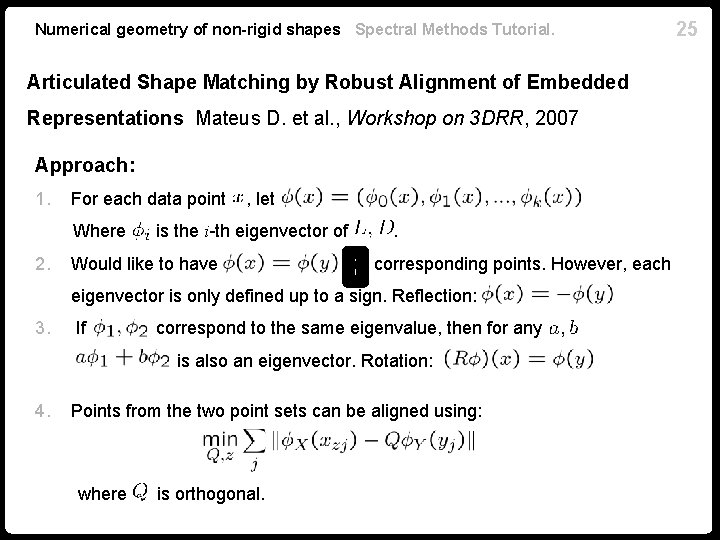
Numerical geometry of non-rigid shapes Spectral Methods Tutorial. Articulated Shape Matching by Robust Alignment of Embedded Representations Mateus D. et al. , Workshop on 3 DRR, 2007 Approach: 1. For each data point Where 2. , let is the i-th eigenvector of Would like to have . for corresponding points. However, each eigenvector is only defined up to a sign. Reflection: 3. If correspond to the same eigenvalue, then for any is also an eigenvector. Rotation: 4. Points from the two point sets can be aligned using: where is orthogonal. 25
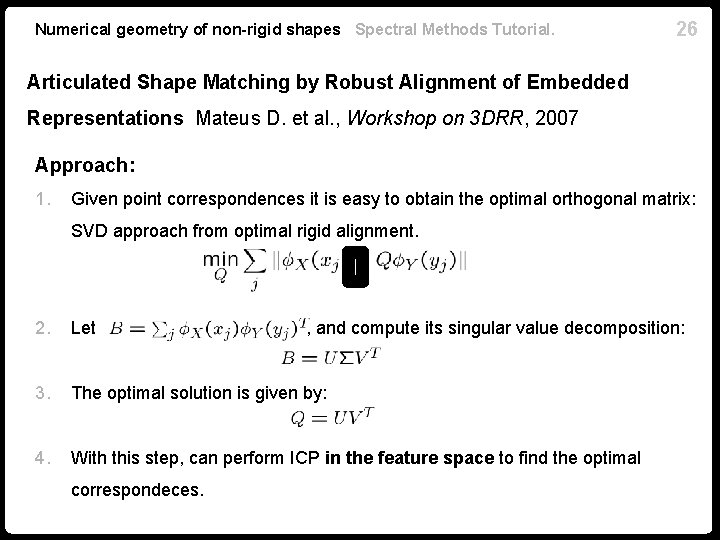
Numerical geometry of non-rigid shapes Spectral Methods Tutorial. 26 Articulated Shape Matching by Robust Alignment of Embedded Representations Mateus D. et al. , Workshop on 3 DRR, 2007 Approach: 1. Given point correspondences it is easy to obtain the optimal orthogonal matrix: SVD approach from optimal rigid alignment. 2. Let 3. The optimal solution is given by: 4. With this step, can perform ICP in the feature space to find the optimal correspondeces. , and compute its singular value decomposition:
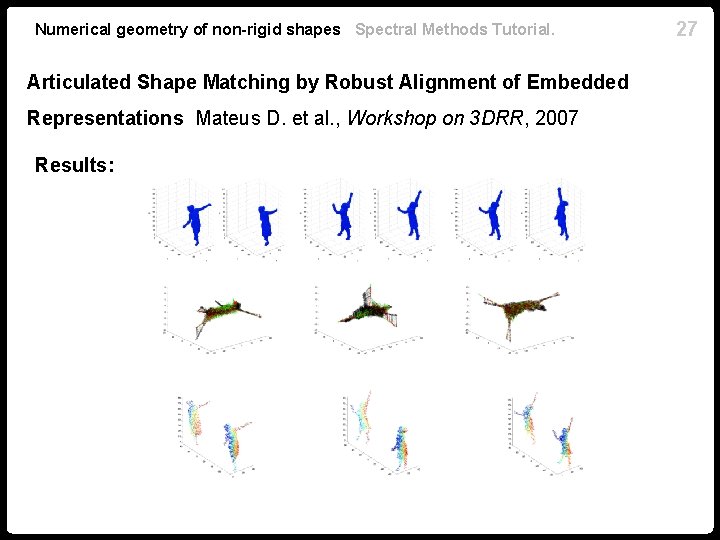
Numerical geometry of non-rigid shapes Spectral Methods Tutorial. Articulated Shape Matching by Robust Alignment of Embedded Representations Mateus D. et al. , Workshop on 3 DRR, 2007 Results: 27
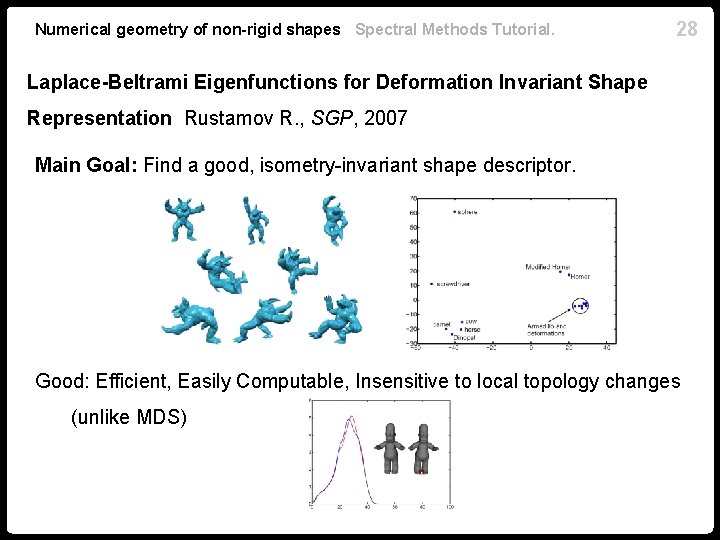
Numerical geometry of non-rigid shapes Spectral Methods Tutorial. 28 Laplace-Beltrami Eigenfunctions for Deformation Invariant Shape Representation Rustamov R. , SGP, 2007 Main Goal: Find a good, isometry-invariant shape descriptor. Good: Efficient, Easily Computable, Insensitive to local topology changes (unlike MDS)
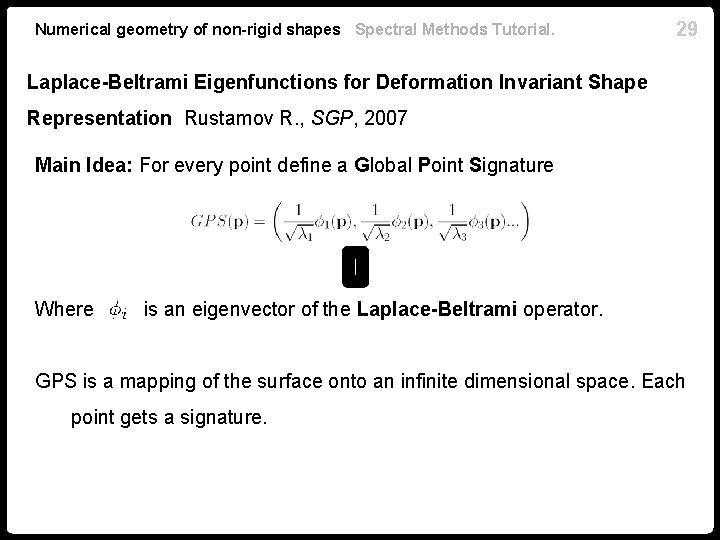
Numerical geometry of non-rigid shapes Spectral Methods Tutorial. 29 Laplace-Beltrami Eigenfunctions for Deformation Invariant Shape Representation Rustamov R. , SGP, 2007 Main Idea: For every point define a Global Point Signature Where is an eigenvector of the Laplace-Beltrami operator. GPS is a mapping of the surface onto an infinite dimensional space. Each point gets a signature.
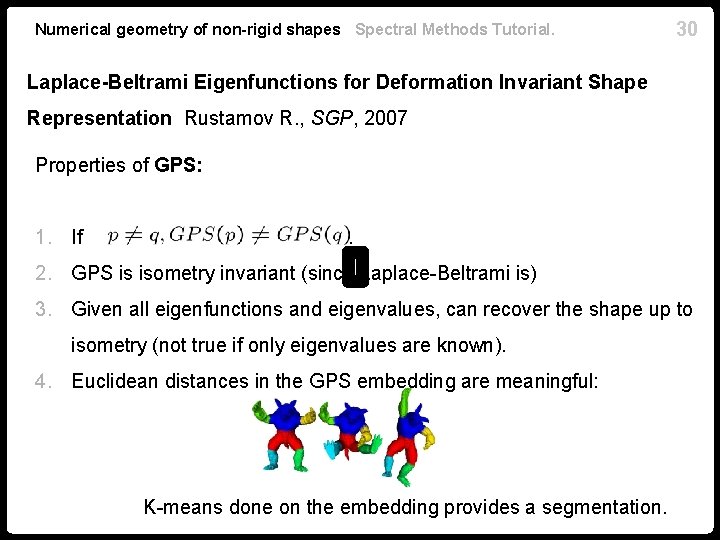
Numerical geometry of non-rigid shapes Spectral Methods Tutorial. 30 Laplace-Beltrami Eigenfunctions for Deformation Invariant Shape Representation Rustamov R. , SGP, 2007 Properties of GPS: 1. If . 2. GPS is isometry invariant (since Laplace-Beltrami is) 3. Given all eigenfunctions and eigenvalues, can recover the shape up to isometry (not true if only eigenvalues are known). 4. Euclidean distances in the GPS embedding are meaningful: K-means done on the embedding provides a segmentation.
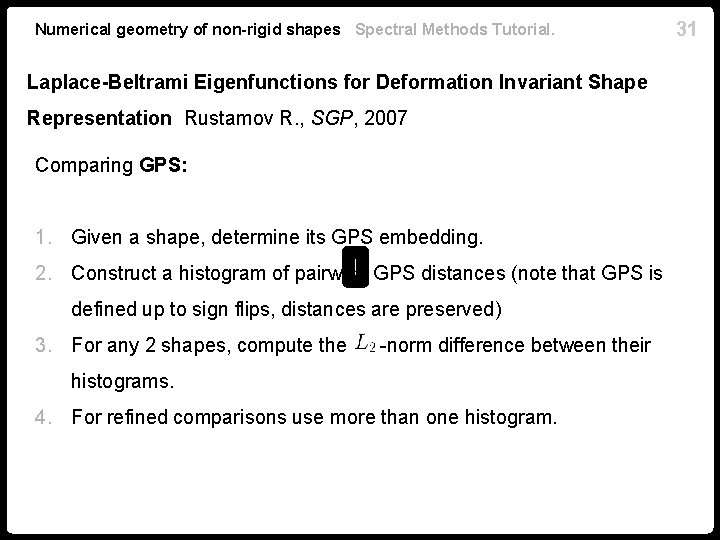
Numerical geometry of non-rigid shapes Spectral Methods Tutorial. Laplace-Beltrami Eigenfunctions for Deformation Invariant Shape Representation Rustamov R. , SGP, 2007 Comparing GPS: 1. Given a shape, determine its GPS embedding. 2. Construct a histogram of pairwise GPS distances (note that GPS is defined up to sign flips, distances are preserved) 3. For any 2 shapes, compute the -norm difference between their histograms. 4. For refined comparisons use more than one histogram. 31
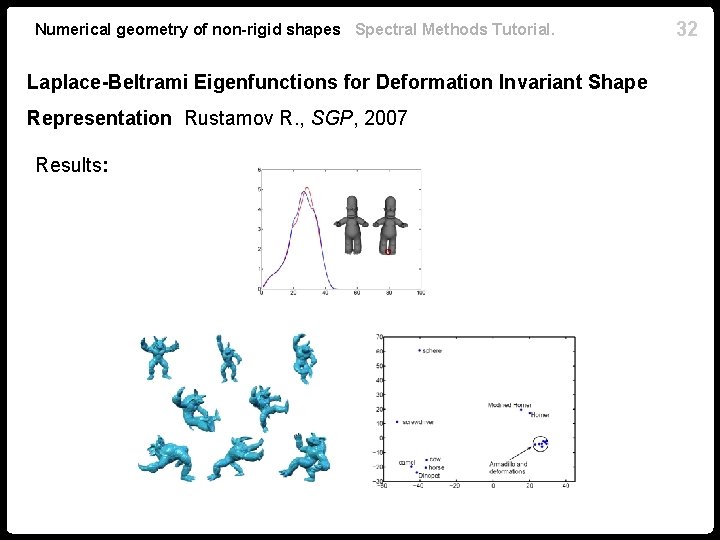
Numerical geometry of non-rigid shapes Spectral Methods Tutorial. Laplace-Beltrami Eigenfunctions for Deformation Invariant Shape Representation Rustamov R. , SGP, 2007 Results: 32
Numerical geometry of non-rigid shapes Spectral Methods Tutorial. 33 Conclusions 1. Kernel methods attempt to embed the shape into a feature space, that can be manipulated more easily. 2. Laplacian embedding is useful because of its isometry-invariance. Can be used for comparing non-rigid shapes under isometric deformations. 3. Sign flipping and repeated eigenvalues can cause difficulties (no canonical way to chose them). Limitations: 1. Embeddings are not necessarily stable or mesh independent. 2. Difficult to compute for large meshes (millions of points) 3. Both topological and geometric stability is not well understood.