
Numerical geometry of nonrigid shapes Nonrigid similarity Alexander
- Slides: 36
Numerical geometry of non-rigid shapes Non-rigid similarity Alexander Bronstein, Michael Bronstein, Ron Kimmel © 2007 All rights reserved. Web: tosca. technion. ac. il 1
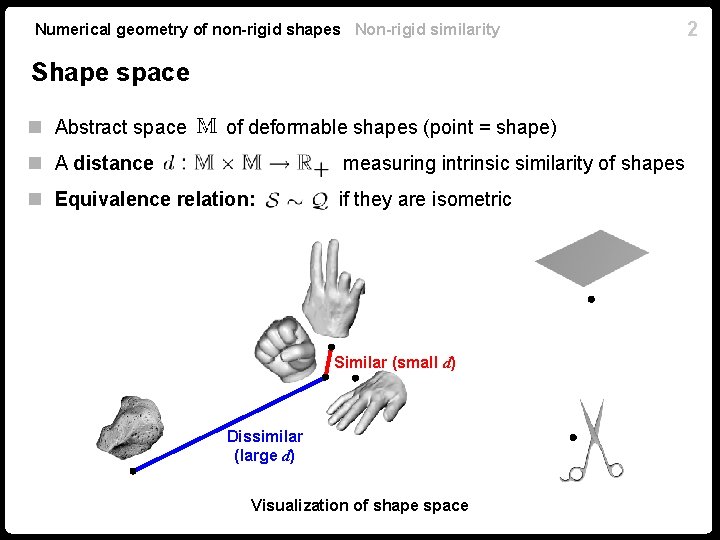
Numerical geometry of non-rigid shapes Non-rigid similarity Shape space n Abstract space of deformable shapes (point = shape) n A distance measuring intrinsic similarity of shapes n Equivalence relation: if they are isometric Similar (small d) Dissimilar (large d) Visualization of shape space 2
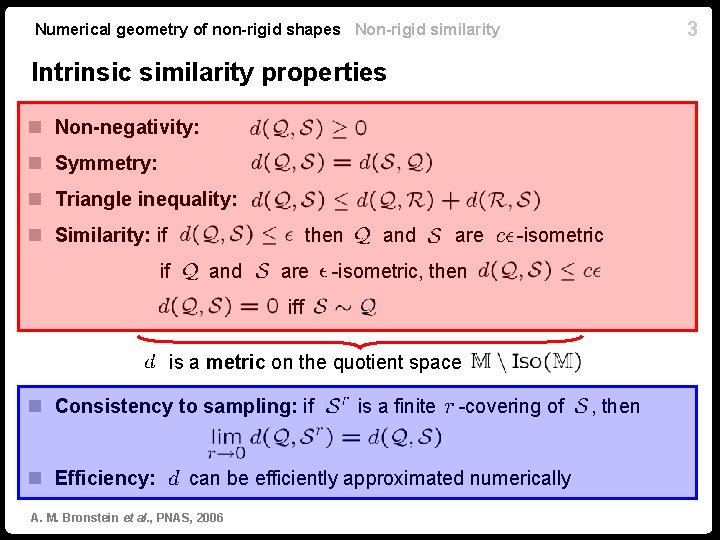
3 Numerical geometry of non-rigid shapes Non-rigid similarity Intrinsic similarity properties n Non-negativity: n Symmetry: n Triangle inequality: n Similarity: if then if and are -isometric, then iff is a metric on the quotient space n Consistency to sampling: if n Efficiency: is a finite -covering of can be efficiently approximated numerically A. M. Bronstein et al. , PNAS, 2006 , then
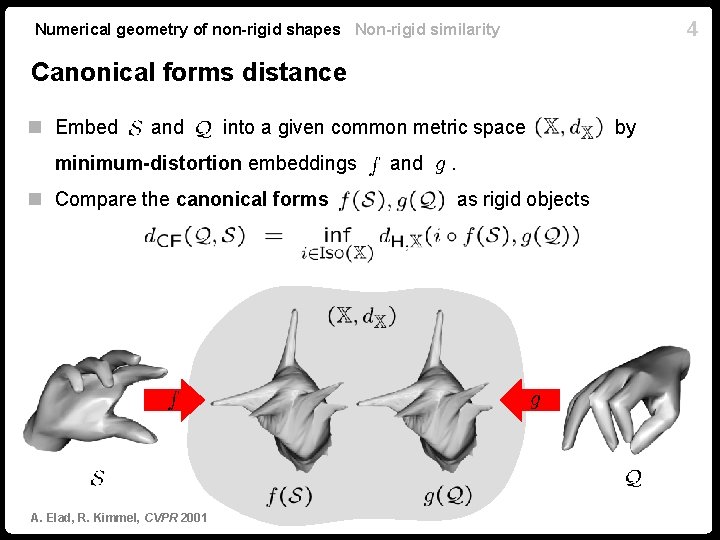
4 Numerical geometry of non-rigid shapes Non-rigid similarity Canonical forms distance n Embed and into a given common metric space minimum-distortion embeddings n Compare the canonical forms A. Elad, R. Kimmel, CVPR 2001 and . as rigid objects by
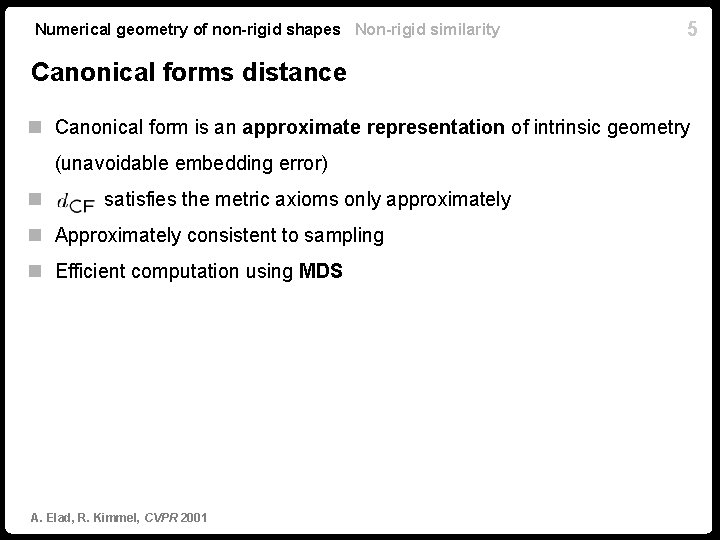
Numerical geometry of non-rigid shapes Non-rigid similarity 5 Canonical forms distance n Canonical form is an approximate representation of intrinsic geometry (unavoidable embedding error) n satisfies the metric axioms only approximately n Approximately consistent to sampling n Efficient computation using MDS A. Elad, R. Kimmel, CVPR 2001
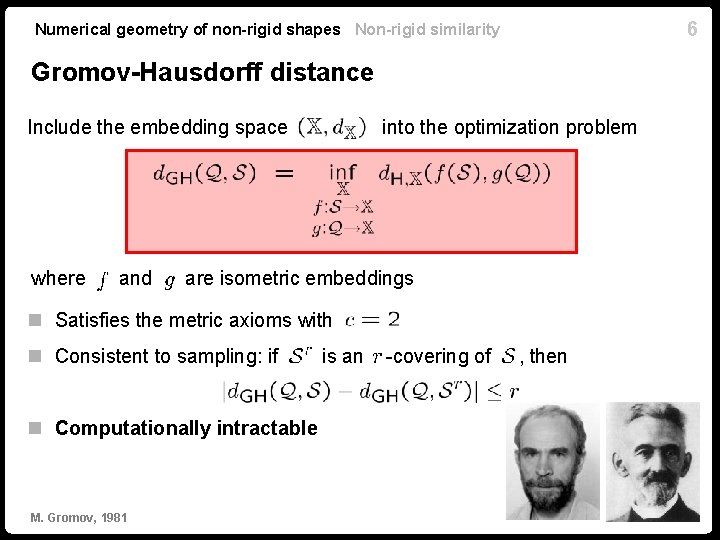
6 Numerical geometry of non-rigid shapes Non-rigid similarity Gromov-Hausdorff distance Include the embedding space where and into the optimization problem are isometric embeddings n Satisfies the metric axioms with n Consistent to sampling: if n Computationally intractable M. Gromov, 1981 is an -covering of , then
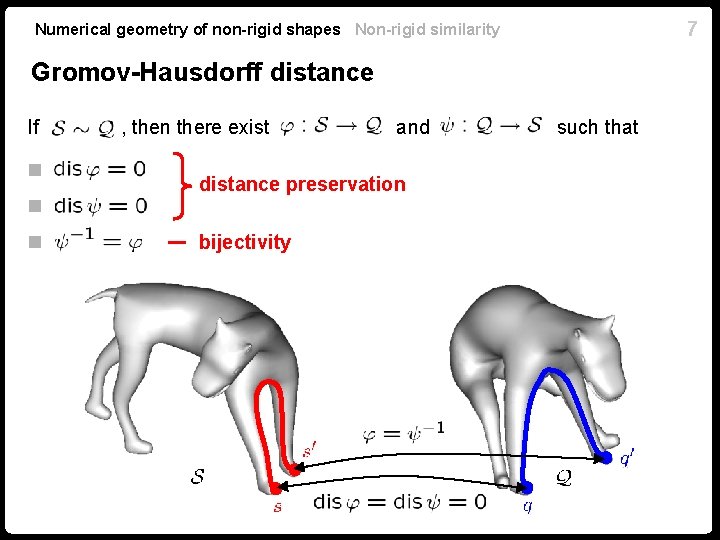
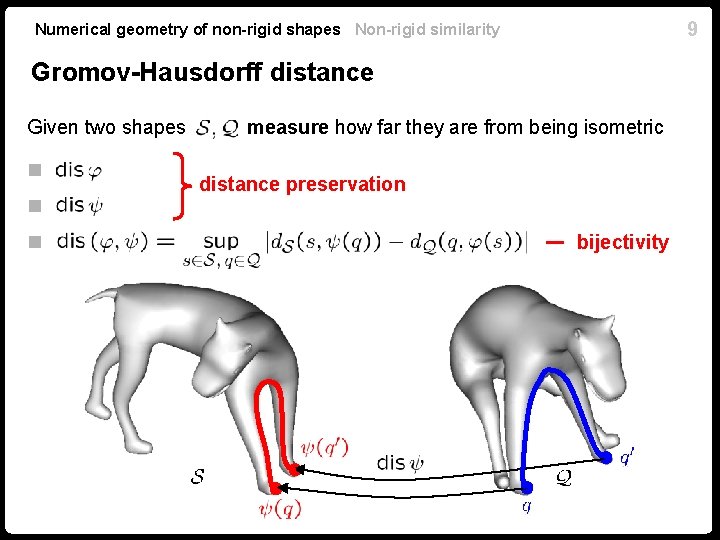
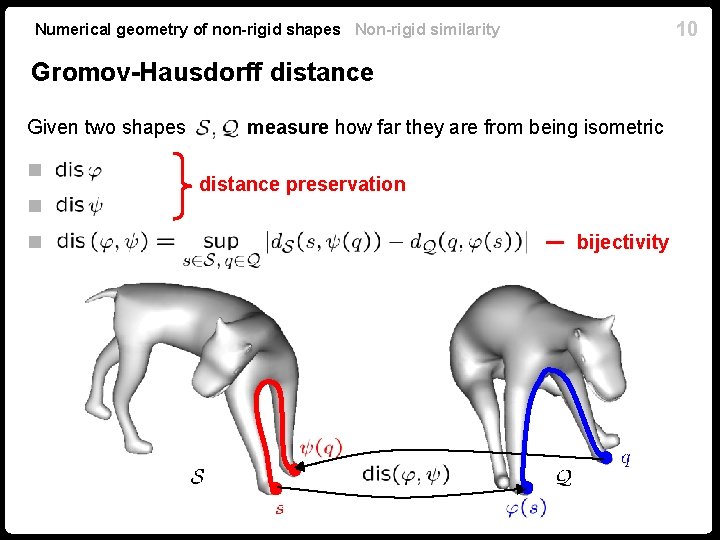
7 Numerical geometry of non-rigid shapes Non-rigid similarity Gromov-Hausdorff distance If n. n n , then there exist and distance preservation bijectivity such that
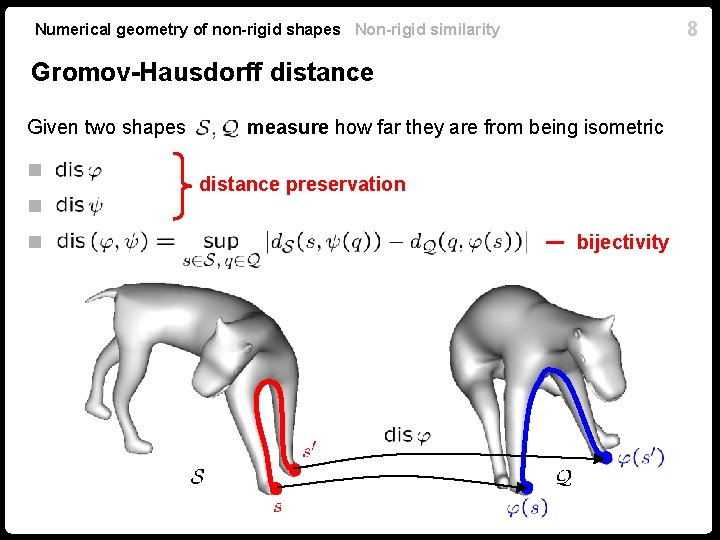
8 Numerical geometry of non-rigid shapes Non-rigid similarity Gromov-Hausdorff distance Given two shapes n. n n measure how far they are from being isometric distance preservation bijectivity
9 Numerical geometry of non-rigid shapes Non-rigid similarity Gromov-Hausdorff distance Given two shapes n. n n measure how far they are from being isometric distance preservation bijectivity
10 Numerical geometry of non-rigid shapes Non-rigid similarity Gromov-Hausdorff distance Given two shapes n. n n measure how far they are from being isometric distance preservation bijectivity
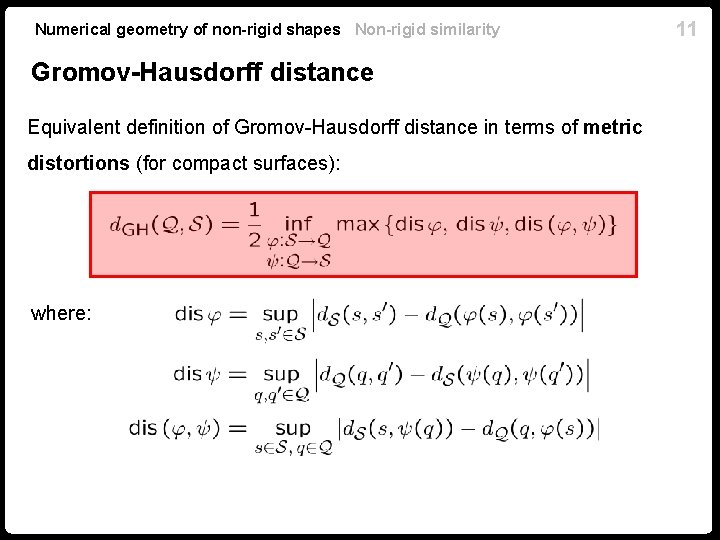
Numerical geometry of non-rigid shapes Non-rigid similarity Gromov-Hausdorff distance Equivalent definition of Gromov-Hausdorff distance in terms of metric distortions (for compact surfaces): where: 11
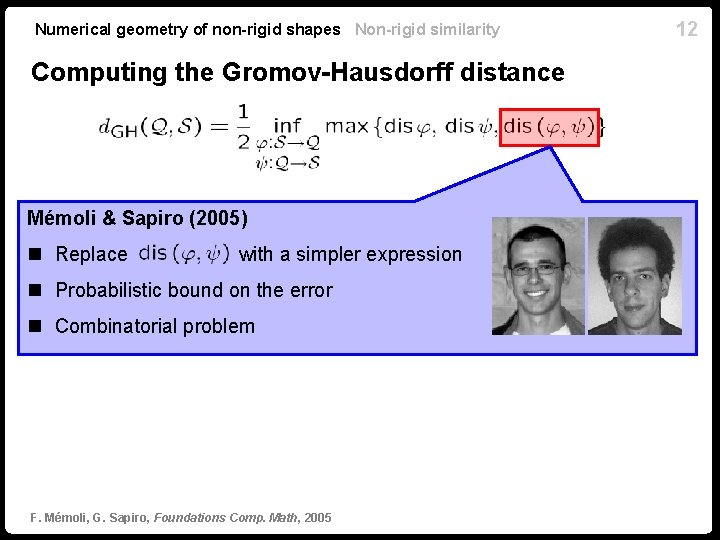
Numerical geometry of non-rigid shapes Non-rigid similarity Computing the Gromov-Hausdorff distance Mémoli & Sapiro (2005) n Replace with a simpler expression n Probabilistic bound on the error n Combinatorial problem F. Mémoli, G. Sapiro, Foundations Comp. Math, 2005 12
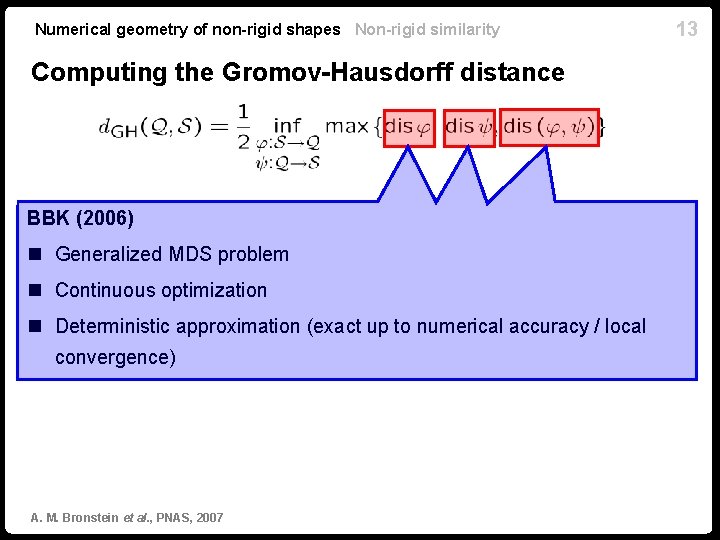
Numerical geometry of non-rigid shapes Non-rigid similarity Computing the Gromov-Hausdorff distance BBK (2006) n Generalized MDS problem n Continuous optimization n Deterministic approximation (exact up to numerical accuracy / local convergence) A. M. Bronstein et al. , PNAS, 2007 13
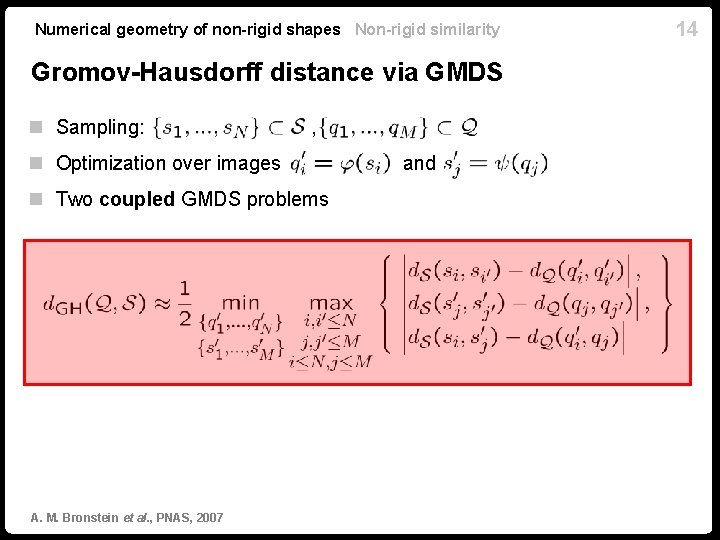
Numerical geometry of non-rigid shapes Non-rigid similarity Gromov-Hausdorff distance via GMDS n Sampling: , n Optimization over images n Two coupled GMDS problems A. M. Bronstein et al. , PNAS, 2007 and 14
Numerical geometry of non-rigid shapes Non-rigid similarity Gromov-Hausdorff distance via GMDS (cont) n Equivalent formulation as a constrained problem using an artificial variable A. M. Bronstein et al. , PNAS, 2007 15
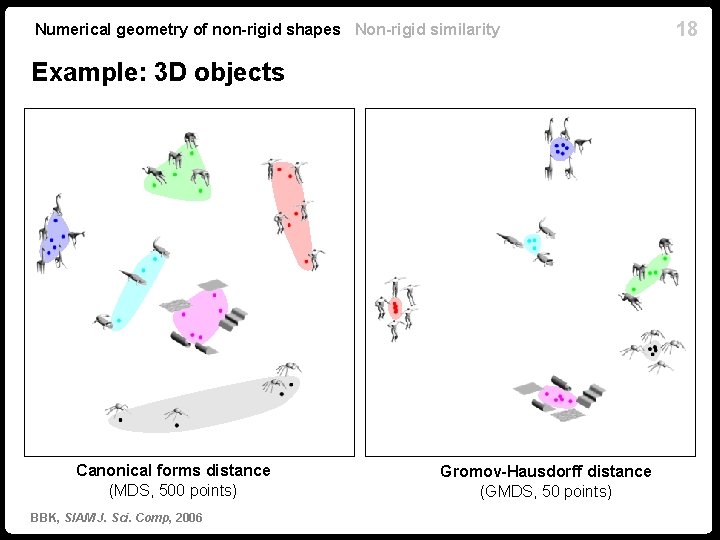
Numerical geometry of non-rigid shapes Non-rigid similarity Gromov-Hausdorff vs. canonical forms CANONICAL FORMS n Two stages: embedding and comparison n Embedding error is a problem degrading accuracy n Many points (~1000) are required for accurate comparison n Computational core: MDS GROMOV-HAUSDORFF n One stage: generalized embedding n Embedding error is the measure of similarity n Few points (~10) are required to compute accurate distortion n Computational core: GMDS 16
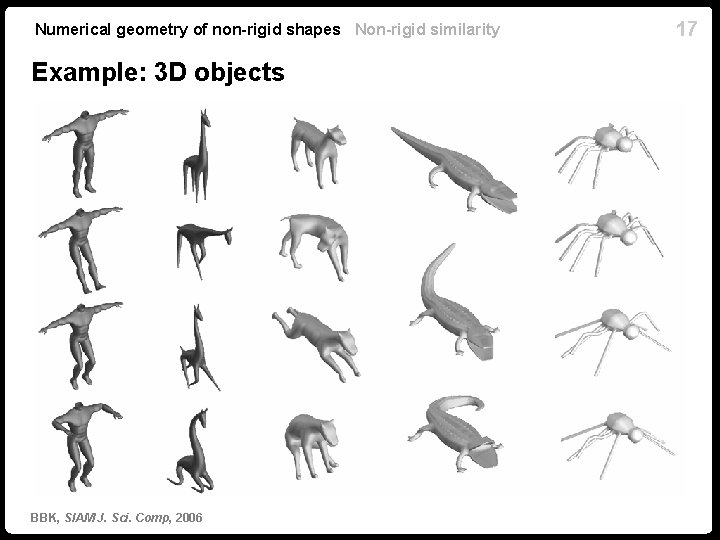
Numerical geometry of non-rigid shapes Non-rigid similarity Example: 3 D objects BBK, SIAM J. Sci. Comp, 2006 17
Numerical geometry of non-rigid shapes Non-rigid similarity Example: 3 D objects Canonical forms distance (MDS, 500 points) BBK, SIAM J. Sci. Comp, 2006 Gromov-Hausdorff distance (GMDS, 50 points) 18
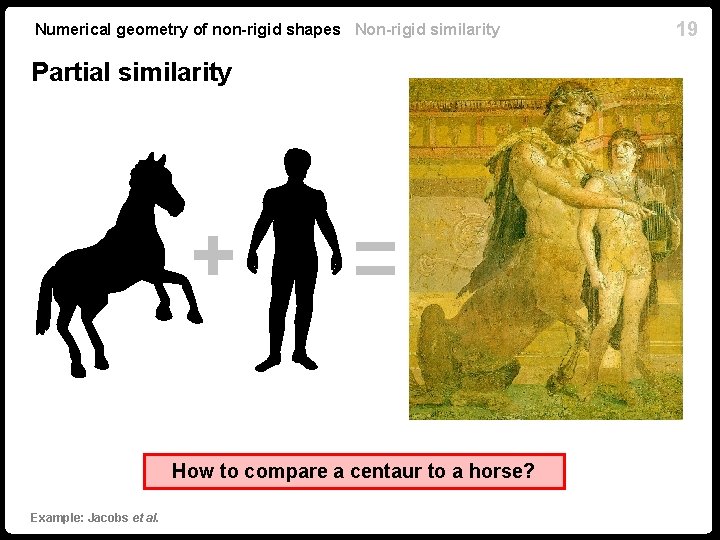
Numerical geometry of non-rigid shapes Non-rigid similarity Partial similarity How to compare a centaur to a horse? Example: Jacobs et al. 19
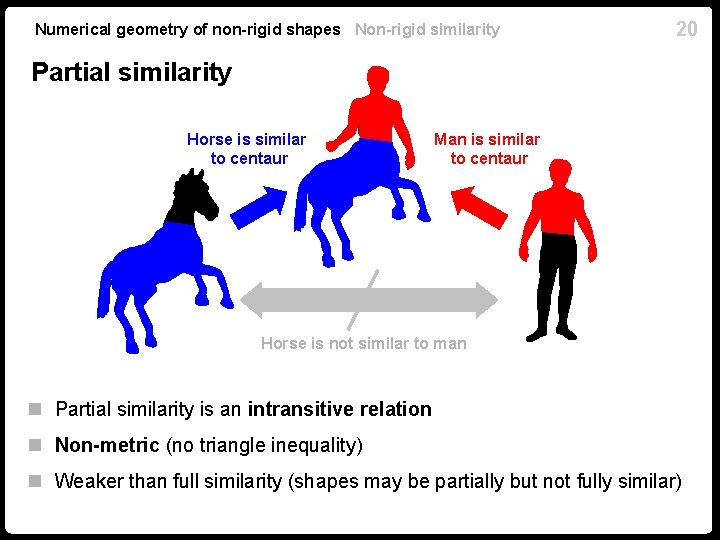
Numerical geometry of non-rigid shapes Non-rigid similarity 20 Partial similarity Horse is similar to centaur Man is similar to centaur Horse is not similar to man n Partial similarity is an intransitive relation n Non-metric (no triangle inequality) n Weaker than full similarity (shapes may be partially but not fully similar)
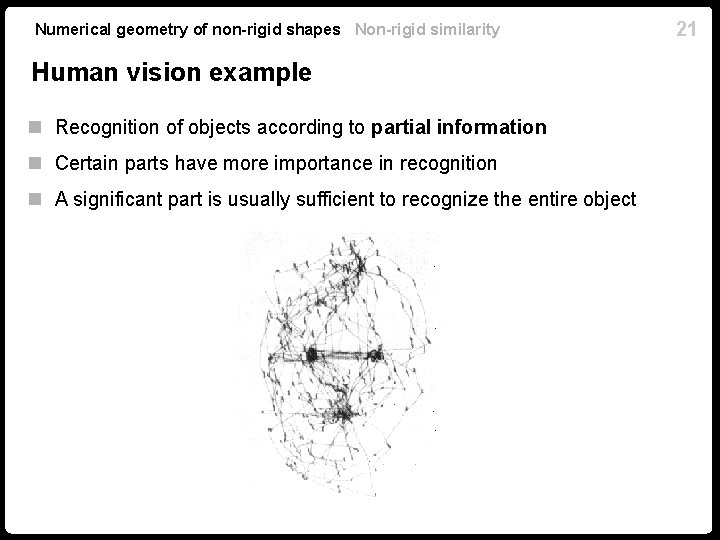
Numerical geometry of non-rigid shapes Non-rigid similarity Human vision example n Recognition of objects according to partial information n Certain parts have more importance in recognition n A significant part is usually sufficient to recognize the entire object ? 21
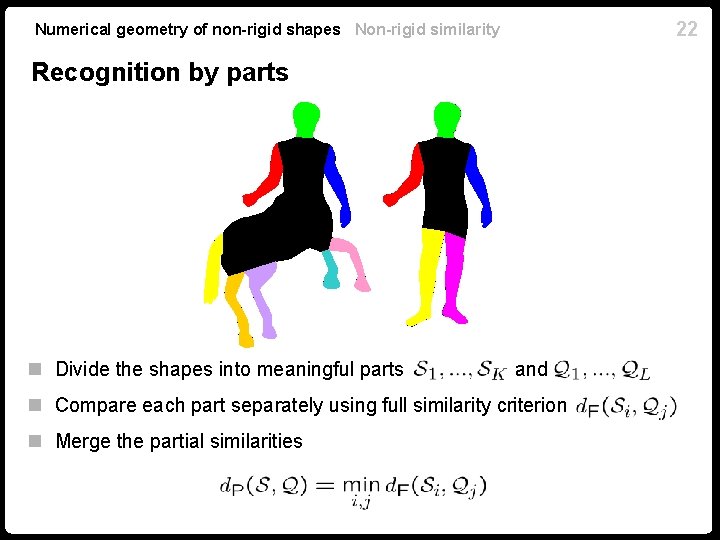
22 Numerical geometry of non-rigid shapes Non-rigid similarity Recognition by parts n Divide the shapes into meaningful parts and n Compare each part separately using full similarity criterion n Merge the partial similarities
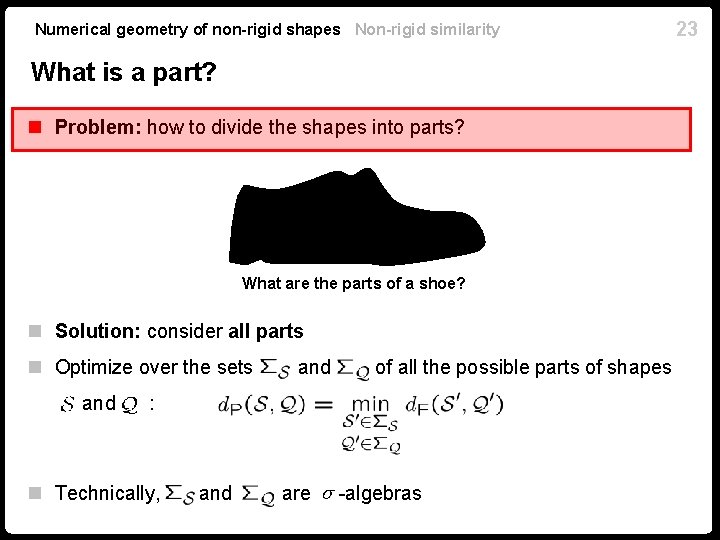
Numerical geometry of non-rigid shapes Non-rigid similarity What is a part? n Problem: how to divide the shapes into parts? What are the parts of a shoe? n Solution: consider all parts n Optimize over the sets and of all the possible parts of shapes : n Technically, and are -algebras 23
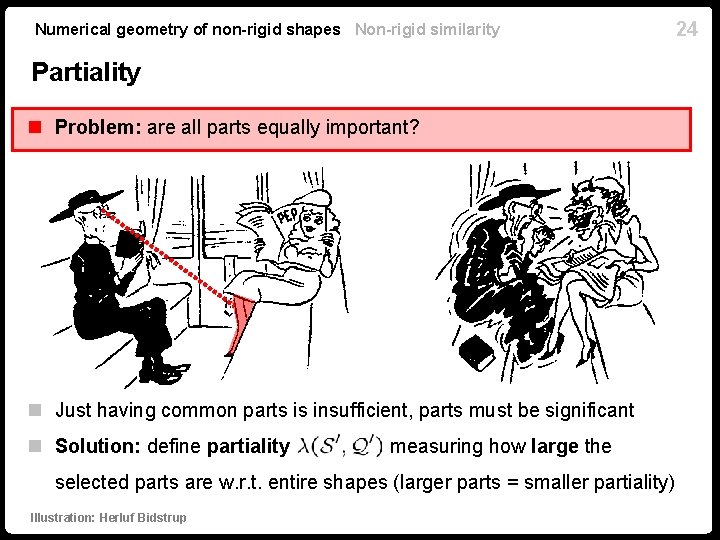
Numerical geometry of non-rigid shapes Non-rigid similarity Partiality n Problem: are all parts equally important? n Just having common parts is insufficient, parts must be significant n Solution: define partiality measuring how large the selected parts are w. r. t. entire shapes (larger parts = smaller partiality) Illustration: Herluf Bidstrup 24
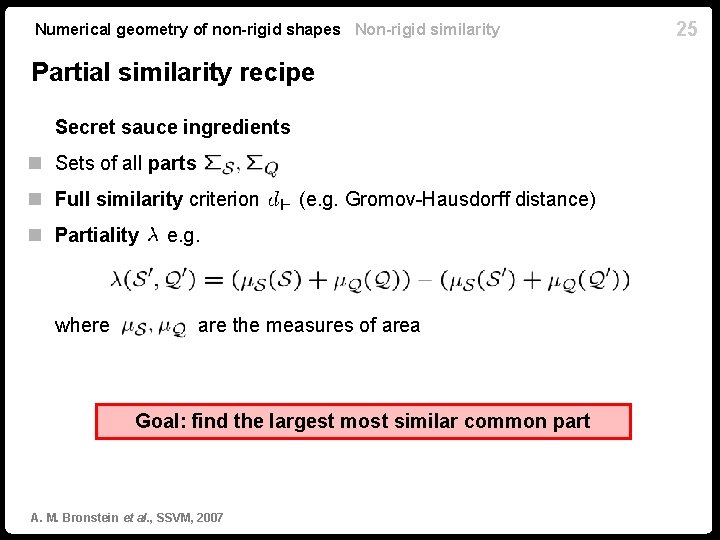
Numerical geometry of non-rigid shapes Non-rigid similarity Partial similarity recipe Secret sauce ingredients n Sets of all parts n Full similarity criterion n Partiality where (e. g. Gromov-Hausdorff distance) e. g. are the measures of area Goal: find the largest most similar common part A. M. Bronstein et al. , SSVM, 2007 25
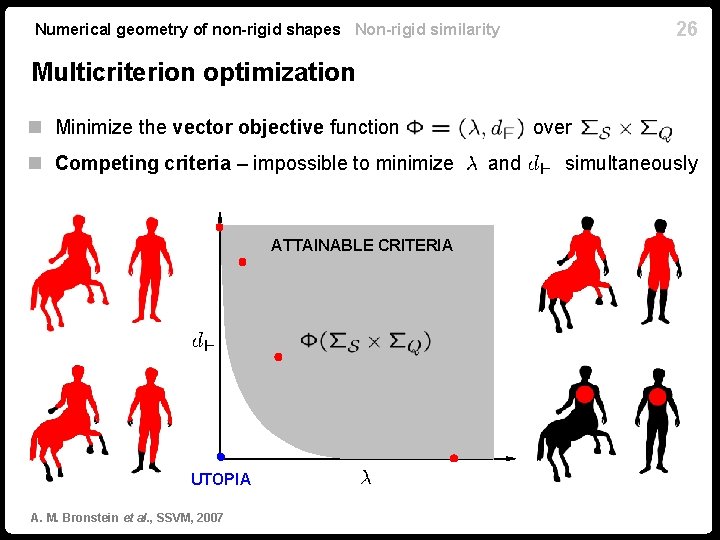
26 Numerical geometry of non-rigid shapes Non-rigid similarity Multicriterion optimization n Minimize the vector objective function n Competing criteria – impossible to minimize ATTAINABLE CRITERIA UTOPIA A. M. Bronstein et al. , SSVM, 2007 over and simultaneously
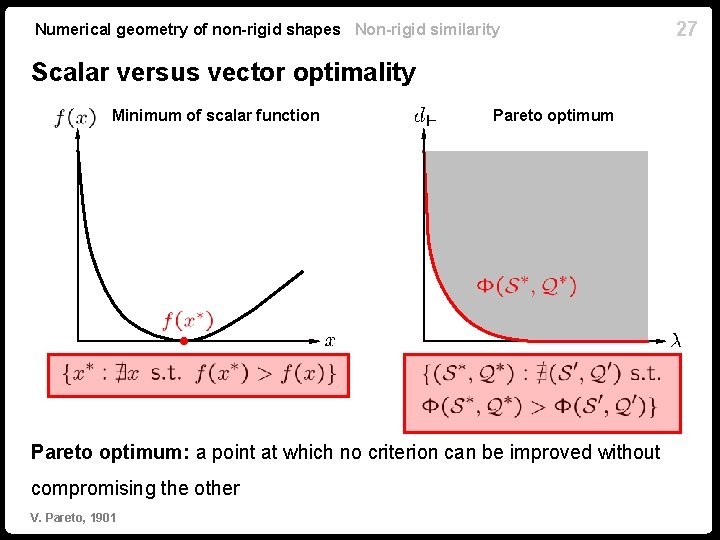
Numerical geometry of non-rigid shapes Non-rigid similarity Scalar versus vector optimality Minimum of scalar function Pareto optimum: a point at which no criterion can be improved without compromising the other V. Pareto, 1901 27
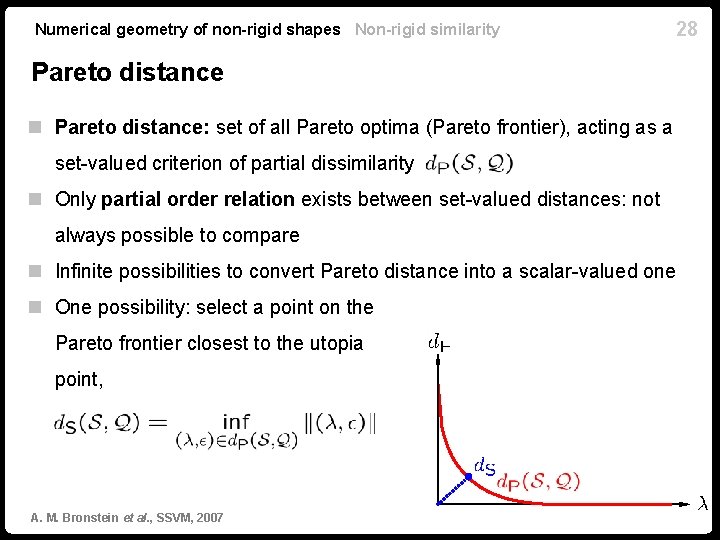
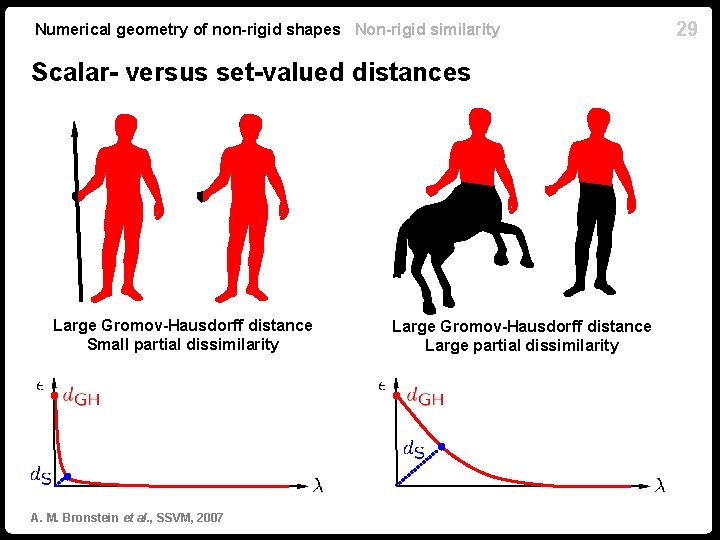
Numerical geometry of non-rigid shapes Non-rigid similarity 28 Pareto distance n Pareto distance: set of all Pareto optima (Pareto frontier), acting as a set-valued criterion of partial dissimilarity n Only partial order relation exists between set-valued distances: not always possible to compare n Infinite possibilities to convert Pareto distance into a scalar-valued one n One possibility: select a point on the Pareto frontier closest to the utopia point, A. M. Bronstein et al. , SSVM, 2007
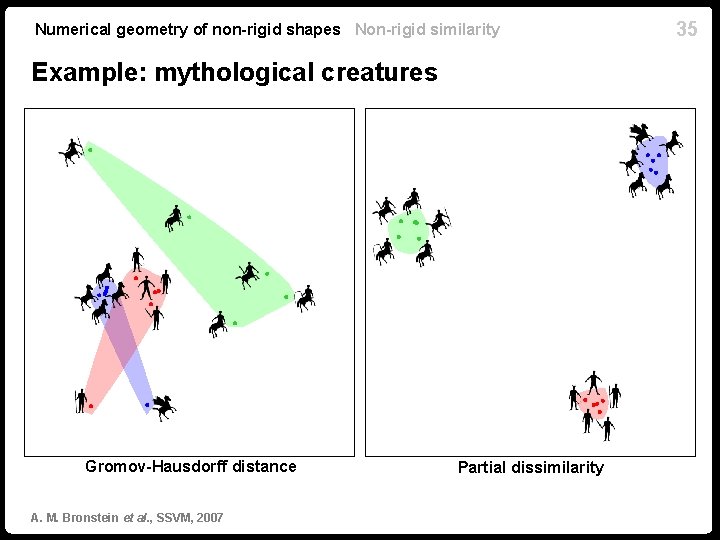
Numerical geometry of non-rigid shapes Non-rigid similarity Scalar- versus set-valued distances Large Gromov-Hausdorff distance Small partial dissimilarity A. M. Bronstein et al. , SSVM, 2007 Large Gromov-Hausdorff distance Large partial dissimilarity 29
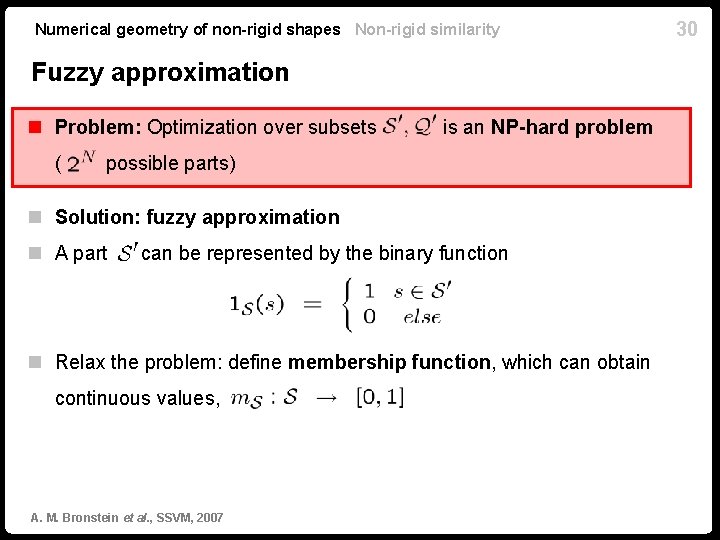
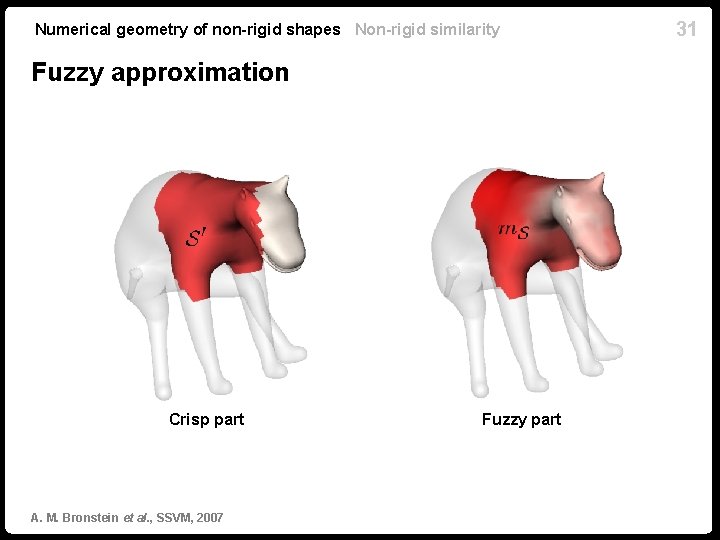
Numerical geometry of non-rigid shapes Non-rigid similarity Fuzzy approximation n Problem: Optimization over subsets ( is an NP-hard problem possible parts) n Solution: fuzzy approximation n A part can be represented by the binary function n Relax the problem: define membership function, which can obtain continuous values, A. M. Bronstein et al. , SSVM, 2007 30
Numerical geometry of non-rigid shapes Non-rigid similarity Fuzzy approximation Crisp part A. M. Bronstein et al. , SSVM, 2007 Fuzzy part 31
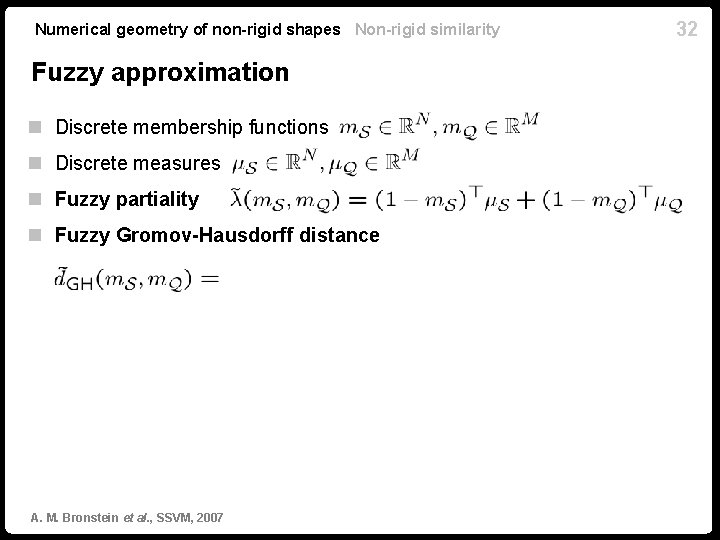
Numerical geometry of non-rigid shapes Non-rigid similarity Fuzzy approximation n Discrete membership functions n Discrete measures n Fuzzy partiality n Fuzzy Gromov-Hausdorff distance A. M. Bronstein et al. , SSVM, 2007 32
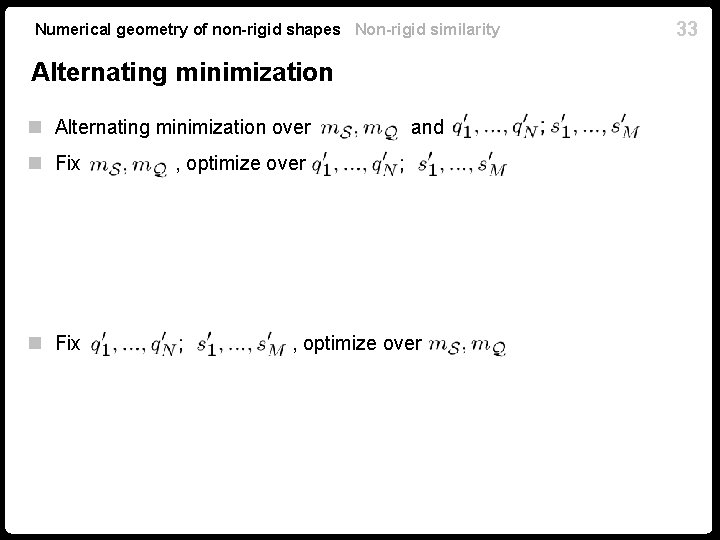
Numerical geometry of non-rigid shapes Non-rigid similarity Alternating minimization n Alternating minimization over n Fix and , optimize over 33
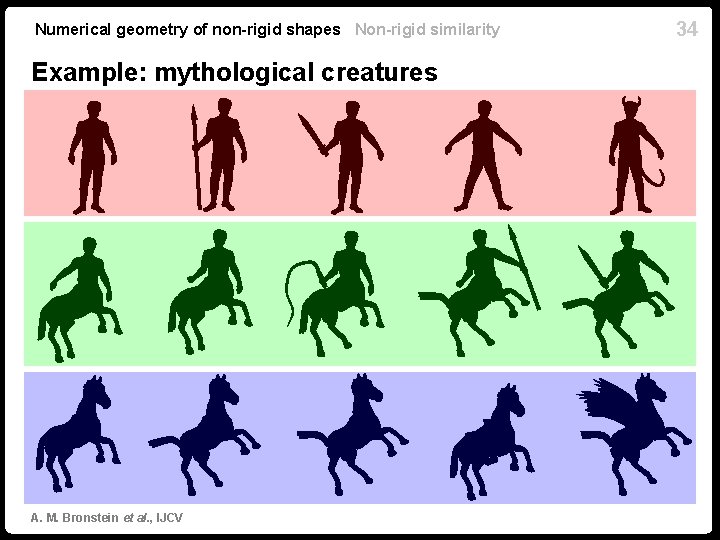
Numerical geometry of non-rigid shapes Non-rigid similarity Example: mythological creatures A. M. Bronstein et al. , IJCV 34
Numerical geometry of non-rigid shapes Non-rigid similarity Example: mythological creatures Gromov-Hausdorff distance A. M. Bronstein et al. , SSVM, 2007 Partial dissimilarity 35
Numerical geometry of non-rigid shapes Non-rigid similarity Conclusions so far n Axiomatic construction of isometry-invariant distances on the space of non-rigid shapes n Gromov-Hausdorff computation using GMDS n Pareto formalism for partial similarity of shapes 36