
Numerical geometry of nonrigid shapes Differential geometry I

- Slides: 31
Numerical geometry of non-rigid shapes Differential geometry I 1 Differential geometry I Lecture 1 © Alexander & Michael Bronstein tosca. cs. technion. ac. il/book Numerical geometry of non-rigid shapes Stanford University, Winter 2009
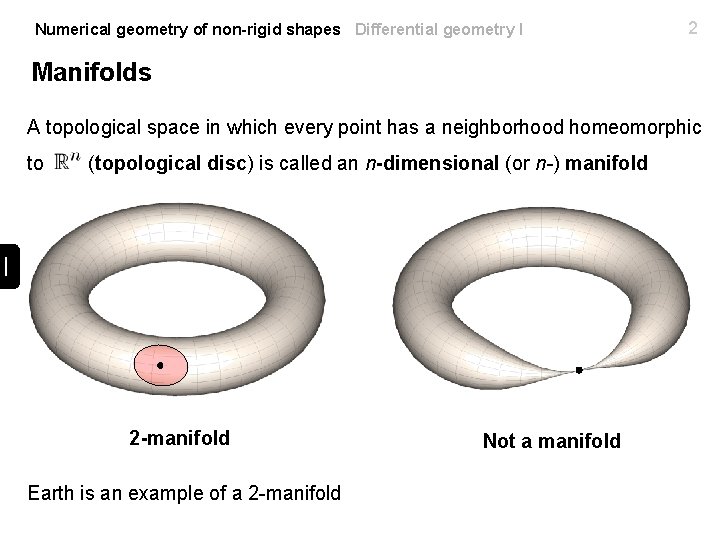
Numerical geometry of non-rigid shapes Differential geometry I 2 Manifolds A topological space in which every point has a neighborhood homeomorphic to (topological disc) is called an n-dimensional (or n-) manifold 2 -manifold Earth is an example of a 2 -manifold Not a manifold
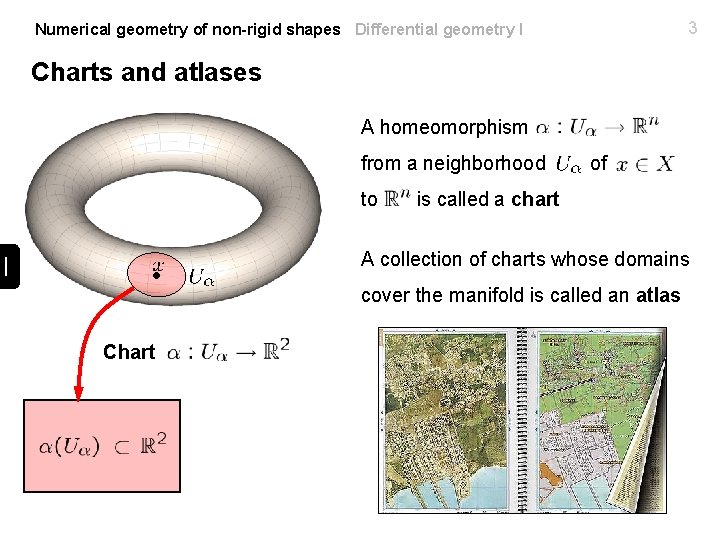
3 Numerical geometry of non-rigid shapes Differential geometry I Charts and atlases A homeomorphism from a neighborhood to of is called a chart A collection of charts whose domains cover the manifold is called an atlas Chart
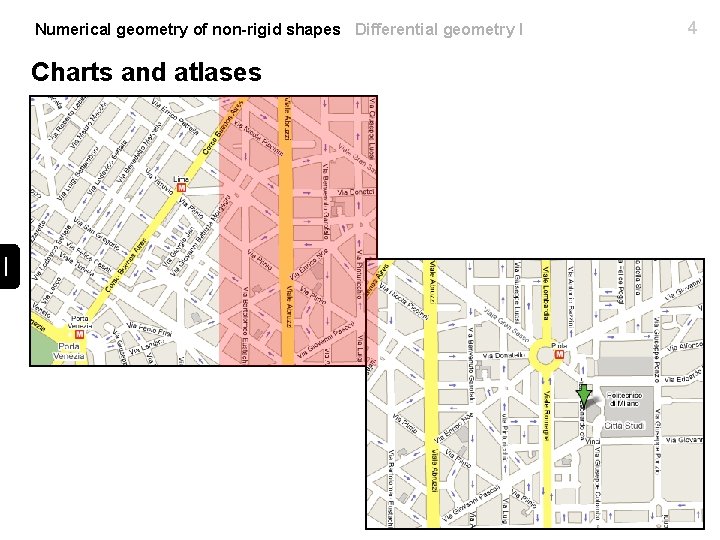
Numerical geometry of non-rigid shapes Differential geometry I Charts and atlases 4
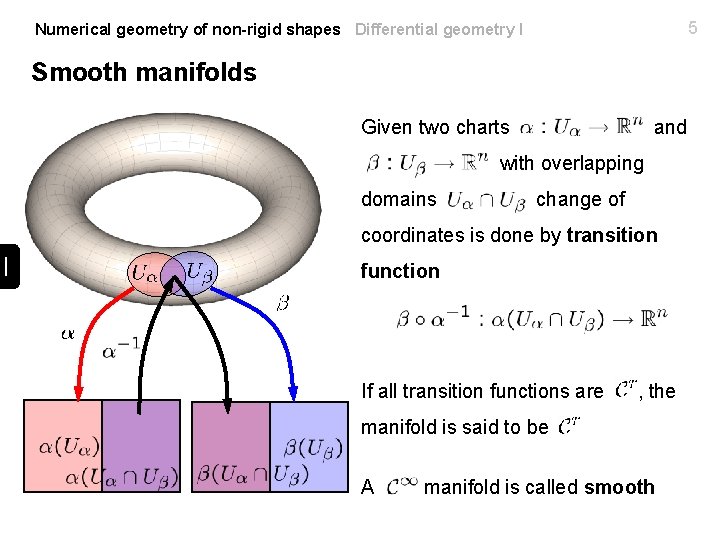
5 Numerical geometry of non-rigid shapes Differential geometry I Smooth manifolds Given two charts and with overlapping domains change of coordinates is done by transition function If all transition functions are , the manifold is said to be A manifold is called smooth
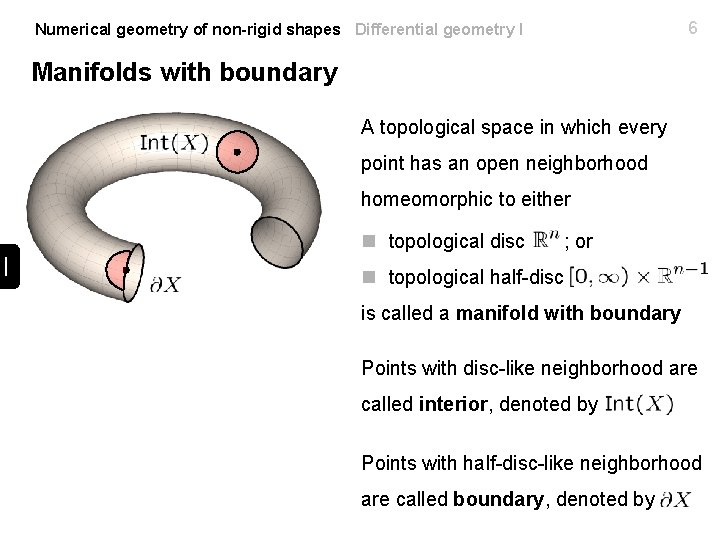
6 Numerical geometry of non-rigid shapes Differential geometry I Manifolds with boundary A topological space in which every point has an open neighborhood homeomorphic to either n topological disc ; or n topological half-disc is called a manifold with boundary Points with disc-like neighborhood are called interior, denoted by Points with half-disc-like neighborhood are called boundary, denoted by
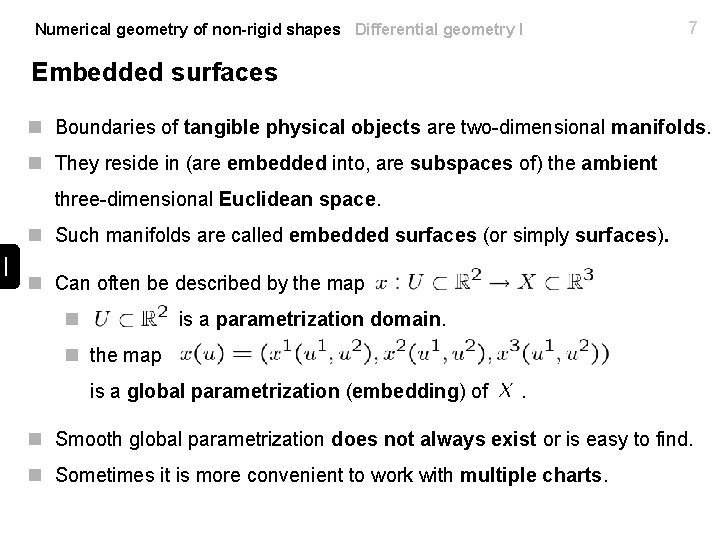
Numerical geometry of non-rigid shapes Differential geometry I 7 Embedded surfaces n Boundaries of tangible physical objects are two-dimensional manifolds. n They reside in (are embedded into, are subspaces of) the ambient three-dimensional Euclidean space. n Such manifolds are called embedded surfaces (or simply surfaces). n Can often be described by the map n is a parametrization domain. n the map is a global parametrization (embedding) of . n Smooth global parametrization does not always exist or is easy to find. n Sometimes it is more convenient to work with multiple charts.
Numerical geometry of non-rigid shapes Differential geometry I Parametrization of the Earth 8
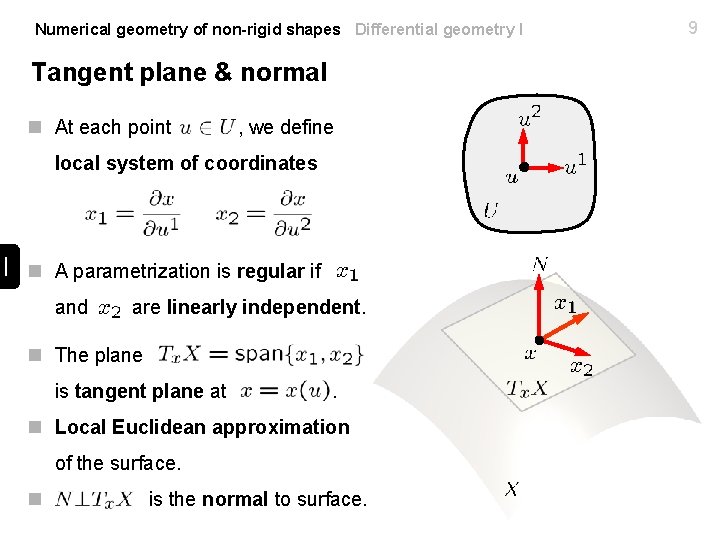
Numerical geometry of non-rigid shapes Differential geometry I Tangent plane & normal n At each point , we define local system of coordinates n A parametrization is regular if and are linearly independent. n The plane is tangent plane at . n Local Euclidean approximation of the surface. n is the normal to surface. 9
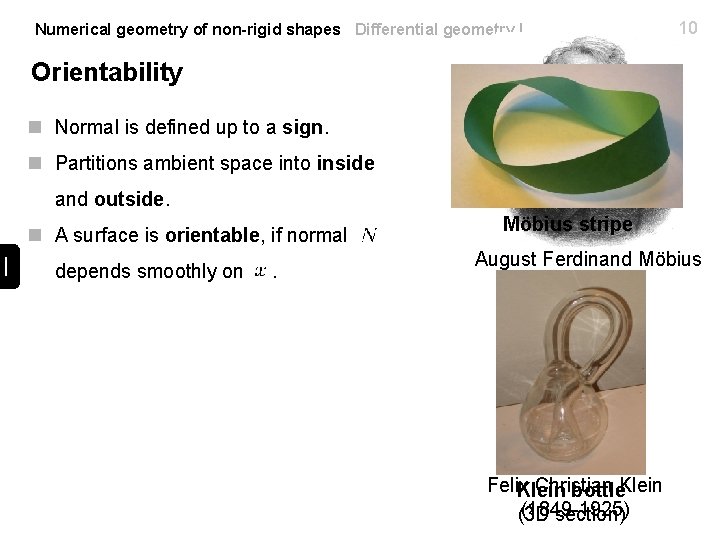
Numerical geometry of non-rigid shapes Differential geometry I 10 Orientability n Normal is defined up to a sign. n Partitions ambient space into inside and outside. n A surface is orientable, if normal depends smoothly on . Möbius stripe August Ferdinand Möbius (1790 -1868) Felix Christian Klein bottle. Klein (1849 -1925) (3 D section)
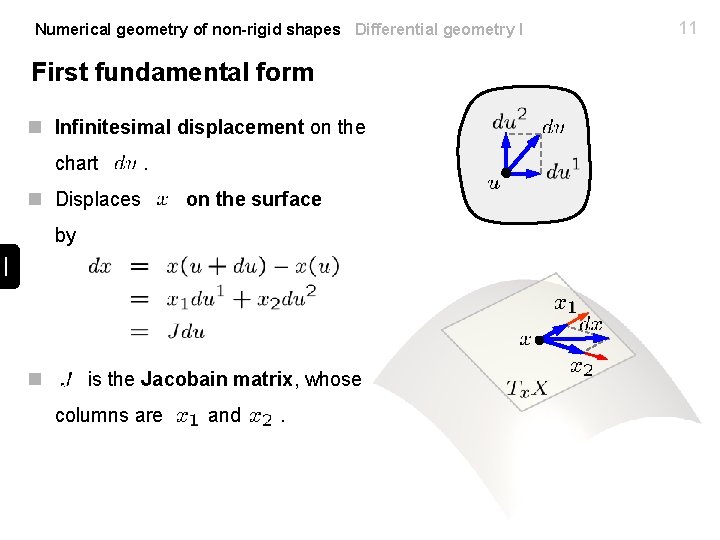
Numerical geometry of non-rigid shapes Differential geometry I First fundamental form n Infinitesimal displacement on the chart . n Displaces on the surface by n is the Jacobain matrix, whose columns are and . 11
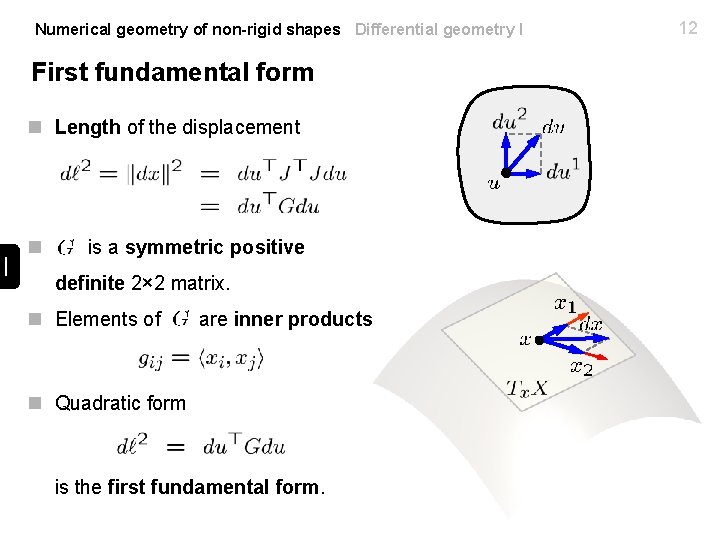
Numerical geometry of non-rigid shapes Differential geometry I First fundamental form n Length of the displacement n is a symmetric positive definite 2× 2 matrix. n Elements of are inner products n Quadratic form is the first fundamental form. 12
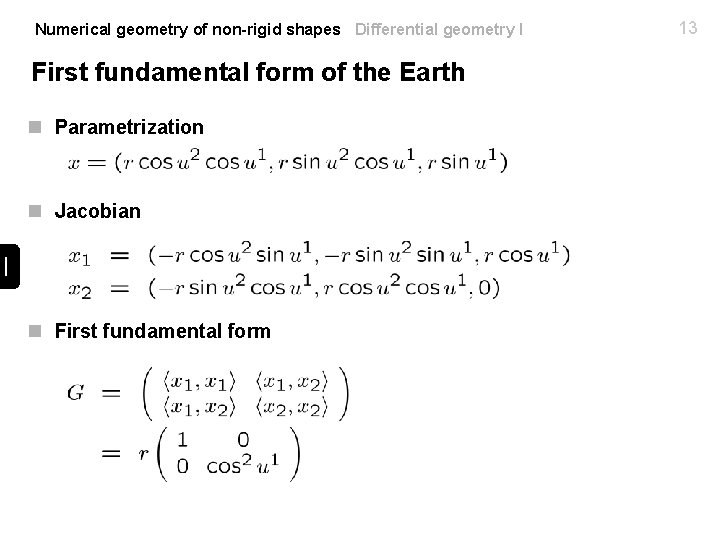
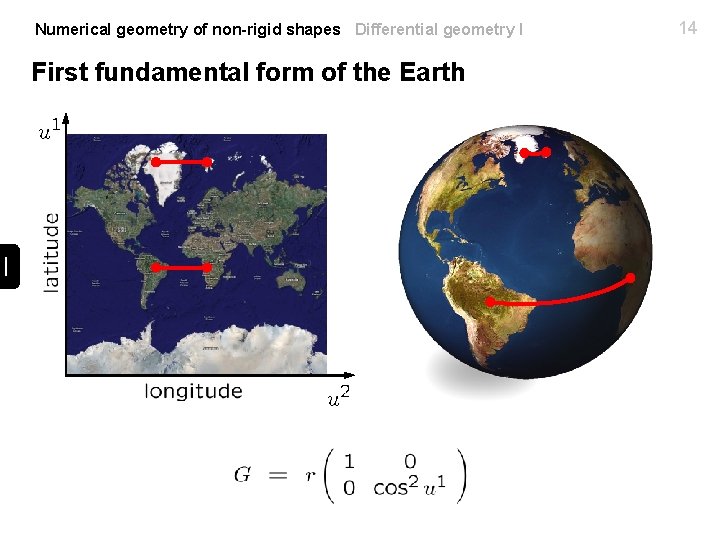
Numerical geometry of non-rigid shapes Differential geometry I First fundamental form of the Earth n Parametrization n Jacobian n First fundamental form 13
Numerical geometry of non-rigid shapes Differential geometry I First fundamental form of the Earth 14
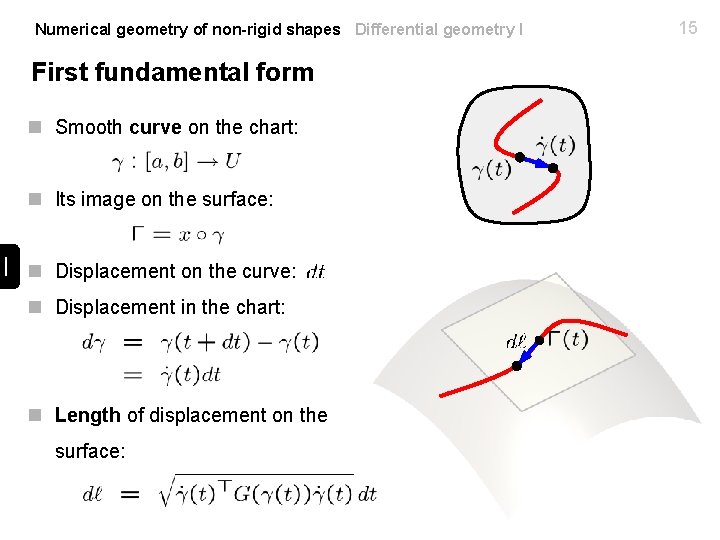
Numerical geometry of non-rigid shapes Differential geometry I First fundamental form n Smooth curve on the chart: n Its image on the surface: n Displacement on the curve: n Displacement in the chart: n Length of displacement on the surface: 15
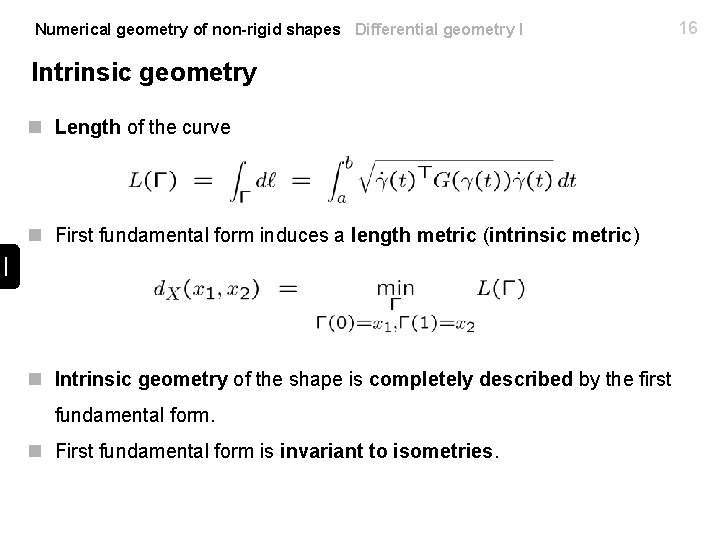
Numerical geometry of non-rigid shapes Differential geometry I Intrinsic geometry n Length of the curve n First fundamental form induces a length metric (intrinsic metric) n Intrinsic geometry of the shape is completely described by the first fundamental form. n First fundamental form is invariant to isometries. 16
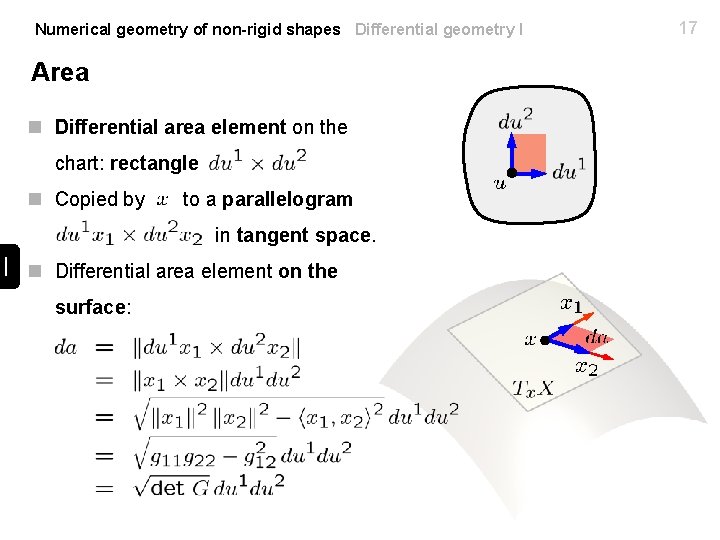
Numerical geometry of non-rigid shapes Differential geometry I Area n Differential area element on the chart: rectangle n Copied by to a parallelogram in tangent space. n Differential area element on the surface: 17
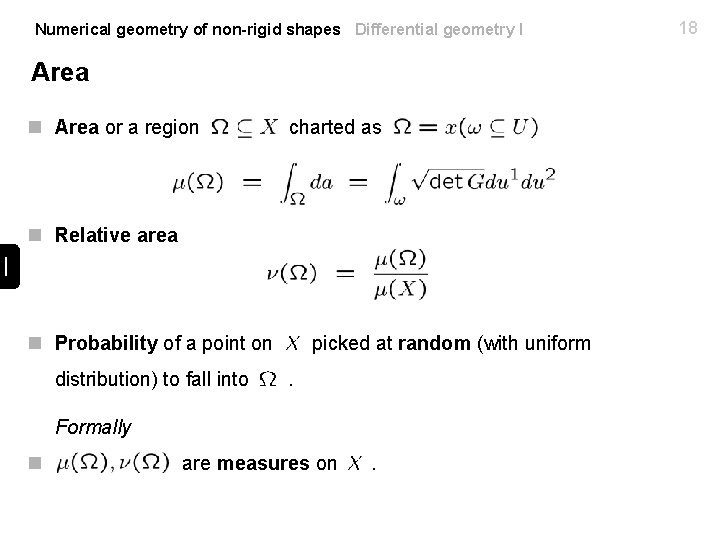
Numerical geometry of non-rigid shapes Differential geometry I Area n Area or a region charted as n Relative area n Probability of a point on distribution) to fall into picked at random (with uniform. Formally n are measures on . 18
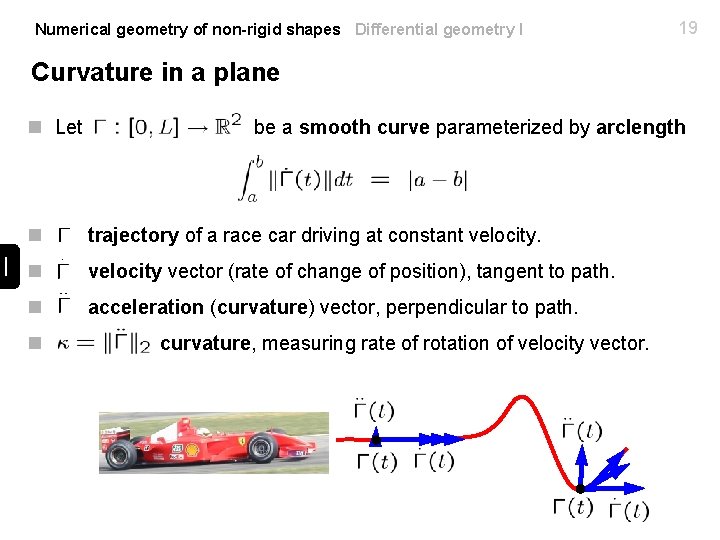
Numerical geometry of non-rigid shapes Differential geometry I 19 Curvature in a plane n Let be a smooth curve parameterized by arclength n trajectory of a race car driving at constant velocity. n velocity vector (rate of change of position), tangent to path. n acceleration (curvature) vector, perpendicular to path. n curvature, measuring rate of rotation of velocity vector.
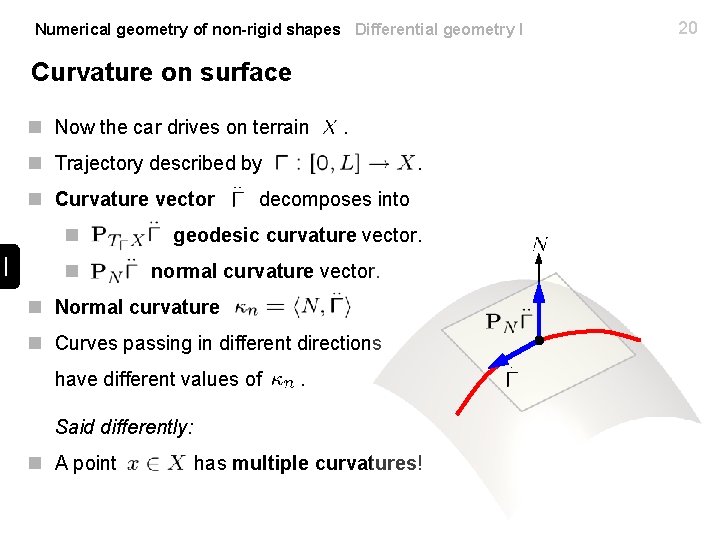
Numerical geometry of non-rigid shapes Differential geometry I Curvature on surface n Now the car drives on terrain . n Trajectory described by n Curvature vector n n . decomposes into geodesic curvature vector. normal curvature vector. n Normal curvature n Curves passing in different directions have different values of . Said differently: n A point has multiple curvatures! 20
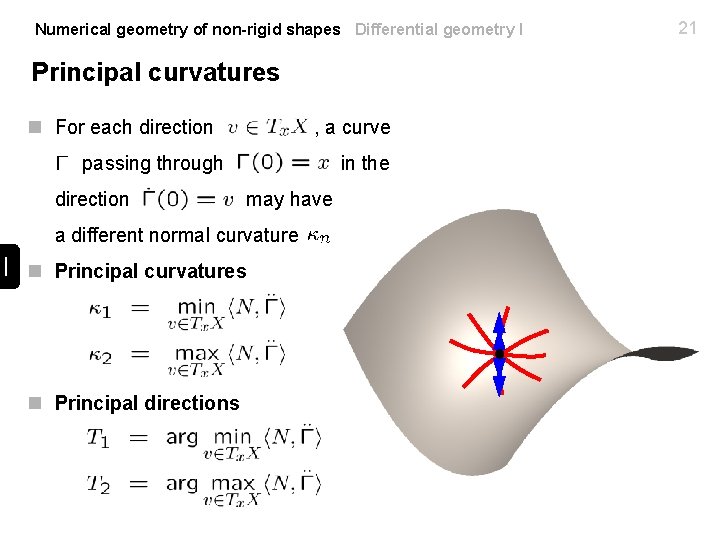
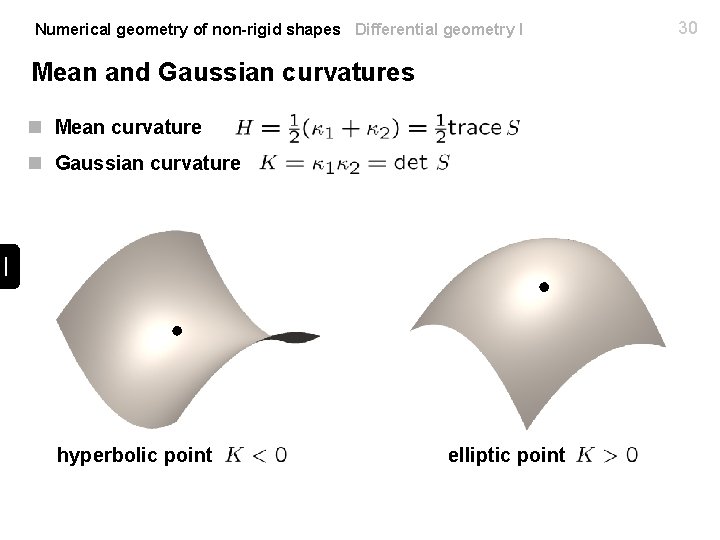
Numerical geometry of non-rigid shapes Differential geometry I Principal curvatures n For each direction , a curve passing through direction in the may have a different normal curvature n Principal curvatures n Principal directions . 21
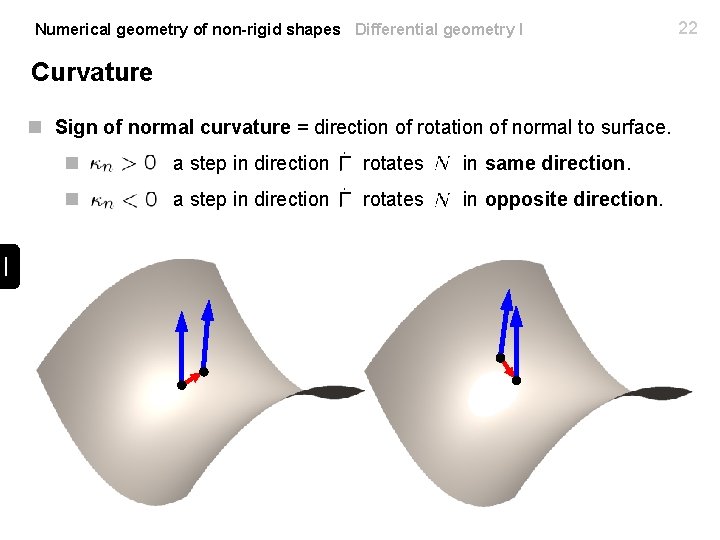
Numerical geometry of non-rigid shapes Differential geometry I Curvature n Sign of normal curvature = direction of rotation of normal to surface. n a step in direction rotates in same direction. n a step in direction rotates in opposite direction. 22
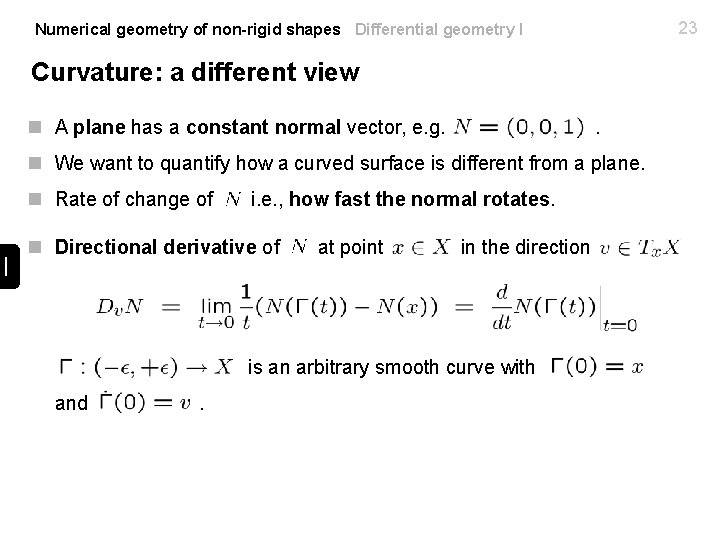
23 Numerical geometry of non-rigid shapes Differential geometry I Curvature: a different view n A plane has a constant normal vector, e. g. . n We want to quantify how a curved surface is different from a plane. n Rate of change of i. e. , how fast the normal rotates. n Directional derivative of at point in the direction is an arbitrary smooth curve with and .
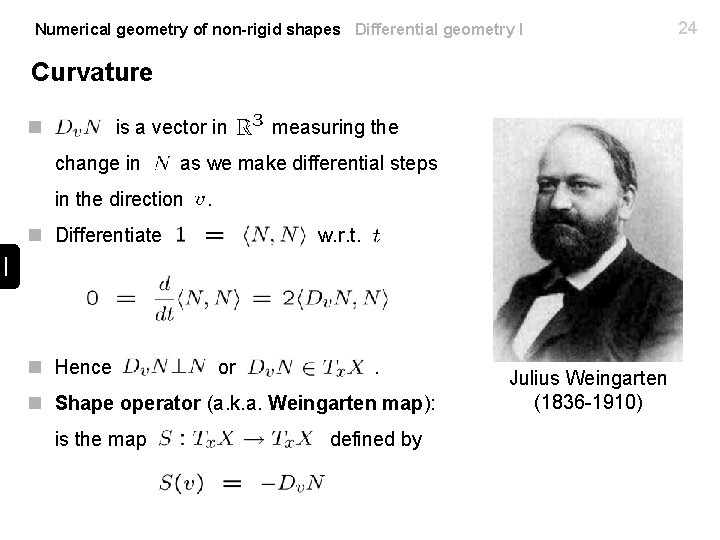
Numerical geometry of non-rigid shapes Differential geometry I Curvature n is a vector in change in as we make differential steps in the direction . n Differentiate n Hence measuring the w. r. t. or . n Shape operator (a. k. a. Weingarten map): is the map defined by Julius Weingarten (1836 -1910) 24
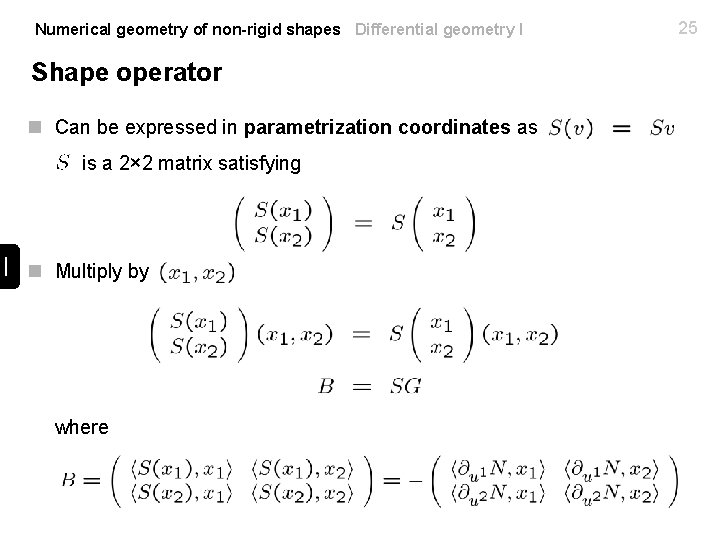
Numerical geometry of non-rigid shapes Differential geometry I Shape operator n Can be expressed in parametrization coordinates as is a 2× 2 matrix satisfying n Multiply by where 25
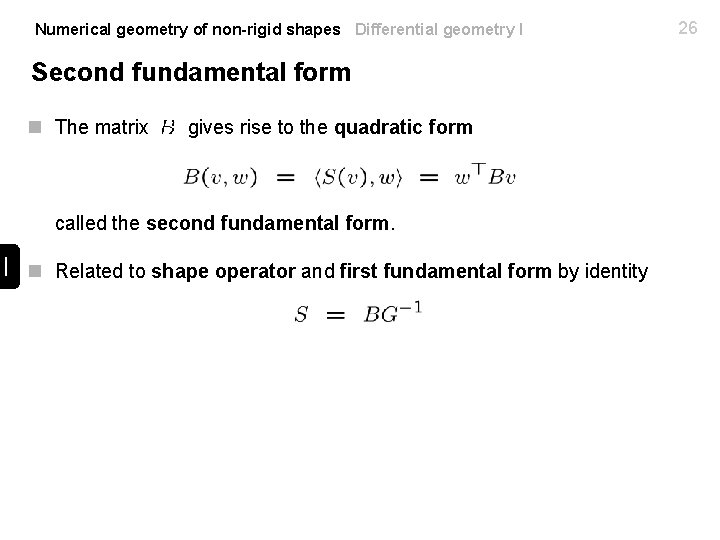
Numerical geometry of non-rigid shapes Differential geometry I Second fundamental form n The matrix gives rise to the quadratic form called the second fundamental form. n Related to shape operator and first fundamental form by identity 26
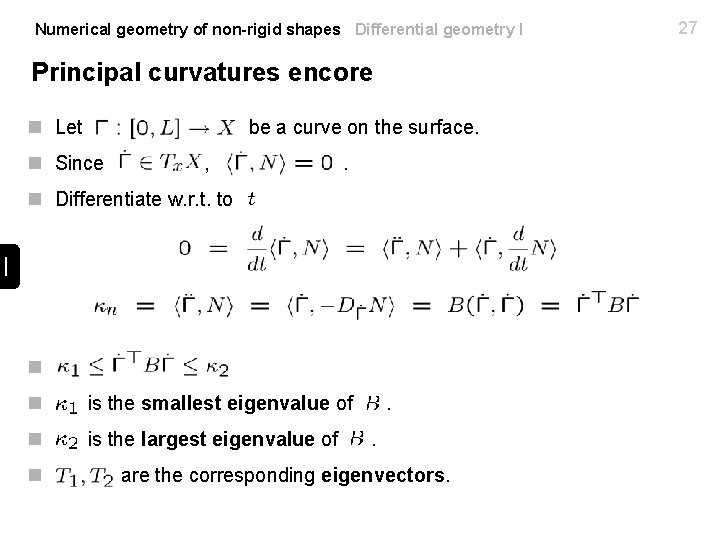
Numerical geometry of non-rigid shapes Differential geometry I Principal curvatures encore n Let be a curve on the surface. n Since , . n Differentiate w. r. t. to n n is the smallest eigenvalue of n is the largest eigenvalue of n . . are the corresponding eigenvectors. 27
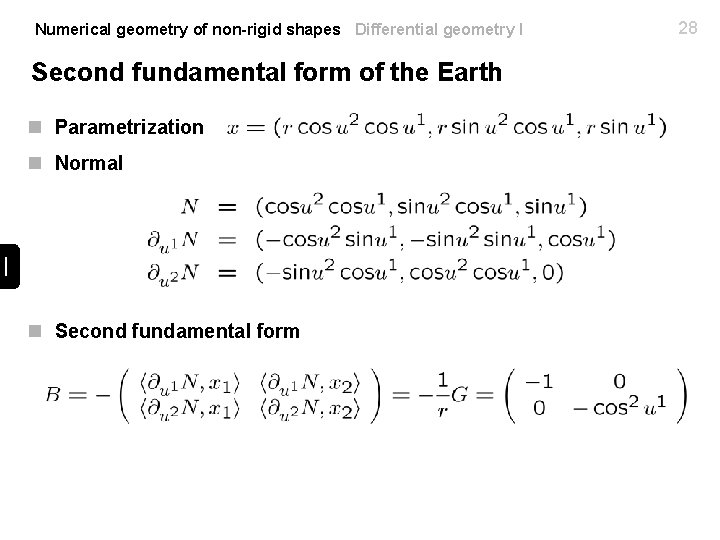
Numerical geometry of non-rigid shapes Differential geometry I Second fundamental form of the Earth n Parametrization n Normal n Second fundamental form 28
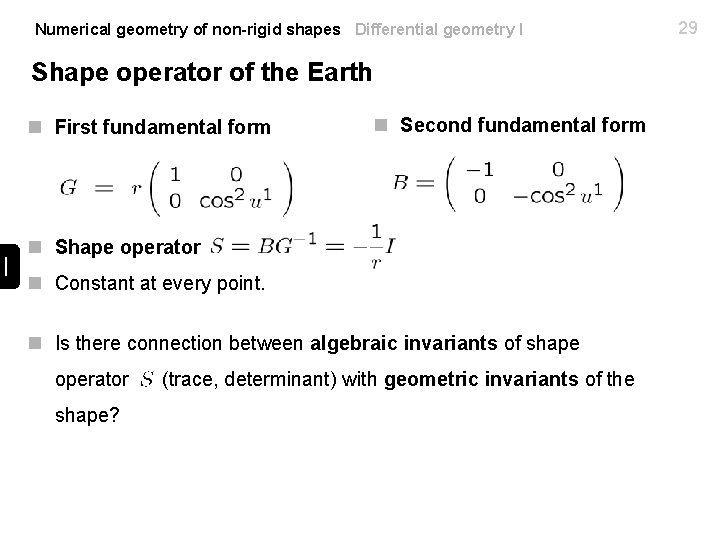
Numerical geometry of non-rigid shapes Differential geometry I Shape operator of the Earth n First fundamental form n Second fundamental form n Shape operator n Constant at every point. n Is there connection between algebraic invariants of shape operator shape? (trace, determinant) with geometric invariants of the 29
Numerical geometry of non-rigid shapes Differential geometry I Mean and Gaussian curvatures n Mean curvature n Gaussian curvature hyperbolic point elliptic point 30
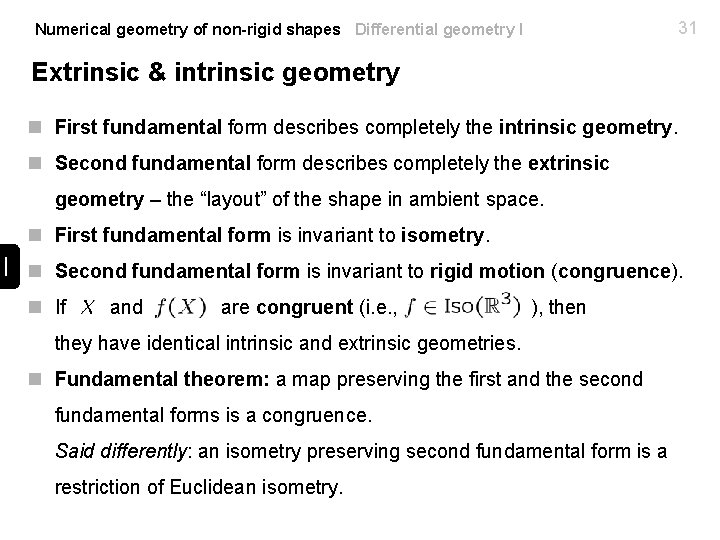
31 Numerical geometry of non-rigid shapes Differential geometry I Extrinsic & intrinsic geometry n First fundamental form describes completely the intrinsic geometry. n Second fundamental form describes completely the extrinsic geometry – the “layout” of the shape in ambient space. n First fundamental form is invariant to isometry. n Second fundamental form is invariant to rigid motion (congruence). n If and are congruent (i. e. , ), then they have identical intrinsic and extrinsic geometries. n Fundamental theorem: a map preserving the first and the second fundamental forms is a congruence. Said differently: an isometry preserving second fundamental form is a restriction of Euclidean isometry.