
NUMERACY LITERACY NATIONAL LITERACY and NUMERACY FRAMEWORK INFORMATION
- Slides: 19
NUMERACY LITERACY NATIONAL LITERACY and NUMERACY FRAMEWORK INFORMATION FOR PARENTS GD
What is the National Literacy and Numeracy Framework? • The Literacy and Numeracy Framework has been developed to help schools to achieve the aims of the Welsh Government, that the children of Wales are able to develop excellent literacy and numeracy skills during their time in school.
Why do we need the National Literacy and Numeracy Framework? Evidence from: • • • research from employers Estyn inspection reports end of Key Stage Teachers’ Assessments PISA results qualifications show that Wales must improve its literacy and numeracy levels across the population.
What is LITERACY ? • Literacy means using language skills in daily activities at school, at home, at work and in the community. • Literacy describes the series of skills, ( talking, listening, reading and writing), that are needed to make sense of the world around us. • It means using literacy skills and knowing how to use Welsh and English.
What is Numeracy ? • Numeracy means using mathematical skills in daily activities - at school, at home, at work and in the community. • Numeracy describes the series of skills that are needed to deal with life’s problems in a variety of situations.
What is the purpose of the National Literacy and Numeracy Framework? • It gives a detailed description of the national expectations for literacy and numeracy for learners aged 5 - 14 ( from the Reception class to Year 9) i. e what learners must learn. • It helps teachers of all subjects to identify and provide opportunities for learners to apply literacy and numeracy across the curriculum i. e. what they have to teach and assess. • It will help to determine learner progress in literacy and numeracy and provide annual reports to parents/carers based on teacher assessment so that they are all clear how learners are progressing and what the next steps are.
How will the National Literacy and Numeracy Framework help schools? By. . . • helping teachers of all subjects to identify and offer opportunities for pupils to develop literacy and numeracy skills across the curriculum i. e in all subjects ( and not only in Welsh and English language and Maths lessons); • helping teachers to assess pupils’ progress in literacy and numeracy and write annual reports for parents/ carers; • informing teachers, pupils and parents / carers on the learners’ development and their next steps.
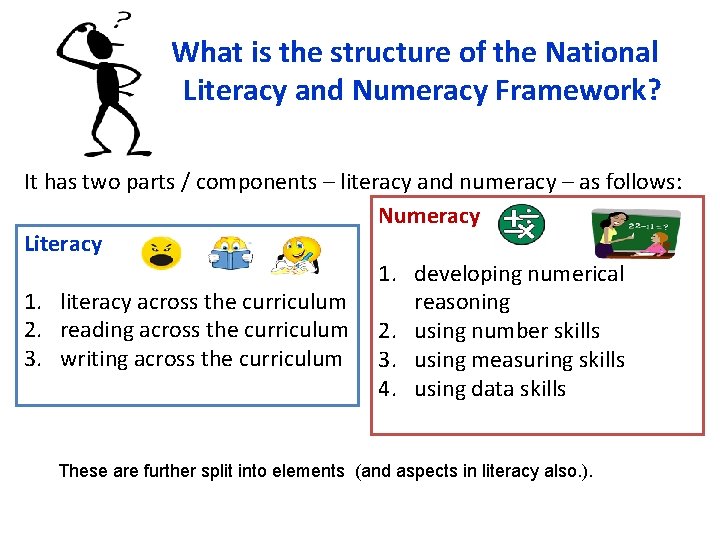
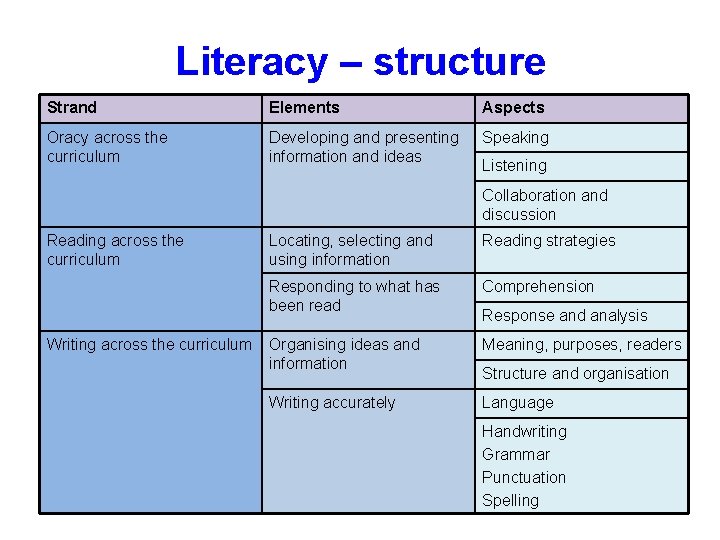
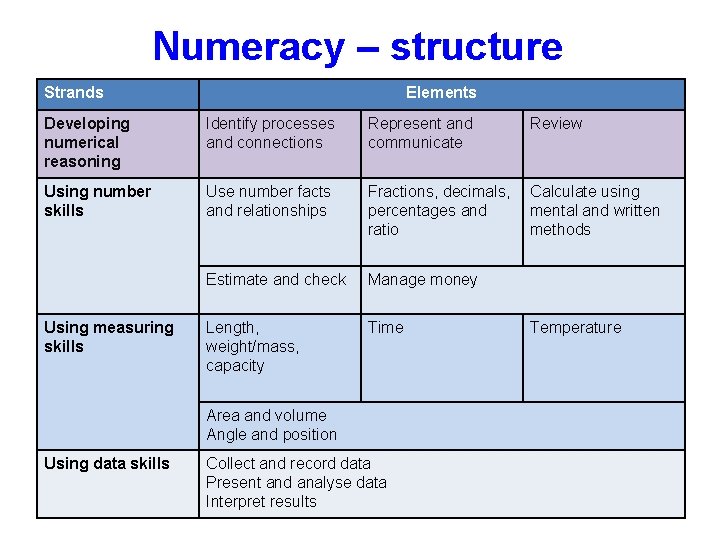
What is the structure of the National Literacy and Numeracy Framework? It has two parts / components – literacy and numeracy – as follows: Numeracy Literacy 1. developing numerical 1. literacy across the curriculum reasoning 2. reading across the curriculum 2. using number skills 3. writing across the curriculum 3. using measuring skills 4. using data skills These are further split into elements (and aspects in literacy also. ).
Literacy – structure Strand Elements Aspects Oracy across the curriculum Developing and presenting information and ideas Speaking Listening Collaboration and discussion Reading across the curriculum Writing across the curriculum Locating, selecting and using information Reading strategies Responding to what has been read Comprehension Organising ideas and information Meaning, purposes, readers Writing accurately Language Response and analysis Structure and organisation Handwriting Grammar Punctuation Spelling
Numeracy – structure Strands Elements Developing numerical reasoning Identify processes and connections Represent and communicate Review Using number skills Use number facts and relationships Fractions, decimals, percentages and ratio Calculate using mental and written methods Estimate and check Manage money Length, weight/mass, capacity Time Using measuring skills Area and volume Angle and position Using data skills Collect and record data Present and analyse data Interpret results Temperature
Example of literacy component - writing
Example of numeracy component
Is there a difference between the Welsh and English Literacy component? No. . . • The literacy component is available in Welsh and English and they both are very similar. • The expectations are the same for Welsh and English, with a few distinctive elements in the Welsh literacy component (e. g. the Mutations).
Is the National Literacy and Numeracy Framework for every pupil? Yes. . . • The Framework includes every learner, from the Reception class to Year 9. Every pupil is expected to make progress according to his / her ability : . • Pupils with Additional Learning Needs (ALN) could be working below the age related expectations. • More able and talented pupils (MAT) could be working beyond the expectations for the year. ( There are extension statements available. )
Is the National Literacy and Numeracy Framework statutory? YES. . . • It has been statutory since September 2013, i. e. all schools must introduce and implement the Framework. and. . . • Assessing against the National Literacy and Numeracy Framework will be a statutory requirement from September 2014 i. e all schools must assess every pupil’s progress according to the Framework and report to parents every year.
Will there be any support ? Yes. . . On-line Guidance and training resources are developed to help schools and teachers to implement the Framework. These can be seen on the Learning Wales website: www. dysgucymru. gov. uk National Support Programme, funded by the Welsh Government, has been developed to offer support and training for schools and teachers, to help them implement the Framework. Every school / cluster of schools have a ‘partner’ supporting them with the work.
How will we have information about our child’s progress in literacy and numeracy? • At the end of every academic year all schools will present a report to parents/ guardians, on the progress made by every pupil. • The report will note the pupil’s strengths in literacy and numeracy and what needs to be developed further. • This information will be collated from all subjects across the curriculum.
What about the Reading and Numeracy Tests ? • As well as the National Literacy and Numeracy Framework there will also be annual Reading and Numeracy Tests ( in May ) for every pupil in Year 2 to Year 9. • Schools will report to parents/guardians on the results of the Tests every year and this information will be collected nationally.
How can we as parents help our child to develop literacy and numeracy skills? By. . . Ø supporting the school’s work. . . . Ø supporting the child’s work e. g. reading with your child. . . . .