
Numbers in the Real World Copyright 2011 Pearson
Numbers in the Real World Copyright © 2011 Pearson Education, Inc.
Unit 3 C Dealing with Uncertainty Copyright © 2011 Pearson Education, Inc. Slide 3 -3

3 -C Significant Digits Type of Digit Significance Nonzero digits Always significant Zeros that follow a nonzero digit and lie to the right of the decimal point (as in 4. 20 or 3. 00) Always significant Zeros between nonzero digits (as in Always significant 4002 or 3. 06) or other significant zeros (such as the first zero in 30. 0) Zeros to the left of the first nonzero digit (as in 0. 006 or 0. 00052) Never significant Zeros to the right of the last Not significant unless stated nonzero digit but before the decimal otherwise point as in (40, 000 or 210) Copyright © 2011 Pearson Education, Inc. Slide 3 -4
3 -C Types of Error Random errors occur because of random and inherently unpredictable events in the measurement process. Systematic errors occur when there is a problem in the measurement system that affects all measurements in the same way, such as making them all too low or too high by the same amount. Copyright © 2011 Pearson Education, Inc. Slide 3 -5
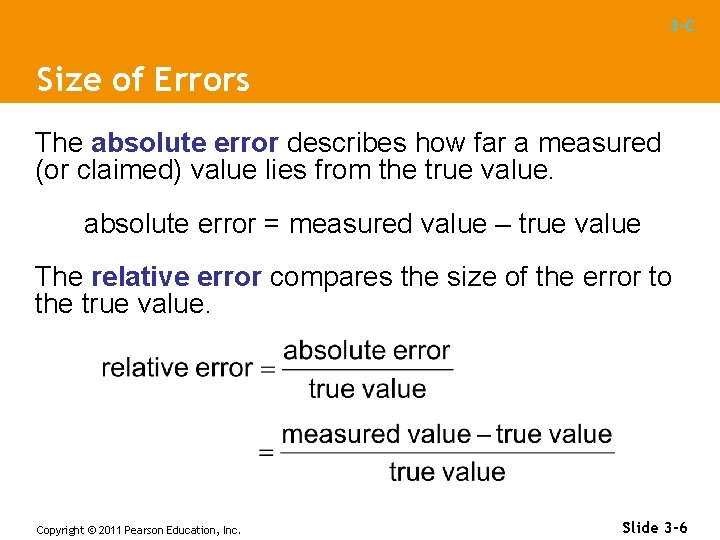
3 -C Size of Errors The absolute error describes how far a measured (or claimed) value lies from the true value. absolute error = measured value – true value The relative error compares the size of the error to the true value. Copyright © 2011 Pearson Education, Inc. Slide 3 -6
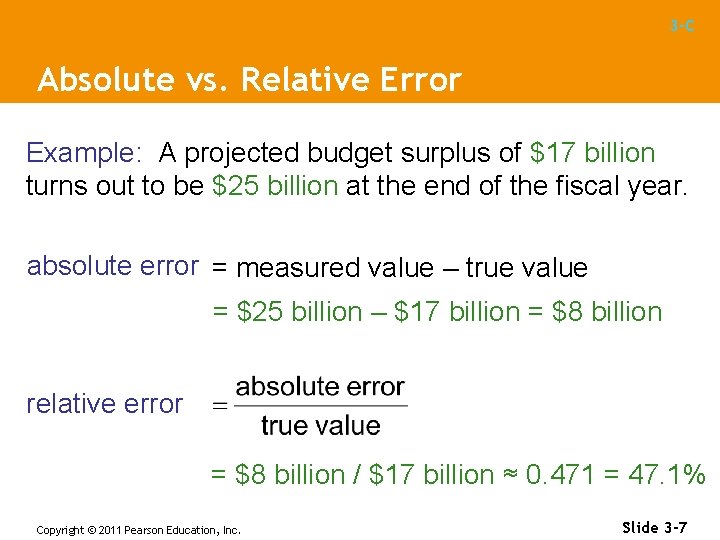
3 -C Absolute vs. Relative Error Example: A projected budget surplus of $17 billion turns out to be $25 billion at the end of the fiscal year. absolute error = measured value – true value = $25 billion – $17 billion = $8 billion relative error = $8 billion / $17 billion ≈ 0. 471 = 47. 1% Copyright © 2011 Pearson Education, Inc. Slide 3 -7
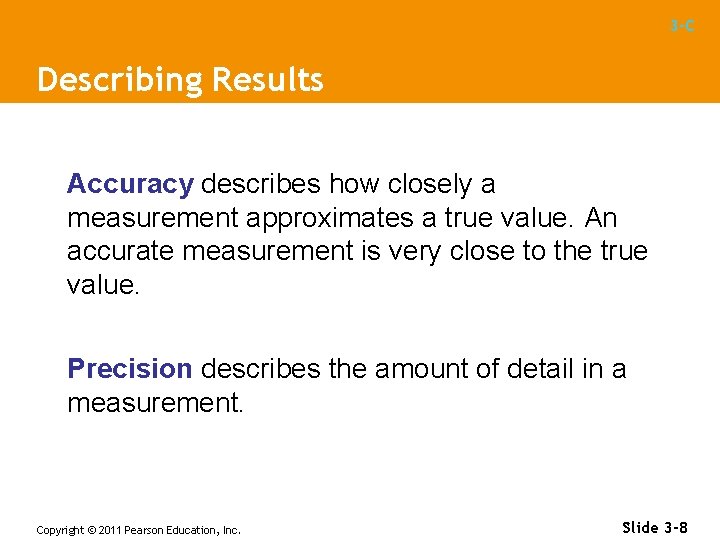
3 -C Describing Results Accuracy describes how closely a measurement approximates a true value. An accurate measurement is very close to the true value. Precision describes the amount of detail in a measurement. Copyright © 2011 Pearson Education, Inc. Slide 3 -8
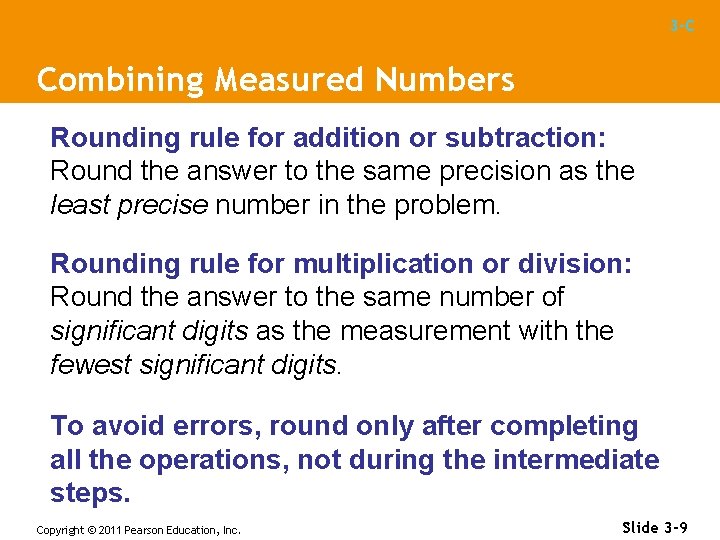
3 -C Combining Measured Numbers Rounding rule for addition or subtraction: Round the answer to the same precision as the least precise number in the problem. Rounding rule for multiplication or division: Round the answer to the same number of significant digits as the measurement with the fewest significant digits. To avoid errors, round only after completing all the operations, not during the intermediate steps. Copyright © 2011 Pearson Education, Inc. Slide 3 -9
- Slides: 9