
Numbering Systems and Digital Electronics Copyright Paul Oh
Numbering Systems and Digital Electronics © Copyright Paul Oh, 2016
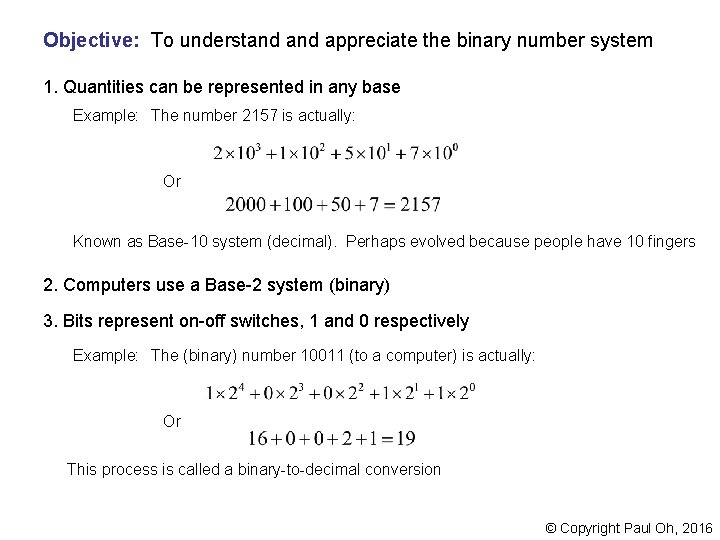
Objective: To understand appreciate the binary number system 1. Quantities can be represented in any base Example: The number 2157 is actually: Or Known as Base-10 system (decimal). Perhaps evolved because people have 10 fingers 2. Computers use a Base-2 system (binary) 3. Bits represent on-off switches, 1 and 0 respectively Example: The (binary) number 10011 (to a computer) is actually: Or This process is called a binary-to-decimal conversion © Copyright Paul Oh, 2016

4. Decimal-to-binary conversion Example: Convert 23410 to binary Step 1: Form table 27 26 25 24 23 22 21 20 128 64 32 16 8 4 2 1 1 1 1 0 1 0 (1) Step 2: Populate table 23410 = Sanity Check: Answer: © Copyright Paul Oh, 2016
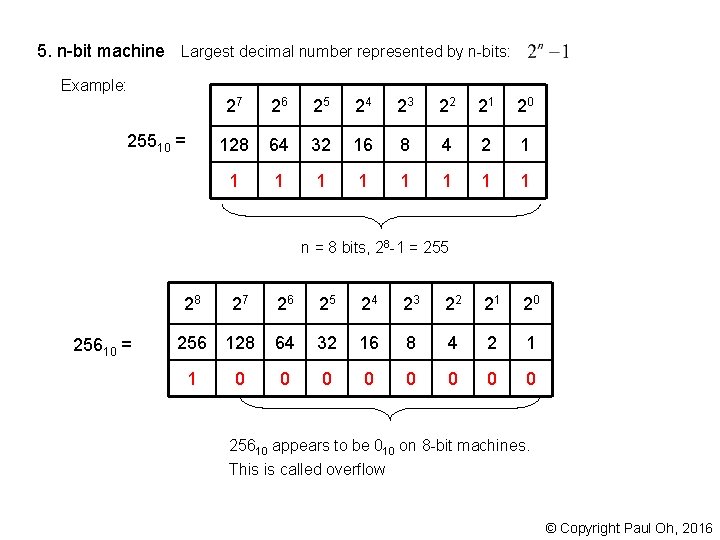
5. n-bit machine Largest decimal number represented by n-bits: Example: 25510 = 27 26 25 24 23 22 21 20 128 64 32 16 8 4 2 1 1 1 1 1 n = 8 bits, 28 -1 = 255 28 25610 = 27 256 128 1 0 26 25 24 23 22 21 20 64 32 16 8 4 2 1 0 0 0 0 25610 appears to be 010 on 8 -bit machines. This is called overflow © Copyright Paul Oh, 2016
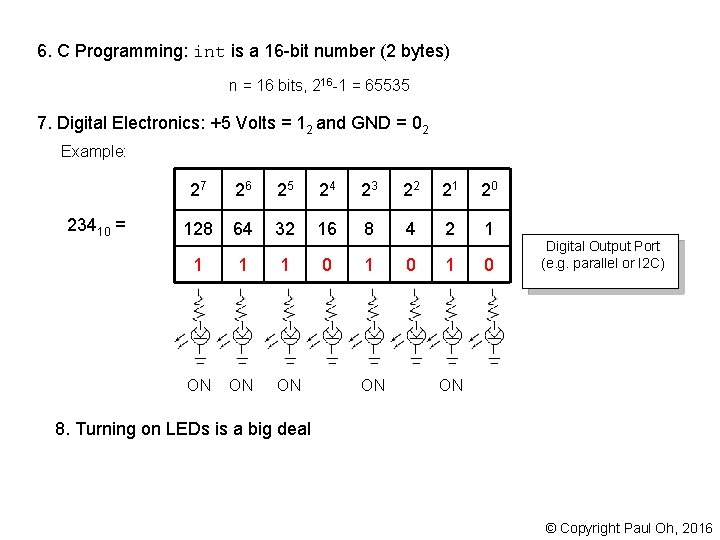
6. C Programming: int is a 16 -bit number (2 bytes) n = 16 bits, 216 -1 = 65535 7. Digital Electronics: +5 Volts = 12 and GND = 02 Example: 23410 = 27 26 25 24 23 22 21 20 128 64 32 16 8 4 2 1 1 ON ON ON 0 1 0 Digital Output Port (e. g. parallel or I 2 C) ON 8. Turning on LEDs is a big deal © Copyright Paul Oh, 2016
- Slides: 5