
Numberblocks Support Materials Series 3 Episode 12 Numberblock

Numberblocks Support Materials Series 3 Episode 12 Numberblock Rally A blue dot in the corner of a slide indicates that there are notes below the slide.

Practitioner Notes

Episode Description The Numberblocks are all set for a rally in their pedal cars. Only one can lift the trophy at the end. Who will get to the end of the race without losing anything from their pedal car? The episode explores taking away.
Maths in the Episode Subtraction as taking away In this episode the Numberblocks’ pedal cars come into difficulty with blocks falling off. This episode introduces the idea of subtraction as reduction, using a ‘first, then, now’ story structure. It introduces the subtraction symbol ( – ) to represent the situations.

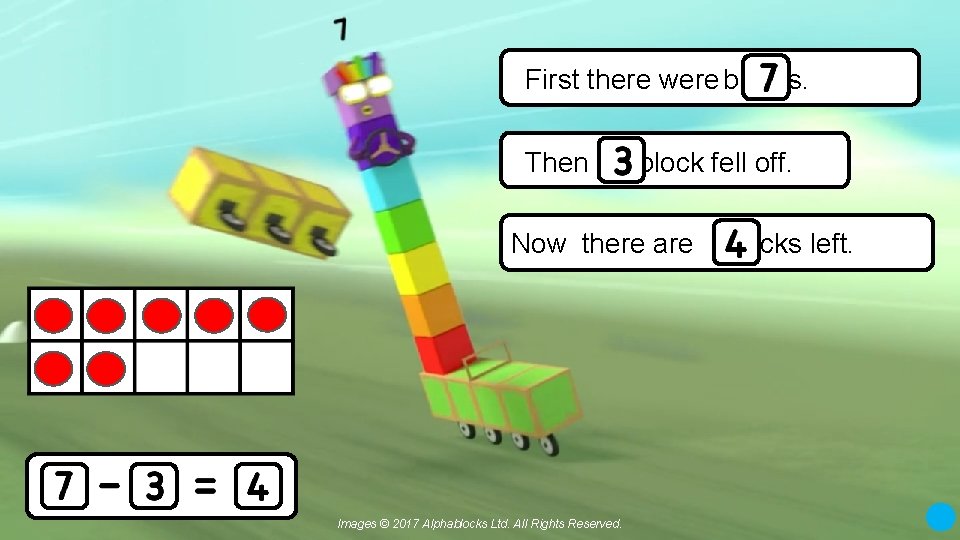
Using Mathematical Language Use these stem sentences to rehearse the mathematical ideas in the programme: “<7> blocks take away <4> blocks leaves <3> blocks. ” “If there are <7> blocks and <4> are taken away, then <3> blocks are left. ” “<7> minus <4> equals <3>. ”

Talk and Discuss Together
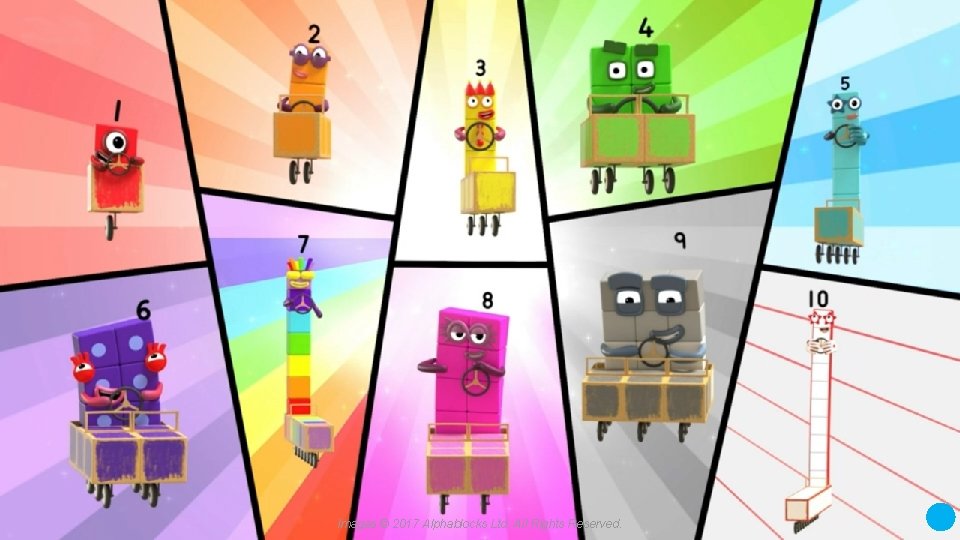
Talk and Discuss Together Watch the episode of Numberblocks. Use the following picture as a stimulus. Has anyone ever ridden a pedal car? What happened to some of the pedal cars? The following slides are designed to stimulate children and adults to talk about the episode and draw out some key aspects of the mathematics.
Images © 2017 Alphablocks Ltd. All Rights Reserved.

Enabling Environments in Reception
Enabling Environments Playing and Exploring Provide opportunities for children to make up and enact their own stories using subtraction as reduction, for example, farm animals moving to a new field, ducks leaving the pond. Active Learning Identify opportunities for experiencing this structure (‘taking away’) in real situations, for example, the numbers of pencils left in a pencil pot/ children left to go outside/ pieces of fruit left after snack time. Creating and Thinking Critically Explore taking away using dice and counters or other small parts. Play a simple game with a dice, taking away from a collection the number rolled on the dice. Who can get to 0 from 10? As the game is played, talk about what is happening, ‘first you had 6 conkers, then you took 2 away, now you have 4 left…I wonder if you will roll four next time to take them all away and have none left!’ Songs and rhymes also offer varied opportunities for exploring this structure. For example, Five Little Ducks, Ten Green Bottles, Five Little Monkeys. Sing the song and act it out with children, encouraging children to show on their fingers how many things are left.

Learning Together in Y 1

First there were blocks. Then block fell off. Now there are Images © 2017 Alphablocks Ltd. All Rights Reserved. blocks left.
First there were blocks. Then block fell off. Now there are Images © 2017 Alphablocks Ltd. All Rights Reserved. blocks left.
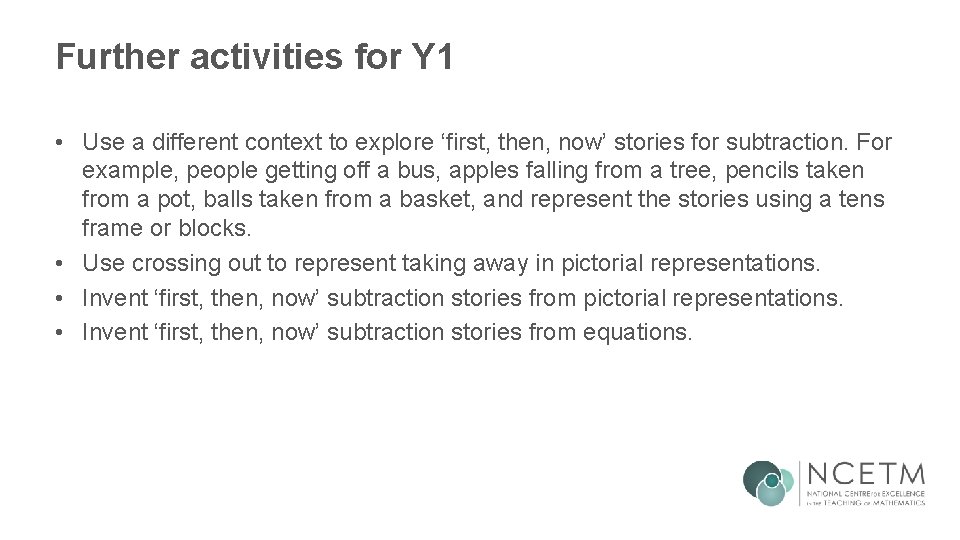
Further activities for Y 1 • Use a different context to explore ‘first, then, now’ stories for subtraction. For example, people getting off a bus, apples falling from a tree, pencils taken from a pot, balls taken from a basket, and represent the stories using a tens frame or blocks. • Use crossing out to represent taking away in pictorial representations. • Invent ‘first, then, now’ subtraction stories from equations.
Learning Together in Y 2
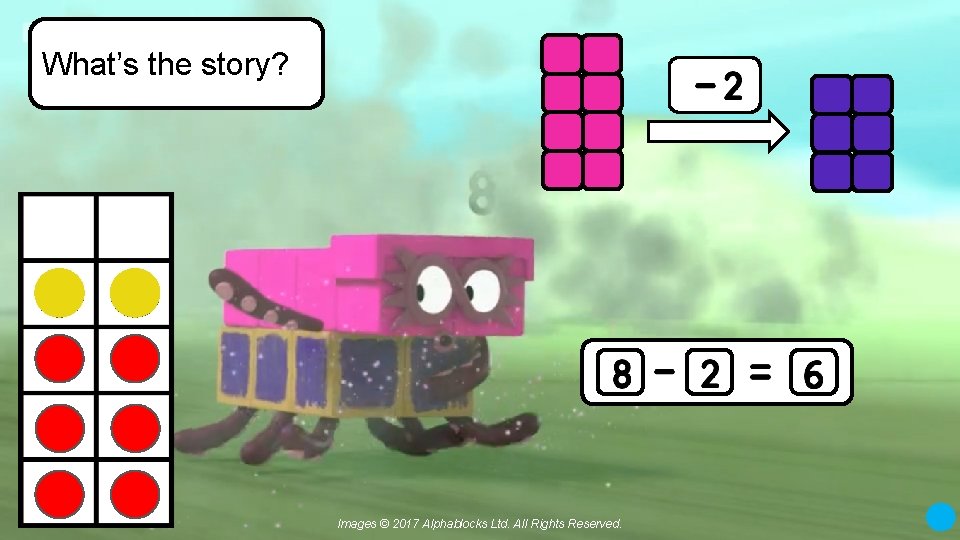
What’s the story? Images © 2017 Alphablocks Ltd. All Rights Reserved.
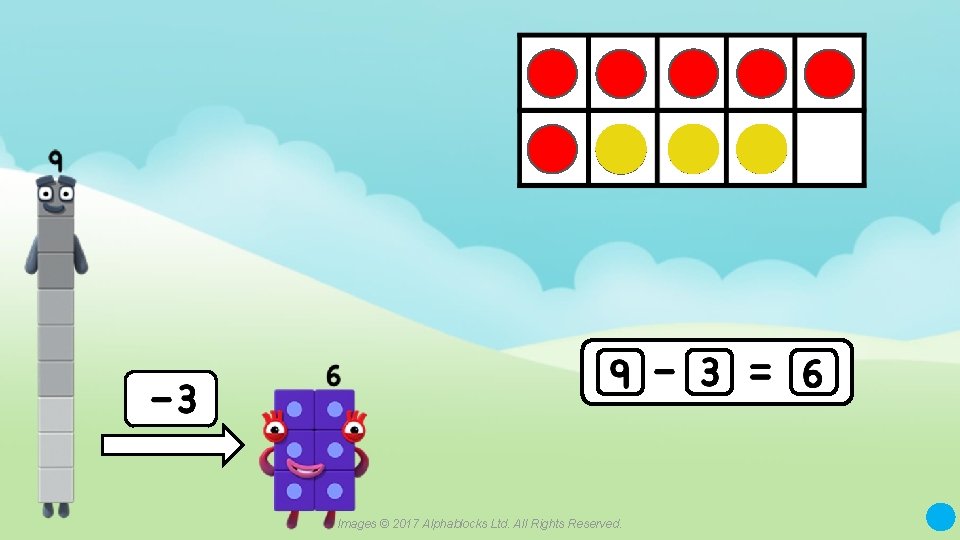
Images © 2017 Alphablocks Ltd. All Rights Reserved.
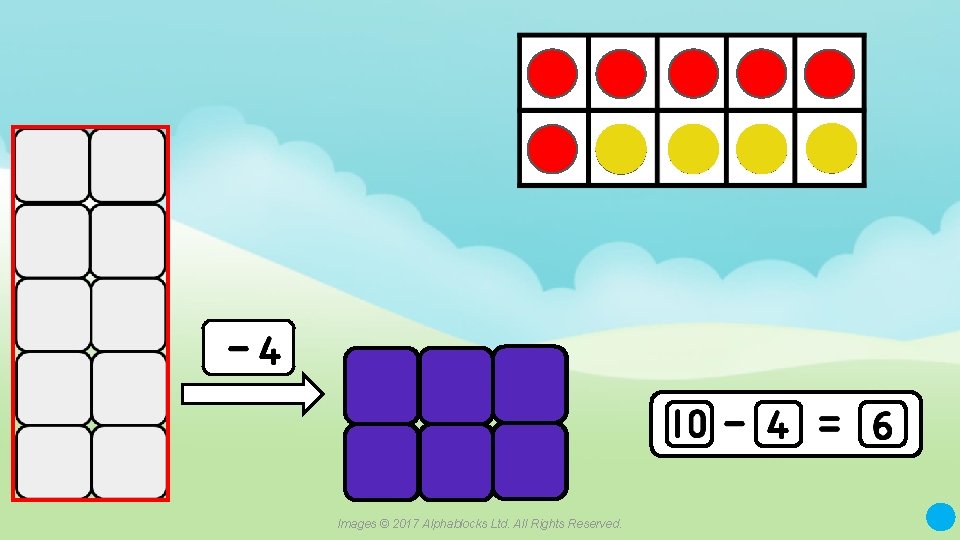
Images © 2017 Alphablocks Ltd. All Rights Reserved.
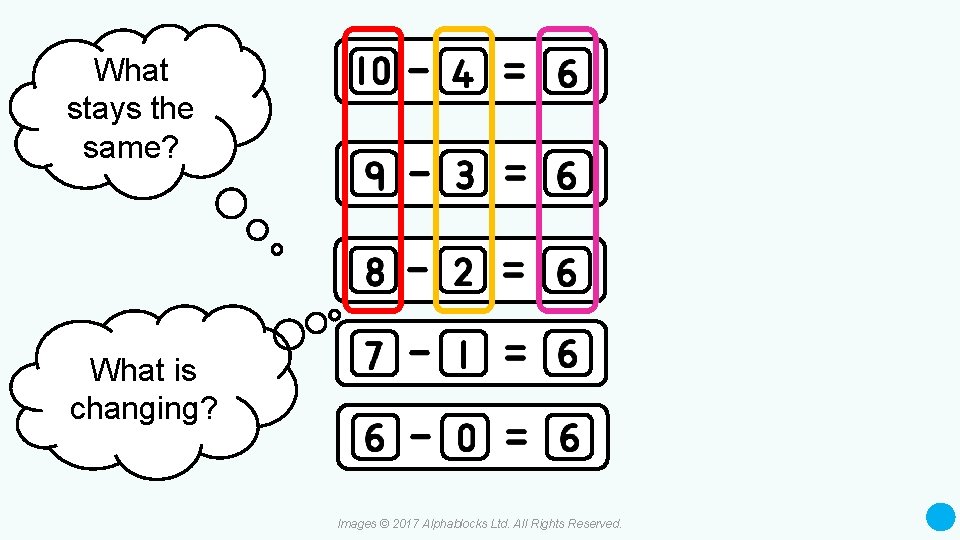
What stays the same? What is changing? Images © 2017 Alphablocks Ltd. All Rights Reserved.
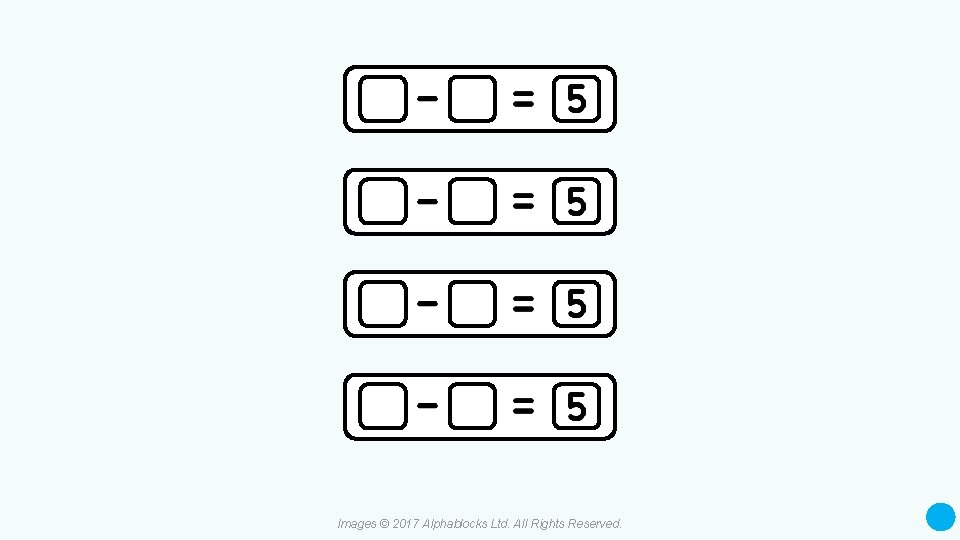
Images © 2017 Alphablocks Ltd. All Rights Reserved.
Further activities for Y 2 • The subtraction equations used in the previous slide introduce the idea of ‘constant difference’. • Represent 3 or 4 equations (for example, 8 -3=5; 9 -4=5; 7 -2=5) with the same difference using concrete or pictorial representations, for example, cubes or counters. • Order a set of equations with the same difference by looking for a pattern in the minuend/ subtrahend. 7 -3=4; 8 -4=4; 9 -5=4. • Explore other ways of varying the minuend and subtrahend whilst keeping the difference the same. For example, provide 2 or 3 subtraction equations with the same difference and ask the children to look for a pattern, and use the pattern to continue the sequence of equations. • Use one equation to solve another. For example, if 9 – 3 = 6 then use this to complete this equation o – 4 = 6; use pictorial representations to show your reasoning.
- Slides: 21