
Number Theory Presented by Shrividya Shivkumar and George
Number Theory Presented by Shrividya Shivkumar and George Frederick
Contents Division Theorem Modular Exponential Prime Numbers Fermat’s Little Theorem Miller-Rabin Primes Is In P Relatively Prime numbers Euclid’s algorithm Extended Euclid algorithm Chinese Remainder Theorem RSA Pollard’s Rho
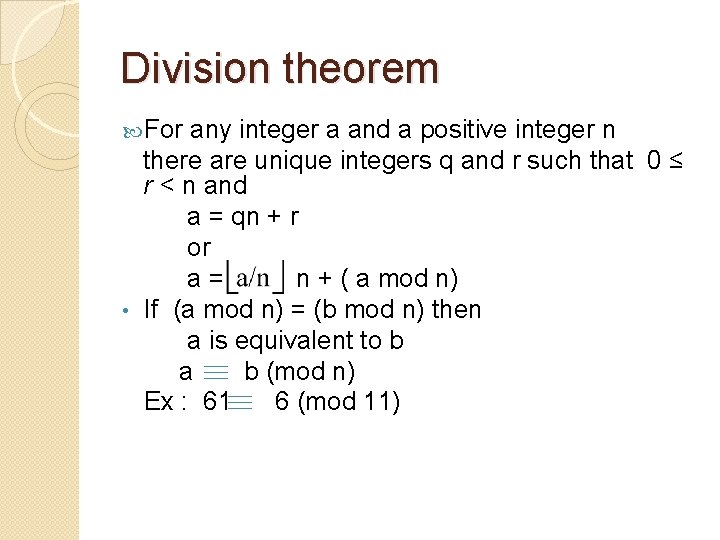
Division theorem For any integer a and a positive integer n there are unique integers q and r such that 0 ≤ r < n and a = qn + r or a= n + ( a mod n) • If (a mod n) = (b mod n) then a is equivalent to b a b (mod n) Ex : 61 6 (mod 11)
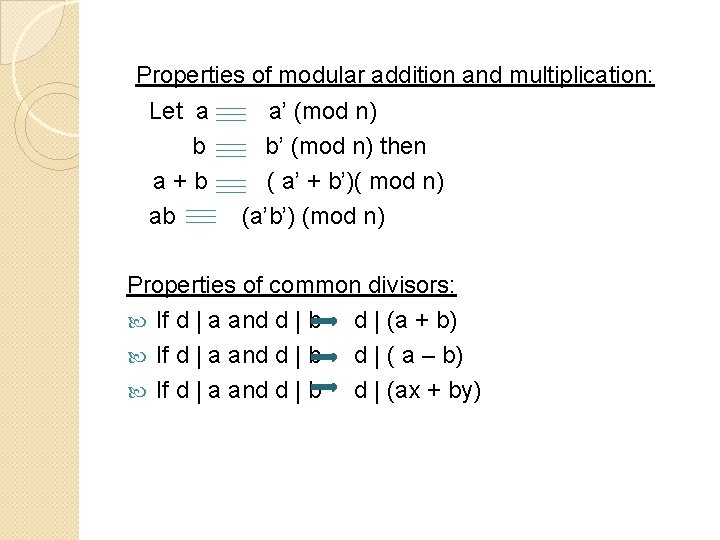
Properties of modular addition and multiplication: Let a b a+b ab a’ (mod n) b’ (mod n) then ( a’ + b’)( mod n) (a’b’) (mod n) Properties of common divisors: If d | a and d | b d | (a + b) If d | a and d | b d | ( a – b) If d | a and d | b d | (ax + by)
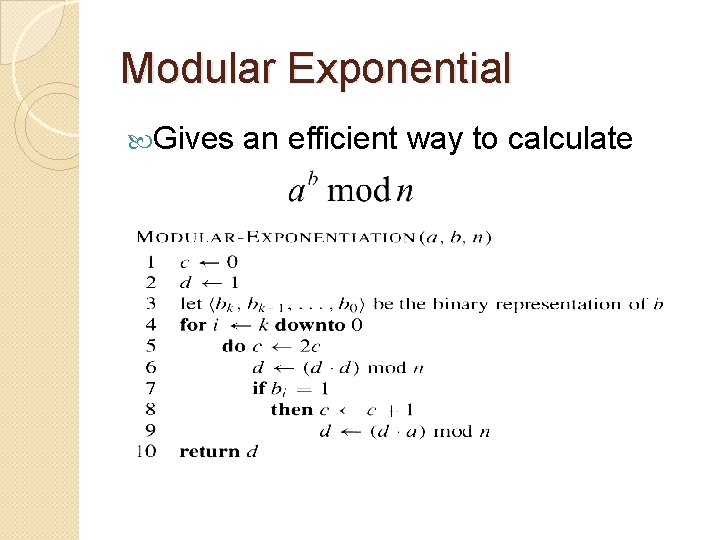
Modular Exponential Gives an efficient way to calculate
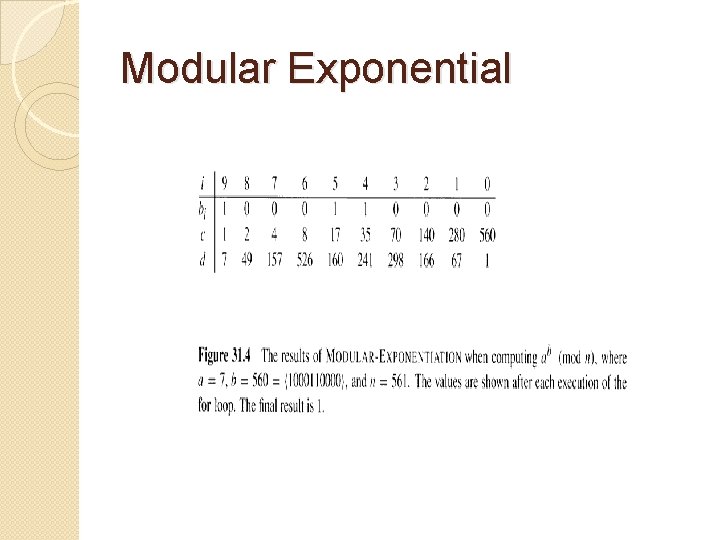
Modular Exponential
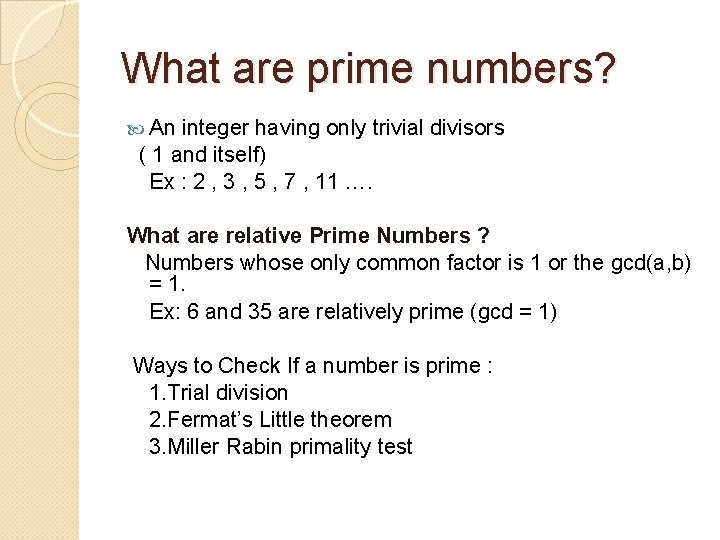
What are prime numbers? An integer having only trivial divisors ( 1 and itself) Ex : 2 , 3 , 5 , 7 , 11 …. What are relative Prime Numbers ? Numbers whose only common factor is 1 or the gcd(a, b) = 1. Ex: 6 and 35 are relatively prime (gcd = 1) Ways to Check If a number is prime : 1. Trial division 2. Fermat’s Little theorem 3. Miller Rabin primality test
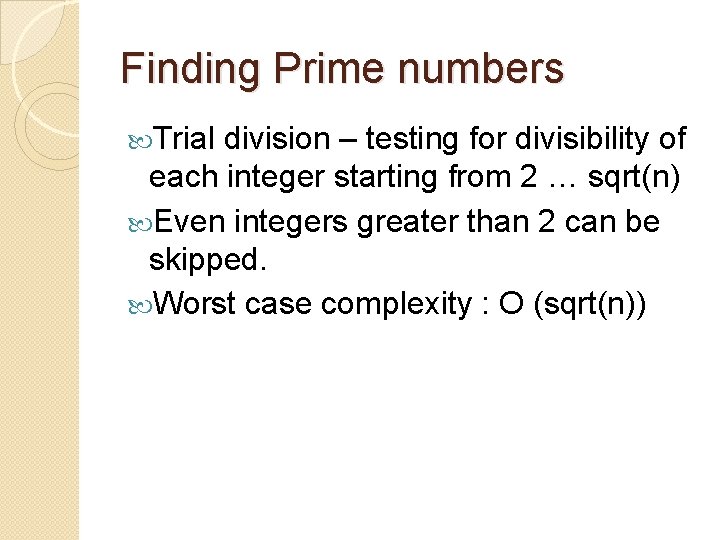
Finding Prime numbers Trial division – testing for divisibility of each integer starting from 2 … sqrt(n) Even integers greater than 2 can be skipped. Worst case complexity : O (sqrt(n))
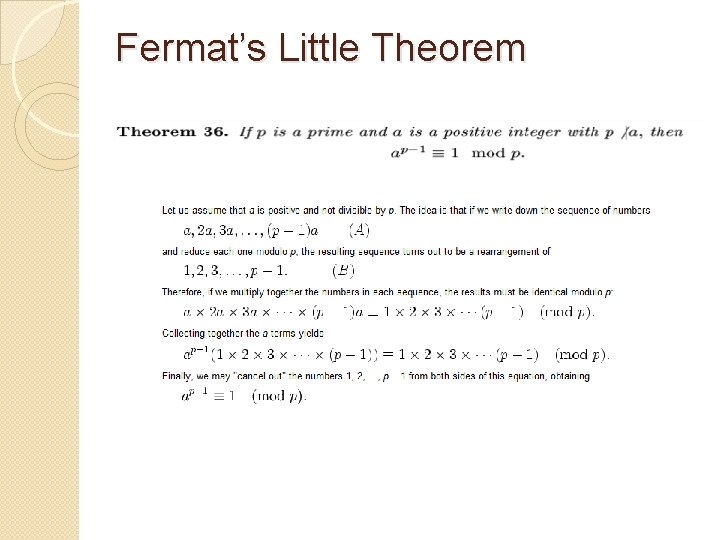
Fermat’s Little Theorem
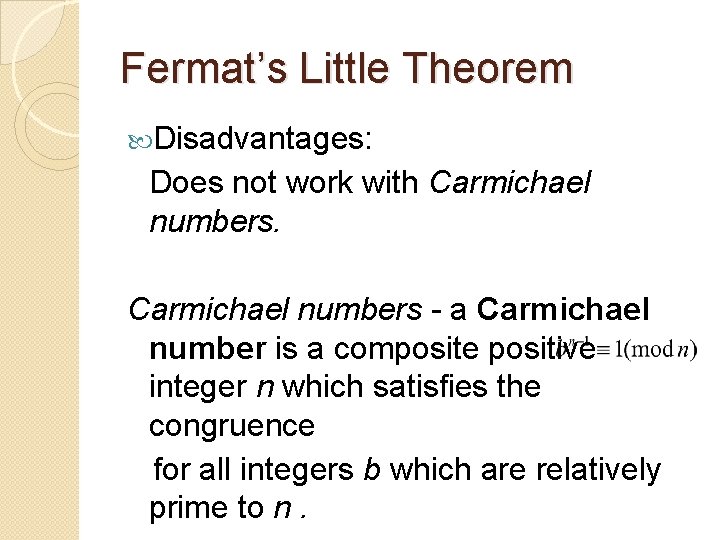
Fermat’s Little Theorem Disadvantages: Does not work with Carmichael numbers - a Carmichael number is a composite positive integer n which satisfies the congruence for all integers b which are relatively prime to n.
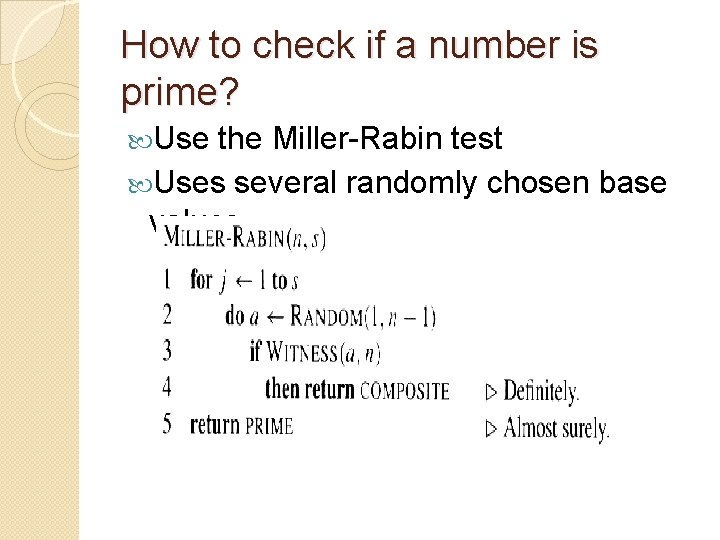
How to check if a number is prime? Use the Miller-Rabin test Uses several randomly chosen base values
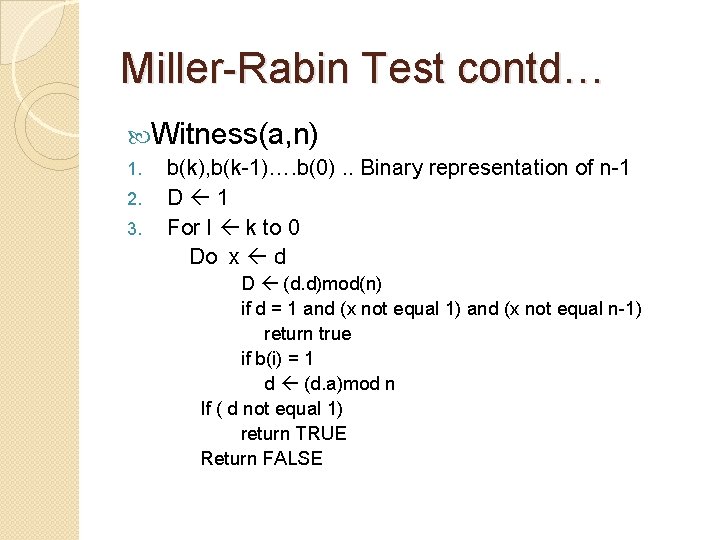
Miller-Rabin Test contd… Witness(a, n) 1. 2. 3. b(k), b(k-1)…. b(0). . Binary representation of n-1 D 1 For I k to 0 Do x d D (d. d)mod(n) if d = 1 and (x not equal 1) and (x not equal n-1) return true if b(i) = 1 d (d. a)mod n If ( d not equal 1) return TRUE Return FALSE
PRIMES is in P Authored by Manindra Agrawal, Neeraj Kayal, and Nitin Saxena Won the 2006 Gödel Prize Produced an unconditional deterministic polynomial-time algorithm that determines whether an input number is prime or composite Previous efforts were all conditional, randomized, or had exponential running times
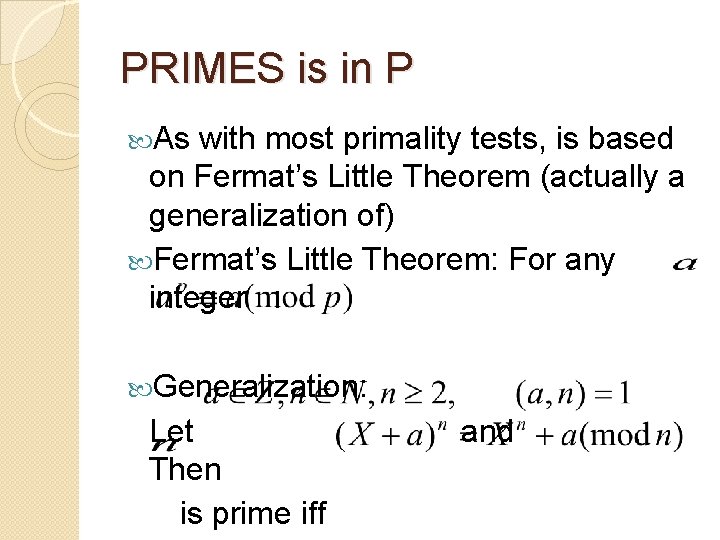
PRIMES is in P As with most primality tests, is based on Fermat’s Little Theorem (actually a generalization of) Fermat’s Little Theorem: For any integer : Generalization: Let Then is prime iff and .
What is a greatest common divisor? The largest common divisor of a and b 1 < = gcd( a, b) <= min ( |a| , | b|)
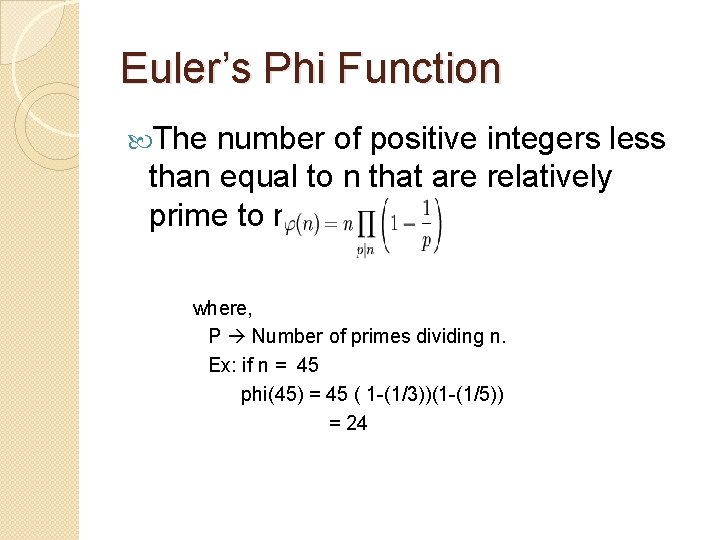
Euler’s Phi Function The number of positive integers less than equal to n that are relatively prime to n where, P Number of primes dividing n. Ex: if n = 45 phi(45) = 45 ( 1 -(1/3))(1 -(1/5)) = 24
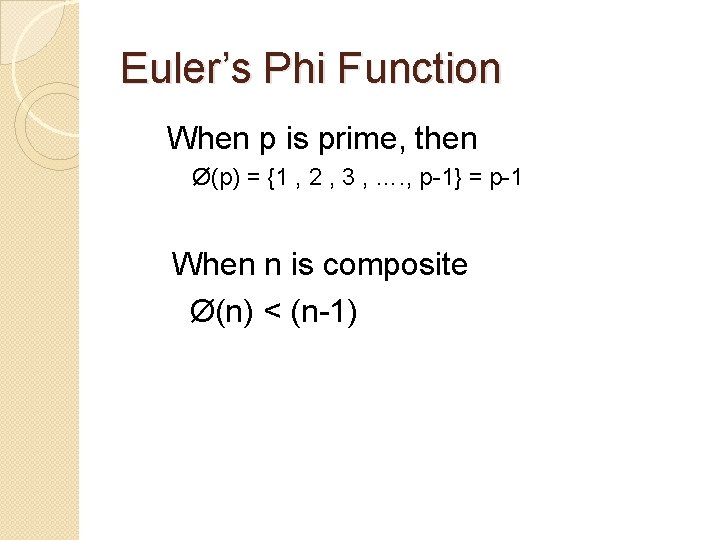
Euler’s Phi Function When p is prime, then Ø(p) = {1 , 2 , 3 , …. , p-1} = p-1 When n is composite Ø(n) < (n-1)
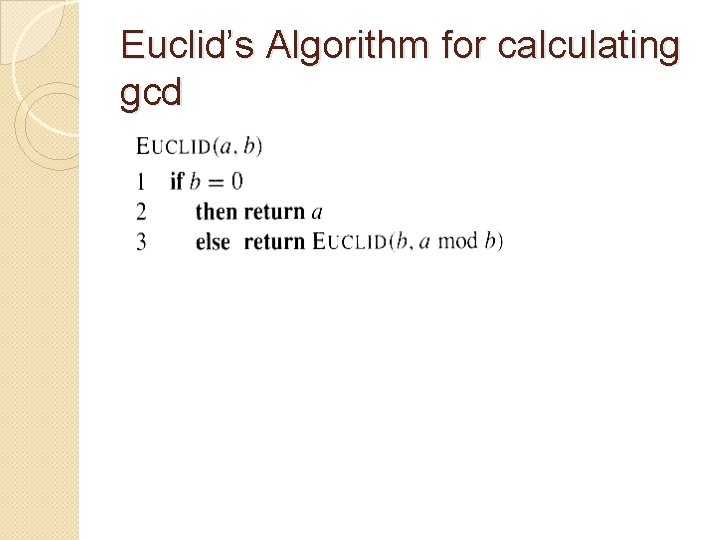
Euclid’s Algorithm for calculating gcd
What is Multiplicative inverse? Multiplicative inverse is nothing but the reciprocal of the number. How to calculate Multiplicative inverse? Using Extended Euclid’s algorithm
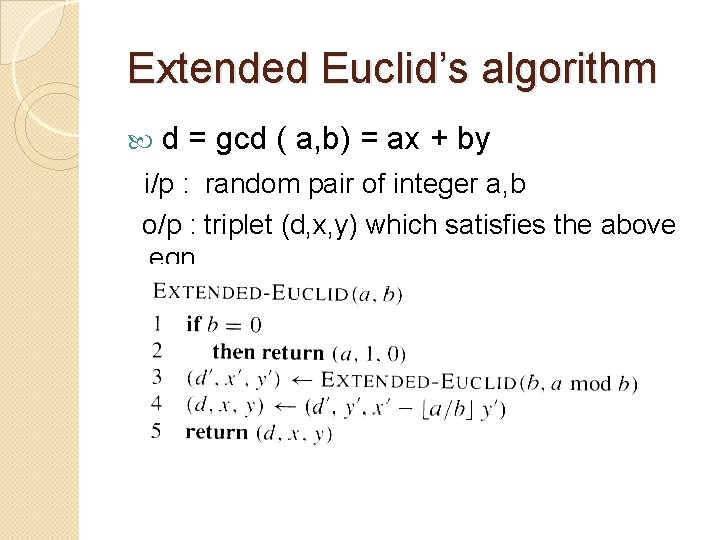
Extended Euclid’s algorithm d = gcd ( a, b) = ax + by i/p : random pair of integer a, b o/p : triplet (d, x, y) which satisfies the above eqn.
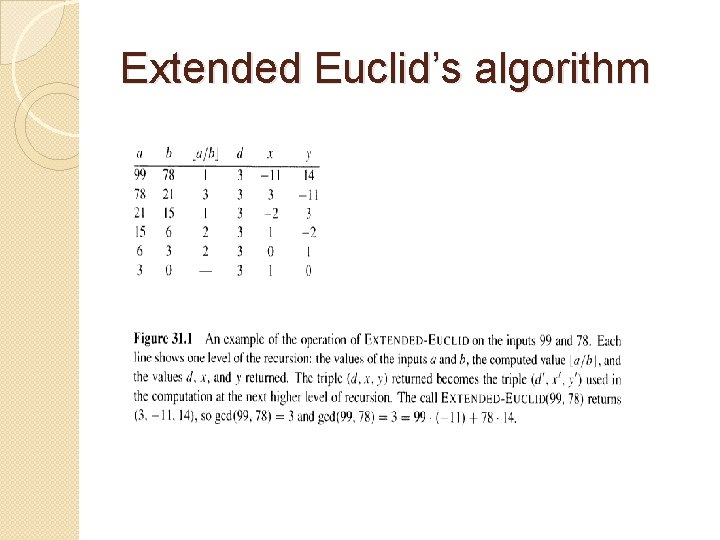
Extended Euclid’s algorithm
Multiplicative inverse using extended Euclid’s algorithm Multiplicative inverse is nothing but the reciprocal of the number. If 2 numbers a, n are relatively prime then gcd ( a, n) = 1 ax + ny = 1 ax = 1(mod n) x = inv(a) mod n Where, a and n are the inputs and x, y, and gcd(a, n) are the outputs for Extended Euclid’s algorithm
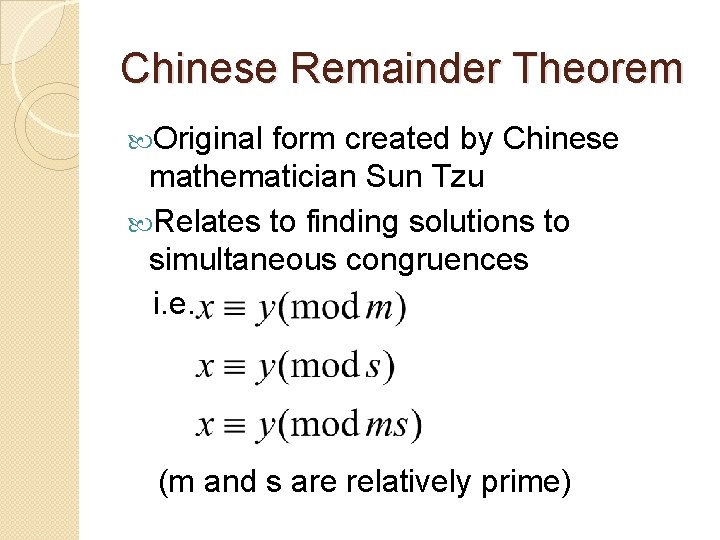
Chinese Remainder Theorem Original form created by Chinese mathematician Sun Tzu Relates to finding solutions to simultaneous congruences i. e. (m and s are relatively prime)
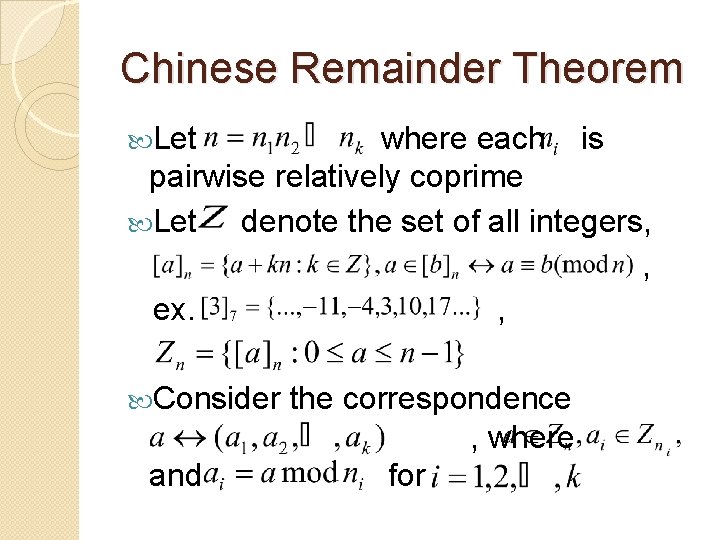
Chinese Remainder Theorem Let where each is pairwise relatively coprime Let denote the set of all integers, , ex. , Consider and the correspondence , where for
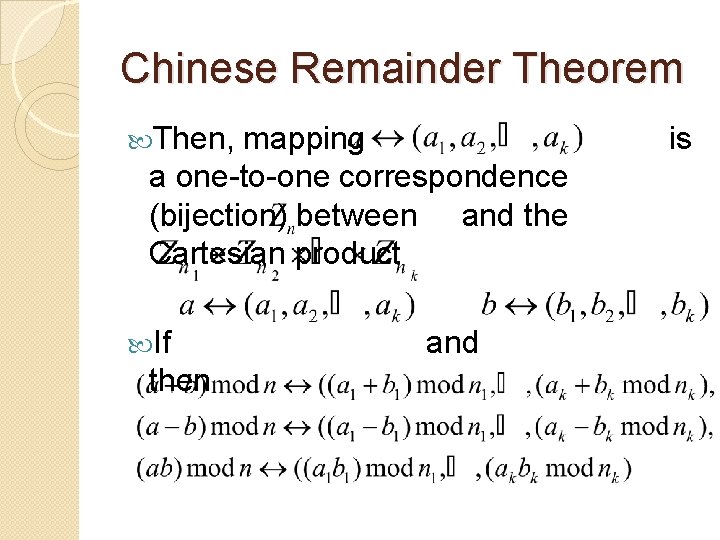
Chinese Remainder Theorem Then, mapping a one-to-one correspondence (bijection) between and the Cartesian product If then and is
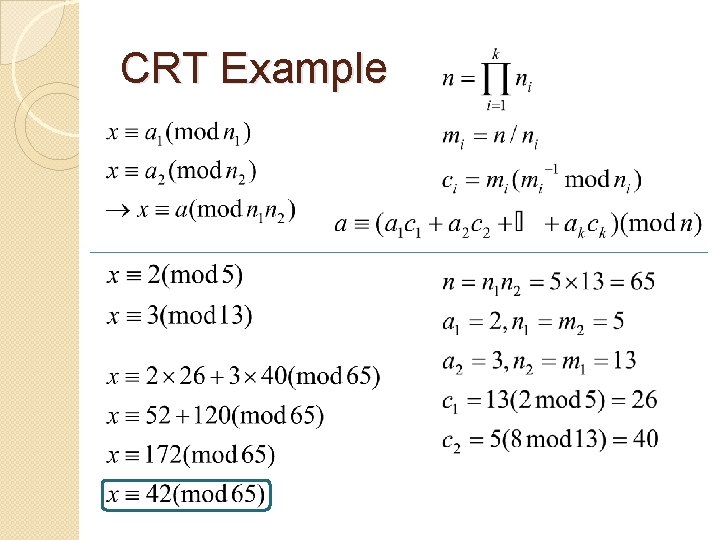
CRT Example
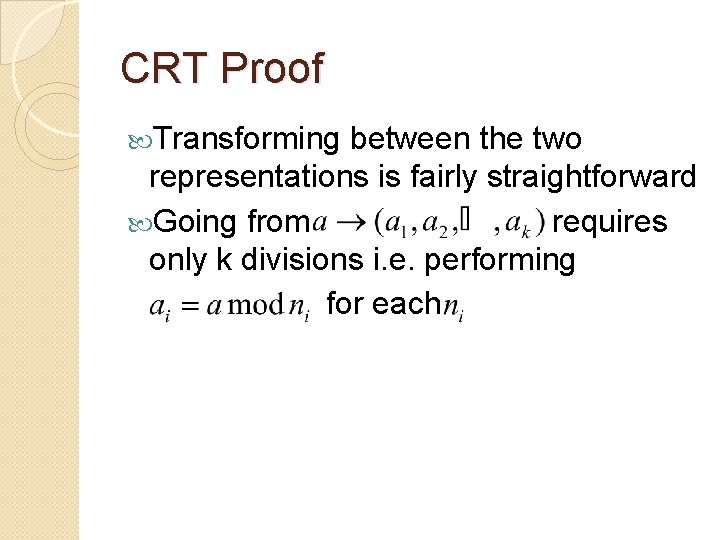
CRT Proof Transforming between the two representations is fairly straightforward Going from requires only k divisions i. e. performing for each
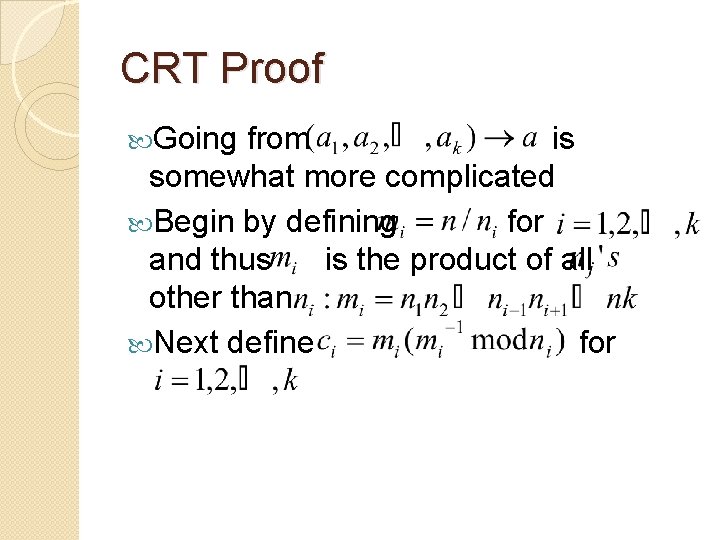
CRT Proof Going from is somewhat more complicated Begin by defining for and thus is the product of all other than Next define for
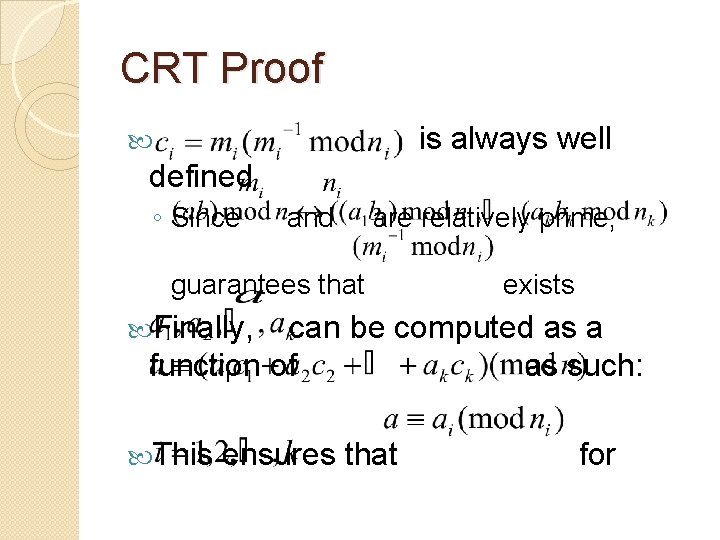
CRT Proof is always well defined ◦ Since and are relatively prime, guarantees that exists Finally, can be computed as a function of as such: This ensures that for
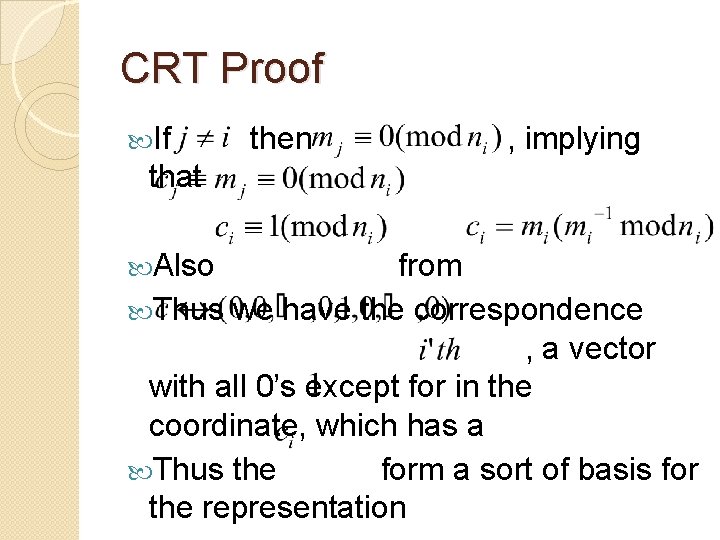
CRT Proof If then , implying that Also from Thus we have the correspondence , a vector with all 0’s except for in the coordinate, which has a Thus the form a sort of basis for the representation
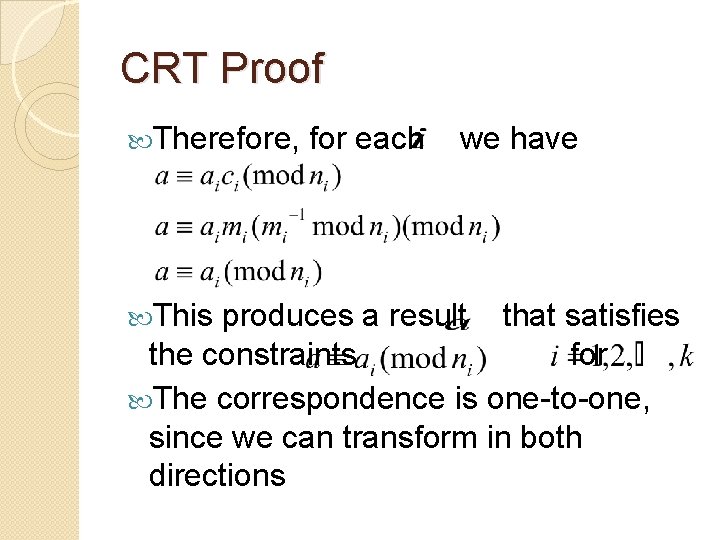
CRT Proof Therefore, This for each we have produces a result that satisfies the constraints for The correspondence is one-to-one, since we can transform in both directions
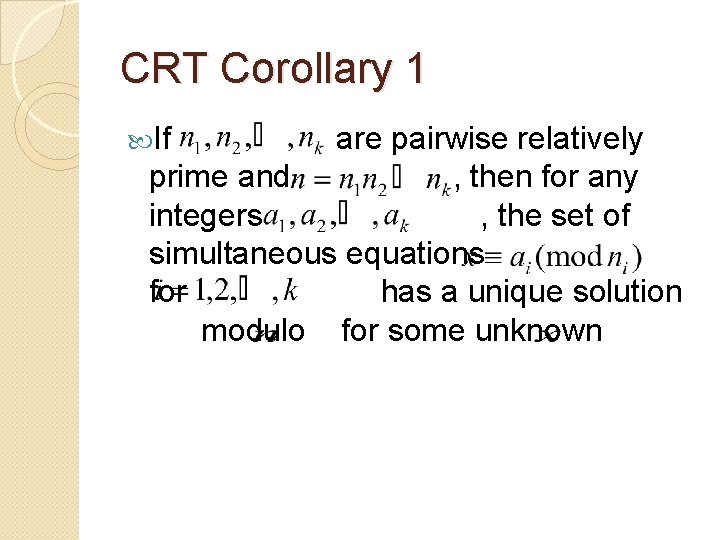
CRT Corollary 1 If are pairwise relatively prime and , then for any integers , the set of simultaneous equations for has a unique solution modulo for some unknown
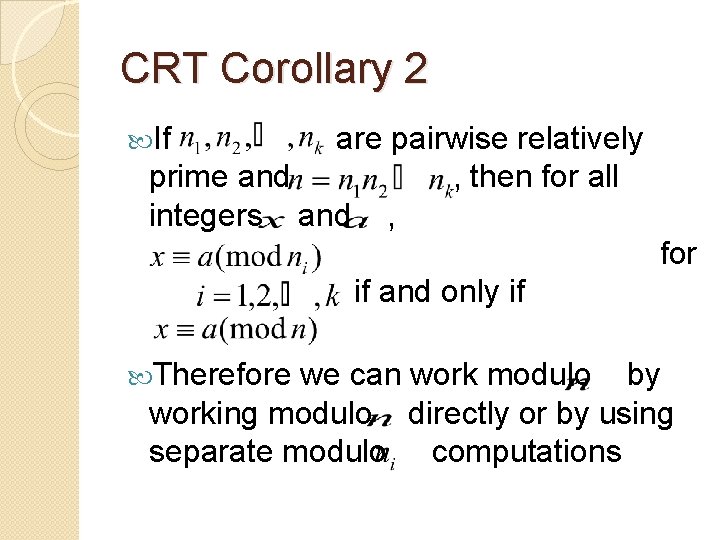
CRT Corollary 2 If are pairwise relatively prime and , then for all integers and , for if and only if Therefore we can work modulo by working modulo directly or by using separate modulo computations
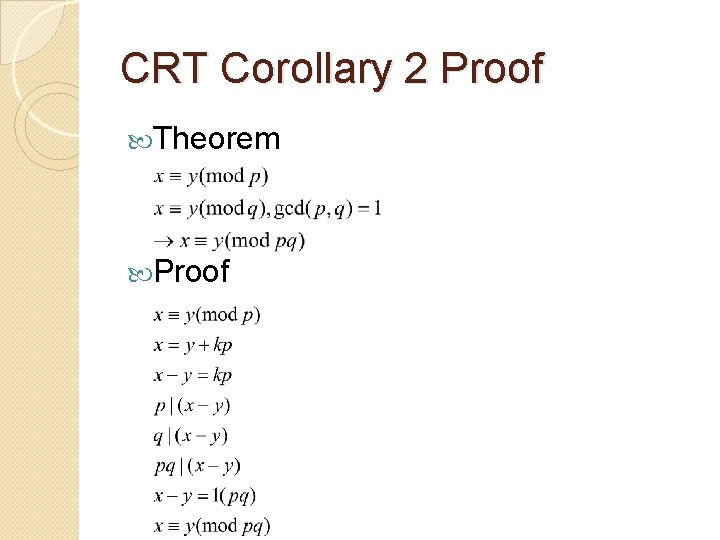
CRT Corollary 2 Proof Theorem Proof
RSA - Introduction Named after its creators Ron Rivest, Adi Shamir, and Leonard Adleman from MIT Public-key cryptosystem Relies on dramatic difference between ease of finding large prime numbers and difficulty of factoring the products of large primes
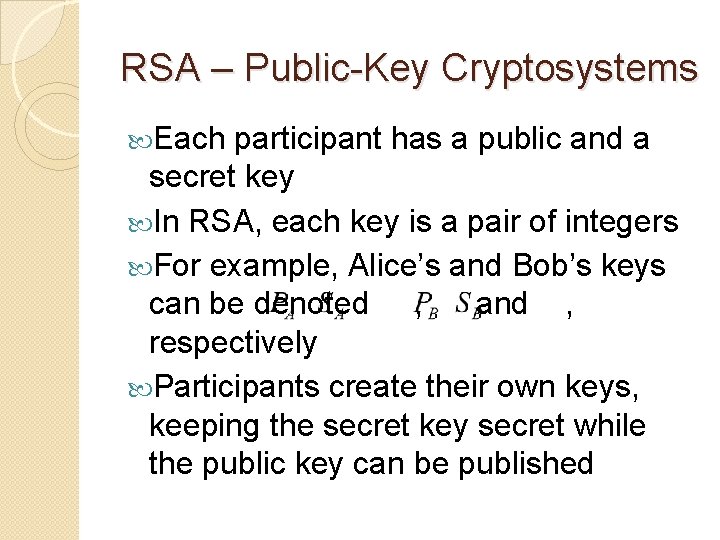
RSA – Public-Key Cryptosystems Each participant has a public and a secret key In RSA, each key is a pair of integers For example, Alice’s and Bob’s keys can be denoted , and , respectively Participants create their own keys, keeping the secret key secret while the public key can be published
RSA – Public-Key Cryptosystems Encrypting a message with the recipient’s public key will ensure that only the recipient will be able to decode it, using his/her secret key Additionally, a public-key cryptosystem allows for the use of unforgeable digital signatures, ensuring the integrity of the message as well as the identity of the sender
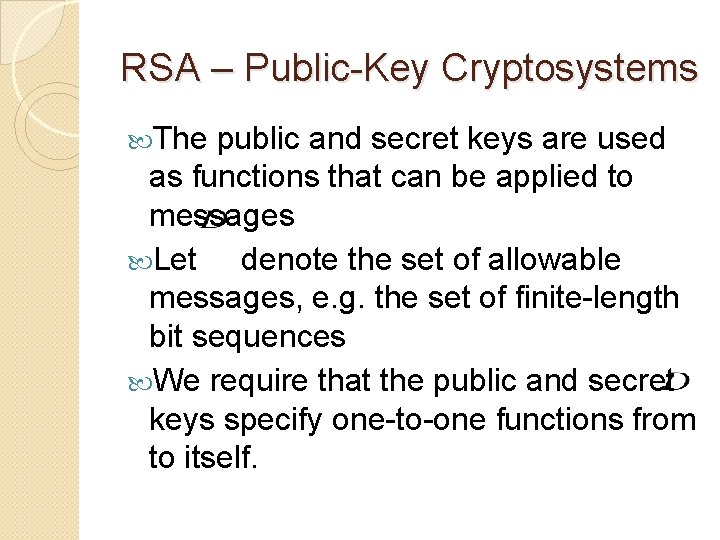
RSA – Public-Key Cryptosystems The public and secret keys are used as functions that can be applied to messages Let denote the set of allowable messages, e. g. the set of finite-length bit sequences We require that the public and secret keys specify one-to-one functions from to itself.
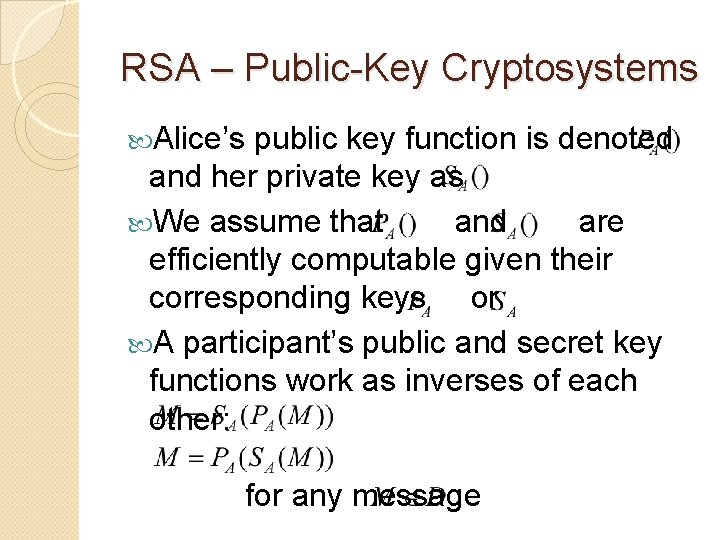
RSA – Public-Key Cryptosystems Alice’s public key function is denoted and her private key as We assume that and are efficiently computable given their corresponding keys or A participant’s public and secret key functions work as inverses of each other: for any message
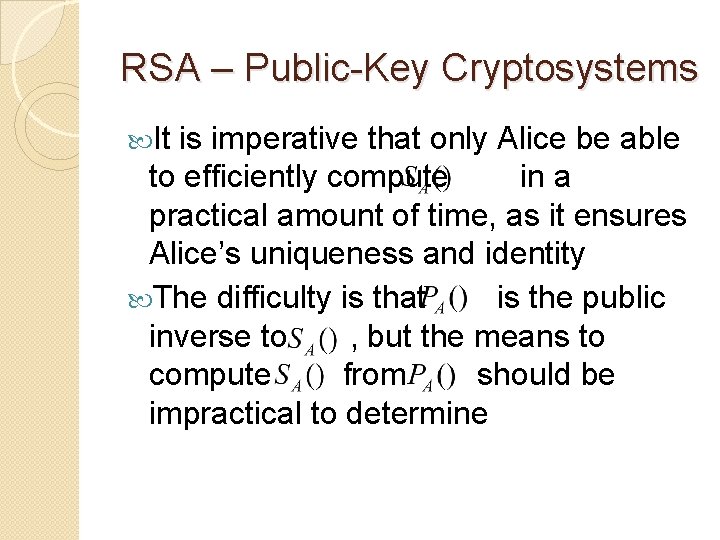
RSA – Public-Key Cryptosystems It is imperative that only Alice be able to efficiently compute in a practical amount of time, as it ensures Alice’s uniqueness and identity The difficulty is that is the public inverse to , but the means to compute from should be impractical to determine
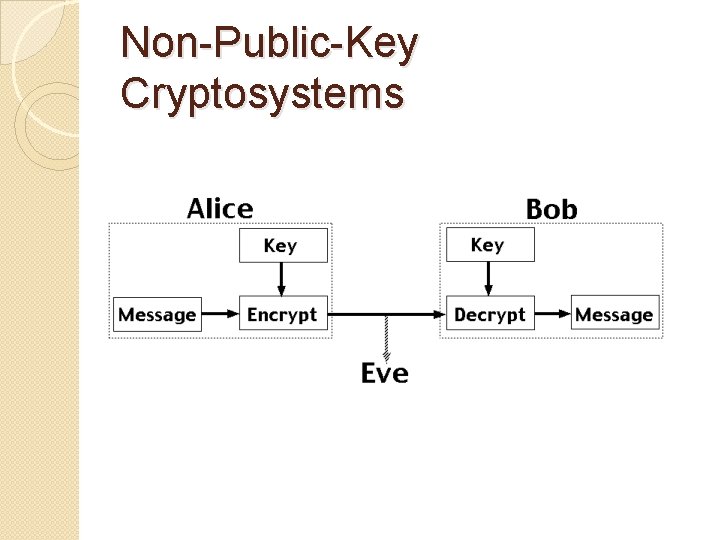
Non-Public-Key Cryptosystems
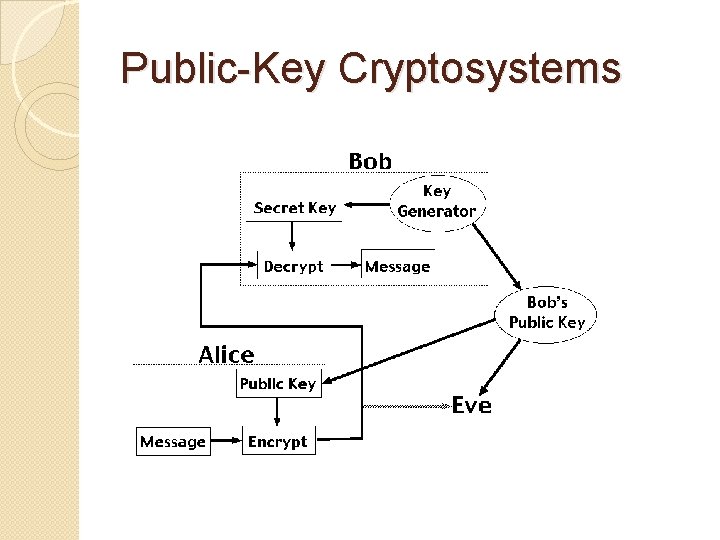
Public-Key Cryptosystems
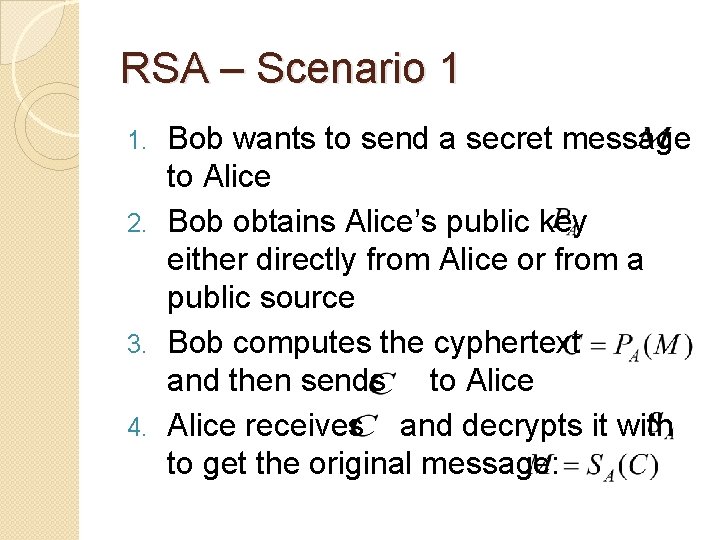
RSA – Scenario 1 Bob wants to send a secret message to Alice 2. Bob obtains Alice’s public key either directly from Alice or from a public source 3. Bob computes the cyphertext and then sends to Alice 4. Alice receives and decrypts it with to get the original message: 1.
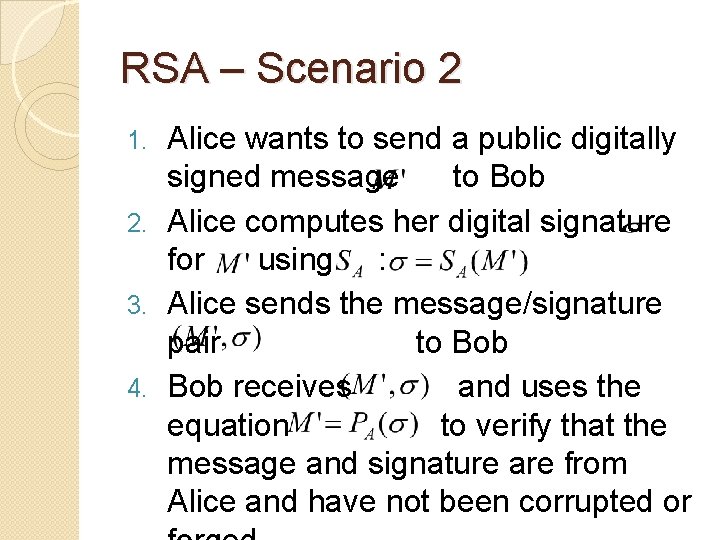
RSA – Scenario 2 Alice wants to send a public digitally signed message to Bob 2. Alice computes her digital signature for using : 3. Alice sends the message/signature pair to Bob 4. Bob receives and uses the equation to verify that the message and signature are from Alice and have not been corrupted or 1.
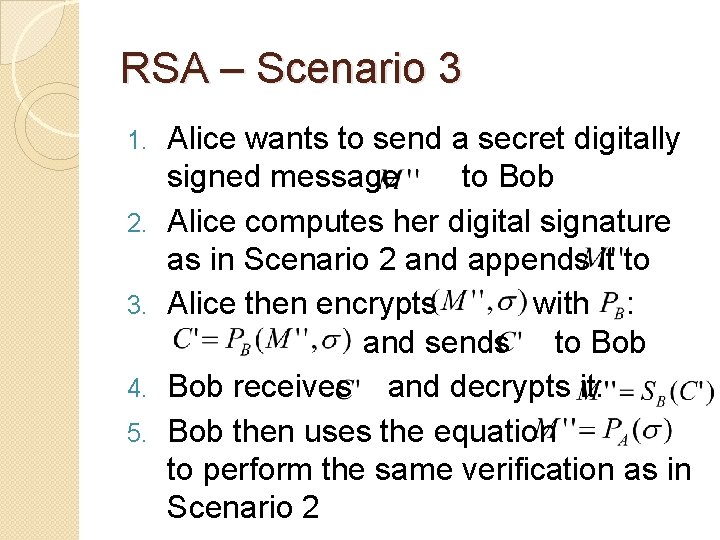
RSA – Scenario 3 1. 2. 3. 4. 5. Alice wants to send a secret digitally signed message to Bob Alice computes her digital signature as in Scenario 2 and appends it to Alice then encrypts with : and sends to Bob receives and decrypts it: Bob then uses the equation to perform the same verification as in Scenario 2
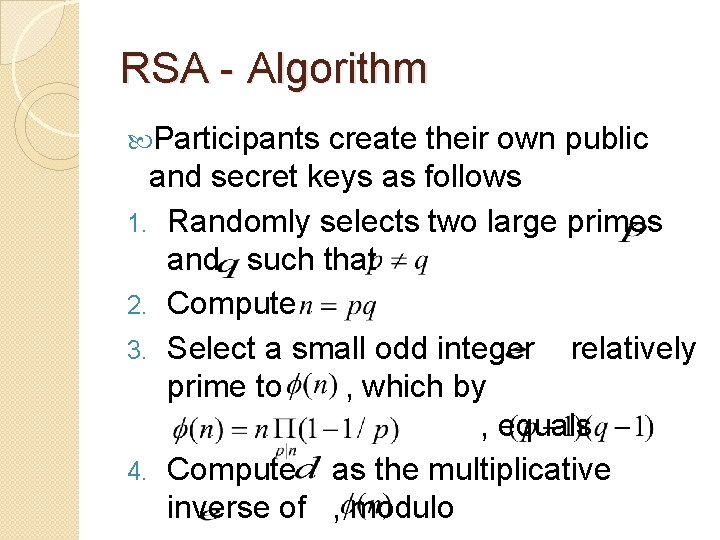
RSA - Algorithm Participants create their own public and secret keys as follows 1. Randomly selects two large primes and such that 2. Compute 3. Select a small odd integer relatively prime to , which by , equals 4. Compute as the multiplicative inverse of , modulo
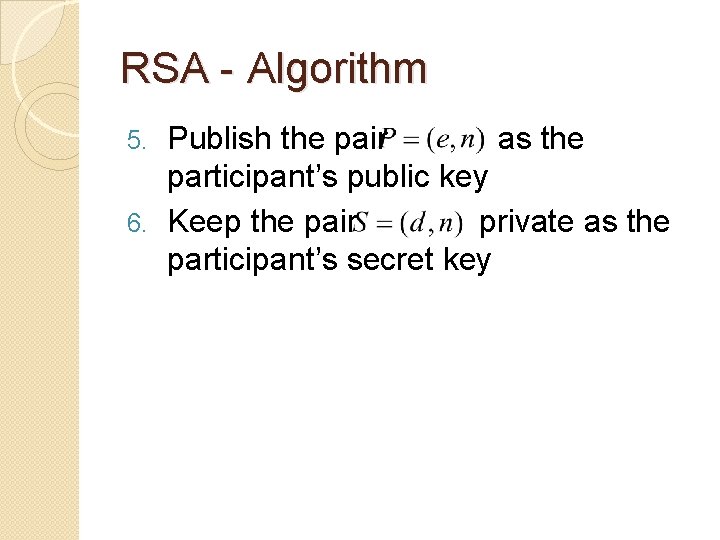
RSA - Algorithm Publish the pair as the participant’s public key 6. Keep the pair private as the participant’s secret key 5.
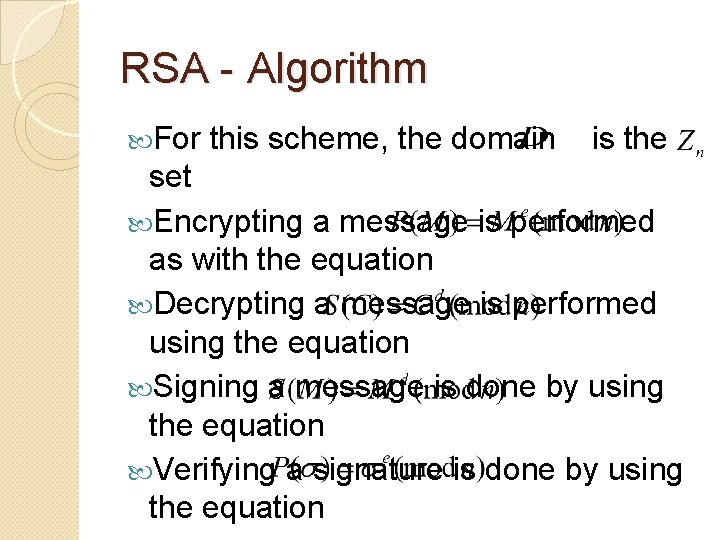
RSA - Algorithm For this scheme, the domain is the set Encrypting a message is performed as with the equation Decrypting a message is performed using the equation Signing a message is done by using the equation Verifying a signature is done by using the equation
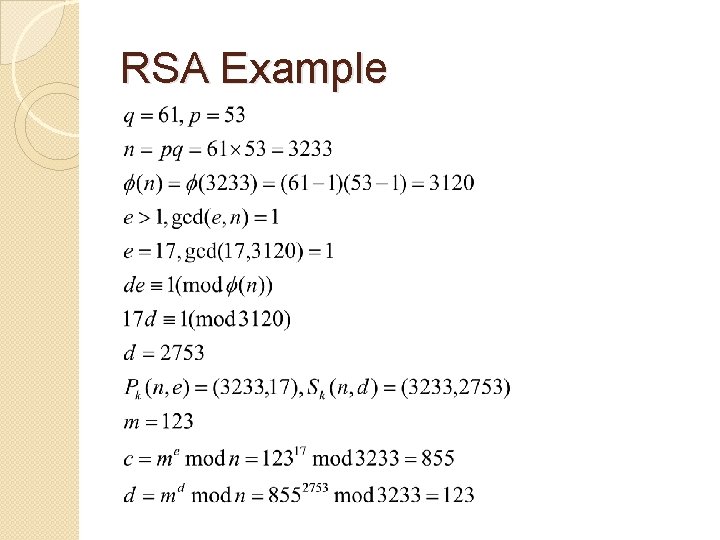
RSA Example
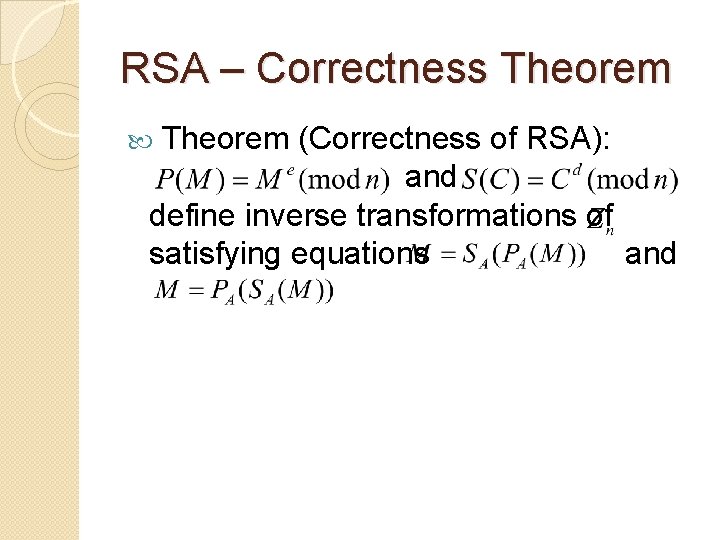
RSA – Correctness Theorem (Correctness of RSA): and define inverse transformations of satisfying equations and
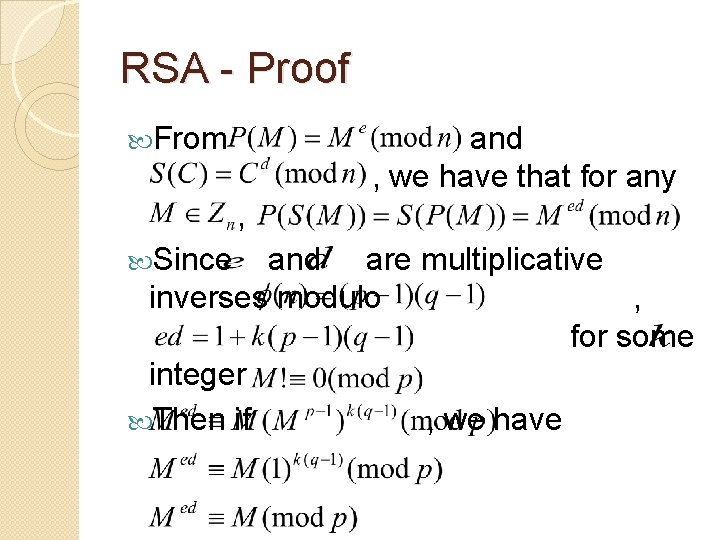
RSA - Proof From and , we have that for any , Since and are multiplicative inverses modulo , for some integer Then if , we have
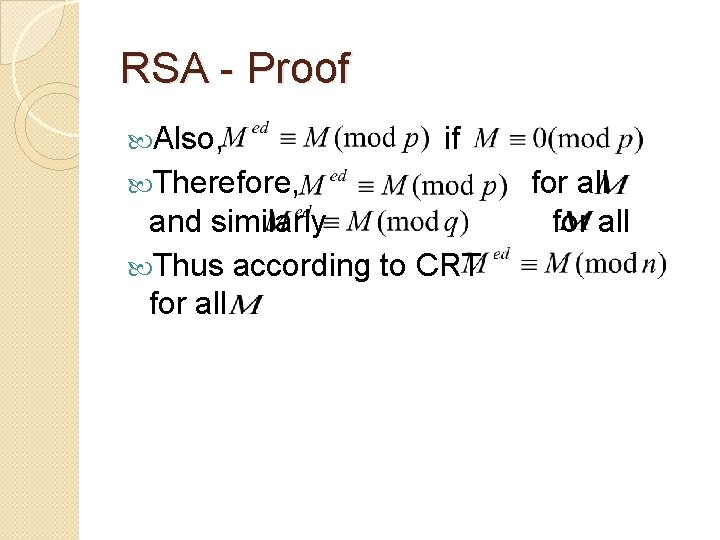
RSA - Proof Also, if Therefore, and similarly Thus according to CRT for all
RSA - Decryption Relies mainly upon the difficulty of factoring large integers If an interceptor can factor the modulus in a public key, he can derive the secret key using knowledge of and in the same way as the keys’ creator used them The statement that if factoring large integers is hard then breaking RSA is hard is unproven, but 20 years of
Pollard’s Rho Factoring large integers is currently computationally infeasible Pollard’s rho is a useful tool for factoring large integers however Pollard’s rho is a heuristic, not an algorithm, meaning its running time and success are not guaranteed Very effective in practice though
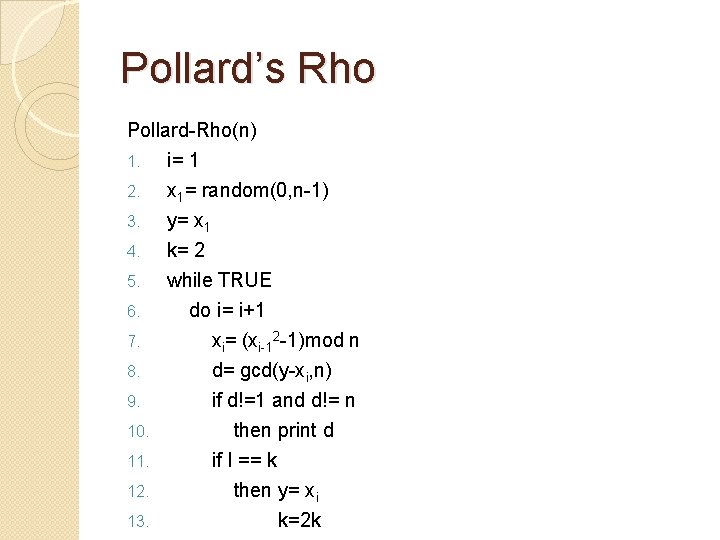
Pollard’s Rho Pollard-Rho(n) 1. i= 1 2. 3. 4. 5. 6. 7. 8. 9. 10. 11. 12. 13. x 1= random(0, n-1) y= x 1 k= 2 while TRUE do i= i+1 xi= (xi-12 -1)mod n d= gcd(y-xi, n) if d!=1 and d!= n then print d if I == k then y= xi k=2 k
Pollard’s Rho Pollard-Rho never prints an incorrect answer Any number printed is a nontrivial divisor of n However Pollard-Rho may not print anything at all There is no guarantee that it will produce a result
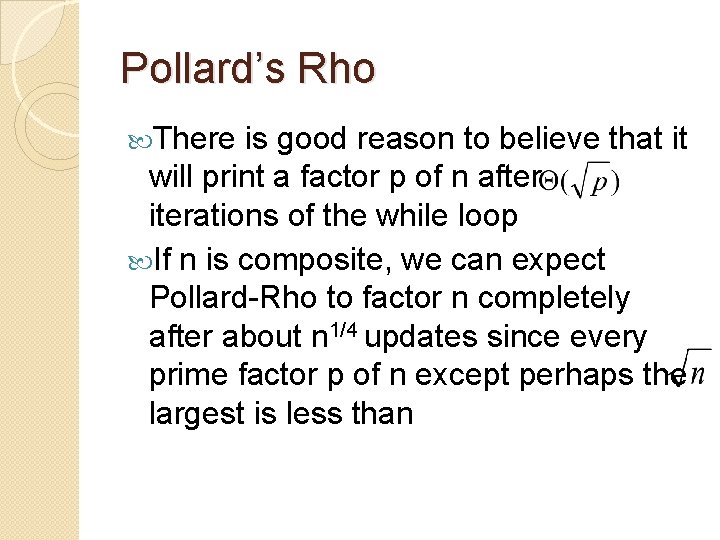
Pollard’s Rho There is good reason to believe that it will print a factor p of n after iterations of the while loop If n is composite, we can expect Pollard-Rho to factor n completely after about n 1/4 updates since every prime factor p of n except perhaps the largest is less than
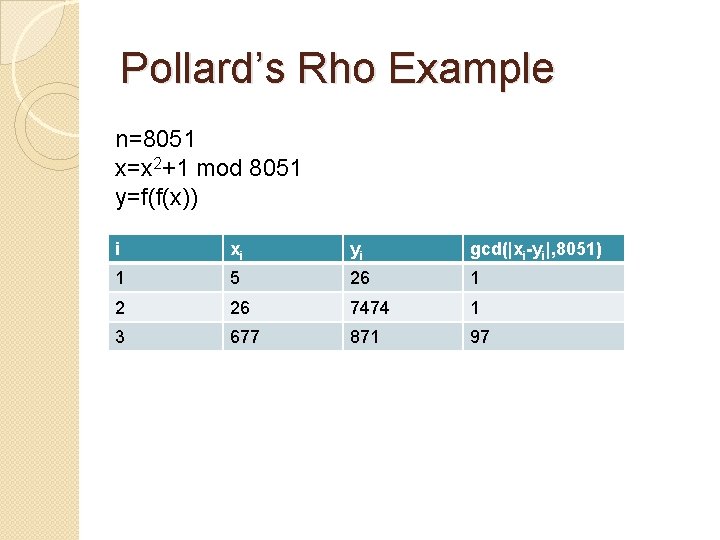
Pollard’s Rho Example n=8051 x=x 2+1 mod 8051 y=f(f(x)) i xi yi gcd(|xi-yi|, 8051) 1 5 26 1 2 26 7474 1 3 677 871 97
Questions?
References Cormen, Thomas H. , et al. Introduction to Algorithms. 2 nd ed. Cambridge, MA: MIT, 2001. Agrawal, Manindra, Neeraj Kayal, Nitin Saxena. “PRIMES is in P. ”Annals of Mathematics 160 (2004): 781 -793.
- Slides: 60