
Number Talks A strategy to engage all learners
Number Talks A strategy to engage all learners in mathematical thinking and conversations Presented by: Lynn Ball, Consultant Teri Avery, Consultant Mathematical Number Talks
Lynn Ball Teri Avery Mathematical. Number. Talks@yahoo. com 916. 601. 2843
Agenda 1. Introductions 2. 3. 4. 5. 6. 7. 8. 9. What is math? Number Talks introduction Number Talks experiences Break time! Numbers talks in classrooms Facilitate Number Talks in a small group Wrap up, debrief, and next steps Evaluation
Objectives Participants will: 1. Take a look at the Standards of Mathematical Practices (SMPs). 2. Explore why this strategy is so effective. 3. Experience a Number Talk as a student. 4. Practice a Number Talk as a facilitator. 5. Be prepared to try Number Talks.
What is Math?
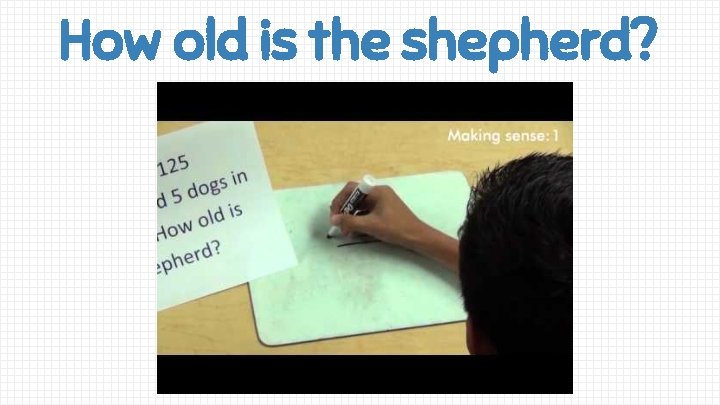
How old is the shepherd?
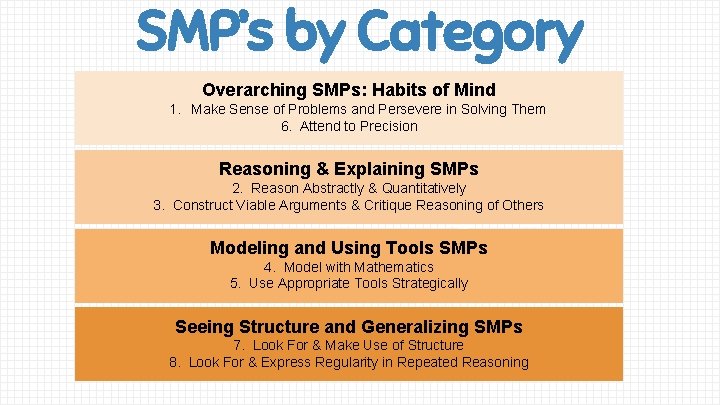
SMP’s by Category Overarching SMPs: Habits of Mind 1. Make Sense of Problems and Persevere in Solving Them 6. Attend to Precision Reasoning & Explaining SMPs SMP’s by Category 2. Reason Abstractly & Quantitatively 3. Construct Viable Arguments & Critique Reasoning of Others Modeling and Using Tools SMPs 4. Model with Mathematics 5. Use Appropriate Tools Strategically Seeing Structure and Generalizing SMPs 7. Look For & Make Use of Structure 8. Look For & Express Regularity in Repeated Reasoning

Number Talks
Develop Vocabulary and Mathematical Language Why Number Talks? Think flexibly with numbers Develop fluency and number sense Go beyond basic memorization of facts and procedures Based on research Utilizes best practices Hear and share different thinking Create opportunities to implement the SMP’s, content, S&L and ELD standards
Number Talks all look a little different and they change over time. Number Talks Basics Community/Relationships Focused on mental math strategies. So, no writing! Respect all answers. Allow the student to lead. Guide students towards their most efficient strategy. Monitor thinking and strategies. The Number Talks will get better with time. Trust the process.
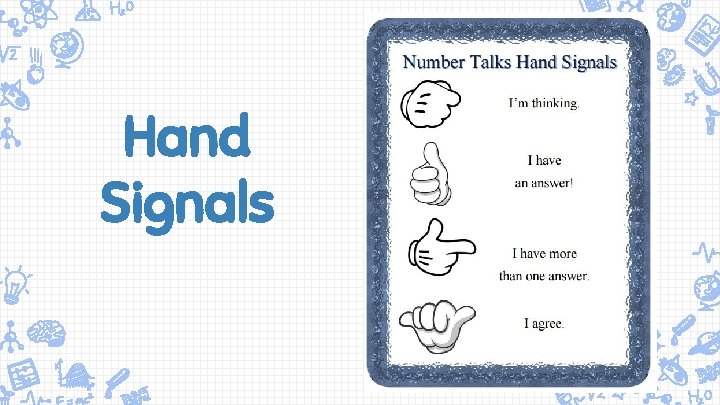
Hand Signals
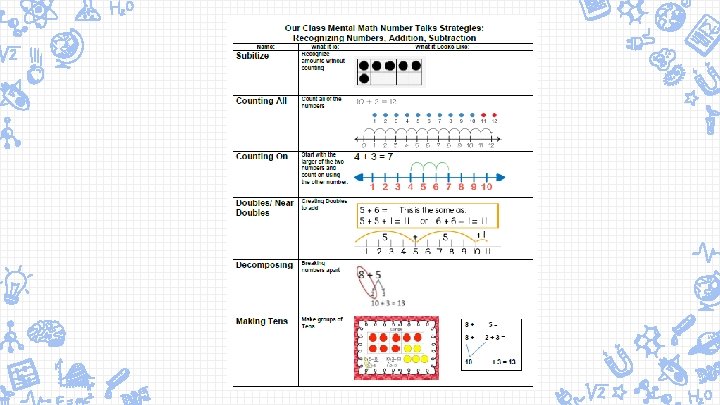
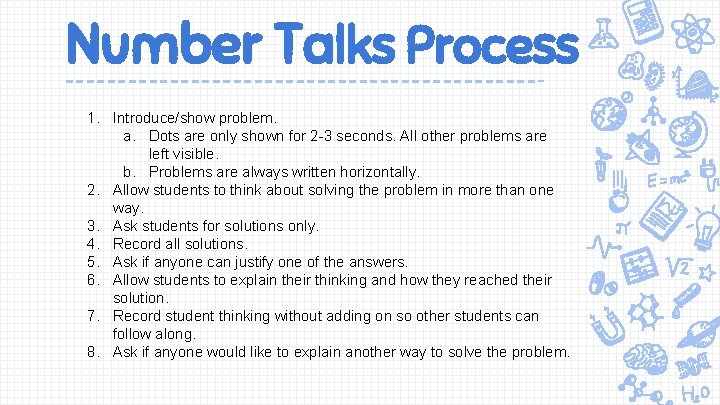
Number Talks Process 1. Introduce/show problem. a. Dots are only shown for 2 -3 seconds. All other problems are left visible. b. Problems are always written horizontally. 2. Allow students to think about solving the problem in more than one way. 3. Ask students for solutions only. 4. Record all solutions. 5. Ask if anyone can justify one of the answers. 6. Allow students to explain their thinking and how they reached their solution. 7. Record student thinking without adding on so other students can follow along. 8. Ask if anyone would like to explain another way to solve the problem.

Dot Card


Debrief ✘ What about the process stands out most to you? ✘ What questions do you have? ✘ How would this kind of instruction impact the people you work with?

Making tens
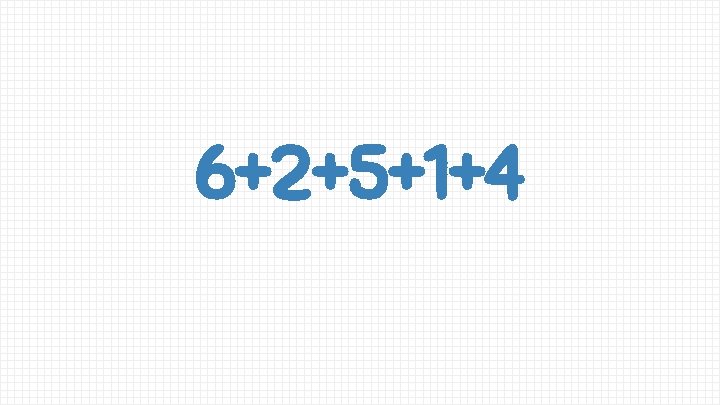
6+2+5+1+4
Debrief ✘ What stands out most to you? ✘ What questions do you have? ✘ How would this kind of instruction impact the people you work with?

Double digit addition
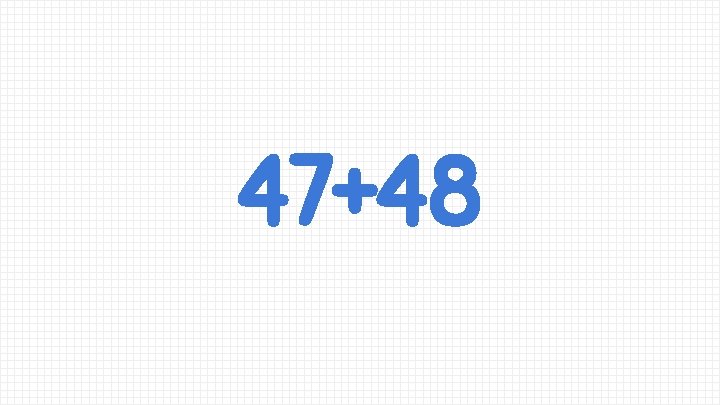
47+48
Number Talks all look a little different and they change over time. Number Talks Basics Focused on mental math strategies. So, no writing! Respect all answers. Allow the student to lead. Guide students towards their most efficient strategy. Reward thinking. Monitor thinking and strategies. The Number Talks will get better with time. Trust the process.

Break Time!
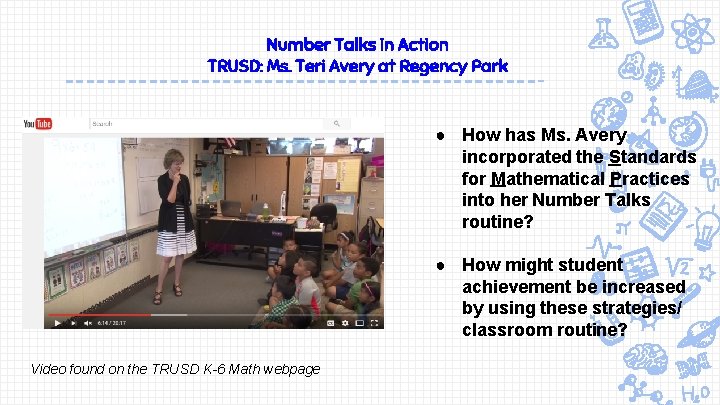
Number Talks in Action TRUSD: Ms. Teri Avery at Regency Park ● How has Ms. Avery incorporated the Standards for Mathematical Practices into her Number Talks routine? ● How might student achievement be increased by using these strategies/ classroom routine? Video found on the TRUSD K-6 Math webpage
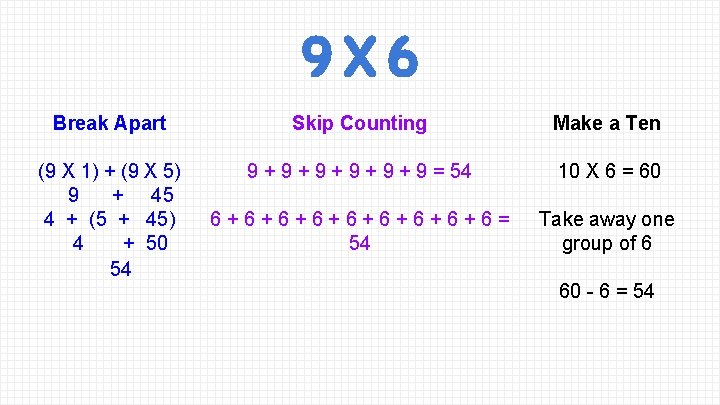
9 X 6 Break Apart Skip Counting Make a Ten (9 X 1) + (9 X 5) 9 + 45 4 + (5 + 45) 4 + 50 54 9 + 9 + 9 + 9 = 54 10 X 6 = 60 6+6+6+6+6= 54 Take away one group of 6 60 - 6 = 54
Number Talks all look DIFFERENT!
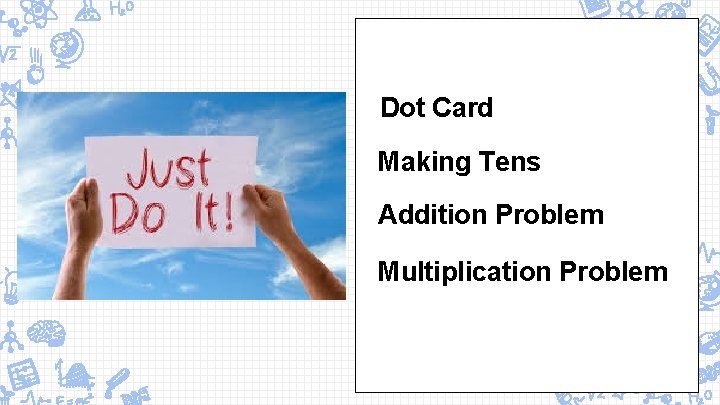
Dot Card Making Tens Addition Problem Multiplication Problem
Debrief ✘ Now looking at the whole process: ✗How would this benefit your work? ✗How can you implement Number Talks? ✗ What questions do you still have?
How do I get started? 1. Pre-assess 2. Addition 3. Grade level 4. What would the student like to try?
Where do the problems come from? 1. Resources 2. Addition, Subtraction, Multiplication, Division 3. By Strategy 4. Random 5. Content
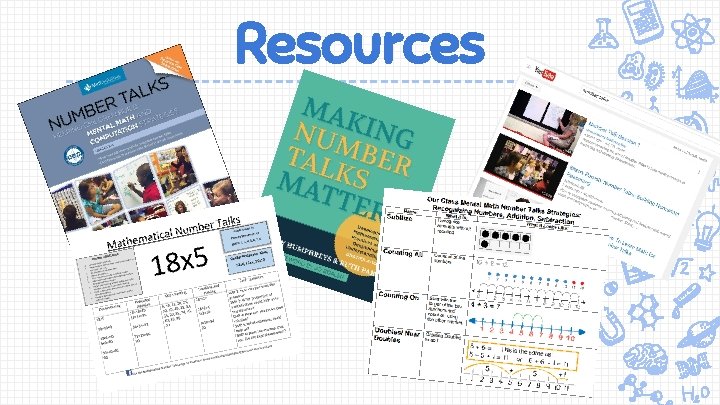
Resources

Did we meet our objectives? 1. Deepen our understanding of the Standards of Mathematical Practices (SMPs). 2. Explore why this strategy is so effective. 3. Experience a Number Talk as a student. 4. Practice a Number Talk as a facilitator. 5. Feel comfortable teaching the strategy to others.

Questions?

Thank You!
- Slides: 39